A watch that never feels quite right usually has a specific fit problem rather than a mysterious comfort problem. The cause may be as simple as wearing the case too close to the hand, although bracelet adjustment, lug geometry, clasp balance, case weight and crown position can all change how the watch behaves once your wrist starts moving. The useful question is therefore not merely whether the watch is tight or loose, but which part of the watch-wrist relationship is failing.
A properly fitted watch should remain reasonably stable without requiring enough pressure to make the wrist uncomfortable. It should tolerate ordinary changes in wrist size during the day, allow normal hand movement and keep its crown and case edges away from repeated pressure points. Some movement is normal, particularly with lighter or deliberately loose-fitting watches, but constant rotation, pinching, overhang or the need to overtighten the bracelet usually indicates something that can be diagnosed.
What a Properly Fitting Watch Should Actually Do
The watch case normally sits on the flatter upper portion of the wrist rather than directly against the hand. The exact position varies with wrist anatomy and personal preference, but moving the watch slightly behind the prominent wrist bone often gives the hand more room to extend without colliding with the crown or case. A fit that looks perfect in a static wrist photograph can therefore become uncomfortable as soon as you type, drive, exercise or bend your hand backward.
The bracelet or strap should keep the case controlled without behaving like a clamp. A little movement does not automatically mean the watch is too loose, while a visible temporary impression after long wear does not automatically mean it is dangerously tight. Persistent pinching, numbness, painful pressure or a bracelet that must compress the wrist severely to stop the case moving deserves a closer look.
Case footprint matters separately from circumference. A watch can fit around the wrist perfectly while still extending too far across its upper surface because the lugs are too long or too straight for that wrist. Conversely, a relatively large-diameter watch with compact downward-curving lugs can sometimes wear more neatly than its diameter suggests.
The complete system also includes thickness, weight, crown geometry, bracelet flexibility and clasp position. A heavy watch whose mass sits high above the wrist may roll sideways even when the bracelet circumference seems correct, while an oversized crown can make an otherwise well-proportioned case uncomfortable near the hand. Solving fit therefore requires looking at where the watch sits, how it moves and which component creates the unwanted motion or pressure.
Start by Diagnosing the Symptom, Not the Size Number
Begin by observing where the watch naturally travels during normal movement. Wear it for at least part of an ordinary day, move the hand through its usual range and notice whether the case moves toward the hand, rotates outward, tilts because of its weight or simply slides evenly around the wrist. Those behaviors point toward different solutions.
Next, notice whether the problem appears immediately or only after several hours. Immediate discomfort often suggests an obvious sizing, edge or crown-clearance issue, whereas a bracelet that feels comfortable in the morning but progressively tighter later may simply have too little adjustment margin for normal wrist variation. The timing of the problem can be as useful as the wrist measurement itself.
Finally, separate visual preference from mechanical behavior. A loose jewellery-style watch may move intentionally, while a substantial sport watch that repeatedly spins beneath the wrist is usually less practical. Decide first whether the behavior interferes with comfort, reading the time or normal activity before assuming every small movement must be eliminated.
Why Does My Watch Slide or Rotate Around My Wrist?
A watch that rotates excessively is usually either too loose or too top-heavy for the amount of restraint provided by its strap or bracelet. Case thickness and weight matter because a heavy mass positioned above the wrist creates leverage that encourages the watch head to fall toward the outside or underside. Tightening may reduce the movement, but excessive tightening is a poor solution if the real problem is case balance.
Why Does My Watch Feel Too Tight and Too Loose at the Same Time?
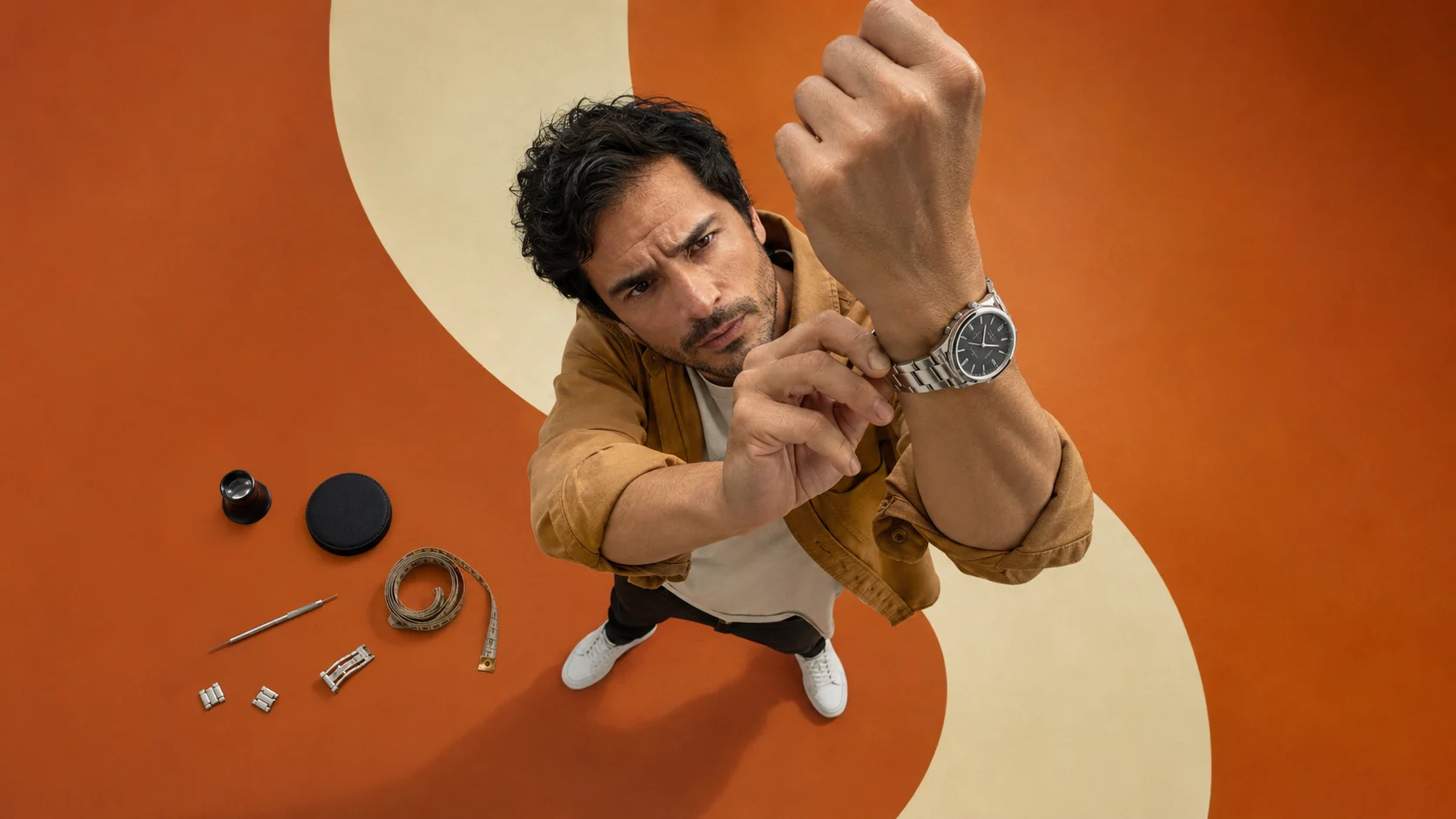
Metal bracelets can create an awkward gap between two available sizes. One configuration may allow too much movement, while removing another full link can make the bracelet noticeably uncomfortable because the change is larger than the wrist needs. In that situation, fine adjustment, a half-link, a different removable-link arrangement or another bracelet configuration may solve the problem more effectively than choosing between two bad extremes.
The same apparent contradiction can happen over the course of one day. A bracelet that feels comfortably snug under one set of conditions can become tighter later, while sizing it for maximum expansion may make it feel loose at another time. The goal is enough adjustment range to accommodate normal variation without allowing the watch head to become uncontrolled.
Quick Watch-Fit Diagnosis
- Slides evenly around the wrist: first check overall circumference and strap adjustment.
- Watch head falls toward the outside: check case weight, thickness and bracelet balance.
- One link removed is too tight, link added is too loose: investigate micro-adjustment, half-links or smaller adjustment increments.
- Crown presses into the hand: check wearing position, bracelet looseness, crown geometry and case size.
- Lugs visibly project beyond the wrist: case footprint or lug-to-lug length may be excessive.
- Clasp sits noticeably to one side: examine how bracelet links are distributed between the 6 o’clock and 12 o’clock sides.
- Watch feels fine initially but becomes tight later: leave enough adjustment margin for normal wrist-size variation.
- Only one edge or link pinches: inspect articulation, clasp position and local bracelet geometry rather than simply increasing circumference.
Why Does the Watch Crown Dig Into My Hand?
Crown discomfort often begins with where the watch sits. If the case slides too close to the hand, wrist extension can push the back of the hand into the crown or crown guards, and the problem becomes more obvious with larger crowns and thicker cases. Moving the watch slightly farther up the wrist or stabilizing an overly loose bracelet can sometimes change the contact point immediately.
A case can also be physically incompatible with a particular combination of wrist shape and wearing position. Someone with a short usable wrist surface may encounter the crown sooner than someone with more space between the wrist bone and hand, even when both wear the same case diameter. If reasonable repositioning and adjustment cannot create clearance, the case or crown geometry may simply be unsuitable.
Why Do the Lugs Hang Over the Wrist?
Visible lug overhang usually indicates that the case footprint is longer than the supported top surface of the wrist. Case diameter contributes to the impression, but lug-to-lug length and the angle at which the lugs leave the case often determine whether the strap can wrap naturally around the wrist. Long straight lugs can therefore make a moderate-size case fit worse than a wider case with compact curved lugs.
Minor visual projection is partly a matter of personal preference, but substantial unsupported lugs can affect more than appearance. The strap may drop nearly vertically from the lug ends, making the case feel perched above the wrist and reducing stability. If the case cannot settle naturally even with a properly adjusted strap, changing strap tension will not correct the underlying geometry.
Does the Watch Clasp Need to Be Perfectly Centered?
The clasp does not have to be mathematically centered to the millimeter for every wrist, because wrists are not perfectly symmetrical and different clasp designs occupy different lengths. What matters is whether the underside hardware sits comfortably, the watch head remains positioned where you want it and the bracelet does not create asymmetric pulling. A slightly offset clasp can therefore be completely acceptable.
A badly positioned clasp can still reveal useful information about link distribution. Removing links only from whichever side is easiest may pull the clasp toward one wrist edge and encourage the watch head to sit crooked on top. Bracelet sizing should consider the relationship between the watch head, both bracelet halves and clasp rather than treating total circumference as the only variable.
Why Does a Heavy Watch Keep Falling to One Side?
Weight becomes especially important when a thick case carries most of its mass above a narrow bracelet or flexible strap. Gravity repeatedly pulls that mass toward the lowest point of the wrist, so the watch may rotate outward whenever the arm is relaxed. Tightening can reduce this effect, but eventually the required tension becomes less comfortable than the movement itself.
A wider or more supportive strap, better bracelet balance or a watch with a lower center of mass can behave very differently at the same nominal circumference. This explains why two watches adjusted to exactly the same wrist measurement can feel dramatically different. Fit is an interaction between geometry and weight distribution, not a circumference setting.
Wrist Fit Studio
Enter your wrist and watch measurements to see whether the case footprint, lug length, thickness and adjustment system work together - before a beautiful watch becomes an uncomfortable one.
 CASE
WRIST
FIT
CASE
WRIST
FIT
Your wrist
Measure where the watch normally sits, just above the wrist bone. Flat wrist width is optional; if you skip it, the experience uses a conservative estimate.
The watch
Use the manufacturer's listed dimensions where possible. Lug-to-lug is especially important because two watches with the same diameter can wear very differently.
Attachment and adjustment
A well-sized case can still be uncomfortable if the strap or bracelet cannot reach a useful intermediate setting.
How it behaves
If you have tried the watch already, choose the issue that best describes it. This helps separate size problems from adjustment and balance problems.
Why Case Diameter Alone Cannot Diagnose Watch Fit
Case diameter is useful for comparing similar round watches, although it only describes one part of the footprint. A 38 mm watch with compact lugs can occupy less wrist length than a 36 mm watch with long straight lugs, while square and rectangular watches make diameter comparisons even less meaningful. When fit is questionable, look at the complete outline that actually touches or spans the wrist.
Lug-to-lug length often becomes more informative once the watch approaches the width of the usable wrist surface. The measurement shows how far the watch extends from the upper lug tips to the lower ones, but the number still does not describe whether those lugs curve downward. Photographs from the side can therefore reveal something a specification table cannot.
Thickness changes both physical clearance and weight distribution. A thick case can collide with cuffs, sit higher above the wrist and create more leverage when the watch tries to rotate. Thickness does not automatically make a watch uncomfortable, but it becomes more important as case weight increases or wrist width decreases.
The bracelet has its own geometry as well. Link length determines the minimum size increment available during resizing, articulation affects how naturally the bracelet wraps around a curved wrist, and the clasp contributes a rigid section underneath. A bracelet can therefore be technically the correct circumference while still positioning the clasp or case poorly.
| Fit symptom | Likely factors to inspect | First corrective step |
|---|---|---|
| Watch rotates around wrist | Overall looseness, high case weight, narrow strap, poor weight balance | Reduce excess play without creating pressure, then reassess weight balance |
| Too tight with one link removed | Large link increment, limited clasp adjustment, missing half-link | Look for micro-adjustment or a smaller adjustment increment |
| Crown digs into hand | Watch worn too close to hand, loose bracelet, large crown, thick case | Move the watch farther behind the wrist bone and test normal hand extension |
| Lugs overhang | Long lug-to-lug length, straight lugs, narrow usable wrist surface | Check whether another strap changes the wrap; otherwise reconsider case geometry |
| Clasp sits far to one side | Uneven link distribution, clasp length, wrist asymmetry | Redistribute removable links while preserving comfortable circumference |
| Case falls outward | High center of mass, bracelet imbalance, insufficient support | Rebalance attachment first, then assess whether case weight is inherently unsuitable |
Bracelet Balance Matters More Than Equal Link Counts
It is tempting to assume that the same number of links should always sit on both sides of the watch. That arrangement may work, but the real objective is comfortable clasp placement and stable watch-head position. Wrist shape, clasp length and case geometry can make an intentionally unequal link arrangement perform better.
The 6 o’clock and 12 o’clock bracelet halves perform different mechanical roles once the clasp closes around the wrist. Changing one side shifts where the clasp settles underneath and can pull the watch head toward or away from the wearer. This is why bracelet resizing sometimes improves dramatically after links are redistributed without changing the total circumference.
Bracelet specialists commonly use this balancing approach rather than removing links mechanically in pairs. One watchmaker’s bracelet-sizing guide, for example, explains that the aim is to keep the clasp properly positioned beneath the wrist and notes that slight deliberate imbalance can sometimes improve comfort and watch-head position.
Equal Links Are Not a Universal Rule
Two bracelet halves do not need identical link counts if the clasp remains comfortable and the case sits correctly. A long clasp body or asymmetric wrist can make mathematical symmetry less comfortable than a slightly unequal arrangement. Evaluate the result on the wrist instead of using link count as the final definition of correctness.
Micro-Adjustment Can Be More Valuable Than Another Full Link
Micro-adjustment exists because full removable links are often too large for fine comfort changes. Depending on the bracelet, adjustment may come from clasp holes, an internal sliding position, a half-link or an on-the-fly system that allows small changes without removing links. These smaller increments become especially valuable when the wearer repeatedly falls between two full-link settings.

If you are still choosing a watch rather than trying to rescue an existing fit problem, the broader guide to choosing a women’s watch that actually fits explains why bracelet adjustability should be evaluated before purchase. A beautiful bracelet with poor adjustment range can become a daily frustration even when the case dimensions are excellent. Fit flexibility is part of the specification, not merely an after-sales detail.
Your Wrist Does Not Stay Exactly the Same Size All Day
Wrist dimensions can vary enough through heat, activity and ordinary daily conditions for a close-fitting bracelet to feel different several hours later. This does not mean every bracelet needs to be worn visibly loose, but it does mean sizing at the absolute minimum possible circumference can leave no comfort margin. Fine adjustment is particularly useful for wearers who notice these changes regularly.
The same principle explains why a fit that seemed perfect in an air-conditioned store can feel different outside or after sustained activity. Test a new sizing configuration for more than a few minutes whenever possible. A technically precise measurement cannot replace actual wear across normal conditions.
Wearing Position Can Fix Problems That Resizing Cannot
Many watches become less intrusive when worn slightly behind the prominent wrist bone rather than directly against the hand. That position gives the hand more room to extend and can increase crown clearance without changing a single bracelet link. It also gives the watch a more stable section of the forearm to sit on for many wearers.
Wearing the watch very close to the hand can create the opposite effect. The crown and case repeatedly meet the back of the hand during extension, and a loose watch may slide into that collision zone again each time the arm drops. Tightening the bracelet without moving the case position can therefore treat the symptom while preserving the original source of irritation.
Personal anatomy still matters. Some wrists have a large prominent bone, some have relatively flat upper surfaces and others taper rapidly toward the hand. The most comfortable position is the one that provides adequate hand movement while keeping the watch supported, so there is no useful reason to force everyone into an identical distance from the wrist bone.
If wearing position repeatedly causes discomfort rather than simply awkwardness, the separate guide on watches and wrist pain addresses when pressure, skin irritation or symptoms deserve more attention. Mechanical fit should be corrected rather than endured until discomfort becomes normal.
Fix the Most Reversible Cause First
Start with positioning because it costs nothing and can immediately reveal whether the crown, case or bracelet behaves differently farther from the hand. Wear the watch in the adjusted position through normal movement rather than judging the result while holding the wrist still. If the original problem disappears, you may not need any bracelet modification.
Next, use whatever built-in fine adjustment the watch provides. Move one adjustment increment at a time, wear the new setting long enough to observe it and resist the temptation to compensate for a heavy unstable case by making the bracelet excessively tight. The goal is controlled movement with usable comfort.
If the circumference is satisfactory but the watch or clasp sits crooked, investigate link distribution. Moving one removable link from one bracelet half to the other changes the balance while keeping total bracelet length almost unchanged. That can be far more effective than adding or removing another full link.
A Different Strap Can Change the Entire Fit
A strap can change more than appearance because thickness, stiffness and attachment angle affect how the case settles against the wrist. A rigid strap that initially leaves the lugs at a steep angle may soften with use, while a more flexible strap can immediately allow the case to sit closer to a curved wrist. Changing from a heavy bracelet to a supportive strap can also reduce the feeling of overall weight.
The different types of watches also behave differently because dress, dive-style, field and chronograph cases can have very different thickness, crown and lug geometry. A fit expectation that works for a thin dress watch may be unrealistic for a substantial sports case. Evaluate the physical design you are wearing rather than applying one universal rule.
Sometimes the Watch Itself Is the Wrong Geometry
There is a point where adjustment stops being the sensible answer. If the lugs substantially exceed the supported wrist surface, the crown still collides with the hand after repositioning or the case needs uncomfortable bracelet tension to prevent constant rotation, the case may simply be a poor match for that wrist. No number of link changes can shorten the lugs or move the crown inward.
This does not mean the watch is objectively too large or badly designed. Another wearer with a wider, flatter or differently shaped wrist may find it extremely comfortable. Fit compatibility is personal geometry interacting with product geometry, which is why wrist circumference alone cannot predict every outcome.
Buying Online Makes Fit Errors Easier to Miss
Online product photography often makes watches difficult to compare because wrist sizes, camera lenses, viewing angles and image crops are inconsistent. A watch photographed close to the lens can look substantially larger, while carefully positioned sleeves or hands can hide thickness and lug behavior. Specifications become more useful when you cannot physically try the watch.
Look for case diameter, lug-to-lug length, thickness, weight and attachment information before buying. Bracelet buyers should also investigate removable-link dimensions, clasp adjustment and whether compatible half-links exist when the manufacturer provides them. A retailer description that simply says “adjustable bracelet” tells you very little about how fine the available adjustment actually is.
Use a watch that already fits you as a reference whenever possible. Compare its case diameter, lug-to-lug, thickness and approximate weight with the new model rather than starting from a generic wrist-size chart. A known comfortable watch gives you evidence about your own geometry and preferences.
Before Buying, Check These Fit Variables
- Case diameter
- Lug-to-lug length
- Lug curvature
- Case thickness
- Approximate watch weight
- Crown size and position
- Strap or bracelet width
- Removable-link size
- Availability of half-links
- Clasp adjustment range
- Whether the first bracelet links articulate immediately
- Return conditions after bracelet sizing
- How the watch compares with one you already wear comfortably
When a Watchmaker Can Solve the Problem Faster
A competent watchmaker or bracelet-sizing specialist can be valuable when a bracelet is between sizes, the clasp cannot be centered comfortably or you are unsure which links should move. They can inspect how the case and clasp sit on the actual wrist rather than resizing from circumference alone. This is particularly useful with expensive bracelets where unnecessary scratches or damaged pins would be costly.
Professional help is also sensible when the bracelet uses unfamiliar screws, collars, sleeves or other small hardware that can easily be lost or damaged. Some integrated bracelets are much less forgiving than ordinary push-pin designs, and forcing a stubborn component can turn a fit adjustment into a repair. If you are uncertain about the mechanism, the saving from doing it yourself may be small compared with the risk.
A watchmaker cannot alter the fundamental case geometry, however. If a professional can balance the bracelet only by making the circumference uncomfortable, or if the lugs and crown remain incompatible with the wrist, that is useful information rather than a failed adjustment. The correct recommendation may be another case or bracelet design.
| Situation | Try yourself first | Professional help makes sense when |
|---|---|---|
| Watch slides toward hand | Move it behind the wrist bone and test a slightly closer adjustment | No comfortable setting controls the watch |
| Between bracelet sizes | Check clasp adjustment and manufacturer-supported half-links | Links need redistribution or the bracelet hardware is unfamiliar |
| Clasp sits off-center | Observe whether the watch itself remains centered and comfortable | Clasp position causes pressure or watch-head rotation |
| Crown hits hand | Change wearing position and stabilize excess bracelet movement | Good positioning still cannot provide useful clearance |
| Lugs overhang badly | Test whether a more flexible strap improves wrap | Case footprint remains unsupported regardless of attachment |
The Best Fit Is a System, Not a Number
A watch does not fit correctly merely because its bracelet matches a calculated wrist circumference. The case must be supported, the crown needs usable clearance, the attachment needs enough adjustment range and the complete watch needs enough balance to remain controlled without excessive pressure. Each factor can compensate for another only up to a point.
This is why experienced wearers sometimes find that one watch feels effortless while another with almost identical published dimensions never settles properly. Small changes in lug direction, clasp length, bracelet articulation and center of mass can be more noticeable on the wrist than a one-millimeter difference in case diameter. Real wear remains the final test.
A good troubleshooting process therefore begins with the symptom and works backward. Change position first, use fine adjustment next, examine link distribution and attachment geometry after that, and reconsider the case itself only when the reversible fixes cannot produce a comfortable result. That sequence avoids solving every problem by making the bracelet tighter.
Frequently Asked Questions
How tight should a watch be on your wrist?
A watch should normally be secure enough that the case stays reasonably controlled while still allowing comfortable normal movement. You should not need severe pressure to stop a heavy case from rotating, and persistent pinching, numbness or pain indicates that the fit should be reconsidered. The ideal amount of movement also depends on the design because a light dress watch and a substantial sport watch behave differently.
Why is my watch too loose with one link but too tight without it?
The difference between two full bracelet-link configurations may simply be larger than the adjustment your wrist needs. Check whether the clasp offers micro-adjustment, whether a manufacturer-supported half-link exists or whether the current link distribution can be changed. A watchmaker can often assess these possibilities without forcing you to choose between obvious looseness and uncomfortable tightness.
Should the clasp be centered under my wrist?
The clasp should generally sit in a position that feels comfortable and helps the watch head remain stable, but perfect mathematical centering is not mandatory. Wrist shape and clasp geometry can make a slightly offset position more comfortable. If the clasp is far to one side and the watch head also sits crooked, redistributing bracelet links may help.
Why does my watch keep sliding toward my hand?
The bracelet may have excessive play, the wrist may taper strongly toward the hand or the watch may simply be worn too low. Moving the case slightly behind the wrist bone and then reassessing circumference often improves stability. If the watch still travels significantly, weight distribution and attachment geometry may also be contributing.
Is it normal for a watch crown to touch the back of your hand?
Occasional contact during extreme wrist movement can happen, especially with large crowns, but repeated painful pressure during ordinary activity is a fit problem worth addressing. Try positioning the watch slightly farther from the hand and controlling excessive sliding first. If normal wearing positions still cause significant contact, the case or crown geometry may not suit your wrist particularly well.
Can a watch be the right diameter but still be too big?
Yes, because case diameter does not describe lug-to-lug length, lug curvature, thickness or weight. A watch with long straight lugs can occupy substantially more wrist surface than another watch with the same diameter. Evaluate the complete case footprint and side profile rather than treating diameter as the final sizing decision.
Why does my watch keep rotating to the outside of my wrist?
A watch that consistently falls outward may be too loose, top-heavy or poorly balanced by its bracelet or strap. First remove unnecessary play while preserving comfort, then examine whether the clasp and bracelet halves are positioning the case unevenly. If controlling the watch requires excessive tightness, the case weight or geometry may be the deeper issue.
Action Checklist: Fix Your Watch Fit in the Right Order
- Wear the watch in its normal position and identify the exact movement or pressure problem.
- Move the case slightly farther from the hand before changing bracelet hardware.
- Test the existing micro-adjustment or fine-adjustment positions.
- Check whether the case is rotating because of excessive looseness or because it is top-heavy.
- Inspect lug-to-lug footprint rather than relying only on diameter.
- Look at clasp position and bracelet-link distribution.
- Check whether a compatible half-link or smaller adjustment increment exists.
- Test the revised fit through several hours of ordinary wear.
- Stop overtightening if that is the only way to control the watch.
- Ask a competent watchmaker to inspect bracelet balance when the available configurations remain uncomfortable.
- Consider a different strap when the case itself fits but the attachment does not.
- Consider a different watch geometry when crown clearance, overhang or weight cannot be corrected comfortably.
The aim is not to make the watch completely immobile. A good fit gives the case enough control to remain usable while allowing the wrist and hand to move naturally, and it should continue to feel reasonable after the novelty of trying it on has passed. If achieving that balance requires constant compromise, the most useful conclusion may be that the watch and wrist are simply a poor geometric match.