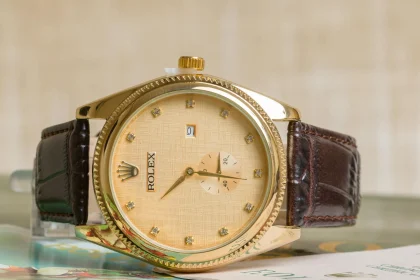



A musical watch is a watch that can perform an actual melody, rather than simply beep, sound an alarm, or strike the current time. In traditional mechanical examples, the music comes from a miniature mechanism inspired by a mechanical music box, often using a rotating cylinder fitted with pins that pluck individually tuned metal teeth. Other musical watches use different architectures, but the defining idea is the same: the watch contains a mechanism programmed to produce recognizable musical notes in sequence.
That makes a musical watch very different from a minute repeater, even though both belong to the broader world of watches that make sound. A minute repeater converts the current time into a pattern of acoustic strikes, while a musical watch performs a predetermined composition or passage of music. Some watches blur the boundaries by combining alarms, striking functions and musical mechanisms, so understanding what the sound represents is the fastest way to tell the complications apart.
A real mechanical example makes the distinction easier to see. The current Boegli Grand Opéra technical specifications describe a dedicated musical movement in which a rotating cylinder works against a 17-tooth comb, while a separate crown winds the musical mechanism and a pusher starts or stops the melody. The ordinary watch movement still keeps time, which means the musical system is effectively another mechanical machine packaged inside the same wristwatch.
What Is a Musical Watch?
In mechanical horology, a musical watch is best understood as a watch containing a mechanism that deliberately plays a sequence of tuned notes. The melody may start when the wearer presses a pusher, may play automatically at a scheduled interval, or may be tied to another complication such as an alarm. The mechanism must control not just when each note sounds, but also its pitch, timing, energy and acoustic transmission through a space dramatically smaller than a traditional music box.
The phrase can become confusing because many watches make noise without actually being musical watches. A digital watch may produce an electronic alarm, a mechanical alarm watch may use a hammer to create a buzzing or ringing signal, and a minute repeater may strike several different tones to communicate the current time. A musical watch goes further by arranging notes into a recognizable melody rather than using sound primarily as an alert or time code.
The technical overview of alarm, repeater, sonnerie and musical watches published by MONOCHROME describes traditional musical wristwatches as descendants of mechanical music boxes. It highlights the engineering challenge of shrinking a revolving cylinder and tuned steel comb enough to fit inside a watch while still producing distinct audible notes. This miniature scale is one reason the complication is far more mechanically demanding than the simple phrase “a watch that plays music” suggests.
Musical Watch vs Minute Repeater, Sonnerie and Alarm Watch
The quickest way to separate these complications is to ask what the sound is supposed to communicate. A musical watch performs music, a repeater tells you the current time when requested, a sonnerie strikes time automatically, and an alarm signals a time that the wearer previously selected. All four may involve springs, regulators, hammers, gongs or other acoustic components, yet the information encoded in the sound is fundamentally different.
| Watch type | What you hear | What the sound means | Typical activation |
|---|---|---|---|
| Musical watch | A sequence of tuned notes forming a melody | The sound is the musical composition itself | Pusher, scheduled playback, alarm or another programmed trigger |
| Minute repeater | Coded low and high strikes | Hours, quarters and minutes of the current time | Usually a slide or pusher operated on demand |
| Grande/Petite Sonnerie | Automatic hour and/or quarter strikes | Current time as the day progresses | Automatic, often with silence or mode controls |
| Alarm watch | Ring, buzz, repeated strike or sometimes a melody | A user-selected alarm time has arrived | Automatic when the set alarm time is reached |
The distinction becomes particularly important with watches marketed using words such as chiming, striking, musical, repeater or carillon. These terms can describe related acoustic ideas without describing the same complication, and “carillon” itself may refer to a sophisticated multi-gong chiming arrangement rather than a music-box mechanism. Looking at the mechanism and the function of the sound is therefore more reliable than judging the watch from its marketing name alone.
A minute repeater, for example, mechanically “reads” the current time and converts that information into a sequence of strikes. Traditional minute repeaters commonly use one acoustic pattern for hours, another for quarters and another for remaining minutes, so the wearer can determine the time without looking at the dial. A musical watch does not need to encode the current hour and minute in this way because its primary acoustic job is to reproduce the programmed melody.
The Simple Test: Ask What the Sound Is Doing
You can usually classify an acoustic watch by checking these four questions:
- Is it playing a recognizable composition? It is probably a musical watch or a watch incorporating a musical complication.
- Is it striking the current hour, quarter and minute after you activate it? That points to a repeater.
- Does it announce the passage of time automatically? That points toward a sonnerie or hour-striking mechanism.
- Does it sound at a time you selected earlier? Its primary function is an alarm, even if the alarm itself happens to be melodic.
The categories are not always mutually exclusive because watchmakers can combine complications in the same movement. A musical alarm, for instance, may perform a melody at the chosen alarm time, meaning it satisfies both an alarm function and a musical function. This is why the mechanism, trigger and purpose of the sound should be considered together instead of assigning a watch to a category simply because it makes an attractive noise.
How Does a Mechanical Musical Watch Actually Make Music?
The classic architecture begins with a deceptively simple interaction: a programmed rotating component determines when individual tuned elements are plucked. In a cylinder-based system, tiny pins project from the cylinder at carefully chosen positions, and as the cylinder turns, those pins contact individual teeth of a tuned metal comb. The spacing of the pins determines the timing of the notes, while the physical properties of each comb tooth determine the pitch.
Think of the cylinder as the watch’s mechanical musical score. A pin positioned at one point tells the mechanism to play a particular note at that moment, another pin positioned slightly farther around the cylinder produces the next note, and the sequence continues as the cylinder rotates. Unlike digital audio, there is no stored sound file being replayed: the melody is physically encoded into the geometry of the mechanism and generated mechanically each time it runs.
The comb supplies the individual pitches. Its teeth are made with different effective lengths, masses or tuning characteristics so that plucking one tooth produces a different frequency from plucking another, much as differently tuned elements in other musical instruments produce different notes. Because the parts are extremely small, achieving usable pitch, volume and tonal separation while keeping the mechanism reliable demands extremely precise construction.
The Five Jobs the Mechanism Must Perform
- Store energy. The musical mechanism needs enough mechanical energy to complete the programmed passage without causing the tempo to collapse as the spring unwinds.
- Encode the melody. Pins, projections or another programmed structure determine which tuned element is activated and in what sequence.
- Produce different pitches. A comb, blade system, gong arrangement or another acoustic mechanism must generate distinguishable notes.
- Control the tempo. The energy cannot simply escape as quickly as possible, so a regulating mechanism governs playback speed.
- Transmit the sound. Vibrations must escape through the movement, dial, crystal, case and surrounding air strongly enough for the wearer to hear the melody.
The final point is easy to underestimate. A mechanical watch case is compact, structurally dense and frequently designed to protect the movement from dust, moisture and impact, while a musical mechanism benefits from allowing useful vibration to reach the outside world. Acoustic watchmaking therefore involves the entire watch architecture rather than simply adding a tiny music box somewhere inside the case.
Why a Musical Watch Often Needs Its Own Energy Source
Playing a melody consumes mechanical energy differently from ordinary timekeeping. A conventional mechanical movement releases energy gradually through its escapement so the hands advance at a controlled rate, while a musical mechanism may need to drive a cylinder, overcome the resistance of multiple comb teeth, regulate playback speed, and sustain enough vibration to remain audible. Trying to draw all of that energy directly from the timekeeping train could disturb rate stability or stop the watch earlier than expected, so many sophisticated designs isolate at least part of the musical workload.
A dedicated spring or barrel gives the watchmaker much greater control over this problem. The wearer can wind the timekeeping movement and musical mechanism separately, allowing the melody to consume its own reserve without taking an unpredictable amount of power from the watch’s primary running train. This separation also means the musical mechanism can be engineered around the power required for playback rather than around the very different demands of maintaining accurate time.
The current Boegli Grand Opéra illustrates that separation clearly. Its watch movement and musical module are operated through separate controls, allowing the musical system to function as a mechanically distinct subsystem inside the same case. That architecture is especially useful for understanding why a serious musical watch is much more complicated than simply attaching something that vibrates to a conventional movement.
Why the Melody Cannot Simply Unwind at Full Speed
A wound spring naturally wants to release its energy quickly, but music becomes meaningless if the cylinder races through all of its programmed notes in a fraction of a second. The mechanism therefore needs a regulator that limits the rate at which its stored energy is released. In functional terms, the regulator is doing for the melody what tempo does for a musician: determining how quickly the sequence progresses.
The challenge becomes harder because the load on the mechanism is not perfectly constant. When a pin lifts and releases a comb tooth, the musical train experiences resistance, and that resistance changes as different parts of the melody are played. The regulator must absorb these variations well enough that the tune remains recognisable instead of speeding up, slowing down, or sounding mechanically uneven.
This is one reason a musical watch can be running perfectly as a timepiece while its melody performs poorly. Timekeeping accuracy and musical playback rely on related but partly independent systems, so a problem in the musical barrel, governor, cylinder, comb, transmission or activation mechanism may affect the tune without noticeably affecting the hands. That distinction becomes useful when diagnosing an older musical watch.
Cylinder vs Disc Musical Watches: How the Melody Is Programmed
A rotating cylinder is the architecture most people associate with a traditional mechanical music box. Tiny projections are positioned around its surface, and each projection reaches a particular comb tooth as the cylinder rotates. The physical position of every pin therefore contains two pieces of information at once: which note should sound and when in the sequence it should occur.
A disc-based mechanism applies the same basic principle in a different geometry. Instead of arranging the program around a cylinder, projections or perforated structures are distributed across a rotating flat disc, which interacts with the sound-generating system as it turns. Disc systems can offer additional surface area for programming, although whether they are practical inside a wristwatch depends heavily on diameter, thickness and the surrounding movement architecture.
Neither system should automatically be considered more musical or more sophisticated merely because of its shape. The quality of the result depends on tuning, programming density, regulator performance, energy consistency, material construction and the way vibration is transmitted through the watch. A beautifully engineered cylinder can outperform a poorly executed disc system, and the reverse can also be true.
What the Programmed Component Actually Controls
The programmed cylinder or disc determines the sequence and timing of the notes, but it does not by itself determine everything the wearer hears. Pitch depends on the tuned acoustic elements, playback speed depends on regulation, and loudness depends heavily on vibration transfer through the movement and case. Those systems have to work together for the melody to sound coherent.
This also places a physical limit on what a miniature mechanical musical system can reproduce. More musical notes require more independently tuned elements, while a longer or more complicated melody requires enough programming space to trigger those elements in the correct sequence. Packaging those requirements inside a wearable case creates a constant trade-off between musical complexity, case dimensions, energy demand and mechanical robustness.
Why a Musical Watch Sounds Different From a Full-Size Music Box
A wristwatch has very little air volume and extremely limited acoustic surface area compared with a traditional tabletop music box. Its vibrating components are also dramatically smaller, so the sound is usually quieter, finer and more delicate than listeners expect from recordings made with microphones positioned close to the watch. The case, crystal, dial, movement plates and even the way the watch is held can influence what reaches the ear.
Acoustic watch design therefore involves more than tuning the comb. The watchmaker has to decide how the musical mechanism contacts or couples with surrounding structures, how vibrations travel into the case, and how much sealing can be retained without suppressing useful acoustic energy. A rigid case may transmit certain frequencies efficiently while damping others, which contributes to the distinctive character of individual musical watches.
That also explains why judging sound quality from an online video can be misleading. Microphone sensitivity, compression, background noise and the surface beneath the watch can exaggerate or suppress different parts of the melody. Whenever possible, a prospective buyer should listen to the actual watch in person rather than treating a promotional recording as a precise representation of its acoustic performance.
What Can Go Wrong With a Mechanical Musical Watch?
A musical watch contains additional moving, regulated and tuned components, so it introduces failure modes that an ordinary three-hand mechanical watch simply does not have. The most useful diagnostic clue is to separate timekeeping problems from musical problems, because a watch that keeps excellent time can still have a weak or malfunctioning musical module. The symptom normally tells you which part of the system deserves attention first.
| Symptom | Possible mechanical area | What to check | Recommended action |
|---|---|---|---|
| No melody after activation | Musical power reserve, activation linkage or blocked musical train | Confirm the musical mechanism has been wound correctly and the control is fully engaged | Stop repeated forcing and arrange specialist inspection if winding does not restore operation |
| Melody plays too fast or too slowly | Governor or tempo regulation | Listen for a consistent tempo rather than one isolated unusual note | Have the regulation system inspected rather than attempting an external adjustment |
| Some notes are missing | Programmed cylinder/disc, individual comb teeth or alignment | Notice whether the same note disappears at the same point during every playback | Specialist inspection is preferable because tuned components are easily damaged |
| Melody becomes weak near the end | Musical spring, power transmission or excessive friction | Compare playback after a proper full musical wind | Service may be required if the symptom repeats consistently |
| Watch keeps time but music has stopped | Dedicated musical system rather than primary movement | Confirm whether the two systems have separate winding or controls | Do not assume a conventional movement service will resolve the musical fault |
Do Not Force a Musical Watch That Refuses to Play
Repeatedly operating a pusher or crown against unusual resistance is a poor troubleshooting strategy. The activation system may connect to small levers, springs and locking components whose job is to release or stop a mechanism carrying stored energy, so forcing the control can turn a service problem into damaged hardware. If the correct winding and activation procedure does not restore normal operation, the safer next step is to stop and have the watch examined by someone familiar with that particular musical architecture.
The same caution applies to a melody that suddenly sounds dramatically different. A single weak or absent note can indicate a problem with a tuned tooth, alignment or the programmed trigger rather than a general loss of volume. Because altering a tuned acoustic component can permanently change its pitch, improvised bending or adjustment is especially risky.
How Musical Watches Differ From Ordinary Chiming Watches Internally
A conventional striking watch frequently produces sound by swinging a hammer against a gong or resonant element. That architecture is ideal for communicating coded information such as hours and minutes because a relatively small number of acoustic pitches can be combined into different strike sequences. Musical watches often require a larger vocabulary of pitches and much more precise timing because the listener needs to perceive an actual melody.
A comb-and-cylinder system approaches the problem differently. Instead of repeatedly striking one or two gongs, multiple independently tuned teeth provide the available notes, and the programmed cylinder determines when each one is released. This means a musical watch may resemble a miniature mechanical music box more closely than it resembles the strike train of a traditional repeater.
There are exceptions because high horology rarely fits perfectly into simple categories. Watchmakers can combine gongs, bells, combs, alarms, repeaters and other acoustic systems in increasingly complicated ways, and some watches occupy more than one category at the same time. The useful classification rule remains functional: identify what produces the sound, what determines the sequence, and what the sound is intended to communicate.
Real Musical Watches That Show How the Complication Evolved
Musical watches are rare enough that a handful of examples can illustrate very different solutions without turning the discussion into a generic “best watches” list. The useful question is not which brand is most prestigious, but what each design reveals about programming, power, playback control and packaging. Looking at contrasting mechanisms makes the category much easier to understand.
Boegli Grand Opéra: Traditional Music-Box Architecture on the Wrist
The Boegli Grand Opéra collection provides one of the clearest modern demonstrations of the classical approach. Current models use a miniature cylinder-and-comb musical mechanism, keeping the conceptual relationship to a traditional mechanical music box easy to see. The design is particularly useful educationally because the musical subsystem and normal timekeeping movement can be understood as separate mechanical jobs sharing one wristwatch case.
Its architecture also demonstrates the packaging cost of music. Adding a programmed cylinder, tuned comb, musical spring, control system and supporting structures requires physical volume that a normal time-only watch does not need. That is one reason musical watches frequently occupy larger or thicker cases than visually similar conventional watches.
Christophe Claret Orchestra: Multiple Melodies and More Playback Control
The Christophe Claret Orchestra pushed the musical-watch concept toward a much more elaborate interpretation. Contemporary descriptions of the watch document two selectable melodies, showing that a mechanical musical watch does not necessarily have to be limited to one permanently fixed tune. Providing selection and control adds another engineering layer because the mechanism must determine not only when the notes play, but which programmed musical sequence is active.
The Orchestra is also useful because it challenges simplistic marketing claims about what constitutes the “first” multi-melody watch. When evaluating modern high-horology launches, the strongest approach is to compare the claimed technical achievement against previous mechanisms rather than relying only on launch language. For collectors, that historical context can matter almost as much as the specification itself.
Jacob & Co. Godfather II: A Modern Approach to Switching Melodies
The 2026 Jacob & Co. Godfather II offers another instructive solution to mechanical melody selection. Specialist coverage of the mechanism describes a musical barrel capable of shifting position so that different programmed tracks can engage the sound-producing system. The interesting engineering point is therefore not merely that the watch contains two tunes, but that mechanical lateral movement can change which sequence is physically presented for playback.
This illustrates how modern musical watchmaking continues to develop without abandoning basic mechanical principles. The watch still has to store energy, encode notes physically, regulate their release and generate audible vibration, but watchmakers can make the programming and switching architecture increasingly sophisticated. The result is a complication that behaves almost like selectable mechanical media despite containing no digital audio file.
What Should You Check Before Buying a Musical Watch?
Buying one should begin with the mechanism rather than the melody name. Two watches may both perform recognisable music yet differ radically in how the tune is generated, how the musical system is wound, how much control the owner receives and how difficult the watch may be to service later. A buyer who understands those differences is much less likely to treat an extraordinary mechanical complication as though it were simply a novelty sound feature.
Check these points before deciding:
- How is the music generated? Identify whether the mechanism uses a cylinder and comb, disc system, hammer-and-gong architecture, or another acoustic arrangement.
- Does the musical mechanism have a separate power source? Separate winding can make operation easier to understand and prevents playback from consuming the same reserve used for timekeeping.
- How is the melody activated? Check whether playback is on demand, scheduled, tied to an alarm, or controlled through multiple modes.
- Can the music be stopped once it begins? Some systems offer greater playback control than others.
- How many melodies are available? One carefully executed mechanical composition may be preferable to multiple melodies if switching complexity compromises another priority.
- How large is the watch? Musical hardware consumes space, so inspect case diameter, thickness, lug geometry and wrist fit rather than judging from frontal photographs.
- What is the stated water resistance? Never assume an expensive complicated watch has the same sealing capability as a sports watch.
- Who can service the musical mechanism? A conventional watchmaker may be comfortable with the basic movement while lacking parts, fixtures or expertise for the musical module.
- Are replacement acoustic parts obtainable? A damaged tuned comb, programmed cylinder or proprietary regulator may be much harder to replace than common timekeeping components.
- Can you hear the actual example before purchasing? Acoustic character varies, and online recordings can distort volume and tone substantially.
The last point matters more than it might seem. In a musical watch, sound quality is part of the product in the same way dial finishing or case proportions are part of an ordinary luxury watch, so a buyer should assess the real acoustic result rather than simply confirm that the complication technically functions. If the melody itself is the emotional reason for buying the watch, hearing the physical piece is one of the most valuable checks available.
Are Musical Watches Practical Everyday Watches?
For some owners, yes, but practicality depends heavily on the specific watch rather than on the category alone. A musical watch can keep ordinary time perfectly well while offering the melody as an occasional complication, yet the additional mechanism usually increases complexity, case volume and service requirements. The more elaborate the musical system becomes, the more carefully the owner should think about moisture exposure, impact, repair access and long-term maintenance.
Wrist fit can also become a decisive issue because the mechanism needs real physical space. A large diameter does not automatically make a watch uncomfortable, but thickness, lug-to-lug length, caseback shape and centre of gravity can make a complicated watch wear very differently from a simple watch with the same nominal diameter. Anyone uncertain about those relationships should measure actual wrist fit rather than relying on case diameter alone.
A musical watch therefore makes the most sense for someone who values the mechanism itself. If the only goal is convenient music playback, a phone or smartwatch obviously does the job more effectively, but that is not the point of mechanical musical horology. Its appeal lies in producing programmed music through springs, regulators, tuned metal and precisely controlled mechanical motion inside an object small enough to wear on the wrist.
Why Are Mechanical Musical Watches So Expensive?
A musical watch adds an entire sound-producing system to a machine that already has to keep accurate time inside a wrist-sized case. The additional parts may include a dedicated spring or barrel, programmed cylinder or disc, tuned comb, governor, transmission train, start-stop mechanism, and structural components that position those parts with extremely small clearances. The cost therefore comes partly from the number of components, but even more from the amount of specialised engineering, assembly, adjustment and testing required to make them operate together.
The acoustic components also demand types of adjustment that ordinary movement parts do not. A comb tooth has to produce the intended pitch, the programmed component must trigger it at the correct point, and the regulator has to preserve a believable tempo while the mechanism’s load continually changes. If one element is slightly out of alignment, the watch may still keep excellent time while producing an obviously flawed melody, so musical performance adds another quality-control layer beyond conventional rate and function checks.
Rarity amplifies the effect. Musical mechanisms are produced in much smaller numbers than standard automatic or quartz movements, which means development, specialist tooling and technical knowledge are spread across fewer watches. That does not mean every expensive musical watch represents equally sophisticated engineering, however, so buyers should still examine the actual mechanism rather than assuming price alone indicates musical complexity.
Price Should Not Be Used as a Shortcut for Mechanical Sophistication
Two musical watches can differ substantially in what their mechanisms actually accomplish. One may use a comparatively straightforward cylinder-and-comb module playing one predetermined tune, while another may provide selectable melodies, unusual programming systems, complex regulators, elaborate displays or additional complications. The correct comparison is therefore mechanism against mechanism rather than simply comparing retail prices.
The current Boegli Grand Opéra specifications, for example, provide unusually concrete information about what is inside the watch: an automatic timekeeping movement, a separately wound musical module, a 17-tooth cylinder system, pusher-controlled playback and a specified musical sequence. That makes it possible to understand what the buyer is receiving mechanically instead of relying on phrases such as “musical masterpiece.” When another watch costs dramatically more, the useful question is what additional movement architecture, finishing, programming, acoustic capability or exclusivity explains the difference.
Can a Musical Watch Be Serviced Like a Normal Mechanical Watch?
The ordinary timekeeping portion sometimes can, but the complete watch may require much more specialised support. A watchmaker familiar with automatic movements may be perfectly capable of servicing the base calibre while having little experience with miniature musical cylinders, tuned combs, acoustic regulators or proprietary playback mechanisms. That distinction should be checked before purchase because long-term service access can matter more than the initial complexity visible through the caseback.
Complicated mechanical watches are commonly assessed individually because the required work depends on the specific architecture, condition and availability of components. Specialist workshops offering complications support describe diagnosis, movement servicing, restoration advice and parts sourcing as separate areas of work precisely because highly complicated movements cannot always be treated like routine three-hand watches. The practical lesson for a musical-watch owner is to establish who can service both the watch movement and the music mechanism, rather than assuming any luxury-watch workshop can handle the complete assembly.
Before authorising service, ask whether the workshop has direct experience with the specific musical module or access to the manufacturer that produced it. Also ask whether the musical mechanism will be tested for playback sequence, tempo and acoustic performance after reassembly rather than only checking that it starts and stops. A mechanism that technically runs but returns with poor regulation, weak notes or altered tuning has not necessarily been restored correctly.
Parts Availability Can Matter More Than Movement Familiarity
A conventional movement may contain components that are familiar to many professional watchmakers, while a musical module can rely on highly specific parts made for one model or one manufacturer. A damaged comb, programmed cylinder, custom governor or proprietary engagement lever may therefore be far harder to replace than an ordinary wheel or spring. This becomes particularly important with older or very limited-production watches whose original manufacturers no longer hold complete parts inventories.
Collectors considering a vintage musical watch should therefore treat service history as part of the buying decision. A clean dial and functioning timekeeping movement do not reveal whether the musical train has worn pivots, damaged teeth, weak springs or previous modifications. Listening to a complete playback cycle and obtaining a specialist mechanical assessment can reveal risks that normal visual inspection will miss.
Does Water Resistance Matter More on a Musical Watch?
Water resistance matters on any mechanical watch, but a musical mechanism gives moisture even more hardware to damage. Corrosion around a conventional movement is already serious; corrosion affecting tuned elements, pins, regulators or finely aligned acoustic parts can add difficult restoration problems on top of normal movement repair. A high purchase price does not imply high water resistance, so the case’s stated rating should always be checked independently from the watch’s complication level.
Water resistance also changes with age and condition rather than remaining permanent indefinitely. Manufacturer service guidance such as Hamilton’s explanation of watch interventions notes that gaskets age and that knocks can compromise sealing, which is why pressure testing forms part of appropriate maintenance. A musical watch owner should therefore follow the actual manufacturer’s water-resistance instructions and have sealing verified when necessary instead of assuming that the watch is protected because it was resistant when new.
There is another practical acoustic consideration: the case has to protect the movement while still allowing the mechanical sound to be perceived. Different manufacturers solve that balance differently, and the audible result cannot be used to infer the watch’s sealing capability. A louder watch is not automatically less water resistant, and a quieter one is not automatically better sealed.
How to Care for a Mechanical Musical Watch
A musical watch does not need to be treated as though it were too fragile to wear, but its extra mechanisms reward more deliberate handling. The correct routine depends on the manufacturer, especially because winding direction, crown function, melody activation and stopping procedures can differ from one design to another. The safest starting point is therefore the operating manual for the specific movement rather than a generic technique learned from another musical watch.
Use these habits as a practical baseline:
- Learn which control winds the musical system. Do not assume the normal timekeeping crown also powers the melody.
- Stop winding when the mechanism reaches its normal limit. Forcing resistance can damage winding or transmission components.
- Operate pushers deliberately rather than repeatedly stabbing them. Give the mechanism time to engage or stop as designed.
- Listen for changes in the same part of the melody. A repeatedly missing or weak note is more diagnostically useful than a vague impression that the watch sounds different.
- Avoid shocks while the melody is running. The acoustic train contains small moving and vibrating components operating under stored energy.
- Follow the stated moisture limits. Complexity and luxury positioning do not substitute for a verified water-resistance rating.
- Keep service documentation. Future technicians benefit from knowing what was previously adjusted or replaced.
- Use qualified complications support when the musical system itself needs work. Timekeeping service alone may not address acoustic faults.
The owner should also resist unnecessary experimentation. Opening the case to make a melody louder, touching the comb, bending a weak tooth or attempting to lubricate visible musical components can alter the mechanism in ways that are difficult to reverse. A tuned component is fundamentally different from a loose screw: changing its geometry may also change the sound it was designed to produce.
Are Mechanical Musical Watches the Same as Watches That Play Digital Music?
No. A mechanical musical watch physically generates its notes through moving components, whereas a digital or electronic watch can store or synthesise audio and reproduce it through an electronic sound-producing system. Both can literally “play music,” but the engineering problem and horological significance are completely different.
This distinction is important because searches for musical watches can surface children’s electronic watches, smartwatches, novelty products and mechanical high-horology pieces together. Someone who merely wants a watch that outputs songs will usually find an electronic device far more capable, while someone interested in mechanical musical horology is looking for the transformation of stored spring energy into a physically programmed sequence of notes. The article’s use of musical watch therefore refers primarily to the mechanical horological complication unless electronic examples are explicitly identified.
Can You Change the Song in a Mechanical Musical Watch?
Usually not in the way you would change a track on a digital device. In many traditional designs, the melody is physically encoded by the locations of pins or projections on the cylinder or another programmed component, so changing the composition could require changing a significant mechanical part rather than selecting a different digital file. The tune is effectively built into the hardware.
Some exceptional watches are designed with more than one programmed melody and a mechanical way of selecting between them. This does not mean the wearer can upload arbitrary songs, because the available compositions still have to be engineered into the physical musical system. Multi-melody capability is therefore best understood as selectable mechanical programming rather than general-purpose music playback.
Musical Watches Are Really Mechanical Programming
The most revealing way to understand a musical watch is to stop thinking of it as a tiny speaker. In a traditional cylinder-and-comb design, the positions of physical projections encode a sequence, the tuned teeth provide the available pitches, the spring supplies energy, and the governor determines how quickly that sequence is read. The mechanism is performing stored instructions mechanically.
That makes musical watches especially interesting within the wider world of different types of watches. Most complications display, measure or announce information, whereas a musical mechanism uses horological engineering to reproduce a predetermined artistic sequence. It is simultaneously a timepiece, acoustic mechanism and miniature mechanical program.
The result may seem whimsical, but the engineering is anything but casual. Producing one recognisable melody requires controlled energy, reliable sequencing, tuned components, stable tempo and workable acoustic transmission inside a case small enough to wear. The better you understand those constraints, the easier it becomes to distinguish genuine mechanical achievement from a watch that merely happens to make sound.
Frequently Asked Questions About Musical Watches
Frequently Asked Questions About Musical Watches
Do musical watches actually play real music?
Yes. A mechanical musical watch can produce a recognizable melody using physical components rather than playing a digital audio recording. Traditional designs may use a rotating pinned cylinder to activate tuned metal teeth in a programmed sequence, effectively miniaturizing the operating principle of a mechanical music box.
Is a musical watch the same as a minute repeater?
No. A minute repeater converts the current time into coded acoustic strikes, while a musical watch performs a predetermined melody. Both are mechanical acoustic complications, but the purpose of the sound and the mechanisms used to create it can be very different.
Can a mechanical musical watch play more than one song?
Some can, although multiple melodies are not standard across the category. A multi-melody mechanical watch needs physical programming for each composition and a mechanism that can select the appropriate sequence. Unlike a smartwatch, it cannot normally download or store arbitrary digital songs.
Do mechanical musical watches need batteries?
A purely mechanical musical watch does not need a battery to create its melody. Energy can be stored in a wound spring and released through gears, regulators, a programmed musical component, and tuned acoustic elements. Electronic watches that play music operate differently and may use a disposable or rechargeable battery.
Can you change the song in a mechanical musical watch?
Usually not in the way you would change a track on a phone or smartwatch. In many mechanical designs, the melody is physically encoded by pins, projections, or another programmed component, so changing the tune could require replacing or redesigning part of the mechanism. Some watches provide two or more mechanically programmed melodies that the wearer can select.
Why does my musical watch keep time but no longer play music?
The musical system may use its own spring, winding control, gear train, and regulator, so a problem with the musical module does not necessarily stop the timekeeping movement. First confirm that the musical mechanism has been wound and activated according to the manufacturer’s instructions. If a control feels unusually stiff or the fault repeats, stop forcing it and arrange specialist inspection.
Why does a musical watch sometimes play too fast or too slowly?
Mechanical musical mechanisms need a regulator or governor to control how quickly stored energy is released. If that regulation changes because of wear, friction, contamination, or another mechanical problem, the melody may run noticeably faster or slower than intended. A persistent tempo problem should be inspected rather than corrected through DIY adjustment.
What does it mean if the same note is missing every time?
A note that disappears at the same point during every playback can indicate a localized problem rather than a general loss of power. Possible areas include an individual tuned tooth, the programmed cylinder or disc, the trigger point, or alignment between musical components. Because altering a tuned component can change its pitch permanently, this type of fault is best left to a specialist.
Can you make a mechanical musical watch louder?
Owners should not modify the comb, case, movement, or acoustic components simply to make a musical watch louder. Sound depends on tuning, component geometry, vibration transfer, case construction, and the condition of the mechanism. If a watch has become substantially quieter than it used to be, diagnosis is safer than alteration.
Are mechanical musical watches difficult to service?
They can be more difficult to service than ordinary mechanical watches because the musical module introduces specialized parts and additional adjustment requirements. A watchmaker may be experienced with the timekeeping calibre but not with a tuned comb, programmed cylinder, musical regulator, or proprietary activation system. Before buying an older or rare example, it is worth confirming who can service the complete watch and whether replacement parts remain available.
Are musical watches good investments?
A musical complication by itself does not make a watch a good financial investment. Future value can depend on the maker, rarity, originality, condition, provenance, serviceability, collector demand, and historical importance of the mechanism. It is safer to buy a musical watch because you value the engineering and ownership experience rather than relying on guaranteed appreciation.
Are musical watches suitable for small wrists?
Some are, but the extra musical hardware can make these watches larger or thicker than simpler mechanical watches. Comfort depends on case diameter, thickness, lug-to-lug length, caseback shape, weight, and how the mass is distributed across the wrist. Trying on the exact model is more useful than judging suitability from case diameter alone.
The Bottom Line
A true mechanical musical watch is essentially a miniature mechanically programmed instrument integrated with a watch. Its melody may be encoded on a cylinder, disc or another purpose-built component, while springs supply energy, regulators control tempo and tuned elements create the individual notes. That separates it from repeaters, sonneries and ordinary alarms, whose sounds usually communicate time or an alert rather than perform a musical composition.
The most useful buying questions are therefore mechanical ones: What generates the notes? How is the melody programmed? What powers it? How is playback regulated? Who can service it? Once those answers are clear, the spectacle becomes easier to evaluate on its real merits. A musical watch is impressive because an arrangement that normally occupies a music box has been compressed into a wearable mechanical machine – and still has to tell the time while the music plays.