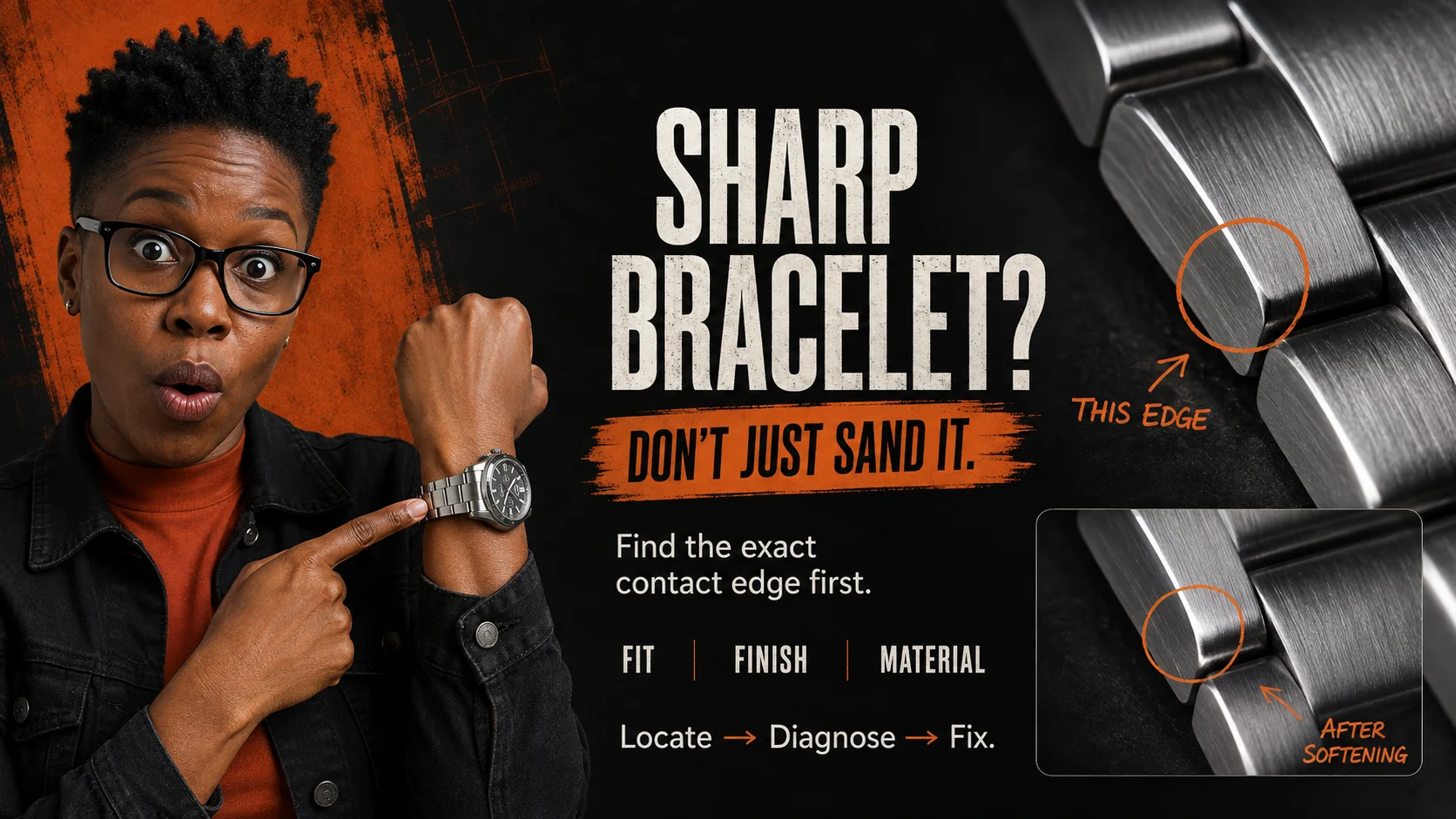
If a watch bracelet or clasp is sharp enough to scrape your wrist, snag clothing or leave the skin raw, first identify the exact edge causing the contact before polishing anything. The problem may be an unfinished burr or insufficiently softened edge, but an overly tight fit, hair being trapped between links, a rough engraving or an intentionally crisp design can feel similar. A new or valuable watch that actually cuts or repeatedly abrades the skin is usually better returned or professionally inspected than immediately attacked with files or sandpaper.
Material matters just as much as sharpness. Plain stainless steel can often be professionally softened and refinished, whereas abrasive work on plated, PVD/DLC-coated, gold, titanium or ceramic parts can permanently alter the surface or expose another material beneath it. The goal is therefore to correct the offending contact edge without unnecessarily changing the bracelet’s geometry or finish.
| What you feel | Most useful check | Best first action |
|---|---|---|
| One particular corner scratches the skin | Locate the exact link, clasp edge or burr | Inspect the finish before deciding whether controlled refinishing is appropriate |
| Entire underside feels harsh | Compare several links and the clasp rather than one isolated edge | Consider return, bracelet replacement or professional edge finishing |
| Only hurts when bracelet is tight | Check circumference and clasp position | Correct fit before modifying metal |
| Hair is pulled but skin is not scraped | Watch where hair enters gaps between moving links | Diagnose articulation and link gaps rather than polishing edges |
| Coated or plated surface feels sharp | Identify the finish before touching it with abrasive material | Prefer manufacturer, retailer or professional service |
Why Metal Bracelet Edges Can Feel Sharp
A machined or stamped metal component does not emerge with every contact edge automatically comfortable against skin. After the basic shape is created, edge-breaking, deburring, chamfering, polishing, brushing and other finishing steps determine whether an edge remains a hard 90-degree corner or becomes slightly softened. Two bracelets can therefore look almost identical in photographs while feeling dramatically different in the hand.
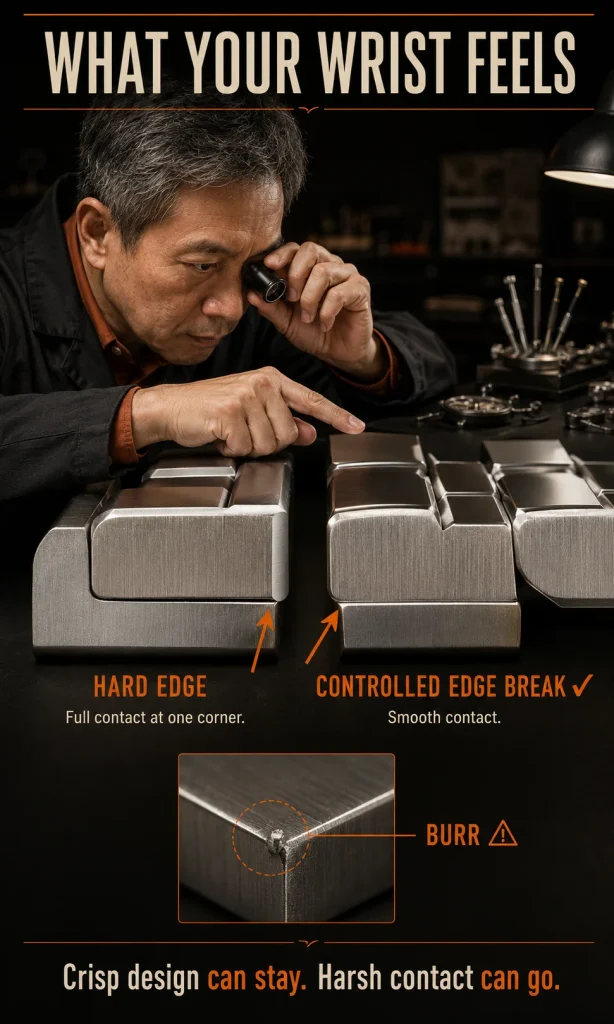
This is one reason current enthusiasts increasingly talk about bracelet “feel” rather than judging quality only from photographs. A recent discussion specifically highlighted articulation, sharp edges, clasp feel and surface smoothness as characteristics that become immediately obvious on the wrist even when visual differences are difficult to see. That observation agrees with the broader comfort principles in Timex’s current guide to all-day watch comfort, which treats strap construction, fit, case design and sharp metal contact points as genuine wearability factors.
The contact zone matters more than whether the watch has visually crisp styling. A sharply defined polished bevel on the upper side of a link can be an intentional design feature because it barely contacts the skin, while the same hard corner on the underside of a clasp can become irritating after several hours. Judge the edge according to where it contacts the wearer, not merely whether it looks geometrically sharp.
A Crisp Edge Is Not Automatically a Bad Edge
Many high-quality watches deliberately preserve sharply defined transitions between brushed and polished surfaces. Those transitions make the bracelet visually precise, and excessive rounding can make expensive finishing look soft or over-polished. A good bracelet can therefore have crisp visual geometry without behaving like a cutting edge against the wrist.
The useful distinction is whether the edge is controlled. A deliberate bevel or crisp transition should feel consistent across equivalent links, while an unfinished burr often feels isolated, irregular or noticeably harsher than the neighboring surfaces. If one link scratches while every corresponding link feels smooth, inspect that individual component rather than assuming the bracelet design itself is uncomfortable.
The underside and clasp deserve particular attention because they spend the most time in direct contact with skin or desks. Run a clean fingertip gently along the suspect area while the watch is off your wrist and compare the same edge on neighboring links. Do not deliberately press hard enough to cut yourself merely to prove that an edge is sharp.
Find the Exact Contact Point Before Changing Anything
The fastest way to ruin a bracelet finish is to start polishing a large area when only one tiny corner causes the problem. Wear the watch briefly in a controlled setting, note where the irritation occurs and then inspect the bracelet off the wrist. A small piece of low-tack removable tape placed near the suspected link can help you remember the location without scratching or marking the metal.
A soft lint-free cloth can also help locate an obvious burr because a damaged or unusually rough edge may catch fibres more readily than the surrounding links. This is only a locator, not a pass/fail laboratory test, because some brushed finishes naturally feel more textured than highly polished surfaces. Compare equivalent areas before deciding that the finish is defective.
Look at the clasp from several angles as well. The lower edge of a stamped or milled clasp, the corner of a safety flap, the transition around a push button and even a raised engraving can all be the true contact point while the bracelet links themselves are comfortable.
Check These Areas First
- underside corners of removable links;
- bottom and side edges of the clasp;
- fold-over safety-lock corners;
- link-to-clasp transition;
- underside of solid end links;
- caseback engraving or raised relief near the wrist;
- protruding link screws or pins;
- sharp corners created by previous damage;
- manufacturing burrs around drilled or machined openings.
Do Not Confuse a Sharp Edge With Hair Pulling
A bracelet that pulls arm hair may contain perfectly smooth edges. Hair can become trapped between articulating links and then get pinched as those gaps close while the wrist moves. Smoothing the outside edge will accomplish very little when the actual problem occurs between links.
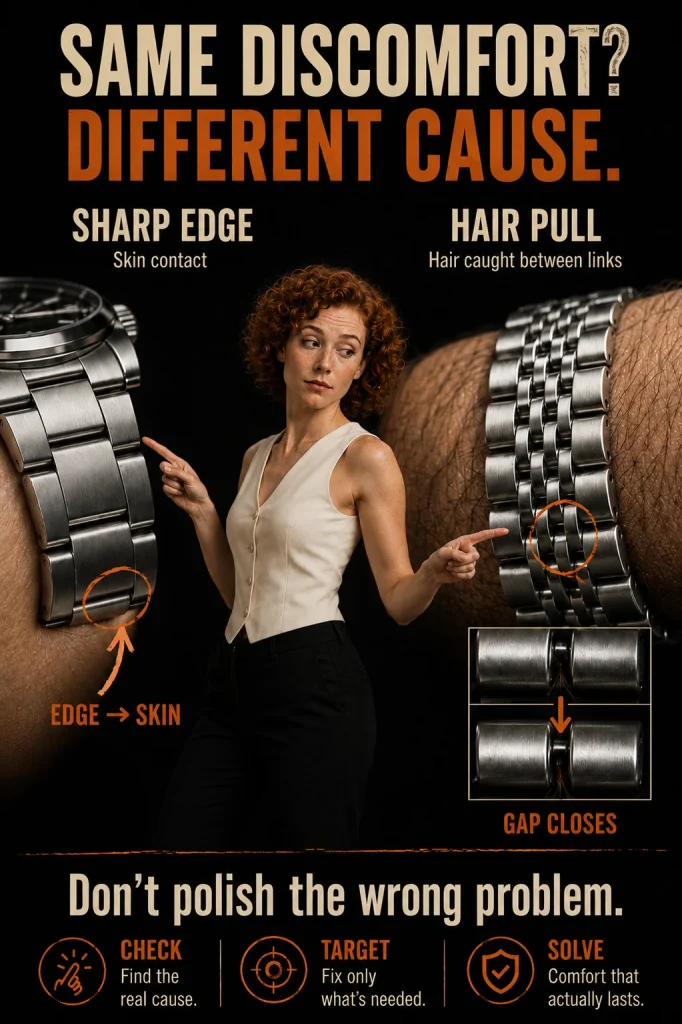
Hair pulling often feels like a brief tug at changing locations around the bracelet, whereas a sharp edge tends to irritate the same line or spot repeatedly. Look at the bracelet while flexing it slowly off the wrist and identify where the gaps open and close. Multi-link bracelets with many articulation points naturally create more opportunities for hair to enter moving gaps.
A different bracelet construction or strap can solve severe hair pulling more effectively than refinishing. If you primarily have sliding, rotation, clasp-balance or circumference problems rather than a rough metal surface, the Watch Fit Problems guide owns that diagnosis.
Fit Can Turn a Mild Edge Into a Painful One
Bracelet tension controls how firmly every underside edge presses against the wrist. A moderately crisp clasp that feels fine with a small amount of movement may become irritating when the bracelet is tightened enough to push that corner continuously into the skin. This is why altering metal should not be the first response when discomfort only appears after aggressive sizing.
Try one legitimate fine-adjustment position if the bracelet provides one and observe whether the contact point changes. If loosening the bracelet slightly eliminates the irritation without causing excessive watch movement, the underlying problem may be fit rather than inadequate finishing. Do not create a dangerously loose bracelet solely to avoid one harsh component, because that component may still deserve attention.
The opposite can occur with very loose bracelets as well. A loose heavy watch can repeatedly slide over the same sharp area or allow a clasp corner to rotate into the wrist at an awkward angle. Comfort comes from the interaction between surface finish and geometry rather than either factor in isolation.
Can Sharp Stainless-Steel Bracelet Edges Be Softened?
Yes, plain stainless-steel bracelet edges can often be softened or refinished, but the job should be much more localized than a full cosmetic polish. A watchmaker or refinishing specialist can break an offending corner, remove a burr and then reproduce the surrounding brushed or polished finish so the repaired area does not look obviously altered.
The important phrase is plain stainless steel. A surface that merely needs a microscopic edge broken is fundamentally different from a bracelet whose appearance comes from plating, PVD/DLC treatment, complex alternating finishes or collectible original geometry. The material and finish should be identified before any abrasive process begins.
Professional finishing is a normal watch-service operation rather than an improvised internet trick. Longines’ customer-service process includes polishing and restoration to original specifications, while Rolex’s official care guidance specifically directs owners to professional service for watch polishing.
Why DIY Sanding Can Make a Good Watch Worse
Abrasives remove material. Even when the amount seems tiny, working across the wrong face can blur the line between brushing and polishing, round an intentionally crisp bevel or create a shiny patch inside an otherwise satin-finished bracelet. The repair may feel smoother but look worse.
This risk grows with valuable watches because original geometry and finish can matter to both appearance and resale. Rolex describes case and bracelet refinishing as a delicate operation performed according to the original finish, which illustrates why professional refinishing involves more than making every surface shiny.
If the watch is inexpensive, uncoated stainless steel and out of its return period, a wearer may reasonably decide that removing one obvious burr is preferable to replacing the entire bracelet. Even then, work only on the confirmed contact edge and stop as soon as the defect is removed; do not convert a small comfort correction into a complete amateur refinishing project.
Material Changes the Correct Repair
| Material / finish | Can the edge be refinished? | Main risk | Preferred approach |
|---|---|---|---|
| Uncoated stainless steel | Usually yes | Changing brushed/polished geometry | Localized professional refinishing |
| Titanium | Often possible | Finish mismatch can be difficult to disguise | Brand or experienced refinisher |
| Gold / precious metal | Technically yes | Soft metal and unnecessary material removal | Professional only |
| PVD / DLC / plated finish | Not like bare steel | Abrasive work can remove or visibly thin the surface finish | Return, manufacturer service or specialist assessment |
| Ceramic | Not a normal DIY refinishing job | Damage or difficult component restoration | Manufacturer or qualified specialist |
The coating distinction is easy to overlook because two bracelets may both be described as “stainless steel.” A watch such as the current Longines Flagship with PVD-coated steel demonstrates that the visible surface can be a treatment over the steel substrate rather than bare steel itself. Removing metal from such a component is therefore not equivalent to touching up an ordinary unfinished steel edge.
New Watch? Return or Exchange It Before Refinishing
A new watch that leaves the wrist raw after normal wear should not require the owner to perform amateur metalwork on day one. If the offending edge appears to be a manufacturing or finishing problem, photograph the location, compare it with another example when possible and contact the retailer before altering the bracelet.
This is especially important when the problem is obvious across several links rather than one isolated burr. Consistently harsh underside edges may indicate the finishing standard of that entire bracelet, which makes a replacement strap or another watch a more rational solution than individually reshaping dozens of links. Current owners explicitly describe abandoning otherwise attractive bracelets because their sharpness made the watch substantially less enjoyable to wear.
Refinishing can also complicate returns because the retailer can reasonably regard abrasive work as modification. Decide whether you are keeping the watch before permanently changing its external surfaces.
A Sharp Clasp Needs Its Own Inspection
The clasp can be the harshest component because it contains rigid folded or machined sections underneath the wrist. First identify whether the sharp point is part of the intended outer geometry, a burr on the hidden underside, a raised screw or pin, or a deformed component resulting from impact.
Do not polish a clasp merely because the closure feels awkward. If the real problem is that the clasp fails to remain locked, that is a security issue rather than a surface-finishing issue and should be diagnosed through the watch clasp that keeps opening guide. Likewise, a protruding retaining screw belongs to the separate bracelet screw diagnosis.
A clasp that is mechanically sound but has one uncomfortable underside corner can often be addressed through localized professional refinishing. The repair should preserve push-button movement, folding alignment and locking geometry rather than altering the parts that actually secure the watch.
What About a Rough or Sharp Caseback?
Not every “bracelet” irritation originates from the bracelet. Deep laser engraving, raised relief, an unfinished case edge or a caseback that protrudes against the wrist can produce a rough sensation in exactly the same area.
Remove the bracelet or hold it away from the wrist and place only the watch head gently against the skin. If the irritation remains in the same spot, inspect the caseback before modifying the bracelet. Changing bracelet finish cannot fix a rough engraved surface underneath the watch head.
Caseback texture becomes particularly noticeable on a tight watch because there is little opportunity for pressure to redistribute. Again, fit and surface finishing can amplify one another even though they require different corrections.
Does a Sharp Bracelet “Break In” With Wear?
Some bracelets feel better after wear because links articulate more freely, surface contamination is cleaned away and the wearer finds a better fit. That does not mean a physically sharp metal corner necessarily rounds itself safely through ordinary wrist contact.
Metal significant enough to feel like a cutting edge will not disappear quickly simply because skin rubs against it. Waiting may therefore be reasonable for stiffness or squeaking, but a bracelet that scratches skin or damages clothing should be inspected rather than used as its own polishing machine.
If a new bracelet merely feels crisp when handled but causes no discomfort during normal wear, there may be nothing to fix. Avoid creating a cosmetic problem in pursuit of perfectly rounded edges that the design never intended.
What a Watchmaker Can Do
A good watchmaker or refinishing specialist first identifies the exact contact point and the existing finish. They can determine whether the solution requires simple burr removal, a controlled edge break, restoration of a brushed grain, polishing of a small surface, component replacement or no refinishing at all.
Professional work also lets the bracelet be separated from the watch head when necessary. This protects the case and movement from loose abrasive particles and allows individual links or clasp components to be positioned correctly for finishing. Manufacturers such as Longines and Rolex include controlled case and bracelet refinishing within formal service processes, which reflects how much finish matching matters.
Ask the refinisher to preserve the original geometry rather than simply “make it smooth.” That wording distinguishes a small comfort correction from aggressive polishing that rounds every visible edge.
Return, Service, Refinish or Replace?
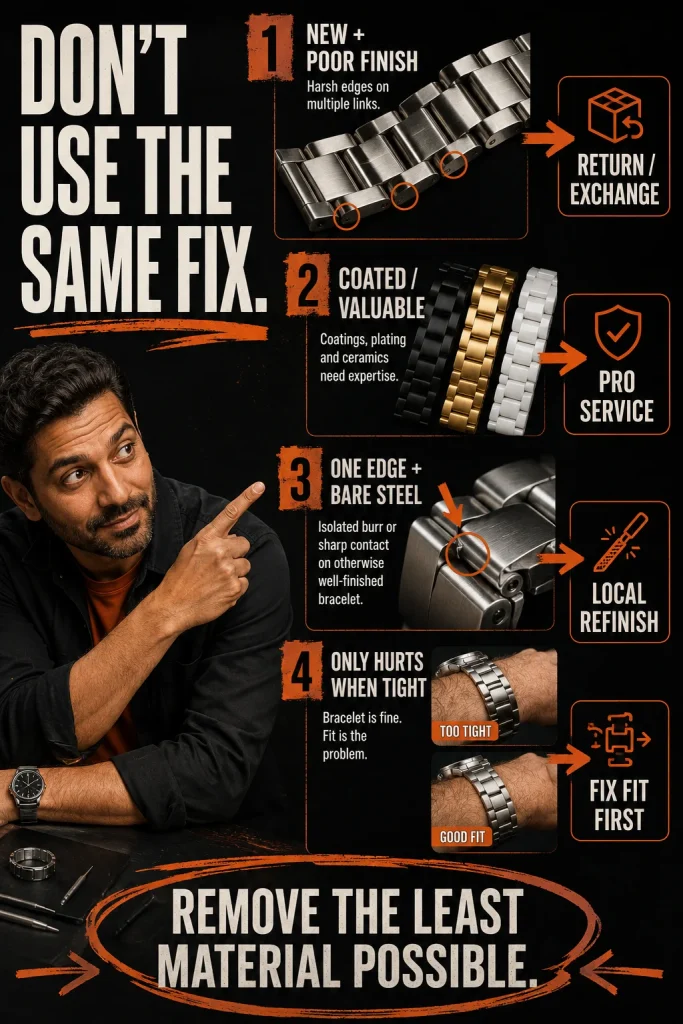
Use the least destructive option that solves the actual cause.
- Return or exchange: best for a new watch with broadly poor finishing, a coated bracelet, or a defect you should not be expected to correct yourself.
- Adjust the fit first: best when sharpness appears only at one bracelet tension or clasp position.
- Professional localized refinishing: best for an otherwise good uncoated metal bracelet with one or a few genuinely harsh contact edges.
- Replace the bracelet or use another strap: best when the entire bracelet architecture is uncomfortable, pulls hair severely or would require extensive modification.
- Manufacturer/authorized service: preferable for valuable, coated, precious-metal, ceramic, proprietary or collectible bracelets.
- Leave it alone: appropriate when an edge merely feels crisp in the hand but does not scrape skin, damage clothing or interfere with normal wear.
How to Check the Result Before Wearing It All Day
After an adjustment or refinishing job, inspect the bracelet off the wrist before committing to a full day of wear. Compare the corrected area with neighboring links under both visual inspection and gentle fingertip contact, and confirm that no screw, pin or clasp component was disturbed during the work.
Then wear the watch for a short period in an ordinary low-risk setting. Pay attention to the original irritation location rather than searching for microscopic differences everywhere, because a properly corrected contact point should simply stop drawing attention to itself.
If discomfort returns immediately, stop modifying other surfaces at random. Re-evaluate whether the actual cause is fit, link articulation, hair pulling, a rough caseback or a component that needs replacement rather than more polishing.
Frequently Asked Questions
Why does my new watch bracelet feel sharp?
A new metal bracelet may feel sharp because some contact edges were left with minimal edge breaking, one component has a burr, the clasp has a harsh underside corner or the bracelet fit is pressing otherwise acceptable geometry firmly into the wrist. Compare equivalent links to determine whether the problem is one defective edge or the overall finishing standard. If a new bracelet actually scrapes the skin, contact the retailer before permanently refinishing it.
Can I sand sharp watch bracelet edges myself?
A tiny defect on an inexpensive uncoated stainless-steel bracelet can sometimes be corrected with controlled refinishing, but sanding can alter brushed or polished surfaces and permanently change the bracelet geometry. Avoid DIY abrasive work on valuable, coated, plated, titanium, gold or ceramic components. Professional localized refinishing is safer when preserving the original finish matters.
Will sharp bracelet edges become smoother with wear?
A bracelet may feel better as its links articulate and its fit settles, but a genuinely harsh metal corner should not be expected to disappear quickly through contact with your skin. If the bracelet scratches the wrist or damages clothing, inspect the cause rather than relying on wear to fix it. A merely crisp edge that causes no discomfort may not require any correction.
Why does my bracelet pull hair even though the edges feel smooth?
Hair pulling often happens when hair enters gaps between moving links and is pinched as those links articulate. This is different from a sharp outer edge scraping the skin. Watch the gaps while flexing the bracelet off the wrist before assuming polishing will solve the problem.
Should I return a watch because the bracelet is sharp?
Returning or exchanging a new watch is reasonable when normal wear causes repeated abrasion, the finishing problem affects many links or correction would require modifying a coated or valuable bracelet. Document the offending area before altering it. If the problem is one minor edge on an otherwise excellent uncoated bracelet you intend to keep, professional localized refinishing may be another option.
Can polishing a bracelet reduce the value of a watch?
Aggressive or poorly executed polishing can alter original edges, brushing and case or bracelet geometry, which matters especially on collectible watches. Professional refinishing aims to preserve or reproduce the intended surface geometry rather than simply remove metal until everything looks shiny. Valuable or vintage watches should therefore be assessed before cosmetic refinishing.
Action Checklist
- Locate the exact edge causing the irritation.
- Compare it with equivalent neighboring links.
- Check whether tightness or clasp position is increasing pressure.
- Separate true sharpness from hair pulling between links.
- Inspect the clasp, link screws, pins and caseback as possible sources.
- Identify the bracelet material and surface treatment.
- Do not use abrasive DIY fixes on coated, plated, precious-metal or ceramic components.
- Give a retailer the first opportunity to correct a new-watch finishing defect.
- Prefer localized refinishing over indiscriminate full-bracelet polishing.
- Preserve original brushed, polished and beveled geometry.
- Replace the bracelet or use another strap when the entire architecture is uncomfortable.
- Test any correction briefly before returning to all-day wear.
- Stop modifying the bracelet if the original symptom remains; reassess the diagnosis instead.