




Bipolar disorder has no established cure, but treatment can bring symptoms into remission and help people build a satisfying, sustainable life. The useful distinction is between ending an episode, reducing the chance of another one and recovering everyday abilities; feeling well does not by itself show that ongoing treatment is no longer needed.
When people ask whether bipolar disorder is curable, they are often asking something more personal: will I always feel this way, can I work again, or will treatment take over my life? Those questions deserve separate answers. A long-term diagnosis does not mean continuous symptoms, permanent incapacity or an identical treatment plan forever.
The strongest practical goal is a life that works at an ordinary, repeatable pace, with treatment that is effective and tolerable. A burst of productivity, a symptom-free appointment or a dramatic online recovery story cannot establish that the vulnerability to future episodes has disappeared. Equally, needing support after an episode does not erase the progress already made.
On small screens, swipe horizontally to compare the table.
| Term | What it tells you | What it does not establish |
|---|---|---|
| Response | Symptoms have improved from the starting point. | That the episode is over or functioning has fully returned. |
| Remission | Symptoms are minimal or absent under the definition being used. | That future episodes are impossible or treatment is unnecessary. |
| Functional recovery | Ordinary activities and roles are becoming manageable again. | A fixed recovery deadline or the need to match someone else’s workload. |
| Cure | A claim that the underlying disorder has been eliminated. | An established outcome of current bipolar treatment. |
If there is immediate danger, an inability to stay safe, severe confusion or psychotic symptoms, seek local emergency help now. A rapidly escalating change in sleep, energy or judgment needs prompt assessment; do not use the everyday adaptations below to wait out a serious episode.
If bipolar disorder is not curable, what does recovery actually mean?
Response, remission and recovery describe different outcomes
Response means symptoms have improved meaningfully from where they started. Remission generally means symptoms are absent or sufficiently reduced that the current episode is no longer fully expressed. The ISBD terminology consensus distinguishes these outcomes, while definitions and time requirements used in assessments and studies need interpretation. These words should not become a home scoring system.
Recovery can refer to sustained improvement in clinical research, but people also use it to mean regaining a life they value. That can include reliable meals, relationships, education, paid work, creativity or confidence about making plans. Someone may have few mood symptoms while concentration and stamina remain limited; another person may be participating in life while still receiving treatment for residual difficulties.
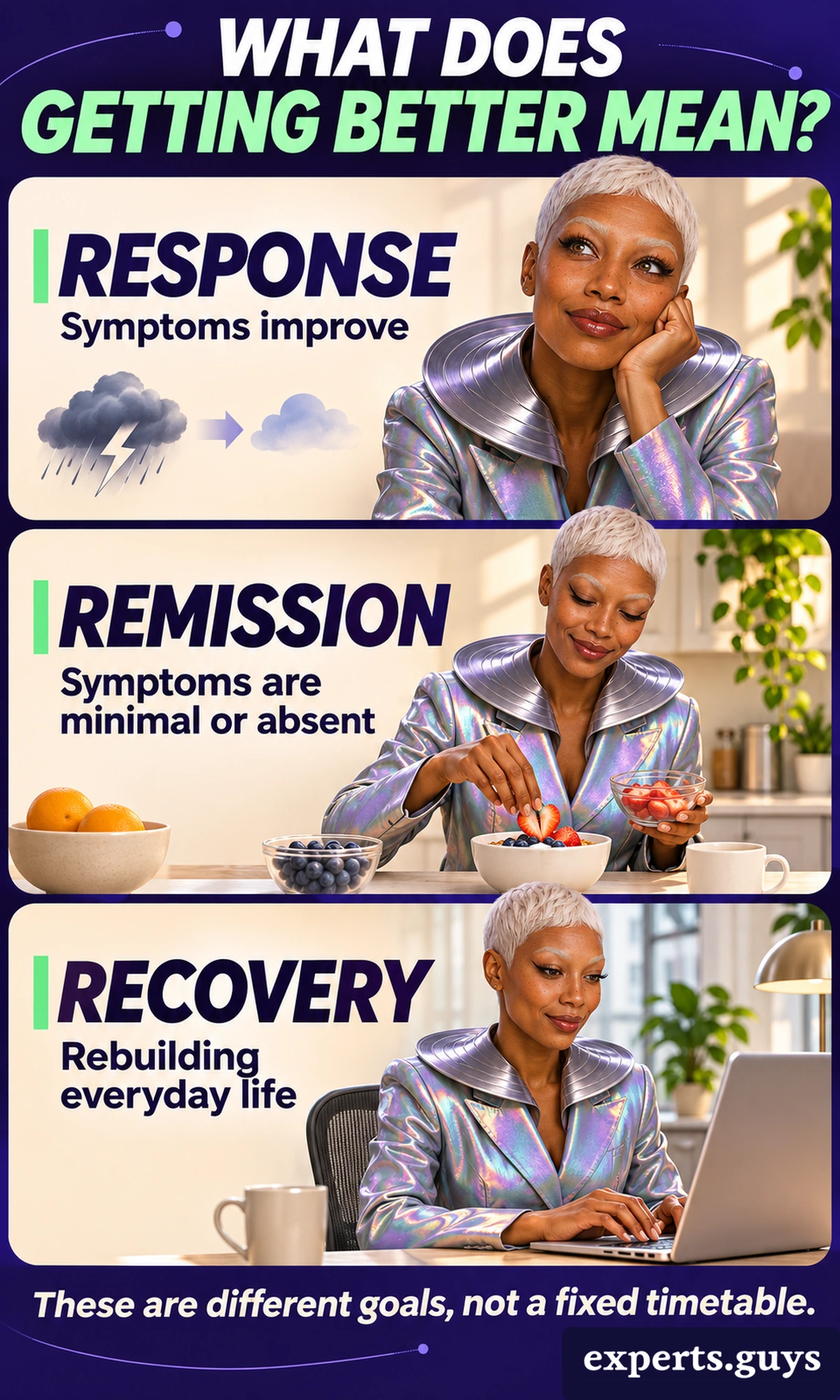
Ask which outcome is being discussed before comparing yourself with a treatment advertisement or another person’s story. “Their depression improved” is different from “they stayed well over a longer follow-up,” and both differ from “they returned to full-time work.” A claim can be true at one level without establishing the others.
The NHS overview of bipolar disorder describes stable periods that can last weeks, months or years. It does not give an individual timetable. The practical implication is hopeful without being predictive: a person can have substantial well periods, while the length and support needed differ.
A diagnosis can remain relevant when symptoms are quiet
An episode is an active period of illness; a diagnosis reflects the wider pattern, including previous episodes. If an assessment established bipolar disorder from a convincing history, a well interval does not automatically overturn that history. This is why treatment decisions consider what happened before, the consequences of recurrence and how well the current plan is working.
There is also a legitimate separate question: was the original diagnosis correct? A history affected by substances, prescribed medicines, another health condition or incomplete information may need reconsideration. Diagnostic reassessment is an evidence-based conversation about the lifetime pattern, rather than a test in which someone stops treatment to see what happens.
If you are still trying to understand the diagnosis itself, the guide to bipolar types and clinical assessment covers that broader question. This page focuses on interpreting improvement after the diagnosis has been considered, so it does not repeat a full symptom checklist or invite you to identify a subtype from recovery speed.
Feeling energetic is useful only in context
Ordinary recovery allows more choice: you can start a task, pause it, sleep and return to it later. A concerning change may instead feel driven, involve much less sleep without ordinary tiredness, or produce commitments and risks unlike your usual self. Those differences matter more than whether the person looks cheerful.
This is not a rule that happiness or ambition is suspicious. The concern is a distinct change in the person’s usual pattern, especially when several changes occur together and judgment or safety is affected. Someone can be excited about a new opportunity without having hypomania; someone in an activated episode may feel excellent while others see mounting consequences.

Consider an illustrative return-to-work example. One person resumes a manageable shift, takes a meal break and can leave unfinished work for tomorrow. Another suddenly accepts several extra shifts, sleeps far less and feels no need to slow down despite unusual spending. The second pattern deserves prompt attention even if output has increased; neither scenario is a diagnostic test.
Our editorial recommendation is to judge progress by repeatable functioning rather than peak output. Repeatability asks whether the activity leaves room for ordinary sleep, food, relationships and the next day’s responsibilities. It gives a more useful recovery target than trying to recreate the most energized period you remember.
Why does treatment often continue after someone feels well?
Treatment has more than one job
Acute treatment addresses the current episode. Maintenance treatment aims to reduce future episodes. Psychological care can help with understanding the condition, relationships and the skills needed to live with it. The best combination depends on previous episodes, response, unwanted effects, other health needs, preferences and access.
The NIMH treatment guide explains that medicines used during an episode and those used over the longer term may differ. Feeling better while receiving treatment therefore cannot tell you what would happen without it. Nor does a recommendation for ongoing care mean that every current medicine must remain unchanged indefinitely.
On small screens, swipe horizontally to compare the table.
| Job | Useful question | Important limit |
|---|---|---|
| Current episode | Which symptoms and safety needs need attention now? | The immediate plan may differ from maintenance care. |
| Prevention | What has helped reduce recurrence, and how tolerable is it? | A quiet period cannot establish that future risk has disappeared. |
| Everyday functioning | Which remaining obstacle prevents ordinary participation? | Symptom improvement and functional improvement may not occur together. |
| Unwanted effects | What change could preserve benefit while reducing this difficulty? | Changes require an agreed medicine-specific plan. |
A side effect is a treatment problem worth solving
Being more stable but too sleepy to manage mornings is not a satisfactory endpoint to ignore. The relevant question is how to preserve benefit while addressing the difficulty. Sometimes a treatment adjustment is appropriate; sometimes symptoms, sleep problems, another medicine or a physical health issue help explain what is happening.
Before a review, choose one concrete difficulty you can describe from ordinary life. “I fall asleep during the first part of my shift” gives the conversation a clearer target than “the medication is bad.” Explain the change, when you first noticed it as accurately as you can, and what it prevents you from doing. No diary or written exercise is required.
Then ask what options could reduce that problem, what trade-offs each option carries, and how you will know whether the agreed change is helping. A supporter can join with your consent or help you communicate if speaking is difficult. The useful result is a shared next step, including who to contact if the problem worsens, rather than an unsupervised dose experiment.
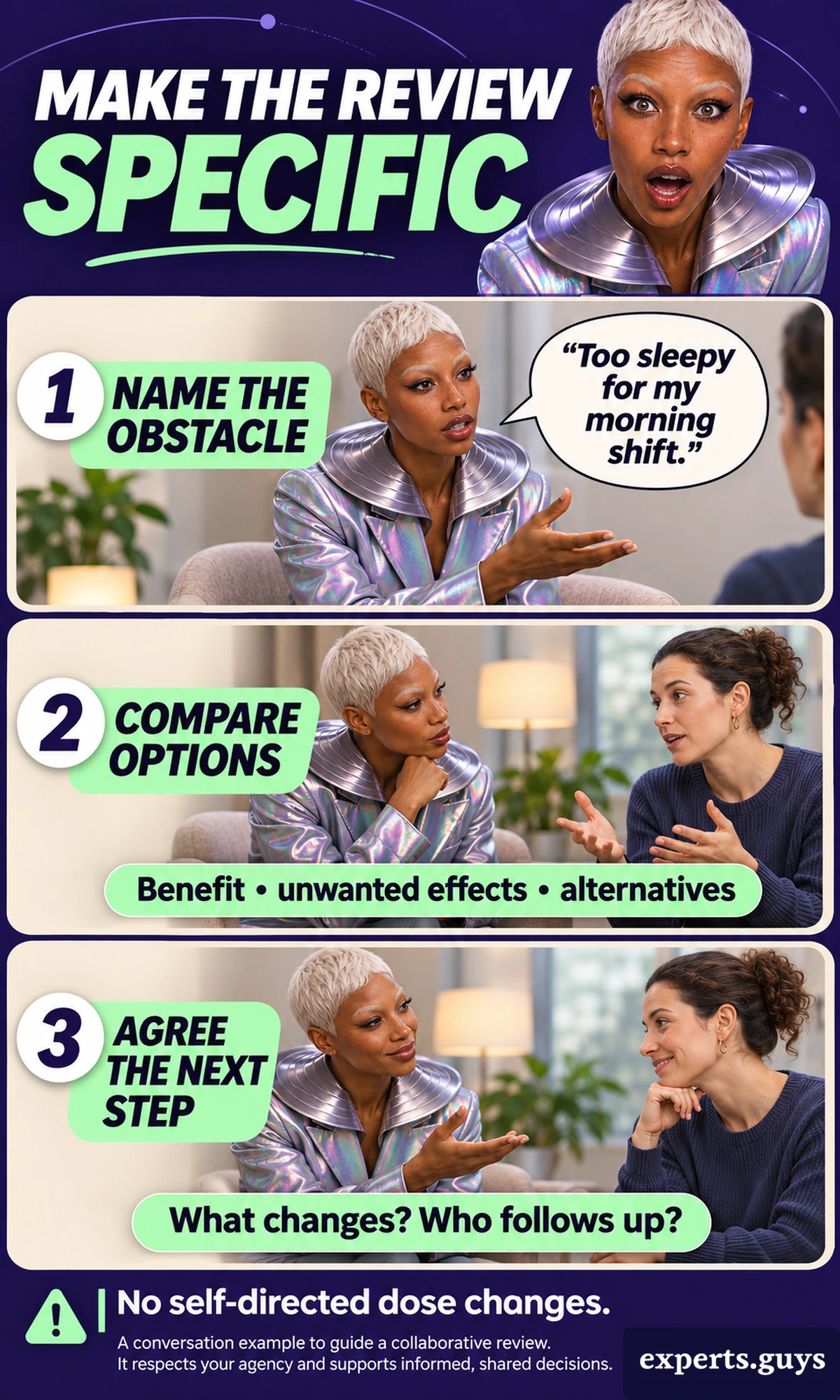
Do not stop, skip, restart or change prescribed treatment merely because you feel well or dislike a side effect. If you have already missed doses, obtain advice specific to the medicine before restarting; some medicines need particular restart arrangements. If you develop a severe reaction or feel acutely unwell, seek urgent medical advice rather than waiting for a routine review.
Long-term care includes physical health
Medication risks deserve a balanced discussion, not the claim that bipolar medication inevitably shortens life. Untreated illness also carries serious risks, and different medicines have different benefits and monitoring needs. A meaningful decision compares the relevant alternatives for the individual, rather than comparing a real treatment with an imaginary option carrying no risk.
Depending on the medicine and circumstances, monitoring may include weight, blood pressure, blood glucose, lipids or medicine-specific tests. For lithium, kidney and thyroid function and lithium levels are important parts of safe care. Keep the actual monitoring arrangement supplied for your treatment; a general article cannot set your test schedule.
The NICE bipolar management recommendations support discussing long-term benefits, unwanted effects and relapse risk together. These are UK recommendations, used here for their treatment principles rather than as a worldwide prescribing rule. If discontinuation is appropriate, the plan needs a medicine-specific process and follow-up, not a universal taper copied from a website.
Why a recurrence does not prove that treatment was pointless
Risk reduction and guaranteed prevention are different promises. An episode can occur despite treatment, just as a period of stability does not prove that every part of a plan is essential. A recurrence calls for reassessing the episode, treatment response, access problems and other contributors; it is not evidence of personal failure.
Avoid a second mistaken conclusion: that a new episode means inevitable deterioration from now on. The future cannot be read from one relapse. What can change is the next care decision, the support available during recovery and the practical obstacles that previously made the plan difficult to maintain.
How can you rebuild daily life without turning recovery into a stress test?
Reopen one household task with a clear finish
After symptoms improve, it is tempting to use a good morning to catch up on every postponed responsibility. That makes it hard to tell whether ordinary capacity is returning or whether the day has simply become overloaded. A smaller, complete task provides a clearer practical result without asking you to prove that you are fully recovered.
Use the following adaptation when you are safe, reasonably settled and trying to resume an ordinary activity. It is a way of organizing a demand, not a treatment for an active mood episode or an exercise that measures remission. Do not use it to push through severe exhaustion, agitation or an unsafe situation.
For example, restore one place setting after a meal. Work at a stable sink or seated preparation area that is comfortable for you. Use only light, unbroken items and your usual washing method; avoid knives, heavy pans and very hot water if concentration or coordination is reduced.
- Choose the finish before starting: one plate and one cup, rather than the whole sink.
- Bring just those items within comfortable reach. Leave unrelated dishes outside the task.
- Wash and rinse with your normal safe method, then place them securely on the drying rack.
- Stop at the agreed finish. Return to the rest of the day rather than expanding the task.
The checkpoint is concrete: the plate and cup are clean and safely left to dry. You do not need a better mood, an immaculate kitchen or proof that you can do the same task at maximum speed. If even this is too much, the easier version is washing the cup alone, or asking someone to manage the washing while you put one clean item away.
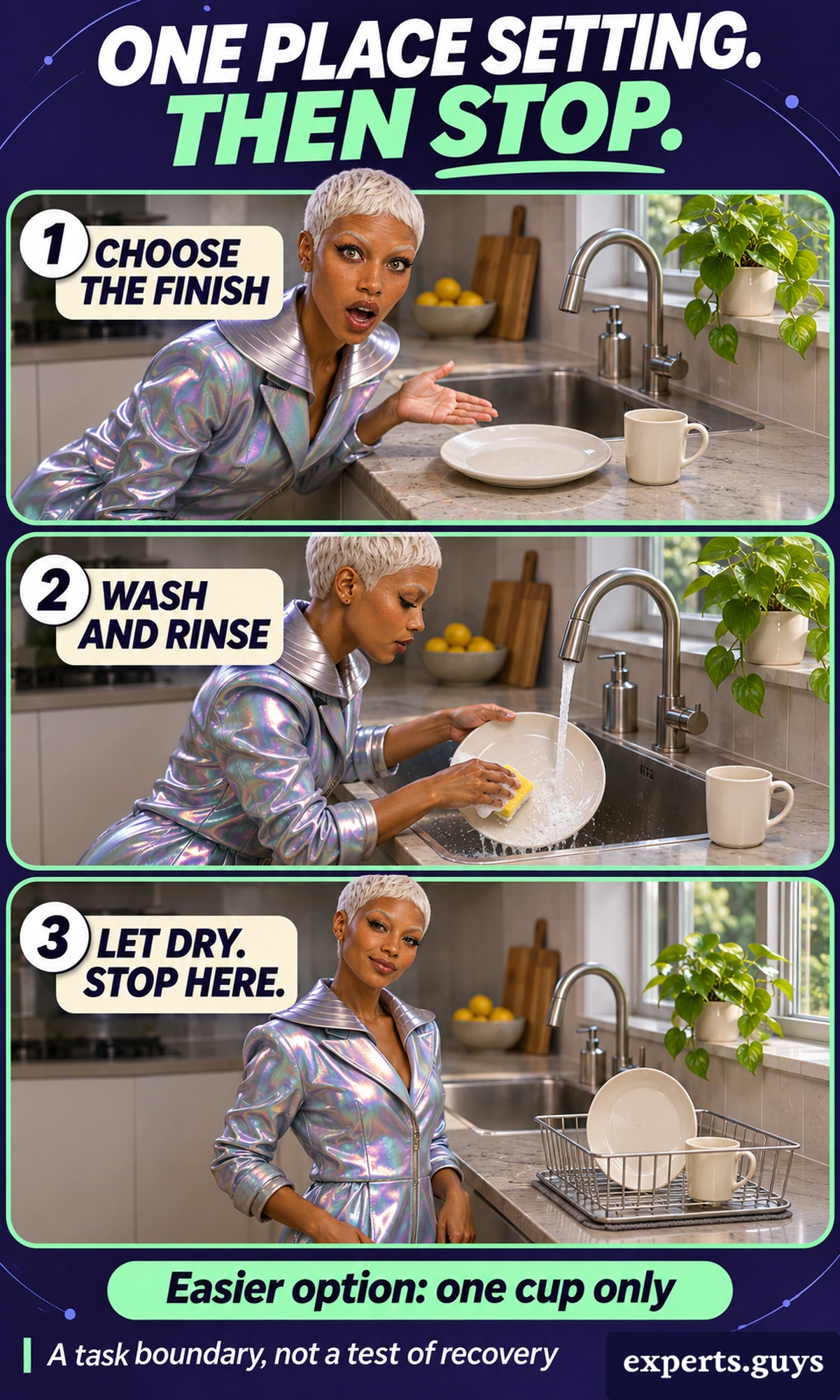
The common mistake is moving the finish line. A cleared place setting becomes a full sink, then cupboards, then the rest of the home. Correct that by leaving the unrelated items for their own occasion. If the small task repeatedly leaves essential meals or sleep harder to manage, the demand needs further adjustment and any persistent loss of function deserves attention.
This differs from handing an entire demand to someone else when functioning is declining. The separate guide to recognizing a possible depressive return addresses a worsening pattern and practical support. Here, the task is chosen for someone rebuilding an activity after improvement; it should never disguise a new decline as a challenge to overcome through effort.
Protect the end of the day with an evening setup
A new project can quietly expand into the period normally used for settling down. An environmental boundary is easier to use when the next task is already prepared to wait. The aim is to reduce avoidable last-minute demands around your existing sleep routine, rather than to force sleep or prescribe a new bedtime.
Choose a calm evening when there is no urgent problem to solve. You need a safe place for ordinary work materials, tomorrow’s clothes if useful, and access to your usual evening routine. Do not change medicine timing, create a sleep-restriction schedule or add bright-light treatment as part of this adaptation.
- Close the current nonessential task and place its light materials in their usual safe location.
- Set out only what removes a predictable morning demand, such as one outfit on a chair or hanger.
- Leave the task for tomorrow and continue your usual evening routine, keeping the ordinary sleep opportunity available.
The visible result is a room and task arrangement that allows the evening to finish. If standing or tidying is difficult, set only one light item aside while seated, or ask someone to place the clothes within reach. You can also say, “I want to stop here and return to this tomorrow,” without explaining or defending the whole diagnosis.
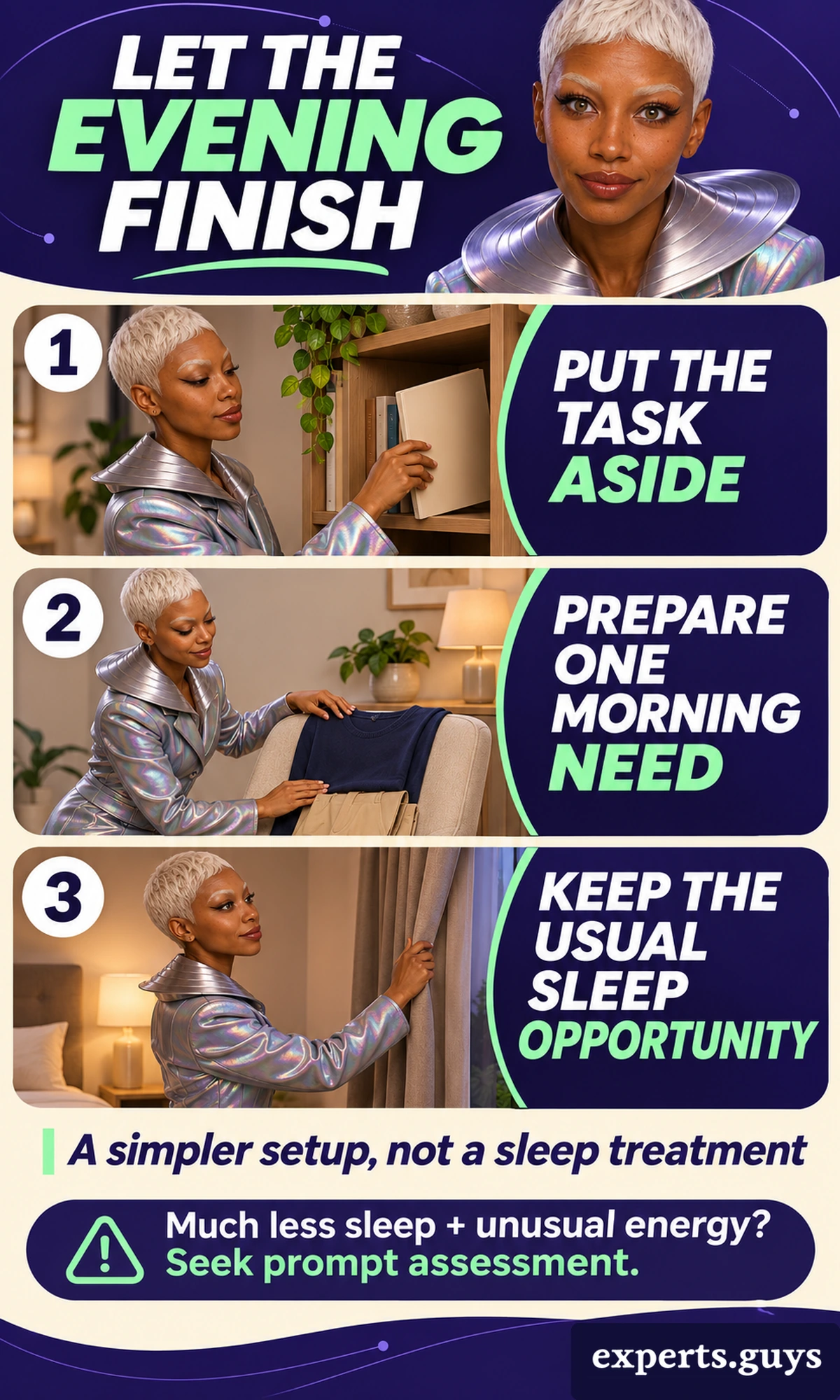
A common failure is treating the setup as permission to finish one more large job first. Move the stopping boundary earlier in the sequence: put the task materials aside before starting another activity. The correction is about reducing friction, not making the routine elaborate or achieving a perfect bedroom.
If you are sleeping markedly less yet feel unusually energized, cannot slow down or are making risky decisions, contact the care team promptly. Do not assume that better organization can manage emerging mania. Likewise, a persistent inability to sleep deserves an assessment even when you are tired rather than energized; the setup is an accommodation, not a diagnosis or a sleep treatment.
Check access to treatment before a predictable disruption
A weekend closure, trip or change of address can interrupt a working plan without any deliberate decision to stop treatment. A practical access check is useful before such a disruption. Its job is to keep the existing prescription obtainable, not to decide how much medicine you ought to take.
Use the original labelled packaging and the contact details for your dispensing pharmacy. Keep medicines away from children and pets throughout. Leave tablets in their normal packaging; do not lay them out for a photograph, share them or move them into an unlabelled container.
- Check the dispensing label and remaining packaged supply against the prescription you actually follow; ask the pharmacist if the quantity is unclear.
- Check the pharmacy’s opening times and the repeat-prescription process before the closure or trip.
- Arrange the next supply through the usual authorized route. Confirm collection or delivery instead of assuming a request has been completed.
The completed result is a confirmed route to your next lawful supply before the current one runs out. If the label or remaining supply is hard to interpret, ask the pharmacist to check rather than calculating from memory. A trusted person can help collect a prescription with your permission and within local arrangements.
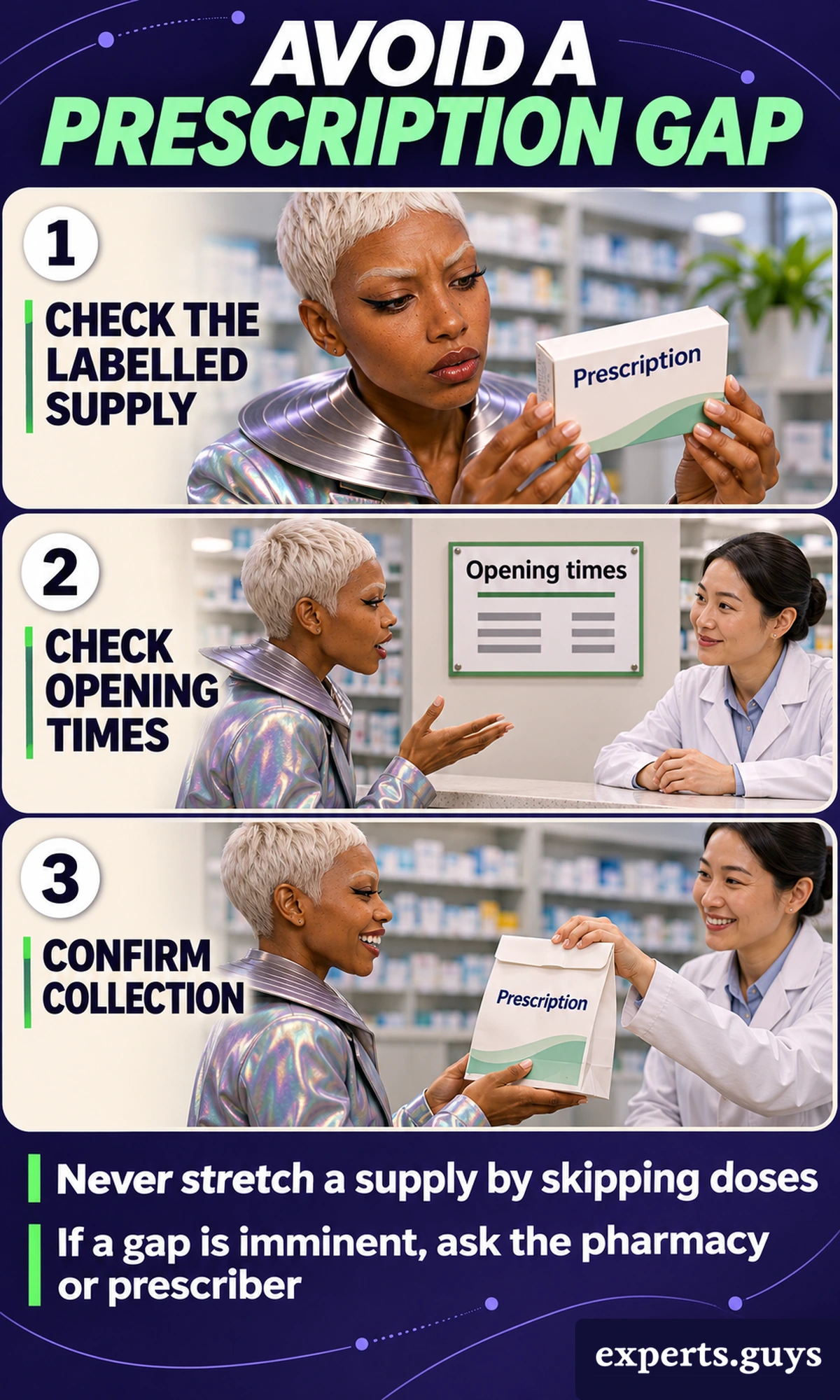
The common mistake is stretching a supply by skipping doses or assuming another person’s tablets are interchangeable. If a gap is already imminent, contact the pharmacist or prescribing service for medicine-specific advice. Do not double a later dose or restart after a break on the basis of this article. Travel rules and emergency supply arrangements differ, so confirm the actual destination requirements before travelling.
These three adaptations address different obstacles: a task that grows, an evening that does not end and an avoidable access gap. Choose the one connected to a real difficulty. Adding all of them at once would create extra demands without showing which change actually made life easier.
What should you make of permanent-cure claims and long-term predictions?
Ask what the claim actually demonstrated
A testimonial showing someone feeling well today cannot establish that they will never have another episode. A study showing improvement in depressive symptoms cannot automatically demonstrate prevention of mania, restored functioning or permanent cure. The length of observation and the outcomes measured matter as much as the confidence of the headline.
When a cure claim appears, use a simple reading check. First identify the promised outcome: symptom relief, prevention of recurrence or removal of the disorder. Then look for the actual supporting study and what participants were receiving alongside the advertised intervention. Finally, check whether the follow-up and comparison can support the promise being made.
If those details are missing, the defensible conclusion is that the claim has not been established, not that the intervention must work because an enthusiastic person describes it. You do not need to buy a product or stop treatment to investigate the claim. If technical details are inaccessible, bring the actual claim to a pharmacist or care review before making a change.
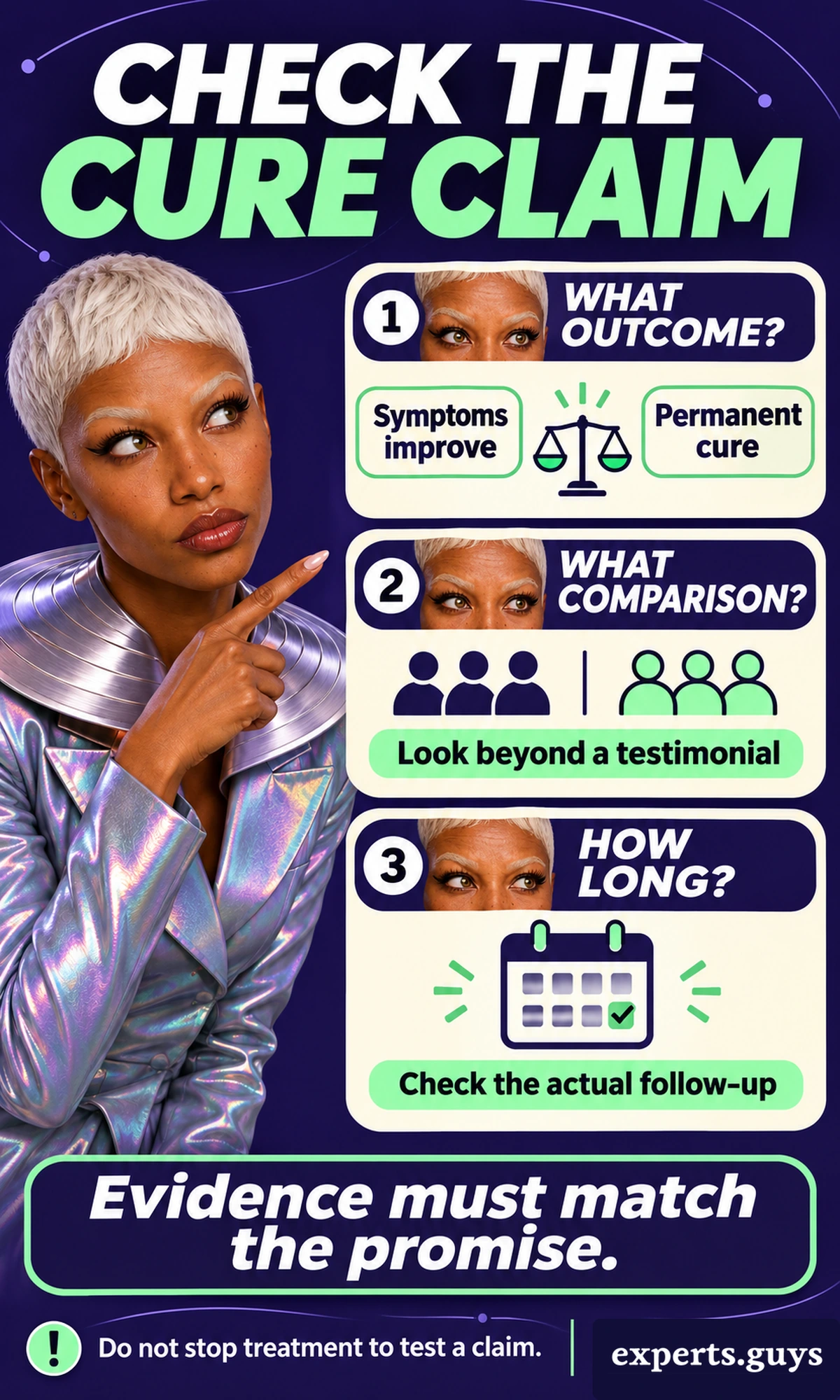
The common mistake is letting “natural,” “root cause” or “clinically proven” stand in for an answer to those questions. A product may be natural and still cause harm or interact with treatment. A study may be genuine while measuring a much narrower outcome than the advertisement suggests. Ask whether the evidence matches the particular promise, rather than whether the advertisement contains any scientific vocabulary.
The World Health Organization’s bipolar disorder fact sheet describes recovery-oriented care and effective treatment, including the importance of participation in ordinary life. That supports taking recovery seriously. It does not convert a particular diet, supplement, commercial program or personal story into an established permanent cure.
Lifestyle support does not replace episode-specific treatment
Regular routines, ordinary physical activity and avoiding harmful substance use can support wellbeing. They do not answer the same clinical question as treating mania, bipolar depression or preventing recurrence. Nor is the person responsible for an episode because they did not maintain an ideal routine.
Some complementary approaches have limited or uncertain evidence, and some products can interact with medicines or affect mood. An honest comparison needs the exact product, intended outcome, known risks and current treatment. Do not add a supplement simply because an online list calls it a mood stabilizer, and do not assume that a sleep product is automatically suitable for bipolar disorder.
This article deliberately does not give a menu of supplements or a self-directed medication alternative. The useful decision is whether a claim deserves trust and whether a proposed addition is compatible with the actual care plan. That question can be answered without purchasing an unproven package or treating lack of a cure as lack of effective care.
“End stage” is not a prognosis you can assign yourself
Some research discusses staging and different illness courses, but there is no everyday sequence in which every person inevitably progresses to a terminal “end stage” of bipolar disorder. Repeated episodes, persistent symptoms or cognitive difficulties can be serious and deserve targeted assessment. They do not permit a website to predict an individual’s future from age or diagnosis alone.
When a current difficulty is named precisely, it becomes easier to address. Problems with attention may need a different response from sedation, disrupted sleep, an active mood episode or another health condition. Calling all of them irreversible decline closes questions that should remain open until the actual problem is assessed.
On small screens, swipe horizontally to compare the table.
| Claim | More accurate interpretation | Practical consequence |
|---|---|---|
| “I feel well, so I am cured.” | A well interval is valuable; it cannot by itself establish permanent cure. | Review the plan using benefit, tolerability and episode history. |
| “I relapsed, so treatment failed completely.” | Risk reduction does not guarantee prevention of every episode. | Reassess what happened and which part of the plan needs attention. |
| “Medication inevitably shortens life.” | Medicine-specific risks must be balanced against benefits and illness risks. | Keep appropriate monitoring and discuss the actual alternative. |
| “Getting older means inevitable end-stage illness.” | Course varies; current problems need individual assessment. | Name the specific symptom or functional problem rather than assume irreversible decline. |
The same caution applies to “Does bipolar get worse with age?” The useful answer depends on the person’s course, other health conditions, treatment and support, rather than age as a single cause. Planning for a sustainable life remains reasonable even when the next stage requires more help than expected.
Recovery is not a competition with another person's life
An online account rarely shows everything that made the person’s improvement possible: the episode pattern, treatment history, financial support, accommodations or time away from work. You can learn from someone’s description without treating their outcome as a deadline for your own recovery. Be especially cautious when a personal story ends in a product sale or a demand to abandon care.
For someone who wants to return to a demanding role, the first question is which part of the role is currently manageable and repeatable. A smaller start may preserve participation while capacity improves. It can also reveal a specific remaining obstacle, such as early-morning sedation or difficulty switching tasks, that deserves a focused adjustment rather than a general judgment about motivation.
For someone whose symptoms have been quiet for a long time, the next question may be whether treatment remains effective, tolerable and practical. Stability is a good reason for a careful review; it is not proof that treatment should end. A review can recognize progress while considering future risk and the person’s preferences honestly.
Frequently asked questions
Can a clinician say that bipolar disorder is in remission?
Yes. Remission is a clinical description of symptom status under the definition being used. Ask whether it refers to the current episode, a sustained well period or both, and what the follow-up plan is. It does not mean that future episodes have been ruled out.
Can someone recover without returning to their previous workload?
Yes. A valuable recovery goal can be participation that fits current capacity, including a different schedule or role. Returning to a former workload is one possible outcome, not a universal measure of a worthwhile life or a requirement for recognizing improvement.
Does needing treatment for years mean the same prescription forever?
No. Ongoing care and an unchanged prescription are different things. Treatment can be reviewed as response, unwanted effects, health needs and circumstances change. Any medicine change needs an agreed plan rather than an experiment prompted by feeling better.
Can one symptom-free period prove that an online cure worked?
No. Improvement after an intervention does not establish that it caused the improvement, prevented future episodes or removed the disorder. Check what was measured, the comparison, other treatment being received and follow-up before accepting a permanent-cure claim.
Choose the next step that fits your situation
If you are stable but an ordinary responsibility has become difficult to resume, use one small, clearly finished task as a practical starting point. If the main obstacle is a side effect or an access problem, address that specific obstacle through the relevant treatment or dispensing service. If sleep, energy or judgment is changing quickly, prioritize prompt assessment over self-help.
The aim is not to prove that bipolar disorder has disappeared. It is to make treatment and everyday life work together well enough that improvement is meaningful, sustainable and yours to build on. A realistic plan leaves room for pleasure and ambition as well as prevention, and it can change as your needs change.










