


Possible bipolar signs in women include a distinct change in mood together with energy, sleep and behavior, particularly unusually increased activity or much less need for sleep. If you notice this in someone close to you, describe the change and its consequences rather than announcing a diagnosis; one argument, purchase or emotional afternoon cannot establish bipolar disorder.
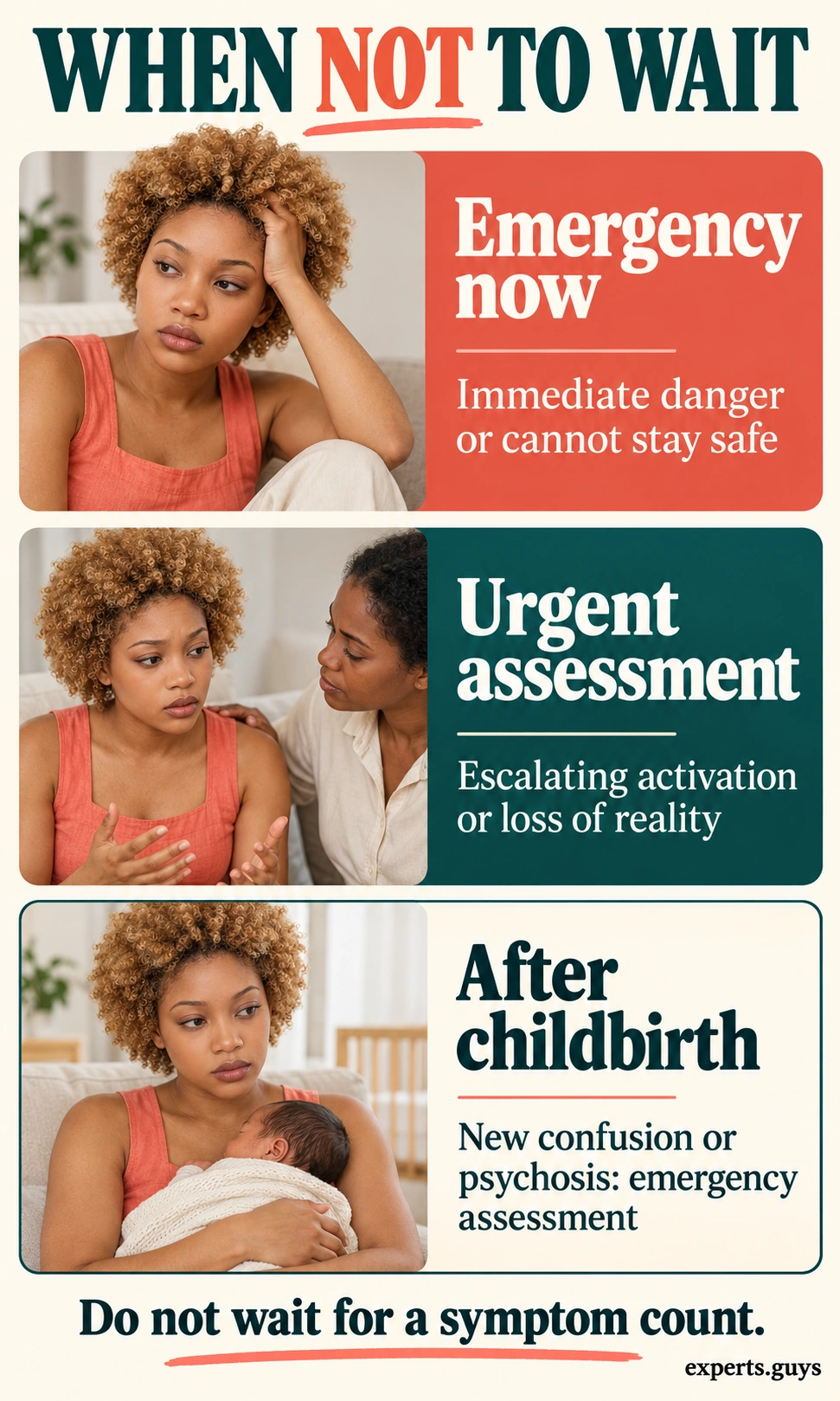
Safety comes first: immediate danger, an inability to stay safe or severe confusion needs emergency care. New confusion, hallucinations or delusions after childbirth needs emergency assessment. Do not wait for agreement about a diagnosis before responding to a serious safety concern.
This guide focuses on the observer’s job: recognizing a meaningful change, raising one concern, and supporting an assessment without taking over. If you are noticing changes in yourself, you can also use it to explain what kind of help you want. The broader guide to bipolar symptoms in women covers symptoms and reproductive context in more depth.
A woman’s confidence, clothing, ambition or willingness to disagree is not a symptom. What matters is a departure from her own usual functioning, considered with the full clinical history. The aim is to make a concern understandable, not to win an argument about what women should be like.
Before speaking, distinguish the facts you directly know from the explanation you suspect. That simple distinction keeps a useful observation from becoming a label the other person has to defend herself against.
- What you observed: a concrete change you saw or heard, without claiming knowledge of private behavior.
- What it affected: a task, conversation, decision or safety issue that became different.
- What you do not know: the cause, the full sleep history or whether diagnostic criteria are met.
- What help you can offer: a specific, voluntary next step rather than a demand for agreement.
What can you observe without trying to diagnose her?
You can notice changes in pace, activity, conversation and everyday functioning. You can also listen when she describes sleeping much less yet feeling unusually energized. These observations are most useful when they occur together and are different from her usual self; an observer cannot infer someone’s sleep need simply because a light was on late.
Separate observation from interpretation. “You spoke much faster than usual during dinner, and I found it hard to follow” describes an interaction. “You are manic” names a clinical state you may not be qualified to identify. The first statement can remain useful even if the eventual explanation is something other than bipolar disorder.
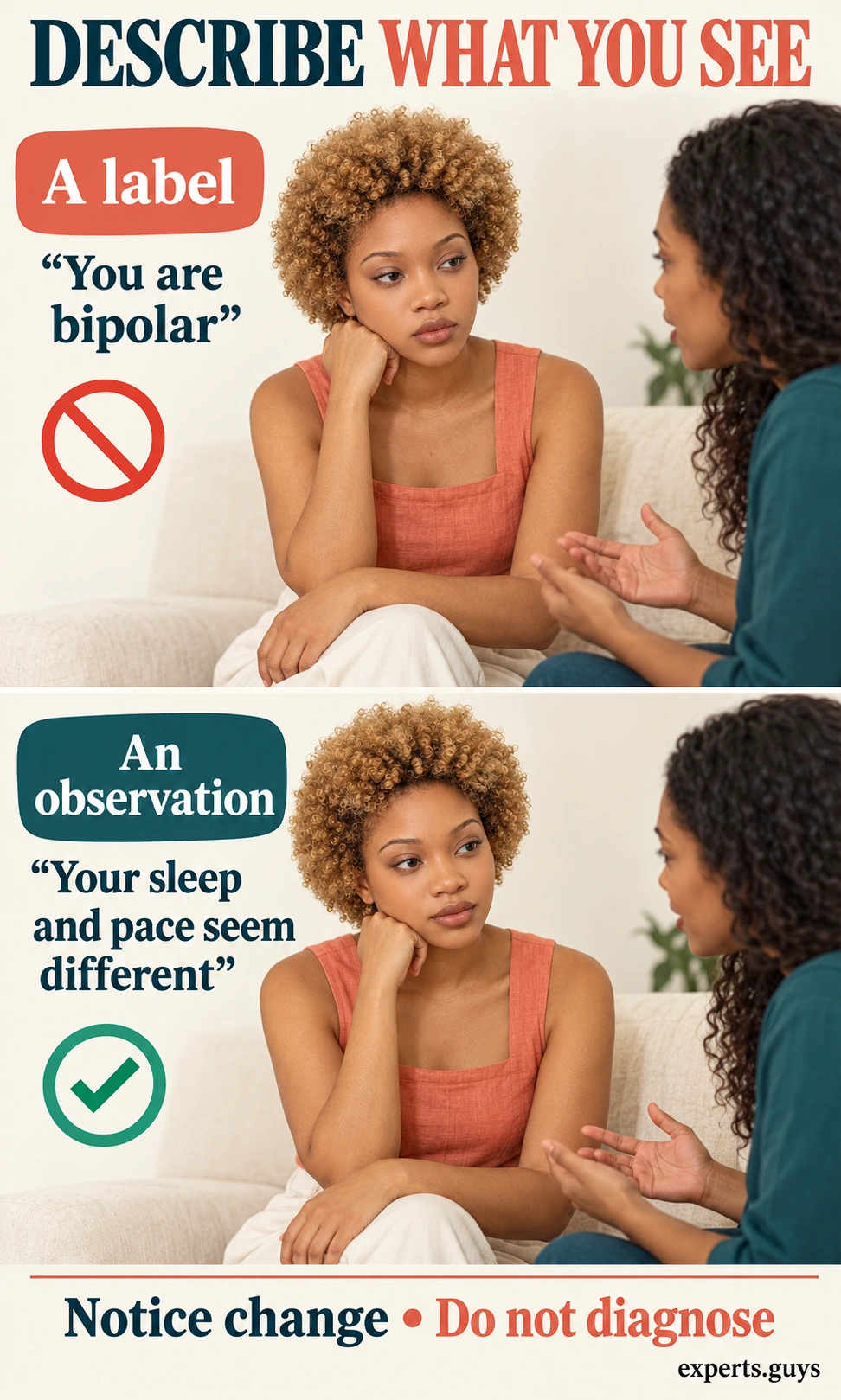
The clinical picture of bipolar disorder includes episodes involving mood, energy and activity. Hypomania may feel productive, while mania can involve severe impairment or psychosis. A person can therefore feel that something is going well while people close to her notice a consequential change.
That difference in perspective does not mean the observer is always right. A naturally fast speaker, a new job or an exciting project can be misunderstood when compared with someone else’s preferences. Compare with what is usual for this person, and leave room for an explanation you have not heard.
The following examples show how to make an observation more precise. They are hypothetical communication examples, not diagnostic criteria or a checklist to complete.
| Avoid assuming | A more useful observation | What remains uncertain |
|---|---|---|
| “You are bipolar because you are angry.” | “Your pace and irritability seem different from usual this week.” | Anger and irritability have many possible explanations. |
| “You barely need sleep.” | “You told me you slept much less and still felt full of energy.” | Whether this is a sustained change and what else accompanies it. |
| “That purchase proves mania.” | “This decision seems different from your usual approach, and it affects our shared bill.” | A purchase alone does not establish an episode. |
| “You look fine, so nothing is wrong.” | “You are still working, but you said ordinary tasks have become much harder.” | Visible output does not reveal the full level of distress or impairment. |
Context can change the explanation. Medicines, substances, physical illness, stress and disrupted sleep may contribute to a change or coexist with a mood episode. Reproductive timing can also matter, but “it is just hormones” is not a substitute for assessment. The comparison of depression, anxiety and bipolar disorder explains why overlapping symptoms need a wider history.

You do not need to collect evidence secretly or watch every decision. A concern can begin with one honest example and an admission of uncertainty. If you do not know when a change began, say that; invented precision is less helpful than a clear account of what you actually noticed.
How can you raise a concern without starting a diagnosis debate?
Keep the first conversation about a specific change and a practical offer. A respectful discussion cannot guarantee agreement, but it gives the person something concrete to respond to. The NHS guidance on supporting someone emphasizes listening and offering practical help without forcing the conversation. It also avoids turning a possible illness into an explanation for every disagreement in the relationship.
Raise one concern: change, impact, offer
Use this brief spoken approach when there is no immediate danger and both people can participate safely. It is a communication example, not a technique for managing severe mania, violence or an emergency. Choose a moment when you are not in the middle of a public confrontation or a time-critical task.
- Name one change. Say what you directly observed or what she told you: “You said you have been sleeping much less, and your pace seems different.” Avoid diagnosing or making claims about motives.
- Explain one concrete impact. “You seemed too distracted to follow the route yesterday, and I was worried about the drive.” Use a relevant consequence, not a list of unrelated grievances.
- Offer a choice and listen. “Would you like me to come with you to an appointment, or help arrange a ride?” Give her room to explain, disagree or suggest another form of help.
Worked example: “I may not understand what is happening. Your sleep and pace seem different, and yesterday’s drive worried me. Would you like help getting to an assessment?” The observation, consequence and offer are clear without requiring the person to accept the word bipolar.
Common mistake: repeating the same concern more loudly or bringing several relatives into the conversation can turn an offer into pressure. Return to the concrete issue instead of compiling accusations. Do not promise secrecy about an immediate danger that requires help.
Easier version and checkpoint: use one short observation and one offer if a longer conversation is difficult. Allow time to respond, use an interpreter or accessible communication when needed, and do not insist on eye contact. The useful result is that the concern and offered support are understood; agreement about a diagnosis is not the target.

If she disagrees, you can acknowledge that you may see the situation differently without withdrawing a genuine safety concern. Ordinary disagreement does not justify taking her possessions, accessing private accounts or controlling unrelated choices. When symptoms are escalating, the decision becomes how to obtain appropriate help, not how to construct a better argument.
For someone already diagnosed, follow the response she previously agreed with her care team where available. A familiar relapse pattern belongs in that plan; the early warning signs guide covers that ongoing task. Do not invent a new monitoring system during a disagreement.
What should a companion do before and during an assessment?
A companion’s role is to make the person’s account easier to hear and add relevant observations when appropriate. It is not to present a verdict or answer every question for her. NIH appointment guidance describes both the usefulness of a companion and the importance of keeping the patient central, including private consultation time.
Agree the companion’s role
Use this procedure for an ordinary appointment when the person can express a preference. Clinical teams handle emergency situations differently according to the person’s needs and applicable rules; this is not a legal guide to consent. If you are the patient, you can initiate the same agreement yourself.
- Ask who should join. Before entering, ask whether she wants you in the room, waiting outside or joining for only part of the appointment. Agree whether she wants you to contribute a particular observation.
- Let her speak first. Sit where she can speak directly to the clinician. If invited, add a brief first-hand example and say which details you do not know. Avoid turning your interpretation into a fact.
- Make room for privacy. Step out when she or the clinician requests private time. A companion does not need access to every part of the consultation to provide useful support.
Worked example: She wants to explain her own symptoms but worries that she will forget a change someone else noticed. The companion waits until invited, describes that one observation, then leaves space for her response. This preserves both accounts instead of replacing one with the other.
Correction and easier option: do not interrupt to challenge every detail or treat a different memory as dishonesty. If attending is difficult, the clinic can explain an appropriate way to receive relevant information; do not assume that receiving your concern permits staff to disclose confidential information back to you. For an ordinary visit, waiting outside and helping with transport may be the whole role.
Completion: she knows who is joining, her account has room to be heard, and any companion contribution is clearly identified. The clinician decides how to weigh the information. No diary, symptom score or completed form is needed to begin asking for help.

The assessment may consider earlier episodes, physical health, family history, prescribed medicines and substances as well as the current change. If medicine identification is difficult, the linked women’s symptoms guide already demonstrates bringing original packaging. Treatment decisions belong with the clinical team; the bipolar treatment guide explains why the episode and history affect those choices.
When does safety override the conversation?
Seek emergency care for immediate danger, inability to stay safe or severe confusion. Escalating activation, marked impairment or loss of contact with reality needs urgent clinical assessment. New confusion, hallucinations or delusions after childbirth is a medical emergency, as explained in the postpartum psychosis guidance. Do not make a successful conversation a condition of receiving help.
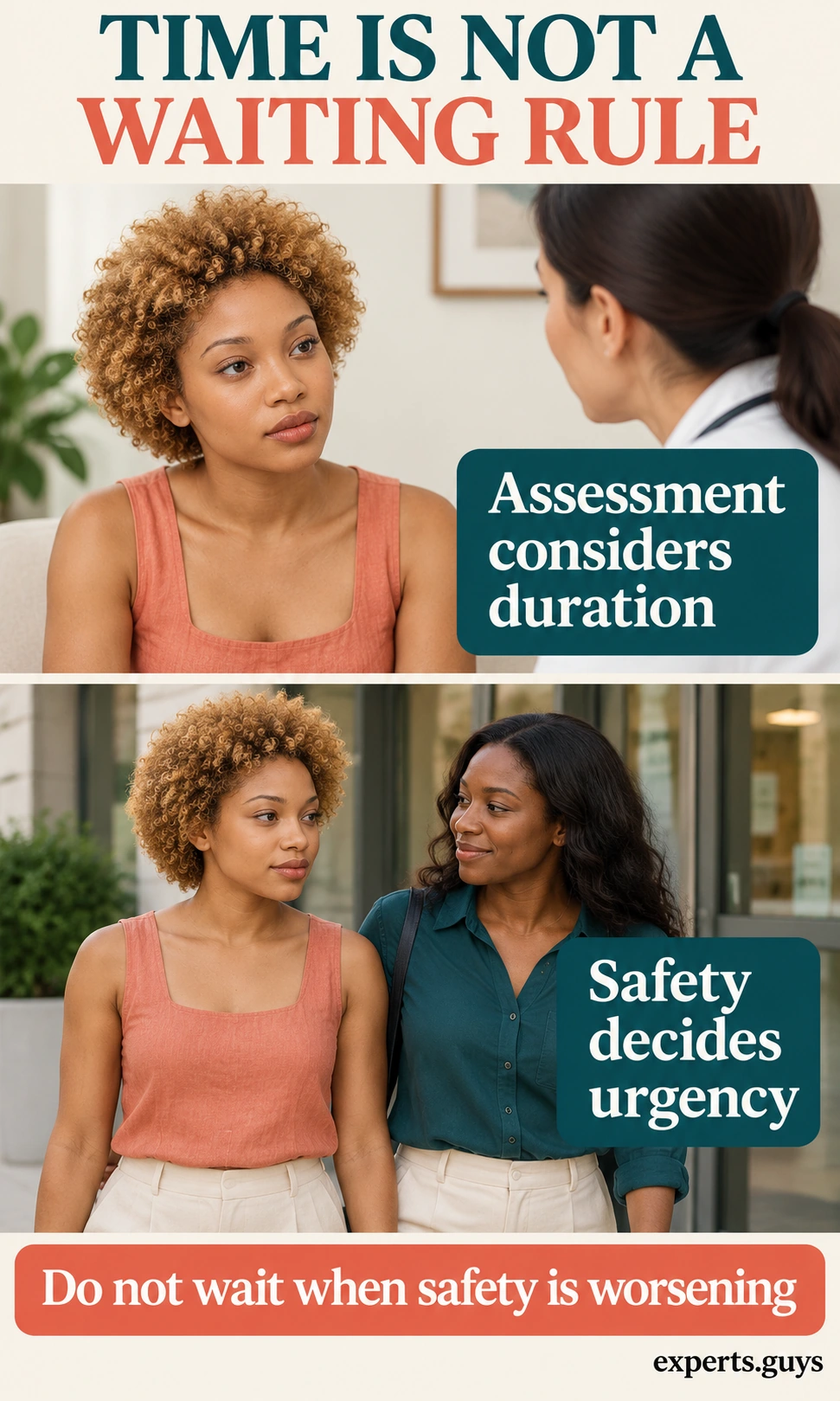
Duration criteria help clinicians classify episodes; they do not set a compulsory waiting period. For example, NICE referral guidance uses a history of at least four days of overactivity or disinhibition as a reason to consider specialist assessment in an adult presenting with depression. That does not mean a dangerous change on an earlier day should be watched at home until it qualifies.
Choose a safer ride
When current sleep loss, distraction, agitation or impaired judgment makes driving unsafe, change the transport arrangement. A diagnosis alone does not tell you how someone can travel today. Follow clinical advice and local driving requirements, and use emergency services when an ordinary journey cannot be managed safely.
- Agree on a trusted, sober and capable driver or an appropriate accessible ride. Any transfer of keys should be voluntary; do not wrestle for them.
- Travel as a passenger with the seat belt used normally. A trusted companion can accompany the person into the appointment if wanted.
- If there is immediate danger, severe confusion or no safe way to travel in an ordinary vehicle, contact local emergency services instead.
Example: Someone is too distracted to follow directions and wants to drive herself to urgent care. A companion driving removes the need for her to manage traffic. The checkpoint is safe transport, not proof that the clinical concern has resolved.
Correction and easier option: do not assume an unaccompanied taxi is suitable when someone cannot stay safe. If an accessible ride or suitable driver is unavailable, ask the care service about safe transport. Do not restrain someone or escalate a confrontation over the keys.

If the situation is not an emergency but the change persists or disrupts ordinary life, arrange an assessment rather than repeatedly trying to settle the question at home. Explain the most consequential change and how quickly it is developing. If you are frightened of the person or unable to remain safely, prioritize your own safety too.
Frequently asked questions
Should I tell her that I think she has bipolar disorder?
You can say you are concerned about a change without presenting a diagnosis as fact. A useful opening names what you observed, explains its impact and offers support. If she asks about bipolar disorder, describe it as one possibility for a clinician to assess, not a conclusion you have reached.
What if she seems happier and more productive?
Feeling better does not by itself indicate illness. An unusual increase in activity becomes more concerning when it accompanies changes such as much less need for sleep, impaired judgment or significant consequences. Work output alone cannot establish whether someone is well.
Can bipolar disorder look irritable rather than cheerful?
Yes, elevated episodes can involve marked irritability rather than obvious happiness. Irritability alone is nonspecific, however, and cannot identify mania or hypomania. The wider change in energy, activity, sleep and functioning matters.
Does rapid cycling mean several mood changes in one day?
No. Rapid cycling describes at least four qualifying mood episodes in a year under clinical criteria. It is not a label for every quick emotional reaction. Do not use it to interpret an argument or a difficult afternoon.
Can a companion diagnose from an online checklist?
No. A checklist does not establish the cause, distinguish all overlapping conditions or replace a clinical history. A reassuring score should not override an obvious safety concern, and a high score does not give someone authority over another adult’s choices.
What if I cannot remember the exact dates?
Give the approximate period and clearly say what you are unsure about. A concrete example of changed behavior and its consequence can start a useful conversation. Do not delay an urgent assessment to reconstruct a perfect history.
Your action checklist
- Describe a specific change, not a personality judgment or diagnosis.
- If there is no immediate danger, raise one concern and offer a concrete choice.
- Agree what an accompanying person should contribute and preserve private consultation time.
- Let safety determine urgency and transport; do not wait for a symptom count or agreement about a label.