
Identity in an Algorithmic Environment
In physical environments, identity presentation influences perception.
In digital ecosystems, identity presentation influences metrics.
Metrics influence visibility.
Visibility influences reach.
Reach influences opportunity.
Personal branding therefore becomes structurally connected to algorithmic systems.
It is not merely aesthetic.
It is probabilistic.
Identity becomes a signal within ranking models.
Identity as Engagement Signal
Digital platforms measure interaction.
Interaction signals include:
- Click-through rate
- Profile dwell time
- Follow probability
- Share frequency
- Comment velocity
- Direct response rate
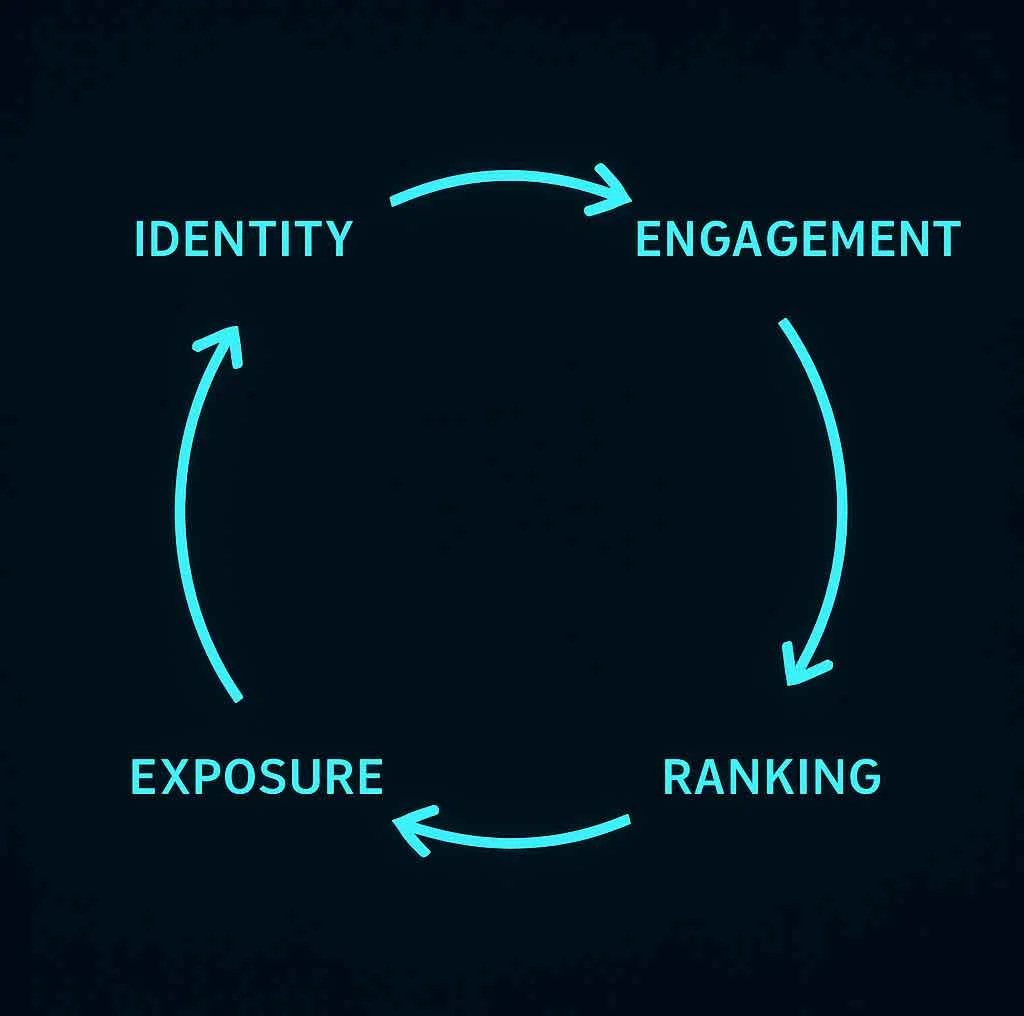
When identity presentation increases these signals, algorithms adjust exposure probability.
Identity that generates engagement receives greater distribution.
Distribution reinforces recognition.
Recognition increases engagement likelihood.
The cycle compounds.
This mechanism reflects engagement-weighted visibility systems where performance influences future reach. Identity presentation becomes part of measurable signal input.
The algorithm does not interpret personality.
It interprets probability.
Probability shapes distribution.
Performance-Based Identity
In digital ecosystems, identity often becomes partially performance-based.
Performance metrics include:
- Engagement ratio
- Audience growth velocity
- Interaction depth
- Retention duration
- Conversion probability
If certain identity traits correlate with engagement, those traits are amplified.
Amplification increases exposure.
Exposure increases adoption of similar presentation styles.
Over time, patterns converge.
Convergence reduces diversity of visible identity styles.
Identity becomes optimized within algorithmic constraints.
Attention Scarcity and Identity Competition
Digital reach is constrained by finite attention.
If attention is limited, visibility must be allocated selectively.
Algorithms allocate selectively based on predicted engagement.
This allocation reflects the scarcity of digital attention that governs platform distribution. Identity presentation competes for engagement probability under constrained visibility.
Competition intensifies optimization behavior.
Optimization shapes identity formatting.
Formatting influences engagement.
Engagement influences reach.
Algorithmic Filtering Layers
Identity does not appear to all users equally.
Filtering layers include:
- Recommendation algorithms
- Follower feed ranking
- Search result positioning
- Trending classification
- Category tagging
Each filter assesses probability.
If identity presentation aligns with high-engagement patterns, exposure expands.
If alignment weakens, exposure contracts.
Exposure fluctuation influences perceived relevance.
Relevance perception influences audience growth trajectory.
Identity therefore exists inside filtering architecture.
Consistency as Signal Stability
Algorithms favor predictable engagement patterns.
Consistent posting frequency stabilizes signal.
Consistent tone stabilizes audience expectation.
Stable expectation improves interaction predictability.
Predictability improves ranking confidence.
Confidence increases exposure allocation.
Inconsistent identity signals introduce uncertainty.
Uncertainty reduces prediction accuracy.
Reduced prediction accuracy lowers distribution priority.
Consistency becomes strategic.
Identity Optimization Behavior
Participants adapt when they observe:
- Certain formats outperform
- Specific aesthetics attract engagement
- Particular topics generate higher interaction
Adaptation produces strategic identity shaping.
Shaping increases engagement probability.
Probability improves reach.
Reach reinforces identity style.
Style becomes recognizable.
Recognition strengthens engagement.
The loop compounds.
This adaptation resembles behavioral reinforcement loops observed in subscription systems. Repeated engagement strengthens predictability.
Predictability strengthens distribution.
Distribution strengthens identity amplification.
Identity as Economic Asset
In digital ecosystems, identity is not only expressive.
It is economically instrumental.
When engagement metrics increase reach, reach increases monetization potential.
Monetization may include:
- Advertising revenue
- Subscription tiers
- Sponsored placement
- Affiliate partnerships
- Product launches
- Consulting or service opportunities
Reach becomes leverage.
Leverage converts identity into asset.
Asset value depends on:
- Audience size
- Engagement density
- Conversion probability
- Trust perception
If identity presentation improves these variables, economic return increases.
Monetization Layers and Brand Stability
Personal branding operates within layered monetization systems.
Examples include:
- Creator subscription platforms
- Ad revenue sharing programs
- Sponsored content partnerships
- Premium community access
- Paid digital products
When identity generates predictable engagement, monetization stabilizes.
Stable monetization reduces volatility.
Reduced volatility increases strategic planning capacity.
Strategic planning strengthens brand continuity.
Continuity reinforces recognition.
Recognition improves engagement probability.
The loop compounds.
Many creator models operate within subscription retention architecture where identity consistency sustains recurring revenue. Brand predictability supports long-term monetization.
Identity becomes economically structured.
Visibility Amplification and Paid Promotion
Personal branding does not rely solely on organic reach.
Platforms often provide amplification tools:
- Sponsored posts
- Boosted visibility
- Paid discovery
- Algorithmic promotion packages
When identity interacts with paid amplification, reach becomes partially purchasable.
This reflects digital marketplace concentration dynamics where visibility clusters around high-performing or well-funded nodes. Paid amplification can accelerate identity growth when engagement signals remain strong.
Amplification increases exposure.
Exposure increases follower acquisition.
Follower acquisition increases social proof.
Social proof increases engagement probability.
The compounding effect strengthens brand authority.
Identity Clustering and Hierarchy
Not all personal brands achieve equal reach.
Engagement-weighted systems create tiered distribution:
- Top-tier high-visibility profiles
- Mid-tier competitive profiles
- Entry-level emerging profiles
Tier formation emerges through:
- Engagement compounding
- Review or comment volume
- Follower growth velocity
- Algorithmic confidence
This tiered pattern mirrors digital hierarchy formation observed in ranking systems. Identity becomes partially stratified by engagement performance.
Stratification does not eliminate upward mobility.
However, compounding advantages make mobility statistically uneven.
Hierarchy influences perception.
Perception influences future engagement.
Engagement reinforces hierarchy.
Data-Driven Persona Modeling
Platforms collect behavioral data at scale.
Data includes:
- Audience interaction patterns
- Content preference clusters
- Viewing duration
- Conversion behavior
- Demographic signals
This data allows platforms to model persona compatibility.
If identity presentation aligns with audience clusters likely to engage, distribution increases.
Alignment improves engagement probability.
Probability strengthens algorithmic confidence.
Confidence expands reach.
Persona modeling therefore shapes exposure.
Identity optimization often adapts to these data-driven signals.
Consistency vs Authenticity Tension
In algorithmic systems, consistency improves predictability.
Predictability improves reach.
However, excessive optimization may reduce perceived authenticity.
If identity becomes overly performance-driven, audience trust may weaken.
Trust decline reduces engagement.
Engagement decline lowers exposure.
Exposure contraction reduces reach.
Personal branding sustainability depends on balancing:
- Optimization efficiency
- Authentic expression
- Audience trust
The tension between consistency and authenticity becomes structural rather than purely creative.
Persona Fatigue and Audience Saturation
As identity becomes performance-optimized, patterns begin to converge.
Similar visual styles.
Similar tone structures.
Similar content pacing.
Similar engagement hooks.
Optimization improves predictability.
Predictability increases reach.
But excessive convergence can reduce differentiation.
When many identities optimize around the same engagement signals, audience fatigue may emerge.
Fatigue reduces:
- Interaction depth
- Comment frequency
- Share probability
- Return engagement
Reduced engagement weakens ranking confidence.
Confidence decline reduces exposure.
Exposure contraction pressures further optimization.
Optimization cycles intensify.
Intensification increases performance pressure.
Network Effects in Creator Ecosystems
Personal branding does not operate in isolation.
Creators exist within interconnected networks:
- Collaborative content
- Shared audiences
- Cross-promotion
- Platform algorithms linking similar profiles
Network effects amplify identity reach.
If a high-visibility profile collaborates with emerging profiles, exposure transfers.
Transferred exposure increases engagement probability.
Increased engagement strengthens ranking signals.
Signals expand distribution further.
However, network effects also cluster visibility.
High-tier profiles frequently collaborate with similar-tier profiles.
Clustering reinforces hierarchy.
Hierarchy reduces equal opportunity perception.
This clustering mirrors marketplace concentration patterns observed in digital commerce systems. Network alignment strengthens exposure loops.
Identity networks therefore contribute to reach stratification.
Platform Dependency Risk
Personal branding growth often depends heavily on a specific platform.
Platform dependency includes:
- Algorithmic distribution
- Monetization infrastructure
- Audience accessibility
- Analytics tools
- Paid amplification systems
If algorithm adjustments alter exposure probability, identity reach may fluctuate rapidly.
Dependency increases vulnerability.
Vulnerability encourages multi-platform diversification.
Diversification distributes risk.
However, managing multiple platforms increases complexity.
Complexity may reduce content quality consistency.
Consistency reduction may affect engagement predictability.
Predictability influences reach stability.
Dependency therefore remains a structural factor.
Structural Limits of Identity Optimization
Identity optimization cannot exceed certain limits.
Constraints include:
- Attention capacity of audience
- Algorithmic saturation thresholds
- Content supply competition
- Cognitive overload
- Trust boundaries
Even highly optimized identity cannot capture unlimited reach.
Attention remains finite.
Finite attention requires allocation.
Allocation is probability-based.
Probability-based allocation inherently limits universal visibility.
This structural constraint explains why personal branding systems naturally stratify.
Stratification emerges from scarcity, not necessarily exclusion.
Authenticity as Stability Variable
Over-optimization may increase short-term reach.
However, long-term sustainability requires audience trust.
Trust is influenced by:
- Message consistency
- Transparent monetization
- Value delivery alignment
- Behavioral reliability
Trust strengthens retention.
Retention stabilizes engagement.
Engagement stabilizes ranking confidence.
Confidence sustains reach.
Identity sustainability depends on balancing:
- Engagement optimization
- Economic incentives
- Audience perception
This balance resembles retention equilibrium in subscription ecosystems.
This balance reflects retention equilibrium models observed in subscription systems. Stability requires alignment between value delivery and incentive design.
Identity durability depends on equilibrium, not intensity.
Data Feedback and Identity Refinement
Behavioral data continuously informs identity refinement.
Creators observe:
- Engagement rate changes
- Audience growth velocity
- Content retention patterns
- Conversion response
Data guides adjustment.
Adjustment improves engagement.
Engagement strengthens exposure.
Exposure generates more data.
The loop accelerates.
However, over-reliance on short-term data may encourage reactive optimization.
Reactive optimization may reduce long-term narrative coherence.
Coherence supports trust.
Trust supports sustainable engagement.
Balance remains necessary.
Long-Term Identity Equilibrium

Personal branding systems rarely stabilize at equal distribution.
They tend toward structured hierarchy with dynamic mobility.
In mature digital ecosystems, identity tiers often resemble:
- High-visibility dominant profiles
- Mid-tier competitive identities
- Entry-level emerging participants
Upward mobility remains possible.
However, mobility probability is influenced by:
- Engagement velocity
- Network positioning
- Monetization reinvestment
- Platform algorithm adjustments
Stability emerges when:
- Audience engagement remains consistent
- Trust remains intact
- Monetization aligns with value
- Algorithmic confidence remains high
Instability appears when:
- Engagement declines
- Identity over-optimizes for metrics
- Trust erodes
- Platform policies shift
Equilibrium is dynamic.
It evolves with algorithm updates and audience expectations.
Monetization Sustainability in Identity Systems
Monetization tied to identity requires careful pacing.
Revenue streams may include:
- Sponsored content
- Subscription communities
- Affiliate links
- Premium services
- Brand partnerships
If monetization density exceeds audience tolerance, engagement declines.
Decline reduces exposure.
Exposure contraction reduces monetization.
Sustainable identity monetization balances:
- Value delivery
- Transparency
- Frequency
- Audience trust
Revenue alignment must reinforce, not distort, identity credibility.
Identity as Strategic Asset in Platform Economies
In digital ecosystems, identity operates as:
- Visibility signal
- Engagement generator
- Trust indicator
- Conversion catalyst
- Network connector
Identity presentation interacts with ranking systems.
Ranking systems allocate exposure based on probability.
Exposure increases recognition.
Recognition strengthens engagement.
Engagement reinforces ranking.
This loop connects identity to algorithmic structure.
Identity growth therefore depends on probability-based exposure allocation within algorithmic systems. Identity becomes partially structured by measurable performance.
Performance-based reach does not eliminate creativity.
It contextualizes it.
Creativity operates within filtering constraints.
Identity Under Scarcity
Across digital ecosystems, several consistent principles emerge:
- Attention is finite.
- Ranking is probabilistic.
- Engagement predicts exposure.
- Exposure compounds advantage.
- Monetization aligns with reach.
- Data informs refinement.
When identity interacts with these principles, personal branding becomes partially performance-shaped.
This does not imply artificiality.
It reflects environmental structure.
Identity adapts to incentive systems.
Incentive systems adapt to revenue objectives.
Revenue objectives respond to attention scarcity.
Scarcity shapes allocation.
Allocation shapes hierarchy.
Hierarchy influences opportunity.
Conclusion
Personal branding in digital ecosystems is not purely self-expression.
It is partially shaped by:
- Engagement-weighted ranking
- Attention scarcity
- Network clustering
- Monetization incentives
- Data-driven refinement
Identity becomes both expressive and probabilistic.
Reach is influenced by presentation.
Presentation influences engagement.
Engagement influences distribution.
Distribution influences opportunity.
Opportunity compounds.
Understanding this structure clarifies why identity visibility often appears performance-driven.
It is embedded within algorithmic filtering systems that reward predictability under scarcity.
Personal branding therefore operates at the intersection of:
- Creativity
- Probability
- Economics
- Platform design
Reach is not random.
It is structurally mediated.
FAQs
How does personal branding affect digital reach?
Personal branding influences engagement metrics such as click-through rate, retention, and interaction depth. Engagement-weighted ranking systems then adjust exposure probability based on these signals.
Is digital reach purely based on creativity?
Digital reach is influenced by creativity but also shaped by algorithmic filtering systems that prioritize predictable engagement under finite attention constraints.
Why do some personal brands grow faster than others?
Growth velocity often depends on engagement compounding, network positioning, and alignment with algorithmic ranking signals that allocate visibility probabilistically.
Can algorithm changes affect personal branding reach?
Yes. Algorithm updates may alter exposure probability, which can increase or reduce reach depending on how identity presentation aligns with revised engagement weighting models.