For hot wings in Washington, D.C., start with a nearby restaurant that matches the way you want the chicken cooked: Nando’s for flame-grilled PERi-PERi, DCity Smokehouse for pit-smoked wings, or Ledo Pizza H Street for a pizza-and-wings order. Check the exact branch and current menu before paying, because heat options, availability and delivery coverage can differ. This guide covers the District of Columbia, not Washington state.
The most useful choice is the one that gets you the right style, manageable heat and a sensible handoff time. A famous name cannot tell you whether a long delivery will suit your preference for crisp skin. The shortlist below is based on official restaurant information, not a tasting visit or a ranked “best wings” test.
Where should you start looking for wings in Washington, D.C.?
| Starting point | D.C. address | Why consider it |
|---|---|---|
| Nando’s Penn Quarter | 836 F Street NW | Flame-grilled PERi-PERi chicken; check the selected branch’s current wing options and heat choices. |
| DCity Smokehouse | 203 Florida Avenue NW | Pit-smoked wings for readers who want smoke flavor; confirm the sauce, portion and pickup availability. |
| Ledo Pizza H Street | 814 H Street NE | Wings alongside pizza, useful for a mixed group order; confirm the local menu’s available flavors. |
These are three starting points, not a complete directory of D.C. wing restaurants. Their official pages identify the branches and wing offerings, but a listing is not a live stock check. Use the selected branch’s checkout for the final price, service method and available collection time.
Confirm the branch before opening the cart
D.C. street quadrants are part of the address, so “H Street” alone is not enough information. A search for Washington can also return businesses in the state or suburbs outside the District. That mismatch can turn a convenient order into an impractical journey.
Begin with your actual destination rather than a broad city search. Compare the restaurant address on its own site with the branch shown in the ordering service. If the two disagree, resolve the branch first instead of assuming that a familiar restaurant name means the same kitchen.
For example, the H Street Ledo branch in this shortlist is at 814 H Street NE. Keep the NE in your directions and check that your cart still shows that location. A map pin alone is a weak checkpoint if you have several restaurant tabs open.
- Open the official branch page and check “Washington, DC.”
- Match the street number, street name and NW, NE, SW or SE quadrant.
- Select pickup or enter the complete delivery address, then confirm the branch again in the cart.

Which wing style and heat level will suit your order?
Choose the texture you actually want
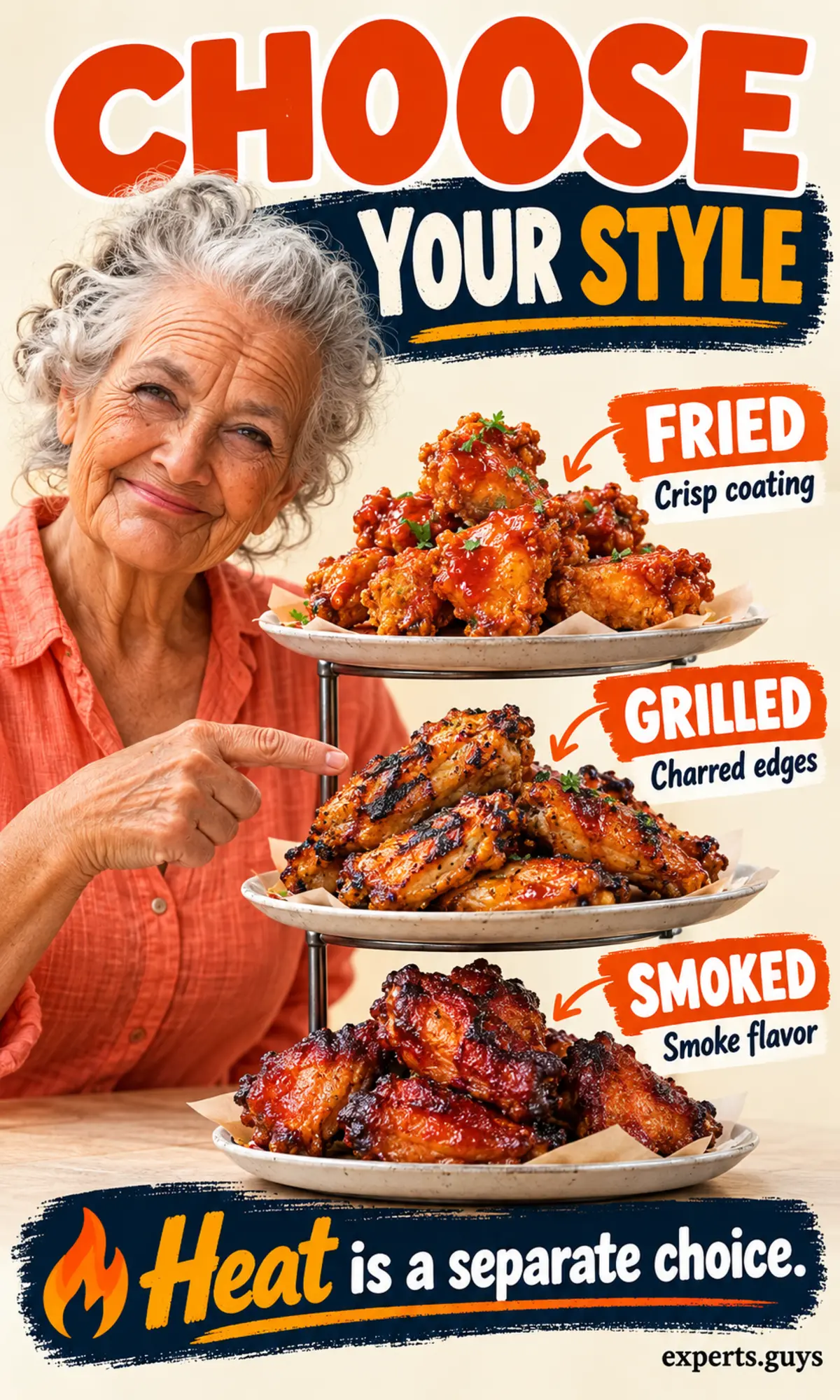
Fried, grilled and smoked describe cooking approaches; hot describes seasoning. A smoked wing can be mild, and a grilled wing can carry substantial heat. Choose the cooking style first so you do not mistake a sauce name for a promise of crunch.
If a crisp coating is the main attraction, look for a fried option and favor eating it soon after preparation. Grilled wings emphasize browned edges and char, while smoked wings put smoke flavor at the center of the choice. Smoked wings may also be finished with another cooking method, so ask how they are served if skin texture matters to you.
- Want a crisp coating? Check whether the wings are fried and whether they are breaded.
- Want charred edges? Look for flame-grilled wings rather than assuming all hot wings are fried.
- Want smoke flavor? Choose a stated smoked-wing option and ask about its finish.
Choose heat without gambling on the whole order
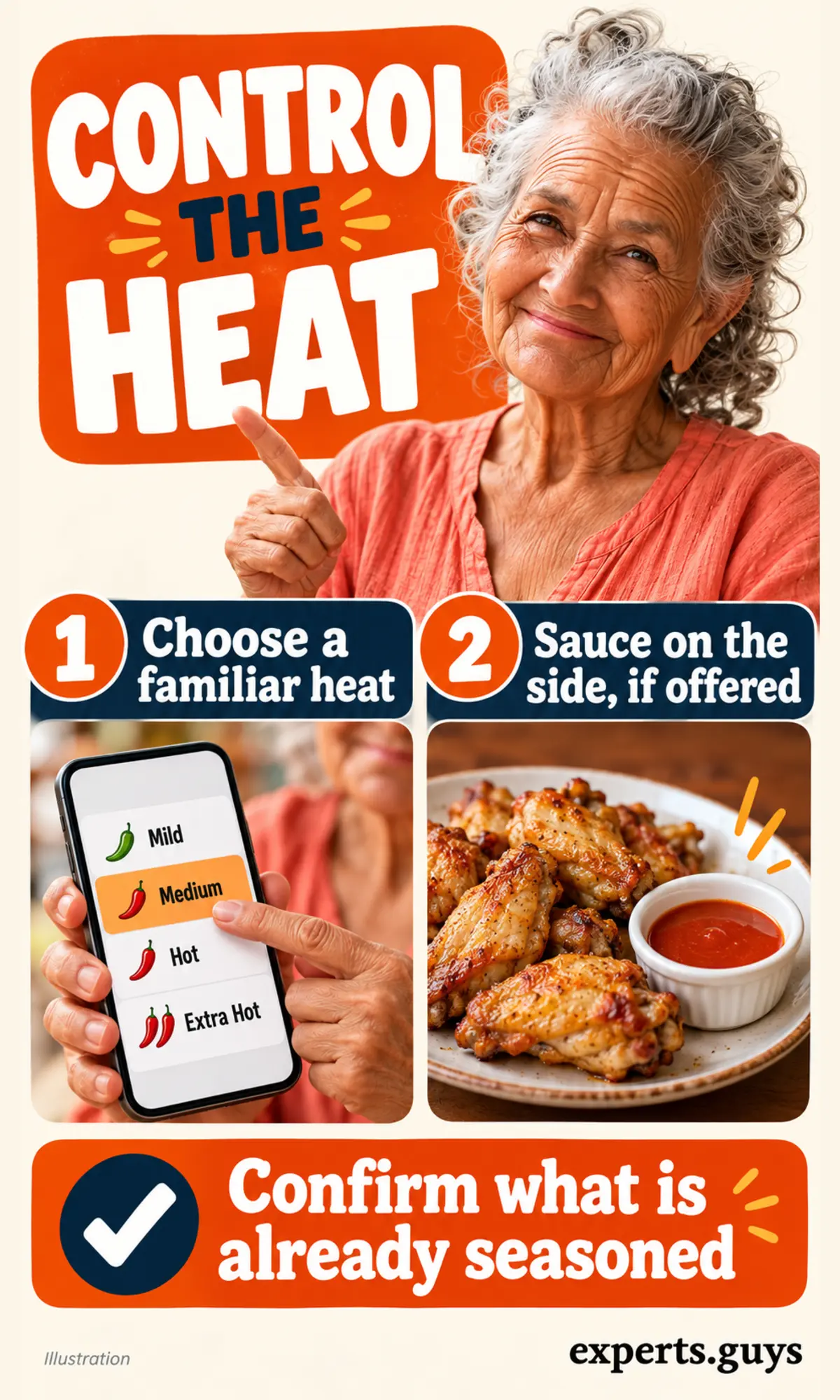
Heat labels are restaurant-specific, so medium at one kitchen does not establish what medium means at another. Sauce on the side can give you more control when it is offered, but it cannot remove spice already in a marinade or dry seasoning. For a first order, use a familiar option or ask which available flavor is gentler.
A useful request is: “Which wing option has the least heat before sauce, and can the hot sauce come separately?” For a group, ask whether separate flavors require separate orders or whether a split is available. Confirm the answer before checkout; a free-text note does not guarantee that the kitchen can change the dish.
Resolve dietary requirements before checkout
A plain-looking wing does not reveal everything in its coating, seasoning or preparation. Sauces and dips can introduce ingredients absent from the chicken itself, and shared equipment can matter for an allergy. Do not treat “unbreaded,” “grilled” or “sauce on the side” as confirmation that an order meets a dietary requirement.
- Name the specific allergen or dietary requirement when you contact the branch.
- Ask about the chicken’s coating or marinade, the chosen sauce and the dip.
- Ask whether the fryer or preparation equipment is shared, and whether the kitchen can meet your requirement.
- If staff cannot confirm, choose an option or restaurant that can; do not rely on an unanswered order note.
Try this direct script: “I need to avoid [ingredient]. Can you check the wings, sauce, dip and shared equipment before I order?” If halal suitability is required, ask the selected branch about its current product and preparation arrangements separately. A brand’s menu or certification in another country is not confirmation for a D.C. order.

How do you compare value without buying the wrong meal?
Compare the meal total, not the advertised wing price
Use the final payable total for the same kind of order: equivalent pieces, sides, sauces and service method. Delivery charges, service fees, tax and any chosen tip can change which cart costs less. A larger bundle is not better value if much of it will go uneaten.
| Check | Why it changes the comparison | Useful question |
|---|---|---|
| Piece definition | A whole wing and a split flat or drumette are not the same unit. | What does one “wing” mean on this menu? |
| Included food | One offer may include sides and dips while another does not. | What will I actually receive? |
| Final total | The menu price may omit charges added at checkout. | What is the total for the same service method? |
| Party fit | A discounted large order can oversupply a small group. | How much will this group realistically eat? |
For an illustrative comparison, 12 equivalent pieces at a $24 final total cost $2 per piece. An 18-piece order at a $45 final total costs $2.50 per piece. These are invented arithmetic examples, not restaurant prices, and they stop being comparable if the piece sizes or included food differ.
Open both carts on your phone and compare their final totals before placing either order. If one is a whole-wing order and the other uses split pieces, compare the meal as a whole rather than trusting the division. When portion information is unclear, a smaller first order is a more useful trial than a large speculative purchase.

Will pickup or delivery give you the result you want?
Choose pickup or delivery around your route
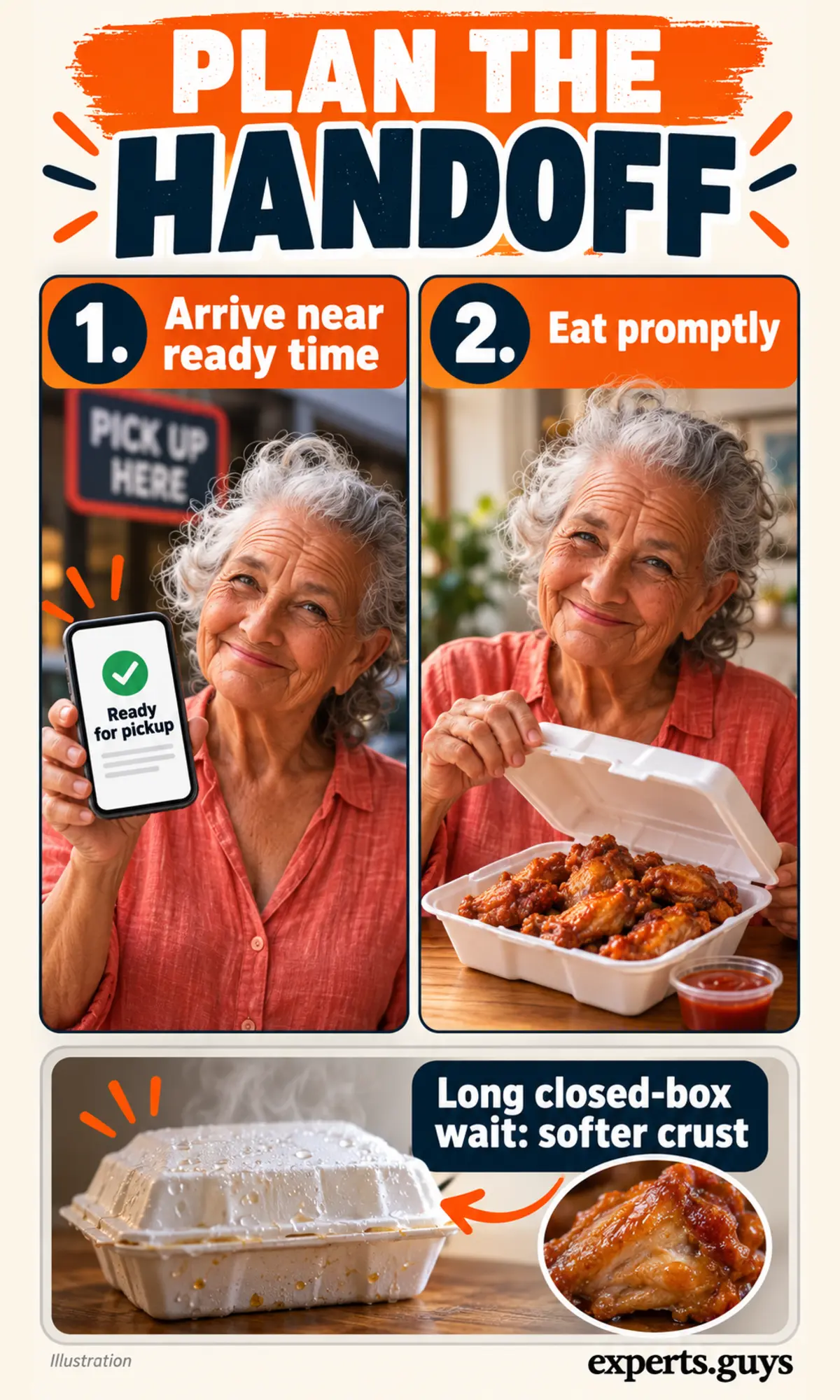
A crisp fried surface can soften as it sits with moisture in a closed container. Sauce also wets that surface, so a longer boxed wait can change the texture even when the flavor is still appealing. If crunch is your priority, eating at the restaurant or arranging a short pickup journey is often the more controllable choice.
Compare the restaurant’s ready time with the time you can actually arrive. A short drive does not help much if the order waits while you finish another errand. When pickup is impractical, choose delivery with realistic texture expectations and request separate sauce only if that option is available.
- Choose a pickup time you can meet and follow the order’s readiness message.
- Keep the journey focused on getting the food to the place where you will eat.
- Open the container when you are ready to eat and serve promptly; do not leave it sitting open to cool.
Check the handoff and protect the leftovers
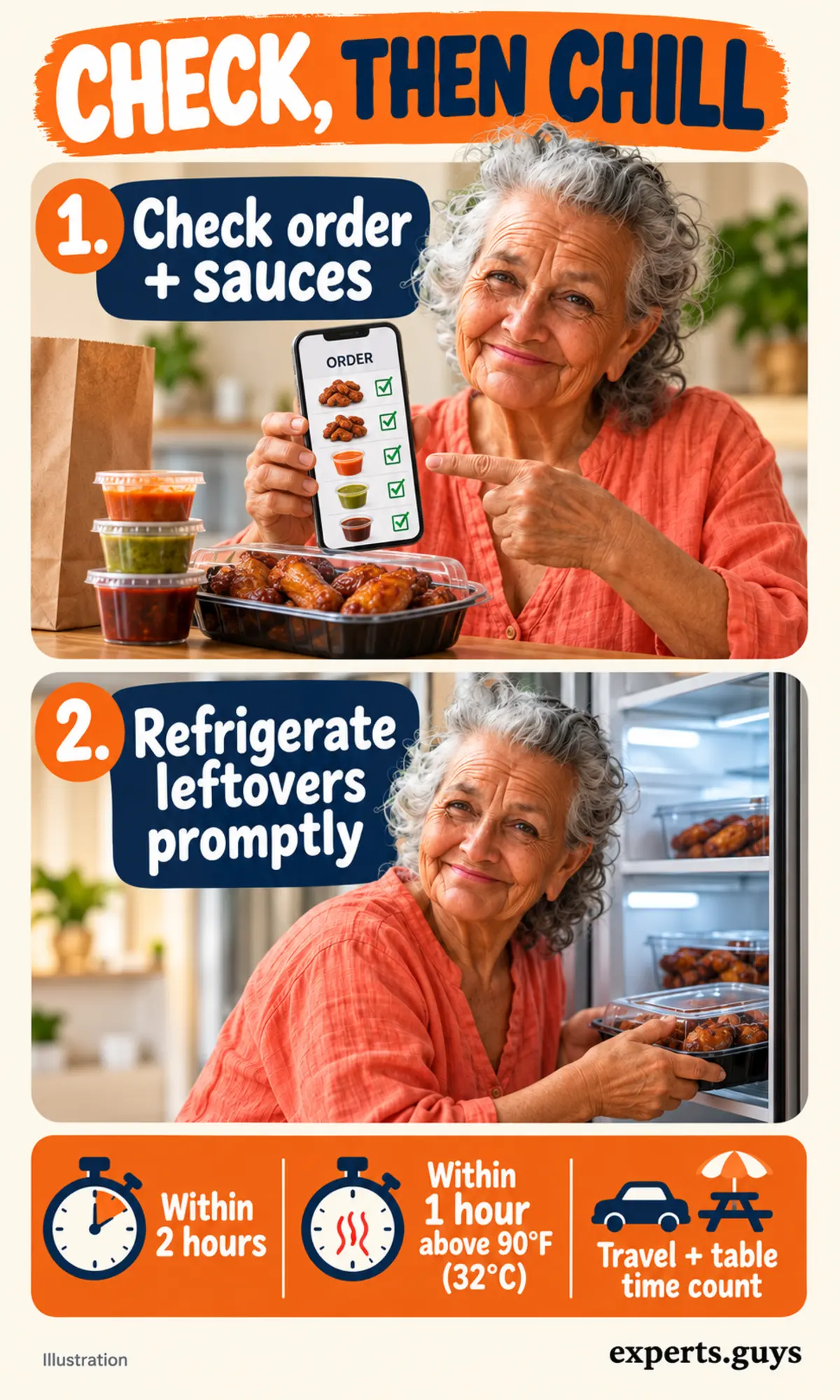
Before leaving the pickup point, compare the order labels with your phone receipt and check that the expected sauces are included. You do not need to unwrap everyone’s meal to catch an obvious missing container. If something is wrong, ask the restaurant to resolve it while the order details are still easy to verify.
- For delivery, photograph a missing or incorrect item and report it through the ordering channel.
- Keep any allergy-related order separate and confirm its label before serving.
- Set aside only the amount you intend to eat; refrigerate the remainder promptly in shallow containers.
Follow the USDA guidance for takeout food: refrigerate perishable food within two hours, or within one hour when the air temperature is above 90°F (about 32°C). Count travel and table time together rather than restarting the clock when you arrive home. Discard food that has exceeded those limits; its smell or appearance cannot establish safety.
Judge the order against your original priorities: correct style, tolerable heat, complete contents and a practical total. If the only disappointment was a soft crust after a long trip, change the handoff next time before concluding that every wing from that kitchen will disappoint. If the cooking style itself was wrong for you, switch styles rather than simply choosing a hotter sauce.
Frequently asked questions
Are these recommendations for Washington state?
No. This shortlist covers Washington, D.C., with addresses in the District. A Washington state search needs its own city-specific restaurant checks rather than these D.C. branches.
Can I order only flats or only drumettes?
Only if the selected restaurant offers or confirms that request. A menu listing for mixed wings does not promise a particular split, and availability can change. Check any surcharge before paying.
Is there a verified cheapest wing restaurant in this guide?
No. Final costs depend on the selected branch, portion, ordering channel and current charges. The arithmetic example teaches a comparison method and is not a live price ranking.
Can I trust a secret-menu suggestion from an old article?
Treat it as unconfirmed until the selected branch says it is available. Descriptions from another country, another restaurant or an old promotion are not current menu evidence. Start with an item the branch actually offers.
Your next order
Choose one nearby branch, decide which cooking style you want, and check the actual cart total. Resolve heat or dietary questions before paying, then match pickup or delivery to when you will eat. That produces a more useful first order than chasing a universal “best” label.
For the broader relationship between texture and meal enjoyment, read why food texture matters more than flavor. Keep that topic separate from choosing a D.C. restaurant. This page focuses on the ordering decision rather than repeating a home-frying recipe.