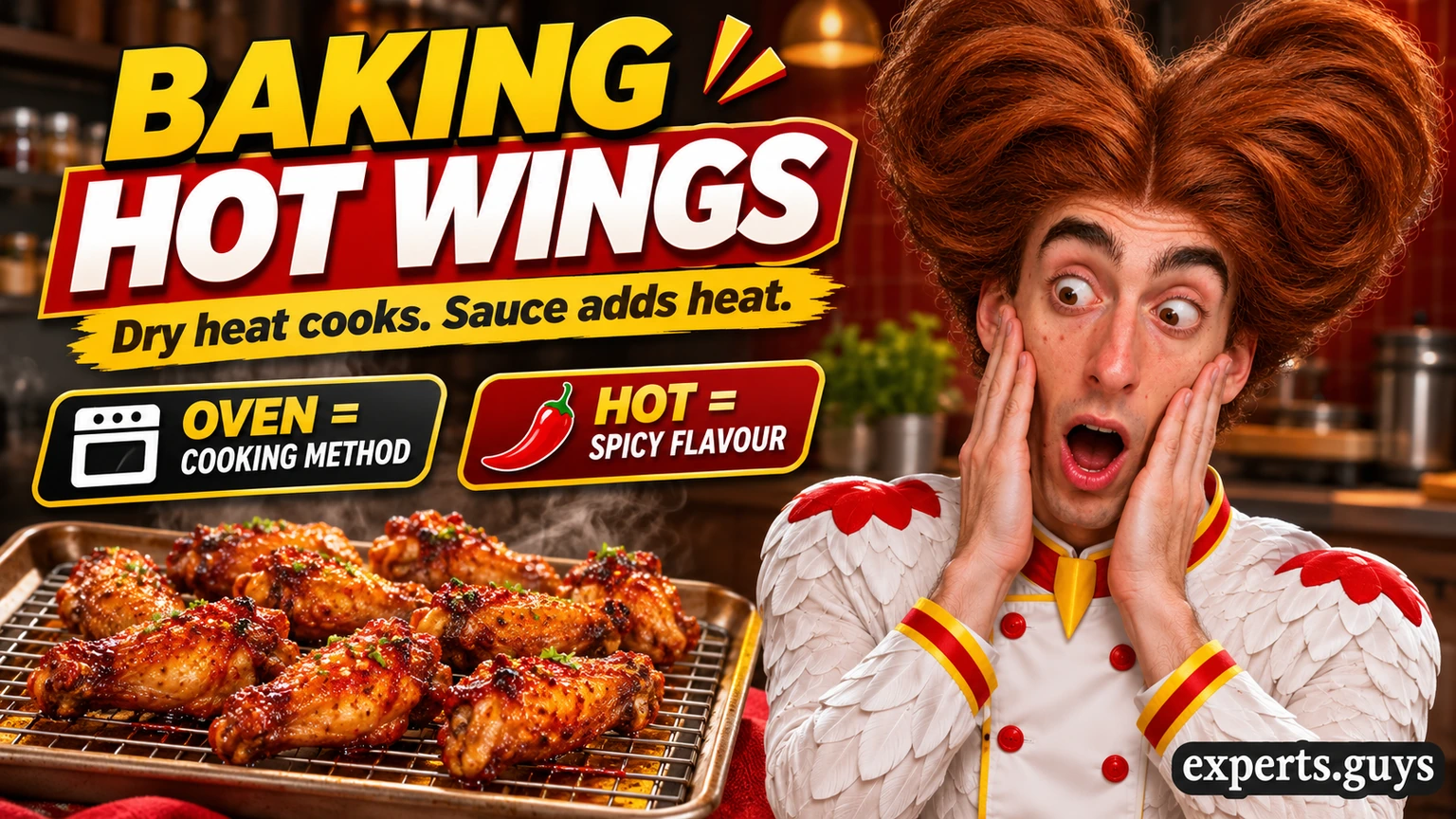
Baking hot wings means cooking chicken wings with the dry heat of an oven, then giving them a spicy seasoning or sauce. The word “baked” describes the cooking method, while “hot” usually describes the flavour; neither word promises crisp skin or confirms that the meat is safely cooked. The useful distinction is whether the wings cook exposed to oven heat, sit in liquid, or receive their coating after cooking.
Does baking mean the same thing as roasting hot wings?
For chicken wings, baking and roasting usually describe the same broad arrangement: chicken cooks in an oven without being submerged in a cooking liquid. Recipe writers may prefer “roasted” when they want to emphasise browned meat and “baked” when they want to emphasise the oven method. Those naming habits are less useful than the actual instructions about liquid, covering and the intended finish.
There is no dependable universal temperature boundary that turns a baked wing into a roasted one. A recipe title cannot tell you whether its method is gentle, intense, brief or prolonged. Look at its oven setting and sequence rather than trying to convert the verb into a temperature. A change in vocabulary does not justify changing the recipe’s heat.
The USDA meat and poultry cooking glossary groups baked and roasted foods together as uncovered oven cooking without added liquid. That is a useful working definition for this particular dish, although cooking terminology varies between books. It explains why two recipes can use different names for essentially the same heat arrangement.
An oven is a location, not a complete description
An uncovered tray of wings, a lidded casserole containing stock and a pan of fully cooked wings warming in sauce can all occupy the same oven. They do not produce the same surface conditions. In the first, the skin is exposed to heat and moisture can escape; in the second, the liquid and enclosed humid space favour a moist result. In the third, the oven may mainly be reheating food rather than cooking raw poultry.
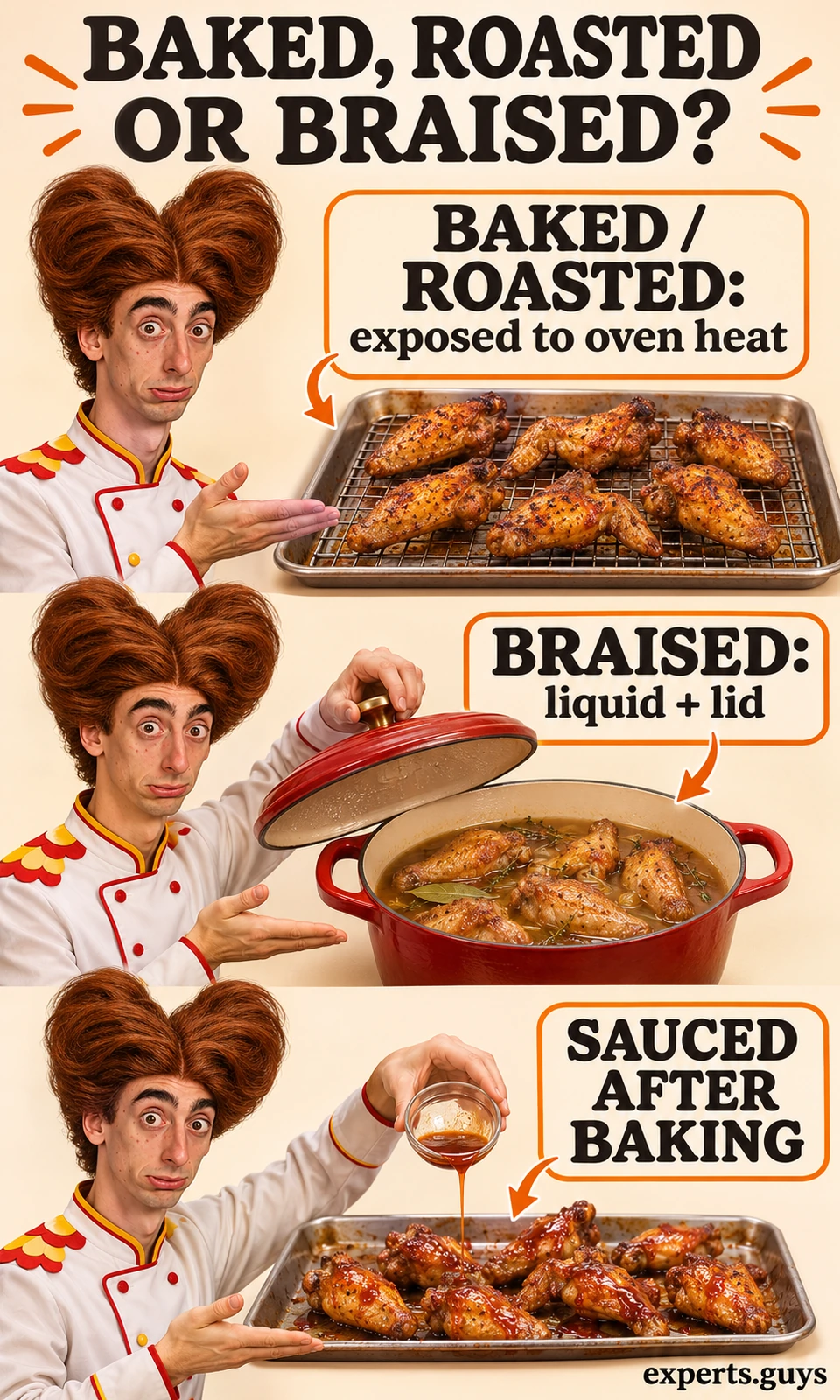
“Oven-baked” is therefore an incomplete promise when your real concern is crunch. Wings can be baked in a sauce-filled dish and emerge tender with soft skin. They can also be baked uncovered and coated afterward. Both may be called baked wings in everyday recipe language, but the reader should expect different eating experiences.
| Description | What to inspect | What it does not prove |
|---|---|---|
| Baked or roasted | Oven cooking; examine the liquid and covering instructions. | Crisp skin, a fixed time or a particular heat level. |
| Braised | A cooking liquid and usually a covered, moist environment. | The same finish as exposed, dry-skinned wings. |
| Dry-rubbed | Dry seasoning rather than a poured coating. | Whether the wings were baked, grilled or fried. |
| Buffalo-style | The sauce ingredients and the stated cooking method. | Deep frying or one standard recipe. |
A dry rub does not make a wing baked
A dry rub identifies a seasoning format: spices and other dry ingredients rather than a poured sauce. A dry-rubbed wing can be baked, grilled or fried. Equally, a baked wing can carry a dry seasoning, a thin hot-sauce coating or a sticky glaze. Treat the seasoning and cooking method as separate choices until the recipe brings them together.
Buffalo-style generally points to a hot-sauce-based finish, often combined with butter. It does not prove that the wings were deep-fried, that the sauce contains a particular chilli, or that every restaurant makes it the same way. Ask how the wings are cooked if the method matters to you; ask about the actual sauce if heat level or ingredients matter.
For choosing between equipment rather than interpreting a recipe title, the comparison of wing cooking methods covers the different jobs of an oven, air fryer, fryer and grill. Here, the useful conclusion is narrower: identify what surrounds the chicken during cooking before predicting its texture.
What does dry oven heat actually do to a wing?
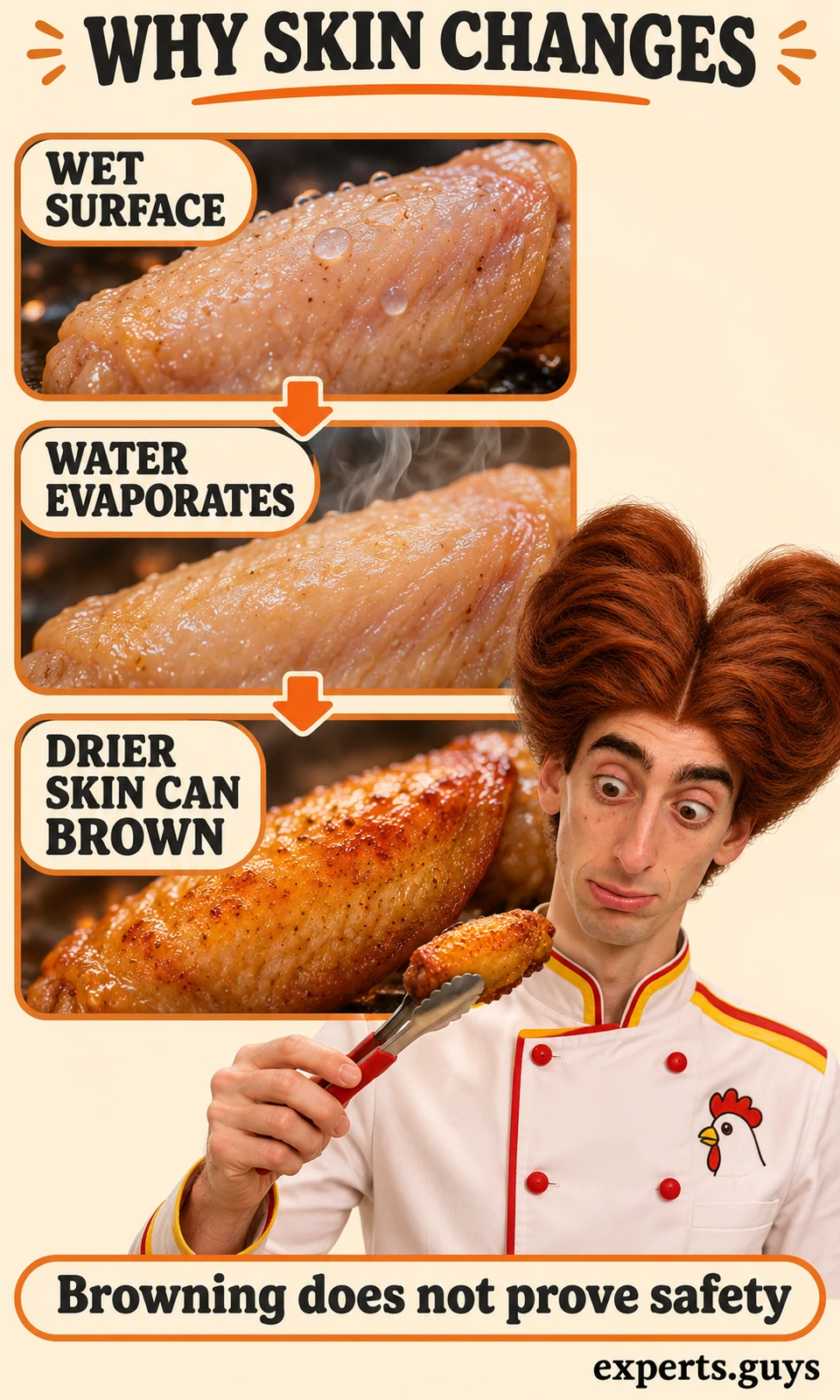
Oven heat warms the chicken, changes its proteins and encourages exposed surfaces to lose moisture. As the skin becomes drier, it can brown and become more brittle, while some fat renders out. Those processes interact, but they do not finish at one shared moment: meat temperature, skin texture and surface colour are separate outcomes.
Hot air is only part of the explanation
An oven transfers heat through moving hot air, radiation from hot surfaces and heating elements, and contact wherever the food meets hot metal. A fan changes air movement; a different tray changes contact; moving nearer an element changes radiant exposure. This is why an oven setting alone cannot fully describe how a particular wing surface is being heated.
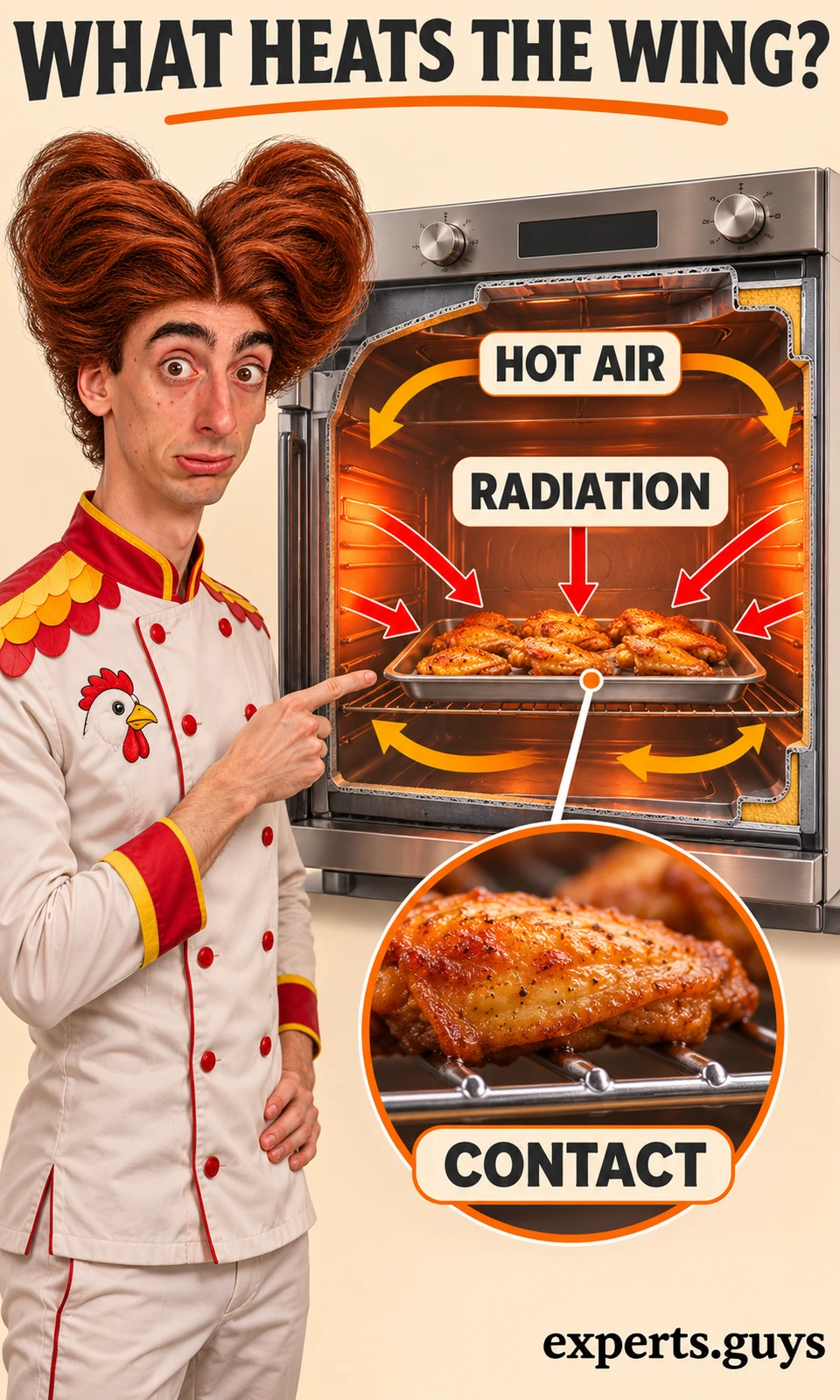
The air temperature shown on the control is not the temperature inside the meat. The exterior receives heat first, and heat then travels inward through the food. A thick drumette can lag behind a small flat even when both sit on the same tray. The relevant safety measurement belongs in the flesh, not beside the tray or against the oven wall.
A wire rack reduces broad contact with the pan and lets drippings fall below the chicken. It still makes small contact points, and it does not turn the oven into a perfectly even heat chamber. A wing resting directly on metal has a different underside from one supported above it. Neither arrangement can be evaluated just by looking at the top surface in a recipe photograph.
Dry heat does not mean an oven contains no moisture
Chicken releases water while it cooks. Calling baking a dry-heat method means water or steam is not the intended cooking medium in the way it is for simmering or steaming. It does not mean the food is water-free, that all steam instantly disappears, or that the flesh should become dry before the wings are ready.
Evaporation uses heat. When the surface is wet, some incoming energy goes into turning that water into vapour instead of driving the surface toward stronger browning. A drier exterior can brown more readily, but the desirable result is a changed surface around cooked meat, not a wing dehydrated throughout. “Dry the skin” and “dry out the meat” describe very different goals.
Water can also collect beneath chicken or remain trapped where pieces touch. That makes the local conditions different from those around an exposed edge. A pale underside therefore does not automatically mean the oven was too cool; it may have experienced more moisture or less exposed surface. Understanding the location of the problem is more informative than assigning one verdict to the entire tray.
Brown, crisp and cooked are different descriptions
Brown describes appearance. Crisp describes how a surface fractures when bitten. Cooked describes changes in the food, while safely cooked requires an appropriate internal temperature. A sweet or heavily seasoned surface can darken while thicker meat still needs cooking; a safely cooked wing can retain soft skin. One description should not silently stand in for the others.
Browning develops through several reactions, including reactions involving proteins and sugars. A recipe’s sugar content, seasoning and surface moisture all affect what you see. Darker is not always better, and blackened spots can be burnt flavour rather than extra crispness. A glossy orange coating can also hide the texture underneath, so a sauced photograph is weak evidence of a crisp original skin.
The sensation of crispness involves more than a brown colour: the surface must fracture rather than simply bend. The separate explanation of why crispy food feels satisfying develops that eating experience. Here, the useful boundary is that an oven can create the conditions for a crisp surface without guaranteeing that every baked dish will have one.
How can you tell what a hot-wing recipe will produce?
Read the ingredients and sequence before judging the title or finished photograph. The most revealing details are the starting product, whether the cooking environment is exposed or liquid-filled, and when wet sauce enters the process. Together, those details tell you more than the words “easy”, “crispy” or “oven-fried”.
Sauce timing changes the promise
When a thin sauce goes onto already cooked wings, it changes the outer coating after the main heating stage. The surface may remain crisp briefly, soften quickly, or become deliberately sticky depending on the sauce and amount. A later coating cannot guarantee lasting crunch, but it avoids asking a wet exterior to remain dry throughout the entire cook.
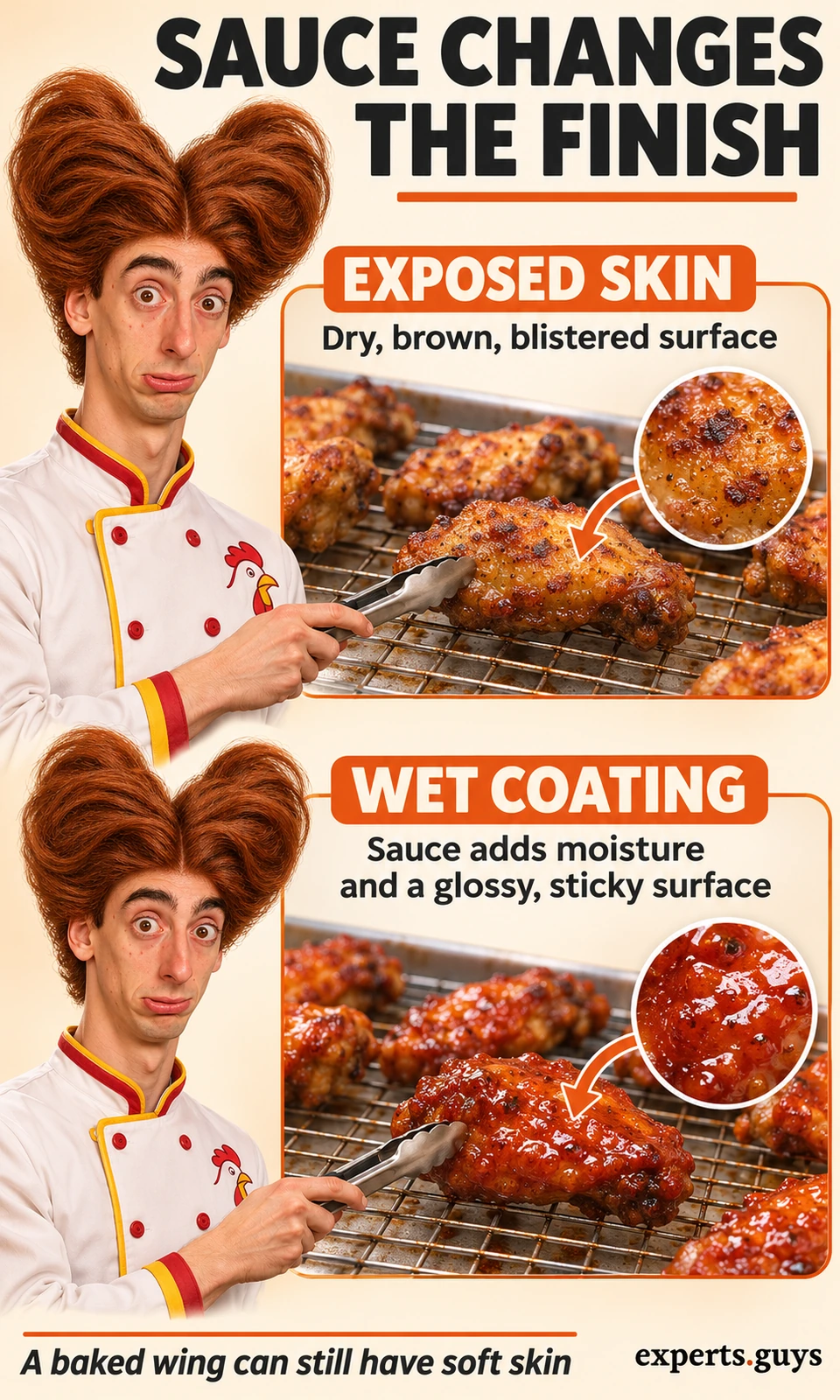
When the wings cook in a substantial quantity of sauce, the recipe has a different job. It may aim for tender chicken and a reduced coating rather than brittle skin. That is a valid dish, not automatically a failed crisp-wing recipe. The mismatch arises when a reader expects a dry, crackly surface from instructions designed to keep the chicken surrounded by moisture.
A glaze is another possibility. A recipe may deliberately build a concentrated coating through controlled heating and staged application. Its sugars can darken rapidly, so instructions written for an unsauced roast cannot simply be applied to a heavily glazed tray. “Sauce last” is a useful choice for one finish, not a law that invalidates every other kind of wing.
Make a three-part recipe check before starting
Do this with the recipe and the unopened chicken package in front of you. No worksheet or tracking is needed. The purpose is to identify a compatible set of instructions before the food is handled, not to invent a substitute cooking schedule.
- Identify the starting chicken. Find whether the package is raw or fully cooked, bone-in or boneless, and whether the recipe expects it thawed. If those details disagree, choose instructions for the actual product rather than guessing a time.
- Identify the cooking environment. Look for an exposed tray or rack, a lid, and any substantial cooking liquid. Decide whether the recipe is aiming to dry the exterior or keep it moist.
- Locate the sauce step. See whether sauce is present from the start, applied in stages or added after cooking. Choose the complete sequence that suits your intended finish.
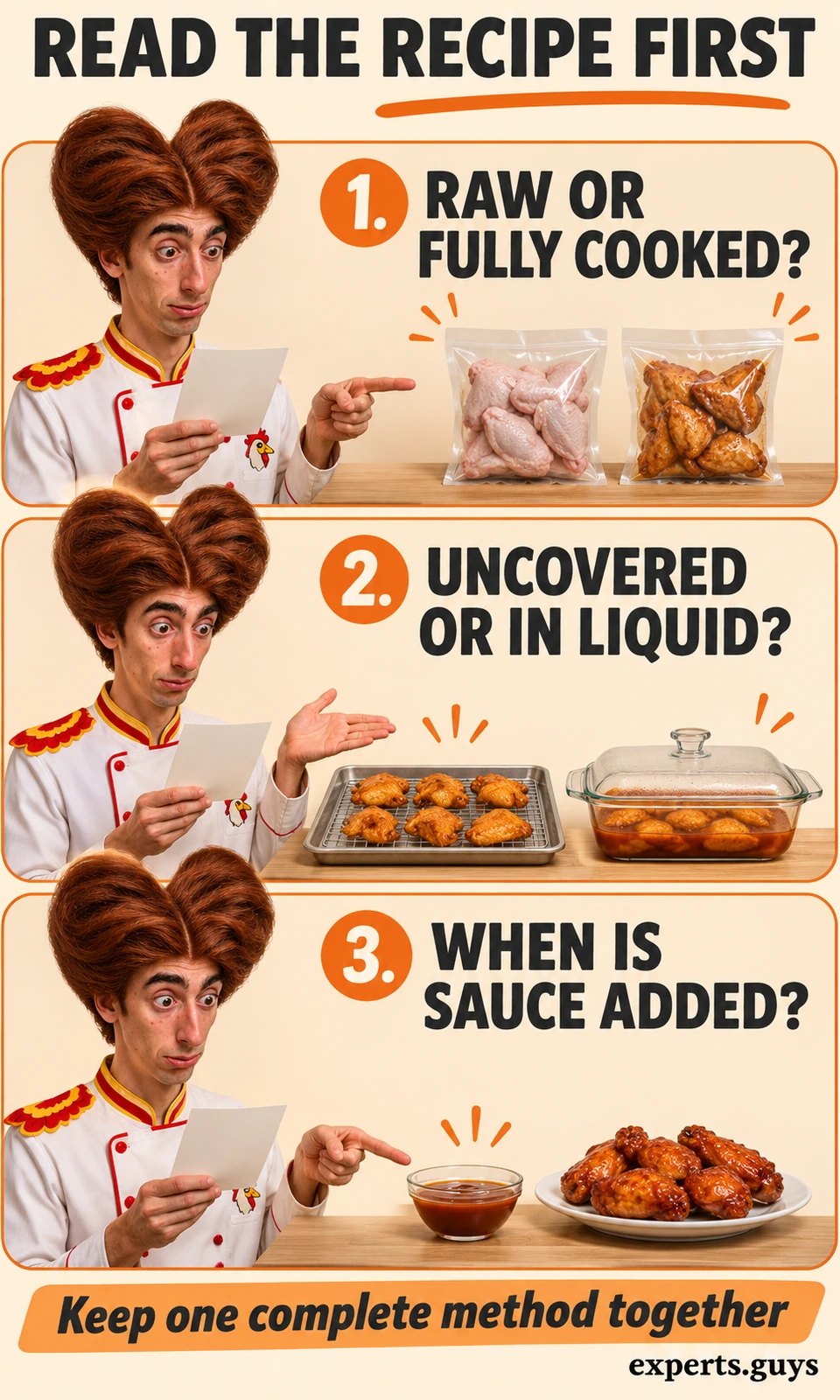
For an illustrative example, imagine a package labelled fully cooked Buffalo wings beside a recipe beginning with raw, unseasoned chicken. Both products look relevant to “baking hot wings”, but the raw recipe is not a reliable reheating instruction for that package. The package may specify cooking from frozen and a particular tray arrangement; those directions belong with that product.
Now imagine two raw-wing recipes. One uses an exposed rack and adds a coating after cooking; the other places the chicken in a lidded dish with liquid. They begin with the same ingredient but pursue different surface conditions. Choosing between them is a texture decision, rather than a contest over which author used the word “baking” correctly.
The common mistake is borrowing the attractive part of each: the hotter setting from one recipe, the wet marinade from another and the shortest timing from a third. Those parts were not developed as one sequence. An easier approach is to choose a recipe that already matches your product and preferred finish, then keep its preparation, settings and checkpoints together.
The practical point is to choose a complete method whose intended finish matches your preference. If you want the measured preparation and oven sequence, use the step-by-step oven hot-wings recipe. It owns the quantities and cooking instructions; mixing unrelated times from several recipes makes the result harder to interpret.
Recipe words that deserve a closer look
“Oven-fried” usually signals an attempt to produce a fried-style exterior with an oven, often using a coating. It does not establish that the food was immersed in oil. Read the ingredients if you need to know whether flour, starch, oil or a leavening ingredient is involved. A name is not an ingredient declaration.
“Air-fried” describes a small appliance with strong circulating hot air rather than an oil bath. It shares principles with fan-assisted oven cooking, but the chamber, airflow and usable load differ. That similarity does not make a full-size oven time directly transferable to a basket. Likewise, a “convection” heading is not permission to apply a second temperature reduction if the appliance already converts its setting.
“Baked from frozen” also needs context. Commercially prepared products may be formulated and instructed for that starting state, while a raw-wing recipe may require fully thawed pieces. Neither instruction should be silently applied to the other. If the package is unclear about whether the chicken is raw or cooked, resolve that uncertainty before selecting the method.
Does baked mean crisp, healthy or safe to eat?
No single cooking label establishes all three. Crispness depends on surface conditions; the nutritional result depends on the ingredients and portion; safety depends on handling and sufficient cooking. A useful evaluation asks a different question for each claim instead of treating “baked” as a general quality stamp.
Confirm safety with the meat temperature
For home preparation, poultry should reach at least 165°F (74°C) internally. The FDA safe food handling guidance gives that minimum and explains why colour and texture cannot confirm safety. A browned coating, hot serving bowl or steaming sauce does not replace the measurement.
To check a wing, place the hot tray on a stable heatproof surface using dry oven mitts. Steady a thick piece with clean tongs and insert the food thermometer from the side into the thickest flesh, keeping the sensing area away from bone and metal. Follow the thermometer’s insertion-depth instructions and wait for the reading to settle. Check pieces from different tray positions, especially the larger ones; if a reading is below the minimum, continue cooking and recheck, cleaning the probe after contact with undercooked meat.
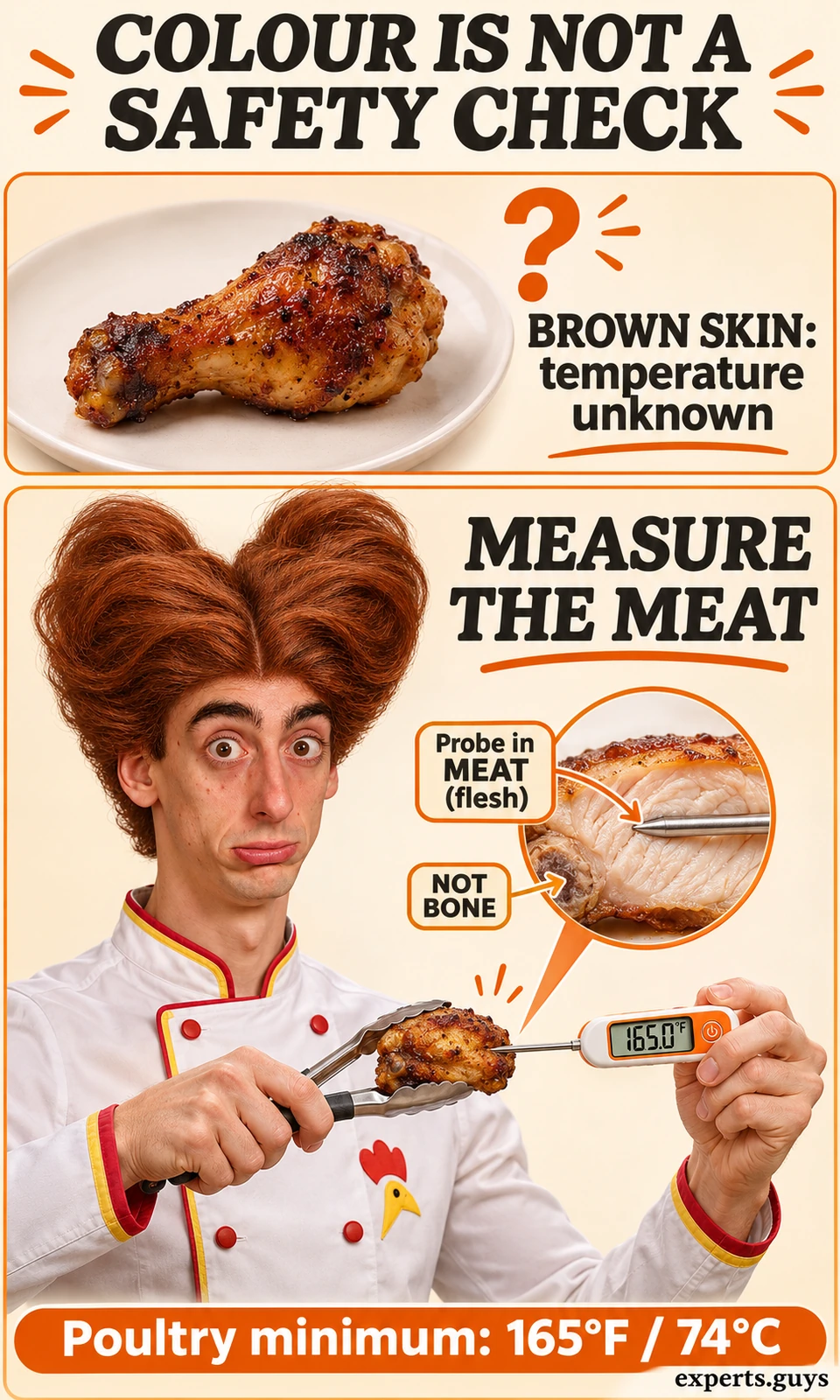
This measurement is a safety checkpoint shared with other poultry methods, not a special benefit of baking. It also has limits: one reading cannot demonstrate the temperature of every differently sized piece. Colour comparisons in the teaching image illustrate that limitation; they are not laboratory results. If you do not have a suitable thermometer, appearance cannot supply an equally reliable replacement.
Raw and fully cooked products also require different handling assumptions. Keep raw chicken and its juices away from food that is ready to eat, and do not wash raw poultry. Use clean equipment for cooked wings. FoodSafety.gov’s clean, separate, cook and chill guidance explains these household precautions; switching from a fryer to an oven does not remove them.
“No deep fryer” is more precise than “healthy”
Baking avoids cooking the wings submerged in a fryer full of oil. That describes a real equipment and process difference. It does not establish a calorie reduction of a particular size, a low-sodium meal or a food suitable for every diet. Skin, coatings, sauce, added butter, dips and the amount eaten all affect the finished serving.
A plain baked wing and a heavily buttered, glazed baked wing share the same cooking label while differing in ingredients. A breaded product may contain wheat even if an unbreaded version does not. Prepared sauces may include allergens that are not obvious from their colour. Read the actual ingredients and relevant packaging rather than inferring dietary suitability from the oven method.
The useful comparison keeps the portion and finish in view. If someone replaces a fried serving with a larger baked serving and more dip, the word “baked” cannot predict the overall nutritional change. Without a defined recipe and serving weight, precise calorie claims would be speculation. Choose baking because its equipment and finish fit the meal, then assess nutrition using the actual food.
Choose between crackly skin, sticky coating and tender sauce
For a reader who specifically wants crisp skin, an exposed dry-heat recipe with a restrained coating near serving is the clearest starting point. That recommendation follows from the moisture problem: it gives the surface a chance to dry before wet sauce arrives. It is a choice for that preference, not proof that one method tastes best to everyone.
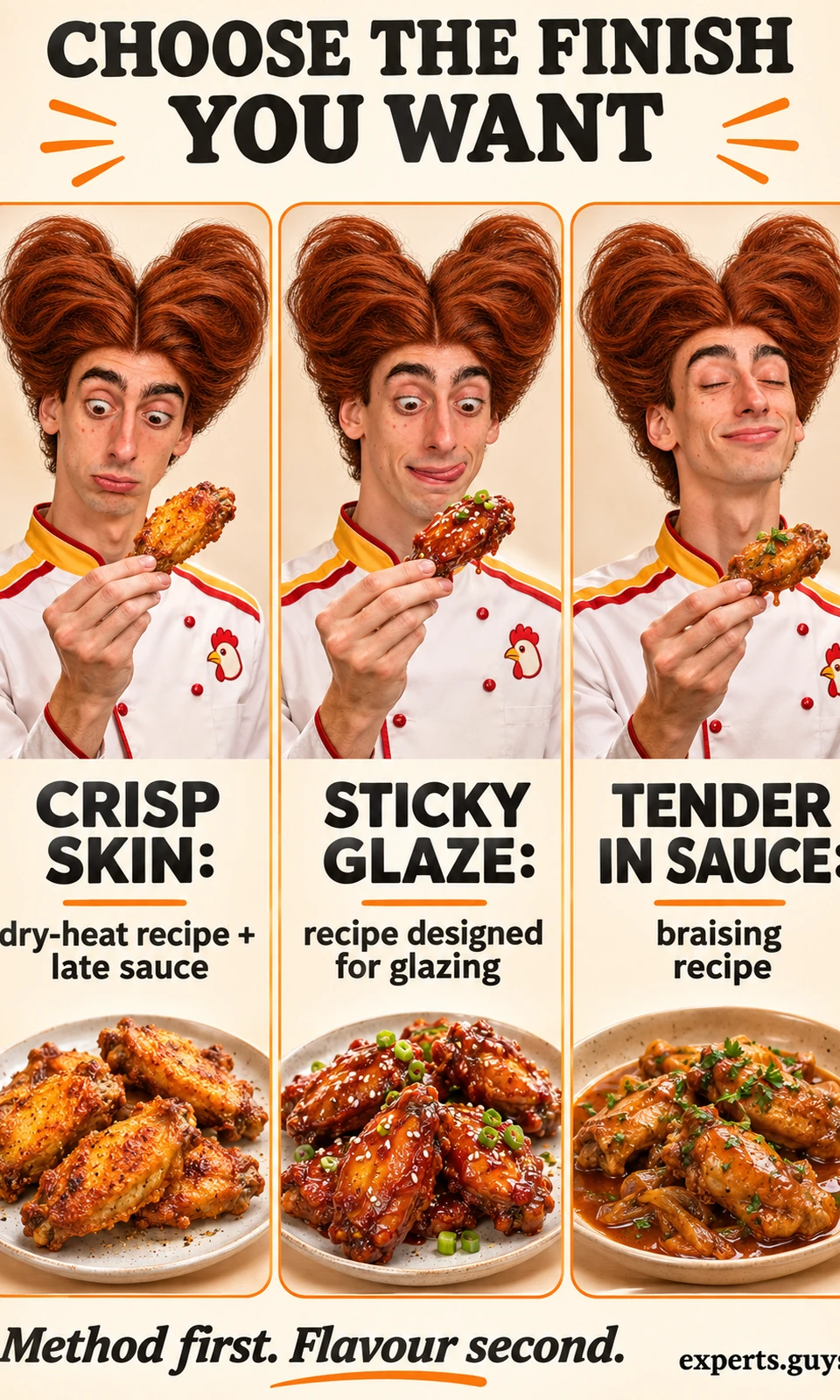
Choose a recipe designed for glazing when a sticky, concentrated coating matters more than a brittle surface. Choose a braising-style recipe when tender wings in sauce are the attraction. Those are different targets, and the method should support the one you actually want. A soft skin is not evidence of failure when the recipe’s purpose was a moist, saucy dish.
For an illustrative family meal, the person who wants tangy sauce and the person who wants a dry surface may prefer different finishes on the same type of chicken. That does not require inventing a new baking definition. It requires choosing compatible cooking instructions and recognising that sauce amount changes the final experience.
For larger gatherings, quantity and service become a separate problem. The hot-wing party portion guide handles buying and batch planning. Baking a large number does not mean they will all fit or remain in their preferred texture until everyone eats, and a cooking label cannot resolve a service bottleneck.
| Claim | Useful evidence |
|---|---|
| Crisp | Surface condition and the recipe’s intended finish. |
| Spicy | The actual seasoning, sauce and quantity used. |
| Safely cooked | An appropriate thermometer reading in the meat. |
| Fits your diet | Ingredients, serving size and relevant product labels. |
| Enough for a party | A confirmed piece count and a workable service plan. |
Questions about baked hot wings
Is the oven’s Bake button the only suitable setting?
No. Control labels vary between ovens, and a recipe may use conventional bake, fan-assisted heat or a roasting mode. Follow the complete method and your appliance instructions. A roasting mode with a stronger top element is not automatically interchangeable with a gentler bake setting.
Do baked hot wings always contain baking powder?
No. Baking powder is an optional ingredient in some crisp-skin recipes, not part of the definition of baking. Do not add it to a recipe merely because the title says baked, and do not substitute baking soda spoon for spoon.
Does boneless mean the same cooking time as a wing?
No. Boneless products may be differently sized breast pieces, breaded pieces or fully cooked prepared foods. Their shape, coating and starting state change the cooking instructions. Use directions for the actual product instead of borrowing the timing for bone-in flats and drumettes.
Can a baked wing also be finished under the broiler?
Yes. A recipe can use baking for the main cook and a separate broiling stage for surface colour. That is a combined sequence, not a contradiction. Broiling can burn a coating quickly and cannot substitute for checking the meat temperature; use a recipe that explicitly includes the stage rather than improvising it.
Choose the recipe by its finish
Start with the result you want to eat: exposed browned skin, a sticky glaze or chicken served in sauce. Check that the recipe matches the product you bought and keep its full sequence together. That gives “baking hot wings” a useful meaning in your kitchen: an oven method selected for a particular finish, with safety confirmed separately in the meat.