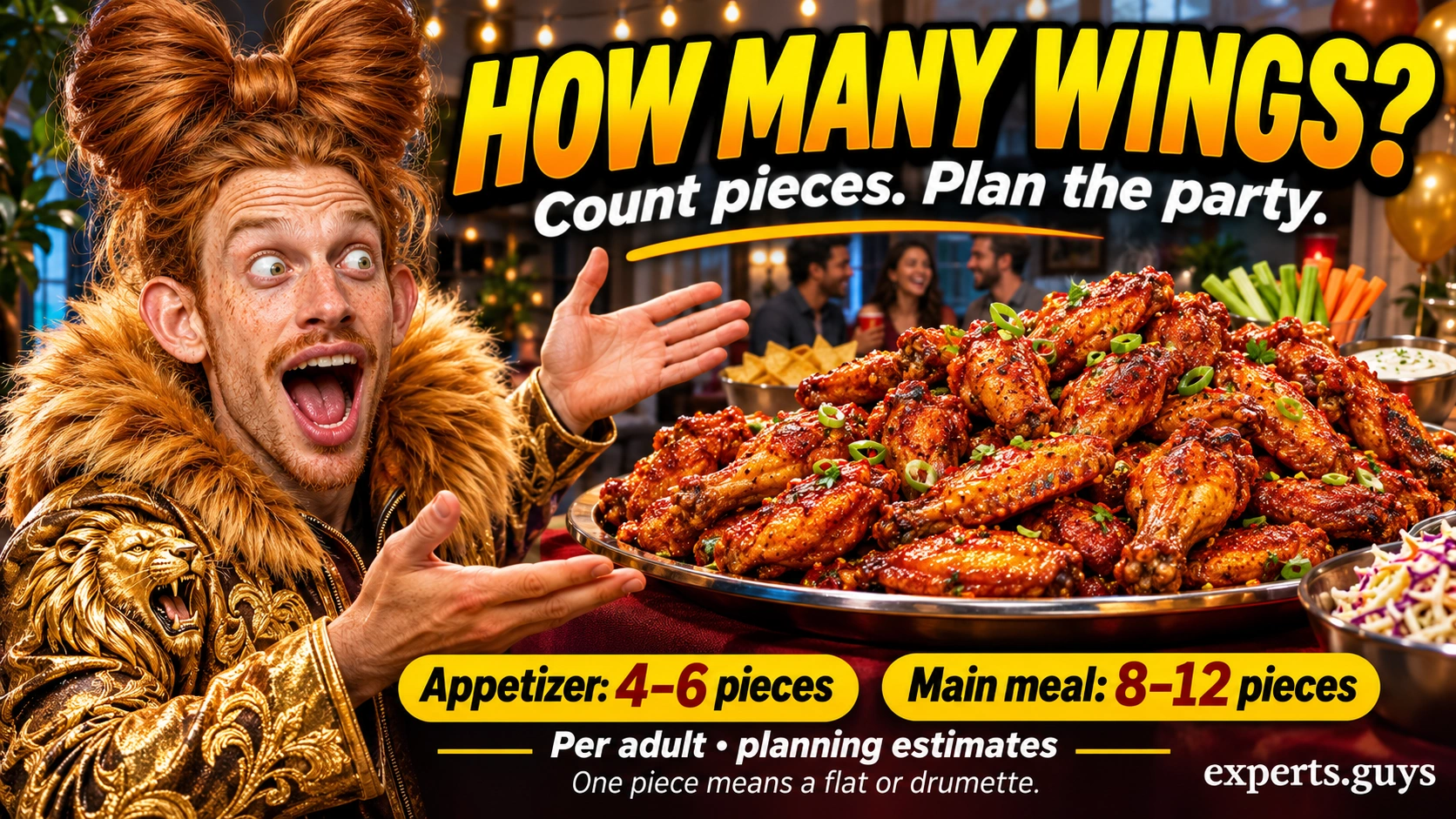
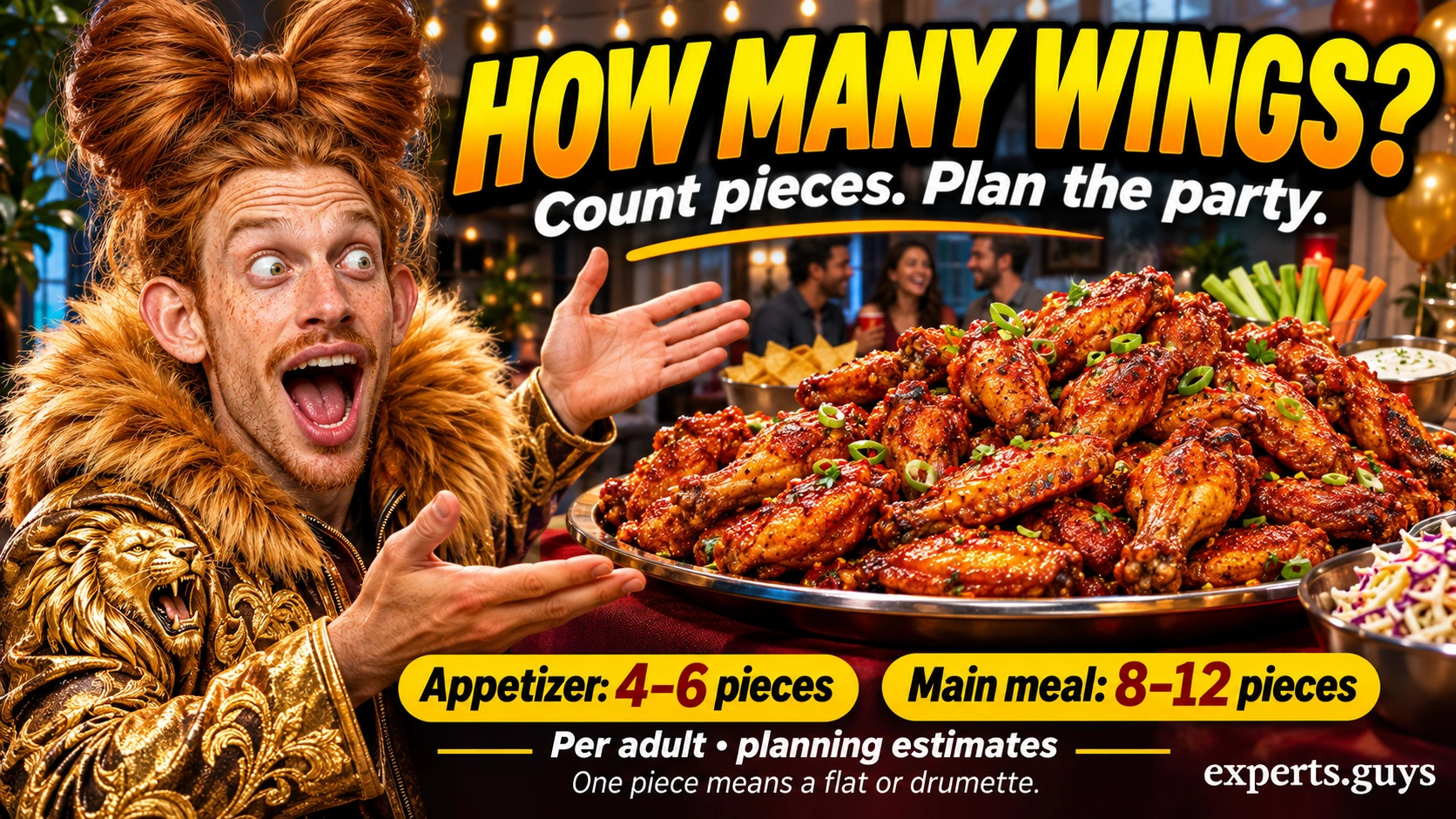
Hot wings for a party are usually counted as individual bone-in flats and drumettes, which makes the shopping total different from a count of whole wings. Plan roughly 4–6 pieces per adult as an appetizer or 8–12 as the main meal, then adjust for appetite, other food and the size of the pieces. These are practical planning estimates, not fixed serving requirements; for 10 adults, that means 40–60 appetizer pieces or 80–120 main-meal pieces before any optional reserve.
How many hot wings should you plan per guest?
Start with the people who will actually eat wings, rather than everyone invited. A guest eating a vegetarian main needs a proper alternative, but should not automatically add another full wing portion to your shopping list. Count teenagers with adult-sized appetites with the adults; use what you know about your younger guests rather than a single age-based rule.
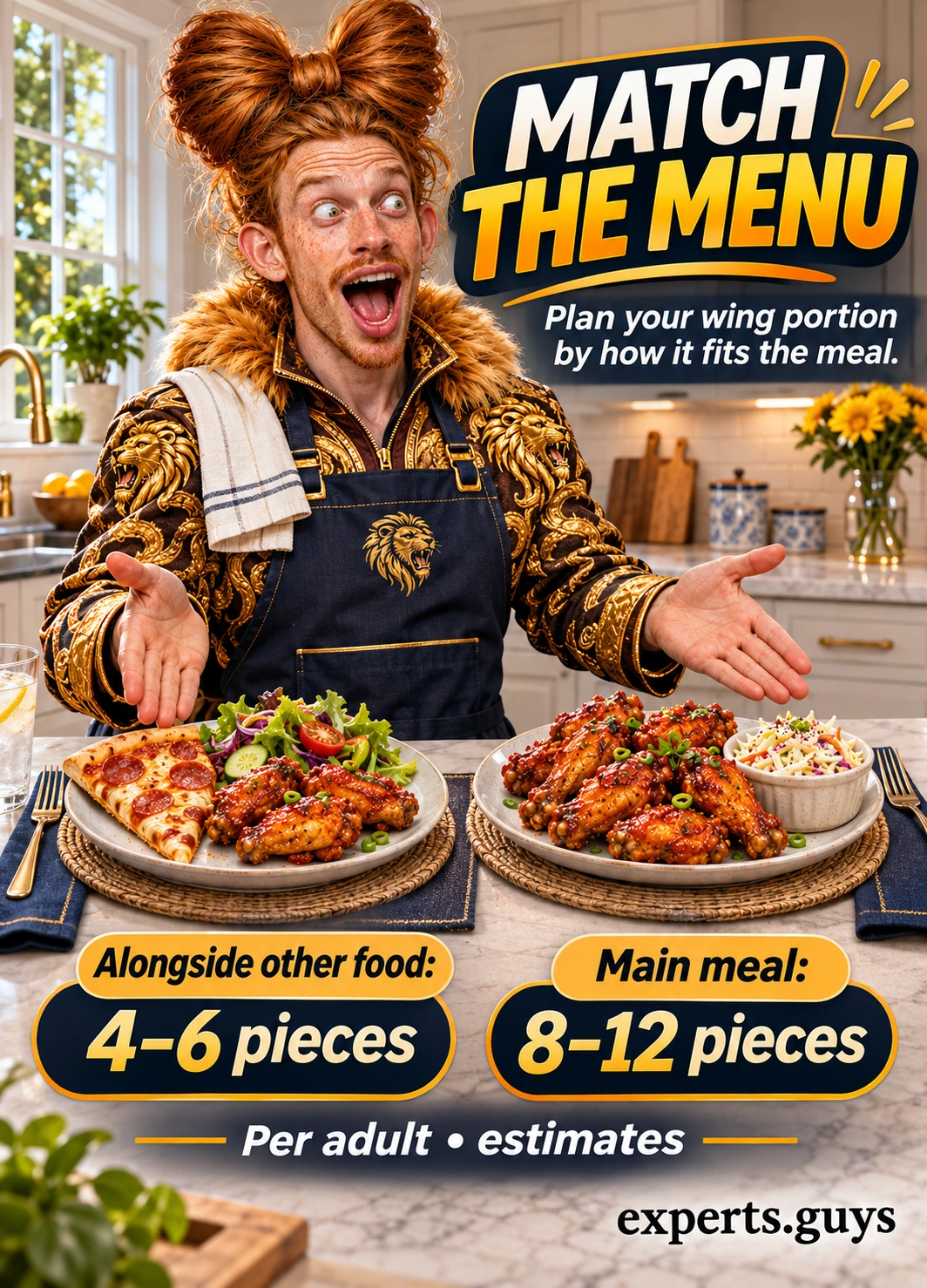
- Appetizer with other substantial food: begin with 4–6 split pieces per adult.
- Main meal with sides: begin with 8–12 split pieces per adult.
- Known bigger appetites: choose the upper end or enter a custom allowance; do not estimate by gender.
- Optional reserve: add around 10% once if attendance or appetite is uncertain and you can safely store the extra.
The table gives a starting range, not a guarantee that everyone will eat the same amount. Choose one column based on the meal, then use the lower or upper end based on actual guests. Do not add the appetizer and main-meal columns together.
| Adults eating wings | Appetizer pieces: 4–6 each | Main-meal pieces: 8–12 each |
|---|---|---|
| 10 | 40–60 | 80–120 |
| 15 | 60–90 | 120–180 |
| 20 | 80–120 | 160–240 |
| 25 | 100–150 | 200–300 |
| 30 | 120–180 | 240–360 |
| 40 | 160–240 | 320–480 |
| 50 | 200–300 | 400–600 |
| 75 | 300–450 | 600–900 |
| 100 | 400–600 | 800–1200 |
For example, 30 adults eating wings as their main meal gives a starting range of 240–360 pieces. Choosing 10 each gives 300 pieces; adding a 10% reserve makes the shopping target 330. If the table’s upper end already reflects generous eating and uncertainty, you may not need another reserve on top.
What counts as one wing?
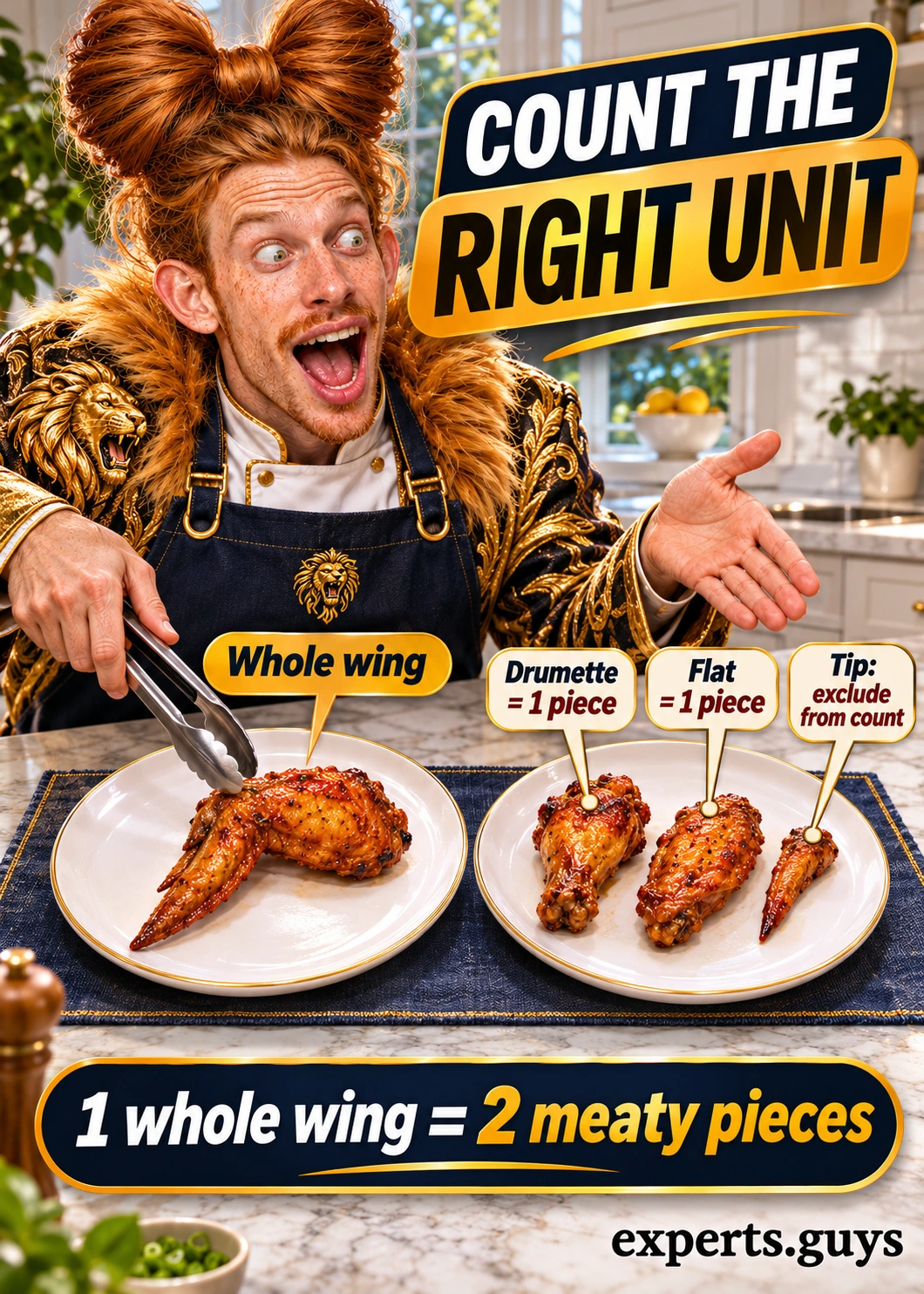
One piece in this guide means one drumette or one flat. A whole chicken wing contains a drumette, a flat and a tip; it supplies two meaty serving pieces when separated. The tip does not count toward the guest allowance. A chicken drumstick is a different, much larger cut, while a boneless “wing” is a differently sized piece of meat and cannot be substituted one-for-one in these calculations.
Before ordering, ask whether “100 wings” means 100 split pieces or 100 whole wings. The latter is roughly 200 meaty pieces after separating. If buying intact wings, divide the split-piece target by two and round up: a 110-piece target corresponds to 55 whole wings. Check the seller’s definition rather than relying on a photograph or the word “party.”
Which end of the range should you use?
Choose the lower end when wings sit beside a substantial spread such as pizza, sandwiches or a filling main dish. Choose nearer the upper end when wings are the centerpiece, the pieces are small, or your guests are enthusiastic wing eaters. Celery and a little dip do not replace a substantial side. A longer gathering does not mean multiplying a dinner portion by every hour; decide whether you are feeding one meal, snacks, or two separate eating occasions.
For mixed appetites, calculate separate groups instead of forcing everyone into an average. An illustrative dinner for eight adults at 10 pieces each and four smaller eaters at four pieces each needs 96 pieces; with a 10% reserve, round 105.6 up to 106. Four is only that example’s selected allowance. For very young children, provide age-appropriate food and preparation rather than treating bone-in wings as a default portion.
How do you turn the piece count into a shopping order?
The dependable conversion comes from the product you intend to buy. Wing size, trimming, bone, coating and any ice glaze change what a pound contains. A universal pieces-per-pound number can give a precise-looking but poor order, especially when switching from small split wings to jumbo wings.
Convert pieces into pounds and packs
- Find the piece count and net weight on the pack or ask the seller for the approximate count. Keep raw weight with raw count; do not use cooked weight to estimate a raw order.
- Divide the pack’s pieces by its weight to get pieces per pound or per kilogram. If the count is a range, use the lower count for a conservative order.
- Divide your target by the pieces per pack and round up to whole packs. Check the resulting total against the original target.
- If there is no reliable count, inspect one representative pack using clean tongs and a rimmed tray, keeping raw chicken chilled and separate from ready-to-eat food. Do not wash raw poultry; clean hands, utensils and surfaces after handling.
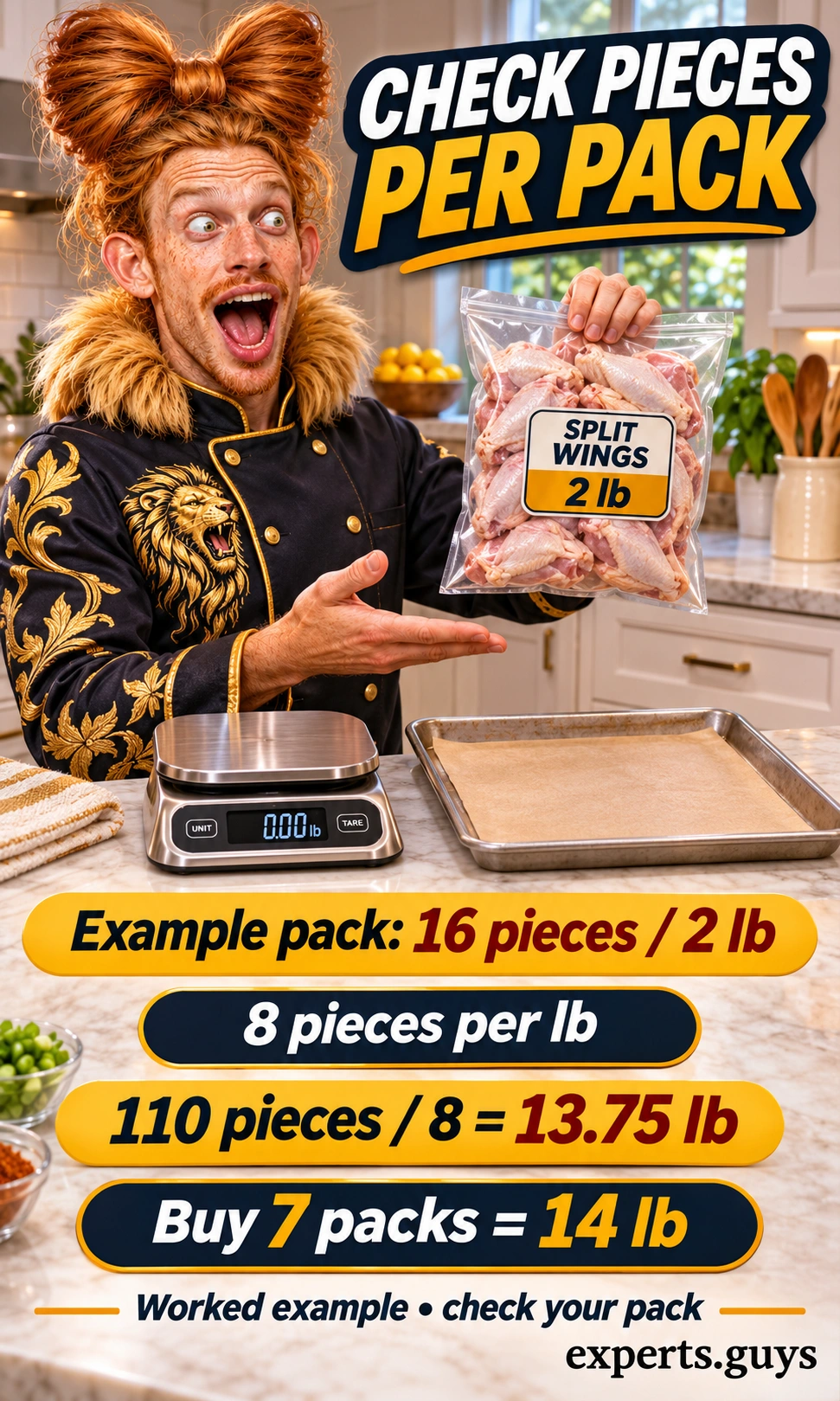
Worked example: a particular 2 lb pack contains 16 split pieces, so that product gives eight pieces per pound. A 110-piece target needs 13.75 lb mathematically, but seven complete packs supply 14 lb and approximately 112 pieces. This example does not establish that every pound has eight pieces. If a 2 lb pack instead contains only 12 pieces, seven packs supply just 84, and the order is too small.
For an easier approach, buy by a confirmed piece count and skip the weight conversion. When comparing prices, divide the pack price by its usable piece count, while remembering that a larger piece contains more food. Whole wings may cost less per pound but include tips and require preparation; compare the food and work you actually receive.
Use the party calculator for your own pack
Enter the number of wing eaters, your chosen pieces per person and the count on your pack. The calculator rounds the reserve, packs and cooking rounds upward separately, so you can see where extra pieces enter the plan. Its default values reproduce the 110-piece example; replace the pack count and tray capacity with your own observations.
PARTY PREP
Turn guests into a shopping plan
Count a flat or drumette as one piece. Use your own pack and tray counts.
The calculator is optional: target pieces = round up(guests × pieces each × (1 + reserve percentage ÷ 100)). For mixed groups, add each group’s base quantity before applying the reserve. A pack count is only as reliable as its label or sample, so leave room for normal product variation.
Can your kitchen deliver that many wings at once?
Enough wings in the refrigerator does not mean enough cooked wings at the table. The limiting factor may be oven space, the number of safe holding appliances, or the time between batches. Resolve that constraint before committing to a large home-cooked order; otherwise the first tray can sit for too long while later trays are still cooking.
Test the tray, not just the recipe multiplier
- Use the same rimmed tray and any oven-safe rack specified by your chosen recipe. Arrange a representative batch in one layer with space between pieces; count the pieces that fit without crowding.
- Check how many trays the oven and recipe can handle together with adequate airflow. Do not assume every rack position can hold a full cooking tray successfully.
- Multiply pieces per tray by usable trays to find one round’s capacity. Divide the shopping target by that capacity and round up.
- Compare the number of rounds with the recipe’s actual batch time, plus preheating, loading and checking. If service would stretch too long, reduce the home-cooked wing share, serve in waves, or arrange a confirmed cooked-food order.
At 24 pieces per tray and two usable trays, one round holds 48 pieces. A 110-piece target therefore needs three rounds: 48, 48 and 14. The final smaller round may behave differently from a crowded full oven, so use doneness checks rather than blindly repeating the first batch’s timing. A single-basket air fryer can be convenient for a small snack but becomes a bottleneck for a large all-at-once dinner.
Use the separate oven hot-wings method for preparation and cooking technique. This party plan owns the quantity and capacity decision; multiplying its shopping total does not justify multiplying oven temperature or stacking wings in a deep pan. Poultry must reach 165°F (74°C) internally; keep the probe away from bone and check the meat, not its color.

Divide the total before adding sauce
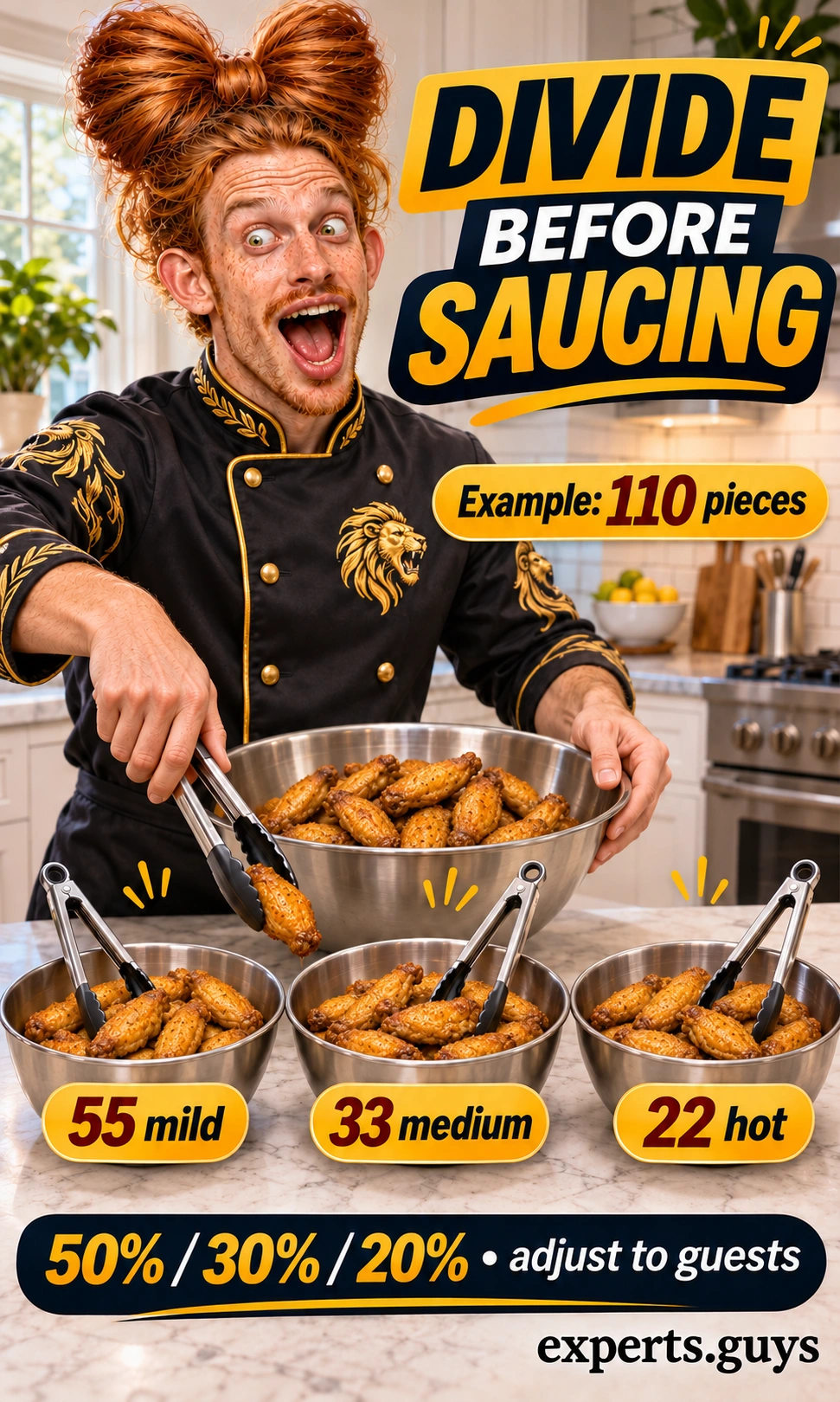
Choose flavor shares that add to 100%, then divide the single cooked-wing total among clean bowls before saucing. For 110 pieces, an illustrative 50% mild, 30% medium and 20% hot split gives 55, 33 and 22 pieces. This is an example allocation, not a claim about the most popular flavors. Ask about the actual group’s preferences; a plain or mild reserve is easier to redirect than an entirely extra-hot batch.
Set each bowl beside its own serving tongs and keep the mild batch separate from hot sauce splashes. If equal handfuls are hard to estimate, use the tongs to portion each bowl directly. With a small party, two flavors are simpler than many tiny batches. A sauce label does not make food allergen-safe: check ingredients and preparation requirements for guests with allergies, including shared utensils, coatings and equipment.
When percentages produce fractions, round the first portions down and give the remaining pieces to the last bowl so the total stays fixed. Do not round every flavor upward and quietly expand the order. If one flavor runs out first, adapt the unsauced reserve while it remains safely held rather than buying another complete party’s worth of that flavor in advance.
How should you serve the batches without wasting the reserve?
Treat serving quantity and safe holding as separate decisions. Smaller platters make replacement manageable, but a small platter is not automatically safe indefinitely. The relevant factors are the food’s temperature and its accumulated time outside temperature control; adding fresh wings does not restart the clock for old ones.
Serve smaller trays and replace them
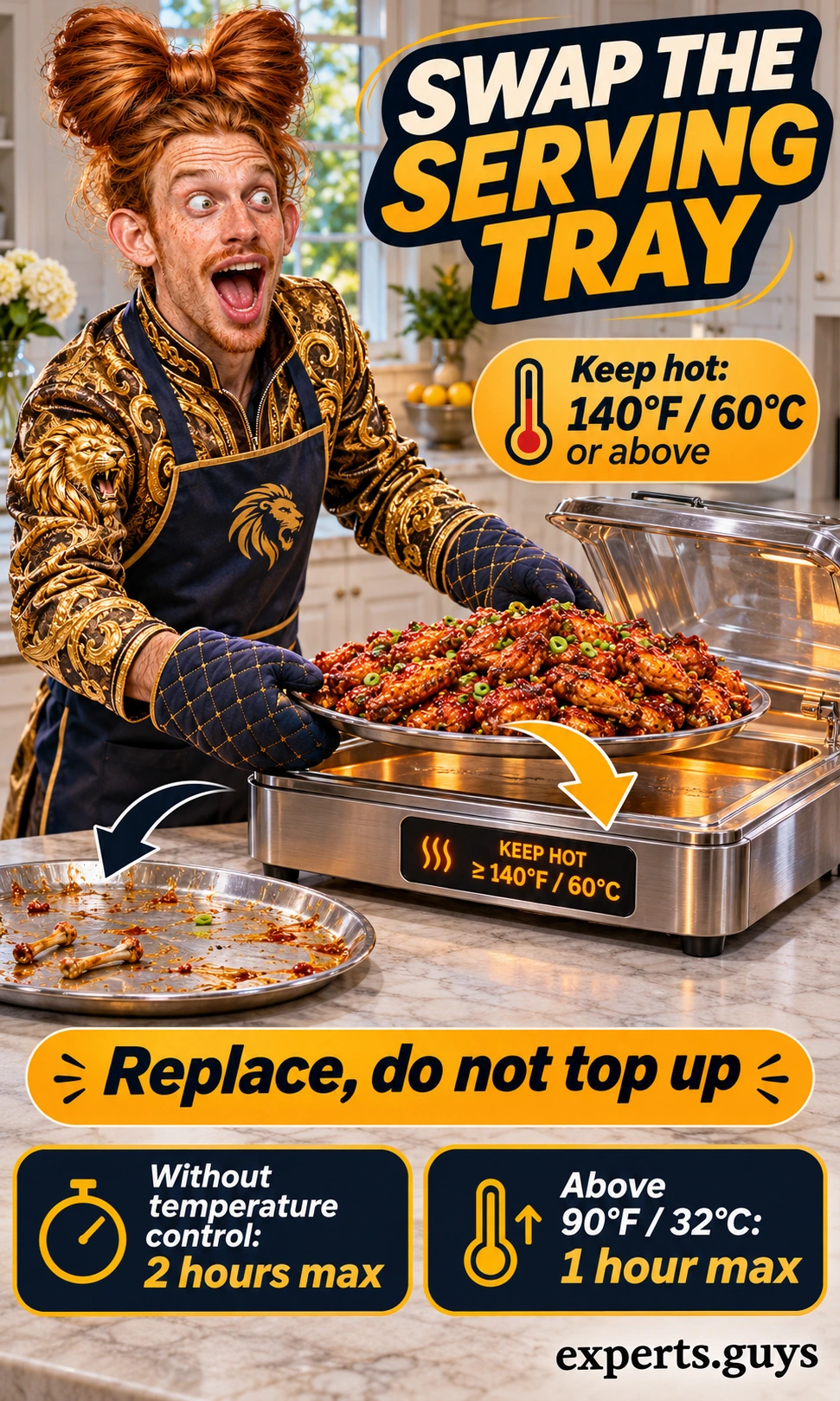
- Put out a manageable platter and keep the remainder under proper temperature control. Use a thermometer to confirm hot-held wings stay at 140°F (60°C) or above; an appliance’s “warm” label alone is not proof.
- When the platter is nearly empty, remove it and put down a clean, freshly filled platter. Do not top up an old batch with a new one. Keep raw-food tools away from the serving area.
- Without hot or cold temperature control, discard perishable food left out for more than two hours, or one hour when the surroundings exceed 90°F (32°C). Include transport and earlier time out.
- Keep cold dips at 40°F (4°C) or below, and replenish with fresh dishes. For a commercial or catered event, follow the applicable local food-service rules.
These are U.S. home-buffet safety guidelines. They explain why replacing dishes and checking temperature matter more than setting out the whole order at once. If you cannot maintain safe holding conditions, serve smaller promptly eaten batches and refrigerate the reserve; do not rely on smell to decide whether a tray is safe.
Deal with the reserve before guests leave
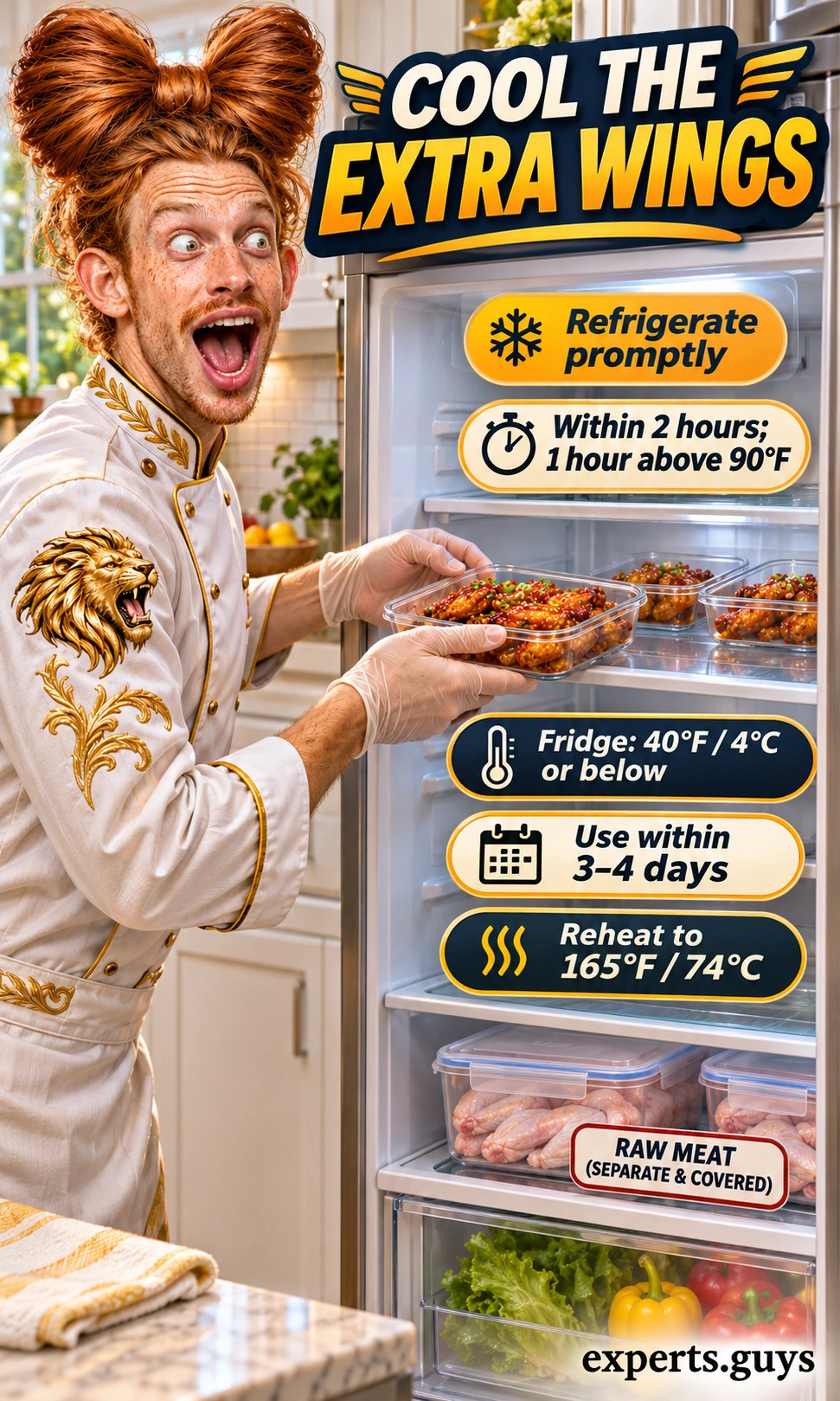
Keep any unserved reserve under temperature control and refrigerate leftovers promptly in shallow containers, within the same two-hour limit or one hour above 90°F. Divide a large quantity among smaller containers rather than leaving a deep mound on the counter to cool. Use the thermometer to confirm the refrigerator is 40°F (4°C) or below, and keep cooked food protected from raw-meat drips.
Use refrigerated leftovers within three to four days or freeze them for longer storage. Reheat leftovers to 165°F (74°C), checking the meat rather than assuming that hot sauce or a browned surface means the center is ready. The USDA leftovers guidance supports these cooling and storage limits. Food that has already exceeded its safe time out should be discarded, not chilled for another day.
If lifting a large tray is awkward, divide the reserve into smaller containers at a comfortable work surface. The useful completion check is simple: no large unattended tray remains out, the leftovers are shallow and chilled promptly, and the next meal has a clear storage limit. Taking food home adds transport time; do not promise guests that an already warm container is safe for a long trip.
Frequently asked questions
Is 100 wings enough for 20 people?
If “100 wings” means 100 split pieces, that is five pieces per person: a reasonable appetizer starting point with other substantial food. It is below this guide’s main-meal starting range of 160–240 pieces for 20 adults. If the order means whole wings, clarify that first because the meaty-piece count is different.
Should I buy equal numbers of flats and drumettes?
An even mix is convenient but not required. Both count as one split piece in this planning method. If guests have a strong preference, confirm the available mix with the seller; an assorted bag does not guarantee equal numbers.
Can I use this table for boneless wings?
Not directly. Boneless pieces differ in size, coating and meat content. Use the product’s portion or weight guidance, then adjust to the meal and guests. Do not apply the whole-wing-to-two-pieces conversion to boneless chicken.
Does frozen weight tell me how many guests a bag feeds?
No. Net weight alone does not identify the number or size of usable pieces. Check whether the product is raw or cooked, whole or split, and whether it has coating or glaze. Use the actual product count whenever possible.
How much extra should I order for unexpected guests?
Choose a reserve that matches the uncertainty rather than adding several separate buffers. Ten percent is an optional planning example, not a requirement. If you already chose a generous allowance and rounded up large packs, inspect that built-in extra before adding more.
Should the reserve already be covered in hot sauce?
A plain or mild reserve offers more flexibility if tastes are mixed. Keep it safely hot or cold, then allocate it as needed. Leaving it unsauced changes flavor flexibility, not the temperature or time limits.
Decision summary: settle the unit, then the order
For your next party, first confirm that the order is counted in flats and drumettes. Choose the appetizer or main-meal range, adjust for the people actually eating wings, and add any reserve only once. Convert that target using your own pack count, then check that your cooking and holding setup can deliver it; if capacity is tight, change the service plan before buying more food.