


Depression CBT worksheets and handouts are most useful when you choose one task, understand what each field means and apply it to a specific example. Start with an explanation sheet if the terms are unfamiliar, or use a digital worksheet to practise a skill you already understand. These resources can support care, but completing a form is not a diagnosis, a treatment plan or proof that depression is improving.
This guide focuses on using forms accurately, not building a larger collection of coping exercises. You can type into an editable document or a private notes app; no pen is needed. The examples are illustrative and do not describe patients or treatment outcomes.
- Need an explanation? Read the matching handout.
- Confused by a box? Compare an event, feeling and thought.
- Stuck after starting? Keep the useful entry and identify the difficult field.
| What you need | Useful format | What it does not establish |
|---|---|---|
| Understand a concept | Brief handout plus one example | That you have mastered the skill |
| Examine an interpretation | Thought record | That every distressing thought is inaccurate |
| Review an action | Activity worksheet | That unchanged mood means failure |
| Get help with the method | One partial example for a session | That you must finish before asking |
Try the CBT Practice Studio
Practise with fictional examples before using a personal situation. Choose a worksheet difficulty, select a response and read the explanation. The practice does not assess symptoms, store answers or measure recovery.
Which depression CBT worksheet or handout should you use?
Choose by the task you need help with, rather than by the number of pages. An explanation sheet supports understanding, while a practice form helps you apply a skill to an example. The format is useful only if you understand what its fields are asking you to do.
The Centre for Clinical Interventions depression resources distinguish information sheets, worksheets and a sequenced workbook. Choose a resource by its purpose and retain its instructions. For a broader selection of activities, see 13 depression worksheets; this page addresses the common mistakes that make a form difficult to use.
Choose a handout for understanding, a worksheet for practice
A handout explains a concept; a worksheet gives you a structure for applying it. Use the explanation first when the headings themselves are confusing. Collecting more blank forms rarely solves a problem with understanding one field.
- Open the description or instructions before choosing a download. Check the publisher and the intended task.
- If you need to understand the thinking-feeling link, read that handout; if you already understand it, open a thought record.
- Choose one section to use now. Keep the rest available rather than making the whole workbook today’s assignment.
Illustrative example: Sam opens a seven-column form but cannot tell what belongs under “thought.” He reads the explanation of thoughts and feelings, then returns to that single column. The useful outcome is knowing what the field asks for, not finishing seven columns.
Lower-effort option: read just the field label and one worked example. Stop when you can explain its purpose in ordinary words. Next, try a single entry; ask your therapist about the form if the purpose is still unclear.

Narrow the situation box to one observable moment
A situation field works best with a bounded event. A whole difficult week contains too many events to connect clearly to one thought or response. Narrowing the entry makes the later boxes easier to interpret without denying the wider problem.
- Choose a recent, manageable example rather than your most distressing experience.
- Type what happened and, if useful, when: “No reply by 6 pm.” Leave the explanation of why for a different field.
- Stop after that moment. Put conclusions such as “Nobody cares” in the thought box.
Illustrative example: “Everything went wrong” becomes “My friend had not replied by 6 pm.” The narrower entry does not establish rejection or explain the friend’s motives. It gives the worksheet a concrete event to examine.
Lower-effort option: a short phrase such as “Unanswered message” is enough to start. Completion means that another person could identify the event without accepting your interpretation. Next, separate the feeling from what you concluded.

What belongs in the situation, feeling and thought boxes?
Keep an observable event, an emotion and an interpretation distinguishable. This prevents a painful conclusion from being treated as an established event. It also lets you examine an interpretation while respecting the emotion that accompanied it.
CBT explores relationships among interpretations, feelings and actions; it does not establish that thoughts are the only cause of depression. Real loss, unsafe conditions, illness and practical problems need appropriate attention. If your main question is how a repeated pattern fits together, use the separate cycle of depression worksheet.
Move interpretations out of the feelings box
A feeling names an emotional experience, such as sadness or frustration. A thought states a meaning, prediction or judgment that can be examined. A sentence beginning “I feel that…” often contains an interpretation, although everyday language naturally mixes the two.
- Read the entry once. Ask whether it names an emotion or makes a claim about yourself, someone else or the future.
- Keep “sad” in the feelings field. Move “I do not matter” into the thoughts field.
- Keep physical sensations separate if your form has a body-response field. Do not force every experience into an emotion word.
Illustrative example: Sam types “I feel ignored.” He chooses “sad” for the emotion and “My friend does not want to hear from me” for the interpretation. That distinction allows the claim to be examined without arguing that his sadness is wrong.
Lower-effort option: choose one approximate emotion word, or mark “unsure” and continue with support. You have completed the step when the emotion and claim are distinguishable. Next, examine the claim rather than trying to disprove the feeling.

Check evidence against the exact claim
Evidence fields become confusing when the claim changes halfway through. “I missed a call” and “I always let people down” are different statements. Keep the original claim visible so each example answers the same question, following the evidence-checking approach in CCI’s thought-challenging module.
- Copy the exact claim into the thought field without strengthening it.
- Add one relevant observation supporting some part of it, then one observation that limits or contradicts it.
- Separate what you know from what you are guessing. Leave uncertainty visible instead of inventing reassuring evidence.
Illustrative example: the claim is “I always let people down.” Missing one agreed call supports that one commitment was missed. Helping someone yesterday challenges the word “always”; it does not erase the missed call or prove that nobody was hurt.
Lower-effort option: use one fact on each side, or mark the missing side “not sure yet.” The checkpoint is relevance, not equal word counts. If the facts support a real problem, the next step may be repair or practical support rather than a more positive interpretation.

How can you tell whether a completed worksheet is useful?
Look for a clearer distinction or a manageable next response, not a required drop in distress. A tidy form can still contain irrelevant evidence or an unbelievable replacement thought. A brief form can be useful if it changes what you understand or what you try next.
The NHS thought record includes examining evidence and considering a more realistic or neutral interpretation. Its digital format can be used electronically rather than printed. The examples here show how to check the quality of an entry without treating the worksheet as a test of optimism.
Replace forced positivity with a credible response
A balanced response should fit the evidence and leave room for difficulty. It is not a command to feel cheerful or a guarantee that the situation will turn out well. If a replacement sentence feels obviously untrue, make it more specific and less absolute.
- Keep the fact that needs acknowledgment: “I missed a call.”
- Remove the sweeping identity verdict: missing that call does not establish “I am useless.”
- Add a realistic option, if there is one: “I can reply.” Read the sentence once and check whether you can honestly stand behind it.
Illustrative example: “I never fail” is too absolute to replace “I am useless.” “I missed a call, and I can reply” is narrower and allows repair. If replying is not currently manageable, “I can ask for help deciding what to say” may fit better.
Lower-effort option: shorten the response to “One missed call is not my whole character.” Completion means producing a fairer statement, even if you still feel low. Next, use the agreed response in the relevant situation rather than repeatedly polishing its wording.

Separate a planned action from its actual outcome
An activity worksheet can become a list of intentions with no clear learning point. Distinguish what you expected, what you actually did and what you noticed. Completion of a small action and improvement in mood are separate outcomes; CCI’s behavioral strategies module explains realistic activity practice.
- Choose one safe, manageable activity that fits your existing care plan or daily needs. State the prediction separately.
- Try the chosen action within your current capacity. Do not use hazardous work, driving or strenuous activity as an experiment.
- Enter what happened in plain terms. If you did less than planned, record the smaller action accurately rather than treating it as nothing.
Illustrative example: Sam expects “There is no point starting,” then opens one unanswered message while safely seated. The result is “Message opened”; he has not yet replied and his mood may be unchanged. That distinguishes a completed first step from the larger task still ahead.
Lower-effort option: identify the message without opening it, or ask someone trusted to sit with you. Completion is the action you actually chose, not a required mood shift. Next, decide whether to repeat, simplify or discuss the barrier; do not increase activity through significant exhaustion.

What if a worksheet feels overwhelming or unhelpful?
Make the point of difficulty visible and reduce the task or pause it. A form that repeatedly increases distress needs discussion, not more pressure to complete it. Persistent, worsening or disabling symptoms warrant professional assessment whether or not the worksheet looks complete.
Repeatedly returning to the same accusation is different from gathering useful information. The guide to depressive rumination and overthinking explains that distinction in more depth. If the form becomes part of that loop, bring the difficulty into care rather than extending the exercise indefinitely.
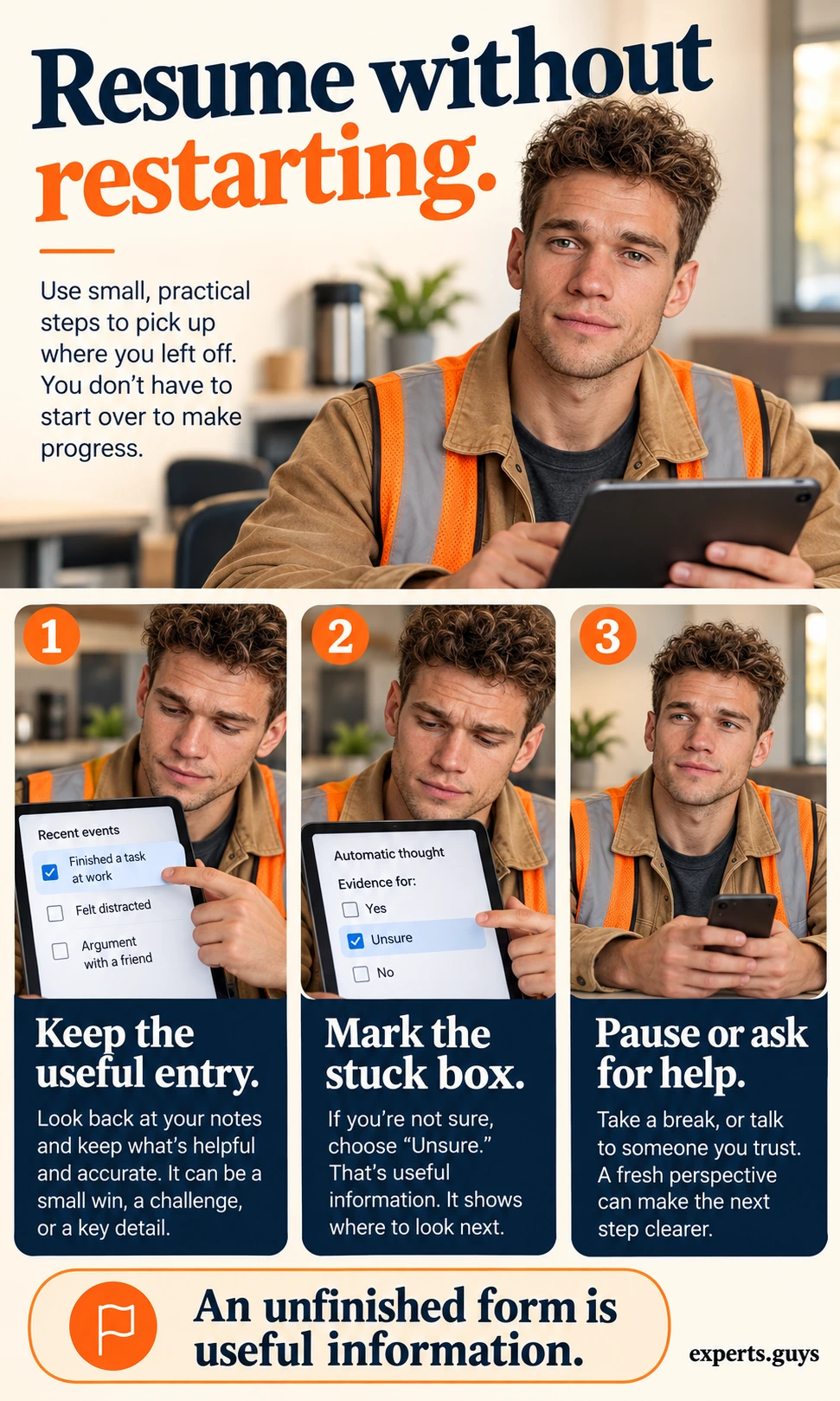
Resume at the stuck field instead of restarting
An unfinished worksheet can identify the part of the method that needs explanation or adaptation. Recopying everything may increase the workload without resolving that difficulty. Preserve what is useful and make the obstacle visible.
- Keep the entry that still describes the situation accurately. Do not rewrite it simply to make the form look tidy.
- Mark the specific sticking point, such as “Evidence: unsure” or “Too tired to continue.”
- Choose to pause, use the shorter version agreed with your therapist, or ask for help with that field. If the exercise increases distress, stop rather than forcing completion.
Illustrative example: Sam has an event and a thought but no convincing evidence entry. He leaves those completed fields intact and marks the evidence box “unsure.” The next conversation can now address a specific question rather than an unexplained blank form.
Lower-effort option: identify only the name of the difficult box. Completion means making the barrier understandable, not finishing the worksheet. Next, return with support if useful; persistent looping or worsening distress is a reason to discuss a different approach.
Bring one worksheet question to the next session
A worksheet is more useful in a session when it shows where you need help. You do not need a polished account or permission to say a technique feels unhelpful. The therapist can use that feedback to clarify the task or consider another approach.
- Choose one example you are willing to discuss. A partial form is acceptable.
- Identify the exact field or instruction that did not make sense.
- Ask a specific question such as “Can we try this balanced-response box together?” Share only the information you choose, using your provider’s agreed secure method.
Illustrative example: Sam shows the response field and explains that the suggested sentence feels unbelievable. He asks to work through a more credible version in the session. The practical outcome is an agreed explanation or adjustment, rather than a completed form that hides the difficulty.
Lower-effort option: show the field label or say “I got stuck here.” Completion is communicating the obstacle. Next, agree what to try between sessions and how you will review whether it was manageable.

Worksheet support is one part of treatment, not a substitute for a clinical assessment. A trained professional can help decide whether CBT, another psychological approach or other care fits your circumstances. See talk therapy for depression for the broader session process.
Keep the digital format practical
| Friction | Useful adjustment | Why it matters |
|---|---|---|
| PDF fields cannot be edited | Use an editable version or copy only the field labels into a private document | A scanned page is not necessarily a fillable form |
| Phone screen feels crowded | Use one field at a time or a larger screen | Layout should not become another concentration task |
| Shared or work device | Avoid entering sensitive details; use an appropriately private device | A local document can still be synced or visible to others |
| Form asks for ratings | Follow its actual scale and instructions; discuss confusion with your therapist | Ratings describe experience and are not diagnostic by themselves |
Questions about CBT handouts
Do I need a diagnosis before reading a handout?
You can read general educational resources without a diagnosis. Whether a particular self-help approach is appropriate depends on your symptoms and circumstances. Seek assessment when symptoms persist, worsen or interfere with daily life.
Is a free worksheet the same as guided self-help?
No. The NICE guided self-help recommendations describe structured materials with support from a trained practitioner. A downloaded worksheet alone does not provide assessment, adaptation or a review of your care.
Can I leave a box blank?
Yes, if you do not know what belongs there or continuing is too difficult. Marking the uncertainty can make the next discussion more useful. Avoid inventing an answer just to make the form look complete.
Should I upload a completed form to any app that offers feedback?
Review who can access the information, whether it is retained and how sharing works before entering sensitive material. Use your provider’s agreed route for clinical communication. The practice experience on this page uses fictional examples and does not need your personal story.
Your next step
- Choose one form and identify the task it serves.
- Use one manageable example and keep facts separate from interpretations.
- Check whether the entry clarifies a response, rather than judging success by immediate mood change.
- Bring the difficult field to care if the method remains confusing or distressing.