




Dysthymia is an older name associated with persistent depressive disorder (PDD), a long-lasting pattern of depression that can affect energy, confidence and everyday life. Treatment may involve psychotherapy, antidepressant medication or both; the practical aim is to make care workable and review whether it is helping, rather than search for a single quick remedy.
This guide is for adults considering or receiving care for persistent low mood. It explains the symptoms briefly, then focuses on seven ways to make treatment more concrete. The examples and AI-created illustrations are educational, not patient stories or evidence of treatment results.
What symptoms can dysthymia cause?
Persistent low mood may come with fatigue, low self-esteem, hopelessness, disrupted sleep or appetite, and difficulty concentrating. In adults, the diagnostic history usually extends over at least two years; younger people have different assessment requirements. You do not need to wait two years to seek help, and duration alone cannot establish a diagnosis.
- A long history still deserves attention: being used to low mood does not make it harmless.
- Functioning does not settle the question: someone may keep working while experiencing substantial distress.
- A recent worsening changes the priority: explain what is different now instead of calling everything your usual pattern.
PDD can coexist with episodes of major depression, so describing it simply as “mild depression” can minimize its impact. A clinician also considers physical illness, medicines, substance use and a history of unusually elevated or irritable mood with reduced need for sleep. MedlinePlus explains the symptoms and assessment of PDD.
There is no single established cause that explains every case. Biological vulnerability, life circumstances and psychological factors can interact, and a symptom list cannot identify the cause for one person. For the separate task of describing a long mood history, see dysthymia; the focus below is using treatment in daily life.
What helps, and what does not count as treatment?
| Approach | What it can contribute | What to clarify |
|---|---|---|
| Psychotherapy | Work on relevant patterns of thinking, behavior or relationships. | The treatment target, practical work and review plan. |
| Prescribed medication | Reduce depressive symptoms when appropriate for the individual. | Benefits, side effects, interactions and follow-up. |
| Combined care | Address different needs when the assessment supports both approaches. | Who coordinates care and how changes will be reviewed. |
| Daily-life support | Make agreed care easier to attend and follow. | Which barrier is preventing participation. |
| An online checklist or a lifestyle promise | May provide information, but does not establish a diagnosis or replace treatment. | Whether the claim is supported and whether it delays needed care. |
The choice depends on symptoms, severity, previous response, preferences and other health needs. UK NICE guidance addresses chronic depressive symptoms, but its options still require an individual clinical discussion. Combining treatments is not a guarantee of a better outcome for every person.
A routine can support care without being a cure. The seven approaches below are practical ways to participate in treatment, not seven independently proven remedies for PDD. Their worked examples show how to make a conversation or arrangement usable; they do not prescribe a particular treatment course.
1. Choose one everyday treatment goal
A treatment goal gives “I want to feel better” a recognizable place in daily life. It should describe something you value, rather than how productive you think you ought to be. Use it alongside symptom assessment, not as a replacement for it.
- Open a private phone note and name one task that low mood makes difficult: answering messages, preparing lunch or joining a conversation.
- Describe a small change that would matter to you, such as replying to one trusted person without spending the whole evening preparing.
- Discuss that goal with your therapist or clinician and agree what is realistic at this stage.
Illustrative example: “I still answer work emails, but I avoid every personal message. I would like enough energy to reply to my sister.” This identifies a meaningful difference between outward functioning and personal recovery. It does not require a target number of messages or a perfect streak.
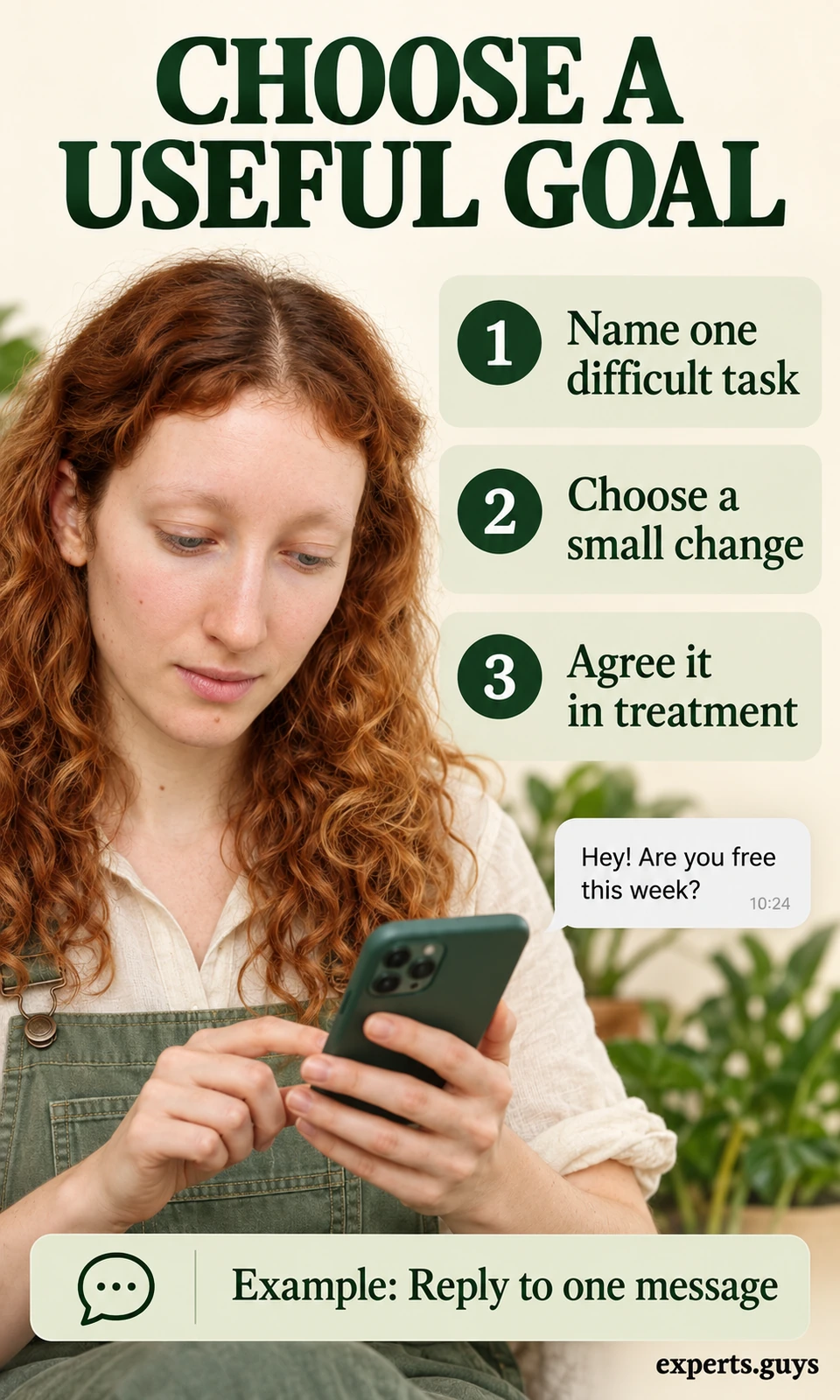
If the goal becomes another source of guilt, reduce its scope with your clinician. A person who cannot manage a full reply might start by identifying whom they would feel comfortable contacting. Progress means the task becomes more manageable or less costly, not that every day meets a quota.
2. Ask what the proposed therapy will actually target
A therapy label alone does not tell you what happens during a session. CBT can address unhelpful thinking and behavior, while interpersonal therapy focuses on relationships and life events. These are discussion routes, not a rule that lets a webpage select your treatment.
- Name the obstacle in ordinary language: “I assume people dislike me” or “Since my separation, conversations end in conflict.”
- Ask the provider how their approach would work with that obstacle and whether they have experience with persistent depression.
- Confirm how you will review benefit, what participation involves and what happens if the approach does not suit you.
Illustrative example: a person repeatedly hears “try to think positively” but does not know what to do when a familiar thought appears. A useful question is: “Could you show me how we would work with one of those thoughts during a session?” The answer should make the proposed work clearer, without promising a cure.

If technical language is confusing, ask for a plain-language example rather than trying to learn every therapy acronym. If the plan still feels unclear, raise that concern before committing to a long course where possible. A clearer explanation is progress in shared decision-making; it is not evidence that the treatment has already worked.
The NIMH guide to psychotherapy outlines useful questions about the approach, goals, experience and progress checks. A preliminary conversation can help clarify fit and practical expectations. It cannot guarantee comfort or benefit throughout treatment.
3. Bring one real situation into the therapy session
When sessions feel abstract, a recent situation can give the conversation a practical focus. This is a way to participate in therapy, not a complete CBT exercise or a substitute for treatment. You can use a short typed note or simply say the example aloud.
- Choose one recent situation that feels manageable to discuss; there is no need to start with your most painful experience.
- Separate what happened from what you predicted: “A message arrived” versus “They will think I am a burden.”
- Ask, “Can we practise how I could respond, and agree what I should try between sessions?”
Illustrative example: the situation is an unread message from a friend; the prediction is that replying will annoy them. The request is to practise a short response with the therapist. This keeps the session connected to an actual difficulty instead of asking you to produce a polished account of your whole week.
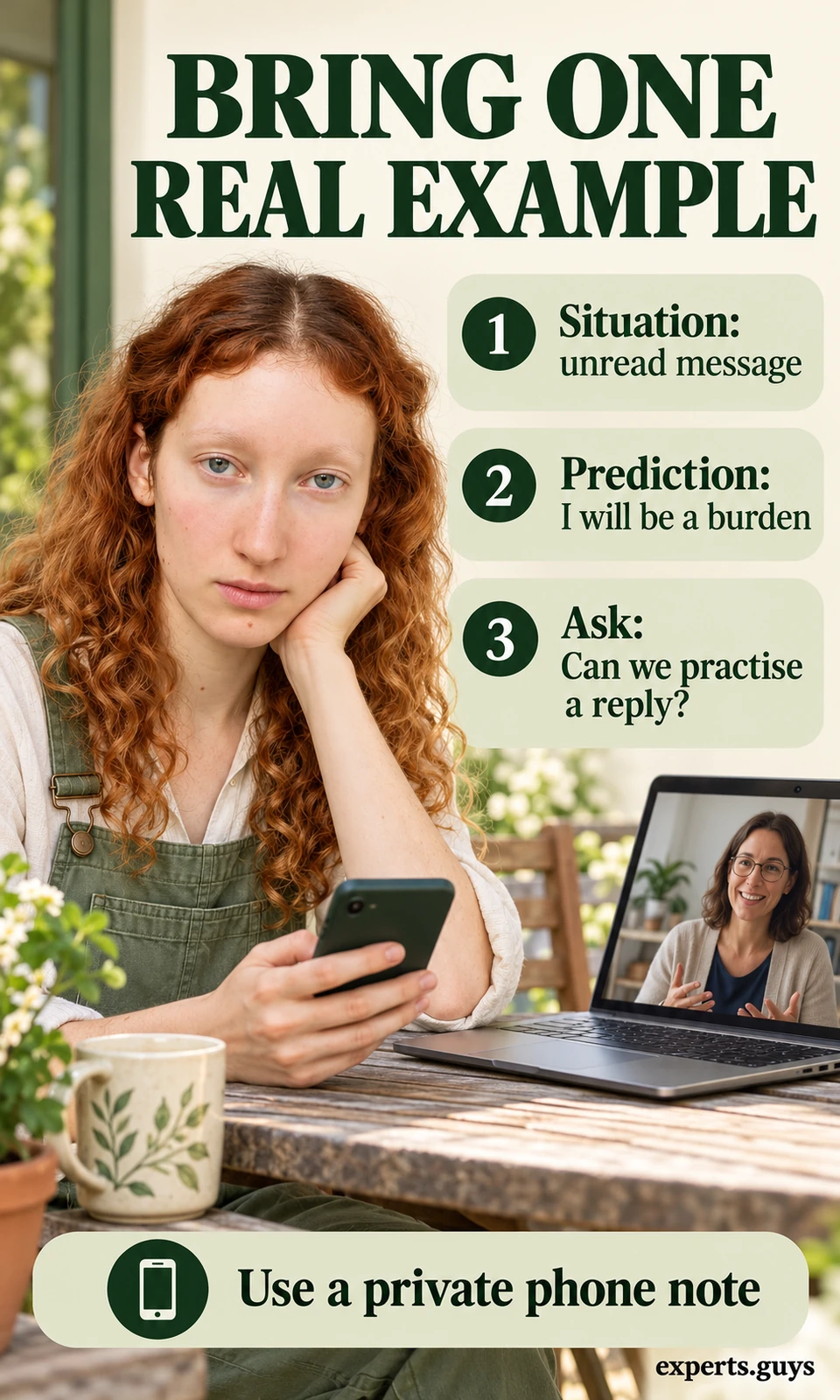
Avoid turning the note into a long prosecution of everything you did wrong. If concentration is poor, bring only the situation and ask the therapist to help unpack it. If the exercise increases distress or feels too exposing, say so and agree a different starting point.
4. Make a prescribed medicine routine clear and manageable
This step applies only if a medicine has already been prescribed for you. The aim is to remove practical uncertainty, not to decide which antidepressant to take. Ask the prescriber or pharmacist to explain any instruction you cannot confidently follow.
- Check the exact medicine instructions, including timing and any food requirements, with the label and pharmacist.
- Set a discreet phone reminder that matches those instructions; choose wording that does not expose private information on your lock screen.
- Ask what to do if you miss a dose, whom to contact about side effects and when your first review will happen.
Illustrative example: a person working changing shifts cannot tell whether their usual reminder still fits the prescribed schedule. The useful action is to ask the pharmacist for a suitable routine, then update the reminder to match the advice. Moving doses around by guesswork is not the solution.
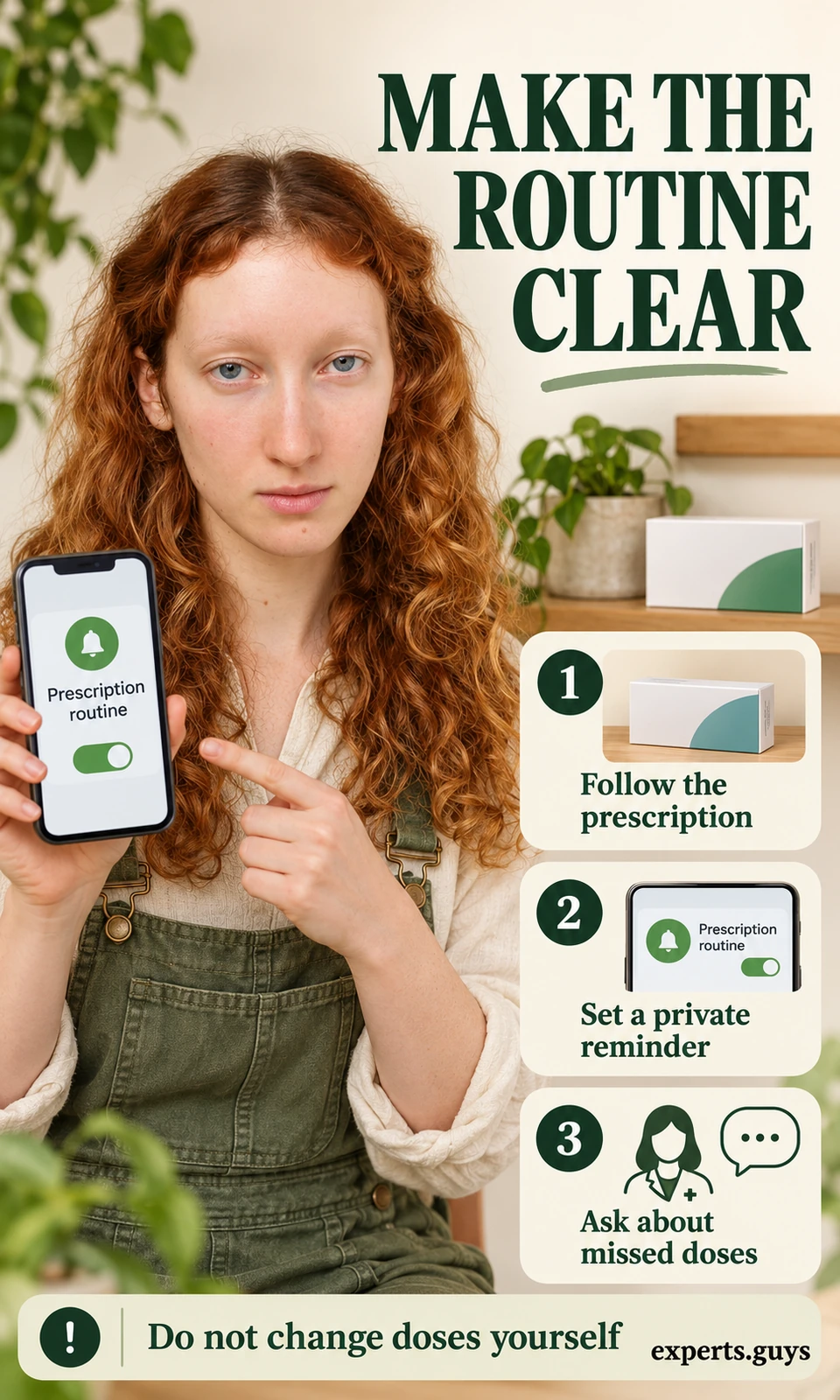
An alarm cannot solve an intolerable side effect, unaffordable prescription or unclear instruction. Tell the care team which obstacle is present instead of describing yourself as “bad at taking medicine.” Do not double, stop or alter doses on your own; use the medicine-specific missed-dose instructions and obtain advice when uncertain.
Antidepressants can take several weeks to help, while unwanted effects may appear earlier. Agree the review timing with your prescriber and report new suicidal thoughts or marked agitation promptly; use emergency care if safety is at risk. The NHS antidepressant guide explains side effects, interactions and why stopping needs a supervised plan.
5. Fix one obstacle that prevents treatment from happening
Sometimes a sensible treatment plan fails because the appointment is impossible to attend. Lack of privacy, transport, money, language support or suitable timing is a practical problem, not proof of unwillingness. Choose the obstacle that is actually stopping the next step.
- Name the barrier precisely: “I share a room and cannot speak privately during video appointments.”
- Ask the service about a feasible alternative, such as an in-person visit, a different time or financial assistance where available.
- Confirm the arrangement before the appointment: location or connection link, cost, time and any access support.
Illustrative example: switching to online therapy solves travel but creates a privacy problem at home. Asking about an in-person slot may be more useful than repeatedly missing video calls. The best format is the one that is clinically appropriate and workable for the person using it.
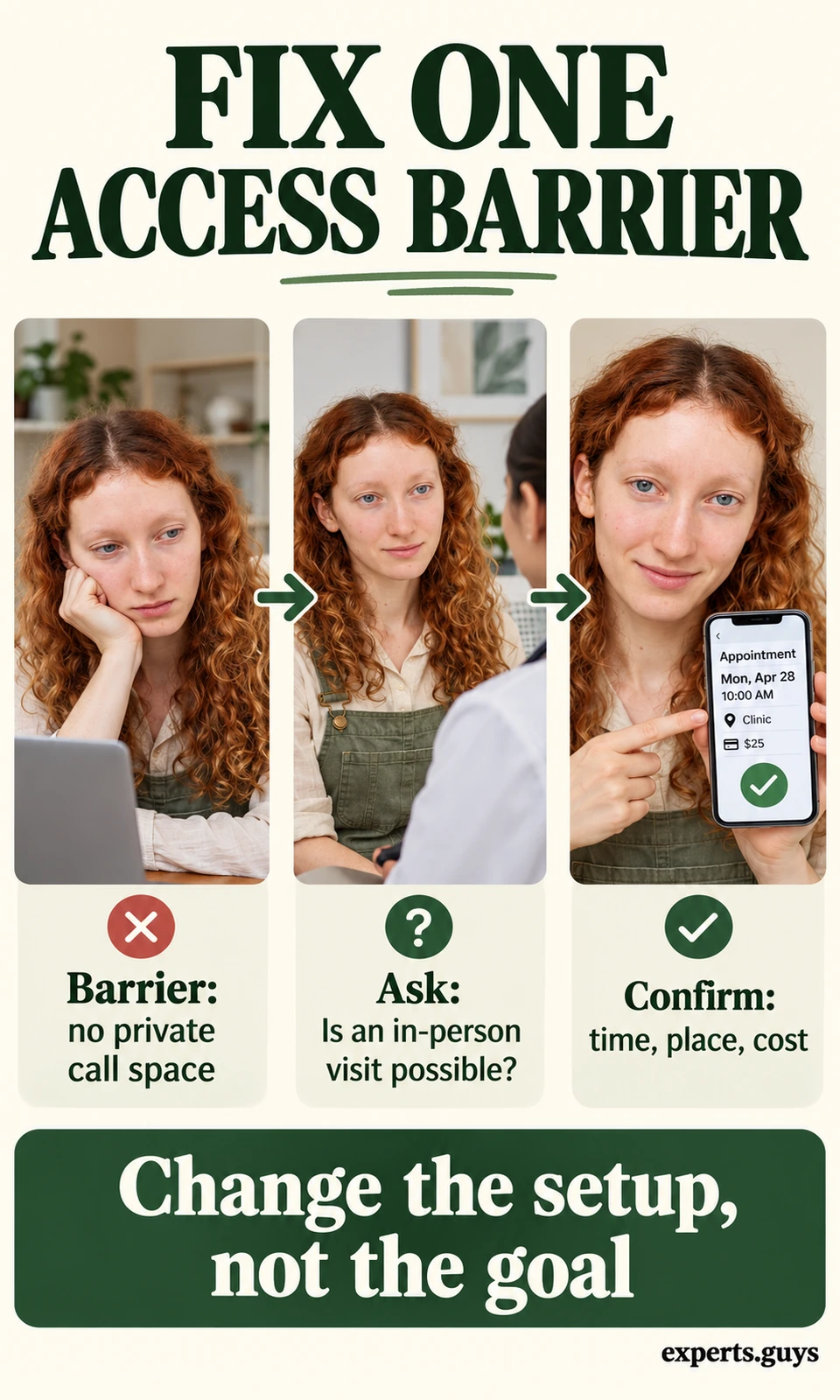
Do not assume that every service offers every option. If the first alternative is unavailable, ask what the service can actually provide and who can help arrange the next step. Success here is a realistic route to receiving care, not an immediate change in mood.
6. Review benefit, effort and unwanted effects together
A review is more informative when it includes what has improved and what still makes life difficult. Mood, everyday function and treatment burden may not change together. Your examples can supplement the symptom measures your clinician uses without turning a phone note into a diagnostic test.
- Return to the same everyday task you chose as a goal and compare a recent example with how it was before.
- Describe effort and recovery as well as completion: “I replied, but needed the rest of the evening alone.”
- Bring benefits, difficult effects, missed sessions or doses and access problems to the agreed review. Ask what the next adjustment should be.
Illustrative example: replying to a message now takes less effort, but sleep remains poor. Both observations belong in the review; neither cancels the other. This is a hypothetical comparison, not a promised recovery sequence or a reason to change a prescription.
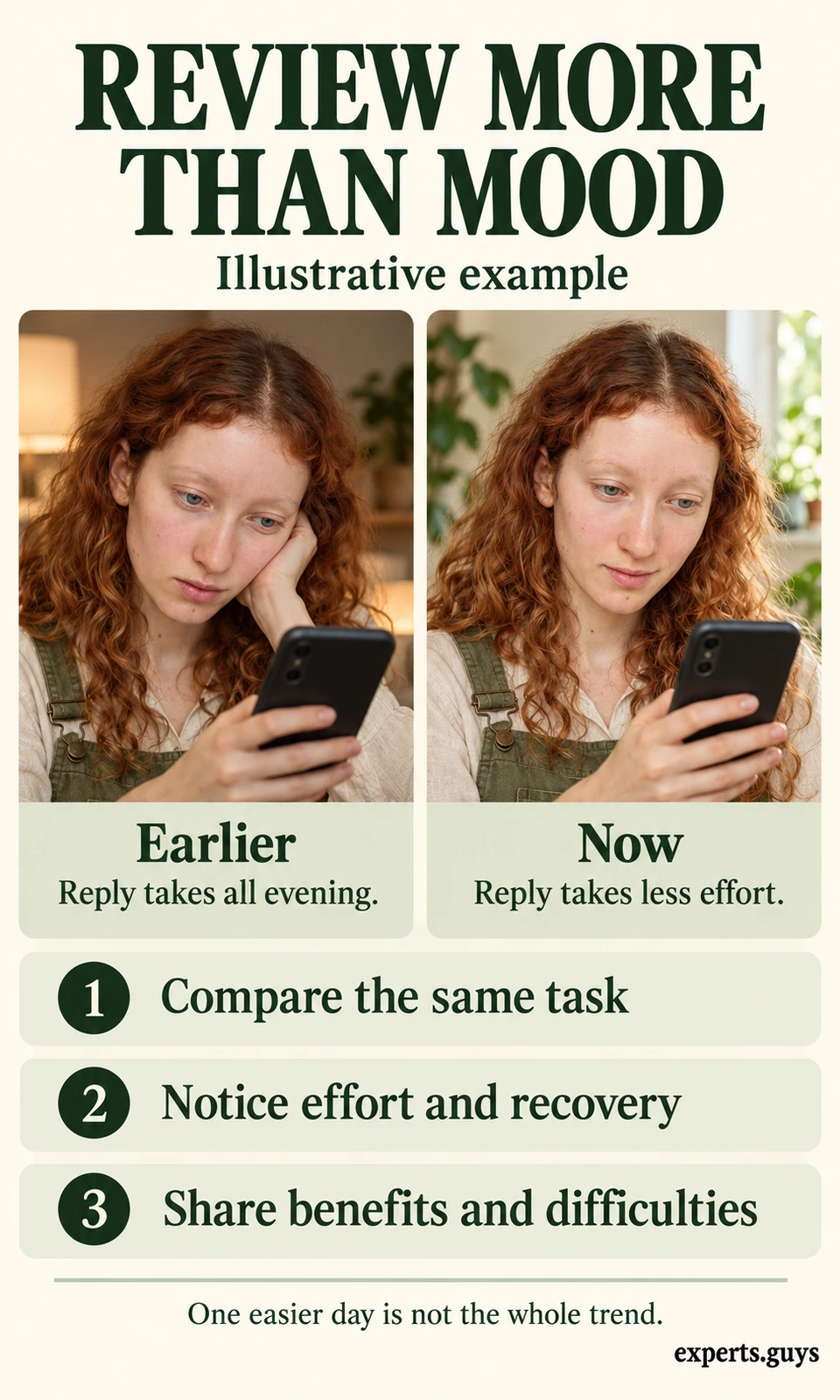
Avoid judging a whole course of treatment by one unusually good or bad day. If tracking becomes repetitive or upsetting, use occasional examples instead of frequent ratings. Worsening symptoms or safety concerns warrant earlier contact rather than waiting to collect a more complete record.
7. Agree how to respond if your condition worsens
A familiar pattern of depression can make a new deterioration easy to dismiss. A short contact plan removes some uncertainty about whom to approach when things change. It should be agreed with your care team and should not rely on a routine inbox for emergencies.
- Ask which changes should prompt earlier contact in your situation, including worsening symptoms or difficult treatment effects.
- Save the correct service contact and ask how quickly messages are usually answered.
- Confirm the out-of-hours route and, if you want support, tell a trusted person what help you would welcome.
Illustrative example: you begin missing meals and appointments after previously managing them. Instead of treating this as an ordinary bad week, contact the care team promptly and explain the change. Ask whether you need an earlier assessment and what to do while waiting.
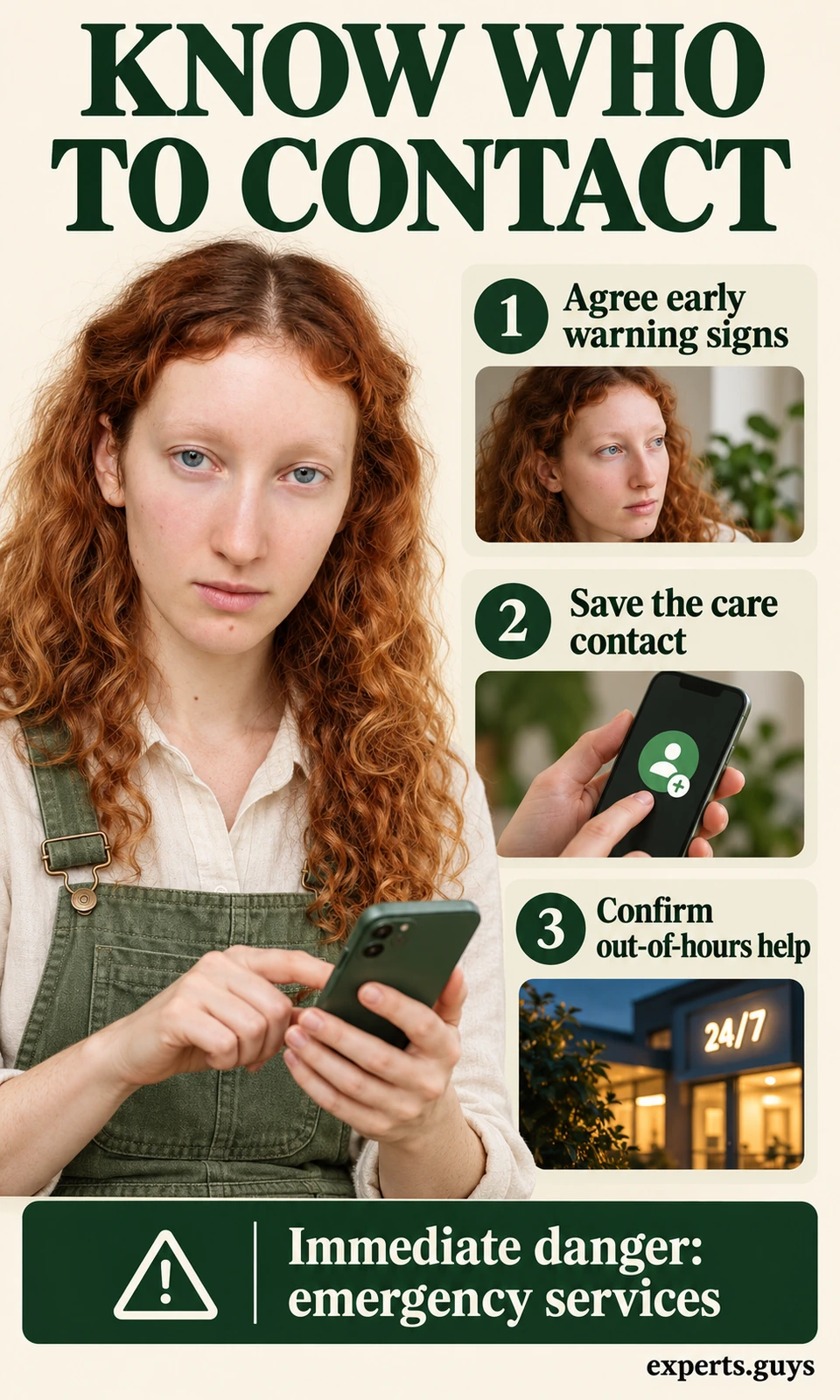
If you might act on suicidal thoughts, have taken an overdose or cannot stay safe, use local emergency services or the nearest emergency department now. New hallucinations, severe confusion or a marked loss of ability to care for yourself also need urgent assessment. This contact plan is not a personalized suicide safety plan; ask for one with a qualified professional if needed.
What if treatment does not seem to be helping?
Bring the lack of benefit into the review as a concrete problem to solve. The discussion may need to distinguish an unsuitable approach, a treatment that has not been delivered as intended, unwanted effects, access barriers or another contributor to symptoms. A disappointing experience is information for reassessment, not proof that improvement is impossible.
| What you notice | A useful review question |
|---|---|
| The therapy goal is still unclear. | “What specific problem are we working on, and how will we assess change?” |
| The plan is understood but difficult to carry out. | “Can we change the format or the practical demands?” |
| There are some benefits and some difficult effects. | “How should we weigh these together?” |
| No meaningful change despite following the agreed course. | “Should we reassess the approach or the diagnosis?” |
| Symptoms are worsening. | “Do I need an earlier assessment?” Use urgent care for immediate danger. |
For general context, the NIMH depression guide describes treatment options and individual variation in response. There is no universal deadline by which every person with PDD should recover. Keep the agreed review, and seek earlier advice when a significant change occurs.
Questions about dysthymia treatment
Do I need an app to use these steps?
No. A private phone note, a calendar reminder or a spoken question may be enough. Choose the simplest format that helps without creating extra work, and consider who can see notifications or shared-device content.
What if I have no memory of a well period?
You can describe what you would like to become easier now. A treatment goal does not require a perfect earlier version of yourself for comparison. Your clinician can help separate the long-standing pattern from recent changes.
Can I ask for help with appointment costs or access?
Yes. Tell the service which practical barrier is preventing care and ask what options exist. Availability differs, so confirm actual fees, format and support rather than assuming a particular arrangement is offered.
Do I have to tell everyone about my diagnosis?
No. You can choose what to share and with whom. For practical help, you may prefer a specific request such as assistance getting to an appointment, without explaining your full history.
If I feel better, can I end treatment immediately?
Improvement is a reason to review the plan, not to stop a prescribed medicine abruptly. Discuss continuation, follow-up and any gradual stopping plan with the prescriber. Therapy endings can also include a plan for recognizing future difficulties.
Your next-step checklist
- Choose the one section that addresses your current obstacle.
- Use its example to prepare one question or practical arrangement.
- Agree the next review and the contact route for worsening symptoms.
- Judge the plan by useful change and manageable participation, not by perfect performance.









