



The chemistry of depression concerns chemical signalling and related biological processes, rather than a routine test showing that one mood chemical is missing. To interpret a test or a research claim, first identify the sample and the measurement, then ask what that result has actually been shown to mean for depression.
What does a claim about brain chemistry actually measure?
The phrase “brain chemistry” can hide several different questions. A researcher might measure the amount of a substance, investigate how a receptor responds, examine a transporter or assess a change in symptoms. Those are not different ways of measuring the same thing. Each captures a particular part of a system, under particular conditions, and has a different relationship to what a person experiences.
Start by replacing the broad phrase with a concrete noun. Is the result a concentration in a sample, a binding measure, a change in cell activity or a clinical outcome? If the description never becomes that specific, the reader cannot tell what the evidence establishes. Scientific terminology is most helpful when it reduces uncertainty about the measurement rather than simply making the explanation sound impressive.
A chemical quantity is an amount measured in some defined setting. A functional response concerns what happens when a system receives or processes a signal. A clinical outcome concerns a person’s symptoms, functioning or another agreed health result. It is possible to study any of these carefully while leaving the others unresolved; none should be silently substituted for another.
Think of an illustrative research announcement saying that an intervention changed a biological measure. Before interpreting that as improved depression, ask whether depression outcomes were measured at all. If the study examined cells, the result may help investigate a mechanism. It has not thereby established what a person would feel, whether the intervention is safe or whether a clinical benefit would persist.
- Name the quantity: an amount, a response, a handling process or a clinical outcome.
- Identify the setting: the sample and method used, rather than the broad phrase brain chemistry.
- Keep the interpretation bounded: what relationship has actually been established?
- Connect the result to its purpose: what question or appropriate decision can it inform?
Amount, response and outcome are different quantities
An amount cannot describe every aspect of a signal. Where a substance is released, the receptors present and the processes handling it also matter. This is why describing chemistry as a tank that needs refilling is an unreliable starting point. It overlooks the parts of communication that determine how a signal is received, regulated and integrated with other activity.
The NCBI neuroscience overview of neurotransmitters describes a cycle involving synthesis, packaging, release, receptor interaction and removal. That framework makes the missing information visible: a measurement of one stage is not automatically a measurement of all the others. The more detailed cell-by-cell explanation belongs in the guide to neurotransmitters and depression.
For example, knowing that a substance is present does not establish that a particular receptor responded in a particular way. Equally, observing a response in a laboratory system does not show that the same response accounts for the full experience of depression. These are not reasons to dismiss the measurement. They are reasons to describe its contribution at the correct level.
The useful distinction is between a result and an interpretation of that result. A result might be a measured difference between samples. An interpretation might propose a mechanism that could explain the difference. The interpretation can be reasonable without being proven, and competing interpretations may remain. Clear reporting keeps the measured observation and the explanatory proposal separate enough to inspect.
| What is measured | What it can describe | What it does not establish alone |
|---|---|---|
| Chemical amount | An amount or concentration in the specified sample using the particular method. The unit, sample and conditions belong to the result. | How every receptor responded, the cause of depression or whether an intervention improves daily functioning. A chemical name does not supply those missing links. |
| Receptor-related measure | A defined property of a receptor or its response under the studied conditions. The method needs to specify which property is being examined. | A complete account of signalling throughout the brain, every downstream effect or the clinical value of changing that property. |
| Transport or handling process | A process involved in moving or handling a substance. This may help investigate how an intervention acts within a biological system. | That everyone who benefits from an intervention had a pre-existing deficiency, or that changing the process guarantees a desirable outcome. |
| Clinical outcome | The outcome actually assessed in people, such as a symptom measure, functioning or a burden associated with treatment. The population and comparison matter. | A direct reading of a particular brain chemical or a full explanation of every mechanism responsible for the observed result. |
| A proposed personal profile | Whatever the specific method has been validated to determine for the stated purpose; the interpretation needs evidence connecting the result to that purpose. | A personal mood diagnosis merely because the report contains laboratory terminology, coloured ranges or a recommendation to buy a product. |
Why a biological target is not an outcome measure
An intervention may be designed to act on a biological target. Showing that it reaches or changes that target answers an important question, but it does not by itself establish a meaningful benefit. A treatment programme still needs evidence concerning the people studied, their outcomes and unwanted effects. “It acts on a relevant pathway” is a starting explanation, not the completed evaluation.
The distinction also works in the opposite direction. A clinically helpful intervention does not have to supply a complete account of every chemical step involved before its benefit can be evaluated. Outcome evidence and mechanistic understanding can advance at different speeds. A useful explanation says which part is established, which remains uncertain and what decision the existing evidence can reasonably inform.
For an illustrative comparison, imagine two reports. One describes a change in a receptor-related laboratory measure. The other describes improvement on a depression outcome in a clinical study. You should not treat the first as though it measured the second, or assume that the second identifies a chemical deficiency before treatment. Both may be informative, but they answer different questions.
This distinction helps avoid a common sales technique: replacing the promised outcome with evidence of a plausible process. A product may be described as participating in a pathway and then advertised as though clinical relief has been demonstrated. The missing step is evidence connecting the actual product, use and population to the advertised benefit, with appropriate attention to harms and uncertainty.
A measurement also needs its unit and method. Two reports using the same chemical name may not be directly comparable if they concern different samples or procedures. Before treating one value as higher or lower in a meaningful sense, establish whether the quantities being compared represent the same thing. Do not supply your own conversion or interpretation from an unrelated online range.
Outcome definitions deserve the same precision. A change on a symptom measure, returning to a necessary activity and the burden of an unwanted effect are different observations. A useful evaluation says which outcome was measured rather than replacing it with the broad word better. That helps readers understand both the value and the limits of the result.

Why is the sample as important as the chemical name?
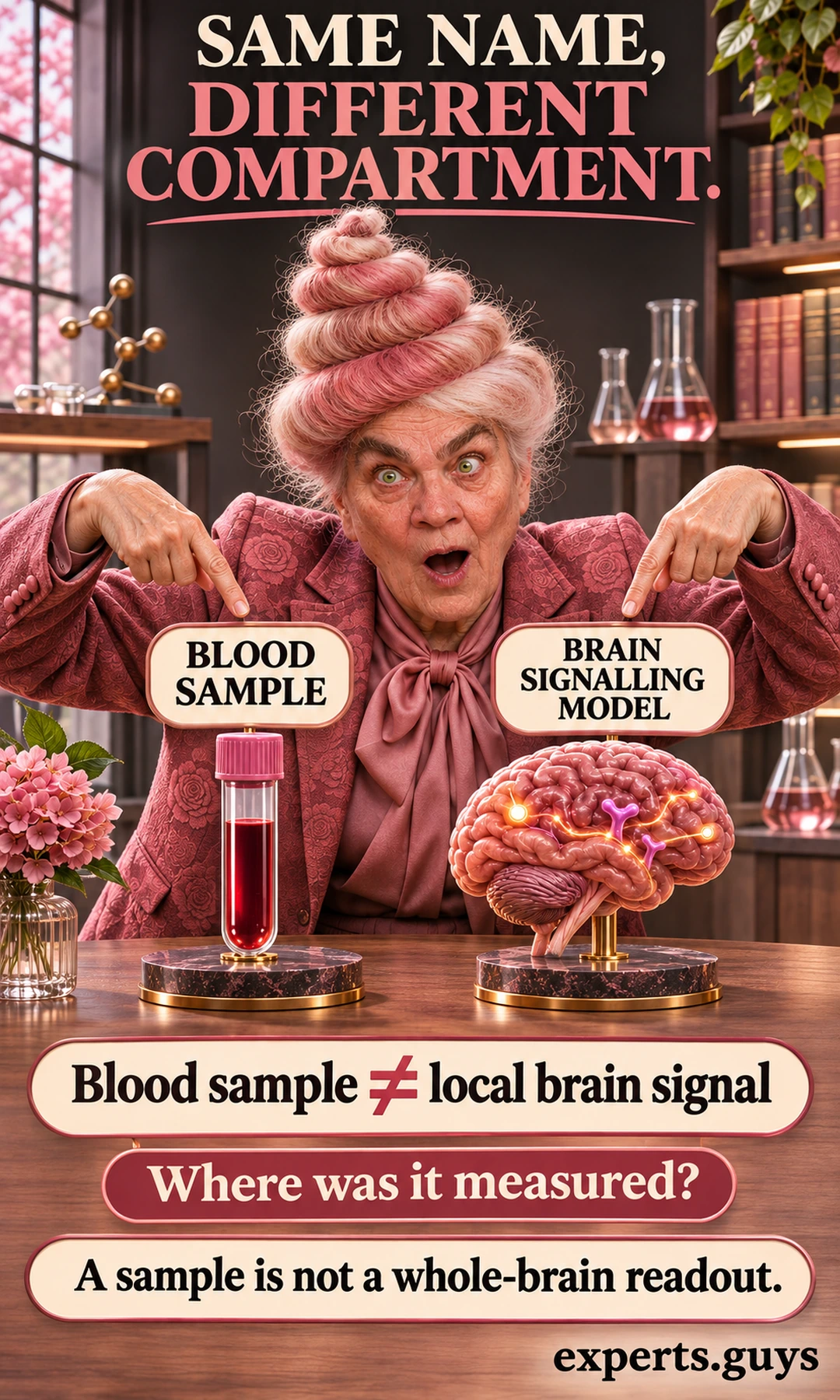
A sample comes from somewhere. Blood, urine, cerebrospinal fluid, tissue and research imaging measures are not interchangeable windows onto the same activity. Before interpreting a chemical result, ask where it originated and what the method was designed to capture. A familiar chemical name does not make measurements from different compartments equivalent.
Serotonin illustrates the point. A review of serotonin synthesis and its roles describes distinct central and peripheral pools because serotonin itself does not cross the blood-brain barrier. That distinction prevents a simple inference from a peripheral measurement to local signalling in a brain circuit. It does not mean that body and brain are unrelated; it means that the connection needs evidence rather than assumption.
The wording matters. “This sample contained a measured concentration” describes the sample. “Your brain has too little signalling in the pathway responsible for your depression” makes a much larger claim. To get from the first statement to the second, the method would need to establish several additional relationships. A professional-looking report does not make those relationships automatic.
What a test can usefully investigate
Some investigations are valuable because they examine another possible contributor to symptoms or a coexisting condition. The NIMH depression guide notes that medical conditions and medications can produce similar symptoms. Investigating an appropriate alternative question is different from ordering a routine neurotransmitter reading to identify a personal depression cause.
Suppose, illustratively, that a clinician investigates a possible thyroid problem because the person’s history makes that question relevant. The result should be interpreted in relation to thyroid function and the clinical situation. It should not be treated as a universal test of whether every symptom is real, whether depression is present or whether all other explanations have been excluded.
A normal result can therefore be useful without being a complete answer. It may narrow one question while leaving another open. An abnormal result also needs interpretation: it can prompt investigation or management without establishing that the abnormality explains the whole presentation. The responsible next step follows the test’s validated purpose, not the emotional weight of the word abnormal.
Reference range and diagnostic meaning are separate
A reference range helps place a measurement within the comparison used by a laboratory. It does not automatically make that measurement a validated way to diagnose depression or select a treatment. The important question is what the particular result has been shown to distinguish or predict, using the method and population relevant to the decision.
For example, a colourful result outside a displayed range may attract attention. The colour is a presentation choice; the clinical interpretation still depends on the substance, sample, method, context and reason for testing. A reader should not move straight from a red box to an explanation of personality, motivation or an entire mood disorder.

The reverse mistake is to assume that a result inside a range guarantees that nothing important is wrong. A test answers a bounded question. If its purpose was to examine one possible medical issue, an in-range value does not measure every brain process or resolve every symptom. The conclusion should remain as specific as the investigation rather than expanding to fit the reassurance someone wants.
Clinical validation asks a further question: does this result support the decision being proposed? A method can be able to measure something consistently without having established that the measurement should determine a particular treatment. Accuracy of measurement and usefulness for a clinical decision are related, but they are not identical achievements.
An illustrative commercial report
Imagine an advertisement offering a “personal mood chemistry profile” from a simple sample. The first useful response is to identify the actual sample and analyte—the substance being measured. Then ask how the result has been connected to the advertised decision. If the response supplies only a general discussion of neurotransmitters, it has not yet answered the question about this particular method.
Next, distinguish the report from the service recommendation attached to it. A laboratory result and a suggested supplement bundle are different claims requiring different justification. The recommendation should not be accepted merely because it appears beside a measurement. Nor should an unfamiliar result lead someone to start or stop prescribed treatment as an experiment in correcting a supposed chemical score.
If these questions are difficult to answer, the immediate conclusion can stay modest: the advertised personal interpretation has not been established for you. That is enough to pause an optional purchase or seek clarification. You do not have to prove that every aspect of the underlying science is false before declining a promise that has not been justified.
What changes when the finding concerns a group or a moment in time?
Research frequently compares groups. A finding may describe a difference in the average value of a measure between groups, while individual values vary within each group. The result can be scientifically informative without telling a particular reader their own value, the cause of their symptoms or which treatment will help. Personal interpretation needs more than membership of a diagnostic category.
The distinction becomes clearer if you describe the two questions separately. “Do these studied groups differ on this measure?” asks about the research comparison. “Does this measure identify what is happening for this person?” asks about individual application. A strong answer to the first can motivate work on the second, but cannot simply be renamed as that answer.

Why comparison groups and overlap matter
A claim about a difference should identify the comparison. Was it between people with and without a diagnosis, before and after an intervention, or between laboratory conditions? Those designs establish different contrasts. A headline that omits the comparison can make a narrow finding sound like a general chemical signature, even when the research question was much more limited.
Variation within a group also matters. A mean can summarise data while concealing the spread or the presence of different patterns. Without information about individual variation and the method’s ability to distinguish relevant cases, a group difference is not enough to establish a personal test. Describing this limitation does not invalidate the research; it identifies the work still needed for clinical use.
The same caution applies to a finding that does not detect a group difference. It answers the studied question under its conditions, not every possible question about every related pathway. A negative result should not be stretched into a claim that biology is irrelevant, just as a positive result should not be stretched into a claim that a personal cause has been discovered.
Timing and context belong to the measurement
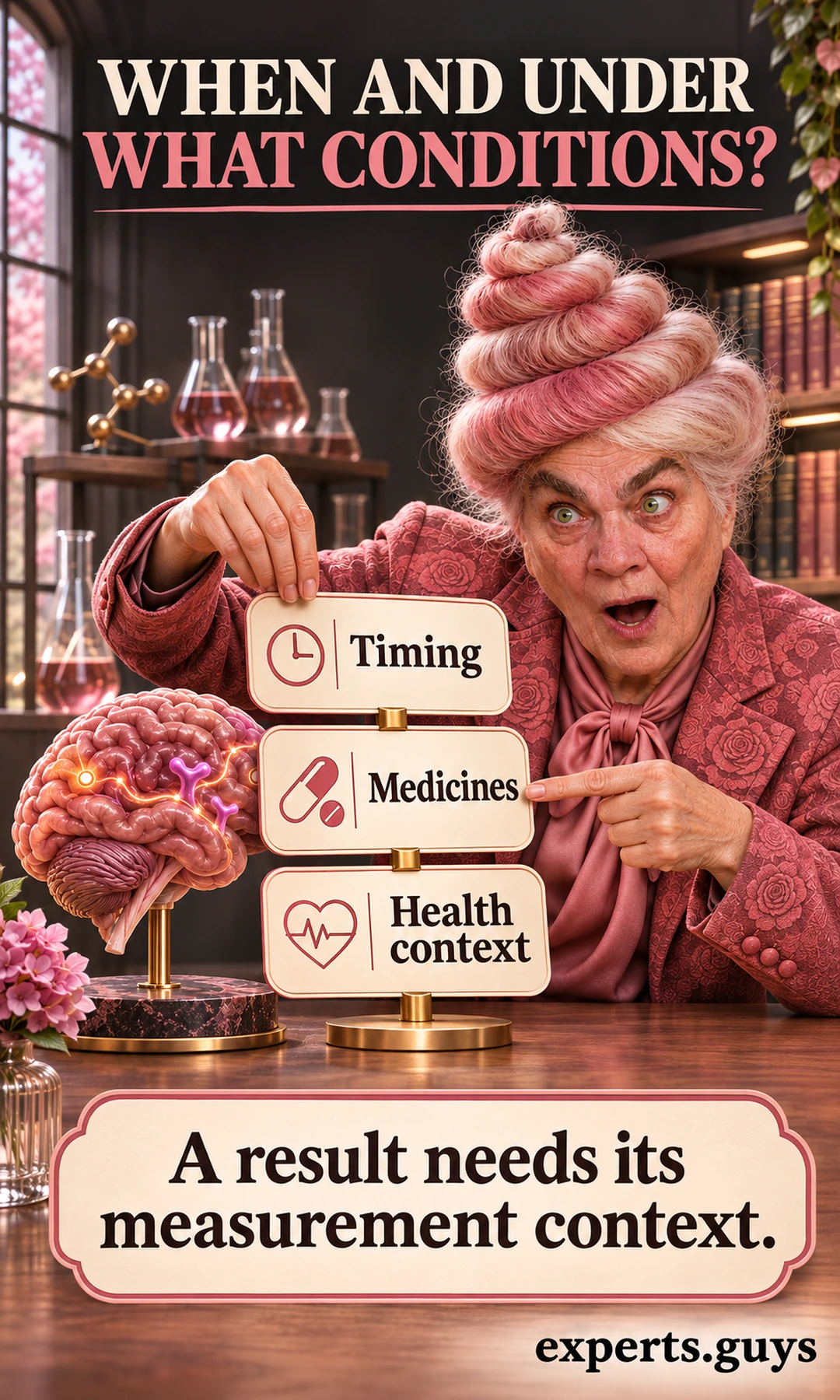
A chemical result is obtained at a time, using a method and under conditions. If the interpretation concerns change, those conditions need to be considered before treating two values as comparable. The relevant details depend on the test; a reader should ask for the method’s actual requirements rather than invent a preparation routine from a general article.
Medications and health context can also matter to an interpretation. That is a reason to provide accurate information when a test is clinically indicated, not a reason to skip a medicine or alter a routine independently. Any preparation instructions should come from the responsible testing or clinical team and be specific to the investigation being performed.
For an illustrative research example, consider a measurement taken after treatment has begun. A difference observed at that point might relate to treatment, the illness, another condition or several factors together. Calling it the original chemical cause requires evidence about timing and alternatives. The sample’s position in the sequence is part of the reasoning, not an incidental footnote.
Similarly, observing an improvement after a change does not identify every reason for that improvement. Symptoms, circumstances and treatment can change together. Careful evaluation can still use the person’s experience, while resisting the urge to assign every change to the most recently discussed chemical mechanism. The goal is a better decision, not a complete story built from insufficient measurements.
Why a diagnosis is not a chemical identity
People who share a diagnosis need not have identical histories, symptoms or biological findings. NIMH’s discussion of translational mental-health research explains why identifying observable characteristics that can improve clinical decisions remains a research challenge. A research initiative aimed at improving prediction is not proof that a simple commercial profile already provides that prediction.
This is also why “biological” and “psychological” are poor labels for sorting people into mutually exclusive types. An experience can have biological processes and meaningful social or psychological context at the same time. The depression theories comparison explains the different explanatory questions; this article keeps the focus on what measurements can support.
How can you follow a result to a useful decision?
Start with the decision rather than the appeal of an impressive explanation. Are you trying to understand a research finding, evaluate an optional purchase or clarify a clinically indicated investigation? The same chemical name can appear in all three settings, but the evidence needed for each decision differs. Making the purpose explicit prevents a report from deciding a question it was never designed to answer.
For a research finding, a useful result may be greater understanding and a better question for the next study. For an optional purchase, the result may be deciding that the advertised benefit has not been established. For clinical care, the result may be a specific conversation about what the test changes. None requires assigning yourself a chemical-deficiency label.
Keep mechanism and outcome side by side
A mechanism concerns what an intervention does within a system. An outcome concerns what changes for the person. A credible evaluation can consider both, but one cannot replace the other. This distinction protects against dismissing a real improvement because a simplified explanation was flawed, and against accepting a treatment promise merely because the mechanism sounds plausible.

If the question concerns medicines, compare the actual treatment option rather than choosing a product from a neurotransmitter slogan. The guide to what a low antidepressant dose means explains why the amount on a label needs purpose and context. A general chemistry explanation cannot determine an individual medicine, dose or combination from a symptom or a laboratory-looking report.
A four-link check for a chemical result
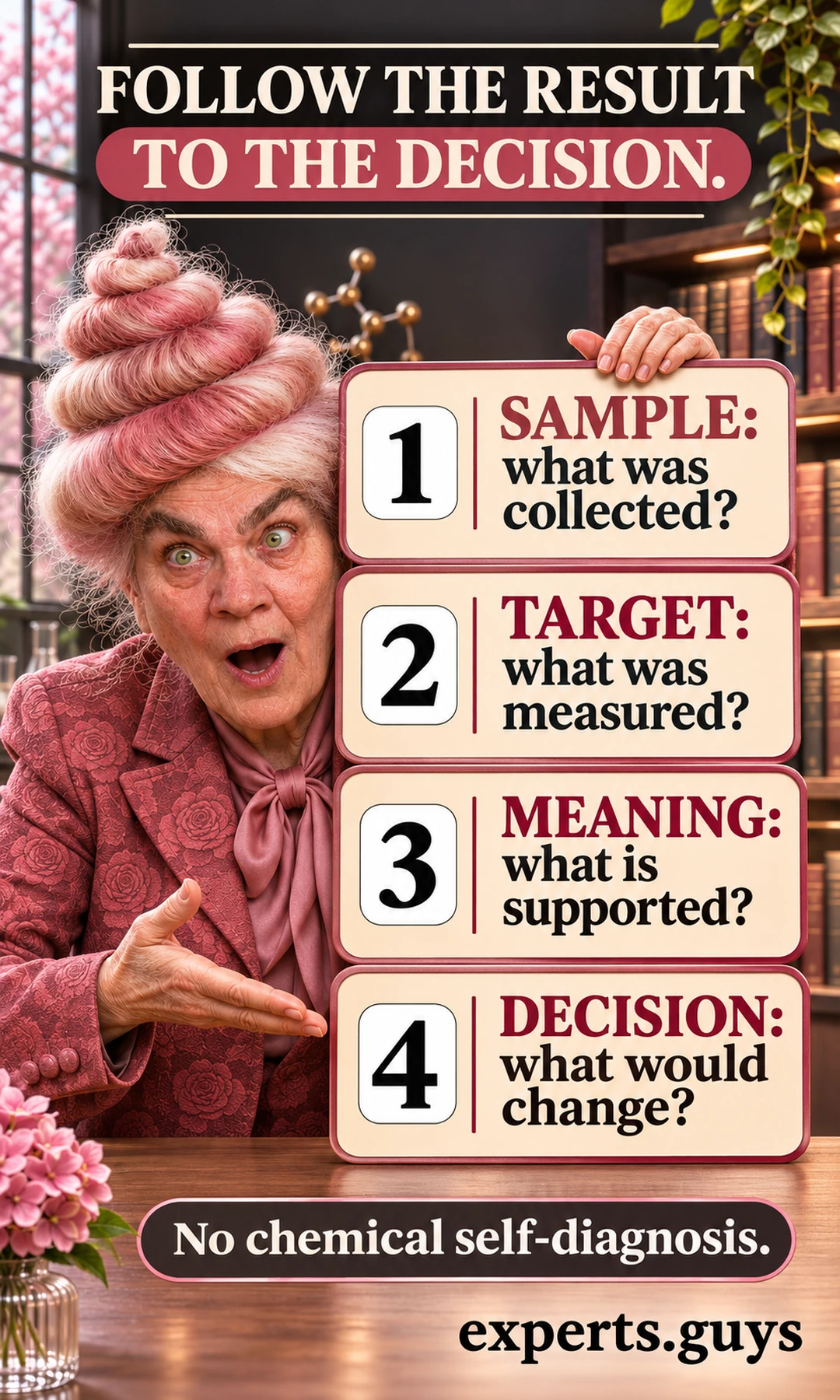
Use four links: sample, target, meaning and decision. This is a way to understand a claim, not a home diagnostic protocol. You can use the wording on an existing report or a public study description without recording symptoms, filling out a worksheet or arranging a test. The aim is to locate the point where the proposed interpretation exceeds what is established.
| Link | The question to answer | A useful checkpoint |
|---|---|---|
| Sample | What was collected, and from which compartment? Identify the actual material rather than accepting brain chemistry as a sampling method. | You can name the sample in plain language. If the interpretation concerns a different compartment, the explanation must justify that connection. |
| Target | What substance, property or outcome did the method measure? Keep a concentration, a functional response and a clinical outcome separate. | You can state the measured target without replacing it with mood, motivation or the entire illness. The method and units fit the stated target. |
| Meaning | What interpretation is supported for this method, population and context? Distinguish a result outside a range from a validated depression conclusion. | The explanation names what is established and what remains uncertain. It does not convert an association or a laboratory result into a personal cause without evidence. |
| Decision | What appropriate decision would change because of this result? A research question, optional purchase and clinical investigation require different next steps. | The proposed action follows from validated use. A result is not treated as permission to change prescribed treatment or accept an unsupported product promise. |
Here is an illustrative walkthrough. An advertisement describes a urine measurement, calls it a brain neurotransmitter profile and recommends a product to correct depression. The sample is urine; the target is the actual substance measured. The next question is whether that measurement has been validated to represent the claimed brain process and support the recommended depression decision. A general pathway diagram does not answer either question.
A common mistake is to assume that asking these questions means rejecting all laboratory testing. The correction is to distinguish purpose. A test can be useful for an established question and unsuitable for a different advertised claim. Evaluating the match between method and decision is more precise than treating every test as either a complete explanation or a worthless procedure.
If the technical wording feels overwhelming, begin with only the first link: what was collected? Then identify the decision being proposed. That shorter version can reveal a large gap without requiring you to interpret specialist details. A satisfactory explanation should be able to say what the test does and does not establish in language that connects to the actual decision.
What to do with an unanswered link
An unanswered question can be a useful stopping point for an optional purchase. You can request the evidence supporting the specific interpretation instead of continuing through a sales process. For a clinically indicated test, ask the responsible team what the result is intended to change and how it fits with the rest of the assessment. These are different situations, so the next action should differ too.
Do not alter prescribed medication to test an online account of chemistry. The Royal College of Psychiatrists’ stopping-antidepressants information explains why withdrawal and an individual stopping plan matter. If symptoms become severe or safety is at immediate risk, seek urgent local help rather than waiting to resolve a scientific explanation.
Questions about chemistry and depression
Does a normal blood result mean depression is not real?
No. A result answers the question that particular investigation was designed to examine. A normal finding may narrow one medical question without resolving every symptom or ruling out depression. It should be interpreted alongside the clinical picture, rather than used as a judgement about whether a person’s difficulties are genuine.
Does an abnormal result identify the chemical cause of my mood?
Not automatically. An abnormal result may deserve investigation or management for its established purpose, but identifying one difference is not the same as explaining every symptom. Ask what the result means for the particular test and what decision it has been validated to support before accepting a broader personal explanation.
Is a more detailed chemical report necessarily more useful?
No. More categories, colours or technical names can create an impression of precision without improving the decision. Usefulness depends on what the method measures, the evidence supporting its interpretation and whether it changes an appropriate action. A shorter, well-explained result can be more informative than an elaborate profile with an unsupported clinical promise.
Can a test be reliable but unsuitable for a particular claim?
Yes. Consistently measuring a substance and establishing that the measurement should determine a depression decision are different achievements. A method may answer a valid laboratory question while leaving the advertised personal interpretation unproven. Evaluate the specific claim and use rather than assuming that a real measurement validates every recommendation attached to it.
What if I cannot understand the technical method?
Begin with the sample and the intended decision. Ask for an explanation of what was collected, what was measured and what the result changes. You do not need to resolve every specialist detail to notice that a general pathway explanation has not answered a question about a specific test’s clinical use.
Should I change treatment after reading a different chemistry explanation?
Do not change prescribed treatment to test an internet explanation. Bring the specific concern, your actual experience and the proposed next question into an appropriate treatment discussion. A flaw in a simplified chemical story does not erase a real benefit or an unwanted effect, and medication changes require an individual plan.
Action checklist
Identify the sample, the measured target, the supported meaning and the decision that would change. Keep a missing link visible instead of filling it with a chemical slogan. That approach lets you take both research and your own difficulties seriously while asking a precise question about what a result can actually do for you.









