
Neurotransmitters are chemical messengers used in communication between cells, and their signalling is one part of depression research. To understand a claim about them, follow the process—release, receptor interaction and clearance—rather than treating a symptom as proof that a particular chemical is low.
What happens when a chemical signal passes between cells?
A neuron is a nerve cell that receives and sends signals. Its activity involves electrical processes within the cell and, at many connections, chemical communication with another cell. The chemical messenger does not carry a single emotion across the brain. It participates in a signalling process whose effect depends on the receiving system and the surrounding activity.
The NIGMS introduction to neurotransmitters describes how vesicles release messengers and how receptors receive them. A useful first picture is a sending side, a small gap and a receiving side. This is a simplified account of a chemical synapse, not a claim that every connection in the nervous system operates identically.
Release makes the messenger available
In a typical chemical-synapse explanation, a signal reaching a nerve ending leads to the release of messenger molecules from vesicles. The messenger becomes available outside the sending cell, where it can interact with appropriate receptors. Describing release tells you about one stage; it does not describe every later response or how the process contributes to an everyday experience.
The distinction matters when reading a headline about “increased neurotransmitter activity.” Does it mean more release, a different receptor response, altered clearance or a different measure altogether? The phrase may be convenient shorthand, but the process needs to be specified before the finding can be interpreted. Otherwise, several different biological changes are being treated as though they were one result.
Binding connects a messenger to a response
Receptors provide a way for a chemical signal to affect a cell. A messenger’s presence is therefore only part of the explanation: the receptor and the cell’s response matter too. After the signalling interaction, clearance processes help regulate or end the messenger’s availability. Release, interaction and clearance are connected stages, rather than separate tanks containing different amounts of happiness.

These stages explain why “more chemical” is not a complete description of stronger or better communication. The location, timing and receiving system also have to be considered. A result about one stage can be useful without answering every question about the others. Keeping the stages separate improves understanding while avoiding a personal conclusion that the measurement did not establish.
A receptor and a transporter have different jobs
A receptor responds to a signal through the processes associated with it. A transporter moves a substance across a membrane; some transporters are involved in taking released messengers back into cells. Those are different jobs. Confusing the terms can make a drug action or research finding sound as though it concerns the receiving cell when it actually concerns the handling of the messenger.
For a simple analogy, imagine an educational display with a receiver and a collection mechanism. The receiver represents a response to a message; the collection mechanism represents movement of the messenger. The analogy is useful only for that distinction. Real receptors and transporters are biological structures, not literal locks, delivery workers or devices designed to make a person feel a particular way.
The word binding also needs care. Saying that a substance binds to a protein does not, on its own, tell the reader the whole functional result. The relevant protein, interaction and measured effect must be specified. A technically accurate description should not move from “binds” to “improves depression” without the additional evidence needed for that clinical claim.
| Term | The useful meaning | The shortcut to avoid |
|---|---|---|
| Release | Messenger molecules become available from the sending side in the chemical-synapse process being described. This concerns one stage of communication. | Treating a release finding as a complete measurement of receptors, clearance, everyday experience and the cause of a particular person’s symptoms. |
| Receptor | A biological structure through which a chemical interaction can affect a cell. The relevant receptor and measured response need to be specified. | Assuming that the messenger’s name tells you the whole effect, or that every receptor interaction produces the same emotional or clinical result. |
| Transporter | A structure involved in moving a substance across a membrane. Some transporters participate in taking released messengers back into cells. | Calling a transporter a receptor, or interpreting a change in handling as a direct measurement of the receiving cell’s full response. |
| Clearance | Processes affecting the removal or handling of a released messenger, including routes such as uptake, breakdown or diffusion according to the setting. | Treating removal as inherently bad, assuming every messenger follows identical routes or deciding that preventing clearance is a universal treatment aim. |
| Clinical outcome | A measured result in people, such as a change in symptoms or functioning during the particular study. It requires its own design and comparison. | Renaming an outcome as a direct transmitter reading or treating a biological target effect as though a clinical benefit has already been demonstrated. |
This vocabulary gives you a practical way to slow down an overbroad explanation. When a statement names a receptor, ask what response is being discussed. When it names a transporter, ask what substance is being moved and where. You do not need to infer a personal chemical level to understand the distinction, and you should not use the terminology to select a medicine independently.
Why does one messenger participate in more than one function?
A chemical name identifies a messenger, not a complete account of its effects. The same messenger can participate in different processes depending on where it acts and which receptors and cells are involved. This is why popular labels such as happiness chemical or pleasure chemical are poor guides to interpreting depression symptoms, personality or a treatment response.
The relevant context includes both the receiving structure and the larger system in which it operates. A statement about one circuit should not be expanded into a claim about every function associated with the messenger. If a study measures a particular task or process, its result needs to remain attached to that task or process unless wider evidence supports a broader interpretation.
Excitation and inhibition are not emotional labels
In neuroscience, excitatory and inhibitory refer to effects on signalling, such as changing the likelihood that a receiving neuron generates an electrical response. They are not synonyms for happy and sad, energetic and lazy, or good and bad. The NCBI summary of postsynaptic signalling describes these terms in relation to electrical responses rather than emotional value.
- Excitatory describes an effect on signalling, not a guarantee of happiness or benefit.
- Inhibitory describes a regulatory effect, not a judgement about effort, motivation or emotional value.
- The receptor, cell and wider system determine what the technical description means in context.

An inhibitory effect can be part of normal, useful regulation. An excitatory effect is not automatically a desirable increase in mood or motivation. Translating these technical terms into a moral or emotional ranking creates an error before the discussion even reaches depression. The correct question is what the effect means within the particular system being studied.
Common messenger names describe broader roles
Dopamine participates in functions including movement, learning and emotion. Serotonin is involved in processes including mood, sleep and digestion, while norepinephrine—also called noradrenaline—has roles that include alertness and other bodily functions. These examples show why one chemical cannot be assigned one feeling. They are descriptions of involvement, not a symptom-to-deficiency chart.
Other messengers and related signalling systems are also studied. A discussion limited to dopamine and serotonin can give the impression that two substances explain the whole condition, when the research question is much broader. The NIMH molecular research framework includes multiple systems; it organises research rather than providing a public diagnostic checklist.
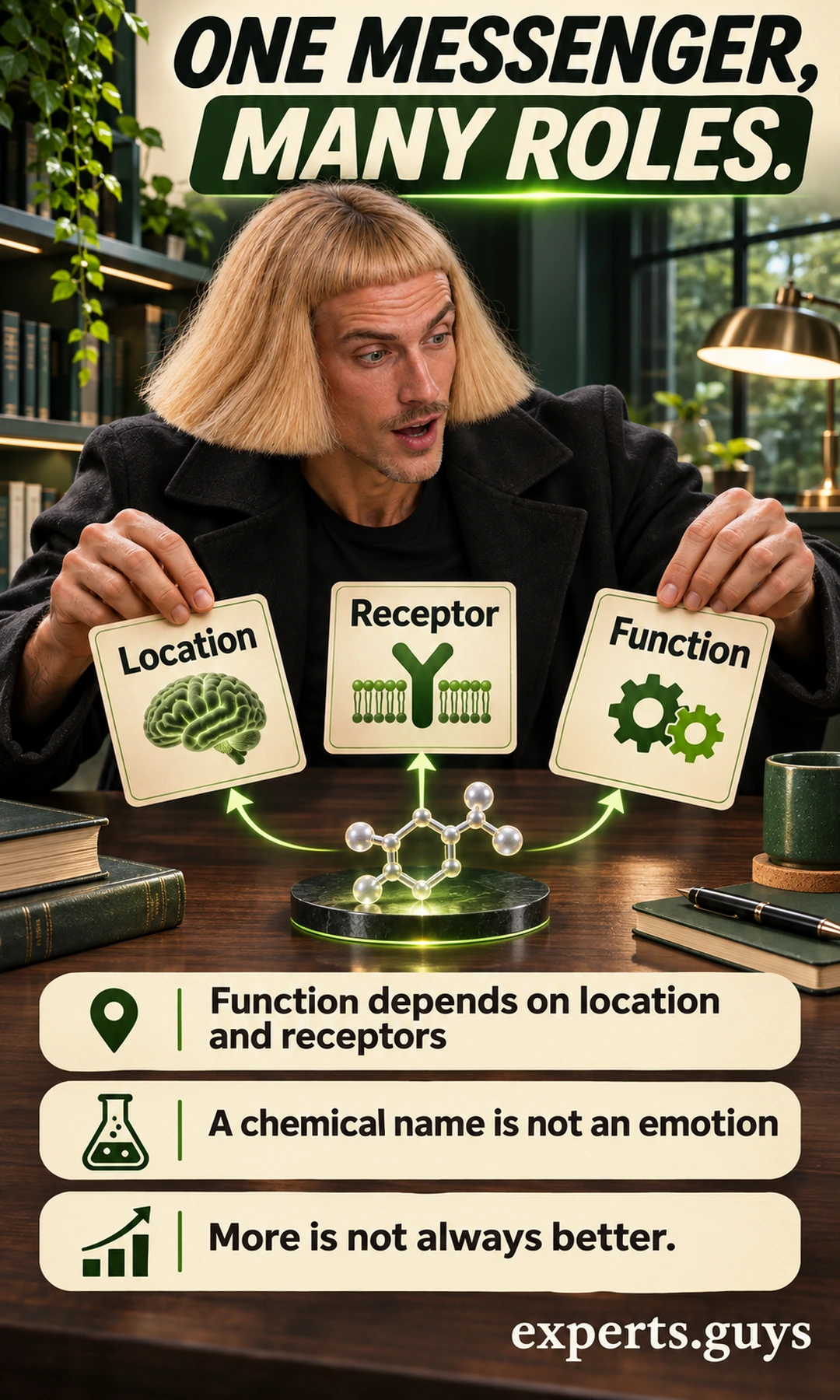
Receptors also help explain differences in the time course of a response. The two broad families of postsynaptic receptors include ionotropic receptors, which combine receptor and channel functions, and metabotropic receptors, which act through intermediate signalling processes. Their effects can therefore develop at different speeds. This is a distinction within cellular communication; it is not a timetable for when someone should feel better during treatment or a reason to interpret slower as inferior.
A receiving neuron also integrates inputs rather than simply obeying one isolated messenger event. The summation of synaptic potentials describes how inputs can combine across space and time to influence whether the cell generates an action potential. A small response at one connection need not determine the outcome alone. This adds another reason to specify the measured process: a finding about one input is not a complete measurement of how the receiving neuron, a circuit or a person behaves.
Why the location changes the question
Consider an illustrative study examining a signalling process during a learning task. Even if the finding is reliable, it is not automatically a finding about every kind of motivation, all daily functioning or the cause of an individual’s depression. The task gives the study a defined question. Generalising beyond that question requires further evidence, not just a familiar chemical name.
The same reasoning applies when a messenger has functions outside the brain. Knowing that a substance is involved in digestion does not make a digestive symptom a direct readout of signalling in a mood-related circuit. The compartment and the process must remain visible. The guide to the chemistry of depression develops the measurement question in more detail.
A cell-level effect is not a complete behaviour
An everyday action involves more than a named messenger. To describe learning, attention or starting a task, an explanation must connect activity across systems with the actual task and circumstances. A finding at one biological level can contribute to that account without constituting the entire explanation. Keeping the levels visible prevents a cell-level description from being mistaken for a complete account of a person.
This also clarifies what an educational model can show. Enlarged props make a sequence easier to follow, but their size, spacing and colour are teaching choices. They are not measurements of a real synapse or a depiction of someone’s brain. The labels communicate the relationship being explained; the illustration does not add evidence beyond the sources and reasoning supporting that relationship.
Symptoms do not identify a measured shortage
Low motivation is an experience that can matter greatly to everyday life. It is not, by itself, a measurement of dopamine. Sadness is not a measurement of serotonin. Assigning a chemical explanation from a symptom skips the steps needed to establish what was measured, where it was measured and how it relates to the particular difficulty.
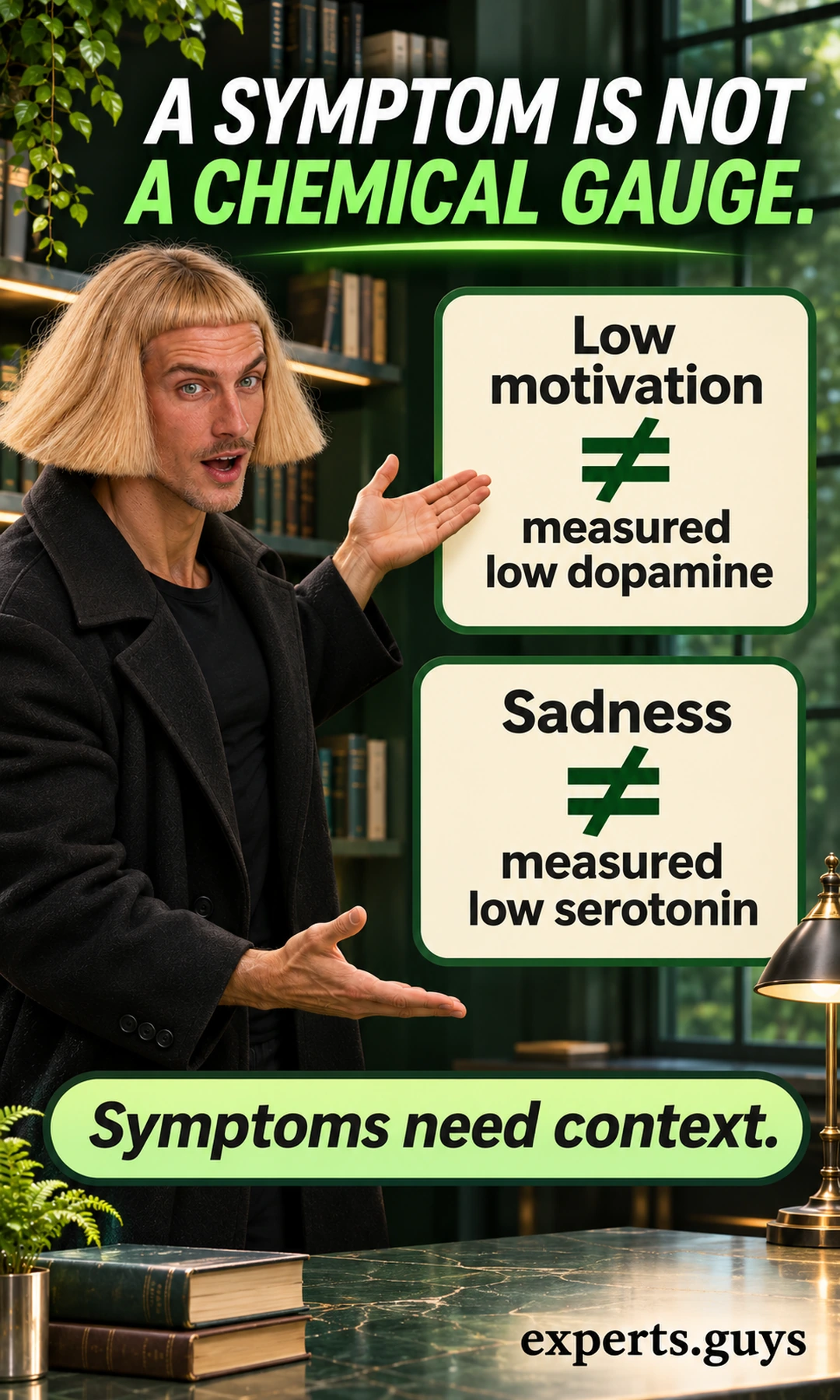
This boundary does not make the symptom less real. A person can take an important change in functioning seriously without knowing its full biological explanation. It also does not make every such change depression. History, circumstances, other symptoms and possible medical or medication-related factors remain relevant to assessment; a chemical slogan cannot replace that context.
For an illustrative example, someone may describe struggling to begin ordinary tasks after a period of poor sleep. Calling this low dopamine prematurely narrows the question. Describing the actual difficulty and its context leaves room to investigate what is happening. A useful explanation should organise that investigation rather than present an unmeasured chemical conclusion as an established fact.
Why a simple deficiency story is incomplete
A shortage account proposes a specific causal explanation. Showing that a messenger is relevant to brain function is a different claim, and showing that a treatment affects that messenger is different again. These distinctions prevent a plausible biological term from becoming a personal diagnosis. The broader comparison of depression theories examines those explanatory questions without requiring one model to explain every case.
Why is clearance part of the signal rather than a failure of it?
A messenger cannot be understood only at the moment of release. What happens afterward affects its availability for further interactions. Clearance is therefore part of how signalling is regulated, not simply a process that removes something beneficial. An account that treats removal as inherently harmful misses the role of controlled communication in a changing biological system.
The neuroscience chapter on transmitter release and removal describes routes involving diffusion, reuptake and enzymatic processes. Which routes apply depends on the messenger and setting. These are categories for understanding regulation; they are not three interchangeable treatments and do not imply that every messenger is handled in exactly the same way.
Three routes, with different meanings
Reuptake refers to taking a released substance into a cell through the relevant transport processes. Enzymatic breakdown changes a substance through biochemical reactions. Diffusion concerns molecules spreading away from a location. In a simplified lesson, all three can help explain changes in availability, but the underlying processes and their roles differ. A precise claim should identify which one is involved.

The teaching props in the image distinguish these ideas rather than reproduce exact molecular structures. A retrieved bead represents collection; separated pieces represent breakdown; spreading beads represent diffusion. The lesson is the difference between handling processes, not a model from which to infer a real concentration, a clinical threshold or a particular person’s brain activity.
Reuptake inhibition is not the same as manufacturing a messenger
The name selective serotonin reuptake inhibitor, or SSRI, describes an action related to serotonin reuptake. Inhibiting reuptake changes the handling of released serotonin; the label should not be read as saying that a medicine simply manufactures a missing ingredient. A known action is also not a complete account of every downstream effect or of an individual’s response.
The NHS overview of antidepressants describes medicines that affect neurotransmitter activity and explains that benefits and unwanted effects vary. For this article, the useful lesson is mechanistic vocabulary. Deciding whether a particular medicine is suitable requires clinical information beyond a general explanation of transporters and signalling.
Different medicine classes can act in different ways, and individual drugs may have more than one relevant action. A class name provides orientation without making all members identical in benefits, unwanted effects or suitability. For a separate practical question about prescription amounts and instructions, the guide to low-dose antidepressants explains why a number on a label needs context.
A process can change before its meaning is understood
Observing a biological change does not settle every clinical question about that change. Researchers may investigate an early target effect, later adaptations and outcomes at different times. A reader should keep those time points distinct rather than assuming that the first measurable action must explain the full course of symptom improvement or unwanted effects.
Likewise, a person’s improvement cannot retrospectively identify a pre-treatment transmitter shortage. A helpful outcome can be evaluated as an outcome while the complete pathway remains under investigation. This is not a reason to dismiss benefit or overlook adverse effects. It is a reason to keep the measured experience and the proposed explanation close enough to compare honestly.
The word selective needs similar restraint. It describes a relative targeting property in a pharmacological context; it does not mean a medicine affects only one everyday experience or has no unwanted effects. A reader should interpret the term as part of an account of action, then look separately at evidence concerning outcomes, interactions and suitability.
For instance, a mechanism description may explain why researchers study a particular target while leaving several practical questions unresolved. Does the intervention help the intended group? What burdens accompany it? What alternatives fit the clinical situation? Those questions cannot be answered by repeating the target’s name, even when the biological description itself is accurate.
More signalling is not a universal aim
Once receptor differences, location and clearance are considered, the question “how do I raise this chemical?” becomes too broad to guide a safe decision. It does not specify the process, the system or the clinical outcome. Increasing an unmeasured quantity is not a meaningful treatment goal merely because the messenger appears in a discussion of depression.
This is especially relevant to supplements or products marketed with neurotransmitter terminology. Participation in a biological pathway does not establish that a product improves depression or is appropriate alongside existing medicines. The evidence must concern the actual intervention, people and outcome being advertised. A diagram of a pathway cannot supply the missing clinical evaluation.
How can you interpret a signalling claim without diagnosing yourself?
Identify the part of communication first. Does the statement concern the sending side, the receiving side or a clearance process? That question prevents vague language from merging distinct findings. It also helps identify what information is missing when a headline claims to have discovered the chemical reason for a complicated everyday experience.
The sending side might be discussed in relation to synthesis, packaging or release. The receiving side might be discussed in relation to receptors and a measured response. Clearance might involve a transporter or another handling process. These descriptions can organise a research question without asserting that one part is defective in a particular reader.

Follow stage, location and result
Use three connected questions: which stage, where was it studied and what result was measured? This is a reading method for understanding a signalling claim, not a protocol for testing your own neurotransmitters. You can practise on a public study summary or an explanation already in front of you, without a symptom log, worksheet or home test.
| Step | What to identify | What a complete answer sounds like |
|---|---|---|
| Stage | Does the statement concern release, receptor interaction, transport, clearance or an outcome outside that cellular sequence? | It specifies the process instead of using neurotransmitter activity as a substitute for a method. Several processes may be involved, but each should be distinguished. |
| Location | Where was the work performed, and in which system? Distinguish a laboratory cell model, an animal study, a particular brain measure and a clinical population. | It identifies the actual setting. The explanation does not move from one setting to a personal treatment promise without the evidence needed for that additional step. |
| Result | What changed, how was it assessed and what question does that measurement answer? Keep a mechanism measure and an outcome in people separate. | It states the measured result and its limits. You can tell what the finding establishes, what remains unknown and why it does not constitute your own chemical diagnosis. |

Consider the illustrative sentence “the intervention changed a transporter-related measure in laboratory cells.” The stage concerns handling or transport, the location is the studied cell system and the result is the specified measure. Rewriting that as “this will restore your motivation” adds a personal clinical promise that the sentence did not establish. The missing connection is the point of the exercise.
Now consider a different example: “participants had a change on a depression outcome during a clinical trial.” That is evidence about the outcome and study population, not automatically a direct measurement of release or receptor activity. The reading method works in both directions. It prevents a mechanism from being promoted to a clinical promise and an outcome from being renamed as a complete causal explanation.
Correct two common reading mistakes
One mistake is to treat a more detailed explanation as a more certain personal answer. Knowing the names of receptors, transporters or signalling stages improves vocabulary, but it does not remove the need for evidence connecting a finding to an individual decision. A technical description should make its scope more visible rather than conceal uncertainty behind specialist terms.
The opposite mistake is to dismiss a finding because it does not answer every question. A cell study can be useful for a cell-level question. A clinical study can be useful for an outcome question. The correction is to judge the result against its actual purpose, while keeping the additional evidence needed for a broader conclusion clearly separate.
If the vocabulary is tiring, begin with one distinction: did the study measure a signalling process or a person’s outcome? Then add the stage and location when you can. That easier version still prevents a common error. Successful reading means you can state what the result concerns and what it leaves open, not that you can explain the entire nervous system.
Let the concern guide the care question
For a personal concern, describe the difficulty you want help with rather than announcing an unmeasured chemical deficit. For example, a change in the ability to start necessary tasks is a useful observation to discuss. The next question can concern assessment, an accessible treatment option or how its usefulness will be reviewed, depending on the actual circumstances.
Do not start, stop or adjust prescribed medicines to test a neurotransmitter explanation. If a treatment is helping, causing difficulty or raising a new concern, discuss the specific change with the responsible clinician or pharmacist. Severe new symptoms or an immediate inability to stay safe call for urgent local help; understanding the signalling model should support care, not become a condition for receiving it.
Questions about neurotransmitters and depression
Are neurotransmitters only found in the brain?
No. Neurotransmitter communication is part of the nervous system, including communication involving other cells such as muscles or glands. The location and process matter when interpreting a claim. A function outside the brain does not mean a symptom there directly reveals signalling in a particular brain circuit.
Is a receptor the same thing as a transporter?
No. A receptor provides a way for a signal to affect a cell; a transporter moves a substance across a membrane. Both can matter to signalling, but they perform different jobs. Identifying the actual target helps prevent a finding about handling from being mistaken for a complete account of the receiving response.
Does inhibitory mean a chemical makes someone depressed?
No. Inhibitory is a technical signalling description, not an emotional diagnosis. Inhibition can contribute to normal regulation, and an excitatory effect is not automatically beneficial. The meaning depends on the system and response being discussed rather than a simple pairing of inhibition with sadness and excitation with happiness.
Why does an article say a chemical affects several unrelated functions?
A messenger participates in different processes depending on location, receptors and the surrounding system. A list of functions illustrates that breadth; it is not a checklist of everything that must change in depression. Nor can one experience on the list identify a personal shortage of the messenger.
Can understanding the signal sequence tell me which medicine to take?
No. The sequence explains vocabulary and helps you interpret a mechanism claim. Choosing a medicine involves clinical needs, previous response, other medicines, possible harms and preferences. A general explanation of release or reuptake is not enough to determine a personal treatment, dose or combination.
What is the easiest way to check a technical claim?
First ask whether the reported result concerns a signalling process or an outcome in people. Then identify the stage and location when possible. A useful result is being able to state what was measured and which broader conclusion remains unestablished; you do not need to diagnose your own biology or understand every molecular detail.
Next steps
Take one signalling statement and identify its stage, location and measured result. Keep a cellular process, an everyday experience and a treatment outcome distinct enough to explain their relationship. That is the useful contribution of neurotransmitter knowledge: clearer questions about communication and evidence, with no invented chemical reading of your own mood.