
Depression subtypes and episode features are distinguished by patterns in mood response, sleep, appetite, energy and timing—not by one symptom on its own. The useful first step is to identify what changed from your usual self and describe it with a concrete example. This guide helps you separate clues that are easily confused, without assigning yourself a diagnosis.
Act on urgent changes first. If you may act on thoughts of harming yourself or someone else, cannot stay safe, or have severe confusion, use local emergency services or the nearest emergency department. New hallucinations or fixed unusual beliefs need urgent assessment; after childbirth, new psychotic symptoms are an emergency. Do not wait to complete a record or reach a two-week threshold.
| Pattern | Useful clue | What one clue cannot tell you |
|---|---|---|
| Melancholic features | Markedly reduced pleasure or little mood response to positive events, alongside other features. | Early waking alone is insufficient. |
| Atypical features | Mood can lift with positive events; oversleeping, increased appetite or heavy limbs may accompany it. | Smiling or enjoying one conversation does not rule depression out. |
| Anxious distress | Tension, apprehension or worry that interferes with concentration during depression. | Feeling restless does not establish a separate anxiety disorder. |
| Mixed features / bipolar history | Unusual activation, reduced need for sleep or other manic symptoms require attention. | Irritability by itself does not establish bipolar disorder. |
| Psychotic features | Hallucinations or delusions alongside a depressive episode. | Intrusive unwanted thoughts alone are not proof of psychosis. |
| Timing patterns | Symptoms relate to a season, pregnancy or another repeated context. | Coinciding events do not prove the cause. |
These descriptions are not separate boxes into which every person fits neatly. Some describe features of a current episode, while others describe its timing or the wider course of an illness. The broader types of depression guide explains the diagnostic vocabulary; here, the focus is how to observe the distinctions without turning them into a home test.
Which changes are more useful than a symptom label?
A change becomes more informative when you can compare it with your usual functioning and describe the circumstances. “I sleep a lot” leaves out whether this is new, whether you actually sleep, and what happens during the day. A short, specific account makes those missing details visible without requiring a score, consistent with assessment that considers history and functioning.
Start with a change from your own baseline
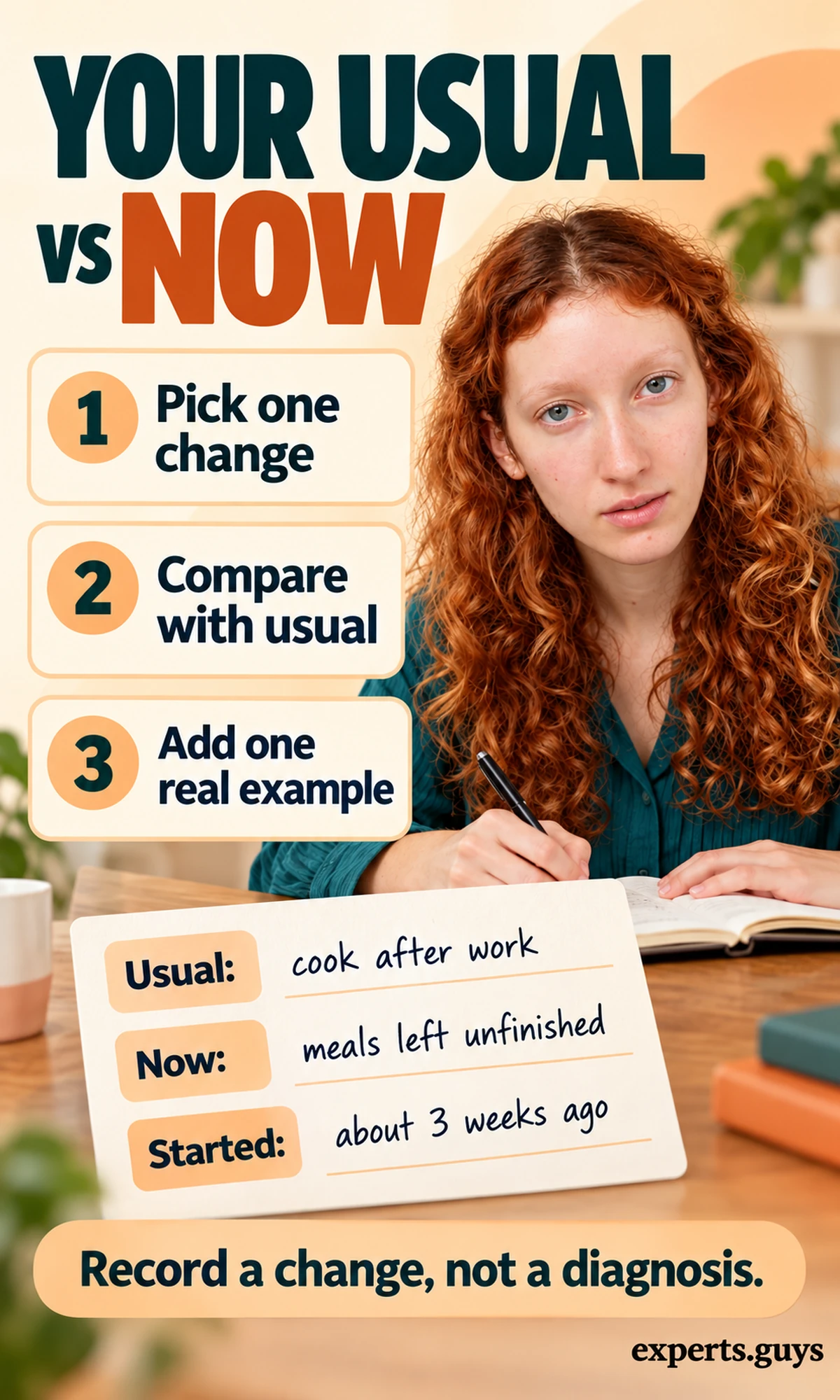
Use this when a symptom feels vague or you are unsure when things changed. Take a blank note and choose one ordinary activity that has become different, such as preparing food or replying to messages. Comparing with your own usual routine avoids confusing a longstanding preference with a new difficulty.
- Write Usual and describe the activity before the change. Choose an actual behavior rather than a judgment such as “normal” or “lazy”.
- Write Now and add one observable difference. Include roughly when it began; “not sure” is an acceptable answer.
- Add the practical effect: a missed meal, an unfinished task or needing more help. Keep this separate from the name you think the symptom might have.
Illustrative example: “Usually I cook after work; recently I leave meals unfinished; this started about three weeks ago.” The common mistake is listing every bad day and losing the main change. If writing is tiring, say the example into a private voice note; the useful outcome is one understandable comparison, not a complete life history.
Separate pleasure from mood reactivity
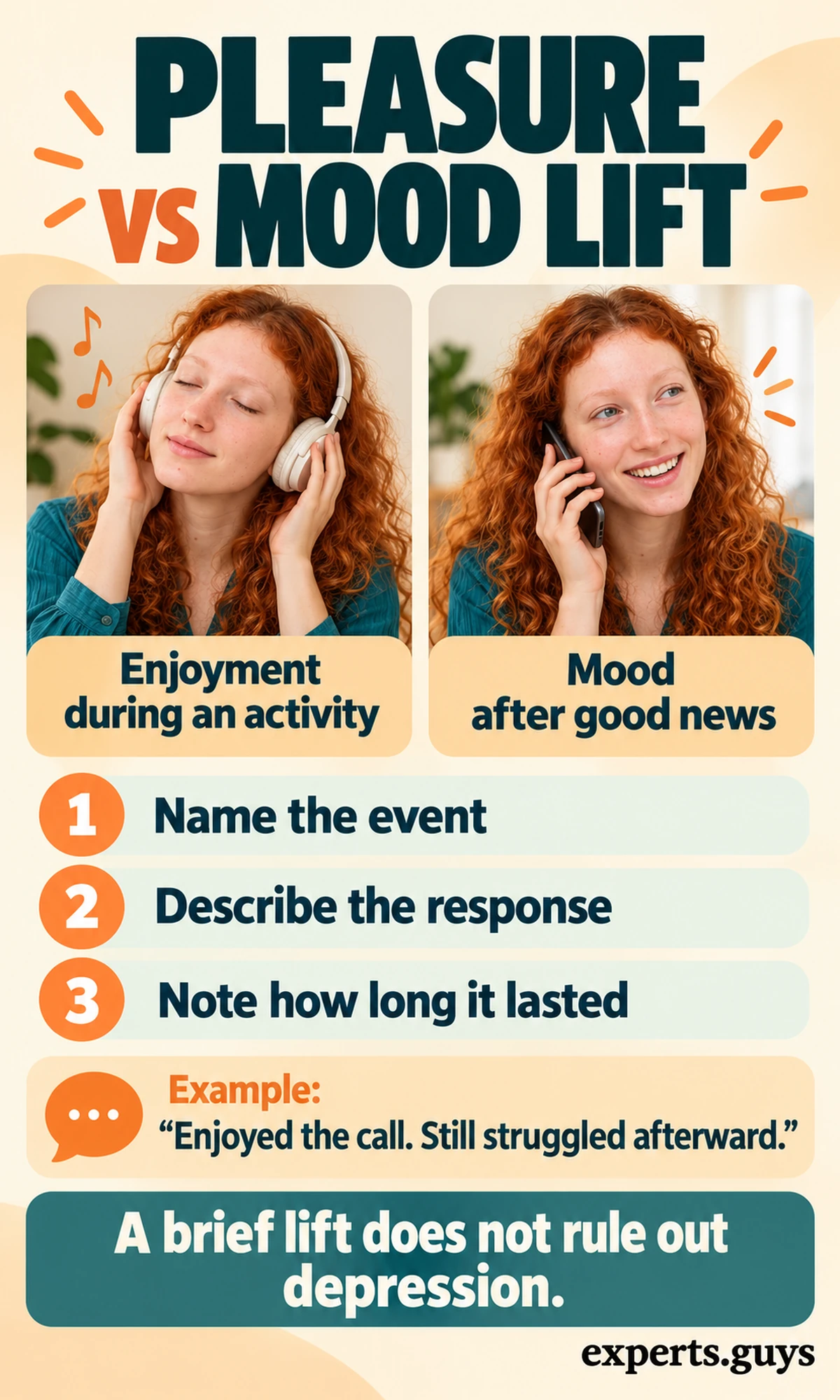
Pleasure means enjoyment during an activity; mood reactivity means your mood can improve in response to something positive. A person might enjoy a call briefly yet remain depressed afterward. This distinction helps explain why a cheerful moment is not evidence that the rest of someone’s difficulties are exaggerated.
- Choose a naturally occurring event, such as hearing a favorite song or receiving good news. Do not force yourself through repeated “happiness tests”.
- Describe enjoyment during the activity and any broader mood lift separately. Use ordinary words such as “some enjoyment”, “no change” or “briefly lighter”.
- Note approximately how long any change lasted and what remained difficult afterward. If you cannot tell, record uncertainty instead of choosing a subtype.
For example, “I enjoyed the call, but preparing dinner still felt impossible” contains two observations rather than a contradiction. Avoid treating a lack of response on one occasion as a diagnosis of melancholic depression. If monitoring makes you repeatedly judge your feelings, stop and use one remembered example instead; this is a description exercise, not a treatment or diagnostic test.
What do sleep, appetite and time-of-day changes actually tell you?
These clues become useful as a pattern, especially when they represent a change and occur alongside other symptoms. Sleep disruption, appetite changes and bodily heaviness can also have explanations unrelated to a depressive subtype. Record the experience precisely before interpreting it, because similar everyday words can describe different things.
Record sleep need, not only sleep hours
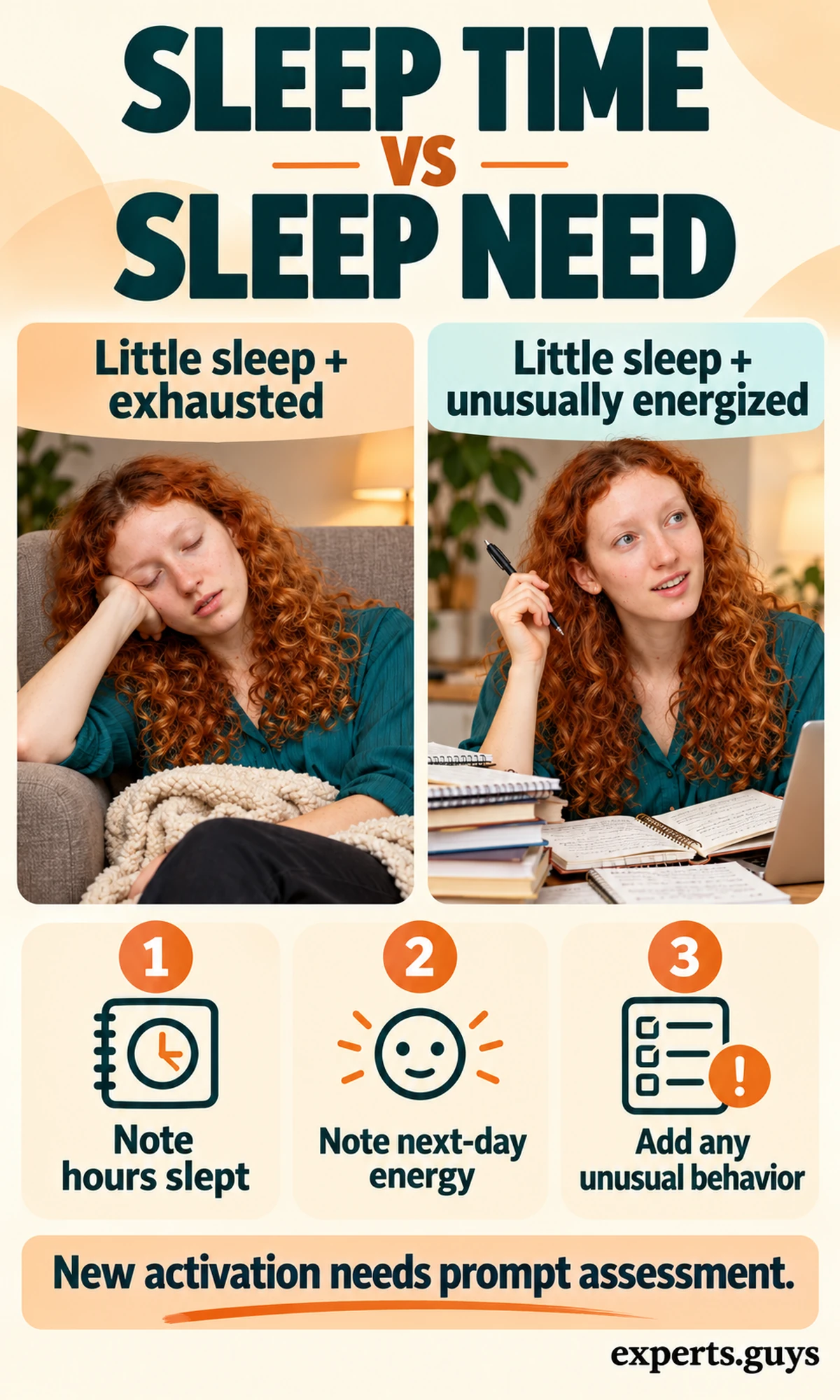
Sleeping little and feeling exhausted differs from sleeping little while feeling unusually energized. The latter deserves prompt attention when it comes with a marked change in activity or behavior. Sleep hours alone cannot make that distinction, and deliberately reducing sleep is not a safe way to investigate it.
- Record approximate actual sleep, separating it from time spent lying awake in bed. Add a nap if it meaningfully changes the picture.
- Describe next-day energy: tired, usual, or unusually energized compared with yourself. Note whether you wanted more sleep.
- Add any striking behavior change, such as unusually fast speech, many new projects or impulsive spending. Report new activation promptly rather than waiting for a diary to fill up.
An illustrative contrast is “four hours and struggling to stay awake” versus “four hours, no tiredness, and starting several unusual projects”. Neither sentence diagnoses an illness, but the second changes what needs to be assessed. For a low-effort version, record only sleep and energy; if there is escalating agitation, unsafe behavior or severe confusion, use urgent help instead of monitoring.
Check whether the day has a repeatable shape
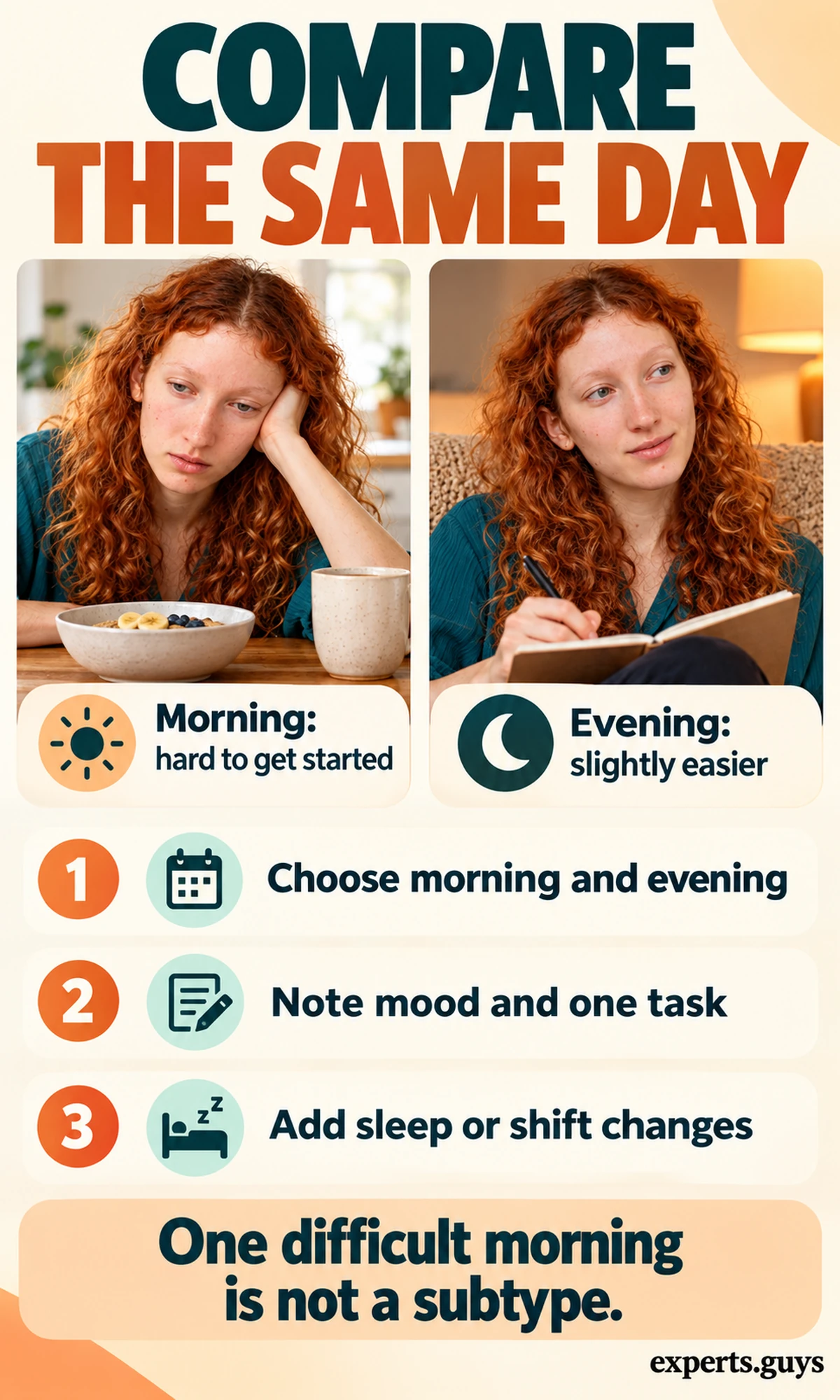
Morning worsening can be part of a melancholic presentation, but a difficult morning alone is not distinctive. Shift work, a poor night and a demanding morning routine can also change how a day feels. Comparing similar time points helps distinguish an impression from a pattern worth mentioning.
- Choose an ordinary morning point and an evening point, without setting alarms that interrupt sleep. Use the same daily anchors when practical.
- At each point, write a few words about mood and one manageable reference task, such as getting dressed. Record what happened rather than grading your performance.
- Alongside the pair, note an obvious context change: a night shift, illness or unusually poor sleep. Do not invent missing entries or postpone assessment to collect more.
A useful example is “morning: dressing took much longer; evening: easier to begin a conversation”. The mistake is comparing a workday morning with a relaxed holiday evening as though the settings were identical. If paired entries are burdensome, use a single clear example and label its context; stop recording if it increases rumination rather than clarity.
Separate appetite from access, effort and heaviness
Appetite is the desire to eat; food intake is what you actually manage to eat. They can diverge when shopping, preparation, nausea or access to food gets in the way. Heavy-feeling limbs are another observation and should not be folded into a vague label such as “tired”.
- Write what hunger felt like: lower than usual, usual, or higher. Avoid using body weight as the only proxy for appetite.
- Add what you actually ate and any barrier, without counting calories. “Hungry, but no energy to prepare lunch” differs from “food did not appeal”.
- Describe any limb heaviness in your own words and say when it appears. A new focal weakness, sudden one-sided change or other acute neurological symptom needs urgent medical assessment, not a depression label.
For example, “hungry at noon; skipped lunch because cooking felt too hard; arms felt heavy later” separates three issues. Do not force a meal plan or repeated weighing into this observation task. If food recording feels distressing, write only the barrier; inability to eat or drink adequately needs prompt care regardless of which pattern you suspect.
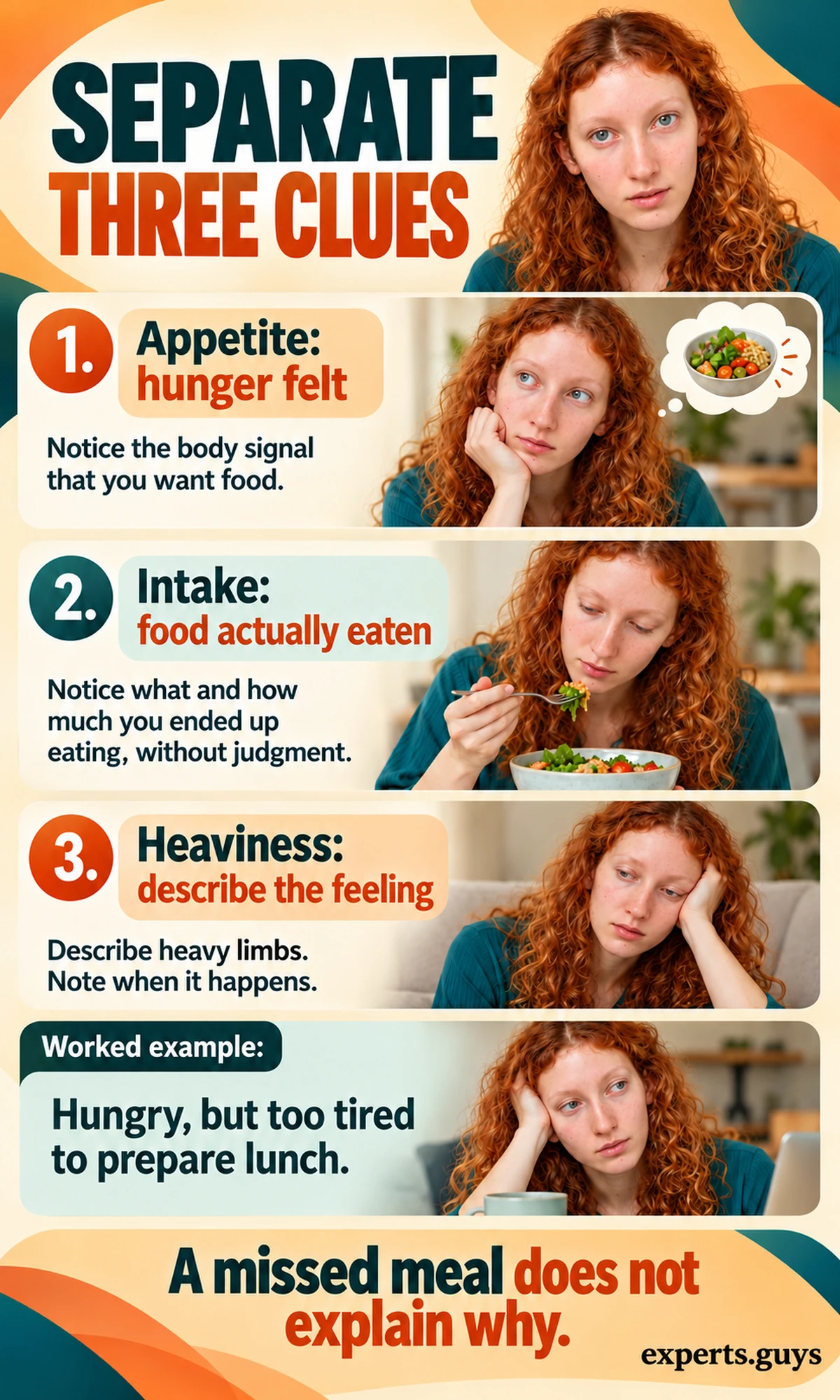
The clinical descriptions of melancholic and atypical features depend on a constellation of symptoms, not the exercises above. CANMAT’s classification discussion supplies the feature terminology, while the observation formats here are editorial examples. For the separate question of effort and ordinary tasks, see why depression makes simple tasks feel hard.
Which clues change the urgency of the next step?
Unusual activation and changes in perceptions or beliefs deserve attention beyond a routine symptom checklist. The reason is practical: they can change the assessment and the safety of a treatment plan. The priority is describing what is happening and obtaining the right level of help, not proving a subtype yourself.
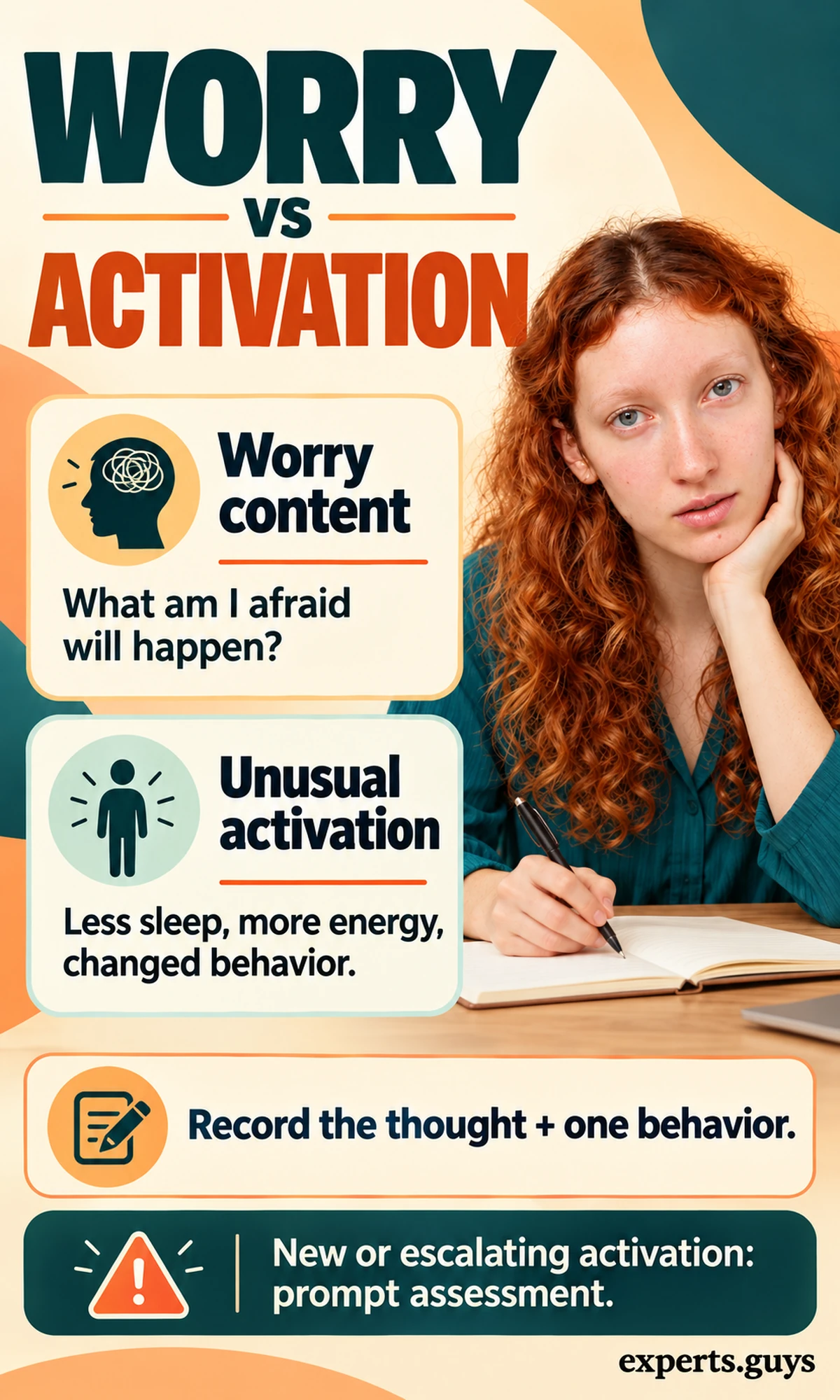
Distinguish anxious tension from unusual activation
Anxious distress can involve worry, tension and difficulty concentrating because of apprehension. Mixed features concern additional manic or hypomanic symptoms during depression, so restlessness alone is not enough. A history of unusually elevated or irritable mood with increased activity also matters even if the person is currently low.
- Separate what your thoughts are about from what your energy and behavior are doing. “I keep worrying about tomorrow” and “I am starting projects all night” describe different information.
- Note whether energy, speech, sleep need or impulsive behavior is unusually different from your baseline. Include an example from a past episode if it clearly stands out.
- If the change is new or escalating, arrange prompt assessment and mention any recent medicine change. Do not stop or alter prescribed medication on your own.
A common error is treating every “racing mind” as the same phenomenon. A simpler alternative is to write the actual thought and one behavior, then leave the interpretation open. NIMH’s bipolar disorder guidance explains why the whole mood history matters; our depression, anxiety or bipolar disorder comparison covers the broader distinction.
Recognize perceptions and beliefs that need urgent attention
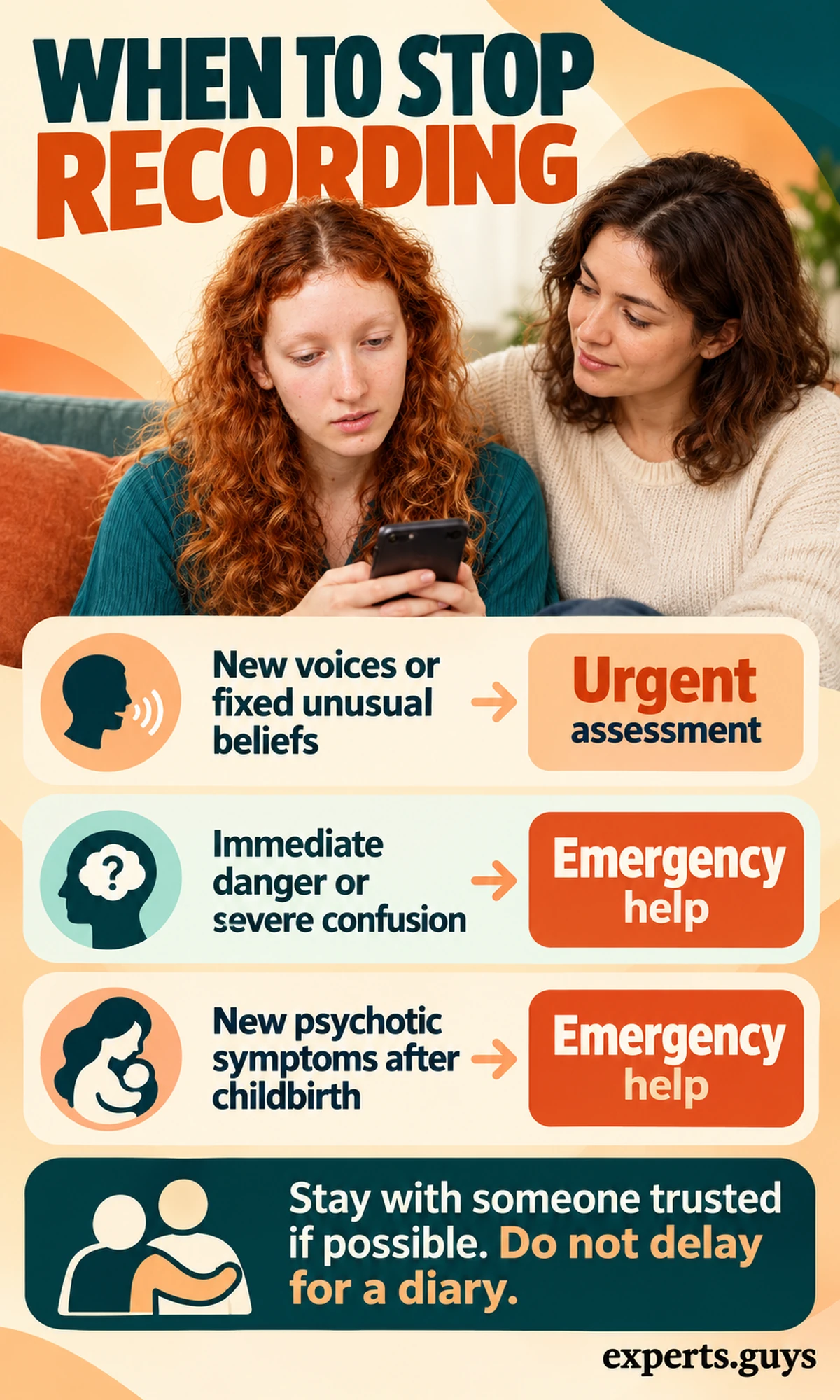
Hearing a voice that others do not hear or developing a fixed unusual belief can indicate a problem requiring assessment. An unwanted frightening thought is not automatically the same experience, and a home checklist cannot reliably separate every possibility. NIMH’s explanation of psychosis also describes several possible causes, so depression should not be assumed to explain it.
- If safe and comfortable, describe the experience in plain words: what was heard or believed, when it began, and whether it affects eating, sleep or behavior. A supporter can describe what they noticed without arguing about the belief.
- Seek urgent assessment for new hallucinations or delusions. If there is immediate danger, severe confusion, or inability to stay safe, use emergency services; new psychotic symptoms after childbirth are an emergency.
- While arranging help, stay with a trusted person if possible and avoid driving if confused or distracted by the experience. Do not delay care to collect proof or complete a record.
For example, a supporter might say, “She says a voice is speaking when nobody is there, and she has stopped eating because of it.” This is useful reporting without endorsing or confronting the experience. If speaking or writing is difficult, share the immediate concern and location first; the fuller psychotic depression article is background reading, not a prerequisite for care.
How can timing clarify a pattern without creating a false explanation?
Timing helps organize possibilities, but “after” does not automatically mean “because of”. A seasonal recurrence, pregnancy-related onset, medicine change or substance exposure can all be relevant context. The same record must leave room for other explanations and for symptoms that began before the apparent trigger.
Build a short context sequence
- Make three headings: Before, Change and After. Under Before, note whether the mood or functioning problem was already present.
- Under Change, add a relevant event with an approximate date: a medicine adjustment, illness, pregnancy, altered work schedule or substance-use change. Include names from an existing medicine list rather than guessing.
- Under After, describe what actually changed and what did not. Mark uncertain dates; if similar episodes occurred before, say so without deciding that the event caused them.
An illustrative entry is “low mood already present; started night shifts; sleep became more irregular afterward”. The mistake is erasing the earlier low mood and concluding that the shift schedule explains everything. If dates are unclear, use “before” and “after” alone; the useful result is a sequence that distinguishes observation from assumption.
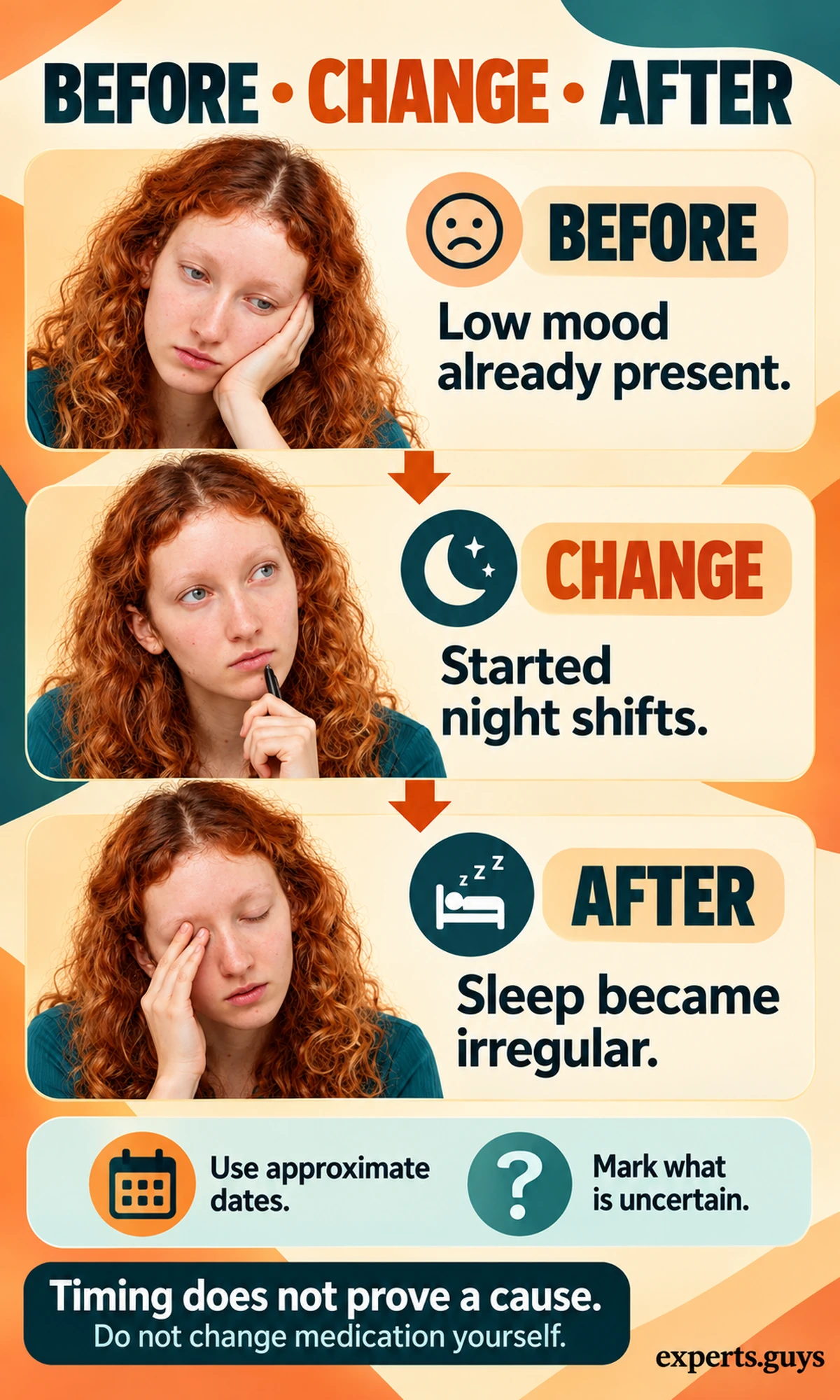
A seasonal pattern needs repeated timing across episodes rather than one difficult winter. Pregnancy and the period after birth also change the care context, while a menstrual pattern needs its own focused assessment rather than a conclusion from one cycle. The seasonal affective disorder guide and perinatal depression guide explain those contexts; this page does not ask readers to collect months of data before seeking help.
Medicines, substance effects and physical illness can resemble or accompany mood symptoms. A timing note helps raise those possibilities, but does not justify stopping treatment or abruptly changing substance use when withdrawal could be dangerous. If the pregnancy-related distinction is your main concern, postpartum depression owns that deeper topic.
Questions that often remain
Can a depression questionnaire identify a subtype?
A depression questionnaire can help assess symptom burden, but it cannot by itself determine melancholic, atypical, psychotic or mixed features. Its result also does not replace mood history or assessment of alternative explanations. Bring the individual experiences behind the answers rather than treating the total as a subtype label.
Does atypical mean unusual or less serious?
No. Atypical is a clinical descriptor, not a measure of how legitimate or severe someone’s difficulties are. Day-to-day impairment and safety still matter even when mood briefly improves after a positive event.
Is treatment-resistant depression another symptom pattern?
It describes inadequate response to treatment rather than a distinctive collection of daily symptoms. Reviewing it requires the treatment names, doses, duration, tolerability and response, together with a reassessment of the diagnosis. One difficult week or one abandoned treatment is not enough to assign that label.
What if I cannot remember how I felt before?
Use the clearest recent example and say that your baseline is uncertain. With your agreement, someone who knows you may be able to describe an observable change. An incomplete account is still useful, and you do not have to finish these exercises before getting help.
Choose one clear observation
Start with the distinction that is confusing you most, and use its example to describe your own change. Useful progress is being able to say what happened, when, and how it affected daily life—not achieving a particular score or proving a diagnosis. If a safety concern or marked deterioration appears, act on it immediately; the observation can remain unfinished.
Images and completed examples are AI-created illustrations, not patient records or evidence of treatment results. The observation formats are educational aids and are not validated diagnostic instruments. Clinical interpretation requires an individual assessment.