

A four-week mood log can help you show a clinician what has changed since you stopped drinking, using a short daily record of mood, sleep, enjoyment and alcohol use. It cannot tell you whether stopping suddenly is safe, diagnose depression or promise that you will feel better by day 28. Start with the observations you have, and seek help sooner when symptoms or safety concerns need attention.
What this four-week log is for
This record is for an adult who has already stopped drinking, or is reducing alcohol under a clinician’s plan, and wants something concrete to bring to an appointment. You can use paper, a notes app or the record below. The useful outcome is a dated account of what happened, including gaps and alcohol-use days, rather than a perfect sobriety streak.
Four weeks gives you a manageable set of observations to discuss; it is not a waiting period before receiving care. A clinical review describes alcohol-induced depressive symptoms that may remit after roughly three to four weeks of abstinence, while also explaining how complicated the distinction from an independent depressive disorder can be. That finding does not predict your individual recovery or allow a diary to establish the cause of your mood symptoms.
Set the two dates before the first mood score
Write the date of your last drink and the date you first start the log in separate places. If you stopped on a Friday but began recording on Monday, the three-day gap matters because it tells the clinician which days were not observed. Keep the original log-start date even if you later record another drinking day.

If you do not remember the exact hour of the last drink, leave the time unknown or mark your estimate as approximate. Do the same with an uncertain date rather than choosing one just to complete the form. Calendar-day differences are a way to organize the record; they do not verify uninterrupted abstinence or assess withdrawal risk.
- Last-drink date: the initial alcohol-use date you remember, with an approximate label when needed.
- Log-start date: the first calendar date covered by this 28-day sheet.
- Later alcohol use: another dated observation, kept alongside the earlier rows.
- Unknown information: a blank or “unknown,” never an invented answer.
Who should not use a log as their only support
If you drink heavily or regularly, have had withdrawal problems before, or feel unwell when you reduce alcohol, speak with a clinician about stopping safely. The NHS alcohol-support guidance explains that suddenly stopping can be harmful when someone is physically dependent. A completed setup form does not clear you to stop, reduce or manage withdrawal at home.
The daily row: mood, sleep, enjoyment and time
Choose one observation time that is practical to record and note the time when you can. Use one subjective mood number from 0 to 10, with 0 meaning your lowest mood and 10 your best, and keep that direction the same each day. This is your personal description, not a validated depression score, and a low number does not measure immediate safety.
Beside mood, write the previous night’s approximate sleep duration and whether anything felt enjoyable: yes, no or unsure. Zero hours of sleep is a real entry; a blank means you do not know. Add one factual note when it changes the picture, such as “flat evening; craving around 8 pm” or “better afternoon.”
If a craving and low mood happen together in the evening, record the clock time rather than reconstructing the whole day afterward. The observation may be useful to discuss, but it does not establish which feeling caused the other. If you write the entry the next morning, label it as a later entry from memory so it does not look like a real-time observation.
How to mark an alcohol-use day without restarting the page
Record whether you drank on that date, and the time if you remember it. If the amount or circumstances matter, write them in a separate note to bring to the appointment, using the actual drink and container details rather than guessing standard units. An alcohol-use day adds information; deleting the earlier rows removes the context the clinician needs.

Keep both the original last-drink date and the later alcohol-use date visible. In the interactive record, the latest recorded alcohol date updates while the original setup and earlier rows remain. Any displayed day difference is a calendar count from a recorded date, and unknown days mean the record cannot certify a continuous alcohol-free period.
Use the Four-Week Mood Record
The record below holds entries in the current tab unless you explicitly choose to save them on this device. You can download a CSV or open a one-page A4 sheet, including an incomplete record. It sends no entries to a server through its own functions, but saved browser data, downloads and printed sheets still need care on a shared device.
Four-Week Mood Record
Keep observations together. Bring the record to your clinician.
Loading the record. If controls stay unavailable, use paper: date, mood, sleep, enjoyment, alcohol use and one short note. Do not wait 28 days to seek care.
A filled sample week, with the gaps left in
The following week is invented to demonstrate the format, not a patient history or an expected recovery pattern. It includes a better afternoon, a flat evening, one entry remembered the next morning and a day with no observation. The changing numbers show how to record an uneven week without turning it into a prediction.
Swipe horizontally to read all columns on a small screen.
| Log day | Mood / sleep | Enjoyment / alcohol | Factual note |
|---|---|---|---|
| Day 1 | 3 / 5 hours | No / no | Evening observation; low mood. |
| Day 2 | 4 / 5.5 hours | Yes / no | Brief enjoyable moment in the afternoon. |
| Day 3 | Unknown / unknown | Unknown / unknown | No entry; leave the gap visible. |
| Day 4 | 5 / 6 hours | Unsure / no | Filled next morning; approximate. |
| Day 5 | 4 / 5 hours | No / yes | Alcohol use recorded; keep earlier rows. |
| Day 6 | 6 / 6.5 hours | Yes / no | Better afternoon; observed at 4 pm. |
| Day 7 | 3 / 5 hours | No / no | Flat evening; craving around 8 pm. |
A missing day does not mean your mood was zero, that you slept zero hours or that you did not drink. If you remember only part of it, record that part and mark it as recalled later. If you miss several days, resume on the next known date instead of filling the blanks to make the sheet look complete.
Better weeks and flat weeks belong on the same sheet
If a week feels unusually hopeful, describe what you noticed in ordinary language, including something you enjoyed or managed to do. If another week feels flatter, use the same fields so the records remain comparable. “Pink cloud” is a phrase some people use in recovery conversations; it is not a diagnosis or a schedule that everyone follows.
Keep a good-day note because it describes that day, without using it as proof that future days must improve. A later low week deserves its own observations and, when needed, earlier contact with your clinician. The record should make changes easier to discuss rather than ask you to explain them on your own.
The appointment summary: three lines that help
At the end of the period, or before an earlier appointment, write your own comparison with the first week: more okay moments, much the same, worse, mixed or unsure. Add what you noticed about sleep and any recorded alcohol-use days. Then write the question you want the clinician to address, such as what else should be assessed alongside the pattern.
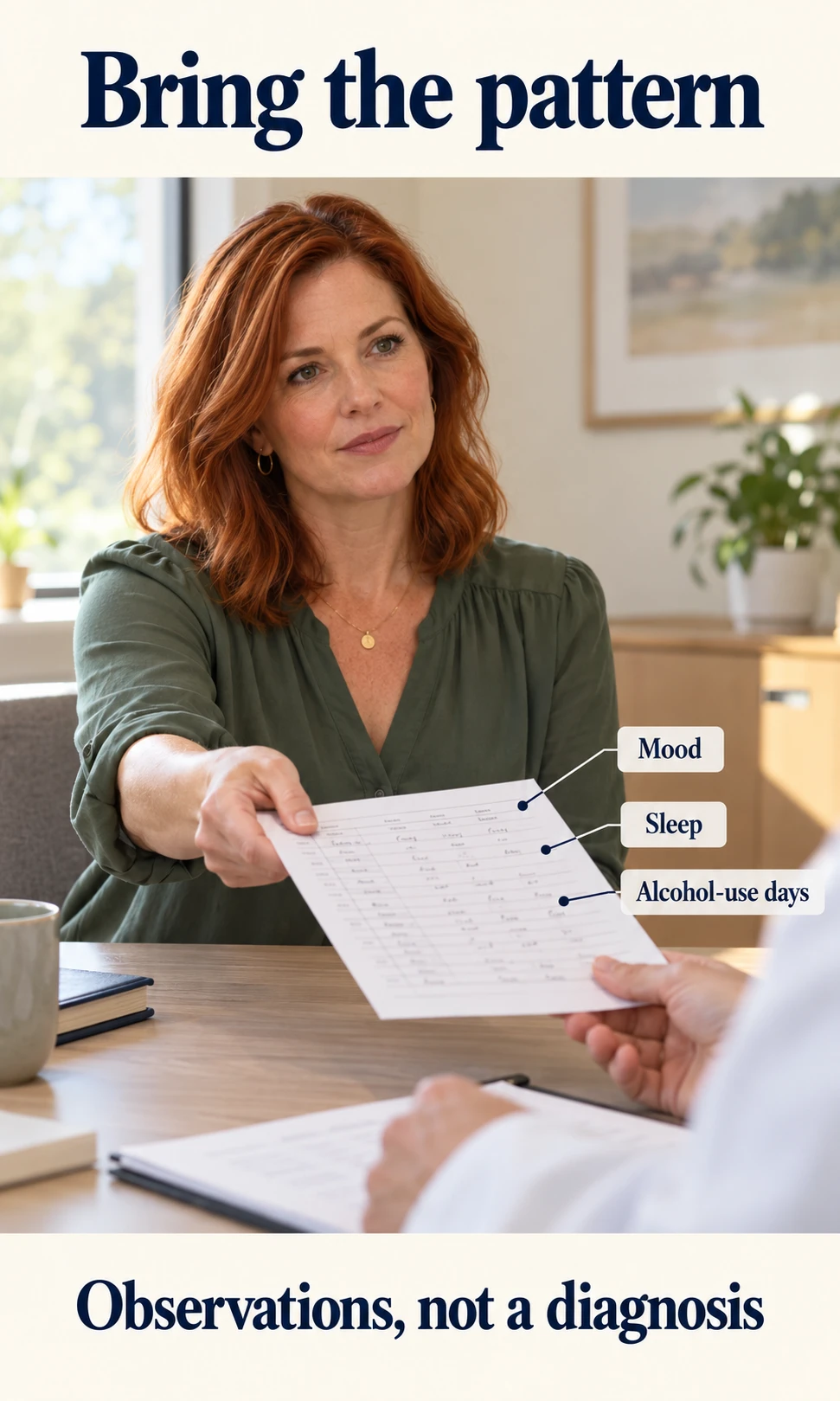
“My weeks felt mixed, with some more enjoyable afternoons. Sleep was uneven, and I recorded one alcohol-use day; several days are missing. I would like to discuss what else could be contributing and what assessment is appropriate.”
The weekly cards report what was entered: completed rows, the range of known mood values, mean sleep among known sleep entries, enjoyment responses and alcohol-use responses. Each count includes its known-data denominator so seven complete days cannot be confused with two observations. No card decides whether a change is clinically meaningful, and your own summary remains separate from those calculations.
What the sheet cannot tell your clinician
A better third week does not establish that alcohol was the only cause of low mood, and a worse week does not establish a separate depressive disorder. Your clinician may need to know whether symptoms existed before drinking changed, what medications or other substances are involved, and how daily functioning has been affected. Bring those details separately if they do not fit in the short daily note.
The NIAAA overview of alcohol and co-occurring mental-health conditions explains why clinical history and assessment matter when alcohol use and mood symptoms overlap. A diary supports that conversation but cannot choose a diagnosis or medication. Keep treatment decisions with the clinician who can assess the broader picture.
Bring another record only when it answers another question
If skipped meals are another concern, the skipped-meal depression record covers a different part of the appointment. If episodes of eating more than intended need discussion, the overeating-day record keeps those observations separate. Use the extra sheet only when it makes the conversation clearer; it does not need to become another daily obligation.
For a broader explanation of symptoms, understanding depression is a separate subject from recording alcohol-related timing. Do not combine these records into a home diagnosis. Bring the concern that matters most to the appointment, with an incomplete sheet if that is what you have.
When to put the record aside and get help
Seek urgent professional help for thoughts of self-harm rather than saving them for the week-four summary. If you may act on those thoughts or cannot stay safe, contact emergency services now. In the US, you can call or text 988 for crisis support; outside the US, use the crisis and emergency services where you are.
Worsening low mood, struggling to manage ordinary responsibilities or concern from someone close to you is a reason to contact your clinician before the planned visit. You do not need a particular number of completed days to explain that things are becoming harder. Recording is useful only while it supports getting the care you need.
Frequently asked questions
Is it normal to feel lower in week two?
A lower second week is something to record, but the week number cannot tell you whether it is harmless or what is causing it. Note the change, its effect on ordinary activities and any alcohol use. Contact your clinician sooner if symptoms worsen rather than treating week two as a phase you must wait out.
Does a better week three mean the low mood was only from drinking?
No. An improving pattern may be useful context, but it does not establish the cause of the symptoms. A clinician still needs your history, current symptoms and other relevant information before making an assessment.
What if I miss four days?
Keep those dates blank or marked unknown, then resume with the next observation you can make. Add recalled information only when you remember it, and label the entry as written later. An honest incomplete record is more useful than invented answers.
Should I restart the log after one drink?
Keep the original 28-day record and add the alcohol-use day in its own row. Preserve the initial last-drink date and record the later date separately. The calendar count can change without deleting the observations already made.
Can I bring this to primary care, or only to a psychiatrist?
You can bring it to a primary-care appointment, a mental-health appointment or an alcohol-service appointment. It organizes observations rather than requiring a particular specialist to read it. Ask the clinician which additional information would be useful for your situation.
Does this replace a PHQ-9?
No. The single mood number is a personal observation, and this record is not a validated depression screening questionnaire. Use any questionnaire requested by your clinician separately, and do not convert diary numbers into a PHQ-9 result.
Take the observations, not a verdict
Keep the two dates separate, leave missing days visible and preserve any alcohol-use days. Bring the record and your own brief summary to the appointment, even if four weeks are not complete. The next useful step is discussing what you noticed with a clinician who can assess it in context.
Sources and method
This is an appointment-preparation format, not a clinical assessment instrument. The example entries are illustrative, and the interface calculates only descriptive summaries from entered observations. Its safety boundaries and clinical context were checked against the sources below; none establishes that a personal diary predicts recovery.
- McHugh and Weiss: Alcohol Use Disorder and Depressive Disorders, Alcohol Research: Current Reviews, for clinical context and the limitations of interpreting symptoms during abstinence.
- NIAAA: Mental Health Issues and Common Co-occurring Conditions, for assessment context.
- NHS: Alcohol support, for withdrawal safety and professional support.
- 988 Lifeline: Get Help, for US crisis-support access.