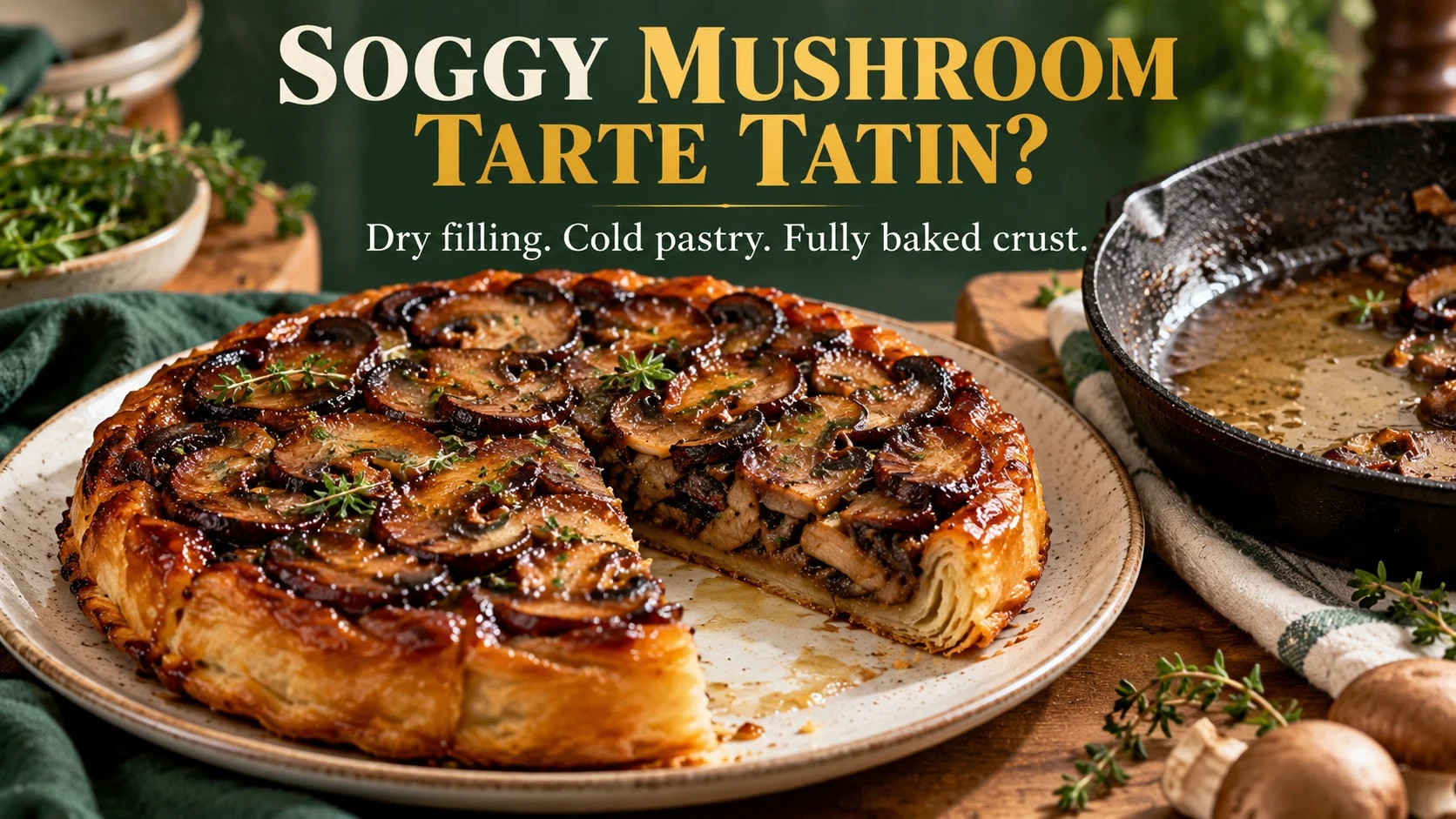
Mushroom tarte tatin usually gets soggy because the filling still contains free liquid, the glaze is too runny, or the pastry has not baked through. Start by checking for a puddle in the mushroom pan, then keep the pastry cold and follow its packet instructions for baking. Once the tart is turned out, serve it promptly because the moist topping will gradually soften the crust.
A golden rim does not tell you whether the middle is cooked, and glossy mushrooms do not tell you whether the glaze has reduced enough. Those are separate checks. Work out whether you have a filling problem, a pastry problem, or softening after serving before changing the next batch.
First, check which kind of mushroom tart you made
A tarte tatin bakes upside down: mushrooms and glaze sit in the pan, pastry covers them, and the finished tart is inverted onto a plate. A mushroom galette starts with pastry underneath and folds its edges around the filling. Both can become soggy, but the assembly and release advice on this page is for the upside-down version.
In a tatin, the pastry surface facing the filling has no opportunity for a separate blind bake. Any excess liquid left below it has to evaporate during baking or remain in contact with the dough. After inversion, that same damp surface becomes the top of the pastry base, where the mushrooms continue to release moisture.
- Before assembly: look for free liquid from the mushrooms and any sauce you added.
- Before baking: check that the filling has cooled and the pastry is still cold and pliable.
- After baking: distinguish a crisp, cooked crust from a golden exterior with a gummy interior.
- After serving: remember that a cooked crust can soften under a wet topping even when it rose well.
Cook off the mushroom liquid before adding pastry
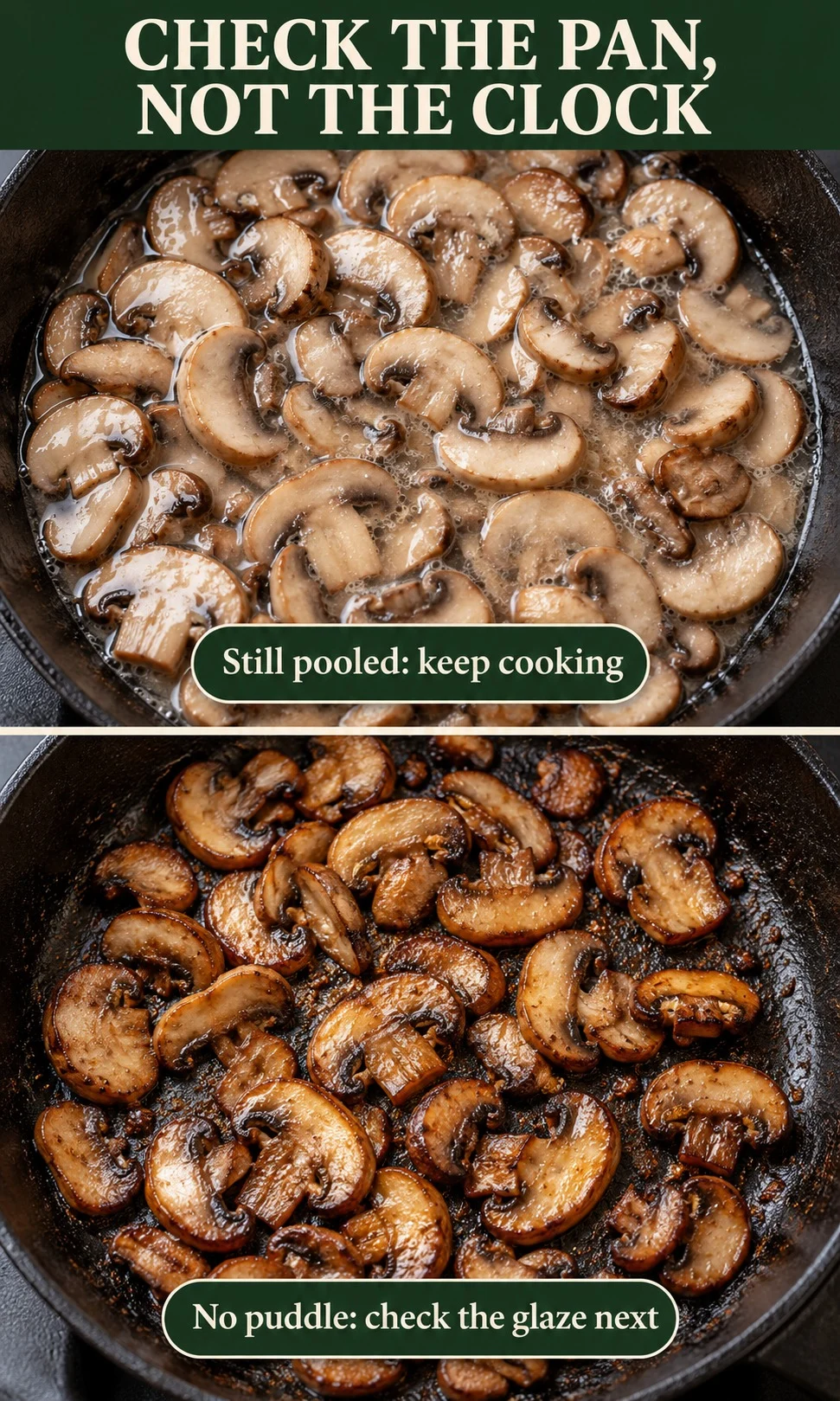
Mushrooms release water as they cook, so a panful can look smaller and softer long before it is ready for a tart. If you cover that wet filling with pastry, you create a humid space underneath the dough. The practical checkpoint is no visible watery puddle when you gently move the mushrooms aside with a spatula.
Use a wide pan and cook in batches when the mushrooms are tightly packed. A pile that keeps refilling the pan with liquid needs more evaporation, not another spoonful of oil. Keep the pan uncovered, adjust the heat so the liquid can cook away without scorching the solids, and give the mushrooms time to develop browned surfaces.
A useful distinction is that steaming mushrooms at the beginning is not automatically a mistake. The Institute of Culinary Education’s mushroom method deliberately starts with water, evaporates it, and only then moves to browning in oil. For a tarte tatin, the mistake is stopping while that water is still in the pan.
Onions, leeks and frozen mushrooms can add further liquid, even if the first mushroom batch was dry. Cook each watery addition adequately and recheck the combined filling. Do the check again after adding balsamic vinegar, tamari or another sauce because a dry pan can become wet a second time.
Browned patches and a nearly dry pan are more useful than a fixed cooking time. Mushroom size, pan width, burner strength and batch depth all change how long evaporation takes. Season to taste as you cook, then taste again after reduction because the same amount of salt becomes more concentrated as water leaves.
Reduce the glaze without turning it into burnt syrup
A maple, balsamic and tamari mixture is a savoury glaze; it does not need to behave like a firm apple-tatin caramel. The useful question is whether it coats the mushrooms or runs around them like broth. A thin puddle can wet the pastry during baking and spill onto the plate after inversion.
Add the glaze after the mushroom water has evaporated, then reduce it according to the recipe while watching the pan. It should cling rather than collect as a large watery pool. Stop short of a blackened, sticky coating because reduced sugars can burn quickly and scorched flavour is difficult to remove.
Do not assume vinegar is the single explanation for a watery glaze. Extra mushroom juice, too much added sauce and insufficient reduction can each contribute. Change one variable at a time next time, and write down the amount of liquid you added so the adjustment has a clear purpose.
Keep pastry cold and the filling cool
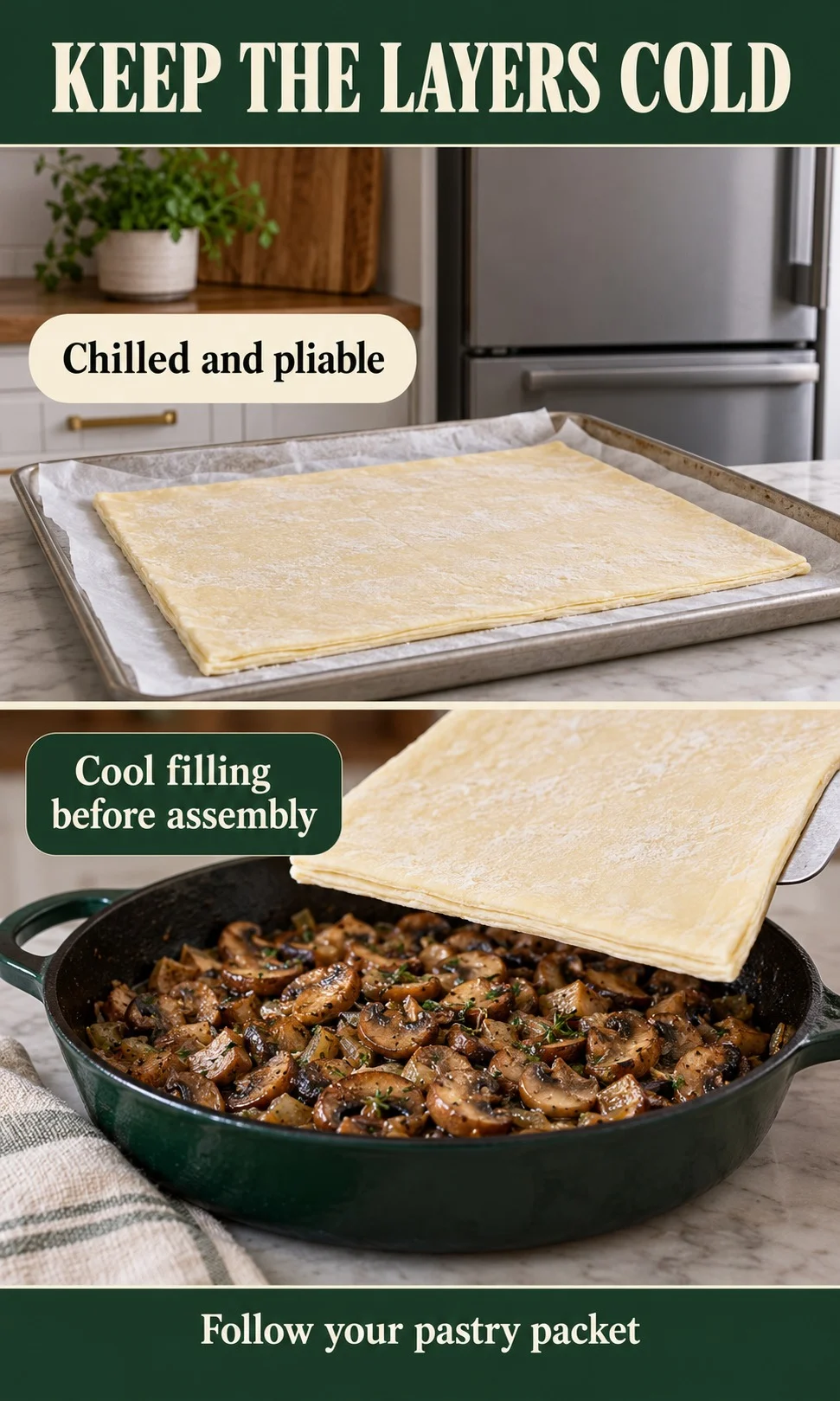
Puff pastry needs intact layers and enough oven heat to expand and set. Putting a cold sheet onto hot mushrooms can soften the fat before the tart reaches the oven. Let the cooked filling cool without leaving it out for prolonged periods, then assemble with pastry that is thawed but still cool and easy to handle.
The pastry manufacturer’s handling guidance calls for cold dough, cooled fillings and a preheated oven. Your own packet controls the thawing method, oven setting and any fan-oven adjustment. Do not force a frozen sheet open, overwork it or press its cut edges together while rolling.
Vegan puff pastry is not inherently unable to rise. Commercial sheets made with vegetable fats can still be laminated pastry, and water in the dough supplies steam during baking. Jus-Rol’s puff-pastry product information illustrates a vegetable-fat formulation; check the specific packet in your country rather than assuming every product is the same.
For a vegan tart, the pastry and every finishing ingredient must also be suitable: dairy butter, cheese and egg wash change that claim. Vegan status does not diagnose a soggy crust. Focus on moisture, handling and baking first, and use the wash specified by your chosen vegan recipe if it calls for one.
Match the symptom to the next action
A pale, gummy centre and a fully cooked crust that softened on the plate need different responses. The first points to incomplete baking or moisture trapped during baking; the second points to contact with the topping after release. Use the visible state to choose a correction rather than increasing every cooking time at once.
Pan choice matters too: use a solid pan whose base, handle and coating are rated for the recipe’s oven temperature. A loose-bottom tin can leak glaze, while an unsuitable handle makes the oven stage unsafe. If your pan is not stovetop-safe, cook the filling separately rather than putting the pan over a burner.
| Symptom | Check | Next action |
|---|---|---|
| Watery mushrooms before assembly | Move them aside and look for a puddle. | Cook uncovered; use batches if evaporation is slow. |
| Runny glaze | Look for liquid collecting around the mushrooms. | Reduce before assembly; avoid scorching the sugars. |
| Pastry became soft before baking | Check whether the filling or work area was warm. | Cool the filling and rechill pliable pastry. |
| Golden edges, gummy middle | Inspect the crust rather than judging only its rim. | Continue the recipe’s baking process if it can cook without burning. |
| Crisp initially, then soft on the plate | Consider how long the wet topping touched the crust. | Serve promptly; reheat individual portions with dry heat if safely handled. |
| Burnt surface, wet interior | Stop and inspect the method and oven setting. | Do not keep baking just to dry it; revise moisture and heat management next time. |
Check your next step in Crisp Crust Studio
Choose whether you are assembling, turning out, serving or reheating the tart, then enter the conditions you can actually observe. The Studio returns the next checks in order, including when to pause for an unsuitable pan or unsafe storage. Its printable report is a kitchen checklist, not proof that a tart is fully cooked or safe to eat.
Bake fully, let bubbling settle, then turn out
Use the temperature and baking method from a suitable tatin recipe and your pastry packet, with the oven fully preheated. Cut the limited vents your recipe specifies, rather than docking the entire sheet if you want lift. Look for a well-baked crust, not just an attractive colour on the outer edge.
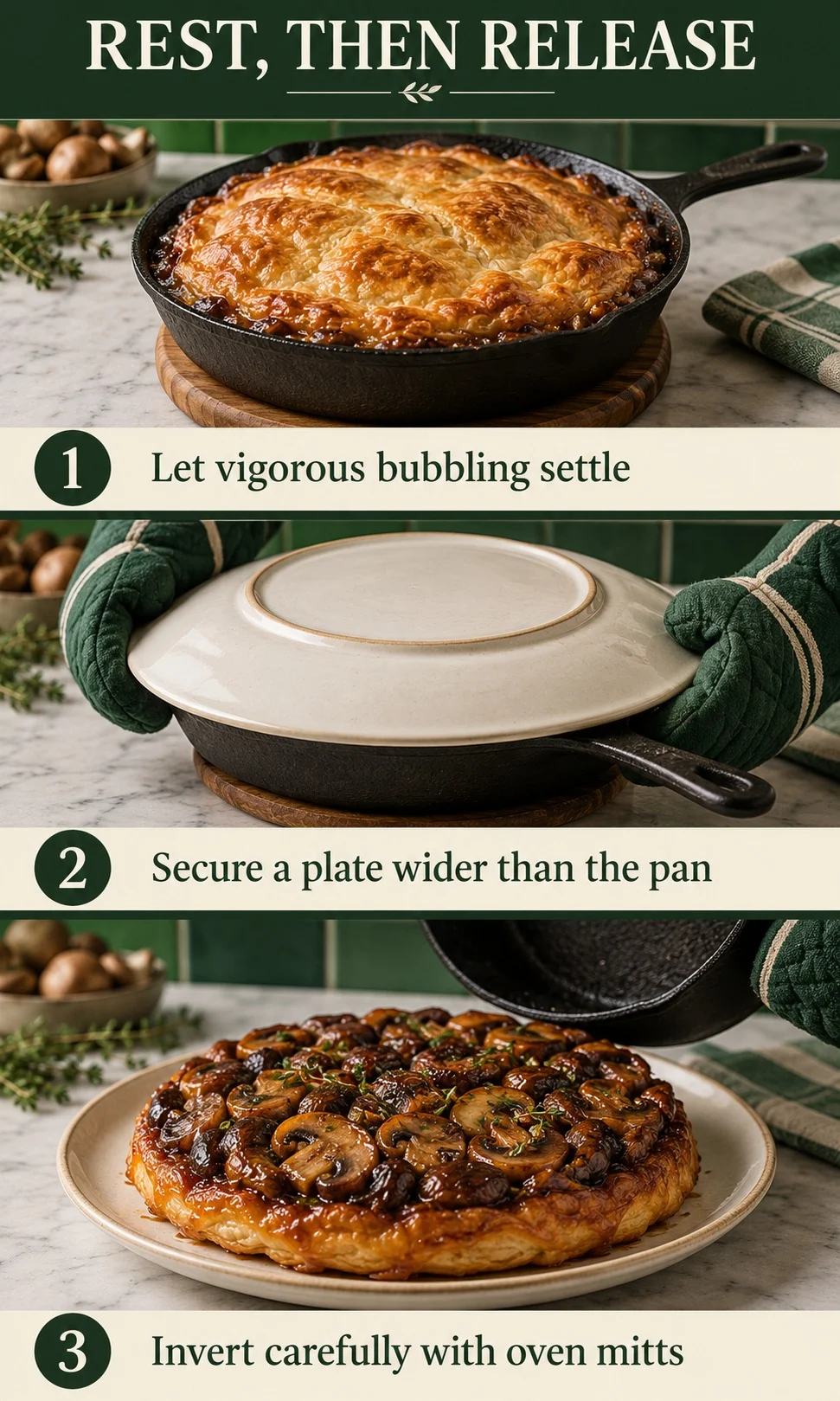
Before inversion, let vigorous bubbling settle while the glaze is still able to release from the pan. There is no dependable universal minute count for every mushroom mixture, pan and glaze. Turning immediately can send very hot liquid onto the plate, while waiting until a sugary glaze hardens can make release harder.
Set the pan on a stable heatproof surface and choose a plate wider than the pan, preferably with a rim to catch juices. Use dry oven mitts to secure both pieces and invert carefully, keeping the movement controlled and away from your body. If the pan is too heavy to hold securely, do not attempt the flip alone.
If the tart sticks, avoid shaking the pan or pulling at the crust over an unstable plate. Only a pan explicitly suitable for the hob may be gently warmed there to loosen a set glaze. An oven-safe tin is not automatically stovetop-safe, so follow your recipe’s release method for that vessel instead.
What to do if the tart is already soggy
If the crust was fully cooked and has merely softened, try reheating individual portions with dry oven heat. Set them on an oven-safe rack over a tray so air can reach the underside and drips are caught. A microwave heats the food but is a poor choice when your aim is to restore crisp pastry.
A gummy, doughy middle is a different problem: a brief warming cycle may not finish cooking it. Additional baking can help only while the filling and outer pastry can tolerate it without burning. If the exterior is already scorched, stop trying to rescue the appearance and correct the wet filling or oven method for the next batch.
Texture recovery has limits because moisture has already moved into the crust. Reheating cannot recreate every separated layer, and it cannot make mishandled leftovers safe. The same filling-versus-crust distinction appears in why pumpkin quesadillas get soggy, although that dish uses a different cooking method.
Make ahead and store with texture and safety in mind
For a more reliable make-ahead approach, cook the filling ahead, cool it promptly and refrigerate it separately from the pastry. Assemble close to baking rather than letting dough sit against a moist topping for hours. If you use a recipe that permits advance assembly, follow its refrigeration directions and expect some effect on texture.
Apply the USDA’s general cooked-leftover guidance: refrigerate promptly within two hours, or within one hour above 90°F (about 32°C), and keep the refrigerator at 40°F (about 4°C) or below. Use properly stored leftovers within three to four days and reheat them to 165°F (74°C). These are safety limits, not a promise that puff pastry will remain crisp for that long.
Divide leftovers into portions or shallow containers so they cool promptly rather than leaving the whole tart out to protect the pastry. Once refrigerated, cover them to protect the food and accept that the crust may soften. If storage history is uncertain or the food was left out beyond the limit, discard it rather than using smell or reheating as a safety test.
This guidance brings together manufacturer handling instructions and general cooking and storage principles. The images illustrate the checks rather than documenting a controlled kitchen experiment. No side-by-side batch test or guaranteed crispness result is claimed.
Frequently asked questions
Why is the bottom of my mushroom puff pastry soggy?
The filling may contain free liquid, or the pastry may not have baked through where it touches the mushrooms. Check the mushroom pan and the glaze before assembly, then inspect the cooked crust rather than only its rim. A crust that was crisp and softened later is usually a contact-and-serving problem instead.
Why did my puff pastry not rise?
Warm dough, compressed edges, heavy handling or inadequate oven heat can interfere with lift. Wet filling can also make the contact surface gummy even when the top expands. Check packet directions and handling before assuming the pastry’s vegan formulation caused the problem.
How do I stop mushroom tarte tatin glaze going watery?
Cook off the mushroom liquid before adding the glaze, then reduce the combined mixture until it coats the mushrooms without a large watery pool. Recheck after every liquid addition. Do not reduce so aggressively that the sugary coating scorches.
When should I flip a mushroom tarte tatin?
Turn it out after vigorous bubbling has settled but before the glaze hardens and sticks, following the timing in your recipe. Pan material and glaze composition make a single universal rest time unreliable. Secure a plate wider than the pan and use dry oven mitts because hot glaze can cause burns.
Can vegan puff pastry work for mushroom tarte tatin?
Yes, a suitable commercial vegan puff pastry can work, and vegetable-fat pastry can still have laminated layers. Check the exact packet for ingredients, handling and baking directions. Keep dairy cheese, dairy butter and egg wash out of the preparation if the finished tart is intended to be vegan.
How long can I keep mushroom puff pastry tart in the fridge?
Use general cooked-leftover guidance of three to four days only when the tart was refrigerated promptly and kept at 40°F (about 4°C) or below. Its pastry may soften much earlier. Reheat properly stored leftovers to 165°F (74°C), and discard food with unsafe or uncertain storage history.
A crisper tart starts before the oven
The most useful correction is to remove free liquid before covering the mushrooms with pastry. Keep the dough cold, give the crust enough heat to bake through, and turn the tart out safely while its glaze can still release. Serve promptly, and treat storage safety as a separate decision from whether reheating can improve the crust.