



Why Milk Is Being Questioned Again
Milk has been part of daily diets for generations. It appears in breakfast routines, coffee, desserts, and home cooking. For many people, drinking milk feels natural, familiar, and harmless. Some even associate it with strength, nourishment, and comfort.
Yet in recent years, conversations about milk have quietly shifted.
Across online forums, community groups, and everyday conversations, more people are mentioning bloating, stomach pressure, and digestive discomfort that seem to follow milk consumption. What makes these discussions confusing is that most of the people affected did not experience problems earlier in life. In fact, many drank milk daily for years without noticing anything unusual.

This creates doubt.
To understand why digestion responses change over time, you need to understand how digestion actually works.
If milk was tolerated before, how could it suddenly become a problem?
The answer is not as dramatic as social media headlines suggest. Milk is not “turning bad,” and digestion is not failing overnight. Instead, the body’s ability to process certain components of milk can change gradually, often without obvious warning signs at first.
Bloating related to milk rarely begins with pain or illness. It often starts as a mild heaviness after meals, a sense of fullness that lasts longer than expected, or subtle discomfort that disappears by morning. Because these sensations are not severe, they are easy to dismiss as stress, overeating, or fatigue.
Over time, however, these small signals can become patterns.
What worries digestion experts is not milk itself, but how often early signs are ignored. When the same drink is consumed daily and the body struggles slightly each time, discomfort can slowly build into a consistent digestive issue.
This article is not about fear or elimination. It is about understanding how milk interacts with digestion, why bloating may appear later in life, and how to recognize the difference between normal digestion and repeated strain.
How Milk Is Digested in the Body (Foundational Understanding)
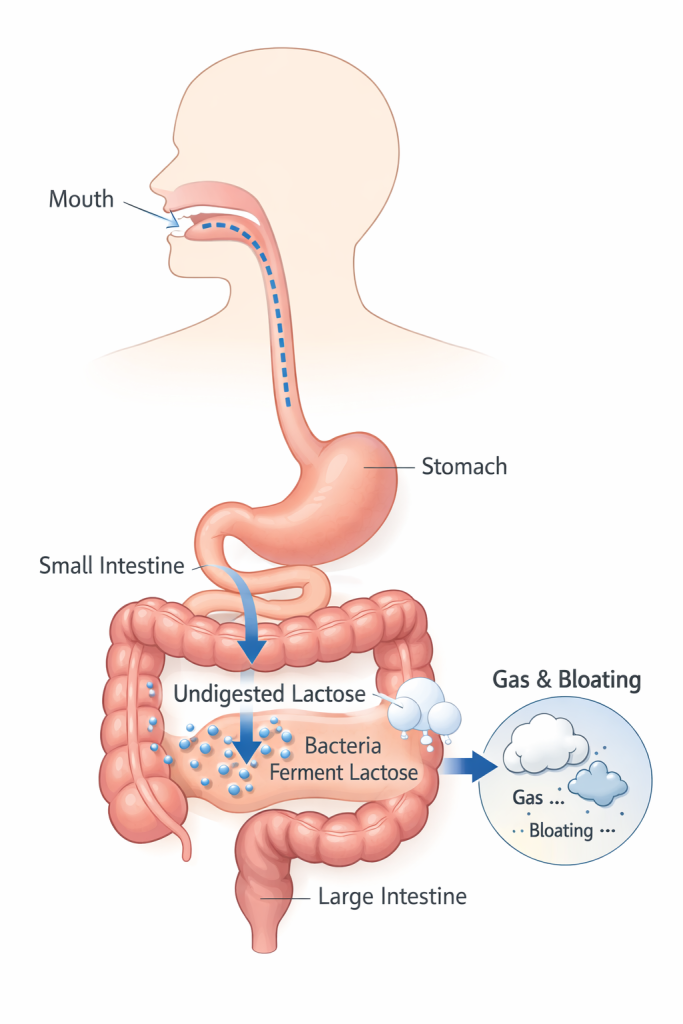
To understand why milk can cause bloating for some people, it helps to first understand how digestion works at a basic level.
Milk contains a natural sugar called lactose. Unlike simple sugars that are easily absorbed, lactose requires a specific digestive enzyme called lactase to be broken down properly in the small intestine. When lactase is present in sufficient amounts, lactose is digested smoothly and absorbed without discomfort.
When lactase levels are lower, lactose passes through the small intestine undigested and enters the large intestine. There, gut bacteria ferment it, producing see gas and by-products. This fermentation process is one of the most common causes of bloating, pressure, and abdominal discomfort after consuming milk.
What many people do not realize is that lactase production is not fixed for life.
In childhood, lactase levels are typically high. As people age, lactase production can gradually decrease. This change does not happen suddenly, and it does not affect everyone equally. Some people retain strong lactase activity throughout adulthood, while others experience a slow decline over time.
This gradual shift explains why milk-related bloating often feels confusing. The body may cope well for years, then begin to struggle quietly, producing subtle symptoms long before discomfort becomes obvious.
This distinction matters because many people assume that if milk caused no issues in the past, it cannot be responsible now. In reality, digestion adapts constantly, responding to age, stress, lifestyle, and gut health.
To understand why digestion responses change over time, you need to understand how digestion actually works. Without that foundation, early signs of intolerance or strain are often misinterpreted or ignored.
Why Milk Symptoms Often Appear Later, Not Immediately
One of the most common questions people ask is why milk-related bloating appears “out of nowhere.”
In most cases, it doesn’t.
Digestive discomfort related to milk usually develops slowly due to a combination of factors:
- Natural reduction in digestive enzyme production
- Changes in gut bacteria balance
- Increased stress affecting digestion speed
- Eating habits that overload digestion, especially late in the day
When these factors combine, the body may no longer process milk as efficiently as before. The result is not immediate pain, but delayed fermentation, gas buildup, and a sense of heaviness that becomes noticeable after repeated exposure.
Digestive discomfort is often the body’s early feedback system, not a sudden failure.
Because the symptoms are gradual, many people adapt without realizing it. They may unconsciously loosen clothing, avoid certain activities after meals, or accept bloating as part of daily life. Over time, what started as a mild inconvenience becomes normalized discomfort.
This is why milk-related bloating is often recognized only after patterns are examined closely.
Why Milk-Related Bloating Often Feels Worse at Night

One pattern appears repeatedly among people who experience bloating linked to milk:
the discomfort is more noticeable in the evening.
This is not a coincidence.
Digestion follows a daily rhythm. During the day, the body is more active, metabolism is higher, and the digestive system processes food more efficiently. As the day progresses, digestion naturally slows. This slowdown is part of the body’s preparation for rest.
When milk is consumed later in the day, several things happen at once:
- Digestive enzymes are less active
- Gut movement slows
- Physical activity decreases
- Larger or richer meals are more common
As a result, lactose that might have been handled adequately earlier in the day can ferment more noticeably at night. Gas production becomes more obvious, and the sensation of bloating feels stronger.
This explains why many people say:
“I feel fine after breakfast milk, but uncomfortable after dinner.”
The issue is not necessarily the quantity of milk alone, but timing combined with digestive capacity.
When this pattern repeats daily, the body begins to associate evening meals with discomfort. Over time, bloating may start earlier in the day or feel more intense, even if milk intake has not changed.
This pattern is explained further in Foods That Commonly Cause Bloating, which outlines how repeated exposure triggers digestive strain.
Why Some People Tolerate Milk Easily While Others Don’t
One of the reasons milk discussions become confusing online is that experiences vary widely.
Some people drink milk daily without any symptoms. Others experience bloating, pressure, or discomfort from small amounts. Both experiences can be valid at the same time.
Several factors influence how milk affects digestion:
- Genetics – lactase production varies naturally
- Gut bacteria balance – different bacteria ferment lactose differently
- Stress levels – stress slows digestion and increases sensitivity
- Portion size – larger servings require more digestive effort
- Frequency – repeated daily intake can strain digestion over time
This variation explains why milk cannot be labeled simply as “good” or “bad.”
Milk is neutral. The body’s response is individual.
Problems arise when people assume that tolerance is permanent. Digestive capacity is not fixed. It changes with age, lifestyle, stress, and overall gut health.
Recognizing this flexibility allows for adjustment rather than panic.
The Pattern Most People Notice Too Late
When people reflect on milk-related bloating, a familiar pattern often emerges:
- Milk is consumed daily as part of routine
- Mild bloating appears occasionally
- Symptoms are ignored or blamed on other causes
- Milk consumption continues unchanged
- Discomfort becomes frequent and expected
At this stage, many people no longer question the symptoms. Bloating becomes part of normal life. Only when discomfort interferes with sleep, clothing fit, or daily comfort does milk come into question.
By then, the digestive system has already been under strain for some time.
This is why early awareness matters. The body often signals discomfort long before it demands attention.
A Real-Life Case Many People Recognize

A working professional in her late thirties drank milk daily in coffee and cereal. For years, she experienced no issues. Gradually, she began to notice bloating in the evenings, especially after dinner.
Medical tests showed no abnormalities. Stress was suggested as the cause. She accepted this explanation and continued her routine.
After tracking her meals for two weeks, she noticed that bloating appeared most consistently on days when milk was consumed multiple times. She reduced portion size and avoided milk late at night. Within a short period, the discomfort eased significantly.
Nothing dramatic changed.
No diagnosis was made.
The improvement came from adjustment, not elimination.
This type of experience is common and often overlooked because it does not fit dramatic narratives.
What to Do If Milk Causes Bloating (Without Panic)
If milk appears to cause discomfort, extreme reactions are rarely necessary.
A professional, measured approach works better:
- Observe patterns
Note when milk is consumed and when bloating appears. - Adjust timing
Avoid drinking milk late in the evening. - Reduce portion size
Smaller amounts are easier to digest. - Space intake
Avoid multiple servings in a short time window. - Give digestion time
Allow the gut to recover between exposures.
These steps help clarify whether milk is truly contributing to bloating or if other factors are involved.
The goal is not to fear food, but to respond intelligently to feedback.
When Milk-Related Bloating Should Not Be Ignored
Occasional bloating is normal.
However, it should not be ignored when it becomes:
- Frequent
- Progressive
- Disruptive to daily comfort
- Associated with persistent digestive discomfort
Repeated signals deserve attention. Ignoring them often leads to stronger symptoms later.
Why Eliminating Milk Completely Is Often the Wrong First Step
When people suspect milk is causing bloating, the most common reaction is to remove it entirely from their diet. While elimination can sometimes be useful short-term, doing it immediately often creates more confusion than clarity.
Removing milk without understanding the pattern can lead to:
- Nutritional imbalance
- Increased anxiety around eating
- Difficulty identifying whether milk was truly the cause
Milk contains nutrients such as calcium, protein, and vitamins that many people still benefit from. The issue is rarely milk alone. It is more often dose, frequency, timing, and digestive capacity.
A measured approach allows the body to respond gradually, revealing whether discomfort improves through adjustment rather than avoidance. In many cases, people discover they tolerate milk well in smaller amounts or earlier in the day.
This insight is lost when milk is removed too quickly.
Short-Term Fixes vs Long-Term Digestive Awareness
Another common mistake is relying on quick fixes such as supplements, enzymes, or constant product switching. While these can provide temporary relief, they do not replace understanding.
Long-term digestive comfort comes from awareness:
- Knowing how your body responds to certain foods
- Recognizing early signals instead of suppressing them
- Adjusting habits before discomfort becomes chronic
Bloating is not a failure of the body. It is communication.
When digestion struggles repeatedly, the solution is rarely dramatic. It is usually a series of small, consistent adjustments that reduce strain and allow the system to function more efficiently.
How to Think About Milk Moving Forward
Milk does not need to be feared. It also does not need to be consumed automatically out of habit.
A healthy relationship with food includes:
- Flexibility
- Observation
- Willingness to adjust
Some people will continue drinking milk daily without issues. Others may find that moderation or timing makes a significant difference. Both outcomes are normal.
What matters is responding to what the body communicates, rather than forcing routines that no longer fit.
Final Thoughts: Listening Early Is Easier Than Fixing Later
Digestive issues rarely begin loudly.
They start quietly, through small discomforts that are easy to ignore. Milk-related bloating follows this same pattern. What feels minor today can become persistent tomorrow if left unaddressed.
The purpose of understanding digestion is not restriction.
It is comfort, balance, and long-term well-being.
Milk remains a useful food for many people.
The key is learning when and how it works best for your body.
FAQ
Does milk always cause bloating?
No. Milk affects individuals differently depending on lactase enzyme levels, overall digestion efficiency, and gut microbiome balance. Some people digest milk comfortably, while others experience bloating or discomfort.
Why does milk bloating appear later in life?
Lactase enzyme production can gradually decline with age, reducing the ability to break down lactose efficiently. This change can make milk more difficult to digest over time.
Is milk intolerance the same as milk allergy?
No. Milk intolerance involves difficulty digesting lactose and primarily affects the digestive system, while a milk allergy involves an immune response to milk proteins and can cause more serious reactions.
Should I stop drinking milk completely?
Not necessarily. Adjusting portion size, choosing lactose-free options, or consuming milk with meals can often reduce symptoms without eliminating it entirely.
Why is milk bloating worse at night?
Digestion naturally slows in the evening, which can make fermentation processes more noticeable. Gas buildup may feel more pronounced when lying down or when overall gut movement decreases.