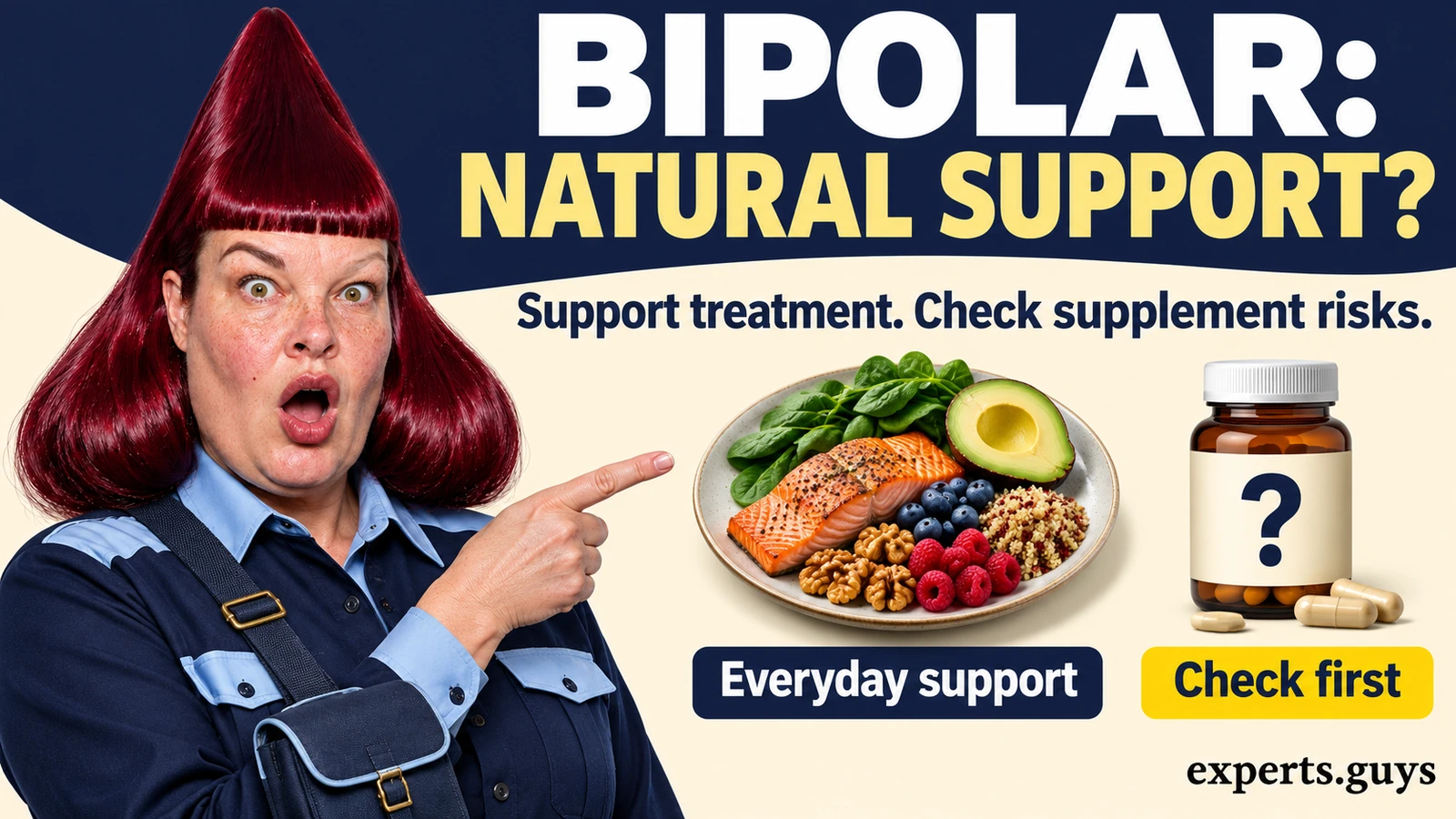
Natural remedies for bipolar disorder include everyday health habits and products such as herbs or nutritional supplements, but these have very different benefits and risks. Regular meals and a sustainable routine can support care; no natural remedy is an established replacement for bipolar treatment, and some mood supplements can trigger problems or interact with medicines. The useful first step is to separate ordinary support from a product that needs a safety check.
Act on urgent changes first. Suicidal thoughts, new hallucinations or delusions, rapidly escalating behavior, or very little sleep with unusually high energy need urgent assessment. If someone cannot stay safe or there is immediate danger, use local emergency services or an emergency department rather than trying a supplement or waiting for a routine appointment.
The most useful question is not which ingredient sounds most natural. It is what you want to improve, whether the proposed approach has evidence for that job, and what it could disrupt. A meal that becomes easier to prepare has a clear everyday purpose; a capsule advertised to stabilize bipolar mood makes a much larger claim.
Can natural remedies safely support bipolar treatment?
Some everyday habits can support physical health and make an existing care plan easier to follow, while supplements require a separate assessment. For a person considering an over-the-counter mood product, the priority is checking its ingredients before taking it. There is no reason to buy six products simply because six ingredients appear in an online article.
| Approach | Useful role | Boundary |
|---|---|---|
| Regular meals and a manageable routine | Support nutrition and everyday functioning. | Do not replace episode-specific treatment. |
| Structured psychological treatment | Develop skills within an agreed bipolar care plan. | Different from generic wellness marketing. |
| Herbs and concentrated supplements | Need a product-specific evidence and safety decision. | Natural origin does not establish safety or benefit. |
| Prescribed medication | Treat or prevent episodes according to the individual plan. | Do not change or replace it yourself. |
Bipolar care has several jobs: responding to a current episode, reducing future episodes, and helping daily life work between episodes. Evidence that something helps general relaxation does not establish that it treats mania or prevents recurrence. For the broader distinctions, the guide to bipolar disorder and its different episodes supplies the background without turning every supplement decision into a diagnostic exercise.
A useful claim names the outcome. “Supports brain health” does not tell you whether a study measured depressive symptoms, manic symptoms, functioning, or relapse. These outcomes cannot be swapped. Even a genuine improvement on one measure leaves other questions unanswered, including whether the effect persists and whether adverse effects outweigh it.
Our practical recommendation is to prioritize an unmet everyday need before buying a mood supplement. If the obstacle is missing lunch because preparation feels impossible, making food accessible directly addresses that obstacle. If the obstacle is an emerging episode, the appropriate response is episode-specific care. A product can be expensive and biologically active without being useful for either job.
“Alongside treatment” also needs a precise meaning. An addition should have an agreed purpose and fit with the medicines, health conditions and other products already involved. The phrase does not mean every supplement becomes safe once a person is taking a mood stabilizer. Combining approaches can introduce interactions as well as potential benefits.
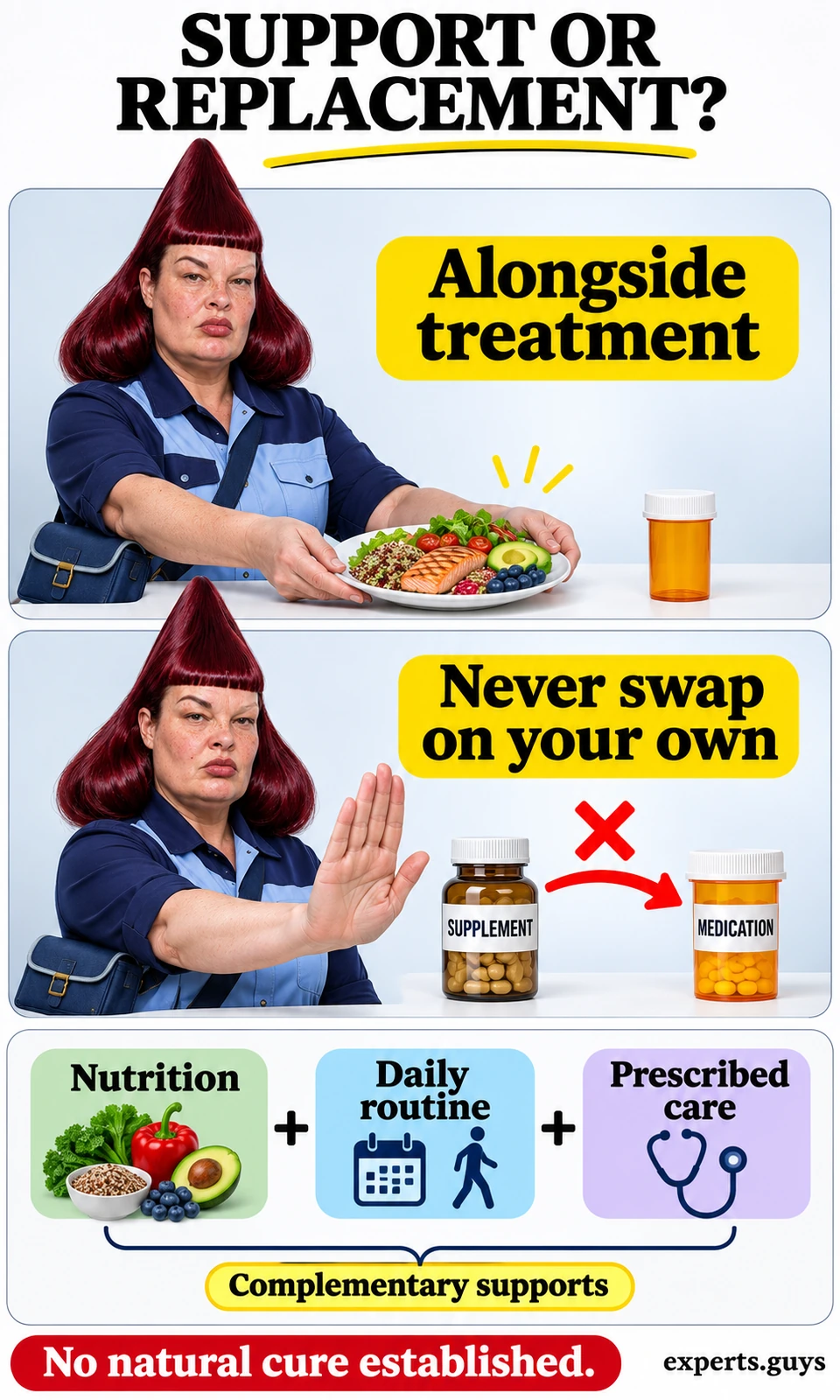
The NIMH overview of bipolar treatment distinguishes medication and psychological treatment from complementary approaches whose effects are less thoroughly established. Non-drug care includes structured psychological treatments; it is not limited to herbs. Wanting more control over daily life is a reasonable goal, and it can be addressed without treating an unverified product as medicine.
Side effects, cost or an unsatisfactory response are reasons to revisit a treatment plan, rather than reasons to silently substitute a supplement. A clear conversation identifies the actual problem: for example, sedation that interferes with work is different from persistent depression. The bipolar treatment guide explains why treatment choices depend on the phase and the person’s history.
What does the evidence say about the six ingredients?
The six products commonly mentioned in this context should not be presented as six equivalent options. Their evidence, composition and safety concerns differ. Use the following distinctions to understand a claim, rather than to select a dose or create a supplement combination.
- A nutrient in food: its normal role in the body does not establish that extra amounts treat an episode.
- A concentrated supplement: the exact ingredients and formulation matter, even when the name is familiar.
- A mood or sleep claim: check whether it was actually studied in bipolar disorder and whether activation or interactions were assessed.
Omega-3: an adjunctive research question, not a mania remedy
Omega-3 supplements have been studied as additions to bipolar treatment, with uncertain and uneven findings. They should not be described as reliably reducing both mania and depression. The VA/DoD bipolar disorder guideline finds insufficient evidence to recommend for or against adding nutritional supplements to reduce bipolar depressive or manic symptoms; a plausible biological explanation is not enough to make them a routine treatment recommendation.
Three distinctions help prevent exaggerated conclusions. First, an add-on study does not test replacing the existing treatment. Second, the product used in a trial may differ from a shop’s formulation. Third, findings about one illness phase cannot establish protection against another. “People were taking fish oil” is therefore too imprecise to tell you what was tested or what decision follows.
You can still choose fish, nuts, seeds or other suitable foods for nutrition. That decision does not require believing that food treats a bipolar episode. Likewise, deciding not to start fish-oil capsules does not imply avoiding all omega-3-containing foods. Food preferences and supplement prescribing are related nutritional topics with different clinical implications.
St John’s wort: do not self-treat bipolar depression with it
St John’s wort is not an appropriate do-it-yourself bipolar remedy. It can interact with many medicines, and worsening bipolar symptoms has been reported. Its reputation as an herbal antidepressant should increase caution in this setting, rather than serve as a reason to add it to treatment.
The NCCIH safety information for St John’s wort explains both serious interaction concerns and the limits of depression evidence. A package that calls the herb a “natural mood booster” does not disclose the full clinical decision. Do not assume a tea, tincture or blend avoids the issue simply because it is not sold as a conventional tablet.
SAMe: naturally present in the body does not mean safe to supplement
SAMe, also written SAM-e, is a compound found in the body and sold as a supplement. That fact does not establish that taking extra SAMe is appropriate for bipolar depression. The safety question concerns the effect of the added product, rather than whether the molecule is naturally occurring.
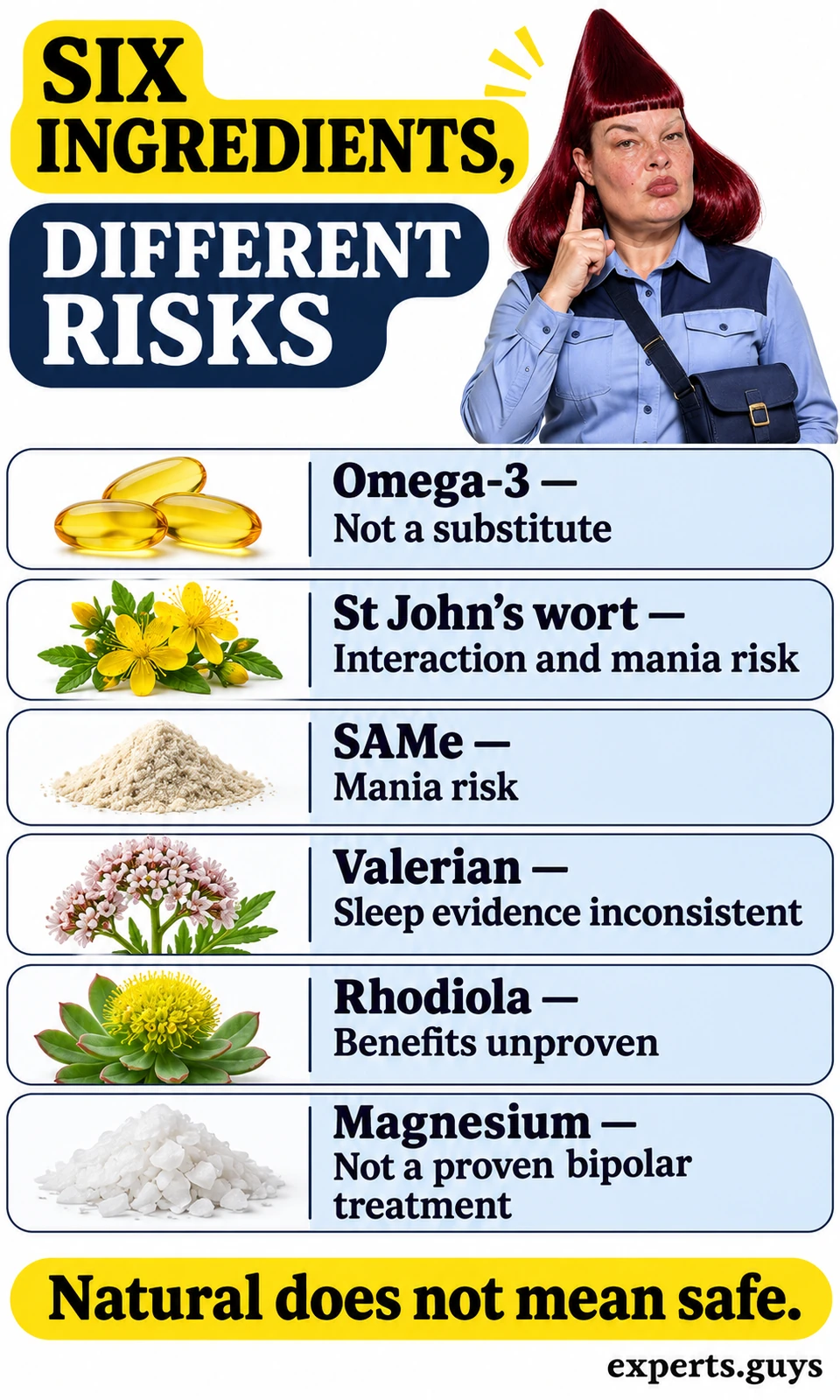
NCCIH’s SAMe guidance warns that it may worsen mania and should not be used for bipolar depressive symptoms except under healthcare supervision. Possible interactions with serotonin-affecting drugs and supplements add another reason not to combine it with a mood blend. This is a specific risk, not a generic disclaimer that can be ignored after reading the benefits.
Valerian: uncertain sleep benefit does not establish bipolar benefit
Valerian is promoted for sleep, but evidence for sleep problems is inconsistent. Feeling sedated would not by itself show that bipolar symptoms are improving. The distinction matters when poor sleep is accompanied by rising energy, agitation or unusual behavior: those changes need assessment, rather than an increasingly complicated sleep-aid mixture.
The NCCIH valerian fact sheet advises against combining it with alcohol or sedatives and notes uncertainty about long-term safety. People already taking a product regularly should describe that actual use when asking about changes. Advice to keep a new bottle unopened is a prevention step, not an instruction to abruptly alter an established regimen.
Rhodiola: “adaptogen” is not evidence of mood stabilization
Rhodiola is marketed for energy, stress and mood, but reliable evidence is insufficient to establish a health benefit. The term “adaptogen” does not tell you that it prevents bipolar episodes, and it does not identify a dose that would be safe for you. Insomnia is among the adverse effects listed in NCCIH’s rhodiola guidance.
The decision problem is especially clear when the goal is “more energy.” Low energy can have several causes, and a product that changes wakefulness has not necessarily treated the cause. For someone vulnerable to activation, the quality of the change matters. A more manageable day is different from needing less sleep while taking on increasingly unrealistic commitments.
Magnesium: treat a nutritional problem as a nutritional problem
Magnesium is essential for normal body functions, but that does not make magnesium supplements an established bipolar treatment. A deficiency or another medical indication can justify a specific plan; the logic should remain attached to that indication. Claims that a mineral “calms the nervous system” do not establish prevention of mania or depression.
Magnesium from food and high supplemental amounts have different safety considerations. Supplements can cause diarrhea and other adverse effects, and impaired kidney function can increase risk. The NIH magnesium fact sheet also explains interactions with some medicines. Check for magnesium in other products, including certain laxatives or indigestion remedies, rather than assuming one bottle represents your entire intake.
| Ingredient | Evidence boundary | Specific caution |
|---|---|---|
| Omega-3 | No established substitute for bipolar treatment; adjunctive evidence is uncertain. | Food intake and concentrated products are different decisions. |
| St John’s wort | Depression marketing is not evidence of bipolar suitability. | Interactions and possible worsening bipolar symptoms. |
| SAMe | Natural presence in the body does not establish supplement benefit. | May worsen mania; do not self-treat bipolar depression with it. |
| Valerian | Sleep findings are inconsistent; no established bipolar benefit. | Avoid combining with alcohol or sedatives; long-term safety uncertain. |
| Rhodiola | Insufficient reliable evidence to establish health benefit. | May cause insomnia; “adaptogen” is not a treatment outcome. |
| Magnesium | A nutritional indication differs from treating bipolar disorder. | Excess supplemental intake and kidney impairment can increase risk. |
A stronger-looking study result still needs to match the decision. Ask whether participants had bipolar disorder, whether they were already receiving treatment, and what the comparison group received. A finding in people with unipolar depression does not answer the bipolar safety question. A change in a laboratory marker also does not automatically establish an improvement in symptoms or daily functioning.
Uncertainty has a practical meaning here. It does not prove that no individual could ever benefit, but it prevents a broad recommendation that readers should add the product. When benefit is unclear and a meaningful risk or cost remains, declining to start it can be a considered choice. There is no obligation to exhaust every supplement before using established care.
Across all six ingredients, a reassuring adjective cannot answer the missing questions. “Gentle,” “traditional” and “clean” describe marketing positions, not the outcomes of a bipolar treatment trial. A recommendation should still stand when those words are removed: what precisely is the proposed benefit, what supports it, and why would the expected benefit justify this person’s risks?
What everyday support is useful without buying a mood supplement?
Focus on ordinary needs that are difficult to meet: regular food, adequate sleep opportunity, appropriate activity and a workable treatment routine. These support health; they are not a promise that better habits will prevent every episode. The aim is to make an existing plan easier to live with, without adding a demanding wellness project.
Keep the food decision separate from the capsule decision
A food can supply useful nutrients without acting like a concentrated product studied in a trial. Fish supplies EPA and DHA, while foods such as walnuts and flaxseeds supply ALA; the body converts only limited amounts of ALA to the other forms. The NIH omega-3 fact sheet explains these differences. They are a reason to describe foods accurately, not to claim that one meal has a therapeutic effect.
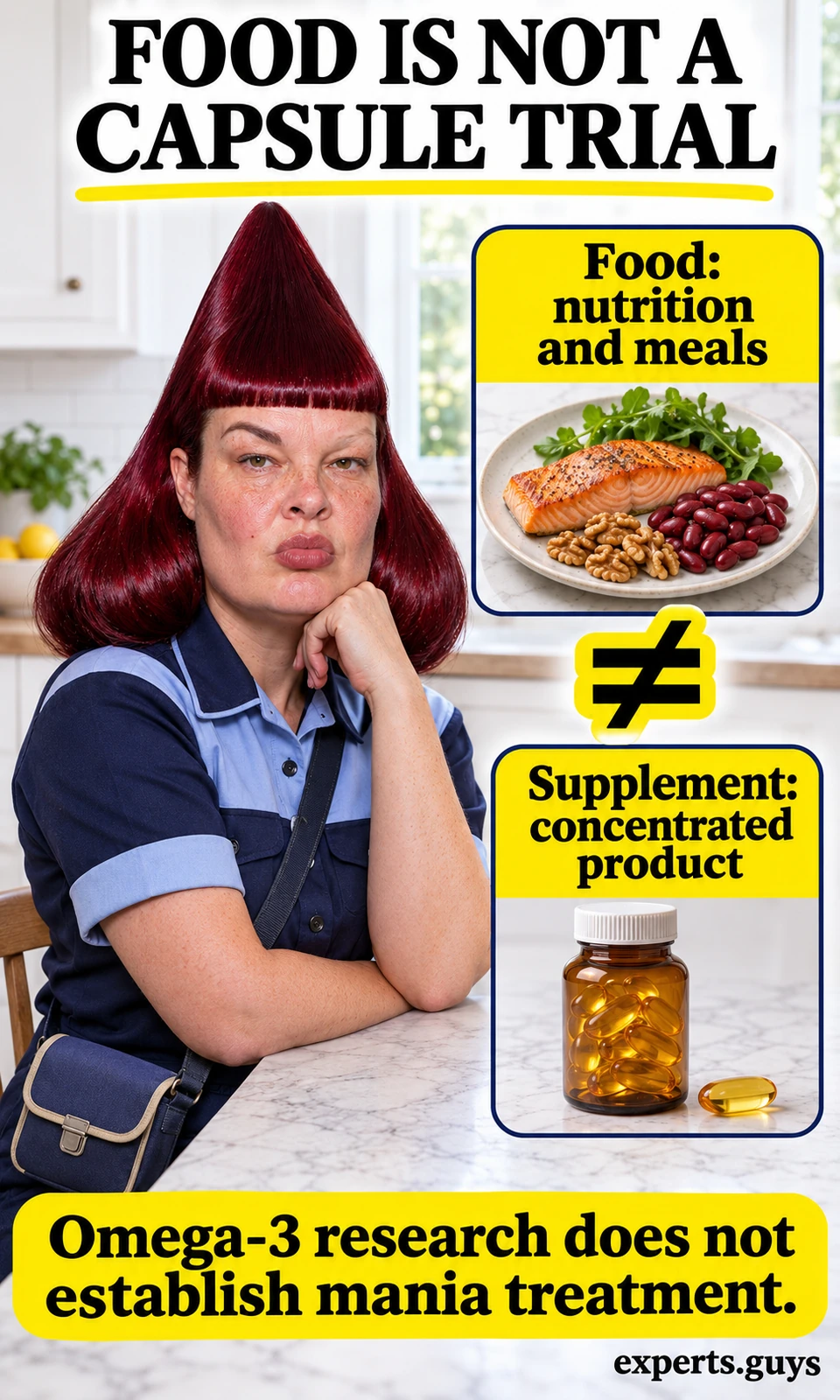
Choose an eating pattern you can sustain within your budget, preferences and medical needs. Someone who dislikes fish does not need to buy it to prove commitment to recovery. A meal assembled from familiar foods may be more useful than an expensive ingredient that remains unused. Where a deficiency, restricted diet or eating difficulty needs individualized support, the relevant question is nutritional adequacy, not finding a universal bipolar superfood.
A hands-on example: assemble one familiar meal
This practical example fits a specific difficulty: you intend to eat, but cooking feels like too many decisions. Prepare a plate or bowl, a ready-to-eat base such as wholegrain bread, a suitable protein food such as ready-to-eat beans, and washed produce. Use foods you tolerate and follow their storage and preparation instructions; the example is an everyday adaptation, not a clinically validated bipolar exercise.
- Choose the ready base. Put the bread or another familiar ready-to-eat base on your plate. Starting with food that needs no cooking removes a preparation barrier.
- Add protein and produce. Serve ready-to-eat beans on the bread or in a bowl and add washed tomatoes or another suitable fruit or vegetable. Use ingredients already safely prepared rather than creating several extra jobs.
- Eat at your usual meal time. Sit somewhere comfortable and have the meal. The checkpoint is food made available and eaten as manageable, not a change in your mood.
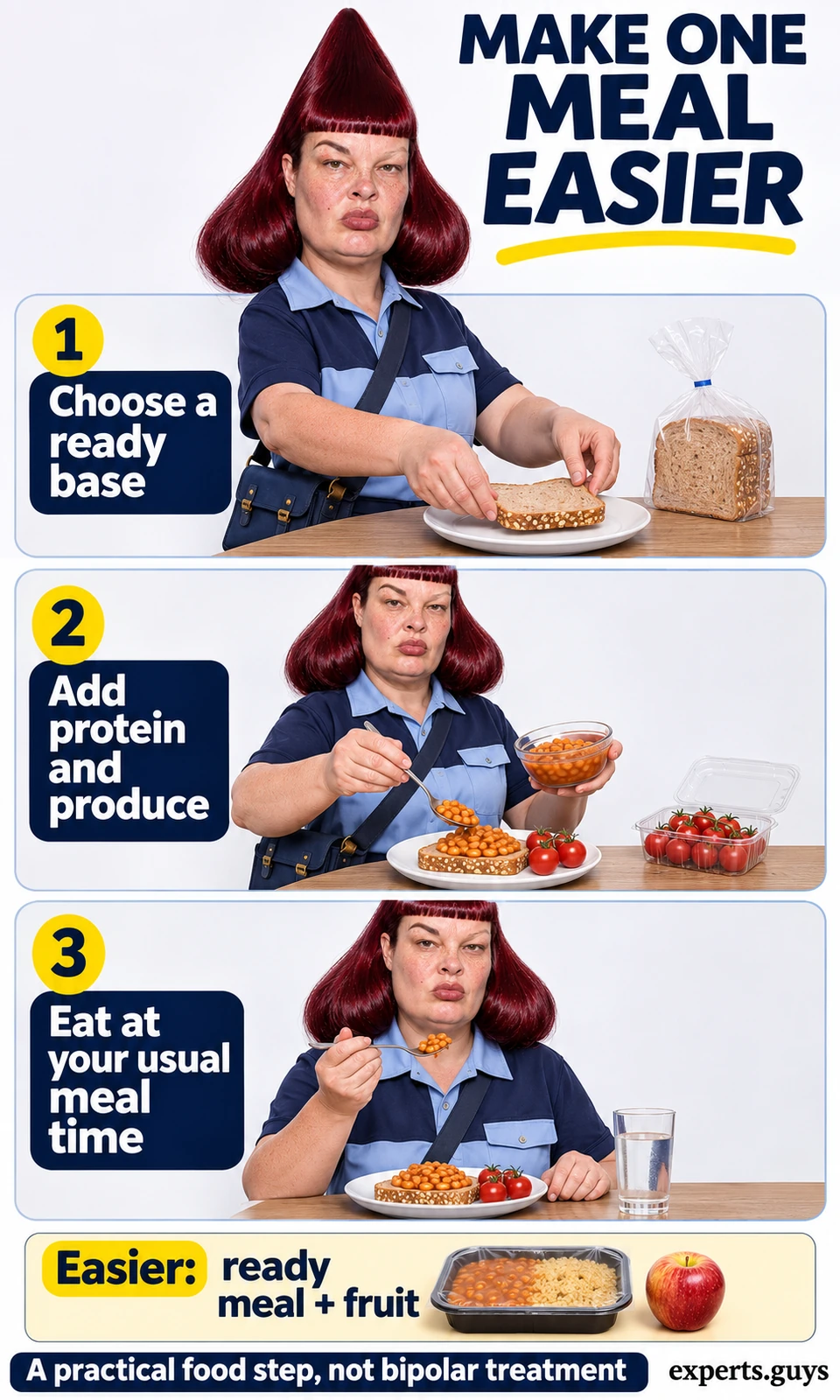
For an illustrative workday, imagine arriving home hungry and considering skipping lunch because the planned recipe requires cooking. Bread, ready-to-eat beans and washed tomatoes provide a simpler route to having food. The decision solves a preparation problem; it does not establish that beans, tomatoes or a particular meal combination stabilize bipolar disorder.
The common mistake is turning a small meal into a nutritional perfection test. If assembling several components is too much, choose a suitable ready meal and a piece of fruit, or ask someone to serve the available food. Adapt portion, texture and ingredients to your needs. If eating or drinking becomes very difficult, the priority changes from optimizing a meal to getting help with the underlying problem.
Completion means you have reduced the immediate food barrier. You do not need to feel brighter afterward for the step to count. If the food is still too difficult to manage, simplify the task or use practical help; do not respond by adding supplement shopping, a restrictive diet or an ambitious meal-preparation schedule.
Protect routine without turning it into another treatment experiment
A regular pattern of sleeping, eating and activity is part of everyday bipolar support. The NHS bipolar disorder guidance includes routine and lifestyle advice alongside treatment. Consistency is a useful direction, but it is not a demand for flawless timing or a reason to blame yourself after an episode.
This page does not prescribe a new sleep-restriction schedule, a bright-light regimen or an exercise dose. Those choices can need individual assessment, particularly when sleep and energy are already changing. Avoid treating an intense wellness challenge as inherently safer than medication simply because no prescription is involved.
If you take lithium, a “detox” or illness that leaves you dehydrated deserves particular caution. Severe vomiting or diarrhea, heavy sweating, or markedly reduced eating and drinking can affect lithium levels. The NHS lithium instructions explain when illness requires urgent advice. Follow your own prescribed sick-day guidance and seek prompt help rather than improvising a supplement-based reset.
Tell improved functioning apart from concerning activation
A return of ordinary interest and manageable activity is different from becoming unusually energized on much less sleep. Neither a burst of productivity nor a tired morning can diagnose an episode. Look at the combination: what has changed in sleep need, speech, judgment, spending and behavior, and how unusual is that change for the person?
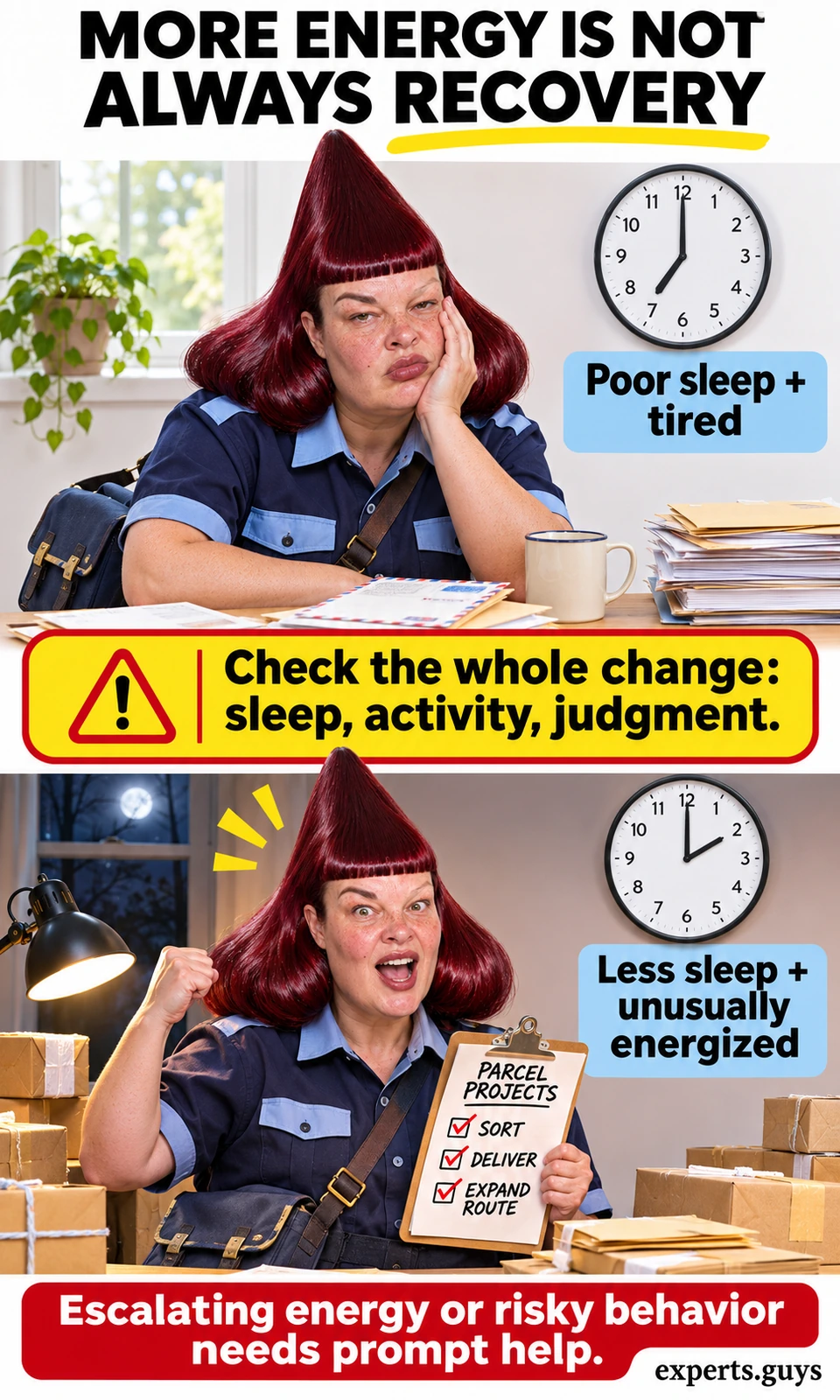
Suppose an energy product is followed by late-night projects and a sense that sleep is unnecessary. This hypothetical sequence does not prove the product caused the change, but it gives no reason to call the change a success. Prompt assessment is more appropriate than increasing the product because “it is working.” The guide to returning bipolar depression warning signs covers the different problem of a familiar depressive decline; it does not replace assessment of rising energy.
How can you check a natural product before taking it?
Use the actual package, not its front-label promise. The practical skill is to expose the full ingredient information, identify what needs review and keep a new product out of use until that review is resolved. It is a safety preparation step, not a home interaction test or a substitute for a pharmacist’s assessment.
Turn, read and hold the unopened package
Start with the product you are considering and keep its original box or leaflet with it. Work in good light where you can comfortably hold or set down the container. You do not need a notebook, symptom chart or online account; the packaging itself is the useful evidence of what the seller says the product contains.
- Turn the bottle or box. Find the full ingredients or supplement-facts panel. A front label may name only the ingredient the seller wants to highlight.
- Read every ingredient. Look beyond the headline nutrient for herbs, stimulants and additional compounds. St John’s wort and SAMe are reasons not to self-start a mood product in bipolar disorder. If an ingredient or blend is unclear, do not guess.
- Keep a new product unopened for review. Bring the original package to a pharmacist or treating clinician and identify your prescribed medicines, other supplements and relevant health conditions. Ask about the exact product rather than asking whether “natural remedies” are generally safe.
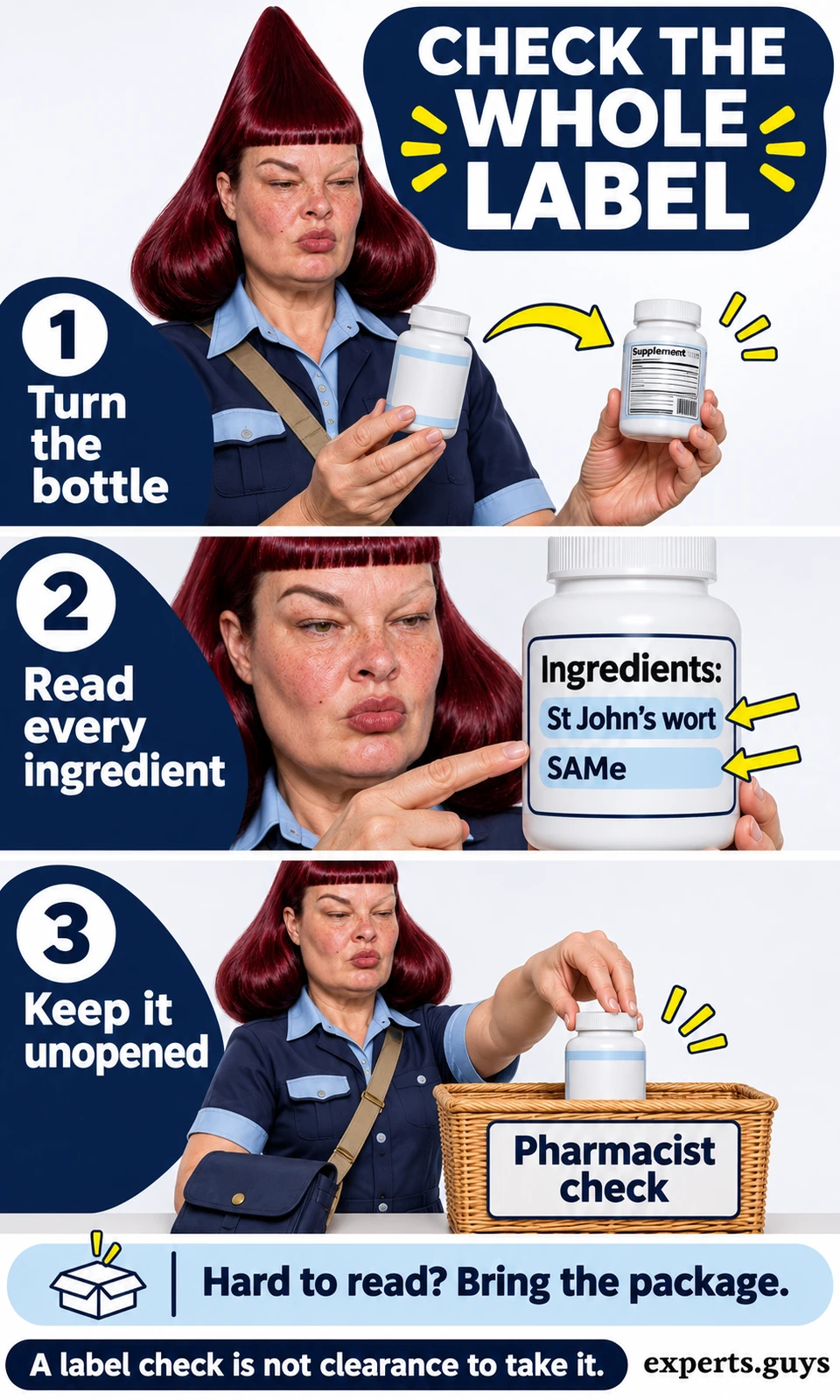
If reading the small print is difficult, bring the whole package rather than trying to interpret an indistinct label. Someone you trust can help read it aloud if you want. The observable result is a product held back from use and its information available for a proper check. Recognizing no familiar risk ingredient does not clear it for you to take.
NCCIH’s supplement safety guidance explains why product quality, interactions and clinical suitability need separate attention. In the United States, dietary supplements are not approved for safety and effectiveness before sale in the same way as medicines. Rules vary elsewhere; availability on a shelf or a website should never be treated as evidence that a product is suitable for bipolar disorder.
Worked example: the reassuring blend with a hidden problem
Consider a hypothetical bottle called “Mood blend.” Its promotional wording emphasizes magnesium, but the ingredients also name St John’s wort and SAMe. Focusing only on the mineral would miss the more consequential decision. The correct next step is not to lower the suggested serving or try it on a quiet weekend; it is to avoid adding the blend yourself and have the exact product reviewed.
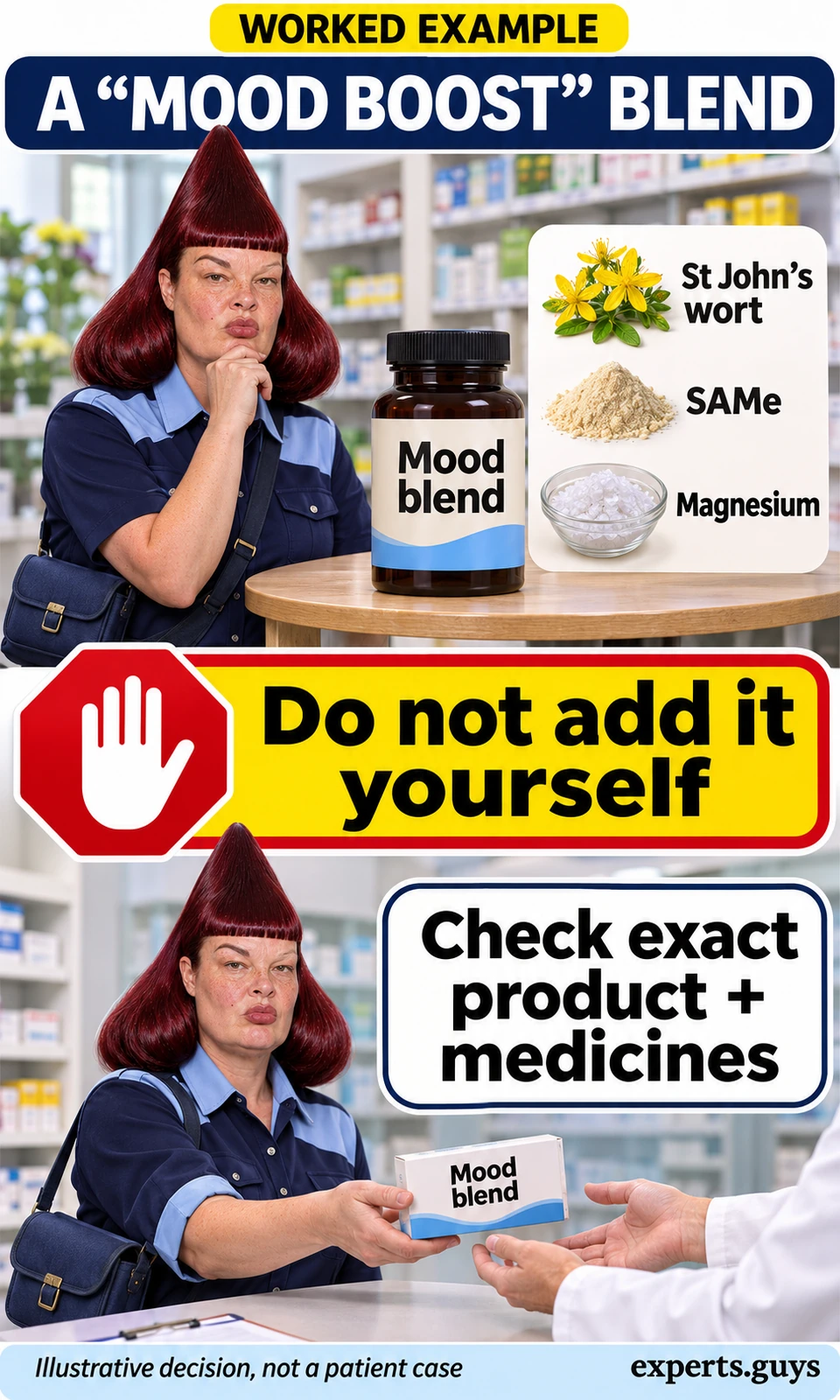
Now change the example: the bottle contains only magnesium. That removes the two named ingredients from this particular decision, but it does not prove benefit, safety or a need to take it. Kidney function, the reason for supplementation, other products and medicines can still matter. A good check narrows the question; it does not manufacture a green light from the absence of one warning.
For online purchases, the exact formulation matters more than a familiar product name. A seller may offer several versions, and a formula may change. Use the package you would actually take rather than a photograph of a different version. If the seller does not disclose enough information to identify the ingredients, that is a reason to hold back, not an invitation to infer what must be inside.
A third-party quality seal, where genuine, addresses only the things that specific testing program checks. It should not be interpreted as proof that the supplement treats bipolar disorder. Likewise, an online testimonial cannot establish causation: symptoms may fluctuate, other treatment may have changed, and negative experiences may never be posted.
Ask a question that can produce an actionable answer
A useful verbal question is: “I have bipolar disorder and am considering this exact product for this specific problem. Could any ingredient affect my medicines or activation risk, and is there a good reason to use it?” If the aim is sleep, name the actual difficulty. Trouble falling asleep with exhaustion is a different concern from sleeping little without feeling tired.
If a clinician recommends a supplement for a defined indication, the plan should identify the product, intended purpose, relevant precautions and when to reconsider it. An agreed plan is especially useful when multiple conditions are involved. This article cannot turn a generalized ingredient list into personal clearance, and it does not supply a dosing schedule for doing so.
If you have already taken a new product and feel unwell, share its name, the package and when it was taken with the clinician or pharmacist. Do not take more to chase a benefit. Sudden confusion, severe agitation, a seizure, collapse, or inability to stay safe warrants urgent emergency assessment; suspected interactions should not be tested by repeating the exposure.
| Finding | Useful next decision |
|---|---|
| A mood blend contains St John’s wort or SAMe | Do not add it yourself; have the exact formulation assessed. |
| The label is incomplete or unreadable | Bring the original package and hold the new product back from use. |
| You recognize no concerning ingredient | Do not infer clearance; interactions and clinical need still require assessment. |
| A new product is followed by marked sleep or behavioral changes | Do not treat increased energy as proof of benefit; seek prompt assessment. |
| A suitable ordinary meal is easier to manage | Use that practical improvement without attributing a bipolar treatment effect to the food. |
Questions about natural bipolar support
Does “drug-free” mean an approach has no side effects?
No. The label says nothing reliable about biological activity, interactions or suitability for bipolar disorder. An herb can affect medicines, and a demanding diet or sleep intervention can create problems even though neither is sold as a drug. Judge the specific approach and purpose rather than the slogan.
Can I use a family member’s successful supplement plan?
Their experience does not establish a safe plan for you. Differences in diagnosis, medicines, product formulation and health conditions can change the decision. A recommendation from someone you trust can be a starting question, but the original product still needs to be considered in your own treatment context.
Is a small amount of a risky ingredient automatically safe?
A lower amount does not establish safety, and this article cannot identify a risk-free threshold for a particular blend. Do not experiment with a smaller serving of St John’s wort or SAMe to bypass the concerns discussed above. Ask about the exact product before adding it.
Should children or pregnant people follow the same supplement advice?
The general caution still applies, but adult information does not establish safety for children, pregnancy or breastfeeding. Product-specific evidence and treatment needs must be assessed for that situation. Do not stop prescribed bipolar medicine or replace it with a supplement because the alternative sounds more natural.
Choose a first step that fits the actual problem
If you are considering a mood product, begin with the unopened-package check. If the immediate difficulty is having food available, use the simple meal example with ingredients that suit you. If sleep, energy or behavior is changing sharply, respond to that change through the care plan rather than starting a wellness experiment. The useful outcome is a safer decision and a more manageable daily need, not a claim that natural means effective.