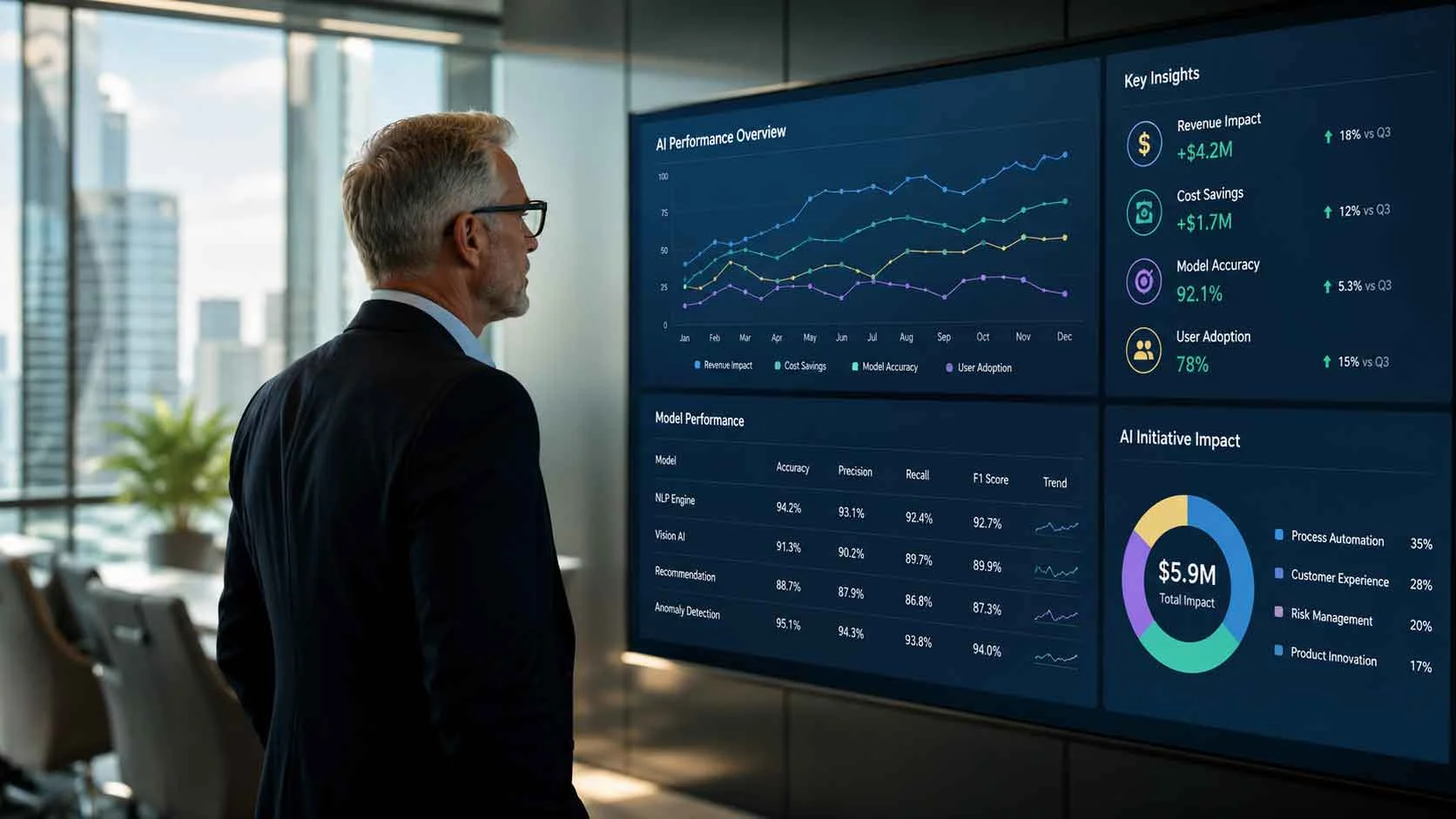
Executives increasingly rely on AI-powered dashboards to monitor business performance, identify operational issues, and support strategic decision-making. Modern reporting systems promise faster insights, automated analysis, and predictive recommendations, allowing leadership teams to review more information than ever before. However, many organizations assume that more data automatically leads to better decisions. In reality, AI reporting often introduces new blind spots that traditional reporting methods did not create.
AI systems only analyze the information they receive. If important business activities are missing, data quality is inconsistent, reporting objectives are poorly defined, or algorithms prioritize the wrong metrics, decision-makers may gain a false sense of confidence. Dashboards can appear highly sophisticated while quietly overlooking operational risks, customer dissatisfaction, financial leakage, or emerging compliance problems.
Understanding AI reporting blind spots is therefore not simply a technical exercise. It is an essential part of enterprise governance, risk management, and long-term business performance. Organizations that recognize these limitations are better positioned to design reporting systems that support accurate decisions rather than creating misleading certainty. Building reliable executive reporting also depends on establishing an effective AI productivity system that standardizes workflows, governance, and information quality before AI-generated insights are used for strategic decisions.
Professional Perspective
AI reporting should never be viewed as a replacement for business judgment. The most successful organizations treat dashboards as decision-support systems rather than decision-makers. Strong governance combines AI-generated insights with operational experience, domain expertise, and continuous validation to ensure that executive reporting reflects the real state of the business rather than only what available data happens to measure.
What Are AI Reporting Blind Spots?

AI reporting blind spots are important business activities, risks, or performance indicators that remain invisible or underrepresented within an AI reporting system. While dashboards often present highly polished visualizations and confidence scores, they can only summarize the information that has been collected, structured, and made available for analysis. Any missing, delayed, biased, or poorly interpreted data creates a blind spot that may influence business decisions without executives realizing it.
Many organizations mistakenly assume that AI dashboards provide a complete picture of operational performance. In reality, every reporting system reflects the limitations of its data sources, integration architecture, governance framework, and measurement strategy. A dashboard may accurately report sales growth while overlooking declining customer satisfaction, increasing employee workload, hidden compliance exposure, or rising operational inefficiencies occurring elsewhere in the business.
ExpertsGuys AI for Business
AI Reporting Blind Spot Analyzer
Discover reporting gaps that may reduce executive visibility, decision quality and long-term AI performance.
Unlike traditional reporting errors, AI blind spots are often more difficult to detect because automated systems continuously generate detailed metrics, forecasts, and recommendations. The abundance of information can create an illusion of completeness, making executives less likely to question whether important information is missing altogether.
Why AI Cannot Report Information It Never Receives
Artificial intelligence does not discover hidden business knowledge independently. Every recommendation depends on available inputs, defined objectives, and measurable variables. If critical business processes are not connected to the reporting platform, AI simply excludes them from its analysis.
Common examples include:
- Customer complaints handled outside the CRM
- Spreadsheet-based financial adjustments
- Informal operational decisions made through messaging platforms
- Manual quality inspections
- Vendor performance discussions
- Employee knowledge that has never been documented
- Regulatory concerns identified outside formal reporting workflows
Although these activities may significantly affect business performance, they remain invisible to AI because they never become structured data.
The Difference Between Missing Data and Missing Knowledge
One of the biggest misconceptions in enterprise AI is believing that collecting more data automatically eliminates reporting gaps. However, data and knowledge are not the same.
| Reporting Element | Missing Data | Missing Knowledge |
|---|---|---|
| Source | Information was never collected. | Information exists but lacks business context. |
| AI Capability | Cannot analyse absent information. | May analyse correctly but reach misleading conclusions. |
| Executive Impact | Hidden operational risks remain unseen. | Incorrect strategic decisions despite accurate calculations. |
| Typical Solution | Expand data collection and integrations. | Improve governance, business rules, and human interpretation. |
Organizations often invest heavily in expanding data pipelines while overlooking the need to capture business knowledge, decision rationale, operational experience, and contextual information. As a result, AI dashboards may become technically impressive while still failing to explain why business outcomes are changing.
Why Blind Spots Become More Dangerous as AI Scales
Early AI pilots typically operate within a single department using well-defined datasets. As AI expands across finance, operations, marketing, customer service, procurement, and executive reporting, the number of connected systems grows rapidly. Each additional integration introduces new assumptions, dependencies, and potential reporting gaps.
Because executives increasingly depend on consolidated dashboards for strategic planning, even small blind spots can influence budgeting, hiring, investment priorities, compliance decisions, and long-term organizational direction. Rather than reducing uncertainty, poorly governed AI reporting may amplify it by presenting incomplete information with a high level of apparent confidence.
Understanding these blind spots is the first step toward building reporting systems that support trustworthy executive decisions rather than simply producing attractive dashboards.
The Biggest AI Reporting Blind Spots Found in Enterprises

Most AI reporting failures do not originate from poor algorithms. Instead, they emerge because organizations unknowingly exclude critical business information from the reporting ecosystem. Dashboards can accurately display the metrics they were designed to measure while simultaneously ignoring the indicators that matter most to executive decision-making.
Recognizing these blind spots allows organizations to strengthen governance before inaccurate reporting influences strategic planning.
1. Measuring Activity Instead of Business Outcomes
Many AI dashboards prioritize operational activity because those metrics are easy to collect automatically. Reports often emphasize the number of AI interactions, automated tasks completed, reports generated, workflow execution times, or chatbot conversations.
While these measurements demonstrate system usage, they rarely explain whether the business is actually improving.
Executives should instead ask whether AI is producing measurable outcomes such as higher customer retention, improved employee productivity, reduced operating costs, stronger regulatory compliance, or faster project delivery. Without connecting operational metrics to business objectives, organizations risk celebrating activity while overlooking declining performance. Many organizations first encounter these reporting issues while discovering the broader hidden costs of AI adoption, where governance gaps and incomplete reporting often increase long-term operational expenses.
Activity Metrics vs Business Value
| Common AI Metric | Hidden Blind Spot | Better Executive KPI |
|---|---|---|
| Number of AI requests | High usage may not improve productivity. | Time saved per employee. |
| Automation volume | Processes may still require manual corrections. | Reduction in operational cost. |
| Dashboard views | Reports may not influence decisions. | Decision quality and implementation rate. |
| Model accuracy | Accurate predictions may still solve the wrong problem. | Business outcome improvement. |
2. Reporting Only Structured Data

Enterprise AI performs best when information is structured inside databases, ERP systems, CRMs, and analytics platforms. Unfortunately, a significant portion of organizational knowledge exists outside these systems.
Examples include:
- Project manager observations
- Customer escalation conversations
- Technical engineer notes
- Vendor negotiations
- Legal interpretations
- Executive meeting discussions
- Operational workarounds
- Employee experience
Because these insights are rarely stored in structured formats, AI reporting often excludes them completely.
3. Ignoring Cross-Department Dependencies

Departments frequently optimize their own reporting independently.
Marketing reports marketing success.
Finance reports financial performance.
Operations reports production efficiency.
Customer service reports ticket resolution.
However, executives rarely make decisions based on one department alone.
A marketing campaign may increase sales while simultaneously overwhelming customer support. Procurement savings may reduce manufacturing quality. HR hiring delays may slow engineering projects.
When dashboards fail to connect these relationships, AI unintentionally hides the true business impact.
4. Assuming Historical Data Predicts Future Conditions
Many AI reporting systems build forecasts using historical business performance.
This assumption works reasonably well during stable market conditions but becomes increasingly unreliable during:
- Economic uncertainty
- Regulatory change
- Supply chain disruption
- New competitors
- Technological innovation
- Consumer behavior shifts
Executives should therefore interpret AI forecasts as decision-support scenarios rather than guaranteed business outcomes.
5. Missing Human Decision Context
One of the least discussed reporting blind spots involves human judgment.
Business decisions are rarely driven solely by measurable data.
Executives consider factors such as:
- Corporate reputation
- Employee morale
- Political risk
- Client relationships
- Market confidence
- Strategic partnerships
- Long-term positioning
These considerations often influence major business decisions despite being absent from AI dashboards.
Without this context, AI may recommend decisions that appear statistically correct while being strategically inappropriate.
Expert Perspective
Experienced business leaders rarely ask, “What does the dashboard show?” Their next question is usually, “What might the dashboard be missing?” That distinction separates organizations that merely consume AI reports from those that build resilient decision-making systems. Effective executive reporting combines quantitative metrics with operational knowledge, governance oversight, and cross-functional context to reduce the likelihood that unseen risks become expensive strategic mistakes. This approach aligns with the ExpertsGuys principle of prioritizing information gain, decision support, and retrieval-ready knowledge rather than simply producing more analytics.
How to Build AI Reporting That Executives Can Actually Trust

Eliminating reporting blind spots does not require collecting every possible piece of business data. Instead, organizations need a reporting framework that balances automation with governance, business context, and continuous validation. Reliable executive reporting is designed to support decision-making rather than simply displaying attractive dashboards.
The following practices help organizations improve reporting quality while reducing the likelihood that important risks remain hidden.
Define Business Decisions Before Building Dashboards
Many organizations begin by selecting reporting software and connecting available data sources. A more effective approach starts with the decisions executives need to make.
For example, if leadership wants to decide whether to expand into a new market, the reporting framework should include customer demand, operational capacity, financial exposure, regulatory considerations, and competitive intelligence rather than simply displaying sales trends.
By designing reports around strategic decisions instead of available data, organizations ensure AI focuses on information that genuinely supports executive planning. Organizations also benefit from implementing an AI workflow automation system that ensures reporting processes, approvals, and business rules remain consistent as AI adoption expands.
Combine Structured Data with Operational Knowledge
Enterprise reporting becomes significantly more valuable when structured metrics are combined with qualitative business information.
This may include:
- Project manager observations
- Customer interview findings
- Employee feedback
- Supplier performance reviews
- Risk committee recommendations
- Internal audit findings
- Engineering incident reports
- Executive strategy discussions
Although these insights are more difficult to standardize, they often explain why business metrics change rather than simply showing that they have changed.
Build Cross-Department Reporting Instead of Department Dashboards
Business performance rarely depends on a single department.
Successful AI reporting combines information across multiple functions to reveal relationships that isolated dashboards cannot identify.
Department-Level Reporting vs Enterprise Reporting
| Reporting Approach | Primary Focus | Potential Blind Spot |
|---|---|---|
| Marketing Dashboard | Campaign performance | Ignores operational delivery capacity. |
| Finance Dashboard | Cost and profitability | May overlook customer experience impacts. |
| Operations Dashboard | Efficiency and productivity | Does not measure strategic market outcomes. |
| Enterprise AI Dashboard | Business-wide decision support | Requires strong governance to avoid data inconsistencies. |
Integrated reporting enables executives to evaluate how decisions in one department influence performance across the organization, reducing the risk of local optimization at the expense of overall business success.
Monitor AI Reporting Quality Continuously

Reporting accuracy should not be assumed after deployment.
Organizations should establish regular review processes that evaluate:
- Missing data sources
- Dashboard usage patterns
- Decision outcomes
- Forecast accuracy
- Data quality issues
- Changes in regulatory requirements
- Emerging business risks
- Executive feedback
Continuous monitoring allows organizations to identify reporting blind spots before they become embedded within strategic planning processes.
Encourage Executives to Challenge Dashboard Conclusions
AI should increase executive curiosity rather than replace critical thinking.
Leadership teams should routinely ask questions such as:
- What information is not included in this report?
- Which business assumptions influence these recommendations?
- Have recent market conditions changed since this model was trained?
- Are important decisions relying on unstructured knowledge that AI cannot measure?
- Would another department interpret these results differently?
These discussions help transform AI reporting from an automated reporting system into a collaborative decision-support framework.
Professional Perspective
The strongest AI reporting systems are not those that display the greatest number of charts or predictive models. They are the systems that consistently help executives make better decisions by combining reliable data, business expertise, governance controls, and continuous validation. Organizations that regularly question their reporting assumptions are often more resilient than those that place unquestioning trust in sophisticated dashboards. As AI becomes increasingly integrated into enterprise decision-making, competitive advantage will depend not only on collecting more information but also on understanding where important information may still be missing.
Common Mistakes That Create AI Reporting Blind Spots

Even organizations with mature analytics capabilities can unintentionally introduce reporting weaknesses during AI implementation. Most reporting failures develop gradually as dashboards become more complex, additional data sources are connected, and executives place increasing confidence in automated insights.
Recognizing these common mistakes allows organizations to strengthen reporting before inaccurate information begins influencing strategic decisions.
Poor reporting often makes AI appear to be a cost center because executives cannot accurately measure the business value created by AI initiatives across different departments.
Treating Dashboard Accuracy as Business Accuracy
One of the most common misconceptions is believing that an accurate dashboard automatically reflects business reality.
An AI system may correctly calculate every metric it receives while still presenting an incomplete picture because important operational information was never included. For example, a customer satisfaction dashboard may report improving survey scores while failing to capture complaints handled through telephone conversations, social media, or field service teams.
Dashboard accuracy measures whether calculations are correct. Business accuracy measures whether executives are seeing the complete situation.
Measuring Only What Is Easy to Collect
AI platforms naturally prioritize structured, digital information because it can be processed efficiently. Unfortunately, many high-value business indicators are difficult to quantify.
Examples include:
- Employee confidence in organizational change
- Supplier relationship quality
- Customer trust
- Executive leadership alignment
- Product reputation
- Emerging operational risks
- Engineering expertise
- Knowledge sharing between departments
Organizations that focus exclusively on measurable metrics often overlook the intangible factors that strongly influence long-term business performance.
Ignoring Data Quality Drift
Data quality is not static.
Customer information changes.
Products evolve.
Business processes are redesigned.
Employees enter information differently over time.
Third-party integrations are updated.
As these changes accumulate, AI reporting gradually becomes less reliable unless organizations continuously validate data quality. Small inconsistencies that appear insignificant individually can eventually distort executive dashboards across multiple departments.
Building Too Many Executive Dashboards
Many organizations respond to increasing data availability by creating additional dashboards rather than improving decision quality.
Executives may receive:
- Financial dashboard
- Sales dashboard
- Customer dashboard
- HR dashboard
- Operations dashboard
- AI performance dashboard
- Risk dashboard
- Compliance dashboard
Although each dashboard may provide valuable information, leadership teams can become overwhelmed by fragmented reporting that lacks a unified business narrative.
The objective should not be producing more dashboards but delivering clearer executive decision support.
Assuming AI Understands Business Priorities
Artificial intelligence optimizes according to the objectives it receives.
If an organization defines success as reducing operational cost, AI may recommend actions that unintentionally reduce customer satisfaction or employee engagement.
Likewise, optimizing sales conversion alone may increase compliance exposure or operational workload if broader business priorities are ignored.
Executives remain responsible for defining balanced objectives that reflect overall organizational strategy rather than isolated performance indicators.
Failing to Review AI Recommendations After Deployment
Many organizations perform extensive validation before launching AI reporting systems but reduce oversight once dashboards become operational.
Effective governance requires continuous review of:
- Forecast accuracy
- Business outcomes
- User adoption
- Decision quality
- Regulatory changes
- Market conditions
- New operational risks
- Emerging data sources
Continuous validation ensures AI reporting evolves alongside the business rather than gradually becoming disconnected from reality.
Executive Checklist for Reducing Reporting Blind Spots

These reporting reviews become significantly more effective when supported by a structured enterprise AI governance framework that clearly defines ownership, accountability, monitoring, and policy enforcement across the organization.
| Question | Why It Matters |
|---|---|
| What important information is missing? | Identifies reporting blind spots before decisions are made. |
| Which assumptions drive these AI recommendations? | Reveals hidden model limitations. |
| Has business context changed since the model was trained? | Improves forecast reliability. |
| Do multiple departments confirm these findings? | Reduces isolated reporting bias. |
| Are executives reviewing decision outcomes? | Ensures AI continues improving over time. |
Expert Perspective
The organizations that achieve the greatest value from AI reporting are not necessarily those with the largest data warehouses or the most advanced analytics platforms. They are the organizations that continuously question whether their dashboards represent the complete business picture. Executive reporting should encourage informed discussion, challenge assumptions, and reveal uncertainty where appropriate. AI becomes significantly more valuable when it supports thoughtful leadership rather than replacing it with unquestioned automation.

Conclusion
Artificial intelligence has transformed enterprise reporting by enabling organizations to process more information, generate insights faster, and identify patterns that would be difficult to detect manually. However, the value of AI reporting depends far less on the sophistication of the algorithms than on the quality, completeness, and governance of the information those systems receive.
Once reporting quality has improved, organizations should also learn how to calculate AI ROI using business outcome measurements rather than relying solely on technical performance metrics.
The most expensive reporting failures rarely occur because AI performs incorrect calculations. They happen because important business knowledge never reaches the reporting platform, critical assumptions remain unchallenged, or executives place excessive confidence in dashboards that present only part of the business reality. Blind spots involving unstructured knowledge, cross-department dependencies, changing market conditions, and governance weaknesses can gradually influence strategic decisions long before they become visible through traditional performance metrics.
Organizations that consistently achieve stronger results approach AI reporting as an evolving decision-support capability rather than a finished technology project. They continuously review data quality, validate assumptions, integrate operational expertise, and encourage leadership teams to question both what the dashboard shows and what it may be overlooking. This combination of technology, governance, and human judgment produces reporting systems that improve resilience instead of simply increasing automation.
As enterprise AI adoption continues to accelerate, the organizations that outperform competitors will not necessarily collect the largest volume of data. They will be the ones that develop the clearest understanding of where reporting uncertainty still exists and build governance processes that reduce those blind spots before they become costly business decisions.
Regular enterprise AI risk assessments help leadership identify emerging reporting weaknesses before they develop into governance, financial, or compliance problems.
Reviewed by Natalie Brooks — Enterprise AI Governance Reviewer
Modern AI reporting should strengthen executive judgment, not replace it. Reliable dashboards are built through disciplined governance, validated business metrics, and continuous oversight rather than technical sophistication alone. Organizations that regularly evaluate reporting blind spots, challenge assumptions, and connect AI insights with operational expertise are better equipped to make strategic decisions with confidence while reducing long-term governance, compliance, and financial risk.
Frequently Asked Questions
What are AI reporting blind spots?
AI reporting blind spots are important business activities, risks, or decision factors that are missing or underrepresented in AI dashboards. They occur when reports rely only on available data while overlooking critical operational context, governance information, or qualitative business knowledge.
Why can AI dashboards give executives a false sense of confidence?
AI dashboards often present polished visualizations and accurate calculations, but they cannot report information that was never collected or integrated. Missing data sources, poor governance, or incomplete business context can create misleading confidence despite technically accurate reports.
Can AI reporting replace executive judgment?
No. AI reporting supports decision-making by summarizing information and identifying patterns, but executives must still evaluate business strategy, operational context, regulatory requirements, and organizational priorities before making important decisions.
What causes reporting blind spots in enterprise AI?
Common causes include poor data quality, disconnected business systems, missing qualitative information, weak governance, isolated departmental reporting, outdated assumptions, and overreliance on historical data without ongoing validation.
How can organizations reduce AI reporting blind spots?
Organizations can reduce blind spots by improving data quality, integrating cross-department information, combining structured data with business expertise, continuously validating reports, and maintaining strong AI governance throughout the reporting lifecycle.
Why is cross-department reporting important for AI?
Business decisions usually affect multiple departments simultaneously. Cross-department reporting helps executives understand how changes in finance, operations, marketing, customer service, and human resources influence one another, reducing isolated reporting bias.
Does collecting more data eliminate AI reporting blind spots?
Not always. Larger datasets improve reporting only when the information is relevant, accurate, well governed, and connected to business objectives. Missing business knowledge and poor decision context can still create significant blind spots.
How often should AI reporting systems be reviewed?
AI reporting systems should be reviewed regularly to validate data quality, forecast accuracy, governance compliance, changing business priorities, and new operational risks. Continuous monitoring helps prevent reporting gaps from influencing executive decisions.