

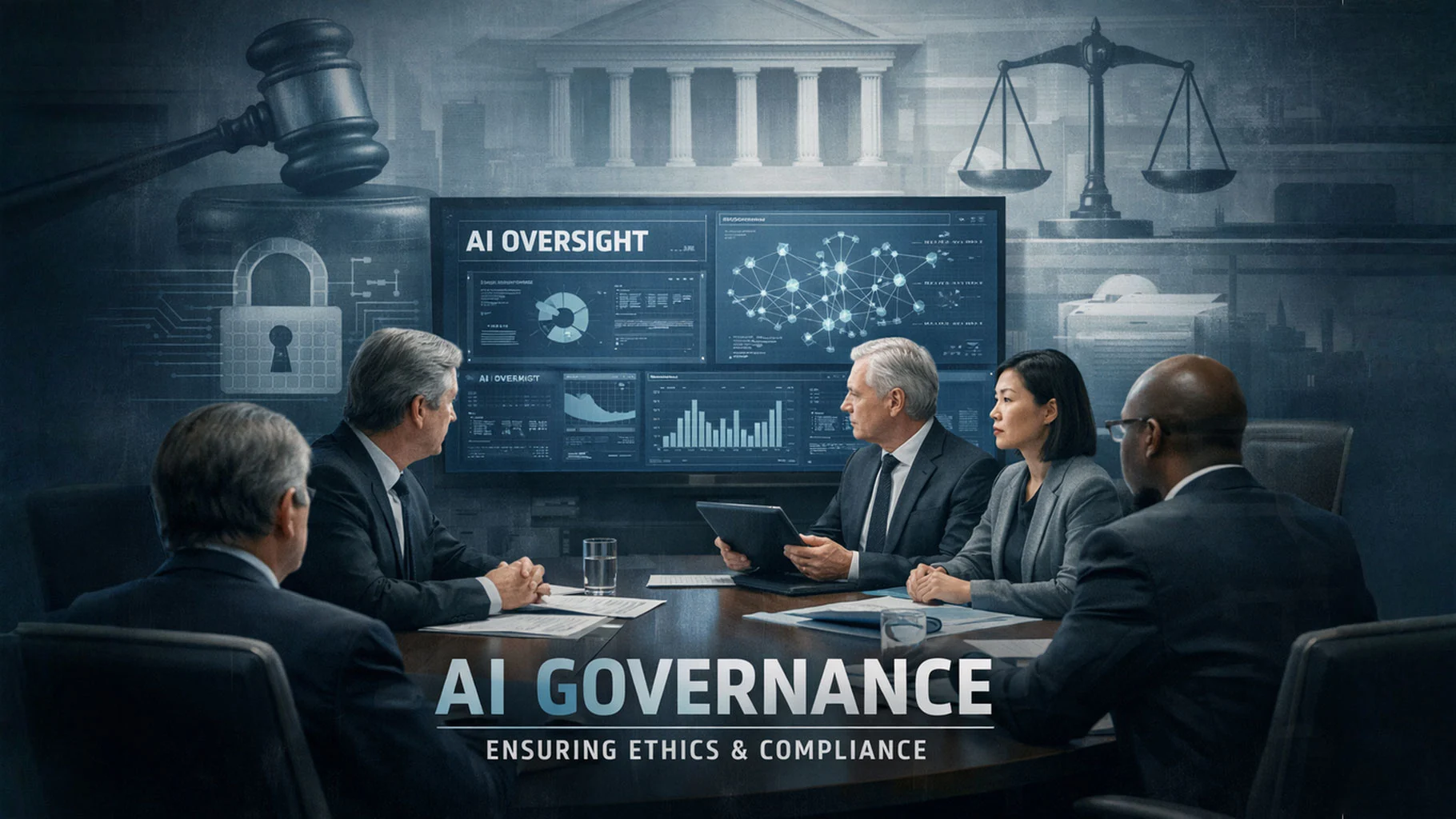

WHAT AI GOVERNANCE ACTUALLY MEANS IN ENTERPRISES
AI governance is often discussed, but rarely defined precisely.
Inside enterprises, AI governance does not mean ethics statements, model documentation, or compliance checklists. Those are artifacts, not governance.
Governance refers to the structures that determine who is responsible for AI-driven decisions, how those decisions are reviewed, and what happens when outcomes are disputed.
Without clarity on these mechanisms, governance exists only in name.
AI Governance Is a Control System, Not a Policy
Governance functions as a control system.
It answers questions such as:
- Who owns the decision when AI influences outcomes?
- How is authority assigned across teams?
- What triggers escalation or intervention?
- Who absorbs legal, financial, and reputational risk?
Policies describe intent. Governance determines behavior under pressure.
When AI systems operate without a functioning control system, decisions occur without accountability.
Why Traditional Governance Models Do Not Translate to AI
Most enterprise governance models were designed for:
- Static processes
- Human decision-makers
- Predictable escalation paths
AI systems violate these assumptions.
They:
- Adapt over time
- Influence decisions indirectly
- Operate continuously across departments
As a result, legacy governance frameworks fail to map cleanly onto AI-driven workflows.
The Difference Between AI Oversight and AI Governance
Oversight is observational.
Governance is authoritative.
Oversight monitors:
- Performance
- Accuracy
- Compliance indicators
Governance determines:
- Whether systems are allowed to operate
- Under what conditions they must be paused
- Who has the authority to override outcomes
Many enterprises implement oversight without governance, creating visibility without control.
Why Governance Failure Is Often Invisible at First
Governance failures rarely surface immediately.
Early AI deployments operate in:
- Low-risk contexts
- Narrow scopes
- Assisted decision environments
In these conditions, governance gaps do not produce visible harm. They remain latent.
As AI systems scale, those same gaps amplify risk rather than contain it.
Governance Failure Is Structural, Not Accidental
AI governance failure is not caused by negligence.
It emerges from structural misalignment:
- Decision authority does not match system influence
- Accountability is distributed but outcomes are centralized
- Risk is abstract until it materializes
These structures allow AI systems to function without meaningful control, even inside well-managed organizations.
These governance gaps help explain why AI ROI collapses after early success, even when systems appear operationally sound.
WHY AI GOVERNANCE BREAKS AT SCALE
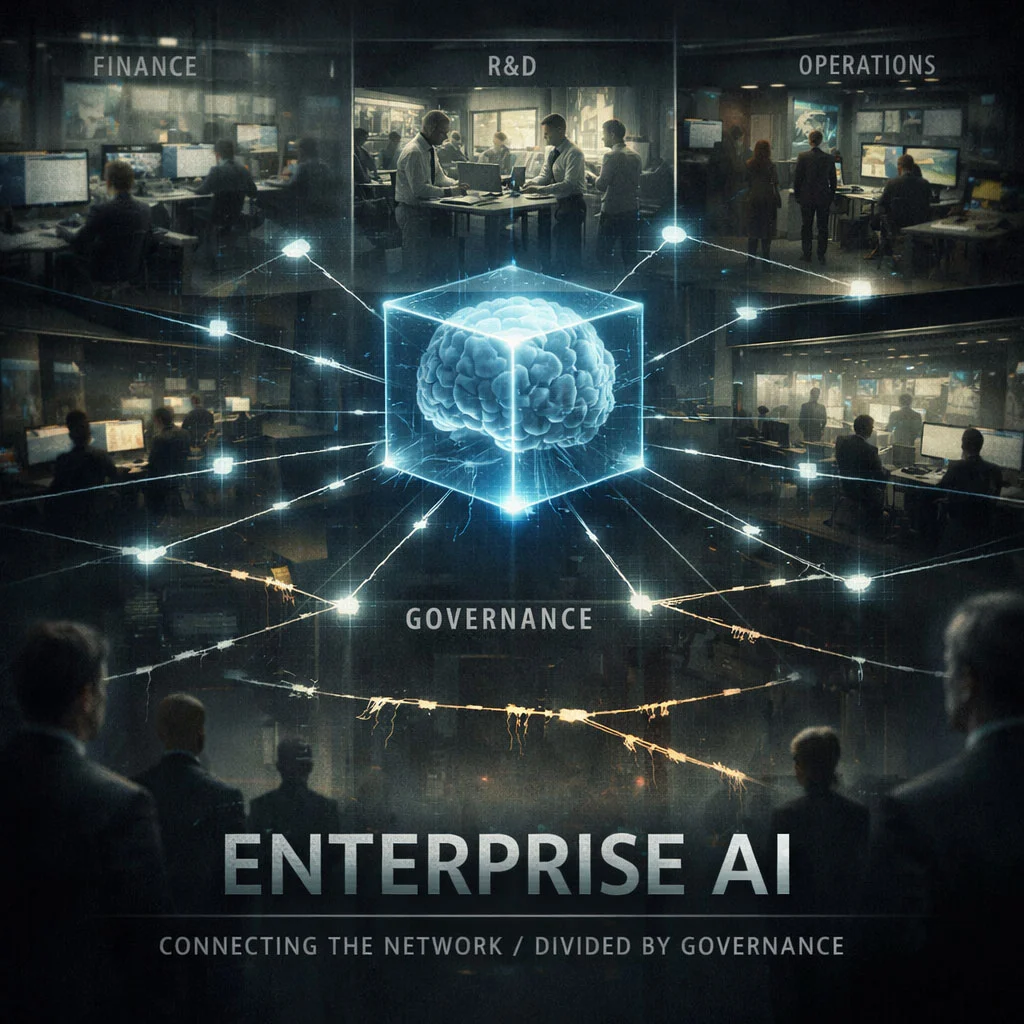
Governance Is Designed for Contained Systems
Early AI deployments remain manageable because they are contained.
They:
- Operate within a single team
- Affect a limited set of decisions
- Have informal escalation paths
Governance works here because scope is narrow and relationships are direct.
Scaling breaks this containment.
Decision Influence Expands Faster Than Authority
As AI systems scale, their influence grows faster than governance authority.
AI begins to:
- Affect pricing decisions
- Shape approvals
- Filter opportunities
Yet authority remains fragmented. No single role owns the decision chain end to end.
Governance breaks when influence exceeds control.
Cross-Department AI Creates Accountability Voids
Enterprise AI rarely stays within one function.
Once deployed, it touches:
- Operations
- Finance
- Legal
- Customer-facing teams
Each group assumes another owns governance. Responsibility becomes diluted rather than shared.
This diffusion creates accountability voids where no one feels empowered to intervene.
Scale Introduces Conflicting Objectives
Departments optimize differently.
AI systems trained or tuned for:
- Efficiency
- Risk minimization
- Revenue growth
may conflict when applied broadly.
Governance frameworks often fail to reconcile these competing objectives, leaving AI outputs unchallenged even when they harm specific business outcomes.
Oversight Does Not Scale Linearly
Monitoring tools scale.
Human judgment does not.
As AI systems expand:
- Review queues grow
- Exception rates increase
- Oversight fatigue sets in
Governance relies on human decision-making at critical points. When volume overwhelms capacity, control weakens.
Governance Lag Becomes Systemic Risk
Governance changes slowly by design.
AI systems change rapidly.
This mismatch creates lag:
- Policies trail reality
- Escalation paths become outdated
- Authority lines blur
By the time governance frameworks are updated, systems have already moved on.
At scale, these breakdowns mirror why AI fails inside companies, even when adoption appears successful.
HOW ACCOUNTABILITY DISSOLVES IN ENTERPRISE AI
AI Decisions Are Distributed, Responsibility Is Not
AI systems rarely make a single, isolated decision.
Instead, they:
- Rank options
- Filter inputs
- Recommend actions
- Trigger automated steps
Each action influences outcomes indirectly. Responsibility becomes fragmented across the decision chain.
When outcomes are questioned, no single actor can fully explain or own the result.
Ownership Is Split Between Builders, Users, and Approvers
Enterprise AI involves multiple roles:
- Builders design and train systems
- Users apply outputs
- Approvers authorize deployment
Each role controls part of the process, but none control the whole. Governance frameworks often fail to assign final accountability when these roles disagree.
This fragmentation weakens enforcement.
Escalation Paths Are Unclear by Design
Escalation requires clarity:
- Who can stop the system
- Under what conditions
- With what authority
In many enterprises, escalation paths are intentionally vague to avoid friction. AI issues are routed through committees, reviews, or delayed audits rather than decisive intervention.
Delay replaces control.
Accountability Is Replaced by Process Compliance
When responsibility is unclear, organizations default to process.
They ask:
- Was the model approved?
- Was documentation completed?
- Were reviews conducted?
These questions assess procedural compliance, not decision quality. As long as processes are followed, outcomes are rarely challenged.
Accountability shifts from results to paperwork.
AI Normalizes Diffused Responsibility
Over time, teams adapt to AI-driven ambiguity.
Decisions influenced by AI are treated as:
- Collective outcomes
- System behavior
- Emergent effects
This framing reduces individual accountability. When no one feels personally responsible, corrective action slows.
Why Accountability Failure Persists
Accountability failure persists because it reduces immediate conflict.
Clear ownership would:
- Force difficult trade-offs
- Trigger intervention
- Expose governance gaps
Diffusion avoids confrontation. It also allows AI risk to accumulate quietly before enterprise failures.
These accountability gaps reinforce why AI governance fails inside enterprises as systems grow more influential.
WHY LEGAL AND COMPLIANCE STRUCTURES LAG AI SYSTEMS

Legal Review Is Reactive by Design
Legal and compliance functions are structured to respond to risk, not anticipate it.
Their workflows focus on:
- Interpreting existing regulations
- Reviewing documented processes
- Responding to incidents
AI systems, by contrast, introduce new decision behaviors continuously. This mismatch makes legal review inherently reactive.
Compliance Frameworks Assume Stable Decision Logic
Traditional compliance assumes that:
- Decision rules are fixed
- Processes change infrequently
- Outcomes are auditable after the fact
AI systems violate these assumptions. Models evolve, data shifts, and outputs vary with context.
Compliance frameworks struggle to map onto systems whose logic is probabilistic rather than deterministic.
Documentation Substitutes for Control
To manage uncertainty, organizations increase documentation.
They require:
- Model cards
- Risk assessments
- Approval records
Documentation provides traceability but not control. It records decisions without necessarily preventing harmful outcomes.
Governance failure persists even as paperwork increases.
Legal Accountability Remains Human-Centered
Regardless of automation, legal responsibility remains human.
Organizations cannot assign liability to systems. Accountability rests with:
- Executives
- Directors
- Officers
When AI influences decisions at scale, legal exposure accumulates faster than organizations recognize. Governance gaps become legal risks only after consequences emerge.
Compliance Lag Creates False Confidence
The absence of enforcement does not indicate safety.
AI systems often operate in regulatory grey zones where:
- Rules are unclear
- Precedents are limited
- Oversight is delayed
This lag creates a false sense of security. By the time standards solidify, organizations may already be exposed.
When Legal Risk Finally Surfaces
Legal risk surfaces after:
- Complaints
- Audits
- External scrutiny
At that point, governance failure is no longer theoretical. Corrective action becomes costly, public, and constrained by existing deployments.
These compliance gaps transform operational uncertainty into material AI business risk once systems reach scale.
WHEN AI GOVERNANCE FAILURE BECOMES VISIBLE
Governance Failure Is Invisible Until Consequences Appear
AI governance rarely fails in isolation.
It fails when:
- A decision harms stakeholders
- An audit identifies gaps
- External scrutiny escalates
Until consequences emerge, governance weaknesses remain abstract. Systems continue operating under assumed control.
External Triggers Force Recognition
Recognition usually comes from outside the organization.
Triggers include:
- Regulatory inquiries
- Legal claims
- Customer complaints
- Media coverage
Internal monitoring rarely initiates governance reform. External pressure forces attention where internal processes did not.
Retrospective Analysis Replaces Prevention
Once failure becomes visible, organizations look backward.
They analyze:
- Approval trails
- Documentation
- Review histories
This retrospective focus explains how governance failed but does not undo damage. Prevention would have required authority structures that did not exist at the time.
Governance Changes Are Reactive and Narrow
Post-incident governance changes tend to be:
- Targeted at the specific failure
- Limited in scope
- Designed to reassure stakeholders
Broader structural issues often remain unaddressed. The system adapts just enough to continue operating.
Visibility Does Not Guarantee Resolution
Even visible failures do not always lead to meaningful reform.
Organizations may:
- Isolate the incident
- Attribute failure to misuse
- Emphasize exceptional circumstances
These narratives preserve continuity while limiting accountability.
Why Visibility Arrives Too Late
By the time governance failure is visible:
- AI systems are embedded
- Dependencies are entrenched
- Exit costs are high
Corrective action is constrained by operational reality rather than guided by design.
At this stage, governance breakdown reinforces why AI ROI collapses once systems are deeply embedded.
WHEN AI GOVERNANCE FINALLY CHANGES

Governance Changes Only When Authority Is Reassigned
AI governance does not improve through additional policies.
It changes when:
- Decision authority is reassigned
- Escalation power is clarified
- Intervention rights are formalized
Without authority, oversight remains observational. Governance requires the power to stop, override, or redesign systems.
Structural Ownership Replaces Diffuse Responsibility
Effective governance assigns ownership at the system level.
This means:
- One accountable role for AI influence
- Clear boundaries between builders and approvers
- Explicit responsibility for outcomes
Structural ownership reduces ambiguity and enables decisive action.
Governance Maturity Requires Accepting Limits
Strong governance acknowledges limits.
It defines:
- Where AI should not be used
- Which decisions require human judgment
- When automation must pause
These limits are not technical constraints. They are organizational choices that protect long-term stability.
Governance Is Preventative, Not Performative
Mature governance focuses on prevention.
It:
- Anticipates failure modes
- Designs escalation before incidents
- Embeds accountability into workflows
Performative governance emphasizes visibility and documentation without control. Prevention requires authority and foresight.
Why Most Organizations Reach This Stage Late
Organizations reach governance maturity late because:
- Early success masks risk
- Incentives favor expansion
- Accountability diffusion feels safer
By the time governance changes, AI systems are deeply embedded. Reform becomes corrective rather than strategic.
The Boundary of AI Governance
AI governance is not:
- A guarantee of accuracy
- A replacement for leadership judgment
- A compliance checkbox
AI governance fails not because organizations ignore risk, but because control systems lag behind influence.
It is a structural response to uncertainty.
Governance succeeds when it reduces the cost of being wrong, not when it eliminates error entirely.
EXECUTIVE SYNTHESIS – WHAT THIS ARTICLE RESOLVES
AI governance fails not because organizations ignore risk, but because control systems lag behind influence.
As AI systems scale:
- Authority fragments
- Accountability dissolves
- Legal exposure accumulates
- Oversight becomes observational
Governance changes only when authority is reclaimed and limits are enforced.
For executives, the risk is not insufficient AI adoption.
It is allowing systems to operate without structures that enable correction.
AI becomes dangerous not when it breaks rules, but when no one is clearly empowered to stop it.
This pattern completes the picture of AI governance failure inside modern enterprises.
FAQ
Why does AI governance fail in large organizations?
AI governance often fails when decision authority, accountability lines, and escalation powers do not evolve as quickly as AI systems begin influencing enterprise-level decisions. Structural lag creates control gaps.
Is AI governance the same as AI oversight?
No. Oversight focuses on observing performance and monitoring outcomes, while governance defines who has the authority to intervene, override, adjust, or halt AI-driven decisions.
Why does accountability become unclear with AI systems?
AI decision chains often span developers, data teams, business units, and executive approvers. When outcomes are questioned, responsibility becomes diffused across multiple actors.
Does compliance documentation prevent AI governance failure?
Documentation improves traceability and audit readiness, but it does not prevent governance failure if authority structures, escalation paths, and control mechanisms are weak.
When do organizations usually fix AI governance problems?
Governance reforms typically occur after external pressure, such as regulatory audits, legal exposure, reputational incidents, or public scrutiny that reveals structural weaknesses.