



WHY AI ROI LOOKS STRONG AT FIRST
Introduction
Most executives do not question AI ROI during the early stages of adoption.
Dashboards show progress.
Teams report efficiency gains.
Vendors highlight success metrics.
At this stage, AI appears to justify its investment.
Yet across enterprises, a consistent pattern emerges: AI ROI weakens over time, often without a clear trigger. The decline is rarely sudden. It unfolds quietly, hidden behind operational noise and adjusted expectations.
Understanding why this happens requires separating early performance optics from long-term structural reality.
Early AI Wins Are Environment-Dependent
Initial AI deployments usually occur under favorable conditions:
- Limited scope
- Clean, curated datasets
- High attention from project teams
- Manual oversight masking system weakness
These environments are not representative of enterprise reality. They reduce variability, suppress edge cases, and create a narrow performance window where AI appears unusually effective.
Early ROI reflects controlled simplicity, not sustainable value creation.
Pilot Success Is Misread as System Readiness
Organizations often treat pilot results as proof of readiness for scale.
This assumption is flawed.
Pilots answer one question:
Can the system work under ideal conditions?
They do not answer:
- How it behaves under operational stress
- How it performs across departments
- How errors propagate downstream
When leadership equates pilot success with long-term ROI potential, expansion begins before structural weaknesses are exposed.
Financial Models Favor Immediate Visibility
AI ROI models tend to emphasize metrics that surface quickly:
- Time saved
- Automation rate
- Reduced manual processing
These indicators are easy to quantify and politically attractive. They create a perception of momentum that supports further investment.
What they fail to capture are delayed costs and indirect consequences, which take months or years to surface.
Optimism Is Reinforced by Organizational Incentives
Early AI success stories are amplified internally.
Teams gain visibility.
Executives reinforce innovation narratives.
Vendors highlight case studies.
Few stakeholders are incentivized to highlight emerging risk or long-term uncertainty during this phase. As a result, optimism compounds even as underlying fragility grows.
This dynamic sets the stage for later ROI disappointment.
ROI Decline Does Not Announce Itself
Unlike failed IT projects, AI initiatives rarely collapse outright.
Instead:
- Gains plateau
- Costs creep upward
- Confidence erodes quietly
By the time leadership questions ROI, the system is already embedded into core workflows, making reversal difficult.
This is why AI ROI collapse is often recognized after strategic flexibility has been lost.
This pattern mirrors why AI quietly fails inside companies, long after early success metrics fade.
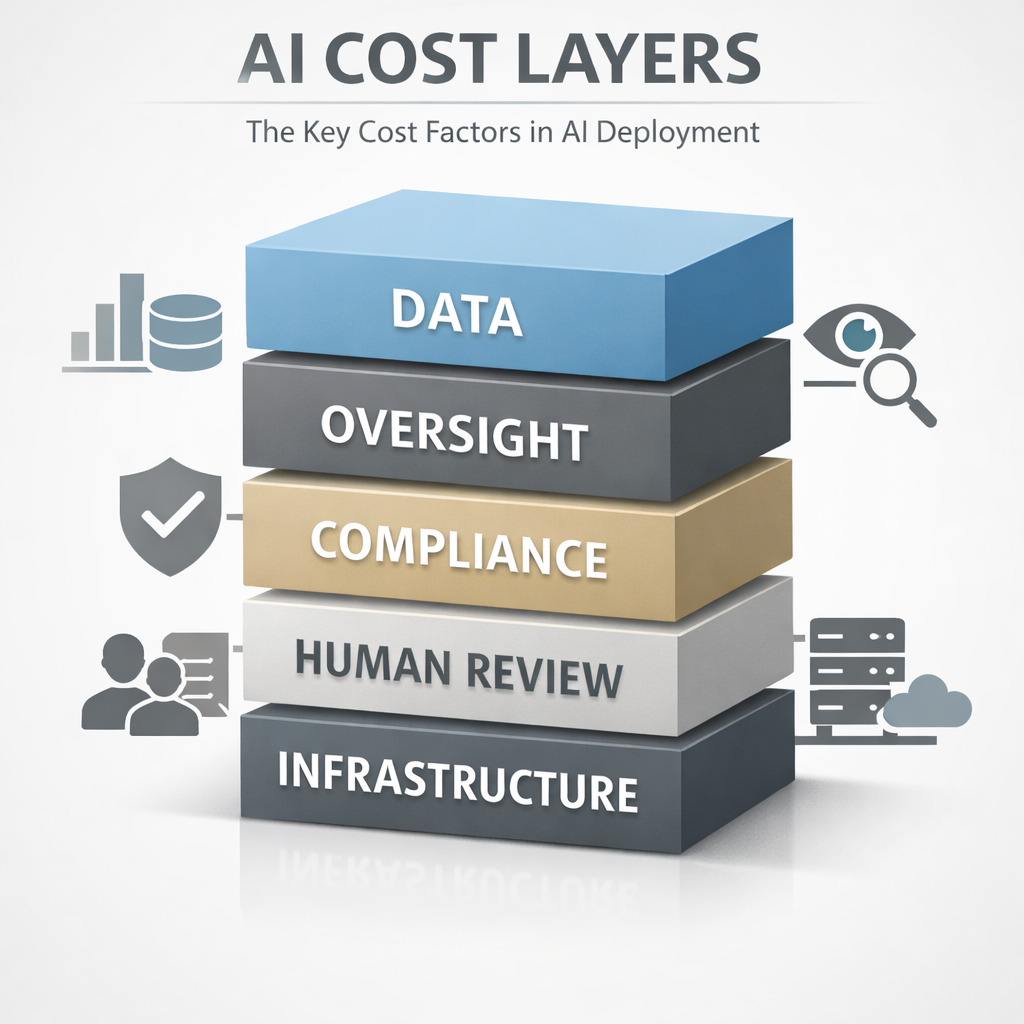
THE HIDDEN COST LAYERS THAT ERODE AI ROI
Infrastructure Costs Do Not Stabilize
AI infrastructure behaves differently from traditional IT.
Compute demand fluctuates.
Storage grows continuously.
Redundancy requirements increase as systems become critical.
What begins as a predictable cloud expense evolves into a variable cost center. Budget forecasts struggle to keep pace with usage patterns driven by expanding scope and increased dependency.
This volatility weakens long-term ROI assumptions.
Maintenance Replaces Development Faster Than Expected
During early phases, AI budgets prioritize development and integration.
As systems mature:
- Model retraining becomes routine
- Data pipelines require constant tuning
- Monitoring tools must be upgraded
Maintenance consumes a growing share of resources. Teams spend more time keeping systems functional than improving performance.
The transition from innovation to upkeep is rarely planned for in ROI models.
Human Oversight Is Not Optional
Despite automation narratives, human oversight remains essential.
Organizations add:
- Review teams for sensitive decisions
- Exception handlers for edge cases
- Audit processes for compliance
These roles expand as AI influence grows. Instead of replacing labor, AI redistributes it into less visible, higher-cost functions.
This labor cost is often excluded from AI ROI calculations.
Governance and Compliance Introduce Permanent Overhead
As AI systems influence regulated processes, governance requirements expand.
This includes:
- Documentation and reporting
- Internal audits
- Policy enforcement
These activities do not scale linearly. Each new AI application introduces incremental oversight obligations that persist indefinitely.
Governance overhead becomes a fixed cost, regardless of performance gains.
Integration Complexity Multiplies Over Time
AI rarely operates in isolation.
As systems integrate across departments:
- Dependencies multiply
- Failure points increase
- Coordination costs rise
Small inefficiencies compound across interconnected workflows, reducing net productivity gains.
The broader the integration, the thinner the ROI margin becomes.
Cost Visibility Declines as AI Becomes Embedded
Once AI is embedded into core operations, cost attribution becomes difficult.
Expenses are spread across:
- IT budgets
- Operational units
- Compliance functions
Without clear ownership, costs are normalized rather than challenged. ROI erosion continues quietly, protected by organizational diffusion.
These hidden costs of AI adoption rarely appear in initial ROI projections, yet they dominate long-term outcomes.
WHY FINANCE TEAMS STRUGGLE TO MEASURE AI ROI

AI Value Does Not Sit in One Cost Center
Finance teams are trained to evaluate investments through clear ownership and attribution.
AI breaks this structure.
AI-related costs and benefits spread across:
- IT infrastructure
- Operations
- Compliance
- Human oversight
- External vendors
No single department owns the full picture. As a result, ROI becomes a narrative assembled from partial data rather than a measurable outcome.
AI Benefits Are Indirect and Delayed
Unlike traditional investments, AI rarely produces immediate, isolated returns.
Its influence appears as:
- Slight efficiency gains
- Incremental decision improvements
- Reduced friction over time
These effects are difficult to isolate from other variables such as market conditions, staffing changes, or process redesigns.
Finance teams struggle to distinguish AI-driven improvement from background noise.
Cost Attribution Becomes Politically Sensitive
As AI costs rise, attribution becomes uncomfortable.
Questions emerge:
- Which department pays for retraining?
- Who absorbs governance overhead?
- Where do compliance expenses belong?
Rather than clarifying ownership, organizations often distribute costs broadly. This diffusion reduces accountability and weakens ROI discipline.
Traditional ROI Frameworks Do Not Fit AI
Most financial models assume:
- Stable inputs
- Predictable outputs
- Linear relationships
AI systems are adaptive and probabilistic. Their performance changes as data, usage, and context evolve.
Applying static ROI frameworks to dynamic systems creates false precision and misplaced confidence.
Finance Reporting Favors Certainty Over Accuracy
Financial reporting prioritizes clarity, consistency, and comparability.
AI ROI is:
- Uncertain
- Context-dependent
- Difficult to standardize
To maintain reporting stability, organizations often simplify AI performance into high-level indicators. These indicators mask underlying volatility rather than revealing it.
Why ROI Conversations Stall at the Executive Level
When finance teams cannot present definitive ROI conclusions, discussions stall.
Executives receive:
- Qualified statements
- Conditional assumptions
- Ambiguous projections
Without clear signals, leadership defaults to continuation. AI initiatives persist not because they perform exceptionally, but because uncertainty prevents decisive action.
These challenges explain why measuring AI ROI becomes increasingly difficult as systems scale across the enterprise.
WHEN AI BECOMES A COST CENTER INSTEAD OF AN EFFICIENCY TOOL
Automation Gains Plateau Faster Than Expected
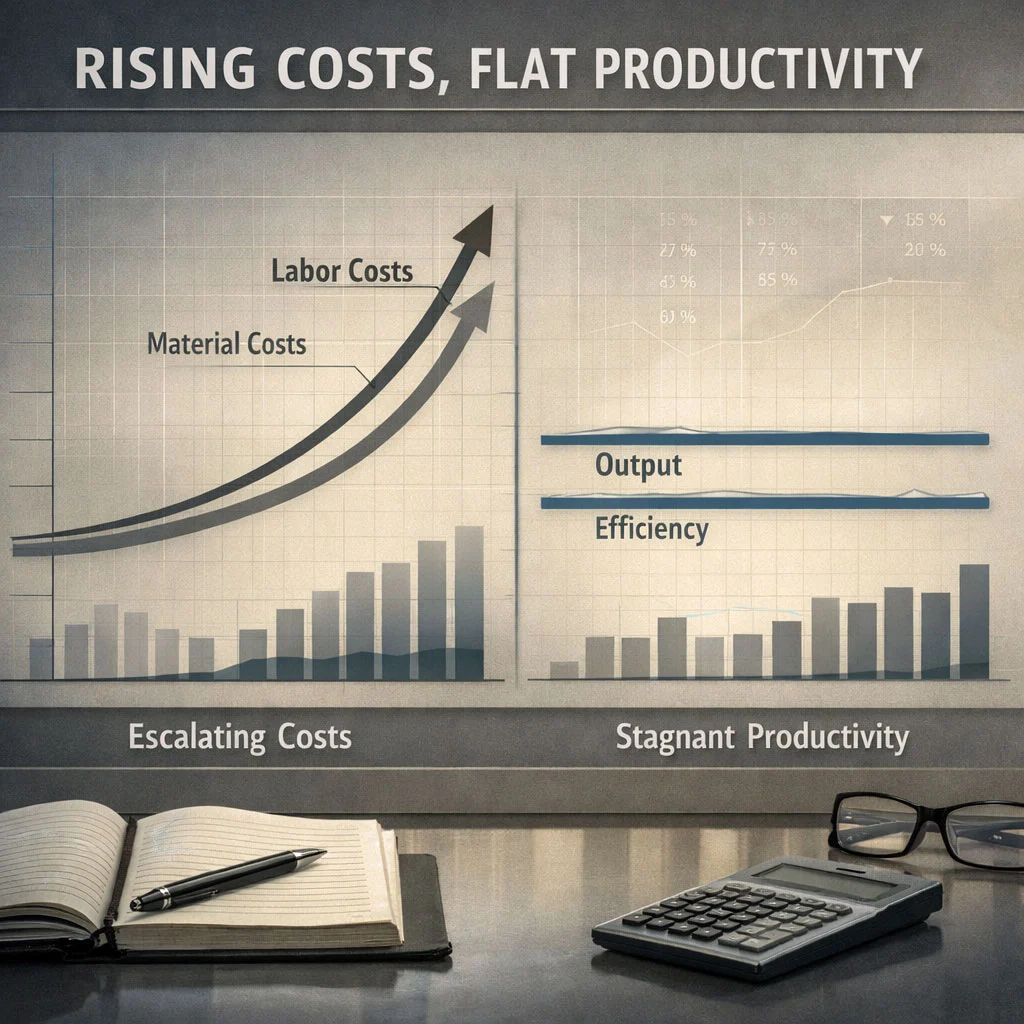
Early AI deployments often automate the most obvious inefficiencies.
Once these are addressed, remaining tasks are:
- Context-heavy
- Exception-driven
- Human-dependent
Automation progress slows. Additional investment produces diminishing returns, yet costs continue to rise.
Complexity Replaces Efficiency
As AI systems expand, complexity grows.
New layers emerge:
- Model orchestration
- Monitoring systems
- Exception handling pipelines
These layers consume time and attention. Instead of simplifying workflows, AI introduces new operational burdens that offset earlier gains.
AI Systems Create New Forms of Dependency
Over time, organizations reorganize processes around AI outputs.
Teams begin to:
- Wait for system results
- Rely on AI recommendations
- Adjust workflows to accommodate model limitations
This dependency reduces flexibility. When AI underperforms, productivity drops instead of reverting smoothly to human processes.
Cost Growth Becomes Structural, Not Temporary
Once AI is embedded:
- Infrastructure scales permanently
- Oversight roles become fixed
- Governance processes persist
These costs do not disappear even if performance stagnates. AI transitions from project expense to baseline operating cost.
Efficiency Narratives Delay Strategic Correction
Organizations continue to frame AI as an efficiency initiative even as evidence weakens.
This narrative:
- Protects prior investment decisions
- Avoids uncomfortable reassessment
- Sustains budget allocation
By the time AI is recognized as a cost center, unwinding it becomes politically and operationally difficult.
Why AI Is Rarely Decommissioned
Unlike failed software, AI systems are rarely turned off.
Reasons include:
- Fear of regression
- Embedded dependencies
- Unclear replacement paths
As a result, underperforming AI remains in operation, quietly eroding ROI over time.
This pattern illustrates the broader AI cost center problem facing mature enterprise deployments.
EXECUTIVE REPORTING BLIND SPOTS

Dashboards Are Designed to Reduce Anxiety
Executive dashboards prioritize clarity and stability.
Metrics are selected to:
- Show consistency
- Minimize volatility
- Support strategic narratives
This design choice reduces cognitive load but also filters out early warning signals. AI systems that appear stable on dashboards may be degrading beneath the surface.
Negative Signals Are Downplayed or Aggregated Away
AI reporting often aggregates performance across:
- Time periods
- Departments
- Decision types
Aggregation smooths variability. While useful for trend analysis, it hides localized failures and emerging risks that require attention.
Executives receive averages, not exceptions.
Reporting Cycles Lag Behind System Behavior
AI systems operate continuously. Reporting cycles do not.
Monthly or quarterly reports:
- Miss rapid shifts
- Delay corrective action
- Encourage reactive oversight
By the time leadership reviews performance, the system may have already influenced hundreds or thousands of decisions.
Vendors Shape Reporting Narratives
External vendors often contribute to reporting frameworks.
Their incentives:
- Highlight success
- Minimize perceived risk
- Emphasize tool capability
When vendor-generated metrics dominate, organizations lose independent visibility into system performance.
Comfort Metrics Replace Diagnostic Metrics
Over time, organizations favor metrics that confirm existing beliefs.
Examples include:
- Adoption rate
- Usage frequency
- Processing speed
These indicators are comforting but not diagnostic. They say little about whether AI improves decision quality or creates hidden exposure.
Why Blind Spots Persist Until Failure
Blind spots persist because they are functional.
They:
- Reduce friction
- Protect reputations
- Maintain momentum
Only when failure becomes undeniable do reporting structures change. By then, damage has already occurred.
These AI reporting blind spots delay recognition of risk until corrective action becomes costly.
WHY ORGANIZATIONS TOLERATE DECLINING AI ROI

Sunk Cost Bias Becomes Institutional
As AI investment grows, it becomes embedded in identity.
Budgets approved.
Careers aligned.
Public narratives established.
Stopping or scaling back AI is no longer a technical decision. It becomes an admission that prior assumptions were incomplete. Institutions prefer continuation over correction.
Reversal Is Framed as Regression
AI adoption is often positioned as progress.
When ROI declines, reconsideration is framed internally as:
- Losing momentum
- Falling behind competitors
- Abandoning innovation
This framing discourages critical reassessment. Declining performance is tolerated to preserve the appearance of advancement.
Accountability Is Diffuse by Design
Large organizations distribute responsibility.
AI outcomes are shaped by:
- Leadership approvals
- Vendor implementations
- Operational usage
No single owner feels fully accountable for ROI decline. Diffused accountability reduces urgency and enables persistence.
Measurement Ambiguity Protects Continuation
As discussed earlier, AI ROI is difficult to measure precisely.
This ambiguity:
- Allows optimistic interpretation
- Delays hard conclusions
- Sustains funding
As long as ROI cannot be definitively disproven, continuation feels safer than termination.
AI Signals Commitment to Modernization
Beyond performance, AI serves a symbolic function.
It signals:
- Technological relevance
- Strategic ambition
- Future readiness
This signaling value often outweighs financial underperformance, especially in industries sensitive to perception.
When Tolerance Turns Into Strategic Risk
Tolerance is not neutral.
Over time, declining AI ROI:
- Consumes capital
- Distracts leadership
- Creates hidden exposure
What begins as patience becomes AI risk accumulation inside enterprises. By the time tolerance is questioned, exit options are limited.
This pattern reflects a deeper AI sunk cost bias shaping enterprise decision-making.
THE INCENTIVE STRUCTURES THAT PROTECT UNDERPERFORMING AI
Career Risk Favors Continuation
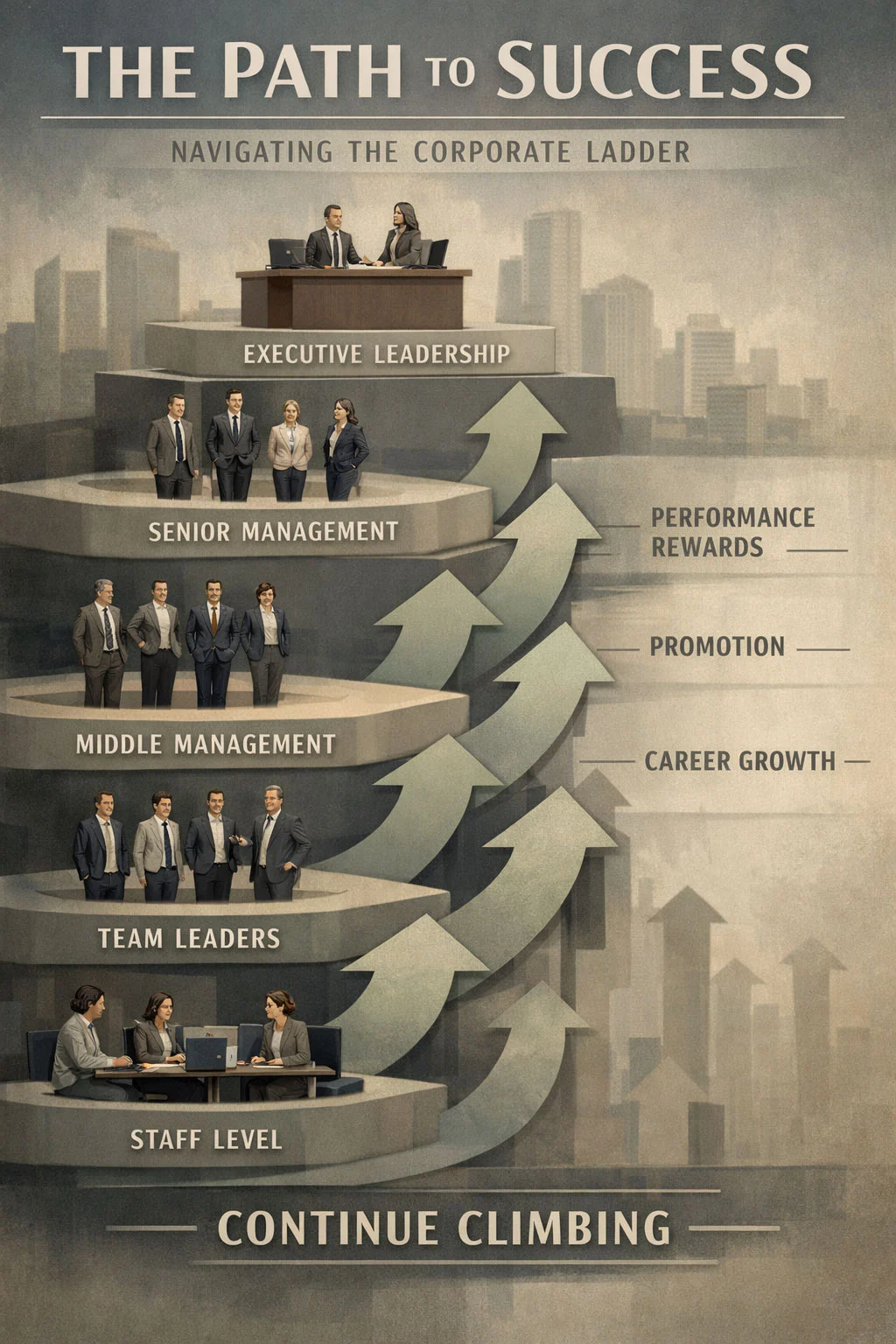
Within large organizations, stopping an AI initiative carries personal risk.
Leaders face:
- Questions about judgment
- Concerns about credibility
- Perceived failure narratives
Continuing a flawed system is often safer than challenging it. Career preservation quietly outweighs performance correction.
Incentives Reward Expansion, Not Evaluation
AI success is frequently measured by:
- Deployment scale
- Feature rollout
- Adoption metrics
These incentives reward expansion rather than effectiveness. Teams advance by growing AI presence, not by questioning its value.
Underperformance becomes invisible when growth itself is the metric.
Governance Structures Lag Behind Adoption Speed
Incentives are reinforced by governance gaps.
AI adoption often outpaces:
- Oversight frameworks
- Accountability definitions
- Decision escalation paths
Without mature governance, there is no structural trigger that forces reassessment when ROI weakens.
Vendor Relationships Reinforce Commitment
Long-term contracts and strategic partnerships create inertia.
Vendors:
- Provide optimistic performance framing
- Emphasize roadmap potential
- Delay negative conclusions
Organizations invested in these relationships hesitate to disrupt them, even when returns decline.
Boards See Risk in Stopping, Not Continuing
At the board level, AI initiatives are rarely questioned unless failure becomes visible.
Continuing AI:
- Appears prudent
- Signals modernization
- Avoids public scrutiny
Stopping AI invites explanation. As long as underperformance remains abstract, continuation feels safer.
Underperformance Becomes the Default State
When incentives align around continuation, underperformance normalizes.
AI systems operate in a grey zone:
- Not clearly successful
- Not clearly failing
This state persists indefinitely, absorbing resources while producing diminishing strategic value.
EXECUTIVE SYNTHESIS – WHAT THIS MEANS FOR LEADERS
AI ROI collapse is not a technology problem.
It is the result of:
- Cost structures that expand silently
- Measurement systems that obscure reality
- Reporting that favors reassurance
- Incentives that protect continuation
Early success masks long-term fragility. By the time ROI decline becomes visible, organizational structures make correction difficult.
For executives, the risk is not adopting AI too slowly.
It is adopting AI without mechanisms that allow honest reassessment.
AI becomes dangerous not when it fails loudly, but when it underperforms quietly.
This pattern highlights the broader AI business risk that emerges when performance, accountability, and incentives fall out of alignment.
FAQ
Why does AI ROI look strong at the beginning?
Early AI gains often appear in controlled pilots with clean data, focused oversight, and limited scope. Under these ideal conditions, improvements are easier to measure and may look stronger than what will occur at full organizational scale.
What usually causes AI ROI to decline over time?
ROI can decline as hidden costs grow, monitoring requirements expand, integration complexity increases, and performance plateaus once systems operate in more realistic and variable workflows.
Why is it hard for finance teams to measure AI ROI accurately?
AI value and cost are distributed across departments, decisions, and long time horizons. This makes attribution difficult and often leads to simplified reporting that does not fully capture volatility or secondary effects.
When does AI become a cost center instead of an efficiency tool?
AI can shift toward being a cost center when automation gains plateau but ongoing expenses such as monitoring, retraining, compliance oversight, and exception handling become permanent operational overhead.
What blind spots happen in executive AI reporting?
Executive dashboards often emphasize high-level KPIs and system stability. Early warning signals such as model drift, edge-case failures, and localized performance drops may be aggregated away and go unnoticed.
Why do organizations keep AI systems running even if ROI declines?
Sunk costs, internal narratives about innovation, diffused accountability, and measurement ambiguity can make continuation feel less risky than reversal, even when performance weakens.
Do vendor metrics always reflect real business impact?
Vendor metrics often highlight model accuracy, usage rates, or feature adoption. True business impact depends on decision quality and downstream outcomes, which may not align directly with tool-level performance indicators.
What is the biggest strategic risk of quiet AI underperformance?
Quiet underperformance can normalize resource drain and subtly reduce decision quality without triggering a visible failure event. This limits the organization’s ability to recognize issues early and adjust strategy in time.