




Bipolar anger is a common informal term for anger or irritability that occurs in someone with bipolar disorder; it is not a separate diagnosis or proof of a mood episode. The useful response depends on what else has changed and whether the situation is safe: protect people first, then consider the wider pattern and address the actual disagreement.
An angry exchange contains several different questions. Is someone becoming unwell? Can this conversation continue without harm? Is there a real problem that still needs solving? Treating those as one question creates avoidable mistakes, such as debating a diagnosis while a doorway is blocked, or dismissing an unfair demand because the person objecting has bipolar disorder.
If there is immediate danger, threats of serious harm, an overdose, or an inability to stay safe, leave the confrontation if you can and contact local emergency services. Do not wait for an argument to finish or for a diagnostic label. New hallucinations, delusions, severely impaired judgment or rapidly escalating behavior need urgent clinical assessment; ordinary conflict skills are not sufficient in those circumstances.
1. Does bipolar anger mean every outburst is an episode?
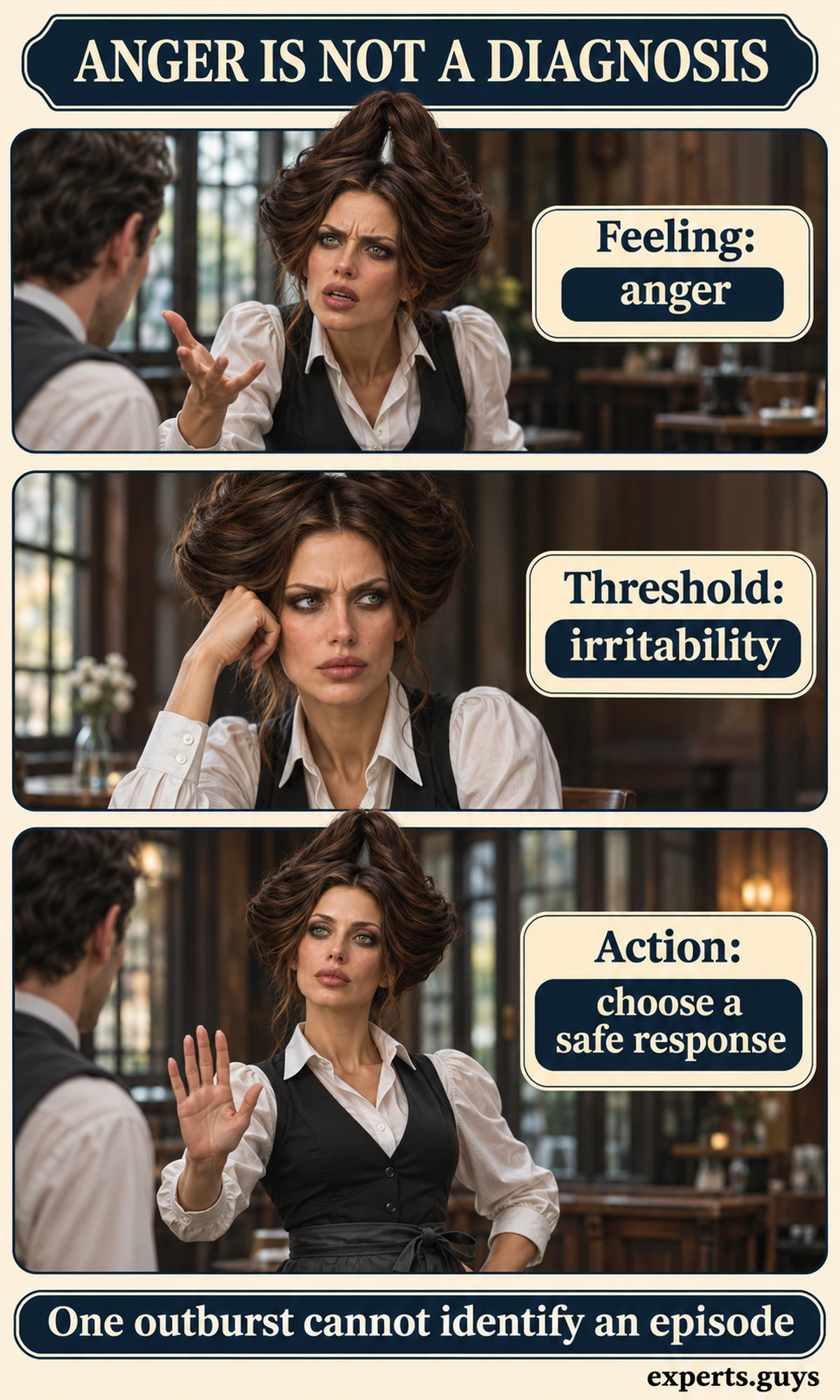
No. The intensity of anger does not identify its cause, and a person can have bipolar disorder while also being angry for ordinary, understandable reasons. Start with the difference between the feeling, the ease with which it arises and the behavior that follows. Those distinctions let you respond to the situation without turning a diagnosis into an explanation for everything.
- Anger is an emotion that can follow frustration, threat or unfairness.
- Irritability means becoming annoyed or frustrated more readily; it may be present before a particular disagreement.
- Aggression describes behavior that threatens or harms. It is not interchangeable with feeling angry.
- A mood episode is a broader clinical pattern involving changes in mood and other aspects of functioning, assessed in context.
Someone can feel furious and still choose a respectful response. Another person may speak quietly while controlling where a partner can go. Volume alone therefore gives a poor account of safety. A useful boundary names the behavior: “I will talk about the bill, but I will leave if you threaten me.” It does not require agreement about why the anger arose.
The distinction also protects legitimate complaints. Imagine a restaurant worker whose break is repeatedly cancelled. Her objection should be considered on its merits. If she also has bipolar disorder, that information does not settle whether the rota is fair. The manager can address the cancelled break while separately responding to any shouting or intimidation. Both responsibilities remain visible.
The argument and the episode run on different timescales
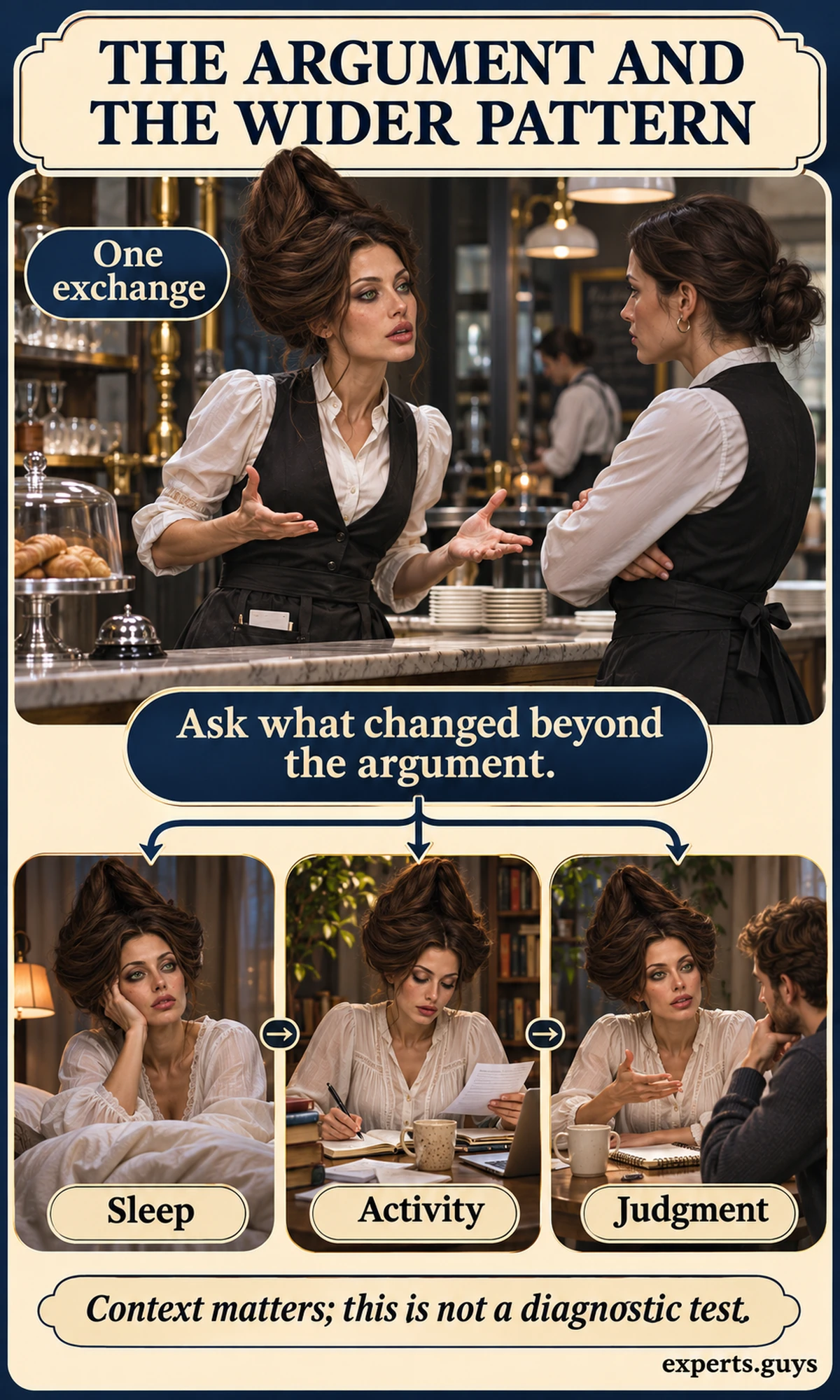
A disagreement may rise and fall within a conversation. A mood episode involves a wider course, with changes that may remain after the immediate topic has passed. This is why the loudest five minutes rarely provide enough information. Ask whether sleep, pace, energy, confidence or everyday decisions changed around the same period, rather than treating the outburst as a diagnostic event by itself.
For example, an illustrative worker becomes upset when a colleague takes credit for her work. After the issue is addressed, she returns to her usual pace and routine. In a different situation, a similar argument occurs during an unfamiliar period of little sleep, unusually intense activity and uncharacteristic commitments. The complaint may be valid in both situations; the second also raises a separate health concern.
The conclusion is not that a trigger proves ordinary anger or that an unexplained outburst proves bipolar illness. Real events and changes in health can occur together. The more useful question is what was happening before the exchange and what continues outside it. That question keeps the assessment open without requiring a family member or colleague to make a diagnosis.
Comparison with the person’s usual behavior also needs familiarity and consent. A new colleague may not know whether rapid speech is normal for someone, and a person communicating in a second language may sound more abrupt than intended. Describe the difficulty you actually encountered rather than converting an unfamiliar communication style into a symptom. A concrete account can be corrected; a character judgment is much harder to discuss.
Likewise, a rapid change in expression is not automatically “rapid cycling.” Clinical terms have specific meanings, and applying them to every argument can make communication less accurate. If your main uncertainty concerns longer-standing relationship patterns versus mood episodes, the comparison of BPD and bipolar patterns explains that separate distinction. Neither condition can be identified from an angry reaction alone.
| What you notice | What it tells you, and its limit |
|---|---|
| Anger after a specific disagreement | There is an immediate issue to understand. This does not establish whether an episode is also present. |
| A change across ordinary activities | The concern extends beyond one argument. Its diagnosis and cause remain uncertain. |
| Someone stops shouting | The exchange may be less intense. Safety and the course of any illness still need separate consideration. |
| A known bipolar diagnosis | Past assessment matters to care. It does not prove this complaint is a symptom. |
Avoid making the label the subject of the argument
Saying “This is your bipolar talking” may sound explanatory, but it often prevents the practical issue from being heard. A more useful opening describes an observation and leaves room for correction: “We are both interrupting, and I am losing track of the question.” That sentence identifies a problem the speakers can address without requiring one person to accept the other’s interpretation of their mind.
The reverse error is making the diagnosis irrelevant in every circumstance. If someone describes an unfamiliar change that resembles a previous episode, take that information seriously. Respecting their account and keeping the complaint separate from the health concern can happen together. The aim is accurate understanding, not deciding which person has the right to feel angry.
There is a useful limit to asking “Was that the illness or the person?” The available information may never divide one exchange neatly into those categories. You can still decide that an assignment needs clarification, that shouting must stop and that an unfamiliar health change needs attention. Waiting for a complete causal explanation can postpone decisions that are already clear enough to make.
2. Which accompanying changes make anger more concerning?
Concern rises when anger accompanies a marked departure from the person’s usual sleep, energy, activity or judgment, especially when the change is worsening. The reason is practical: an argument can be paused, but an evolving mood episode may need a change in care. Feeling calmer for an hour does not by itself settle that second question.
The NIMH overview of bipolar disorder describes episodes through combinations of changes rather than anger alone. Irritable mood can occur with mania, and depressive and manic symptoms can occur together. An angry feeling does not identify the episode type; assessment also considers the person’s history and possible alternative explanations.
Sleep is useful context, but it needs interpretation. Being tired after a late shift differs from sleeping far less than usual while feeling unusually driven. Neither experience should be reduced to an hours-only test. An irregular rota, pain, stress and medicine changes can complicate the picture. Do not deliberately miss sleep or wait through another bad night to test which explanation fits.
A change in judgment may be more consequential than how cheerful or angry someone appears. Think about unfamiliar commitments, unsafe decisions or an inability to reconsider a plan when new information arrives. These observations do not require moral labels such as selfish or difficult. They describe the practical effect of a change and help explain why extra support may be needed.
| Situation | Response and reason |
|---|---|
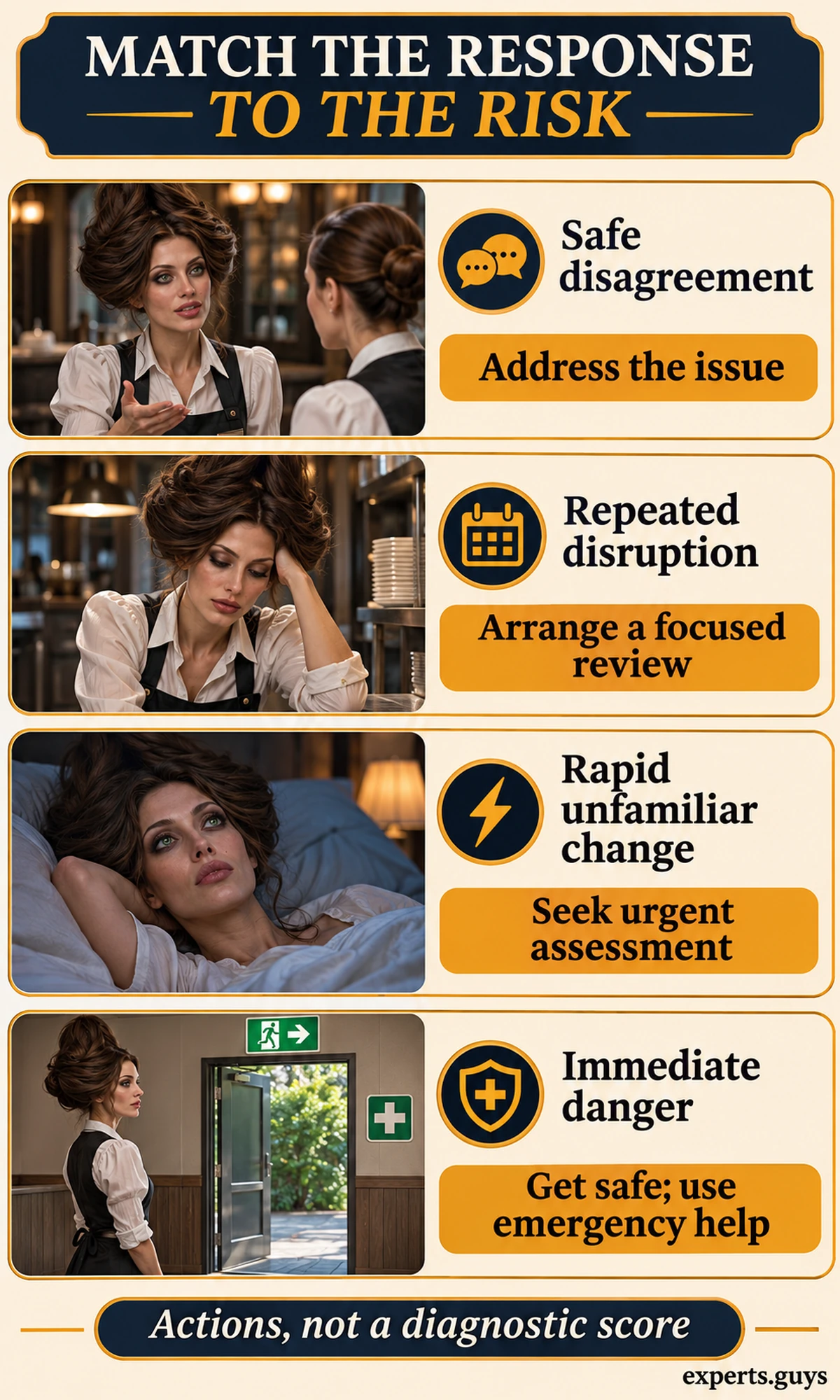
| A safe disagreement with usual functioning | Pause if needed and address the issue. A diagnosis should not displace ordinary problem-solving. |
| Repeated anger disrupting daily life | Arrange a focused treatment or therapy review; the current approach is not meeting the need. |
| Marked activation, much less sleep or rapidly worsening judgment | Seek urgent mental-health advice. Waiting for a routine appointment may be inappropriate. |
| Immediate danger or inability to stay safe | Use local emergency services now. Safety takes priority over explanation. |
Do not use the table as a self-diagnostic checklist. It sorts actions by urgency, not people into disorders. A person who does not match a familiar pattern can still need help, and an angry person who does match part of it may have another explanation. Describe what changed and what is unsafe rather than asserting a diagnosis you cannot establish.
What if anger follows a medicine change?
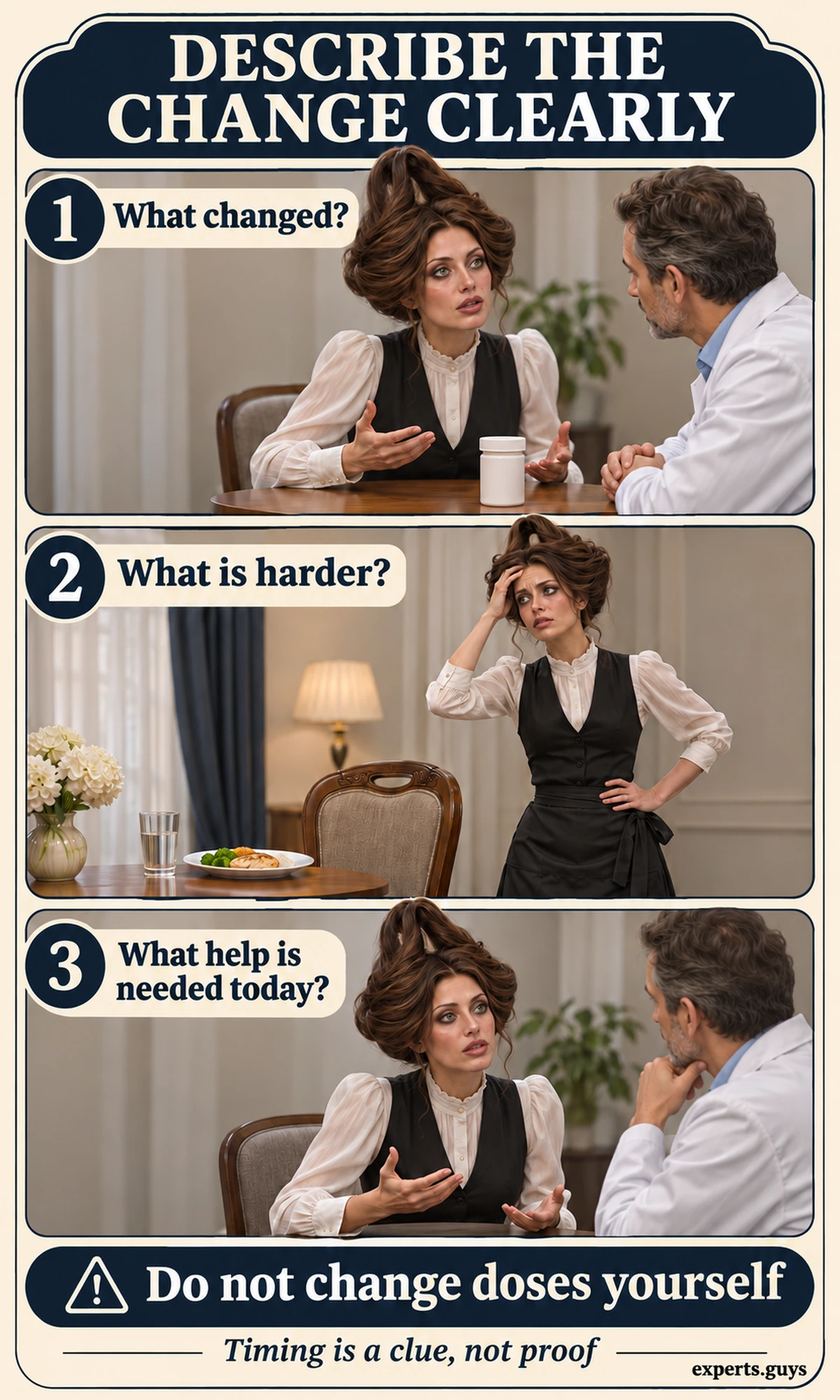
Treat the timing as information, not proof. New agitation or intense restlessness after starting or changing a medicine deserves a conversation with the prescriber. Bring the medicine name, the actual change and a concrete description such as “I cannot sit through a meal.” The purpose is to clarify the problem and its urgency, not to select a replacement medicine from an anger article.
There is no single medicine that can be chosen simply because someone uses the phrase “bipolar rage.” Episode treatment, longer-term prevention, side effects and other conditions require different decisions. The NHS treatment overview explains the role of an individualized plan and warns against stopping bipolar medication without medical advice. Do not add, skip or change doses unless following instructions already given for that situation.
A useful review conversation has three parts: what has changed, what it prevents you from doing, and what decision you need help with. For example: “Since the dose changed I feel intensely restless, I cannot finish a meal, and I need advice about what to do today.” This is an illustrative way to communicate; you do not need a diary, symptom score or completed form before contacting care.
If the concern is specifically irritability during low mood, the guide to irritability in bipolar depression explores that experience more closely. Here the key decision is whether a change needs assessment while the immediate interaction is handled safely. Those two tasks can proceed without waiting for one to explain the other.
Work context should inform support, not become a public diagnosis
A colleague can say that a handover has become difficult or that a task needs covering without announcing a psychiatric interpretation to the room. If help is needed at work, explain the immediate functional need to an appropriate person. “I need someone to take this customer conversation” gives a supervisor an action. It also avoids making private health information the price of a short break.
For an unfamiliar pattern that extends beyond conflict, bipolar symptoms at work covers sleep, speech and judgment in more detail. Employers and coworkers should not use an online guide to decide a person’s diagnosis or fitness for work. The concern here is a specific safe handover and appropriate support, with individual circumstances taken seriously.
3. How can you interrupt escalation without abandoning the issue?
Use a pause that changes what is physically happening: stop the exchange, make any immediate task safe and create space without blocking anyone. This fits a situation in which people can still cooperate and there is no immediate threat. The purpose is to prevent the conversation from doing further damage, not to treat a mood episode or make another person comply.
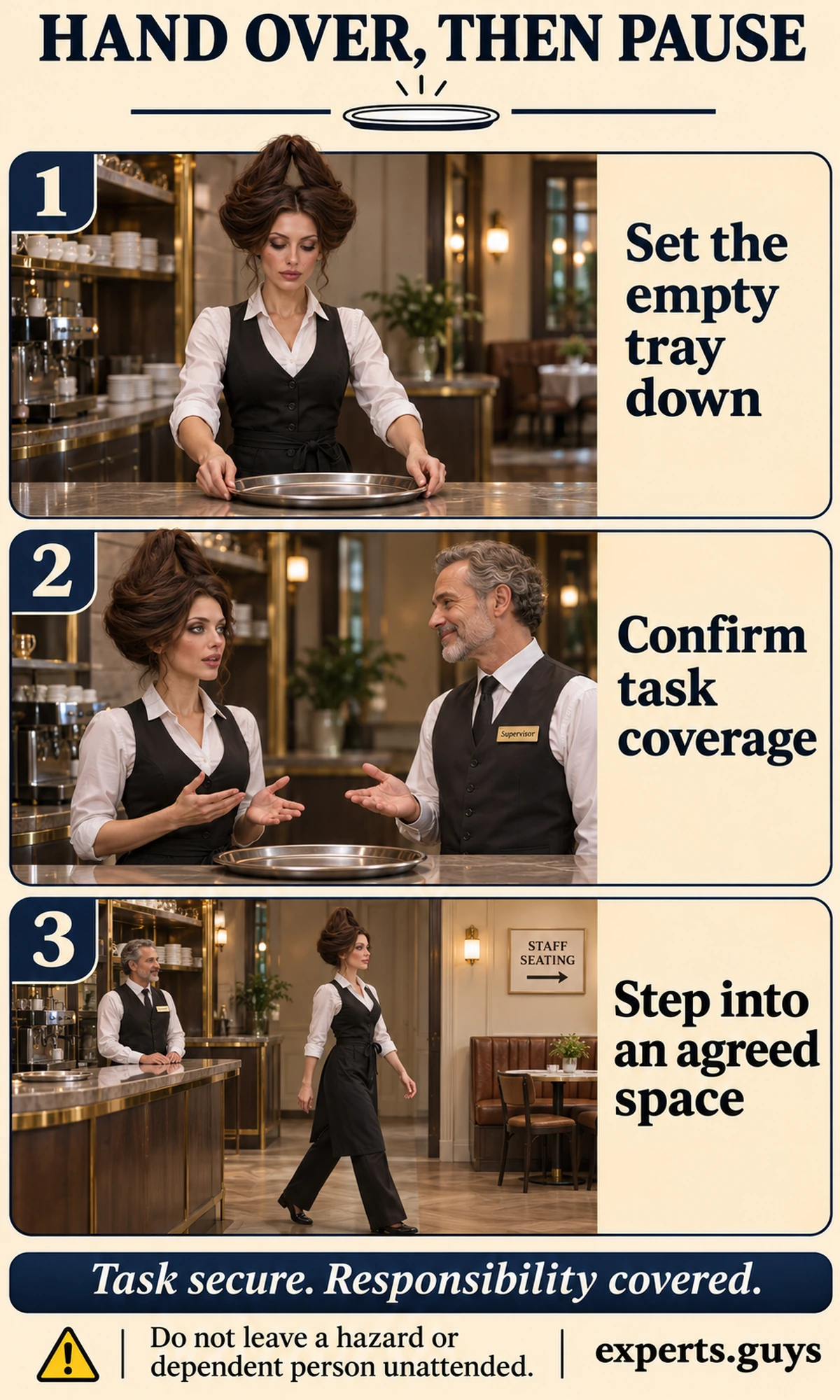
The lead skill here is a safe handover before a pause. It differs from simply disappearing, continuing to argue while carrying objects or asking someone to calm down while they are still responsible for a task. The sequence below uses an empty tray to make the handover visible. The tray is an example of a task that can be set down safely, not equipment for a coping exercise.
Make the task safe, then step out of the exchange
Use this sequence when you notice that you are talking over someone, gripping an object tensely or becoming unable to respond without snapping. Prepare by knowing where the object can safely rest and who, if anyone, can take over the responsibility. In a workplace, follow normal handover arrangements. Do not leave a person who depends on you without appropriate care or abandon a hazard in order to take a break.
- Stop moving the task through the argument. In the example, place the empty tray flat on a stable counter within comfortable reach. Do not carry it into the next room while continuing the exchange.
- State the handover and the pause. Say, “I need to step away from this conversation. Can you cover the table?” Wait for clear acceptance where responsibility must transfer.
- Move to an agreed accessible space. Keep the route open. Explain that the practical issue will be revisited when a safe conversation is possible; do not make an immediate promise you cannot reasonably keep.
Illustrative example: a waitress is upset about a changed assignment and begins replying sharply while holding an empty tray. She sets it on the service counter, asks the supervisor to cover the table and moves to the staff seating area after the supervisor agrees. The assignment remains unresolved. What has changed is that an escalating exchange is no longer happening during an active service task.
Completion means the object is secure, the responsibility is covered where needed and the exchange has stopped safely. It does not require the waitress to feel relaxed, agree with the assignment or prove that her anger was unjustified. The observable result matters because “calm down” gives no usable instruction about the tray, the customer or the next speaker.
The common mistake is treating a pause as permission to drop a responsibility without checking its consequences. Another is following the person into the break space to continue the dispute. Correct the first through an appropriate handover and the second by respecting the pause. If cooperation is no longer possible or a threat develops, stop treating this as a communication exercise and prioritize safety.
Use a seated pause when walking away is unsuitable
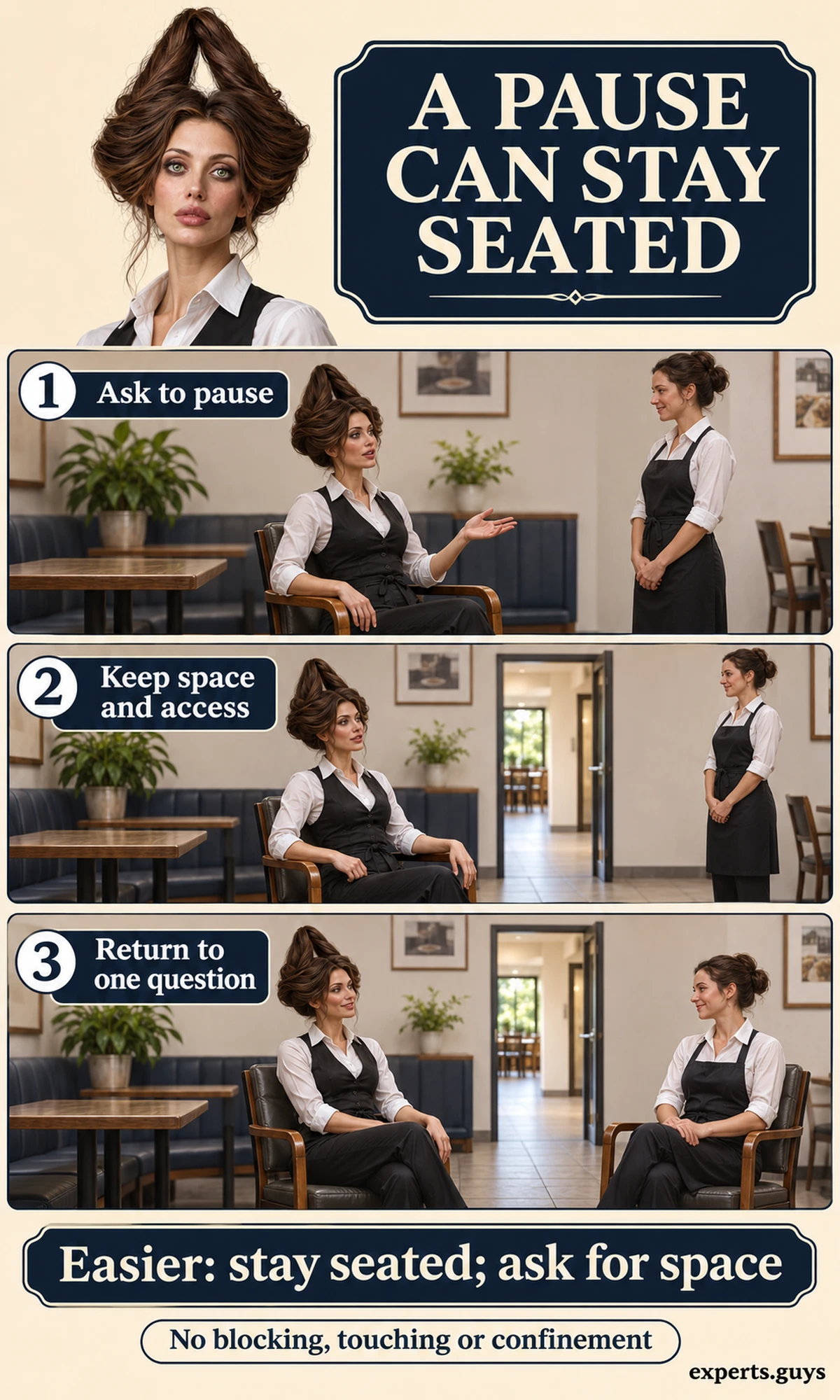
A pause does not have to mean standing up or crossing a room. If mobility, fatigue, pain or the layout makes movement difficult, stop the exchange where you are and ask the willing other person to give you space. Keep access to exits and assistance. No one should be shut in, touched without permission or required to adopt a particular posture to demonstrate cooperation.
- Stop the conversation explicitly. Use a short phrase such as “I need a pause before I answer.” If speech is difficult, use a previously agreed signal.
- Separate the speakers without confinement. Stay seated if that suits you; ask the other person to step back or use another available area. Leave the route clear.
- Check the purpose before restarting. Return to one concrete question only if both people can take turns safely. If that is not possible, arrange another opportunity or seek appropriate support.
An easier version is simply stopping after the first sentence while the other person makes the space. You do not need to perform another activity, use a timer or complete a relaxation routine. If someone continues to challenge the pause, repeating more persuasive explanations may add to the confrontation. Access to safety and help matters more than completing all three steps neatly.
A pause with an intention to return is different from using silence to punish someone. When the situation is safe, make the next opportunity reasonably clear: “We can check whether we are ready to talk after the break.” That is a check-in rather than a deadline by which someone must have stopped feeling angry. If the topic is urgent, arrange an appropriate alternative rather than leaving it indefinitely unresolved.
General anger guidance from Mind supports stepping out of an escalating situation and allowing time before reacting. The specific tray handover and seated arrangement here are practical adaptations, not independently validated bipolar treatments. Their modest purpose is to make a safe pause possible in a real setting while preserving access and responsibilities.
If you are the listener, change the conversation setup
When the other person is upset, reduce the pressure you add. In a safe interaction, one willing person can speak while others give space. Stand or sit without blocking the route, keep your hands relaxed and avoid crowding. Ask one concrete question, then allow an answer rather than adding explanations over it. Eye contact should be comfortable, not demanded.
- Keep space and access. Move away from the doorway or narrow passage. Do not follow, corner, touch or restrain the person.
- Use one speaker. Ask others to step back where appropriate. Say, “I want to understand the assignment problem.”
- Offer one workable choice. For example, “Would you rather pause here or use the staff seating area?” Accept a safe refusal and stop if the interaction becomes threatening.
The easier option is to say less: one acknowledgment and one offer of space may be enough. “That change has upset you; we can pause” leaves less to process than a speech about why everyone should be reasonable. Completion is a less crowded, more workable exchange or a safe decision to stop. It is not getting the person to agree with you.
Offer choices only when they are real. If the staff seating area is locked or inaccessible, do not present it as an option and then criticize someone for declining. Ask what available arrangement would work, within the responsibilities and safety limits of the setting. An agreed pause can involve remaining in place while the other speaker leaves; movement is not a test of willingness.
This reflects principles in NICE de-escalation guidance, including personal space and non-confrontational communication. That guidance is written for health and care settings; the workplace illustration is a limited everyday adaptation, not training in managing violence. Do not attempt physical intervention, surround someone or assume that the right phrase will make a dangerous situation safe.

4. What does repair involve after the anger has passed?
Repair means acknowledging the behavior and its effect, addressing the practical problem and changing what happens next. An explanation may help people understand an incident, but it does not require the person affected to forgive, resume the conversation or remain in a relationship. Likewise, an apology does not establish that a possible mood episode has ended or that further care is unnecessary.
Begin only when a conversation is safe and wanted. Choose an accessible place with room to leave, and keep the scope small enough to finish. If one person is afraid of the other, a joint exercise is inappropriate; seek individual support and prioritize safety. The following sequence is for cooperative repair after an ordinary conflict, not mediation of coercion or abuse.
Name the action, hear its effect, agree one change
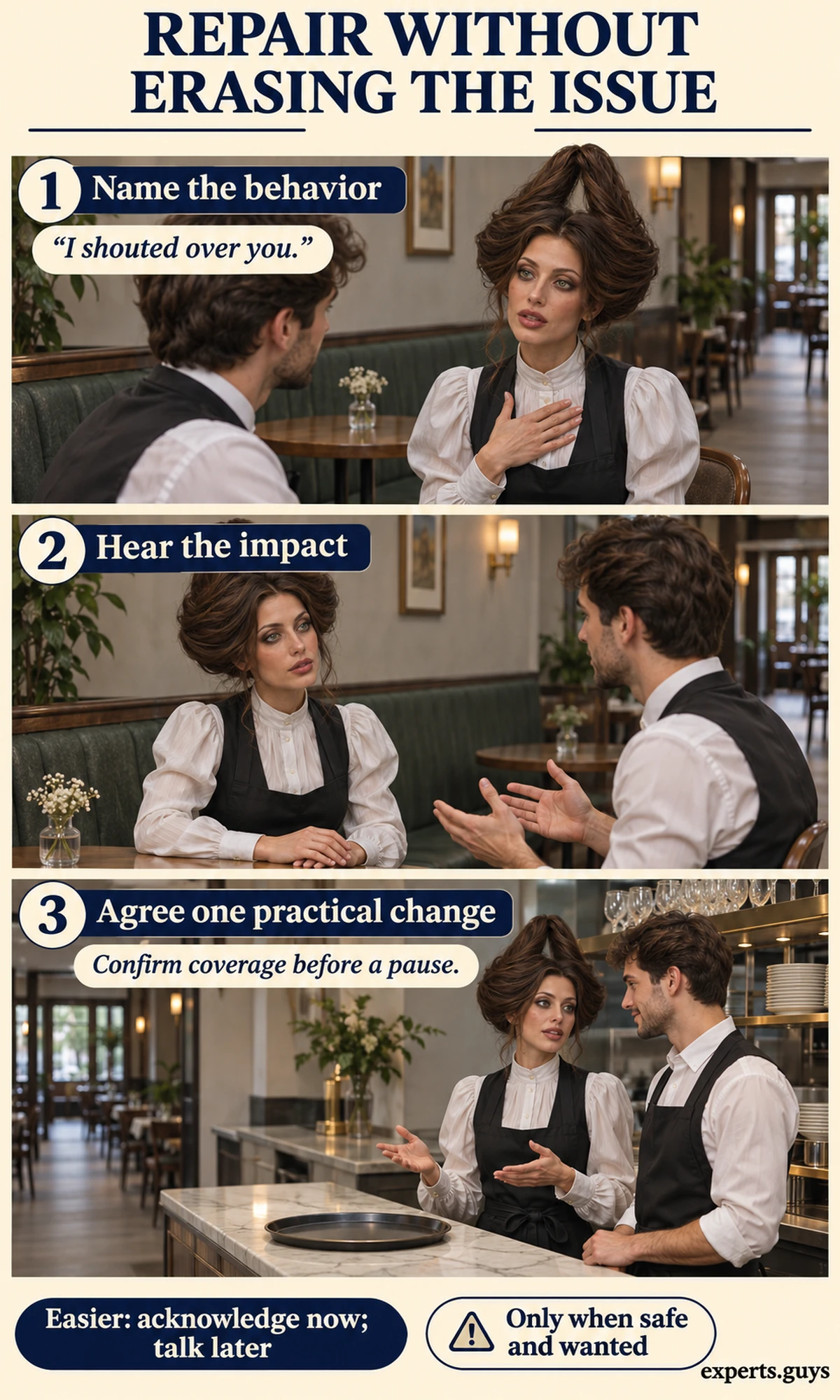
- Name the behavior specifically. Say, “I shouted over you during the handover.” Avoid replacing the action with a label such as “I had bipolar anger.”
- Acknowledge the effect and listen. “You could not finish explaining, and the table was left uncovered.” Let the other person correct the account without demanding reassurance.
- Agree one practical change. “Next time I will hand over the table before I pause, and we will discuss assignment changes privately.” Check that the change is acceptable and feasible for everyone responsible.
Illustrative example: after the shift, the waitress acknowledges interrupting the supervisor and hears that a colleague had to cover unexpectedly. They agree how to request coverage before a pause and separately arrange a conversation about the assignment. The complaint does not disappear. The difference is that responsibility for the interruption and the fairness of the rota no longer compete for the same answer.
A lower-effort version is one sentence of acknowledgment followed by a request to continue later: “I shouted, and that was not okay. Can we arrange a time to discuss the handover?” The other person may decline. Acknowledgment can be completed without an immediate shared conversation, and an apology should not be made conditional on receiving one in return.
Watch for the word “but” cancelling the acknowledgment: “I shouted, but you changed the rota.” Separate the points instead. First name the action and its effect. Then discuss the changed rota as a distinct issue. This preserves the valid concern without using it as permission to interrupt, threaten or humiliate someone.
Judge progress by changes in behavior and support
A useful sign of progress is that a pause happens before further harm, coverage is actually arranged or a difficult topic can be discussed without intimidation. These are practical observations, not a recovery score. One successful conversation does not prove a treatment is working; repeated difficulties do not prove someone is refusing to try. They show that the current arrangement may need more support or a different approach.
The practical change also needs an owner who can carry it out. A waitress cannot promise that the restaurant will always have spare staff, and a colleague cannot guarantee that no one will become upset. They can agree who receives a request for coverage and how to confirm it. When a proposed solution depends on resources that are unavailable, name that constraint and bring it to someone able to change the arrangement.
There is a trade-off between addressing an issue promptly and asking people to keep talking when the exchange is no longer workable. A pause protects the immediate interaction; returning to the issue protects against avoidance. Neither purpose should erase the other. The appropriate interval depends on safety, responsibilities and willingness, rather than a universal rule that everyone must feel ready after a set number of minutes.
If the same sequence repeats, ask what remains unresolved. Is responsibility for the task unclear? Does someone refuse any pause? Is an unfamiliar change in sleep or judgment continuing? Is one person frightened? Those conditions lead to different next steps. More practice is not the right answer to every failure, particularly when the obstacle is a threat or a worsening health change.
For ongoing but non-emergency difficulty, a treatment or therapy review can address both mood management and conflict patterns. Explain the actual impact: missed shifts, damaged relationships, persistent restlessness or fear of losing control. Ask what the existing plan says to do when those changes appear. Family or workplace arrangements can support care, but they should not make an untrained companion responsible for assessing an episode or enforcing medication.
General healthdirect anger-management guidance supports respectful expression, time out and seeking help when anger damages daily life. The repair wording here is an editorial example of applying that principle. No particular sentence guarantees forgiveness, safety or symptom relief. Its value is that responsibility, impact and the next action are stated plainly enough to discuss.
Questions that still come up
Can someone feel angry between bipolar episodes?
Yes. A bipolar diagnosis does not remove ordinary reactions to unfairness, pain, disappointment or stress. Anger between episodes is not automatically evidence of relapse; a persistent or unfamiliar change still deserves attention in the context of the person’s usual functioning.
Is bipolar anger inherited separately from bipolar disorder?
There is no separate diagnosis called bipolar anger for an article to treat as a distinct inherited condition. A family history can matter to bipolar assessment, but it cannot tell you why a particular person is angry or how they will behave in a disagreement.
Does punching a pillow count as a necessary anger exercise?
No. You do not need to hit an object or rehearse aggressive movement to complete any method in this guide. The practical aim is to interrupt an escalating exchange safely. Choose space and a workable pause rather than an activity that frightens someone or feels more activating.
Should a partner or coworker be told the diagnosis before a pause is allowed?
A short request for space can describe the functional need without disclosing a diagnosis. Formal workplace adjustments and care arrangements depend on individual circumstances and local processes. In an emergency, give responders the relevant information you know; do not delay urgent help over disclosure questions.
Choose the next action by what is happening now
- A safe disagreement: make the task safe, arrange any handover and pause the exchange if needed.
- A broader unfamiliar change: contact the appropriate treating or urgent service with the concrete change and its effect.
- Immediate danger: prioritize getting to safety and emergency help.
- A safe opportunity afterward: acknowledge the behavior, hear its impact and agree a practical change without erasing the original concern.









