




Bipolar disorder in girls is suggested by distinct periods of changed mood and energy, not by being emotional, argumentative, or unpredictable. Less need for sleep, unusually fast speech, increased activity, exaggerated confidence, and risky decisions deserve attention when they occur together and differ clearly from her usual behavior. A list of 11 signs cannot diagnose a child or teenager.
The useful decision is whether a change needs assessment and how urgently. Look at the whole period: what was different, how long it continued, and what happened to everyday life. Do not wait to collect enough signs if someone is unsafe, severely confused, or losing contact with reality.
This guide focuses on children and adolescents. “Girls” is not a separate diagnostic category, and clothing, femininity, personality, or appearance cannot establish bipolar disorder. The adult presenter in the illustrations demonstrates comparisons; the pictures are not examples of how a person with a diagnosis must look.
A quiet girl may become unusually driven; an outgoing girl may become much more intense than usual. The reference point is her own functioning, not a sibling, a classmate, or an expectation that young people should always be calm. Use the following distinctions to read the signs in context.
| What you notice | What changes the interpretation | Useful next step |
|---|---|---|
| One difficult afternoon | A brief reaction does not establish a mood episode. | Understand what happened; avoid a diagnostic label. |
| A sustained change in energy and sleep | Several changes appearing in the same period matter more than a total score. | Arrange assessment and describe the change from usual. |
| Immediate danger or loss of contact with reality | Urgency does not depend on proving bipolar disorder. | Seek urgent local help now. |
What makes a mood change more concerning?
A mood episode involves more than the emotion itself: pace, sleep, activity, and thinking can change together. Irritability on its own is nonspecific. For example, a disagreement about homework tells you little about diagnosis; a broader change that continues beyond that disagreement calls for a different conversation.
Duration helps clinicians interpret the pattern, but it is not a home waiting rule. A parent does not need to let a child deteriorate until a textbook duration has passed. Equally, several emotions within one day should not automatically be called several bipolar episodes. The question is whether there is an identifiable period with a meaningful change in mood and activity.

Consider this illustrative contrast. After a disappointing result, a student cries, argues, and later returns to her familiar activities. Another student has a sustained period of very little sleep, unusually intense projects, and behavior that surprises people who know her well. Neither example proves a diagnosis, but the second gives a clinician a different pattern to investigate. These are invented examples for comparison, not patient histories.
Visible success can also obscure a change. Finishing extra work does not make every high-energy period healthy, just as an ambitious goal is not a symptom by itself. Ask whether the pace is unusually difficult to interrupt, whether ordinary responsibilities are being displaced, and whether judgment has changed. The meaning comes from the combination and its context.
Once bipolar disorder has already been diagnosed, an agreed relapse plan serves a different job from first recognition. The guide to early warning signs of a bipolar episode covers that ongoing-care perspective. Here, the priority is describing an unexplained change without deciding its cause in advance.
Which 11 signs deserve a closer look?
Read the following signs as examples of possible changes, not a scoring system. Some concern activation and others concern depression. They need not all occur, and depressive symptoms can have explanations other than bipolar disorder. The NIMH guide for teens and young adults describes these broad symptom groups.
For each sign, the helpful question is “What is different for her?” Words such as “lazy,” “dramatic,” and “out of control” hide useful detail. Observable descriptions are more informative: she stopped an activity she normally enjoys, or her usual conversation became unusually rapid and hard to follow.
- Activation clues: read signs 1–7 together with changes in mood and energy.
- Depression clues: signs 8–11 indicate distress that deserves attention but do not establish bipolar disorder.
- Safety overrides the list: serious danger warrants action even when only one concerning feature is present.
1. Sleeping less without the expected tiredness
Reduced need for sleep differs from wanting sleep but being unable to get it. The clue is an unusual combination: markedly less sleep and feeling energetic rather than exhausted. Ask about the following day as well as the night. Do not deliberately restrict sleep to test this distinction.

2. Unusually elevated or expansive mood
A prolonged, out-of-character sense of excitement or exaggerated cheerfulness may be relevant when energy and behavior change with it. Enjoying a party or feeling proud of an achievement is not enough. Avoid judging ordinary enthusiasm by whether an adult finds it convenient.
3. Intense irritability within a broader change
Severe irritability can accompany mood episodes, but anger is not a shortcut to a bipolar diagnosis. The useful detail is whether it is part of a wider departure from her usual pattern. Constant irritability and a distinct period of changed energy are different histories to describe.
4. Speech becomes unusually rapid or difficult to interrupt
Notice a clear difference from her normal conversational style. A normally talkative teenager is not automatically showing a symptom. What matters is a new pace or pressure that makes it difficult to exchange ideas or follow the conversation.
5. Thoughts feel unusually fast or scattered
She may describe ideas arriving too quickly or difficulty holding one train of thought. Listen to her account rather than inferring everything from outward behavior. Difficulty concentrating can occur in many conditions, so it needs context.
6. Activity and confidence rise beyond the usual pattern
An unusual burst of projects or an inflated sense of ability can be relevant. A practical example is taking on commitments far beyond what she normally attempts while insisting that ordinary limits no longer apply. Talent, creativity, and confidence alone are not illness.
7. Judgment changes and risks increase
The concern is a change toward behavior with meaningful consequences, not a parent’s dislike of a fashion or hobby. Describe the actual risk and the change in judgment. If behavior is immediately dangerous, addressing safety comes before sorting out the diagnosis.

8. Persistent low or irritable mood
A depressive period may involve sadness, hopelessness, or irritability. An absence of obvious crying does not mean there is no distress. Depression can be present without a history of mania or hypomania, which is why a low period alone cannot answer the bipolar question.
9. Loss of interest in familiar activities
A previously valued interest may stop feeling enjoyable. Changing hobbies is normal; losing interest across familiar parts of life is a different concern. Ask about enjoyment itself rather than assuming that attending an activity means she is enjoying it.
10. Energy, appetite, or sleep change during a low period
Low energy, altered eating, and sleeping much more or less can accompany depression. These changes are not specific to bipolar disorder. Explain their effect on familiar routines without turning meals, sleep, or body size into a moral judgment.
11. Concentration and everyday participation decline
Schoolwork, relationships, or routine tasks may become harder to manage. Describe what is difficult rather than equating performance with effort. A capable student can be struggling even while grades remain acceptable.

What else can resemble these signs in girls?
An assessment must consider other explanations and conditions that can coexist. Anxiety, ADHD, depression, sleep disruption, and medication or substance effects may complicate the picture. A single outward behavior cannot reliably distinguish them. The NIMH children and teens guide explains why a careful developmental and clinical history is necessary.
| Possible overlap | Useful distinction to describe | Avoid this conclusion |
|---|---|---|
| Longstanding attention difficulties | What was present before the recent change? | “Distractible means bipolar.” |
| Sleep disruption | Was there too little sleep opportunity, difficulty sleeping, or less perceived need? | “Every late night is mania.” |
| Medication or substance effects | Did the change follow starting, stopping, or changing a substance or medicine? | “We should stop a prescription ourselves.” |
| Menstrual timing | Does the difficulty appear to follow a recurring cycle pattern? | “All distress in girls is hormonal.” |
Menstrual timing is relevant context when applicable, but it should not eclipse the rest of the history. Do not dismiss symptoms as “just hormones,” and do not diagnose bipolar disorder from a difficult premenstrual week. Adult reproductive-stage questions belong in the separate guide to bipolar symptoms in women; they should not be imported wholesale into an adolescent symptom list.
A helpful assessment remains open to more than one issue. A familiar diagnosis does not explain every new behavior, and a new concern does not erase an existing one. The practical goal is a clearer account of what is longstanding, what is new, and what currently interferes with life. You do not have to settle competing diagnoses at home.

How can you explain the change and choose the next step?
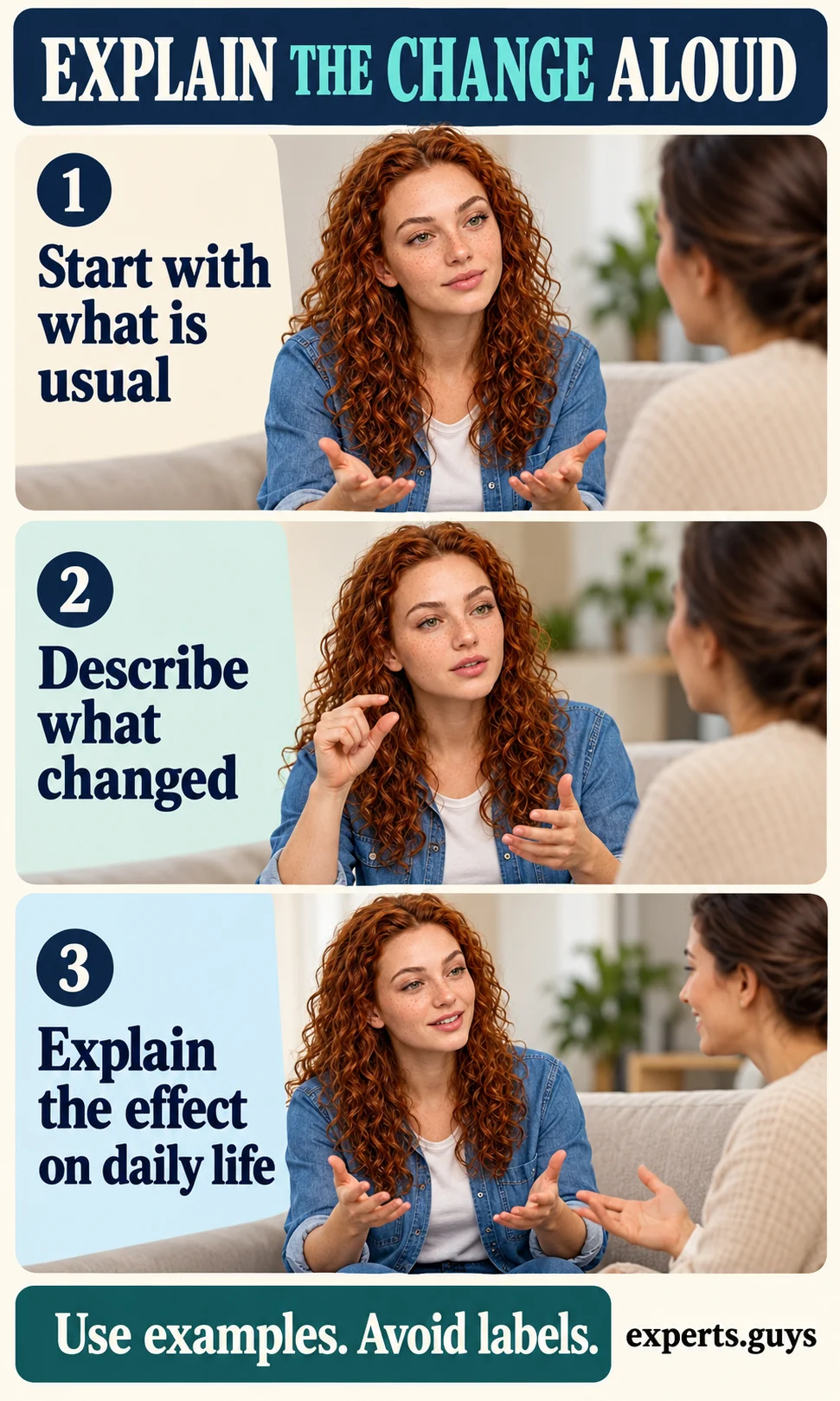
The lead skill here is a spoken comparison of usual functioning and the changed period. It helps a girl, caregiver, or trusted adult communicate a concern without a worksheet, symptom score, or diagnostic label. It is a communication aid, not a treatment or validated screening test.
Use a spoken before-and-during comparison
Choose a private, ordinary conversation when there is no immediate danger. Face each other comfortably; sitting or standing is fine, and eye contact is not required. Let her choose whether a trusted adult helps. The aim is to understand the experience, not to get agreement that she has bipolar disorder.
- Start with what is usual. Say, “Usually, what are sleep, energy, and everyday activities like for you?” Give her room to answer.
- Describe the changed period. Ask, “What felt different, and roughly when did it start?” Use an ordinary event as a time reference if an exact date is hard to remember.
- Explain the effect. Ask, “What became harder, faster, or unsafe?” Offer one concrete example and invite correction.
For example: “Usually you can wind down after dinner. Recently you have seemed energized late into the night, and you say you are not tired. You have also started more projects than usual. Does that fit your experience?” This wording leaves room for disagreement. Replace the example with what actually happened; do not coach someone to match symptoms.
Correction: if the conversation becomes an interrogation, drop the checklist and let her describe the hardest change first. Easier version: use one sentence: “Something has changed with my sleep and energy, and I need help understanding it.” Completion: the listener can repeat the concern in ordinary language and the young person can correct it. Perfect recall is not required before seeking care.
Choose urgency from safety and functioning
For an unexplained sustained change, arrange an assessment with a professional experienced in children and adolescents. Tell the service about marked sleep reduction, unusual energy, worsening judgment, or rapid deterioration when asking how quickly she should be seen. If she already has a care plan, follow its escalation instructions. Avoid changing prescribed medication independently.
Seek urgent help for loss of contact with reality, serious unsafe behavior, suicidal intent, or immediate danger. Use local emergency services when danger is immediate. Stay nearby if it is safe, involve a trusted adult, and avoid arguing about unusual beliefs or trying to physically restrain her. Do not leave a child to manage a crisis alone or wait for the list to “add up.” The NHS bipolar disorder guide includes access to urgent mental-health guidance.

An assessment may take more than one conversation. A clinician can consider the young person’s account, developmental history, health, medicines, and information from adults who know her. An uncertain first appointment is not a reason to dismiss a meaningful change; it is a reason to clarify the next review and what should trigger earlier contact.
Frequently asked questions
Can a child have bipolar disorder before adolescence?
Yes, symptoms can occur in childhood, although diagnosis is often made later. Younger children need a careful specialist assessment because developmental differences and overlapping conditions make interpretation difficult.
Does a family history mean a girl will develop it?
No. Family history is relevant context, not a prediction for an individual. It should inform an assessment without making every difficult day look like a symptom.
Can a blood test confirm bipolar disorder?
No single blood test or brain scan establishes the diagnosis. Tests may help investigate other possible explanations; the diagnosis depends on clinical assessment.
Should I show her this list and ask for a score?
Use it to find language for a concern, not to tally a result. A score from this article has no diagnostic meaning. Ask which change feels most important to her and listen to her explanation.
What to remember
A meaningful change from her usual self is more informative than a label or a symptom total. Describe the changed period, take her account seriously, and choose urgency from safety and functioning. That gives the next conversation a clear purpose while leaving diagnosis to a careful assessment.










