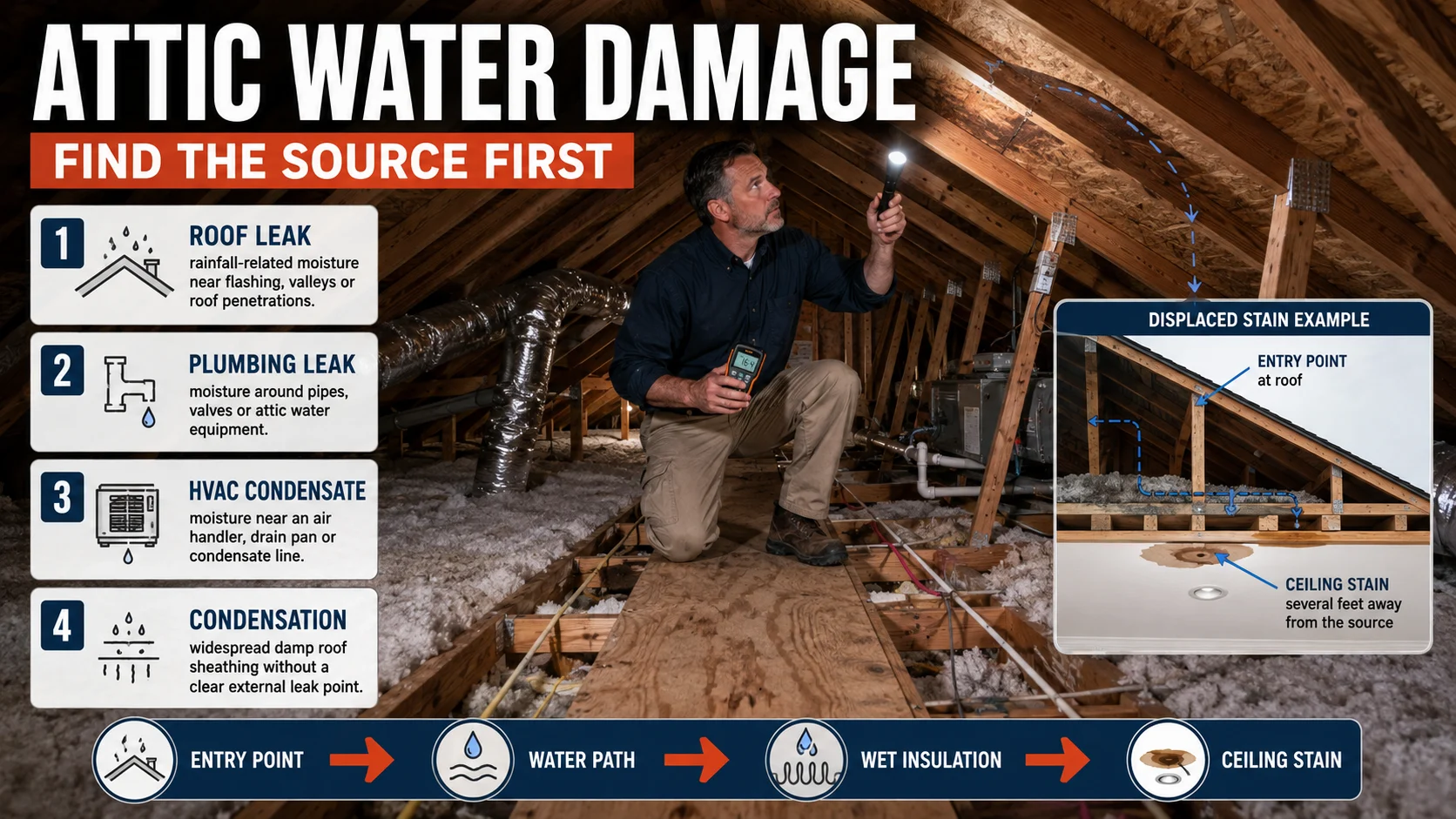

Water damage in an attic should be treated as a source-tracing problem before it becomes a ceiling-repair problem. Moisture can enter through the roof, plumbing, HVAC equipment or condensation, then spread through insulation, roof sheathing, framing and ceiling materials before a stain becomes visible downstairs. The correct repair sequence is to identify and stop the moisture source, determine the actual wet boundary, dry or remove affected materials, verify that the assembly is dry and only then rebuild damaged finishes.
The location of the first visible stain rarely tells the whole story. Water may run along the underside of roof decking, follow a rafter, soak into insulation and finally reach the ceiling several feet away from the original entry point. An attic inspection therefore needs to separate the source, the water path and the material damage, because those may occur in three different locations.
What Should You Do First When You Find Water in the Attic?
Safety comes before leak tracing because attics combine restricted access, structural framing, insulation, electrical wiring and surfaces that may no longer be reliable after prolonged wetting. Do not step between framing members onto ceiling drywall, and avoid entering an attic where electrical components are wet, the ceiling is sagging, structural movement is visible or large quantities of water are present. Suspect insulation should also be left undisturbed when its composition or contamination is uncertain.
If water is actively entering, limit additional damage from a safe location where possible. A controllable plumbing source may be isolated at an appropriate shutoff, while active roof entry during severe weather normally requires temporary containment below the leak rather than climbing onto a wet roof. Photographing stains, wet insulation and damaged finishes before significant removal can also preserve a useful record of how the loss developed.
Remove or protect stored belongings only when you can reach them without walking across unsupported ceiling areas or disturbing potentially hazardous material. Standing water on a safe, accessible decked attic surface can sometimes be removed, but the more important objective is preventing additional moisture from entering. Drying equipment cannot overcome an active leak that continues feeding water into the assembly.
The timing of the moisture provides one of the earliest diagnostic clues. Water that appears during or shortly after rain suggests a roof-envelope route, moisture that develops around pipes or equipment may indicate plumbing or condensate failure, and widespread moisture on the underside of roof sheathing under particular weather conditions can point toward condensation. Recording when the attic becomes wet often narrows the investigation more effectively than looking at stain color.
Before repair work begins, establish what changed immediately before the moisture appeared. A recent storm, roof work, plumbing alteration, new HVAC equipment, blocked drain, added insulation or change in indoor humidity can materially alter the diagnostic direction. An attic that has remained dry for years and suddenly becomes wet after one building change deserves a different investigation from a roof space with a long history of seasonal condensation.
First-response priorities for attic water damage
- Keep people away from wet electrical components and sagging ceilings.
- Stop a safely accessible plumbing or equipment-related source.
- Avoid climbing onto a wet or storm-damaged roof.
- Protect occupied rooms below active dripping where it can be done safely.
- Photograph visible moisture patterns before major removal.
- Note whether the problem follows rain, plumbing use, HVAC operation or weather changes.
- Inspect from safe attic walkways or structural framing only.
- Treat wet insulation as part of the damage investigation rather than assuming the surface beneath it is dry.
- Do not close or repaint the ceiling until concealed materials have been checked.
What Causes Water Damage in an Attic?
Roof leakage is one of the most recognizable causes, although the visible wet area may be displaced from the roofing defect. Water can enter around damaged roofing, failed flashing, valleys, ridge details, roof-to-wall transitions or penetrations and then travel along the roof deck before dripping onto insulation. This is why replacing one shingle directly above a ceiling stain may fail when the actual entry point is farther upslope.
Penetrations deserve particular attention because several materials and drainage planes meet in a small area. Plumbing vents, chimneys, skylights, mechanical penetrations and flashing transitions can admit wind-driven rain if the surrounding detailing deteriorates or was installed incorrectly. Evidence higher on the roof deck or framing is usually more useful than the largest wet patch at the bottom of the attic.
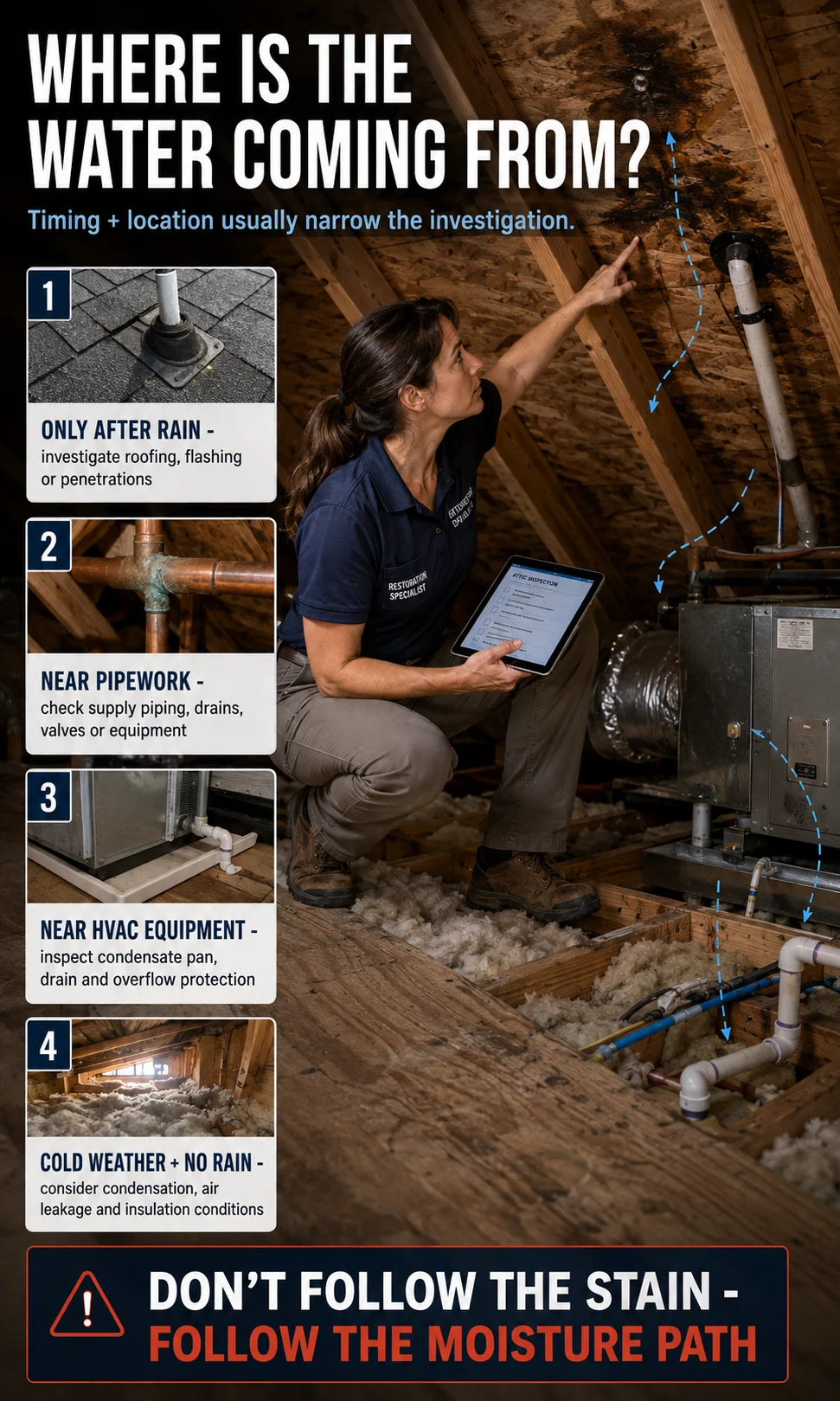
Plumbing and mechanical systems create a different moisture pattern. Attic water heaters, supply piping, drain lines, HVAC air handlers and condensate systems can release water independently of rainfall, and some failures begin as intermittent drips rather than dramatic floods. Moisture concentrated beneath equipment, fittings, valves or condensate components should therefore be investigated separately from roof entry.
Condensation can make an attic look as though the roof leaks even when exterior water is not entering. Warm humid indoor air that reaches sufficiently cold roof sheathing, fasteners, ducts or pipes can release moisture when those surfaces fall below the air’s dew point. The corrective work may involve air sealing, insulation, ventilation, humidity control or mechanical-system corrections rather than roofing replacement.
Cold-climate attics can also experience water intrusion associated with ice-dam conditions when heat escaping from the building warms parts of a snow-covered roof and refreezing occurs near colder edges. Water held behind the ice can work beneath vulnerable roofing details and enter the roof assembly. The long-term response has to address the thermal and air-leakage conditions contributing to uneven roof temperatures as well as any resulting roof damage.
Poor drainage around the roof increases exposure even when the attic itself contains no plumbing. Blocked gutters, overflowing roof drainage and uncontrolled runoff can direct large quantities of water toward vulnerable roof edges, fascia, wall transitions and penetrations. Maintaining drainage and understanding how to stop water runoff from your roof can therefore be part of preventing some recurring attic moisture problems.
How Do You Find Where Attic Water Is Coming From?
Begin with when the material becomes wet, then work toward the highest plausible source rather than beginning at the ceiling stain. A rain-related problem should be compared with wind direction, rainfall intensity and the position of valleys, penetrations and roof transitions. A plumbing problem should be checked under the operating conditions that actually pressurize or drain the suspect component.
Follow staining and wetting upward through the assembly whenever the structure can be inspected safely. Darkened roof sheathing, rusty fasteners, mineral deposits, compressed insulation and repeated staining on one rafter can provide a directional trail. The point where the visible trail disappears is often more diagnostically useful than the point where the most water collected.
Insulation can obscure that trail because it absorbs, redirects or traps moisture. A wet upper surface does not prove the material below is equally wet, while a dry-looking upper surface does not prove the bottom of the insulation or ceiling board beneath it has dried. Inspection needs to consider the full depth and the adjacent structural materials.
Moisture meters can help compare suspected wood or building materials with unaffected reference areas when the device and material are appropriate for the measurement. A single reading should not be treated as a universal verdict because species, density, temperature, coatings and meter type influence interpretation. Patterns and repeat measurements are more useful than one isolated number.
Thermal imaging can sometimes identify temperature differences worth investigating, particularly where evaporation, missing insulation or wet materials alter surface temperature. The camera does not directly identify water, and air leakage or insulation differences can create similar patterns. Suspected moisture still needs physical verification before destructive work or reconstruction decisions are made.
Water that leaves the attic can continue downward through wall cavities without producing an obvious attic puddle. If staining appears at wall-ceiling junctions, around trim or farther down a wall, the investigation may need to follow the pathway described in hidden water damage inside walls. The attic source and the final visible symptom can be separated by several building components.
What Are the Warning Signs of Attic Water Damage?
Ceiling stains are common clues, but they are only one part of the evidence. Damp or matted insulation, darkened roof decking, rusty fasteners, swollen wood-based panels, musty odor, peeling ceiling finishes and recurring moisture after rain can all indicate that water has reached the attic assembly. The more signs that align along one plausible path, the stronger the diagnosis becomes.
A sagging ceiling deserves greater urgency because absorbed water can reduce the strength and stiffness of gypsum board. Water may also accumulate above the finished ceiling before it finds an opening, which adds weight to an already weakened surface. Avoid standing beneath a visibly bulging or water-filled ceiling and have the condition assessed before disturbing it.
What Happens to Wet Attic Insulation?
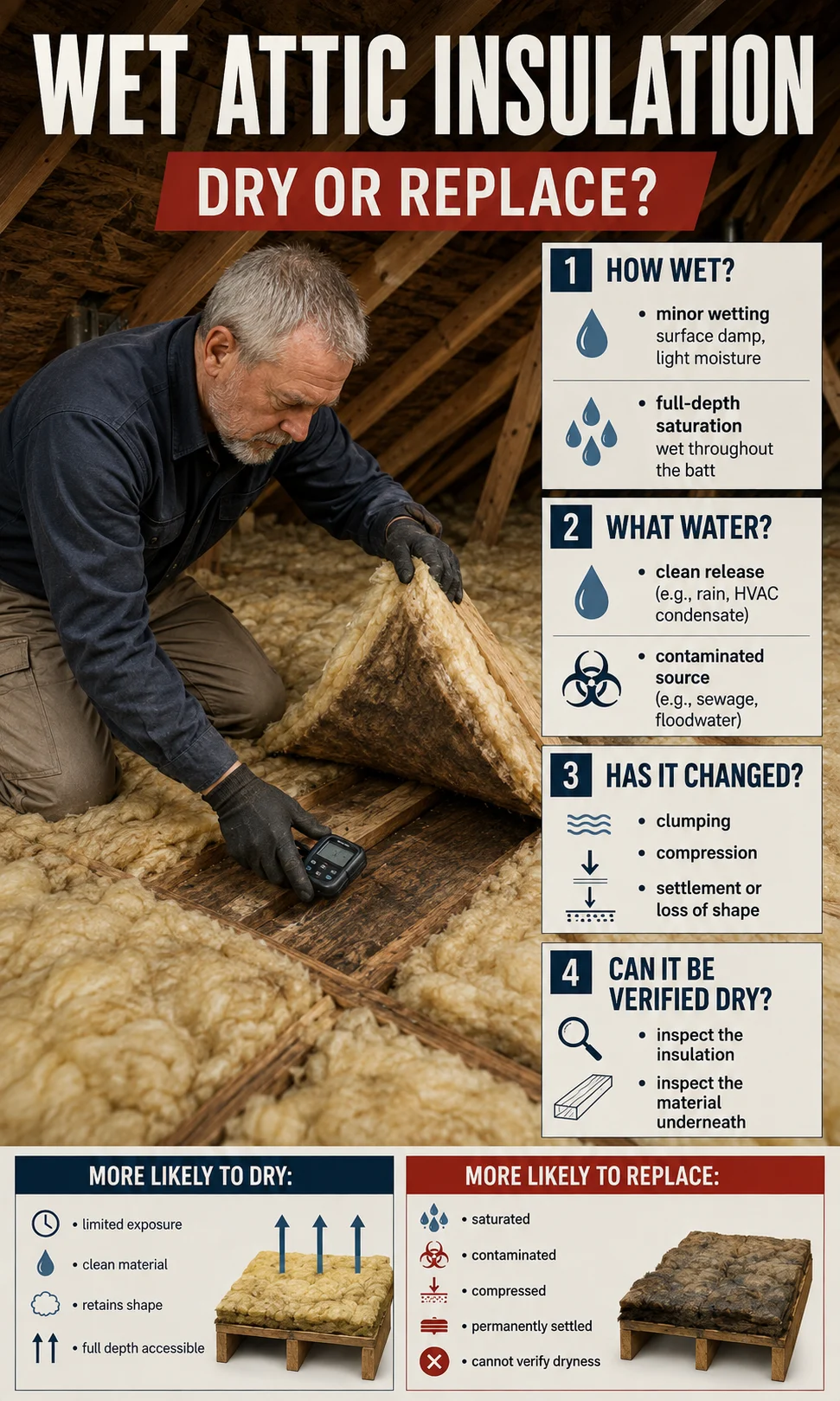
Wet insulation should be evaluated according to its material, depth of saturation, contamination, compression and ability to dry. Fibrous insulation can hold moisture against adjacent timber or ceiling materials even after the top appears dry, while loose-fill products may settle or lose uniform coverage after significant wetting. Simply waiting for the visible surface to dry may leave moisture trapped where airflow is poor.
The roof structure needs separate attention because rafters, trusses and sheathing often dry differently from insulation and ceiling finishes. Solid structural timber can frequently tolerate temporary wetting when it remains structurally sound and is dried effectively, but persistent moisture can lead to staining, fungal deterioration, corrosion of metal connectors and loss of performance in wood-based sheathing. Swollen, delaminated, softened or decayed material requires a different decision from sound timber that is merely wet.
| Attic material | What water can change | Drying may be reasonable when | Replacement or specialist review becomes more likely when |
|---|---|---|---|
| Fiberglass or mineral-fiber insulation | Can retain water, mat, compress and keep neighboring materials wet | Exposure is limited, material remains clean and its full depth can dry | Saturated, contaminated, compressed or impossible to verify dry |
| Loose-fill insulation | Can settle, clump and lose uniform thermal coverage | Wetting is minor and coverage remains stable after complete drying | Significant saturation, contamination or permanent settlement occurs |
| Rafters and truss members | Wood absorbs moisture and can remain wet internally after surfaces change appearance | Members remain structurally sound and moisture can be reduced to an appropriate dry condition | Decay, major deformation, connection damage or structural deterioration is present |
| Roof sheathing | Wood panels can swell, stain, soften or delaminate after prolonged wetting | Panel remains firm, bonded and capable of complete drying | Edges remain badly swollen, layers separate, decay develops or fastener support deteriorates |
| Ceiling drywall | Gypsum and paper can absorb water, stain, soften and sag | Wetting is limited and board retains integrity while the complete assembly can dry | Sagging, softness, delamination, contamination or persistent moisture develops |
Ceiling drywall often receives water after other attic materials have already become wet. A brown stain may remain even after drying, while softened or sagging board can indicate physical deterioration rather than a purely cosmetic problem. Painting over the stain before the insulation and cavity above are verified dry can conceal an unresolved loss.
Electrical wiring and fixtures require a different standard of caution because visible drying does not establish electrical safety. Water can reach junction boxes, recessed fixtures, cables and equipment located below or within the affected area. Electrical components that have been exposed should be evaluated appropriately before power-dependent work continues.
Can Attic Water Damage Cause Mold?
Persistent attic moisture can create conditions that support mold growth on wood, paper-faced drywall, dust and other susceptible materials. Growth is more likely when a wet assembly remains damp because the source continues, insulation restricts drying or humid indoor air repeatedly condenses on cold surfaces. Understanding what causes mold to grow on walls is useful because the same basic relationship between available moisture and susceptible material applies within hidden roof and ceiling cavities.
Visible spotting should not be used to identify a mold species by appearance alone. The priority remains moisture correction, determination of how much material is affected and safe handling of material that cannot simply be cleaned in place. If mold-like growth is already appearing elsewhere in the house, the early signs of mold damage can help distinguish a localized attic event from a broader moisture problem.
How Do You Dry Water Damage in an Attic?
Drying begins after the active water source has been stopped or controlled. Free water should be removed from safely accessible surfaces, and saturated materials that block inspection or cannot reasonably be restored may need controlled removal. Opening the assembly indiscriminately before understanding electrical, structural, insulation and contamination conditions can create additional hazards.
Air movement can accelerate evaporation from suitable exposed materials, while dehumidification removes moisture released into the surrounding air. An attic is more complicated than an ordinary room because outdoor conditions, ventilation, temperature extremes, vapor movement and the connection between attic and conditioned space can change the drying environment. Equipment placement should therefore respond to the actual assembly rather than simply putting a fan beside a wet patch.
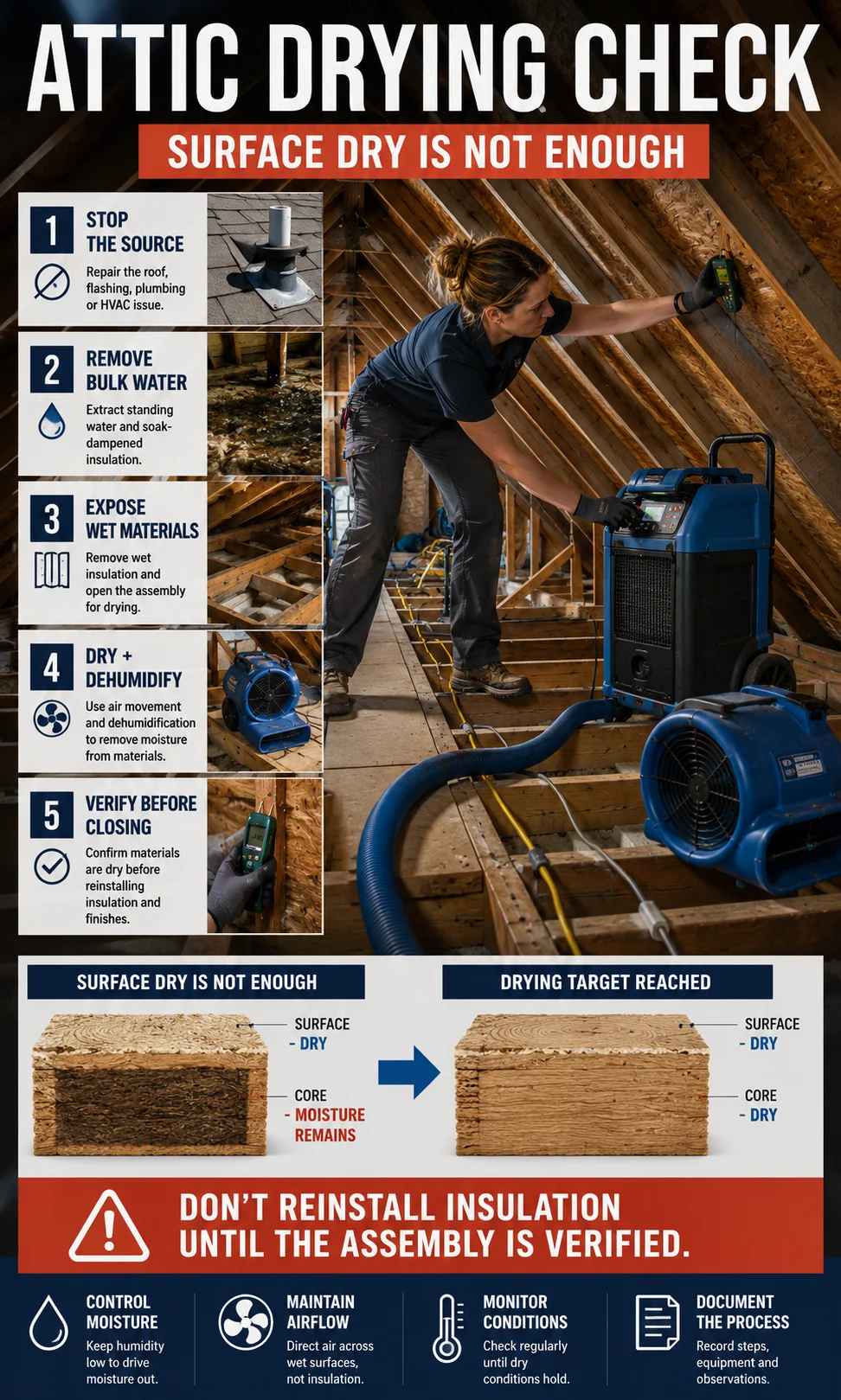
Wet insulation can significantly slow structural drying when it remains in direct contact with framing, sheathing or ceiling drywall. Material that must be removed should be handled in a way that avoids spreading dust or contamination into occupied rooms below. Once insulation is moved or removed appropriately, concealed wood and ceiling materials become easier to inspect and monitor.
Drying progress should be verified by comparing affected materials with suitable dry reference materials and by recording whether moisture levels are moving in the expected direction. A roof deck that looks dry can still contain more moisture than nearby unaffected sheathing, particularly after surface evaporation. Reconstruction should follow documented drying progress rather than a fixed number of days.
The source should also be retested before the attic is closed. Roof repairs may need observation during suitable rainfall or controlled testing by an appropriate professional, while plumbing and condensate repairs can often be checked under their actual operating conditions. A repair that has never been exposed to the condition that originally caused leakage has not yet been meaningfully verified.
Before closing an attic after water damage
- Confirm the original moisture source has been repaired.
- Retest the repair under relevant operating or weather conditions where practical.
- Check the full wet boundary rather than the original stain only.
- Remove or restore wet insulation according to its condition.
- Verify roof sheathing, rafters, trusses and ceiling materials have dried appropriately.
- Inspect connections, fasteners and wood-based panels for deterioration.
- Resolve wet electrical equipment before returning affected systems to normal service.
- Correct air leakage, insulation or ventilation problems when condensation caused the loss.
- Photograph repaired and exposed areas before insulation or finishes conceal them again.
- Recheck the attic after normal building operation resumes.
When Should Wet Attic Materials Be Replaced?
Replacement decisions should be based on material condition as well as moisture. A structurally sound rafter that became wet briefly may recover completely after source correction and controlled drying, while swollen composite sheathing or sagging drywall may retain permanent damage after moisture falls. The question is whether the material can return to acceptable function, not simply whether it can become less wet.
Contamination also changes the decision. Rainwater that has travelled across roofing, dusty cavities, animal contamination or dirty insulation should not automatically be treated like water released directly from a potable plumbing connection. Materials that are difficult to clean, remain saturated or have lost their physical integrity deserve more conservative evaluation.
Aesthetics belong late in the process. Ceiling stain-blocking primer, new paint, replacement trim and repaired finishes can be useful after the attic assembly is dry and stable, but cosmetic work should never become evidence that the moisture problem has been solved. A clean ceiling can still hide wet insulation immediately above it.
Which Professional Should Handle Attic Water Damage?
A roofer is generally the logical starting point when evidence strongly connects the moisture to roofing, flashing or exterior penetrations. A plumber is more appropriate when pressurized pipework, drains, water-heating equipment or plumbing connections are involved, while an HVAC technician may be needed for air handlers, condensate drainage or duct-related moisture. Choosing the trade according to the source prevents a restoration company from drying an attic that will simply become wet again.
A water-restoration professional becomes more useful when the moisture has spread through insulation, framing, ceiling cavities or several rooms, or when the wet boundary cannot be established visually. Their role is different from source repair because the task includes moisture mapping, drying strategy, monitoring and evaluation of affected building materials. Complex losses commonly require both the source specialist and the restoration specialist.
Structural review becomes more important when roof framing is visibly deformed, wood is decayed, connections are compromised or water damage has continued for a long period. A sagging roof deck, damaged truss component or ceiling system carrying significant water should not be treated as a routine cleanup job. The consequences of disturbing weakened structural material can be greater than the original cosmetic damage.
How Can You Prevent Attic Water Damage From Returning?
Prevention should match the mechanism found during diagnosis. Roof leaks call for durable repairs to the failed roofing, flashing or penetration detail, while plumbing and mechanical losses require service or replacement of the failed component. Periodic attic inspection after severe weather or building work can expose a small leak before insulation and ceilings absorb enough water to make the problem visible downstairs.
Roof drainage also deserves routine attention because water should move away from vulnerable building transitions rather than collect or overflow around them. Gutters, roof edges, valleys and drainage outlets should remain clear and direct water appropriately for the roof design. A history of overflow should be treated as a drainage problem rather than waiting for the next interior stain.
Condensation prevention requires controlling the path of indoor moisture into the attic as well as the surface conditions that allow condensation to occur. Air leakage around ceiling penetrations, poorly managed insulation, mechanical exhaust terminating in the attic and inappropriate ventilation arrangements can all contribute. The broader principles in insulating an attic to prevent water damage are particularly relevant when repeated moisture follows weather rather than rainfall.
Mechanical equipment installed in an attic benefits from deliberate leak management because even a relatively small failure can spread across ceilings before anyone notices it. Accessible drain pans, functioning condensate drains, properly maintained equipment and appropriate leak detection can reduce the time between failure and discovery. The value of these measures is greatest where the attic sits directly over finished living areas.
After any repair, revisit the attic instead of assuming the problem is permanently resolved. A short inspection after normal rain, seasonal temperature changes or ordinary mechanical operation can reveal whether staining, condensation or odor is returning. Recurrence usually means either the source was misidentified or another moisture mechanism is operating at the same time.
What Does the Moisture Pattern Suggest?
Attic moisture becomes easier to diagnose when the pattern is connected to the condition that produces it. No single pattern proves a source, but the combination of timing, location and material behavior helps determine what should be tested next. The following matrix is useful for deciding where an investigation should move.
| Moisture pattern | More likely source family | Useful next investigation |
|---|---|---|
| Appears during or soon after rainfall | Roofing, flashing, penetration or drainage | Trace staining upslope and inspect roof details above the highest interior evidence |
| Localized beneath pipe, valve or water-heating equipment | Plumbing | Dry the area and test the relevant pressurized or drainage components separately |
| Localized beneath air handler or condensate components | HVAC condensate | Inspect drain line, pan, overflow protection and equipment operation |
| Widespread droplets or damp sheathing during cool weather without rainfall | Condensation and indoor-air leakage | Assess humidity, ceiling air leakage, insulation and the attic ventilation strategy |
| Staining concentrated around chimney, skylight or vent | Flashing or penetration detail | Inspect the complete flashing assembly rather than sealing only the visible interior gap |
| Ceiling stain appears far from obvious roof defect | Migrating water path | Follow framing, sheathing and insulation toward the highest wet evidence |
Compare Local Home Specialists Near You
Tell us what kind of help you need, then compare nearby businesses by location, Google rating, review volume and contact options.
HomeFix Local Match
Turn a home problem into a practical local hiring decision. Check the clues, see the specialist types that fit, open focused surrounding-location searches, then compare the strongest three before you call.
 YOUR PROBLEM
YOUR AREA
COMPARE 3
✓ Ready to compare
YOUR PROBLEM
YOUR AREA
COMPARE 3
✓ Ready to compare
What is happening?
Choose the closest problem type, then check every clue that applies. Your selections change the specialist order.
Where should the search focus?
Use Google’s “near me” context or enter the area you actually want a specialist to serve.
Simple local search: open nearby Google results, choose the businesses that look suitable, then compare your best three here before you call.
Problem snapshot
Who should you call first?
These are the specialist types most likely to fit the clues you selected.
Search around your location
Compare your top three
Use the same factors for each option so a high star rating does not hide a weak scope, poor diagnosis, missing credentials or unclear aftercare.
Comparison result
Your result combines the Google signals you entered with the practical hiring checks you completed.
Questions to ask every finalist
Use the same questions with each shortlisted business so the comparison stays consistent.
Frequently Asked Questions
Can attic water damage dry on its own?
Some lightly wetted materials may eventually release moisture, but passive drying is unreliable when insulation, enclosed cavities or continuing leakage are involved. A dry-looking surface can coexist with wet material deeper in the assembly. The source should be corrected and affected materials should be checked until an appropriate dry condition is verified.
How can I tell an attic roof leak from condensation?
Roof leakage commonly correlates with rain and often creates a localized path from a roof detail, while condensation is more likely to appear across cold surfaces when humid indoor air reaches the attic. Condensation may affect broad areas of sheathing, fasteners or ducts without a single obvious entry point. Timing, weather conditions and the distribution of moisture should be considered together before deciding which repair is required.
Does wet attic insulation always need to be replaced?
No, although the answer depends on the insulation material, contamination, amount of wetting, settlement and whether its full depth can be dried and verified. Saturated or contaminated insulation can keep adjacent building materials wet and may lose its intended performance. Material that cannot be restored reliably should be removed so the underlying assembly can be inspected and dried.
Can attic water damage cause a ceiling stain in another location?
Yes. Water can travel along roof sheathing, rafters, trusses, pipes and insulation before reaching the ceiling below. The ceiling stain may therefore appear several feet from the original entry point, which is why repairs should follow the moisture path upward rather than assuming the roof defect sits directly above the stain.
How quickly should wet attic materials be dried?
Drying should begin as soon as the source has been safely controlled because prolonged dampness increases the chance of material deterioration and microbial growth. The actual drying time depends on material type, depth of wetting, weather, airflow and access. Use moisture condition and drying progress rather than a fixed number of days to decide when reconstruction can begin.
Should I put fans or a dehumidifier in a wet attic?
Air movement and dehumidification can support drying in suitable conditions, but equipment should not be introduced blindly into a space with electrical hazards, suspect contamination or unresolved leakage. Attic temperature, ventilation and connection to the conditioned house also affect how drying equipment performs. Source control and an understanding of the wet assembly should come before equipment placement.
Do I call a roofer or a water-damage professional for an attic leak?
Call the trade responsible for the source when it can be identified, such as a roofer for roof-entry problems, a plumber for plumbing leakage or an HVAC technician for condensate problems. A restoration professional becomes more useful when moisture has already spread into insulation, framing, ceilings or concealed cavities. Complex losses often need both source repair and structural drying rather than one service alone.
Summary: Fix the Source, Then Prove the Attic Is Dry
Attic water damage is solved most reliably by following the moisture backward from damaged materials to the mechanism that supplied it. Roof entry, plumbing failure, HVAC condensate and condensation can produce similar stains while requiring very different repairs. The inspection should therefore connect timing, location, moisture pattern and material behavior before money is spent on reconstruction.
Once the source is corrected, treat insulation, sheathing, framing and ceiling finishes as separate materials with separate drying and replacement decisions. Verify concealed areas before reinstalling insulation or repainting the ceiling, and return after normal weather or equipment operation to confirm that moisture has not returned. A repaired appearance is useful only after the building assembly itself has been returned to a stable dry condition.