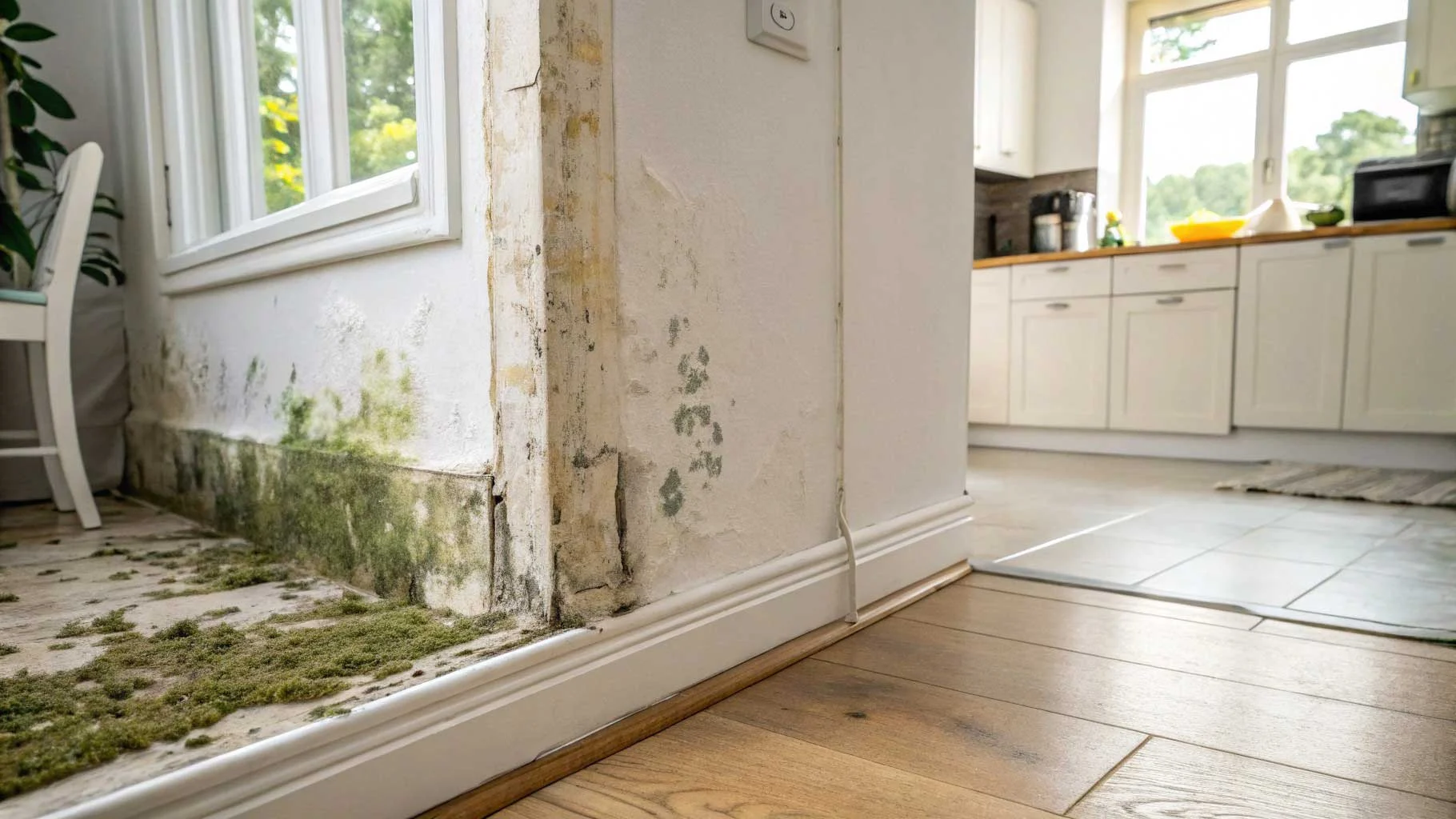

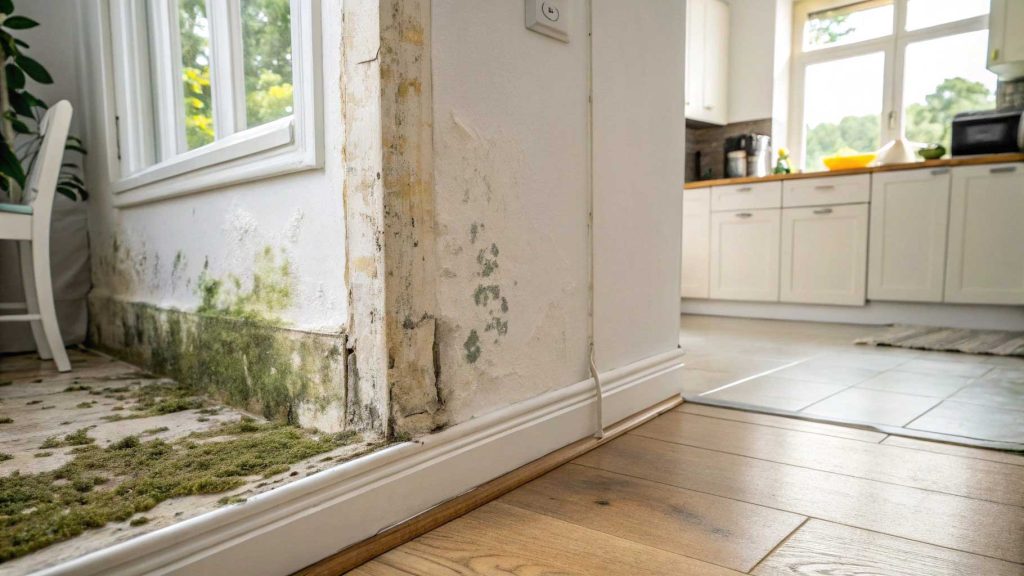
Mold damage often announces itself before a wall turns black or a ceiling develops an obvious patch. The earliest clues are usually a combination of persistent musty odor, recurring discoloration, unusual condensation, peeling finishes, softened drywall, warped wood, damp cabinets, or a stain that returns after cleaning. No single clue proves that mold is growing inside a building, but several moisture-related changes occurring in the same area deserve investigation rather than another coat of paint.
The most useful way to think about mold damage is to start with moisture. Mold spores are common in indoor and outdoor environments, but active indoor growth requires suitable moisture, which is why the EPA’s guidance on mold and moisture places moisture control at the center of prevention and cleanup. When a room repeatedly develops dampness, a leak keeps feeding the same material, or condensation remains trapped behind furniture and finishes, the visible mold is often only one part of the building problem.
There is also an important distinction between mold growth, water damage and material damage. A leaking pipe can stain drywall before mold becomes visible, while mold can continue growing on damp porous material after the original leak has stopped. Paint bubbling, swelling baseboards or cupped flooring therefore tell you that moisture has affected the assembly, while odor, spotting or recurring growth can add another layer of evidence that biological growth may also be present.
Homeowners get into trouble when they judge each clue separately. A faint ceiling mark might be harmless old staining, but the same mark combined with a musty odor and paint that has begun blistering deserves a different response. The location matters too: a stain below a bathroom, beside a window, underneath a sink or along an exterior wall provides information about where moisture may be entering.
Health symptoms require even more caution because they cannot diagnose a mold problem. The CDC’s information on mold and health explains that damp or moldy environments can affect people differently, including people with allergies, asthma or other respiratory sensitivities. If symptoms seem connected to one part of the home, treat that as a reason to investigate the environment and seek appropriate medical advice when needed, rather than using symptoms alone as proof that a particular material contains mold.
A quick first inspection should look for patterns
When you suspect early mold damage, check the room as a system rather than hunting only for dark spots. These observations often reveal more than repeatedly wiping the visible surface:
- Walk into the room after it has been closed for several hours and notice whether a musty or earthy odor is concentrated there.
- Look along ceilings, window edges, baseboards, cabinet backs, exterior-wall corners and plumbing penetrations.
- Compare similar materials. One swollen baseboard beside otherwise flat trim can point toward localized moisture.
- Check whether staining becomes darker after rain, showers, air-conditioning use or periods of high indoor humidity.
- Look behind large furniture where airflow is restricted.
- Pay attention to paint that bubbles, wallpaper that releases at the edges, flooring that cups, or drywall that feels different from surrounding areas.
- Ask whether the same spot has been cleaned, painted or repaired before and then returned.
The Earliest Signs Are Usually Moisture Clues, Not Mold Color
A persistent musty smell is one of the more useful early warning signals because odor can travel from places you cannot readily inspect. Wall cavities, the underside of flooring, damp cabinet panels and enclosed storage areas can hold moisture without presenting a large visible colony on the room-facing surface. An odor that repeatedly returns after ventilation or cleaning is worth tracing, particularly when it is concentrated near a known moisture source.
Odor also needs to be interpreted spatially. If the smell becomes stronger near one wall, below a bathroom, inside a vanity or when an air-conditioning system operates, that pattern can narrow the inspection area. If the entire house smells damp, the investigation may need to look at broader humidity, ventilation, crawlspace or HVAC conditions rather than assuming one isolated patch is responsible.
Discoloration That Keeps Returning
Early surface changes are not always dramatic. Drywall and painted plaster may develop gray shading, small speckles, pale brown marks, irregular yellowing or changes in sheen before a dark colony becomes obvious. A one-time stain that remains perfectly dry may be historic water damage, while a mark that changes after rain, showering or plumbing use suggests the moisture source may still be active.
Paint and wallpaper can provide another clue because trapped moisture interferes with adhesion. Bubbling paint, curling wallpaper seams and localized blistering may occur before mold is visible on the finished face. These signs do not identify mold by themselves, but they tell you that the finish is reacting to conditions underneath it, which is often more important than the surface appearance.
Condensation deserves similar attention. Water collecting regularly on a cold window is different from persistent dampness forming inside a cabinet, along an insulated exterior wall or on a ceiling surface. When condensation repeatedly wets absorbent materials and the area cannot dry properly, conditions become much more favorable for mold growth.
Changes in the wall itself carry more weight than a simple stain. Drywall that feels soft, paper facing that has become loose, trim that swells against the wall or a ceiling surface that sags points toward a moisture problem affecting the material rather than only its finish. When those signs appear without an obvious room-side source, investigating hidden water damage inside walls can help explain what may be happening behind the finished surface.
Read the Building Material, Not Just the Stain
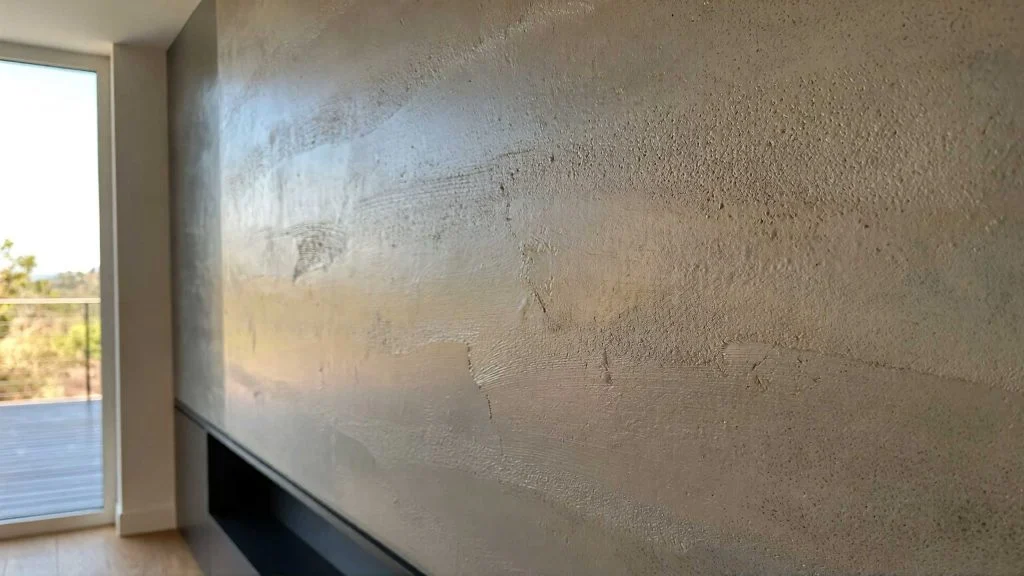
Drywall is particularly useful during an inspection because its paper facing and gypsum core react noticeably to prolonged moisture. Dark spots are only one concern. Swelling around joints, a chalky or weakened surface, soft sections, loose paper and persistent staining can indicate that the board has taken on water and may require more than cosmetic repair.
Wood behaves differently. Baseboards can swell at the lower edge, hardwood flooring may cup, engineered flooring can separate at joints, and cabinet panels may expand around their exposed edges. These movements reveal a moisture history, although they do not prove mold is present. A renovation inspection should therefore ask what caused the material to move and whether that source is still wetting the assembly.
Closets and built-in cabinets create their own microclimates because stored belongings restrict airflow. A closet can look perfectly clean at eye level while the rear wall, lower corners or back of a cabinet remain cool and damp. Clothing that develops a persistent damp odor, spotting behind furniture or repeated growth on leather and fabric can be a reason to inspect the wall surface and room humidity rather than treating every affected item separately.
Baseboards are another useful checkpoint because gravity tends to carry water toward the bottom of an assembly. Swelling, staining at mitred joints, gaps opening between trim and wall, or a paint line that repeatedly darkens near the floor can indicate plumbing leakage, floor-level moisture or water entering from an adjacent wet area. When several adjacent materials show change, the moisture path matters more than identifying which stain appeared first.
Recurring mold after cleaning is one of the clearest signs that the investigation has stopped too early. If a patch disappears and then forms again in the same location, something is continuing to support growth or the affected material was never fully cleaned and dried. The CDC’s mold guidance advises addressing both the mold and the moisture problem, because surface cleaning without correcting dampness does not solve the underlying condition.
Water Damage and Mold Damage Often Appear Together
Water damage can exist without visible mold. A fresh leak may produce staining, swelling and softened materials before biological growth becomes apparent, especially when it is discovered quickly and dried effectively. That means a homeowner should respond to unexplained moisture even when the surface still looks clean.
The reverse situation also occurs. A previous leak may have stopped, yet porous materials inside an enclosed cavity can remain damp much longer than the visible wall surface. If you are repeatedly seeing mold on one wall, understanding what causes mold to grow on walls is more useful than assuming the color or shape of the patch reveals the source.
The practical decision is therefore based on scope, material and moisture source. The EPA notes that smaller mold areas can often be handled by homeowners in many circumstances, while larger areas, extensive water damage and complicated situations can justify professional involvement. Size is only one part of that decision, because sewage contamination, HVAC involvement, vulnerable occupants, inaccessible cavities or repeated unexplained growth can make even a visually modest problem more complicated.
| What you notice | What it may indicate | What to check next |
|---|---|---|
| Musty odor with no visible growth | A damp concealed area or contaminated porous material may be nearby | Trace odor toward walls, cabinets, flooring, plumbing and ventilation paths |
| Paint bubbling or wallpaper releasing | Moisture may be affecting the substrate beneath the finish | Look for leaks, exterior moisture, condensation and softened drywall |
| Floor cupping or swollen baseboards | Water may have reached the floor assembly or lower wall | Inspect nearby plumbing, wet rooms, exterior walls and subfloor conditions |
| Growth returns after cleaning | The moisture source or affected material has probably not been resolved | Find the moisture source before repeating cosmetic treatment |
| Large or spreading affected area | The problem may extend beyond simple surface cleaning | Assess total scope, hidden materials and whether professional remediation is appropriate |
When a Small Clue Becomes a Bigger Renovation Problem
Hidden spread is one reason early mold problems can become expensive. What appears to be a narrow stain on the finished side of drywall may correspond to a larger damp area behind it if insulation, framing or the paper backing has been exposed to moisture. Opening a wall without understanding the source can also disturb contaminated material, so destructive investigation should have a clear purpose rather than being the first response to every suspicious mark.
Material type changes the repair decision. Smooth, nonporous materials can often be cleaned more readily, while absorbent materials such as ceiling tile, insulation, carpet backing and severely affected drywall can hold contamination deeper in their structure. The question is therefore not simply whether the visible surface becomes clean; it is whether the material can realistically be cleaned, dried and returned to a sound condition.
Painting over a suspicious surface is particularly poor diagnostic practice. Fresh paint can temporarily hide discoloration while leaving the moisture source and affected substrate untouched. The CDC advises fixing the water problem and removing mold before painting or caulking, which is why repeated repainting of the same damp corner should trigger investigation rather than another cosmetic repair.
Mold testing is also frequently misunderstood. According to the EPA’s guidance on mold sampling, routine sampling is usually unnecessary when visible mold growth is already present, and there is no federal airborne concentration standard that turns a household test result into a simple safe-or-unsafe verdict. Testing becomes more useful when the result will genuinely affect a decision, such as a professionally designed investigation, a difficult hidden condition or verification associated with a specific remediation need.
Color is another unreliable shortcut. People often use “black mold” as though color identifies the seriousness of the problem, yet indoor molds can appear black, green, gray, white, brown or other colors depending on species, substrate and growth conditions. From a building perspective, visible mold of any color still directs attention back to moisture, affected material and the extent of the problem.
Ventilation problems tend to reveal themselves through repetition. A bathroom ceiling that stays damp long after bathing, a bedroom corner that repeatedly condenses behind furniture or a closet wall that becomes musty during humid periods may have an airflow and surface-temperature problem even when there is no plumbing leak. In these cases, cleaning the visible surface without changing the conditions can turn mold removal into a repeating maintenance cycle.
Plumbing and exterior leaks leave a different pattern. A damp vanity floor, staining below a pipe connection, moisture that appears after rain, or discoloration moving downward from a roof or window area usually gives the investigation a physical path to follow. The visible mold may be several inches or even several feet away from the actual entry point because water can travel along framing, sheathing or other building components.
Time matters after a water event because porous materials are easier to save before they remain wet for an extended period. Both EPA and CDC guidance emphasize drying water-damaged areas promptly, commonly using a 24 to 48 hour window as an important mold-prevention target. That does not mean mold appears on a stopwatch at exactly the same moment in every house; it means unnecessary delay increases the chance that wet materials will become a more complicated cleanup problem.
Situations where the inspection should move beyond routine DIY cleaning
Professional assessment becomes more sensible when the building conditions or occupants increase the consequences of getting the decision wrong. Consider escalating the investigation when:
- Mold or moisture appears to extend into a wall, ceiling, insulation layer, subfloor or HVAC component.
- A significant area is affected or the visible patch is only a small part of wider water damage.
- The same growth returns despite repeated cleaning and moisture-control attempts.
- Sewage, contaminated floodwater or another hazardous source is involved.
- Drywall, flooring, cabinetry or structural materials have softened, delaminated or substantially deteriorated.
- The source of moisture cannot be identified.
- Occupants with asthma, significant respiratory disease or immune suppression could be exposed during cleanup.
- Removing material would disturb a large amount of suspected hidden growth.
What Homeowners Can Check Without Opening a Wall
A useful inspection begins with the least destructive evidence. Look at how surfaces meet: the bottom edge of drywall, baseboard joints, window returns, plumbing penetrations, cabinet floors and ceiling corners often show moisture movement before the center of a wall does. Compare the suspected area with an unaffected part of the same room so differences in staining, swelling and texture are easier to recognize.
A moisture meter can sometimes help compare building materials, but it should be treated as an investigative aid rather than a mold detector. Readings can vary according to material type, meter design, salts, metal fasteners and construction details. A higher reading in one suspicious location is most useful when it supports other evidence such as a leak history, surface change or recurring odor.
Odor tracking can also be done methodically. Close interior doors for a period, then compare rooms rather than trying to judge the smell after you have been inside the house for hours. Check low-airflow locations such as the back of wardrobes, vanity cabinets and areas behind large furniture, because a localized odor there can point toward a smaller investigation zone.
Physical symptoms belong in a different category from building evidence. If coughing, wheezing, nasal irritation or other symptoms seem worse in a damp building, that deserves attention, but it still does not identify where mold is located or whether a particular stain caused the reaction. The CDC’s mold cleanup guidance also identifies groups who should avoid participating in mold cleanup because exposure may carry greater health risk.

If symptoms seem to improve away from one environment and return after spending time there, the pattern may justify looking more closely at dampness, ventilation and other indoor exposures. It should not be used to self-diagnose a mold-related illness or to conclude that a particular species is present. Building investigation and medical evaluation answer different questions, and keeping those questions separate leads to better decisions.
A Practical Decision Sequence for Suspected Mold Damage
The first renovation question should be, “Where is the moisture coming from?” A visible patch is rarely the useful endpoint of an inspection because cleaning it while a pipe continues leaking or condensation keeps forming simply resets the cycle. Roofs, plumbing, shower enclosures, exterior walls, windows, air-conditioning systems and high indoor humidity all create different repair paths.
Next, decide whether the material is still sound and realistically cleanable. A hard surface with limited surface growth presents a very different problem from soaked insulation, crumbling drywall or swollen composite cabinetry. If drywall is involved, the decision about removing mold without removing drywall should be based on the condition and depth of the affected material rather than an automatic desire to preserve the wallboard.
Finally, assess scope and consequence. A small, accessible area with a known, corrected moisture source is easier to approach than repeated growth behind finished walls, extensive water damage or a problem involving vulnerable occupants. Professional help has the most value when the job requires containment, removal of damaged materials, difficult moisture diagnosis or a level of respiratory protection and work practice beyond normal household cleaning.
| Situation | Likely direction | Reason |
|---|---|---|
| Minor surface growth, known moisture source already corrected, material remains sound | Careful homeowner cleanup may be reasonable | The problem is limited, accessible and no longer being fed by moisture |
| Recurring mold on the same surface | Investigate before cleaning again | Recurrence suggests unresolved moisture, hidden growth or unsuitable material conditions |
| Soft drywall, damaged flooring, wet insulation or delaminated cabinetry | Plan for material evaluation and possible removal | Structural condition and cleanability are now part of the decision |
| Large area, hidden cavity, HVAC involvement or extensive water damage | Professional assessment is usually the safer route | Containment, investigation and removal can become substantially more complicated |
| Damage in wood with unclear cause | Identify the damage mechanism before repair | Moisture, fungal growth and insect damage can require very different corrective work |
What to Do After You Find an Early Warning Sign
Start with the moisture source before deciding how attractive the finished repair should look. Tighten or repair leaking plumbing, correct exterior water entry, improve exhaust where persistent condensation is the driver, or address the HVAC or humidity problem responsible for repeated dampness. A repaired wall that continues getting wet is still a failed repair even if the paint looks perfect for several weeks.
Dry affected materials as promptly and completely as practical. Air movement, dehumidification and removal of wet materials may all play a role, but electrical safety, contaminated water and hidden cavities can change what is appropriate. If water has entered a closed assembly, drying the room-facing surface alone may not tell you whether insulation, subflooring or the back of the wallboard has dried.
Then deal with the mold and damaged material according to what you actually found. Hard surfaces with limited contamination may be cleanable, while badly affected porous material may require removal. Do not mix cleaning chemicals, and use appropriate personal protection; if the work has moved beyond a small accessible surface, professional containment and remediation may be more sensible than turning an exploratory cleanup into a larger exposure problem.
Document anything that repeats. A photograph, notes about weather or plumbing use, and a record of where staining first appeared can help distinguish a one-time event from an active moisture pattern. If wood or finishes are deteriorating and the damage mechanism is unclear, the comparison between mold damage and termite damage can help prevent repairs aimed at the wrong cause.
The most important early sign is often the pattern rather than the color. A musty odor beside a swelling baseboard, a ceiling stain that changes after rain, or mold that returns to the same cold corner gives you a chain of evidence about moisture, material and location. Finding that chain early gives you a better chance of fixing a limited building problem before it turns into extensive removal and reconstruction.
Compare Local Home Specialists Near You
Tell us what kind of help you need, then compare nearby businesses by location, Google rating, review volume and contact options.
HomeFix Local Match
Turn a home problem into a practical local hiring decision. Check the clues, see the specialist types that fit, open focused surrounding-location searches, then compare the strongest three before you call.
 YOUR PROBLEM
YOUR AREA
COMPARE 3
✓ Ready to compare
YOUR PROBLEM
YOUR AREA
COMPARE 3
✓ Ready to compare
What is happening?
Choose the closest problem type, then check every clue that applies. Your selections change the specialist order.
Where should the search focus?
Use Google’s “near me” context or enter the area you actually want a specialist to serve.
Simple local search: open nearby Google results, choose the businesses that look suitable, then compare your best three here before you call.
Problem snapshot
Who should you call first?
These are the specialist types most likely to fit the clues you selected.
Search around your location
Compare your top three
Use the same factors for each option so a high star rating does not hide a weak scope, poor diagnosis, missing credentials or unclear aftercare.
Comparison result
Your result combines the Google signals you entered with the practical hiring checks you completed.
Questions to ask every finalist
Use the same questions with each shortlisted business so the comparison stays consistent.
Frequently Asked Questions About Early Mold Damage
What is usually the first sign of mold damage in a house?
A persistent musty odor, recurring moisture or a small unexplained change in a building material can appear before obvious mold growth. Paint blistering, localized discoloration, swollen trim or dampness behind furniture may provide earlier clues than a large dark patch. The strongest reason to investigate is usually a combination of signs occurring around the same moisture-prone area.
Can you have mold damage without seeing mold?
Yes. Mold can grow on the back of drywall, beneath flooring, inside cabinets, under wallpaper or in other concealed materials where the room-facing surface remains relatively clean. A persistent localized odor, moisture history or material changes can justify further investigation even when no colony is visible.
Does a musty smell always mean there is mold?
No single odor proves that mold is present because damp materials, drains, stored belongings and other sources can create unpleasant smells. A musty odor becomes more useful diagnostically when it repeatedly occurs in the same moisture-prone location or accompanies staining, condensation or damaged materials. Trace the environmental cause instead of trying to identify mold from smell alone.
Should I test for mold if I can already see it?
Routine sampling is usually unnecessary when visible mold growth is already present because the immediate building decisions are to determine the extent, correct the moisture source and deal with affected materials. Testing may have a role when a qualified professional needs it to answer a specific question that will change the investigation or remediation plan. A consumer test result should not distract from a visible moisture problem that already requires attention.
Can I paint over an early mold spot?
Painting over active mold or damp material does not solve the source of the problem. The moisture condition needs to be corrected, affected surfaces need to be properly cleaned or removed as appropriate, and the material should be dry before refinishing. Otherwise the stain, deterioration or growth may return underneath or through the new coating.
When should I call a professional about mold damage?
Professional help becomes more appropriate when mold covers a substantial area, follows extensive water damage, appears to extend into concealed cavities, involves HVAC components, repeatedly returns or affects badly deteriorated materials. The threshold should also be lower when cleanup could expose someone with a condition that makes mold exposure more concerning. A professional assessment is especially useful when you cannot identify the moisture source or would need to demolish materials simply to understand the extent of the problem.
How can I tell mold damage from termite damage?
Mold damage is usually associated with dampness, fungal growth, staining or decay conditions, while termite damage involves insects consuming cellulose and can produce galleries, hollowed wood or other pest evidence. Both can occur in moisture-prone areas, so deteriorated wood should not be diagnosed from color alone. When the material damage is unclear, identify the cause before choosing a repair method.
The Most Useful Early Warning Is a Pattern
Early mold damage is easier to manage when you stop asking only, “Is that spot mold?” and start asking what the surrounding building is telling you. Odor, moisture, material movement, recurrence and location create a much more useful picture than color alone, and they can point you toward the source before the finished surface becomes severely damaged.
The practical order is straightforward: identify the moisture, understand which materials were affected, determine the real extent, then choose cleaning, removal or professional remediation accordingly. That approach protects the repair from becoming cosmetic guesswork and gives you a better chance of solving the condition that allowed the damage to develop in the first place.