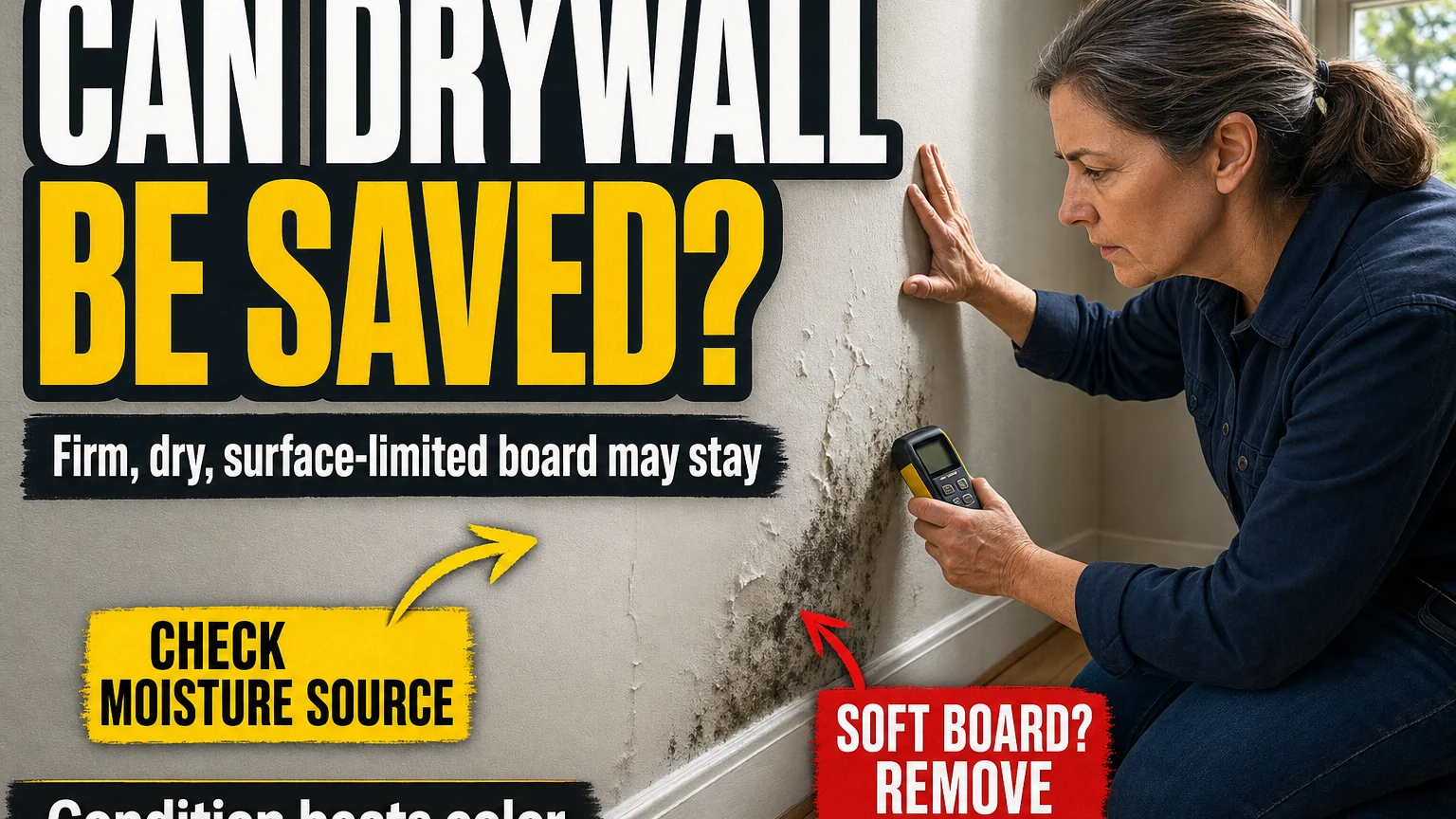

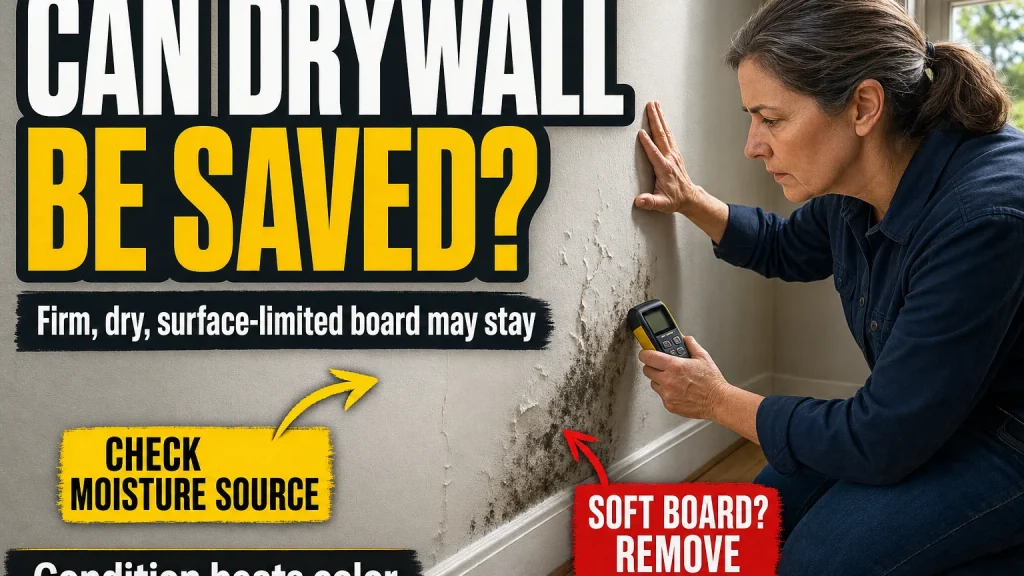
Yes, mold can sometimes be removed from drywall without replacing the board, but only when the problem is genuinely limited to the accessible surface, the drywall remains structurally sound, the moisture source has been corrected, and there is no strong evidence that mold or persistent moisture extends through the paper facing or into the wall cavity. Once drywall becomes soft, swollen, delaminated, repeatedly wet, extensively contaminated or moldy on the rear face, preserving the board becomes a much weaker repair strategy. The decision should be based on the condition of the wall assembly rather than the color of the mold or which household cleaner is available.
Drywall is more complicated than a painted hard surface because it contains a gypsum core covered by paper facing, and the paper provides an organic surface on which mold can grow when moisture persists. Paint may slow liquid absorption on the exposed face, yet seams, screw penetrations, damaged coatings, cut edges, the rear paper and the bottom of the board can still take on moisture. If you need to understand why that moisture is reaching the surface in the first place, begin with what causes mold to grow on walls before treating mold removal as an isolated cleaning job.
The most important distinction is between surface contamination on sound wallboard and mold associated with moisture-damaged wallboard. A small patch growing on dust or residue over intact painted drywall after a temporary humidity problem may present a reasonable cleaning opportunity. A wall with deteriorated paper, swollen gypsum, loose tape, softened joints or repeated moisture exposure is already telling you that the substrate itself has become part of the repair problem.
The phrase “black mold” does not change that technical decision. Mold species can appear in many colors, and the CDC notes that mold color does not reliably indicate whether a mold is more or less dangerous. A dark patch should therefore be treated seriously because mold indicates a moisture problem, while the decision to clean or remove drywall still depends primarily on moisture history, material condition, contamination extent and accessibility.
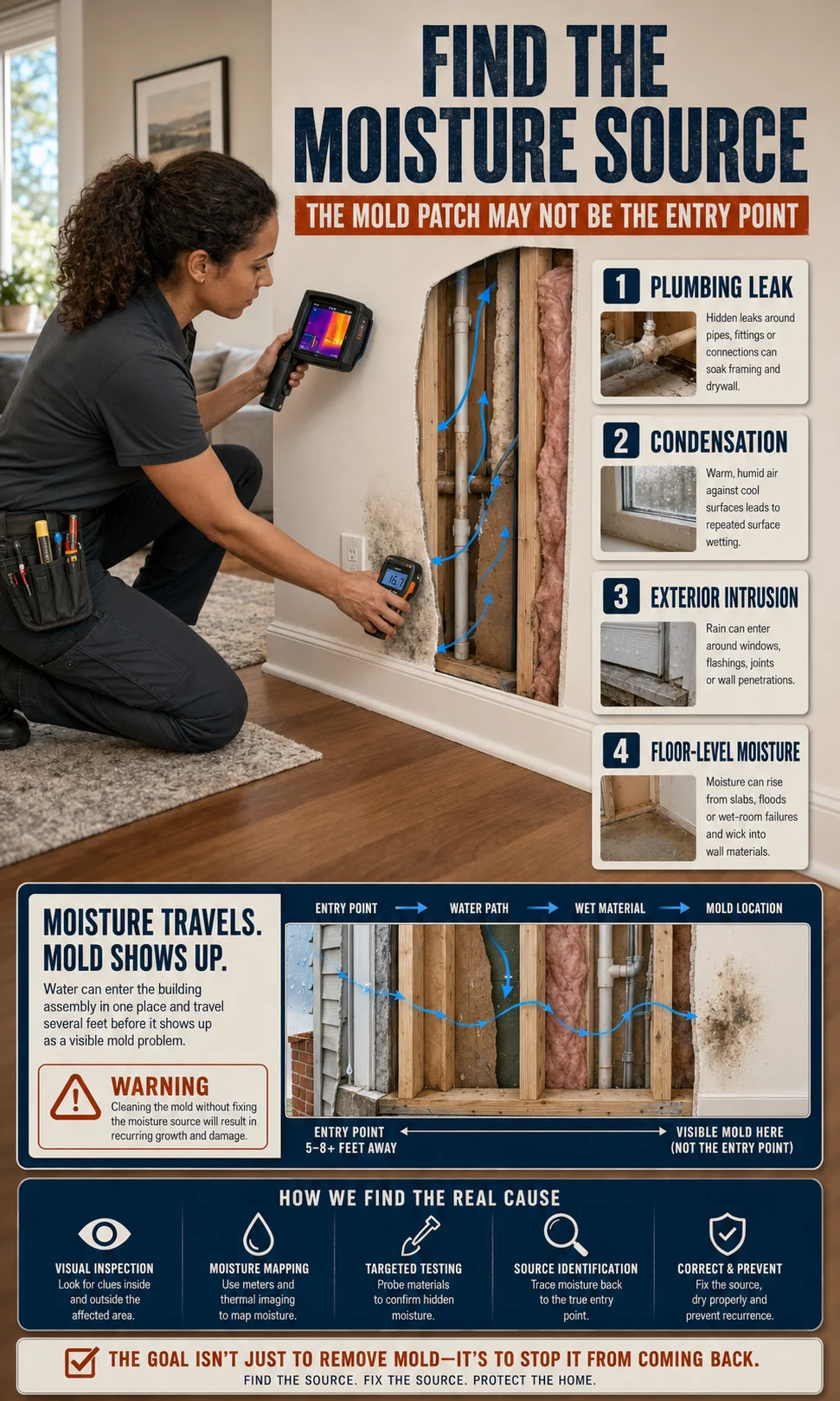
Before touching the mold, identify how the drywall became damp. Cleaning a wall while a plumbing fitting continues leaking behind it, rainwater keeps entering around a window, condensation repeatedly forms on a cold surface, or a shower continues loading the room with excessive humidity simply resets the conditions for another colony. The EPA’s basic mold-cleanup guidance puts moisture correction at the beginning of effective mold control for exactly this reason.
Drywall is more likely to be salvageable when these conditions are present
- The affected area is limited and accessible. A small surface patch is fundamentally different from extensive contamination distributed across several sheets or extending into concealed areas.
- The paint film and paper face remain bonded. There should be no widespread peeling paper, blistering, delamination or chalky deterioration.
- The board feels firm. Pressing gently around the affected area should not reveal unusual softness, crumbling gypsum or movement compared with unaffected drywall.
- There is no visible swelling. Bulged board faces, distorted edges and swollen joints indicate that water has materially affected the wallboard.
- Seams remain intact. Failed joint tape, raised joints or separated seams can indicate prolonged moisture exposure.
- The moisture source is known and corrected. A repaired leak or corrected condensation condition gives the wall a realistic opportunity to remain dry.
- The drywall has returned to a stable dry condition. A wall that remains wet or repeatedly becomes wet is a poor candidate for cosmetic preservation.
- There is no strong evidence of hidden backside contamination. Musty cavity odor, wet insulation or mold seen through an opening changes the decision.
- The water source was not sewage or heavily contaminated water. Contaminated-water events require a more conservative response and often professional remediation.
- Cleaning will not require disturbing a large contaminated area. The more material that must be scraped, sanded or demolished, the greater the risk of spreading mold-containing dust and debris.
HomeFix Local Match
Turn a home problem into a practical local hiring decision. Check the clues, see the specialist types that fit, open focused surrounding-location searches, then compare the strongest three before you call.
 YOUR PROBLEM
YOUR AREA
COMPARE 3
✓ Ready to compare
YOUR PROBLEM
YOUR AREA
COMPARE 3
✓ Ready to compare
What is happening?
Choose the closest problem type, then check every clue that applies. Your selections change the specialist order.
Where should the search focus?
Use Google’s “near me” context or enter the area you actually want a specialist to serve.
Simple local search: open nearby Google results, choose the businesses that look suitable, then compare your best three here before you call.
Problem snapshot
Who should you call first?
These are the specialist types most likely to fit the clues you selected.
Search around your location
Compare your top three
Use the same factors for each option so a high star rating does not hide a weak scope, poor diagnosis, missing credentials or unclear aftercare.
Comparison result
Your result combines the Google signals you entered with the practical hiring checks you completed.
Questions to ask every finalist
Use the same questions with each shortlisted business so the comparison stays consistent.
When Mold Can Stay on the Surface of Drywall
A small mold patch on painted drywall can sometimes remain predominantly superficial when the paint is intact and the moisture event was brief. A typical example is surface condensation in a poorly ventilated room where mold develops on accumulated dust at a cool corner rather than because the gypsum board became saturated. Once the humidity and surface-temperature problem are corrected, the remaining cleanup can be very different from dealing with a board that has absorbed water from behind.
The exposed paper condition matters because drywall is not uniformly resistant to moisture. The gypsum core itself is mineral-based, while the paper facings and accumulated surface dust provide materials that support fungal growth. If moisture has crossed the paint film or reached an unsealed edge, the contamination can involve layers that cannot be effectively evaluated from the room-facing color alone.
Physical integrity is therefore a stronger technical clue than stain darkness. Compare the affected section with nearby dry wallboard using gentle pressure and visual inspection. If the affected board is noticeably softer, swollen, crumbly or distorted, those changes suggest that the moisture event has moved beyond a simple surface-cleaning problem.
The rear face is especially important after plumbing leaks, roof leaks, window leaks or water entering a wall cavity. Mold can develop on the backside of drywall while the room-facing paint still appears reasonably intact, because the rear paper has little protection from water inside the cavity. When staining, odor or moisture readings suggest this possibility, the decision may need to shift toward investigating hidden water damage inside the wall rather than scrubbing the visible patch.
A moisture meter can support this investigation, although it does not detect mold. Pin and pinless meters respond to material properties and moisture conditions, and readings can be influenced by density, fasteners, metal framing, salts and the specific meter calibration. The useful method is comparative: check the suspicious wall and nearby known-dry drywall of similar construction, then interpret any difference together with leak history, staining, swelling and other building evidence.
Infrared imaging can sometimes identify cooler or warmer patterns associated with wet materials, missing insulation or thermal bridging, but a thermal camera also does not directly “see mold.” Temperature differences require interpretation because air leakage, sunlight, framing, electrical equipment and HVAC operation can produce similar thermal patterns. A suspicious thermal anomaly should lead to moisture verification rather than an automatic mold conclusion.
If the wall was wet from a known event, the amount of time it remained wet also matters. EPA guidance repeatedly emphasizes drying wet materials rapidly and commonly uses approximately 24 to 48 hours as an important target because prolonged dampness increases the likelihood of mold growth. That interval is a practical moisture-control target rather than a guarantee that mold appears at one exact hour.
The visible area should also be considered against the likely hidden area. A six-inch spot beside a leaking pipe may represent a very different problem from a six-inch condensation patch on an open painted wall because water can travel along studs, plates, insulation and wallboard surfaces. The dimensions of the visible colony therefore should not be assumed to equal the dimensions of the wet assembly.
Technical Causes That Determine Whether the Drywall Can Be Saved
A plumbing leak frequently creates the most unfavorable condition for preserving wallboard because water can enter directly from the rear. Supply-line fittings, valve bodies, waste connections, shower pipework and concealed plumbing can wet insulation and drywall paper before any obvious room-side dripping appears. When mold is localized near plumbing and the board has softened or stained from the backside, opening the assembly may provide more value than repeated surface cleaning.
Condensation produces a different moisture path. In this case, humid room air reaches a wall surface that is cold enough for surface relative humidity to become very high or for liquid condensation to form. Mold may appear at exterior corners, concrete columns, behind furniture or along thermal bridges while the deeper gypsum remains comparatively sound, which creates a better possibility of preservation once humidity, airflow, insulation or surface-temperature conditions are corrected.
Exterior water intrusion should be suspected when staining or moisture changes with rainfall. Defective flashing, window interfaces, façade joints, roof-wall transitions, penetrations and cracks can allow water to move through construction layers before appearing on the interior finish. Repairing only the drywall without correcting the exterior water path can result in a freshly painted wall becoming wet again during the next weather event.
A previous flood or significant leak may also leave residual moisture inside a closed assembly even after the paint surface appears dry. Insulation can slow cavity drying, timber framing can store moisture, and a gypsum board surface exposed to room air may dry faster than its rear face. That is why the wall needs to be assessed as an assembly rather than assuming a dry-looking paint surface proves that every concealed material is dry.
HVAC operation can contribute through either water or temperature. Condensate drain failure can introduce liquid moisture, while cold supply air can lower adjacent surface temperatures enough to create localized condensation in humid conditions. Mold concentrated around fan-coil units, duct penetrations, condensate lines or cold-air paths deserves investigation of the HVAC moisture mechanism rather than immediate treatment as a paint problem.
Capillary moisture can affect the lower edge of wallboard when water is present at floor level. Gypsum board installed too close to a wet slab, flooded floor, leaking shower threshold or persistently damp base can wick moisture upward through the paper and porous material. Mold and paper deterioration concentrated near the bottom edge often justify checking the floor-wall junction, baseboard and bottom plate rather than assuming humidity is the only cause.
Air leakage can create another less obvious mechanism. Humid outdoor or indoor air moving through wall cavities may encounter cooler construction layers and produce localized condensation where the moisture is concealed from the room. This becomes particularly relevant around poorly sealed penetrations, service openings and discontinuities in the air-control layer.
The wall finish can obscure these mechanisms for surprisingly long periods. Vinyl wallpaper, low-permeability coatings or other finishes may slow drying toward the occupied side, while water continues moving behind them. A wall can therefore look cosmetically acceptable until blistering, seam failure, odor or widespread spotting eventually reveals what has been happening underneath.
How to Inspect Moldy Drywall Before Deciding to Clean or Remove It
Begin with a non-destructive inspection and establish the likely moisture source. Look at the area above, below and beside the visible mold rather than concentrating only on the patch itself. Plumbing locations, exterior-wall status, shower or kitchen use, weather timing, air-conditioning operation and previous water events all change the probability of different moisture paths.
Inspect the paint, paper facing and joint system separately. Blistering paint can indicate moisture underneath the coating, while lifted paper, failed tape or swollen compound shows that the wallboard system itself has been affected. A narrow surface stain on otherwise flat, firm drywall provides a much stronger preservation case than a wall with several different forms of physical deterioration.
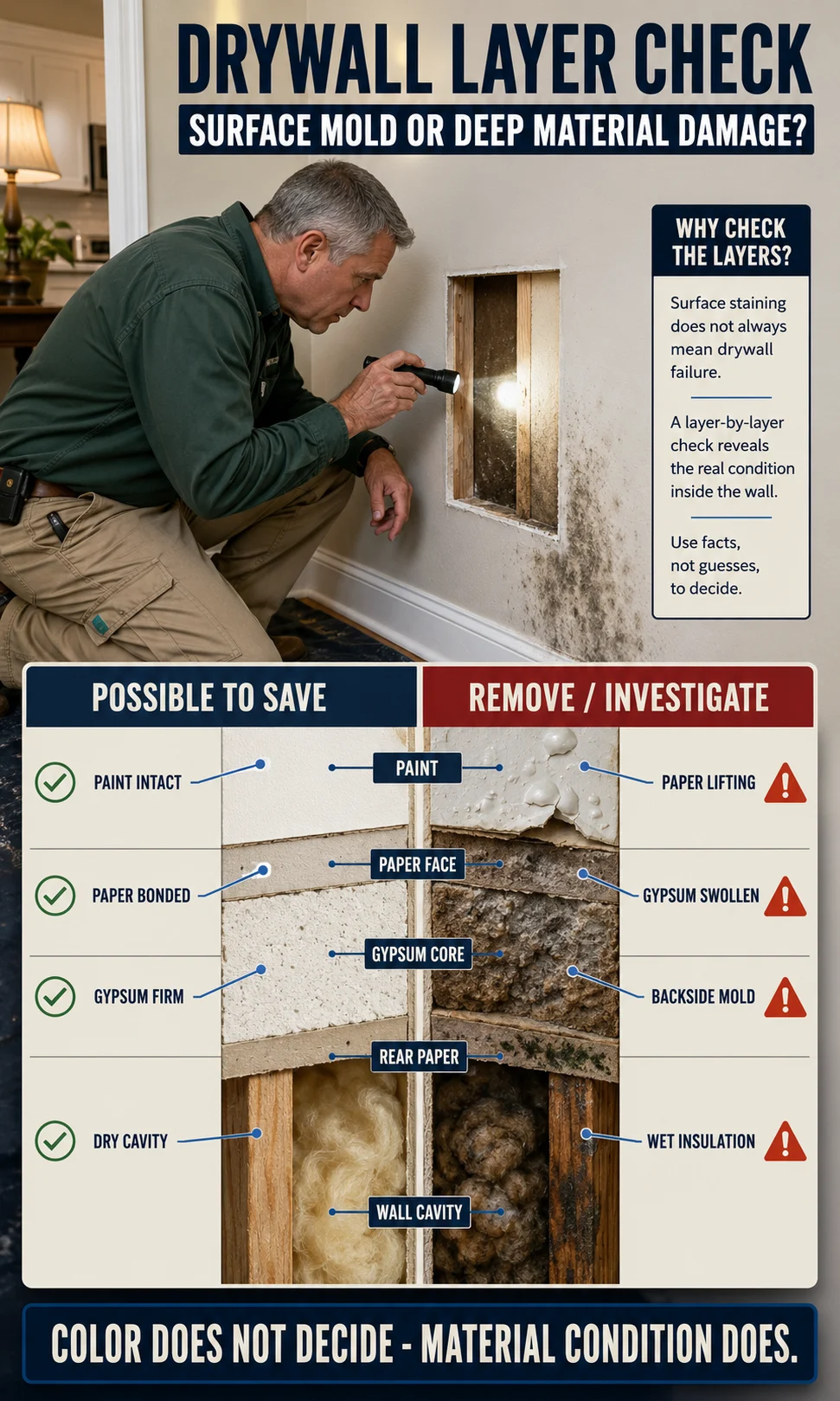
If measurements are used, compare conditions rather than relying on one arbitrary number. Moisture-meter values vary with the instrument and substrate, so establish a dry baseline on comparable drywall and then check the suspicious section. A persistent elevated pattern that follows plumbing, the lower wall or a concealed cavity provides more useful information than one isolated reading near a metal screw.
Where evidence points strongly toward hidden mold or moisture, destructive inspection should be controlled rather than exploratory demolition. Opening a mold-affected wall can release dust and spores and may expose wet insulation or a larger contaminated cavity. If the suspected area is extensive, the water source is contaminated, or containment would be difficult, that investigation is often better handled as remediation work rather than casual DIY inspection.
| Drywall condition | Technical interpretation | Likely direction | Next check |
|---|---|---|---|
| Small surface patch, firm board, intact paint and paper | Contamination may be predominantly superficial | Cleaning and retention may be reasonable | Confirm moisture source is corrected and wall is dry |
| Paint blistering but wall remains firm | Moisture may have moved beneath the coating | Investigate before refinishing | Check moisture gradient and probable source |
| Loose paper, failed tape or damaged seams | Wallboard system has suffered material deterioration | Removal becomes more likely | Assess extent behind finish and along joints |
| Soft, swollen or crumbling gypsum | Water has materially damaged the board | Remove and replace affected material | Determine cavity, framing and insulation condition |
| Visible mold on rear face or inside cavity | Contamination extends beyond the accessible finished surface | Controlled removal is usually more appropriate | Determine containment and full affected area |
| Growth repeatedly returns to the same area | Moisture or concealed contamination remains unresolved | Stop repeated cosmetic treatment | Trace moisture and inspect concealed construction |
How to Clean Mold From Drywall When the Board Is Still Salvageable
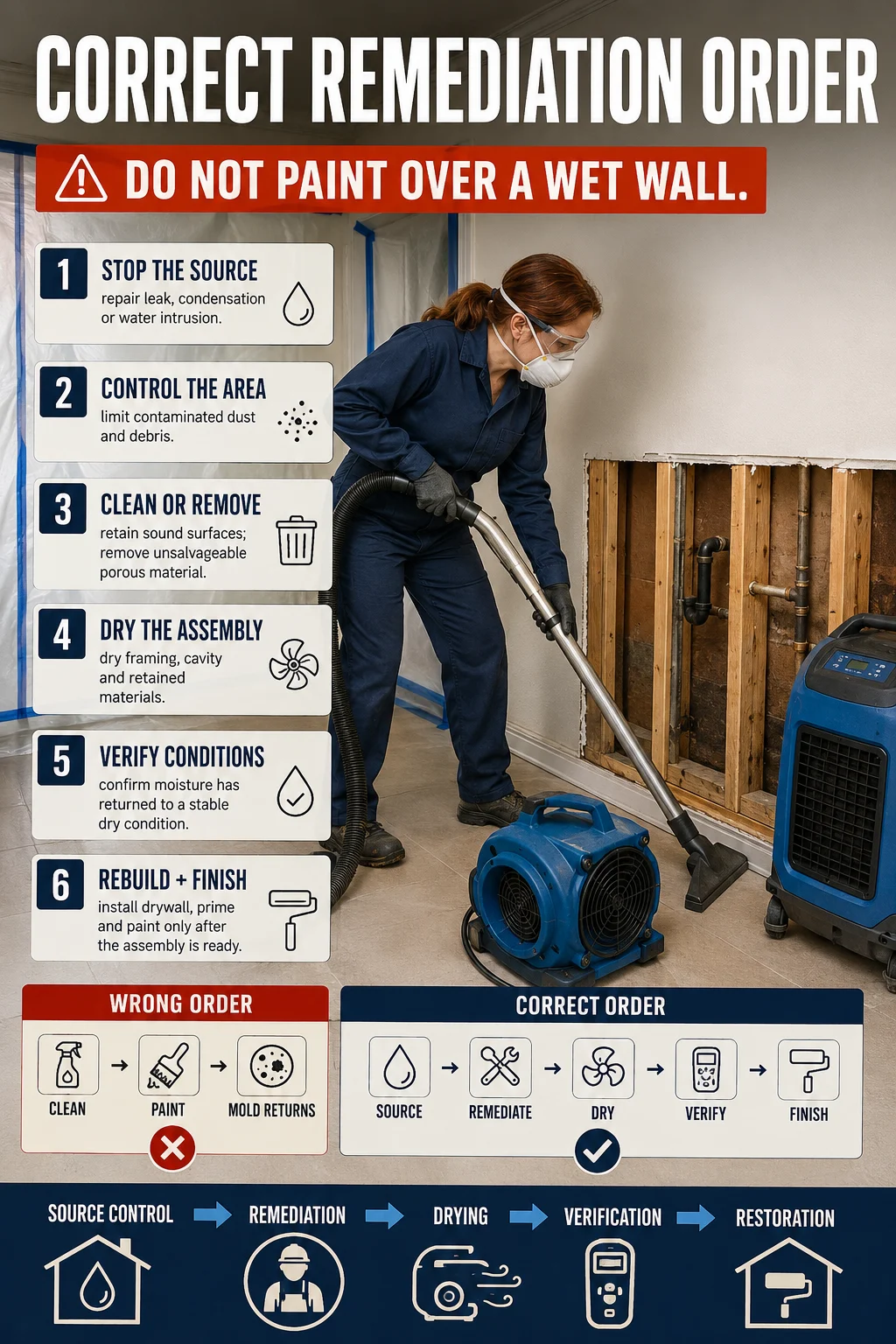
Cleanup should begin only after the water or humidity source has been controlled and the extent of the mold problem is understood. EPA guidance indicates that mold on hard surfaces can often be scrubbed with detergent and water, while absorbent or porous materials may need to be discarded because contamination can extend into spaces that are difficult to clean completely. Drywall sits in a more difficult middle ground because its finished painted face may behave differently from exposed or damaged paper.
Personal protection should match the work being performed. The CDC’s mold-cleanup guidance recommends protecting the eyes and skin and using appropriate respiratory protection when disturbing moldy materials, with greater protection warranted for more extensive work such as tearing out moldy drywall. People with significant respiratory or immune-system vulnerabilities should avoid treating a mold-removal project as routine household cleaning.
The goal of cleaning a salvageable drywall surface is physical removal of contamination while avoiding unnecessary damage to the wallboard. Aggressive saturation is counterproductive because drywall is moisture-sensitive, and abrasive sanding can distribute contaminated dust. The correct method depends on the actual surface coating and material condition, so the wall should remain as dry as practical while visible residue is removed.
Chemical strength is not the central measure of success. A product can kill organisms on part of a surface while still leaving contaminated material, moisture and debris behind, and the EPA does not recommend routine biocide use as the primary strategy in mold remediation. Physical removal, moisture correction and complete drying are more fundamental than trying to sterilize an ordinary building.
HEPA vacuuming has a different role from ordinary vacuuming. EPA remediation guidance describes HEPA vacuuming as a final-cleaning method after contaminated materials have been removed and the work area has dried, particularly for dust that may have settled around remediation work. A standard household vacuum can discharge fine particles back into the room and should not be assumed to perform the same function.
Drying should be verified before repair coatings are applied. A wall that feels dry to the hand can still contain elevated moisture relative to unaffected material, particularly near edges or on the concealed face. Use moisture comparison, elapsed drying conditions and knowledge of the original leak path together rather than relying entirely on surface appearance.
Primer and paint belong at the end of the repair sequence. The EPA specifically advises against painting or caulking moldy surfaces before they are cleaned and dried, and coating damp or contaminated drywall can hide evidence while the wall continues deteriorating. Mold-resistant coatings can reduce future surface susceptibility in appropriate environments, but they cannot compensate for a leaking pipe, failed waterproofing or persistent condensation.
When Moldy Drywall Should Be Removed Instead
Once the paper facing or gypsum has materially deteriorated, keeping the board can create more repair work than replacing the affected section. Water-damaged wallboard that has obvious swelling or compromised seams is specifically identified by EPA guidance as material that should be removed and replaced rather than simply dried in place. That provides a more useful technical criterion than deciding from the darkness of the mold stain.
Extent also changes the practical risk. EPA household guidance uses about 10 square feet as a general point below which homeowners can handle many straightforward mold problems themselves, while larger areas, substantial water damage and complex contamination justify additional remediation guidance or professional involvement. The number is a general decision aid rather than a guarantee that every smaller mold problem is simple.
The water category matters even when the visible area is small. Sewage, drain backups and other contaminated-water sources can introduce hazards beyond mold, and the material-removal strategy becomes much more conservative. In these situations, protecting the drywall is usually a much lower priority than removing contaminated porous materials safely and controlling exposure.
Repeated regrowth is another strong removal or investigation signal. If the same drywall has been cleaned, dried and repainted yet mold returns, there is little value in treating the next recurrence as an isolated surface event. Look for moisture behind the wall, contaminated rear paper, persistent condensation, failed air sealing or another condition that continues to supply water.
Technical conditions that strongly favor drywall removal
- The board is soft, swollen, crumbling or distorted.
- The gypsum and facing have already lost normal physical performance.
- Cleaning cannot restore the original material integrity.
- The paper facing is peeling or delaminated.
- The mold-sensitive paper system has deteriorated.
- Adhesion and future finish performance become unreliable.
- Joint tape or seams have failed.
- Moisture has affected the jointing system rather than only the surface paint.
- Cutting back to stable material generally produces a more reliable repair.
- Mold is visible on the rear face.
- Surface treatment cannot adequately address concealed contamination.
- The cavity condition and adjacent framing also need inspection.
- Insulation behind the board is wet or mold affected.
- Drywall preservation does not solve the concealed material problem.
- The wall needs to be opened sufficiently to remove or dry affected components.
- The wall remained wet for an extended period.
- Prolonged wetting increases the probability of deeper contamination and material deterioration.
- The backside may remain wet after the exposed face appears dry.
- The moisture source involved sewage or contaminated water.
- Porous material retention becomes much less appropriate.
- Professional remediation may be warranted.
- The mold covers a substantial area.
- Disturbance can spread contaminated dust.
- Containment and respiratory-protection requirements become more important.
- The same area repeatedly regrows after cleaning.
- A concealed source or deeper material involvement is likely.
- Repeated treatment is no longer functioning as remediation.
- Removal is required to correct the actual building defect.
- Access to leaking pipework, failed waterproofing, wet insulation or damaged framing may require the board to come out regardless of whether part of its visible face looks salvageable.
How Professional Drywall Remediation Differs From Simple Cleaning
Professional remediation starts by defining the work area and contamination extent before demolition begins. This prevents the removal process itself from distributing mold-containing debris into clean rooms. EPA remediation guidance scales containment and PPE according to area, complexity and potential exposure, which is why pulling several moldy sheets from a wall is a different operation from wiping a small isolated surface patch.
A controlled removal process also considers how air moves through the building. Open doorways, HVAC returns and pressure differences can carry dust away from a demolition area if the work is not isolated appropriately. Larger professional projects may therefore use containment and controlled air pressure so contaminated particles are directed away from occupied clean areas.
Once damaged drywall is removed, the remaining cavity should not be closed immediately. Framing, sheathing and adjacent construction need to be inspected for water staining, visible growth and residual moisture. Reinstalling new gypsum board against a wet stud or wet exterior sheathing can conceal the original problem inside a brand-new wall.
The cavity also provides an opportunity to identify the moisture path more accurately. A pipe leak may leave a vertical wetting pattern, exterior water may show staining near sheathing or window interfaces, and condensation may reveal cold framing or insulation discontinuities. Repairing the cause while the cavity is open is usually less expensive than rebuilding the finish and discovering the defect again later.
New drywall should be installed only after the assembly has reached an acceptably dry and stable condition for the materials involved. That means the repair sequence may include leak correction, water extraction, removal of unsalvageable insulation, controlled drying and moisture verification before reconstruction. Closing the cavity prematurely can recreate a high-humidity environment around the new board.
The final finish should match the environment where the problem occurred. Bathrooms and other moisture-prone rooms may benefit from appropriate moisture-resistant construction and coatings, but material selection should complement rather than replace ventilation, waterproofing and leak prevention. A better finish system helps only after the underlying moisture mechanism has been corrected.
How to Prevent Mold From Returning to Repaired Drywall
Long-term prevention is most effective when it targets the exact failure mechanism identified during diagnosis. If the original problem was condensation, controlling indoor humidity and raising cold surface temperature may matter more than applying a stronger cleaner. If a window leaked, drainage and flashing details matter more than increasing ventilation.
Bathrooms should be assessed for actual moisture removal rather than merely whether an exhaust fan makes noise. Confirm that the fan exhausts outdoors, the air path into the room allows replacement air to enter, and moisture clears within a reasonable period after bathing. Persistent condensation on ceilings and walls indicates that the moisture balance is still unfavorable.
Furniture against exterior walls should leave sufficient space for air circulation where condensation has been a recurring problem. This is particularly important for wardrobes and cabinets that create isolated cold pockets. If adequate clearance does not resolve repeated moisture, the wall may require investigation of insulation continuity, thermal bridging or air leakage.
Plumbing repairs should be checked after the wall is restored rather than assumed successful because the fitting looks dry during one inspection. Slow leaks can appear only under pressure, during fixture use or after temperature changes. Monitoring the repaired area during normal use provides stronger evidence that the moisture source has been eliminated.
Indoor humidity should also be interpreted in relation to climate and surface temperature. EPA recommends keeping indoor relative humidity below 60 percent and ideally around 30 to 50 percent where practical, but condensation can still occur locally on sufficiently cold surfaces. A normal room humidity reading therefore does not exclude a thermal bridge or cold-wall problem.
Ultimately, the best mold repair is the one that changes the conditions that allowed mold to grow. Drywall cleaning addresses contamination that is genuinely superficial, while replacement addresses material that has become part of the damaged assembly. Choosing between them on the basis of moisture path, wallboard integrity and contamination depth produces a much more reliable result than choosing among household mold-removal products.
Compare Local Home Specialists Near You
Tell us what kind of help you need, then compare nearby businesses by location, Google rating, review volume and contact options.
Frequently Asked Questions About Mold on Drywall
Can mold really be removed from drywall without cutting it out?
Yes, limited surface mold can sometimes be removed while leaving drywall in place when the board remains firm, dry and physically intact and the contamination has not clearly penetrated the paper or reached the rear face. The moisture source must also be corrected before the wall is considered salvageable. If the board is swollen, soft, delaminated or mold affected inside the cavity, replacement is generally the more reliable repair.
How do I know if mold is only on the surface of drywall?
No single visual check can prove that mold is confined to the exposed surface. An intact paint film, firm board, corrected surface-condensation source and normal moisture conditions make superficial contamination more plausible, while softness, swelling, recurring odor, failed joints or a leak from behind increase concern about deeper involvement. When the evidence points into the cavity, further inspection may be more useful than continued surface cleaning.
Does black mold mean the drywall automatically needs to be removed?
No. Mold color alone does not determine whether drywall must be removed, and dark-colored mold is not a reliable measure of contamination depth or material damage. The decision should instead consider moisture history, board integrity, affected area, rear-face involvement and whether the material can realistically be cleaned and kept dry.
Should I use bleach on moldy drywall?
Chemical choice should not be the first decision in a drywall mold problem because the main questions are whether the moisture source has been corrected and whether the porous wallboard remains salvageable. EPA guidance emphasizes physical mold removal, correction of moisture and proper drying, and it does not recommend routine biocide use as the primary remediation strategy. If cleaning products are used, follow their labels carefully, provide appropriate ventilation and never mix incompatible cleaners.
Can a moisture meter tell me whether drywall has mold inside it?
No. A moisture meter measures or estimates moisture-related properties of the material, not the presence of mold. It is most useful when suspicious drywall is compared with similar known-dry drywall and the readings are interpreted together with leak history, staining, material damage and other evidence.
How much drywall mold can I clean myself?
EPA household guidance uses approximately 10 square feet as a general boundary below which many straightforward mold-cleanup projects may be handled by homeowners. Size is only one consideration, however, because hidden growth, extensive water damage, contaminated water, HVAC involvement, vulnerable occupants or deteriorated wallboard can make a small visible patch much more complicated. When the job requires opening large areas or controlling airborne debris, professional remediation becomes more appropriate.
Can I paint over drywall after cleaning mold from it?
Yes, but only after the mold has been properly addressed, the moisture source has been corrected and the drywall has dried sufficiently. Painting an actively moldy or damp surface can conceal continuing moisture and can lead to coating failure or recurrence. Primer and finish paint should therefore be treated as the final restoration stage rather than the mold-removal method itself.
Why does mold keep coming back through new paint?
Recurring mold usually means that the conditions behind the original problem were never fully corrected. Moisture may still be entering the wall, condensation may continue to occur, or contaminated porous material may remain behind the finished surface. Repeated repainting should therefore trigger renewed moisture investigation rather than another cosmetic treatment.
The Real Decision Is Whether the Drywall Is Still a Sound Building Material
Removing mold without removing drywall is reasonable only when preserving the board still makes technical sense. A firm, dry, intact wall with limited accessible surface growth presents a completely different repair problem from swollen gypsum, damaged paper, a moldy rear face or a wet insulated cavity. Looking at those material conditions first prevents a desire to save one sheet of drywall from turning into repeated cleanup and reconstruction later.
The most reliable sequence is to identify the moisture source, determine how deeply the wall assembly was affected, decide whether the board remains cleanable and structurally serviceable, and only then choose cleaning or controlled removal. Once the assembly is dry and the source has been corrected, refinishing becomes the final step rather than the repair itself.