
In recent years, home inspection reports across many regions have shown a consistent pattern: water damage is often discovered inside walls that look completely normal from the outside.
This surprises many homeowners.
When people think of water damage, they imagine obvious signs — peeling paint, damp patches, or visible mold. In reality, many of the most serious cases begin quietly, without surface indicators.
Inspection findings often reveal moisture trapped behind:
- Bathroom tiles
- Kitchen cabinets
- Drywall near plumbing lines
- Exterior walls exposed to rain
Because walls are designed to hide structure, damage can develop unnoticed for long periods. By the time symptoms appear on the surface, the underlying issue has often existed for months or years.
This is not a failure of homeowners.
It is a characteristic of how buildings are constructed.
To understand how moisture leads to structural damage over time, it helps to understand how mold and water damage develop inside homes and why early signs are easy to miss.
HOW HIDDEN WATER DAMAGE ACTUALLY FORMS
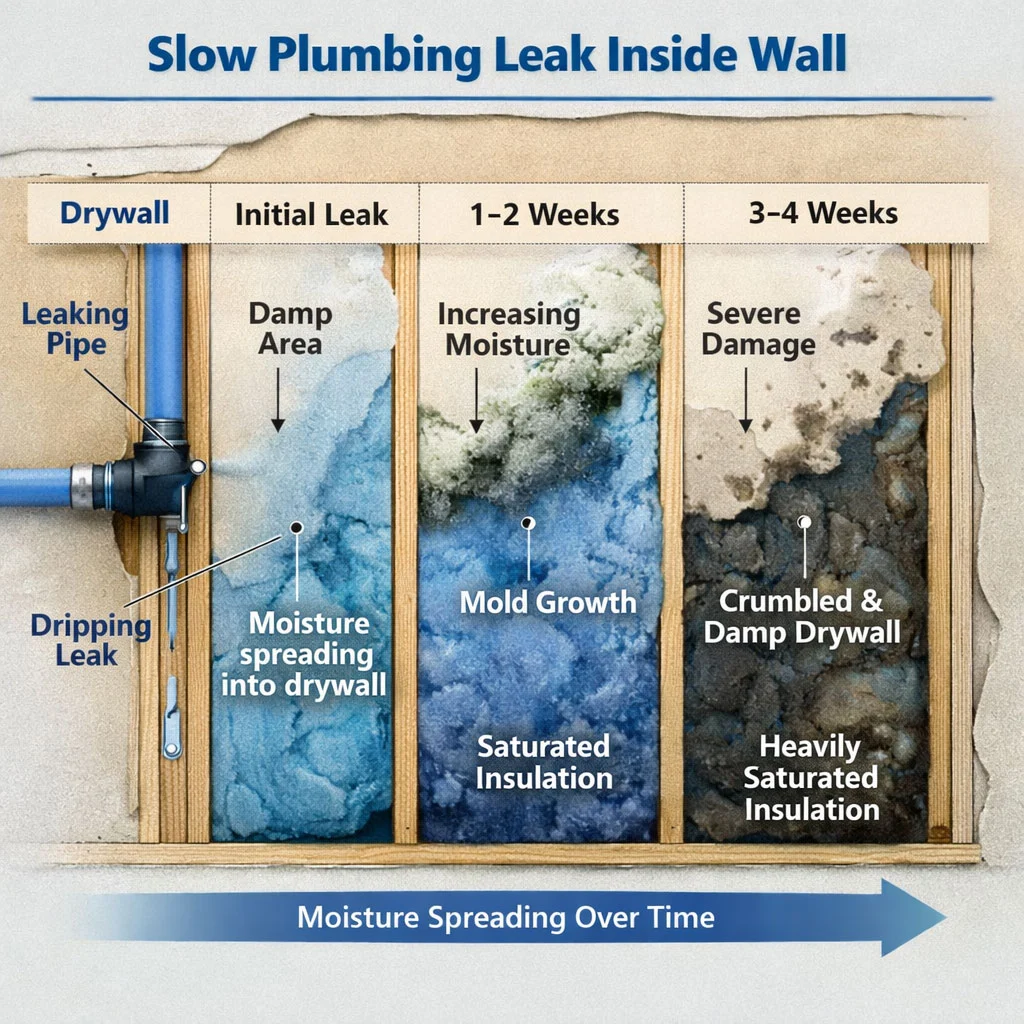
Hidden water damage usually begins with small, repetitive moisture exposure, not dramatic flooding. This is why it goes unnoticed.
Common sources include:
- Slow plumbing leaks inside walls
- Failed waterproofing behind bathroom tiles
- Condensation forming on cold pipes
- Hairline cracks in exterior walls
- Sealant failure around windows and service yards
When moisture enters enclosed spaces, it has limited evaporation paths. Drywall, insulation, and timber framing absorb moisture slowly, often without visible surface changes. Over time, materials remain damp long enough for deterioration to begin.
This process is gradual. There is rarely a single moment when damage “starts.” Instead, it accumulates quietly.
WHY WALLS CAN LOOK NORMAL WHILE DAMAGE GROWS
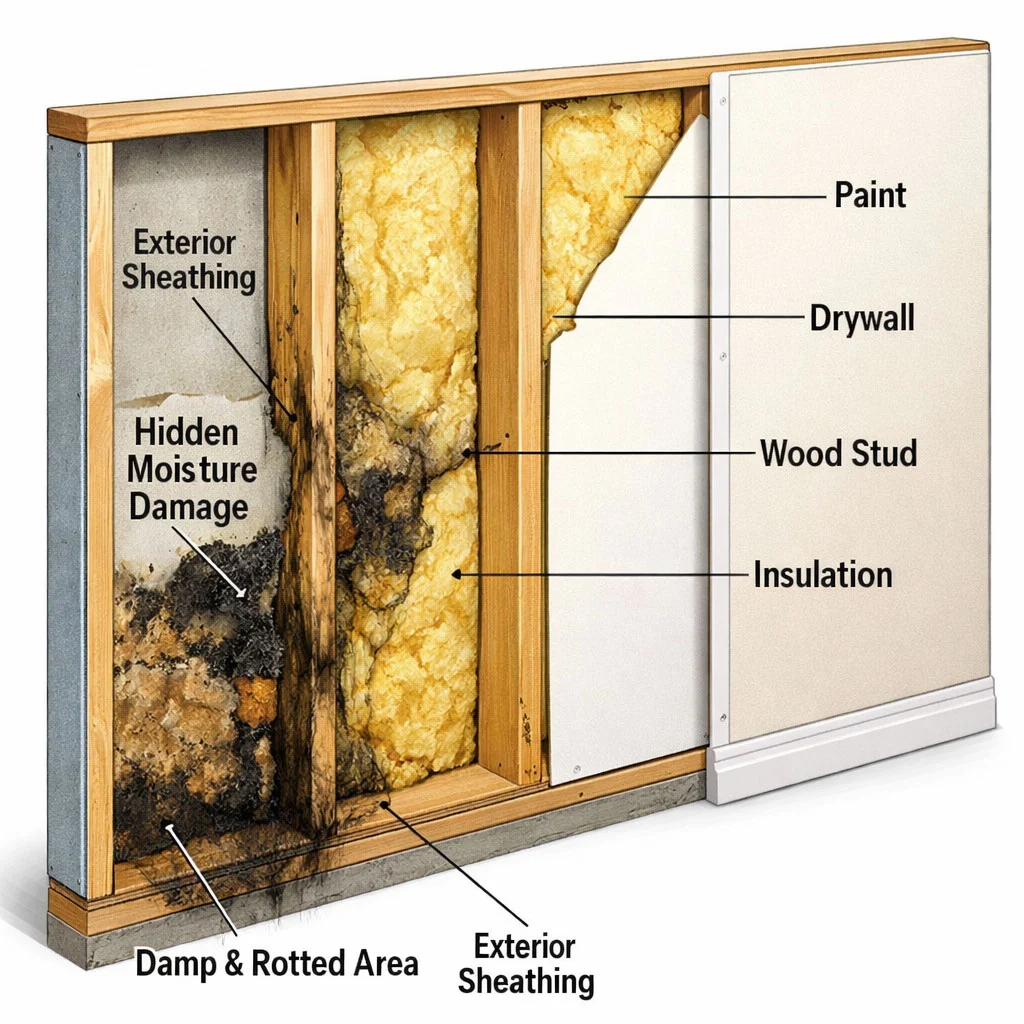
Modern walls are layered systems. Paint and tiles are only the outermost layer.
Behind them are:
- Gypsum boards
- Timber or metal studs
- Insulation materials
- Plumbing or electrical runs
Moisture can remain trapped within these layers while the surface appears intact. Paint is designed to resist moisture penetration, which ironically delays visible warning signs.
By the time peeling paint or staining appears, internal materials may already be compromised.
This explains why inspection reports often note:
- “No visible signs externally”
- “Moisture detected internally”
- “Damage likely pre-existing”
Understanding this separation between appearance and structure is critical for interpreting inspection findings accurately.
WHAT HOME INSPECTIONS ACTUALLY CHECK (AND WHAT THEY DON’T)
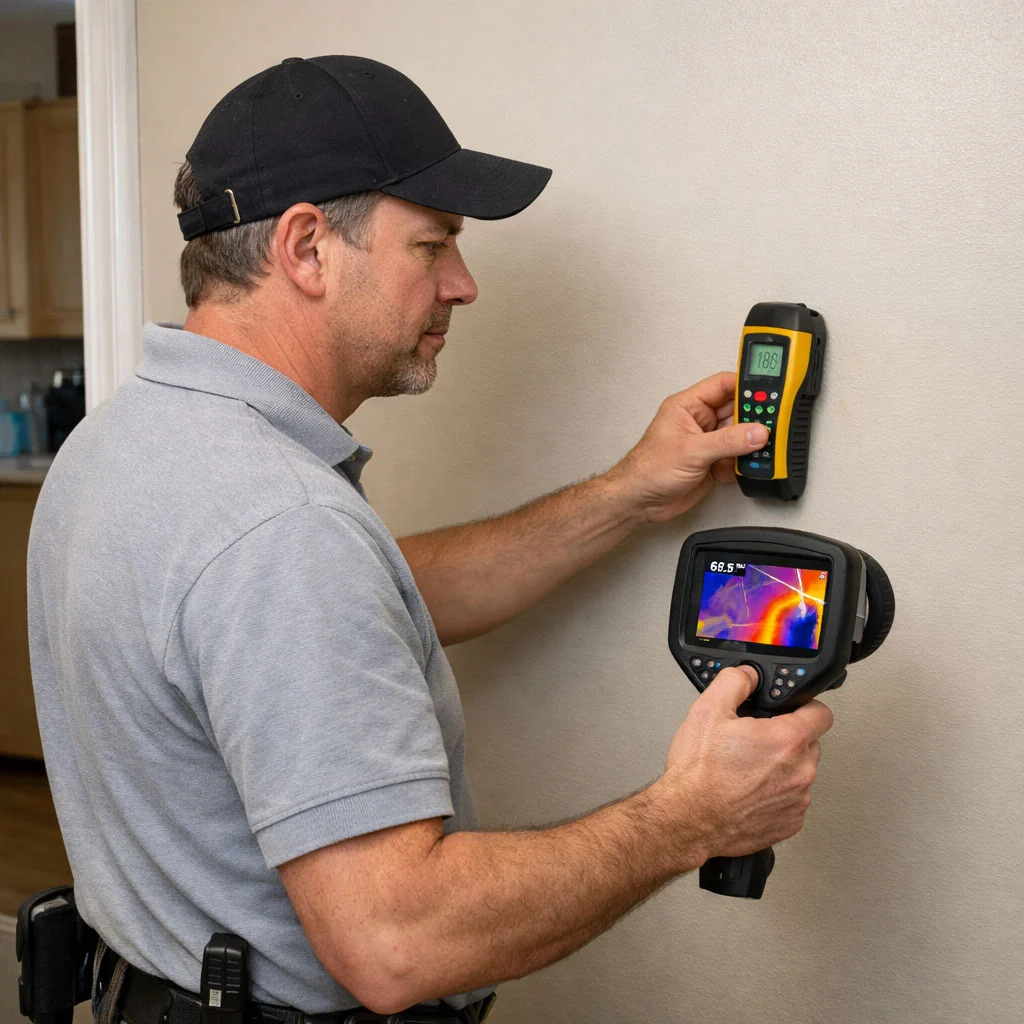
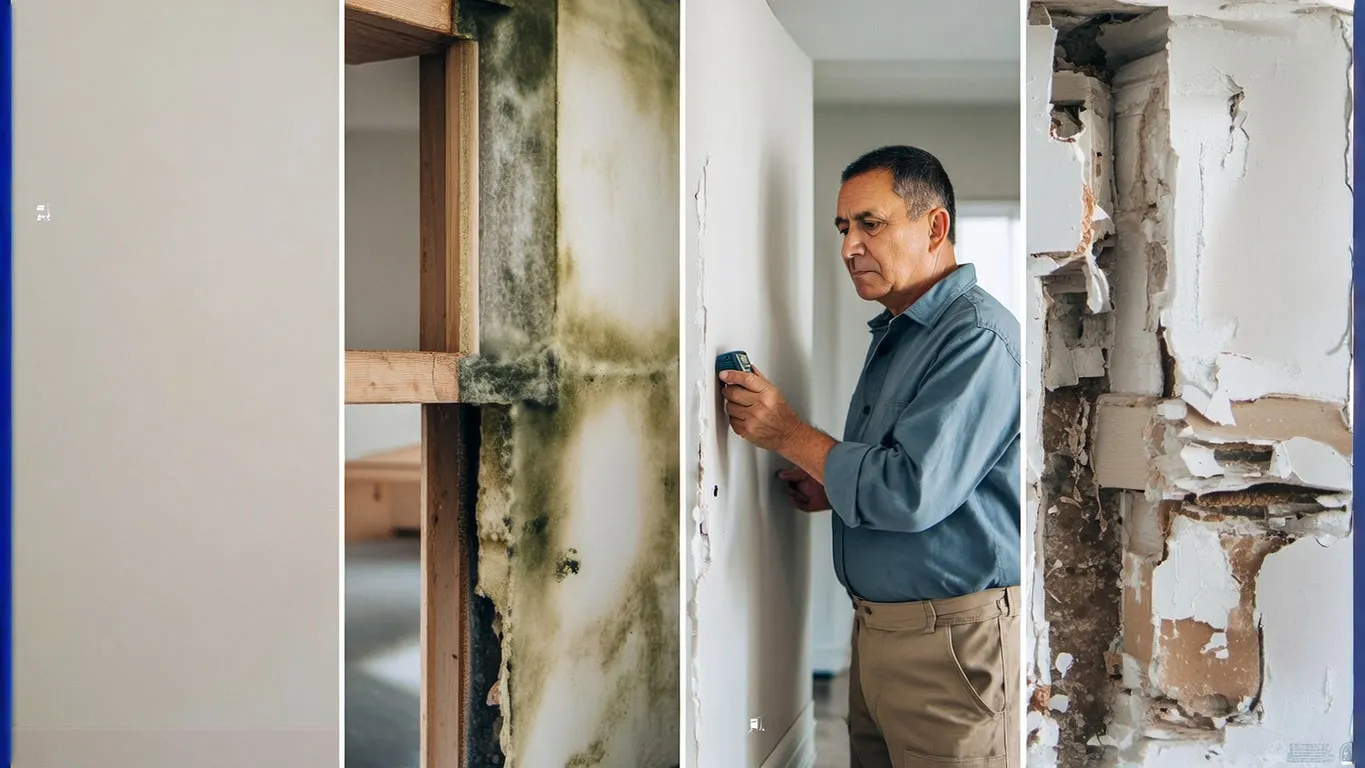
Home inspections are not guesswork. Inspectors rely on tools and methods designed to detect hidden issues.
Common inspection tools include:
- Moisture meters for wall readings
- Infrared cameras to detect temperature differences
- Visual access through service panels
- Probing in high-risk zones (bathrooms, kitchens)
However, inspections also have limitations.
Inspectors cannot:
- Open walls without permission
- See behind every surface
- Predict future leaks
- Guarantee absence of hidden damage
This is why inspection reports often use careful language. Findings are based on evidence available at the time, not absolute certainty.
Understanding this prevents misinterpretation of reports as either over- or under-alarming.
WHY VISUAL CHECKS ALONE ARE UNRELIABLE
Many homeowners rely on visual checks to assess property condition. While helpful, visual checks are insufficient for detecting moisture problems.
Water damage progresses in three stages:
- Moisture accumulation
- Material saturation
- Structural or biological damage
Visual signs typically appear only at stage three.
This is why inspections often detect issues that homeowners were unaware of. The absence of visible damage does not equal the absence of a problem.
This distinction matters — especially in bathrooms and kitchens, where moisture exposure is constant.
Most structural damage doesn’t happen suddenly. It develops quietly in places we rarely see.
A REAL-WORLD HOMEOWNER SCENARIO
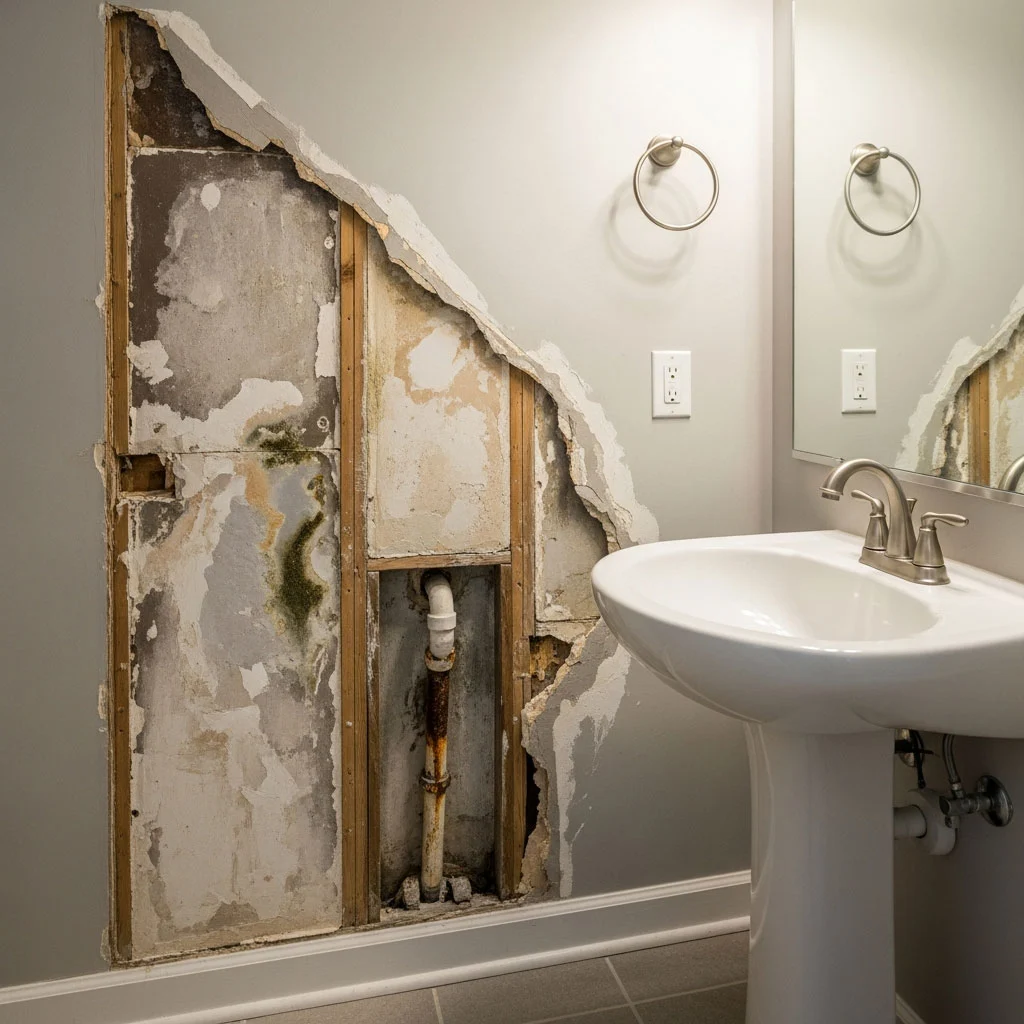
A homeowner noticed a faint musty smell near a bathroom wall but saw no stains or peeling paint. Assuming it was temporary humidity, the issue was ignored.
During a routine inspection, elevated moisture levels were detected behind the tiled wall. A minor plumbing leak had been slowly saturating insulation for an extended period.
The surface looked normal.
The damage was not.
Early detection allowed targeted repair instead of extensive renovation. This scenario appears frequently in inspection records and highlights why hidden damage is often discovered incidentally.
WHAT THESE FINDINGS DO NOT MEAN
It’s important to clarify what inspection findings do not imply.
They do not mean:
- Homes are unsafe by default
- All walls contain damage
- Renovation is always required
- Homeownership is inherently risky
They mean that buildings age, materials wear, and moisture behaves in predictable ways that are not always visible.
Inspection findings are information, not judgment.
HOW HOMEOWNERS SHOULD INTERPRET THIS INFORMATION
For homeowners, the key takeaway is not fear – it is awareness.
Understanding that:
- Damage can exist without surface signs
- Inspections rely on tools, not intuition
- Early detection reduces repair scope
…helps homeowners make informed decisions about maintenance and monitoring.
The most effective response is not panic, but periodic assessment in high-risk areas.
WHY THIS TOPIC KEEPS APPEARING IN REPORTS
Hidden water damage is not increasing because homes are worse built. It appears more often because detection methods have improved.
Better tools reveal issues that previously remained unnoticed. This makes inspection data appear alarming, when in fact it reflects better visibility into how buildings function over time.
FINAL THOUGHT
Hidden damage challenges assumptions about what “looks fine.”
Home inspections are not about finding fault. They are about understanding how structures behave beyond what the eye can see.
Knowledge does not create problems.
It prevents them from growing unnoticed.
Compare Local Home Specialists Near You
Tell us what kind of help you need, then compare nearby businesses by location, Google rating, review volume and contact options.
HomeFix Local Match
Turn a home problem into a practical local hiring decision. Check the clues, see the specialist types that fit, open focused surrounding-location searches, then compare the strongest three before you call.
 YOUR PROBLEM
YOUR AREA
COMPARE 3
✓ Ready to compare
YOUR PROBLEM
YOUR AREA
COMPARE 3
✓ Ready to compare
What is happening?
Choose the closest problem type, then check every clue that applies. Your selections change the specialist order.
Where should the search focus?
Use Google’s “near me” context or enter the area you actually want a specialist to serve.
Simple local search: open nearby Google results, choose the businesses that look suitable, then compare your best three here before you call.
Problem snapshot
Who should you call first?
These are the specialist types most likely to fit the clues you selected.
Search around your location
Compare your top three
Use the same factors for each option so a high star rating does not hide a weak scope, poor diagnosis, missing credentials or unclear aftercare.
Comparison result
Your result combines the Google signals you entered with the practical hiring checks you completed.
Questions to ask every finalist
Use the same questions with each shortlisted business so the comparison stays consistent.
FAQ
Can water damage exist if walls look normal?
Yes. Water damage can develop behind drywall, tiles, or cabinetry long before visible stains, peeling paint, or swelling appear on the surface.
How do home inspections detect hidden water damage?
Inspectors commonly use moisture meters, infrared thermal imaging, and targeted evaluation of high-risk areas such as bathrooms, kitchens, ceilings, and window frames.
Does hidden water damage always require major renovation?
No. When detected early, water damage can often be addressed with localized drying and targeted repairs instead of full structural renovation.
Why didn’t I notice any warning signs earlier?
Modern finishes such as tiles, waterproof coatings, and painted drywall can conceal internal moisture buildup, delaying visible warning signs until damage progresses further.
Are inspections guaranteed to find all hidden damage?
No. Inspections are based on accessible evidence and non-invasive tools. They may not detect moisture concealed in fully sealed or inaccessible structural cavities.