
Roof runoff is rainwater that flows off your roof, and the problem starts when it wets the walls, erodes soil, or collects beside the foundation. To control it, find where water first escapes, restore a clear route through the gutter and downspout, and discharge it to a suitable place that drains away from the house. An extension helps only if the water cannot turn back toward the building.
Where does roof runoff first leave its intended path?
Start with the route you can see from a window or sheltered ground-level position during ordinary rain. Follow the roof edge, the gutter, the downspout, and then the ground beyond its outlet; do not go outside during thunder, lightning, strong winds, or flooding. This is an observation check, not a reason to climb a wet ladder or roof.
Look for the first escape point, not just the largest puddle. Water spilling from a roof valley may land beside a perfectly clear downspout, while a blocked buried outlet can cause trouble even when the gutter catches everything correctly. A puddle tells you where water stopped; it does not tell you where the failure began.
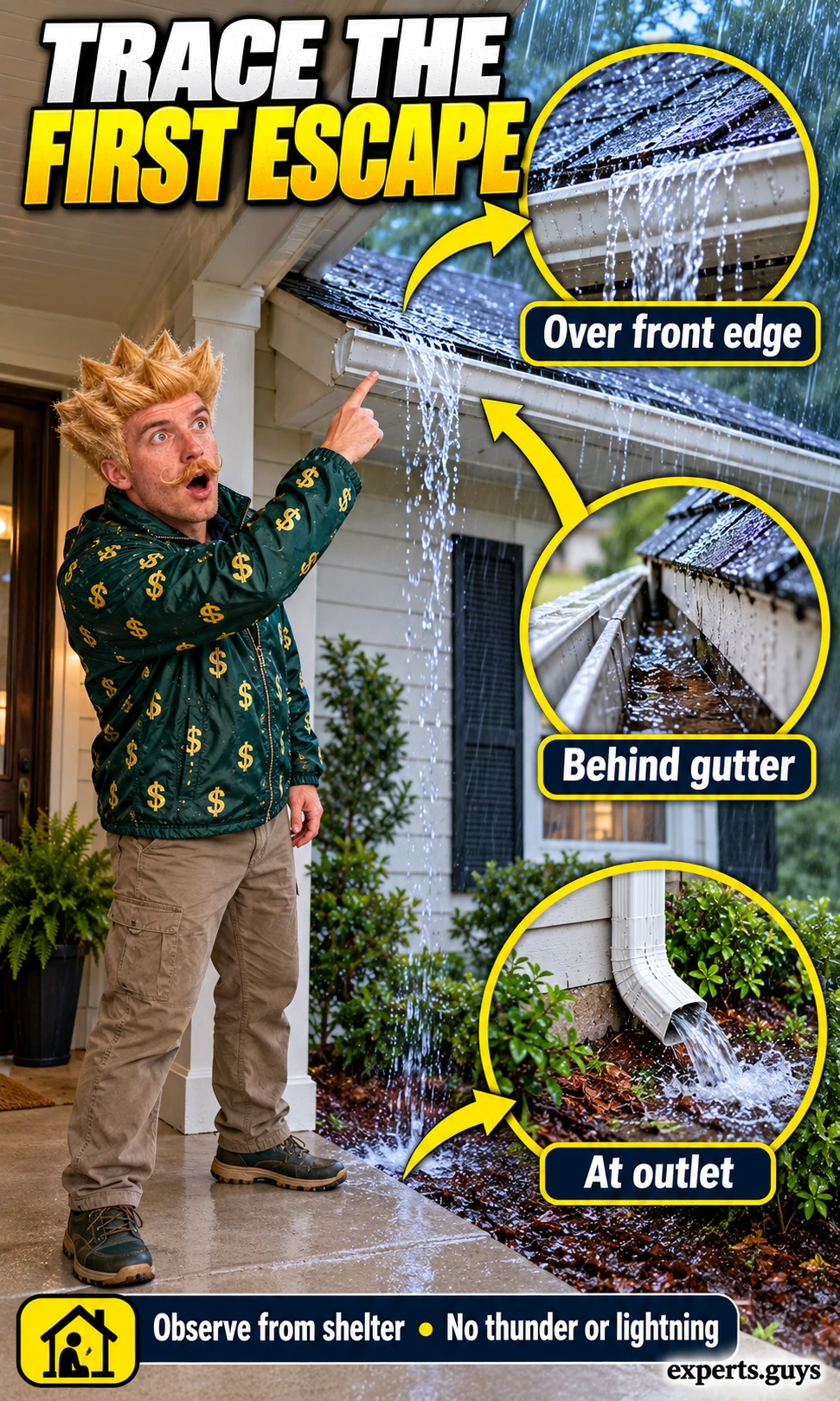
Watch whether water builds up inside the gutter before spilling, shoots past its outer lip, or runs down the surface behind it. A full gutter suggests restricted outflow, poor fall, or insufficient capacity; a concentrated stream that misses the gutter suggests a capture problem. These clues narrow the investigation, but a ground-level view cannot confirm every hidden defect.
Check the ground-level outlet at the same time. If water leaves briskly but immediately runs back toward the wall, buying larger gutters will not correct that return path. If no discharge appears while rain is entering the gutter, an obstruction or hidden connection needs investigation before more water is introduced.
| What you see | What to distinguish | Useful next action |
|---|---|---|
| Water spills over the front lip | A blockage or sag versus insufficient capacity | Check the outlet first; arrange safe gutter inspection if the problem is above reach. |
| A roof-valley stream jumps over the gutter | Incoming water missing the collection channel | Have gutter position, valley flow and capacity assessed together. |
| Water appears behind the gutter | Roof-edge flashing, attachment or gutter alignment | Treat it as a roof-edge detail; do not cover the symptom with random sealant. |
| The downspout runs, but water returns to the house | A discharge or grading problem | Choose a continuous route and suitable receiving area. |
| A buried connection backs up | A hidden obstruction or insufficient downstream capacity | Stop adding test water and have that drain assessed. |
Keep the distinction between exterior runoff and water already entering the roof. Ceiling staining or wet roof framing needs a separate roof water-entry investigation; a new splash block cannot repair a roof penetration. That is a different job from redirecting water outside.

Before changing anything, use the simplest branch that matches the visible failure. Do not assume that every wet wall needs a French drain or that every overflowing gutter needs replacement. The aim is to change the component that is failing, then verify the entire route.
- Reachable outlet covered by loose leaves: uncover the opening after the rain has stopped.
- Open downspout dumping beside the house: assess a surface-extension route before buying parts.
- Failure at roof height: arrange safe access and a specific inspection of that failure point.
- No safe downhill destination: pause the extension idea; the property needs a drainage design.
Which ground-level correction can you make safely?
A reachable outlet obstruction or an unsuitable open discharge may be manageable without roof work. Wait for dry, stable footing and keep children and pets away from the work area. Wear gloves around sharp metal and debris, and use parts intended for the existing downspout size rather than forcing a mismatched connection.
Uncover a reachable outlet
This method suits loose leaves or mulch around an exposed outlet. It does not suit a blocked underground pipe, a trapped animal, or a downspout you cannot reach comfortably. Start by making the opening visible; pushing debris farther inside can hide the symptom while making the blockage harder to reach.
- Find the actual discharge end, including any extension partly hidden by planting or mulch. Stand on firm ground rather than in the wet patch.
- Lift away loose material around the mouth with gloved hands. Keep your hand outside buried piping and leave fixed grilles or unfamiliar fittings in place.
- Look along the visible route for a crushed section, disconnected joint, or outlet submerged in a low spot. Remove only loose obstructions that you can reach safely.
- Stop when the opening is clear and its receiving area is visible. If water still backs up, or the pipe disappears underground without an accessible outlet, arrange a drain assessment.

If bending is difficult, use a long-handled grabber for loose surface leaves or ask someone to help with that single task. The completion checkpoint is an exposed, unobstructed opening, not a cleaned underground system. Check again during rain because an opening that looks clear can still feed into a downstream restriction.
Fit an extension to an existing open discharge
Choose this method only when the downspout already ends above ground and a permitted, gently falling route is available. Do not cut a pipe out of an existing drainage connection on the assumption that discharge onto the lawn is allowed. On narrow lots, steep ground, or sites with retaining walls, the destination needs more attention than the connector.
Measure the available route from ground level and check the receiving ground, not just the extension length. A useful U.S. reference is guidance for discharge at least 5 feet from foundations, with different provisions for underground catchment. That is not a universal approval distance: local requirements, soil, slope, neighboring structures and the way water travels can require a different solution.
- Choose a compatible extension and connector. Follow its fitting instructions; support the existing downspout so the new piece does not pull it loose.
- Lay the route out before fastening. Keep it out of paths, gates and mowing routes, with a continuous fall toward the outlet and no low pocket that can hold water.
- Fit and secure the connector as its manufacturer specifies. Do not improvise a connection that narrows the waterway or strains the elbow.
- Set the outlet over suitable splash protection on stable ground. The splash block must release water toward the receiving area, not trap it behind a raised edge or point it back at the wall.
- Check that the end remains visible and accessible for maintenance. If a safe route requires crossing a walkway, choose another route or obtain a properly designed alternative.
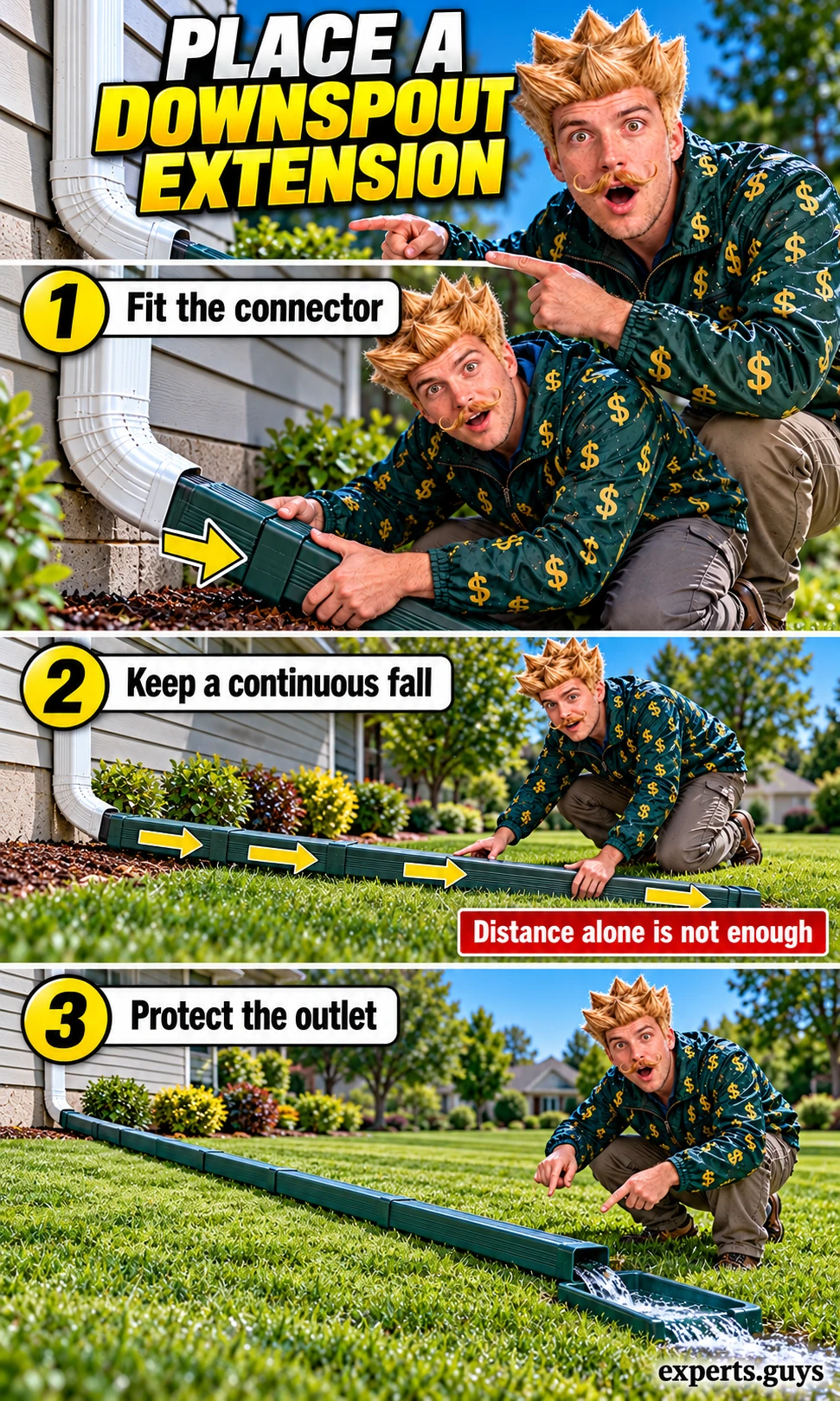
A longer extension is not automatically a better extension. If its far end sits in a hollow, water can collect there and flow back; if the route sags, it can retain sediment or ice. For an easier setup, choose a lightweight compatible piece you can position comfortably, but do not trade away a suitable destination merely to reduce its weight.
Check the extension with a small flow
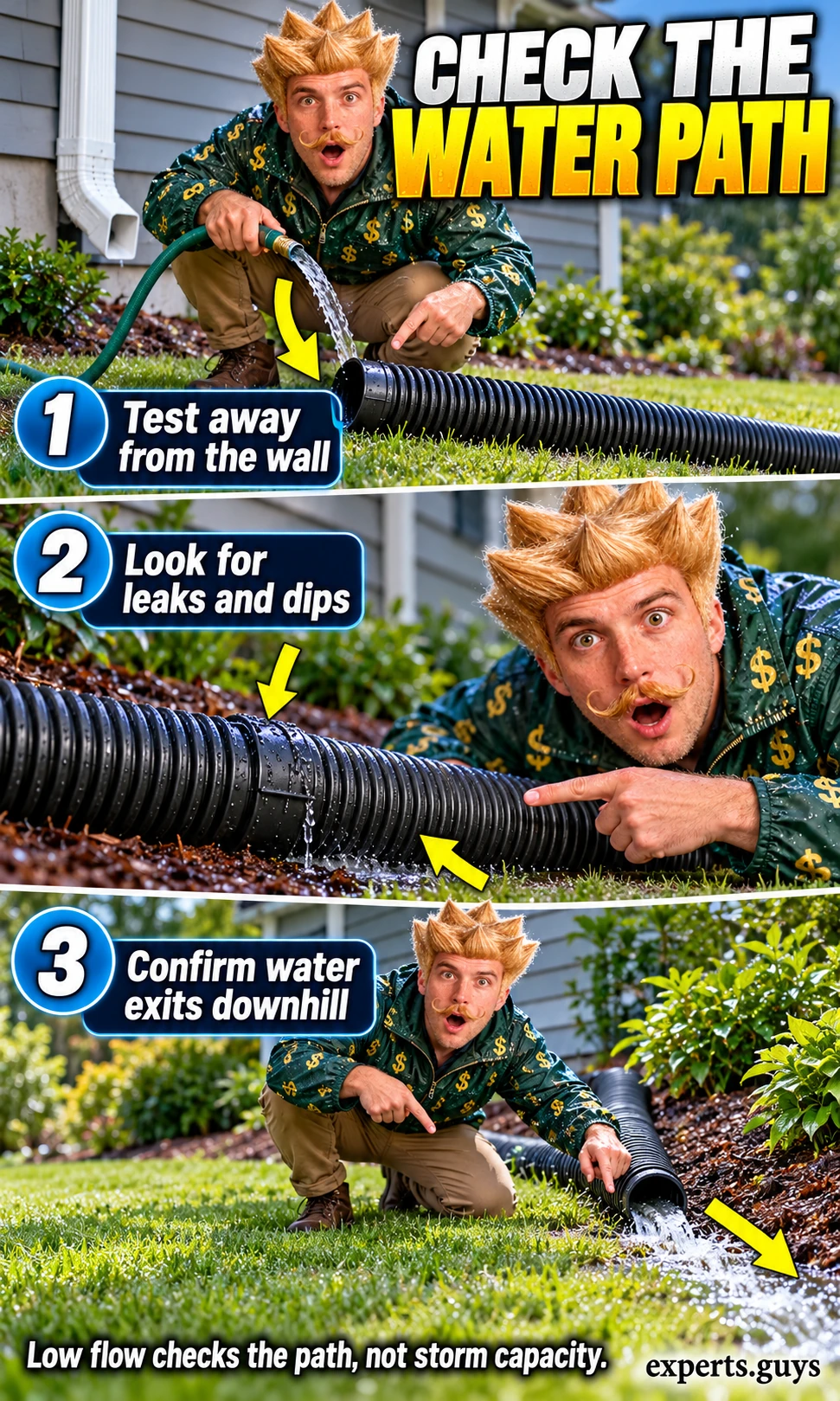
Before reconnecting a removable aboveground extension, place it on a suitable sloping lawn away from the wall. Feed a small flow from a hose into its open inlet without sealing the hose into the pipe, then inspect the joints and watch the outlet. Stop if water ponds, leaks from a joint, or runs toward anything that must stay dry; correct the fit or route and repeat the limited check.
This checks whether that visible extension passes water along the intended path. It does not test gutter capacity, simulate wind-driven rain, or prove a buried drain is clear; never force hose water into an unknown underground connection. A shorter, lighter section can be checked the same way if handling the full extension is difficult.
Where should the water go after it leaves the downspout?
The receiving area must safely accept the discharge and provide somewhere for excess water to go. A small patch of already saturated soil is not an adequate destination simply because it is farther from the house. Consider neighboring property, paths, retaining walls, wells, septic areas and other structures before choosing a route.
Treat conveyance, storage and infiltration as different jobs. A solid pipe moves water; a barrel stores a limited amount; a rain garden holds water temporarily while it soaks into suitable soil. Combining them can work, but adding one does not remove the need to think about what happens when the next component is full.
| Destination | When it may fit | What can make it fail |
|---|---|---|
| Gently sloping lawn | Enough suitable ground to receive and disperse the water | Saturation, return flow, erosion, or discharge across a boundary. |
| Designed rain garden | Site suitability, setbacks and infiltration have been checked | Treating an existing wet hollow as a ready-made rain garden. |
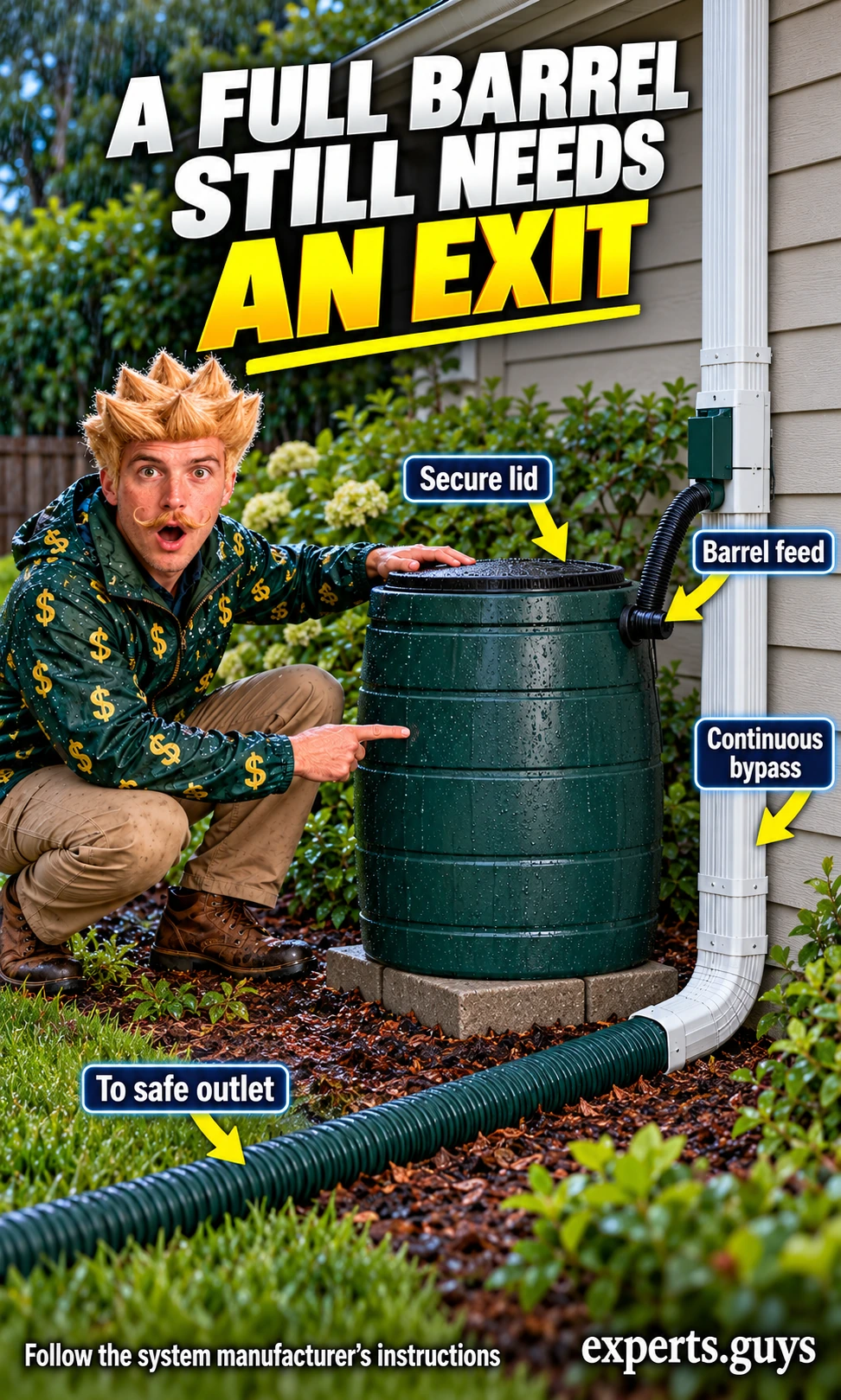
| Rain barrel with bypass | Useful non-potable demand and a safe excess-water route | A full barrel with nowhere for additional water to go. |
| Approved piped outlet | Surface discharge is unsuitable and a lawful connection is available | Unknown connection, blockage, insufficient capacity, or lack of maintenance access. |
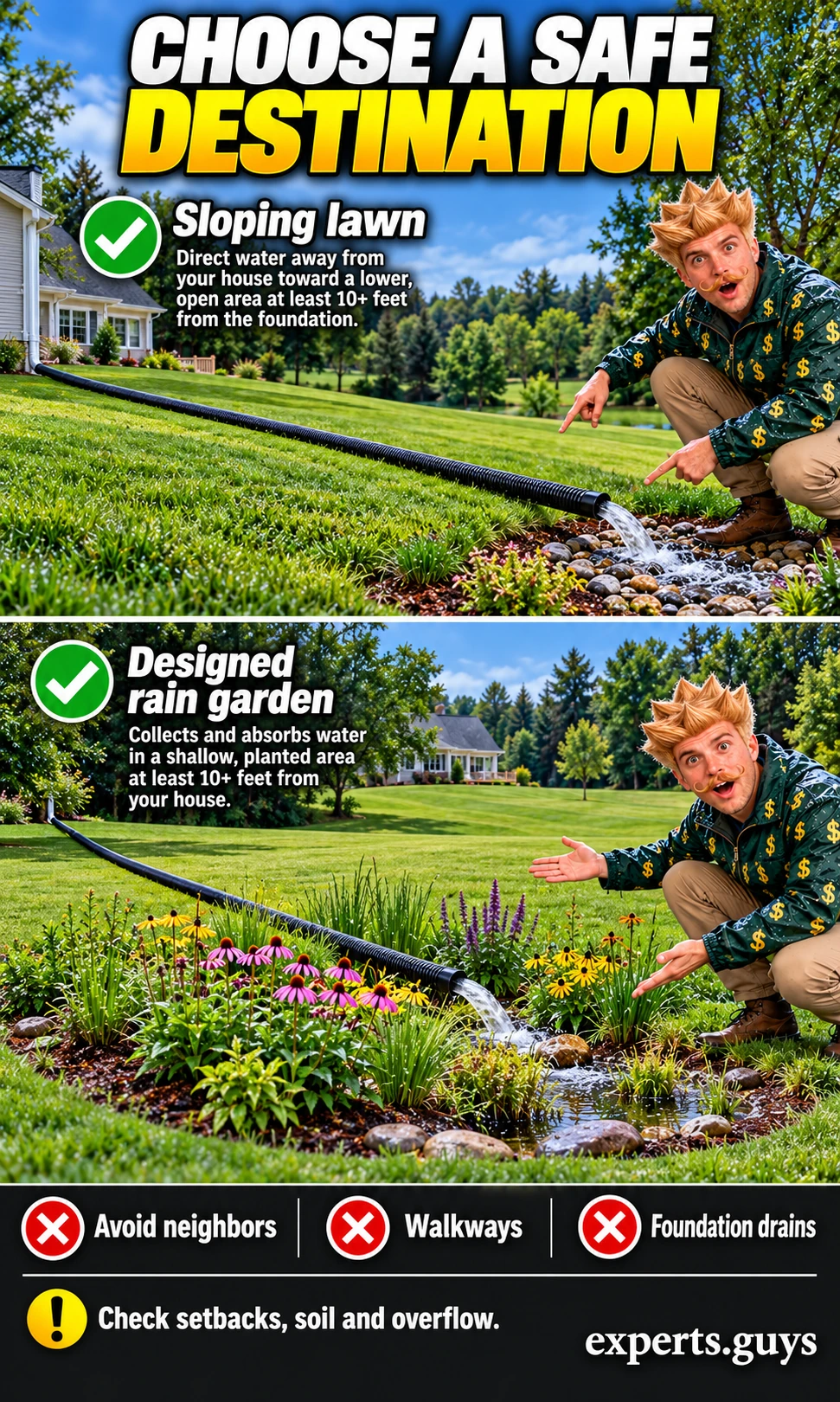
The illustration uses a longer route of at least 10 feet for both examples; that is an example layout, not a universal surface-discharge minimum. A rain garden is a designed receiving area, not just planting around the downspout. Rain-garden siting guidance uses a minimum 10-foot separation from buildings and checks whether water can drain within 48 hours; local conditions may require other setbacks or design measures. This article does not teach excavation or size a basin: that work needs soil, groundwater, utilities and overflow assessment.
Keep roof-water piping separate from perforated foundation drains. Feeding concentrated roof discharge into a system intended to manage water near the footing can overload the very area you are trying to protect. Likewise, a French drain is not a universal replacement for a solid conveyance pipe, and a gravel strip without an appropriate outlet may simply store water close to the house.
Understand what a rain barrel can and cannot hold
Inspect an existing barrel from ground level: identify its inlet, secure lid, and overflow or bypass, then follow the excess-water route to its destination. Use the system manufacturer’s instructions to check that the bypass remains available when the barrel is full. If you cannot identify that route, treat it as an unresolved drainage issue rather than assuming a hose attached near the top is sufficient.
For scale, a horizontal roof catchment of 500 square feet under 1 inch of rain receives about 312 U.S. gallons before losses. A completely empty 50-gallon barrel would leave about 262 gallons beyond its available storage; a partly full barrel has less space. These are volume calculations, not predictions of actual collected water or proof that an overflow pipe can pass the peak flow.
Use the horizontal roof area that feeds the particular downspout, not the sloping roofing surface and not automatically the whole house footprint. A simple gable may divide flow between two eaves, but valleys, dormers and upper-roof downspouts can change that split. Use an existing dimensioned drawing or a reliable ground-level estimate; if the catchment is uncertain, compare plausible areas and keep the result provisional. Do not climb the roof to obtain that number.
The estimator below compares rainfall volume with empty storage space. In metric units, square metres multiplied by millimetres gives litres; in U.S. units, square feet multiplied by inches and approximately 0.623 gives gallons. The relationship is consistent with rainwater-yield guidance, but actual collection is reduced by wetting, splashing and other losses.
How much water needs an exit?
Compare one roof catchment’s rainfall volume with the empty space in your barrel. This estimates volume before collection losses; it does not size gutters or drains.

Potential volume before losses
Keep a safe overflow route even when the estimate fits. Actual collection, an already wet garden, rainfall intensity and outlet capacity are not modeled. More stored volume does not prove flood protection.
Assumptions and limits
Potential U.S. gallons = ft² × inches × 0.6233766. Potential litres = m² × mm. Storage used = the smaller of potential volume and empty storage. Volume beyond storage = max(0, potential volume − empty storage). The calculation assumes all rain on that area is available before losses, no drawdown during the event, and an initially known empty space. It does not determine pipe diameter, peak flow, safe siting, discharge permissions or required storage.
Supported ranges: U.S. area 0.01–100,000 ft²; rain 0.01–40 inches; empty storage 0–100,000 gallons. Metric area 0.0009290304–9,290.304 m²; rain 0.254–1,016 mm; storage 0–378,541.1784 litres. These are input limits, not design recommendations.
Find help for an unresolved drainage problem
For an overflowing gutter, look for a gutter installer; for a roof-edge leak, a roofer; for buried backup or no suitable destination, a drainage contractor or designer. Compare the proposed diagnosis, discharge route, maintenance access and written scope before choosing.
Search results are external; no provider, rating, price or availability is verified here. Ask comparable candidates to explain the same observed failure and quote the same scope.
Keep barrel lids secure and follow the product’s screening and maintenance instructions. Collected roof water is non-potable; do not connect a barrel to drinking-water or indoor plumbing without an appropriately designed system. A green roof is also a separate building project requiring structural and waterproofing assessment, not a quick substitute for fixing a failed outlet.
How do you know the correction worked?
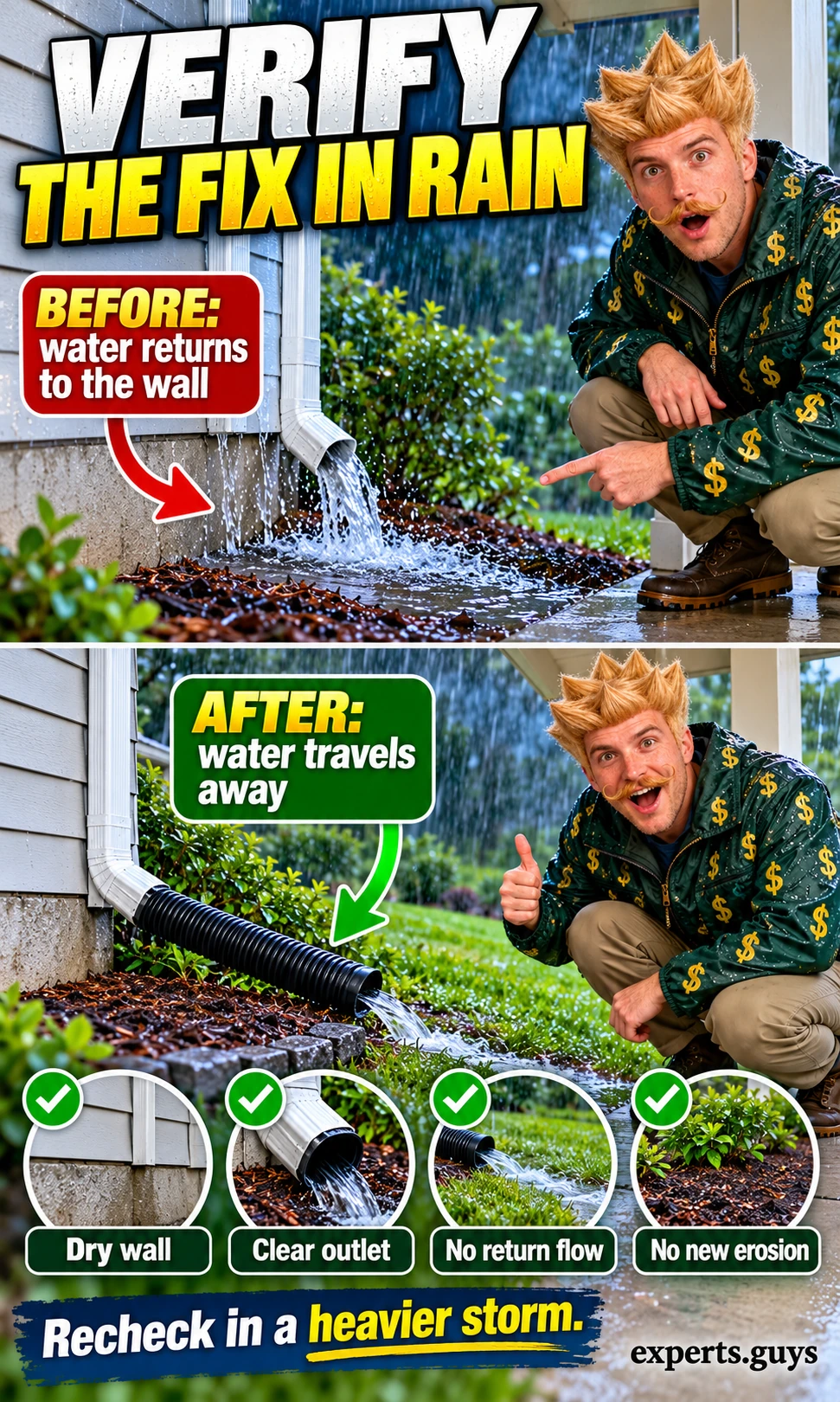
A successful correction reduces the original failure without creating another one downstream. Recheck the same visible route during ordinary rain from a safe sheltered position; after the rain, inspect the receiving area when footing is safe. A dry-looking wall after a light shower does not establish that the system will cope with a longer or more intense storm.
- At the roof edge: no new stream is escaping at the place you were trying to correct.
- Along the downspout and extension: joints stay connected and water reaches the intended outlet.
- At the destination: water moves away without returning to the wall, crossing a path, or leaving the property where it should not.
- After the rain: there is no fresh scour channel, displaced splash block, or new pool caused by your alteration.
If the gutter still overflows after an accessible outlet is cleared, the next check belongs upstream: debris at height, gutter fall, attachment, downspout restrictions and system capacity. If the outlet works but the lawn remains flooded, focus downstream on receiving-area capacity and grading. Repeating the same extension change cannot resolve both kinds of failure.
Snow and ice introduce a different mechanism. Frozen outlets can obstruct flow, while ice dams may involve roof temperature and heat loss; attic insulation and moisture control address that separate part of the building. Do not chip ice from elevated gutters or assume that a summertime drainage check covers winter conditions.
| Unresolved condition | Relevant help | Ask for a useful scope |
|---|---|---|
| Persistent overflow or missed gutter | Gutter installer or roofing contractor | Identify the failing catchment, outlet, gutter position and capacity before recommending replacement. |
| Water behind gutter or into roof | Roofing contractor | Inspect the roof-edge and flashing details, not only the visible stain. |
| Buried drain backup or no safe outlet | Drainage contractor or suitable drainage designer | Identify the existing connection, receiving capacity, access and permitted discharge route. |
| New erosion, movement, or water entering the building | Appropriate building or drainage professional | Assess the immediate hazard and its cause; pause DIY testing. |
Do not wait for another storm test if water is entering occupied space, approaching electrical equipment, or affecting a visibly unstable ceiling or structure. Keep clear of the affected area and obtain urgent help appropriate to the hazard. The practical checks here are for accessible exterior runoff, not floodwater, electrical work, or structural repair.
Compare Local Home Specialists Near You
Tell us what kind of help you need, then compare nearby businesses by location, Google rating, review volume and contact options.
HomeFix Local Match
Turn a home problem into a practical local hiring decision. Check the clues, see the specialist types that fit, open focused surrounding-location searches, then compare the strongest three before you call.
 YOUR PROBLEM
YOUR AREA
COMPARE 3
✓ Ready to compare
What is happening?
Choose the closest problem type, then check every clue that applies. Your selections change the specialist order.
Where should the search focus?
Use Google’s “near me” context or enter the area you actually want a specialist to serve.
Simple local search: open nearby Google results, choose the businesses that look suitable, then compare your best three here before you call.
Problem snapshot
Who should you call first?
These are the specialist types most likely to fit the clues you selected.
Search around your location
Compare your top three
Use the same factors for each option so a high star rating does not hide a weak scope, poor diagnosis, missing credentials or unclear aftercare.
Comparison result
Your result combines the Google signals you entered with the practical hiring checks you completed.
Questions to ask every finalist
Use the same questions with each shortlisted business so the comparison stays consistent.
Frequently asked questions
Will gutter guards stop runoff problems?
They may reduce some debris entry, but they do not correct a poor discharge route, an unsuitable gutter position, or inadequate capacity. Guards still need inspection and maintenance; check how the particular product handles the roof’s flow and surrounding debris.
Can I use a rain chain instead of a downspout?
A rain chain can guide some roof water downward, but it still needs a suitable receiver and a route away from the building. Wind and concentrated flow can cause splashing. It is not a direct cure for water collecting beside a foundation.
Should I seal the gap behind a leaking gutter?
Do not assume a visible gap is the defect. Water behind a gutter can involve the roof edge, flashing or alignment. Sealing the wrong place can conceal the symptom or obstruct intended drainage; first establish how the roof edge is meant to shed water.
Can I send roof water into a street drain?
Only through a discharge arrangement permitted by the local authority. A visible street inlet is not permission to connect a pipe or send water across a public walkway. Confirm the approved destination before altering an existing connection.
Why does runoff get worse after a new roof or patio?
A changed roof edge can alter how water enters the gutter, and a new paved area can change where ground-level water travels. Compare the route before and after the work and ask the installer to inspect the changed detail; timing alone does not prove which component is responsible.
How often should I inspect the outlet?
Use conditions rather than a single calendar rule: check after significant leaf fall, landscaping changes, strong storms, or any new overflow. The outlet should remain visible and accessible. Follow the gutter and barrel manufacturers’ maintenance instructions as well.
Next steps
Choose the first failure you can actually see. Clear a reachable loose obstruction or fit an appropriate surface extension only when its destination is suitable, then check the whole route again in rain. If the defect is above reach or the property has no safe discharge area, take that specific question to the relevant installer or drainage specialist.