
Roof water damage repair involves stopping water entry and dealing with the materials the water has affected. A complete scope identifies both jobs, explains how concealed damage will be handled, and sets a checkpoint before insulation or ceiling finishes hide the repaired area.
Start with the missing part of the job: if the proposal only says “repair leak,” ask which roof components, affected interior materials and finishing work are included. A patch can stop a drip while leaving a separate drying, replacement or ceiling-restoration job unresolved.
What should a roof water damage repair include?
Think of the work as linked responsibilities rather than one vague promise. The roof repair addresses the entry defect; the damage assessment decides what can remain; drying deals with retained wet materials; reinstatement restores the usable interior. One company may manage all four, or different trades may divide them, but someone must own each handover.
A useful proposal identifies the repair location in ordinary terms, such as the flashing beside a particular skylight, and describes the components to be disturbed. It should also say what the contractor has actually inspected. “No deck damage observed” means less when the deck is still concealed beneath the covering.
The repair area is not necessarily the size of the ceiling stain. Roof access, the position of sound material, and the way adjacent components join can require a larger opening than the visible defect. Equally, one stained ceiling does not by itself establish that the whole roof needs replacement.
Different roof systems require different repair details. Shingles, metal panels, tile and low-slope membranes are not interchangeable examples: the proposed materials and joining method must suit the installed system. The homeowner’s job is to obtain a clear explanation, not to choose a sealant or fastener pattern from a generic illustration.
Does the whole roof need replacing?
A local repair is worth discussing when the defect is limited and the surrounding assembly can support a durable repair. Wider deterioration, repeated failures across separate areas, or an inability to integrate the repair with serviceable surrounding materials can change that decision. Ask the roofer to connect the recommendation to observed conditions; roof age alone is not a complete explanation.

Ask to see the evidence from a safe location. Contractor photographs or a ground-level explanation can show the affected component and the proposed boundary without requiring you to climb a ladder. If the recommendation changes from a patch to a larger replacement, ask what newly observed condition changed the scope.
A small patch that cannot be joined correctly to the surrounding system may be false economy. A full replacement without an explanation of why localized work is unsuitable can also leave the decision unresolved. The useful comparison is between defensible repair options for this roof, not simply the smallest and largest prices.
Compare the work before comparing the total
Two estimates can look far apart because they cover different outcomes. One may include only the roof surface; another may include deck replacement allowances, debris removal and interior restoration. Before treating either as better value, line up the boundaries and identify what remains outside each offer.
Request an itemized description with materials, timing and price, and check applicable licensing and insurance. The FTC’s contractor guidance explains why multiple written estimates and a clear agreement matter. Local rules differ, so use the relevant authority for any legal requirements rather than assuming a universal deposit or cancellation rule.
The word “included” should describe an actual task. “Inspect exposed decking within the opened repair area” is clearer than “check roof.” “Ceiling paint excluded” is useful when it makes the remaining job visible. An exclusion is not automatically unreasonable; an undisclosed gap is the problem.
A provisional allowance is different from a fixed amount of completed work. Ask what quantity it assumes, what happens if the quantity changes, and how any additional work will be approved. A unit rate only helps if the unit and included labor, materials and disposal are clear.
For example, one quote might cover a localized roof repair but exclude wet insulation and ceiling repair. Another may coordinate those interior tasks. The first could still be suitable if you already have separate arrangements; it is incomplete for your needs if everyone assumes someone else will deal with the interior.
| Scope item | What should be clear | Gap to resolve |
|---|---|---|
| Water-entry repair | Location, affected component and proposed repair | “Seal leak” without a defined component |
| Concealed deck | Inspection within the opened area and approval process | Unrestricted extra work or no hidden-damage plan |
| Affected interior | Who assesses insulation, ceiling and adjacent materials | Roof completed but interior responsibility unassigned |
| Drying and closure | Who confirms readiness and what evidence they use | Closing because a fixed number of days has passed |
| Finish and handover | Patch extent, paint extent, cleanup and aftercare | A finished-looking spot with unresolved exclusions |
What happens when the roof is opened?
Concealed damage is a genuine uncertainty, not a reason to accept an unlimited scope. Before opening work begins, agree who will explain newly exposed damage, how any proposed extra area is priced, and who can approve it. The roof must also have a weather-protection plan if the permanent work cannot be completed in that visit.
Ask the contractor to distinguish material discoloration from loss of serviceability. A photograph can identify a location and show obvious deterioration, but it cannot independently establish hidden strength or fastening capacity. Those judgments belong to the person assessing the actual assembly, with structural expertise where the condition calls for it.
The practical decision is whether the exposed condition still matches the agreed repair. If it does not, the contractor should explain the revised boundary and any change to cost, materials or timing before proceeding with additional permanent work. Necessary emergency protection may require separate agreed arrangements.
For an easier version, use one direct question: “If the material beneath this patch is damaged, what happens before you cover it again?” A clear answer should identify inspection, explanation and authorization. You do not need to take measurements on the roof or maintain a separate diary to ask it.
Treat a stop in planned finishing as useful when it exposes an unresolved issue. Covering an uncertain area can make later assessment harder. The desired result is a defined, justified scope that accounts for what was found, not a commitment to finish on the original date regardless of conditions.
- Before opening: confirm the initial repair boundary and the procedure for additional damage.
- When damage is exposed: ask for the location, extent and reason the proposed material cannot remain.
- Before extra permanent work: resolve the revised work, price basis and authorization.
- Before leaving the area: confirm responsibility for temporary weather protection and the next visit.

Which wet materials can stay?
Moisture and damage are separate questions. A material may dry while remaining swollen, delaminated or weakened. Conversely, a visible stain does not establish that every surrounding material must be removed. The assessment needs the material type, condition, exposure and any contamination concerns.
For clean-water incidents, EPA’s material-specific guidance allows drying wallboard in place when there is no obvious swelling and its seams remain intact, while advising replacement of wet cellulose and fiberglass insulation. It is not permission to keep a sagging ceiling or to reuse contaminated material; the actual condition still controls the decision.
| Material or condition | Decision to resolve | What does not prove it |
|---|---|---|
| Roof deck or framing | Whether it remains sound and suitable for its intended role | A dry surface or a fresh covering |
| Intact wallboard | Whether drying in place is appropriate for the exposure | A stain becoming lighter |
| Swollen or damaged wallboard | Extent of removal and reinstatement | Primer hiding the mark |
| Wet insulation | Material-specific removal/replacement plan | The roofer finishing outside |
| Retained cavity materials | Drying evidence before concealment | Warm room air or elapsed time alone |

Do not disturb suspect mold, unknown old coatings or insulation simply to test a theory. Keep clear of sagging ceilings, unstable areas and water near electrical equipment; use suitable emergency or specialist help for those hazards. This scope check is for deciding what work remains, not for entering a dangerous area.
Act promptly on wet materials. The commonly cited 24–48-hour window is an early response target, not a guarantee that mold cannot develop sooner or that every material is dry after two days. Where contamination or established mold is suspected, a clean-water drying approach may not apply.
When is the ceiling ready to close?
Use a hold point before concealment: the person responsible for restoring the finish confirms that the source repair and affected-material decisions are complete and that retained materials meet appropriate drying requirements. This is more useful than assuming the ceiling installer will discover every problem after arriving.
Ask what supports the drying decision and which materials were checked. Meter readings require the correct material setting and interpretation; an isolated number is not a universal pass. The separate guide to interpreting moisture readings after water damage owns that measurement method. Here, the decision is whether suitable evidence exists before concealment.
- The entry repair is completed, with any limitation explained.
- Affected materials have been assessed and required removal or replacement has been addressed.
- Retained materials have appropriate drying evidence; no unresolved damp area is simply being enclosed.
- The person restoring the ceiling knows the agreed finish extent and any outstanding work.
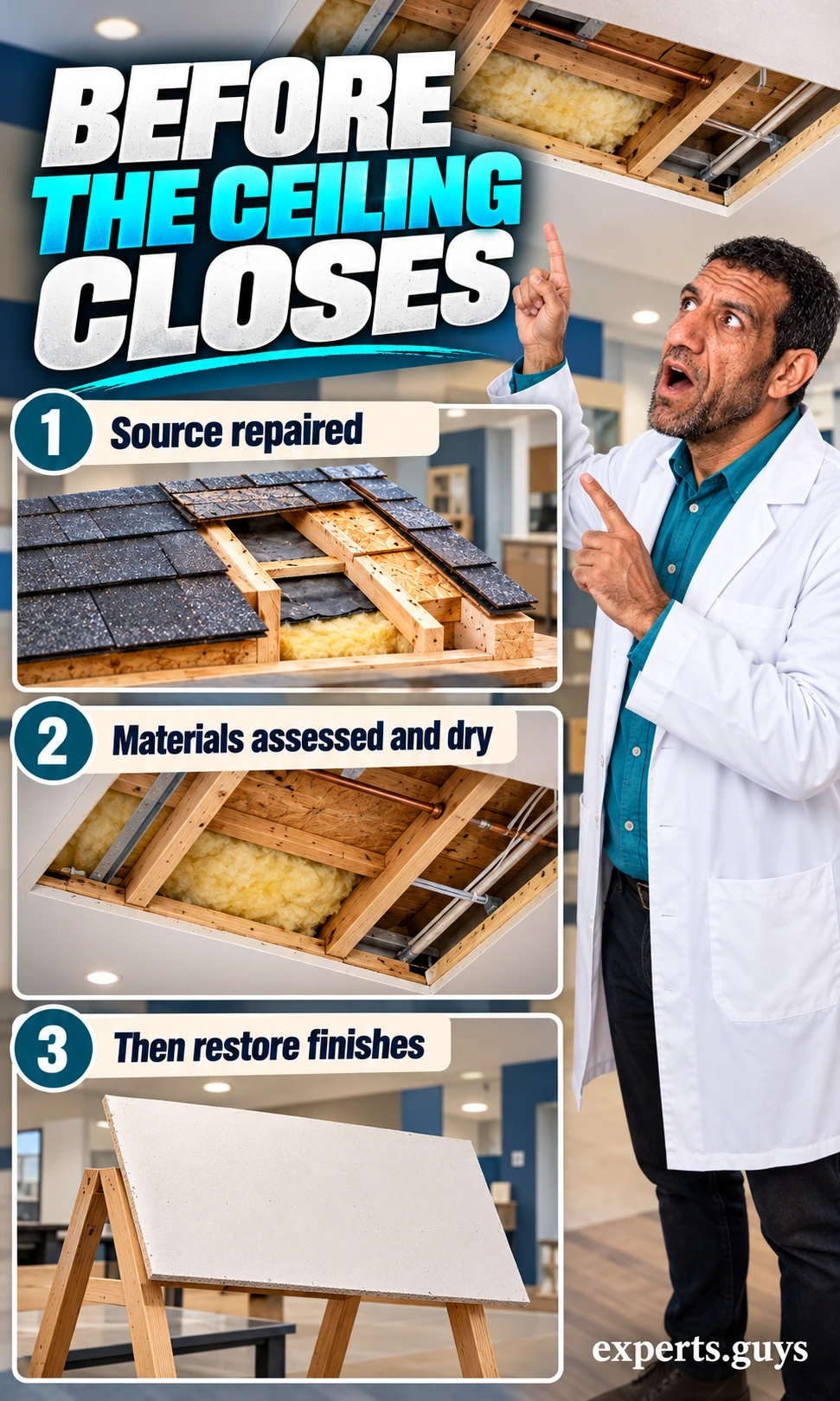
The images use teaching models and staged comparisons to make the decisions visible. An open roof cutaway illustrates layers and scope; it is not a construction detail or a completed weatherproof roof. Actual installation details must follow the selected roofing system and applicable requirements.
What should the final handover show?
Compare the completed work with the agreed locations and outcomes from the floor or another safe, accessible position. Ask the contractor to show inaccessible work through their own completion evidence. You should not have to walk on a roof, enter a damaged attic or open a ceiling to accept a repair.
- Match the location: identify the repaired roof area and the interior area that was included.
- Match the outcome: ask what was replaced, what remained and how concealed areas were assessed before closing.
- Resolve the remaining work: clarify unfinished paint, trim, cleanup or another trade’s responsibility.
- Confirm aftercare: establish who handles recurrence, what the workmanship warranty covers and what exclusions remain.

If stain matching matters, settle the paint boundary before work begins. A small patch can differ from an aged ceiling even when the substrate repair is sound. Ask whether the price covers only the patch or a larger continuous surface, and whether texture matching has practical limitations. This is a finish expectation, separate from confirming the water problem is resolved.
A quiet period after repair is reassuring but does not test every weather condition. Agree how a recurrence will be handled and distinguish an unfinished repair from a different water source. Do not spray water onto the roof to create your own test; any controlled testing should be appropriate to the assembly and performed by someone competent to manage it.
Use Repair Scope Check to find the missing decision
Select what is known about the proposed work. The result highlights the next clarification; it does not approve workmanship, assess structural safety or estimate a price. You can use the questions verbally without saving anything or creating an account.
BEFORE WORK IS HIDDEN
Repair Scope Check
Find the next question to resolve before the repair moves forward.

This checks missing scope information, not roof safety, workmanship or insurance coverage. No answers are stored or sent.
Find suitable local help
Use a roofer for the roof boundary, a restoration contractor for affected materials, and an appropriate building professional for structural concerns. For immediate danger, use local emergency help rather than a contractor search.
Compare three candidates
Confirm relevant experience, applicable credentials, availability, scope and aftercare. Search results are not endorsements. Compare reviews critically alongside these details.
No candidate details are stored, ranked or sent. The action card contains only the scope result.
Questions that often remain
Will insurance pay for the whole repair?
Coverage cannot be inferred from a roof leak alone. Cause, policy terms, exclusions and the insurer’s assessment matter. Ask the insurer about the actual event and proposed work; do not rely on a general promise that all wet-attic or roof-leak repairs are covered.
Is a temporary patch the same as a permanent repair?
No. Temporary protection reduces further exposure while permanent work is arranged. Ask how long the measure is intended to serve, what conditions limit it, and what permanent work remains.
Does a long warranty mean the repair scope is complete?
No. A warranty can apply to a narrowly defined repair and exclude other areas or interior damage. Read the covered work, duration, reporting process and exclusions alongside the scope.
What if the water problem is really gutter overflow?
The repair decision changes when runoff is the problem. Use the roof-runoff guide for that water-management job rather than treating every overflow as a damaged roof covering.
Can the ceiling be repainted if the stain is old?
Possibly, but first establish that the source is resolved, the material is suitable to keep and the area is dry. Paint is a finish treatment; it cannot establish those conditions.
Next steps
Choose the unresolved boundary: the roof repair, the concealed damage, the drying decision or the interior finish. Ask the responsible contractor to explain that boundary before the next stage hides it. If the water is escaping at gutters and downspouts, continue with roof runoff and drainage; if the concern is moisture beyond the visible surface, see hidden water damage inside walls.
Compare Local Home Specialists Near You
Tell us what kind of help you need, then compare nearby businesses by location, Google rating, review volume and contact options.
HomeFix Local Match
Turn a home problem into a practical local hiring decision. Check the clues, see the specialist types that fit, open focused surrounding-location searches, then compare the strongest three before you call.
 YOUR PROBLEM
YOUR AREA
COMPARE 3
✓ Ready to compare
What is happening?
Choose the closest problem type, then check every clue that applies. Your selections change the specialist order.
Where should the search focus?
Use Google’s “near me” context or enter the area you actually want a specialist to serve.
Simple local search: open nearby Google results, choose the businesses that look suitable, then compare your best three here before you call.
Problem snapshot
Who should you call first?
These are the specialist types most likely to fit the clues you selected.
Search around your location
Compare your top three
Use the same factors for each option so a high star rating does not hide a weak scope, poor diagnosis, missing credentials or unclear aftercare.
Comparison result
Your result combines the Google signals you entered with the practical hiring checks you completed.
Questions to ask every finalist
Use the same questions with each shortlisted business so the comparison stays consistent.