



Semantic network analysis can connect words that occur together to show themes in a collection of text. In Reddit discussions about bipolar and depressive disorders, those patterns can help explain what people talk about, but they cannot tell you which diagnosis you have or which treatment to choose.
What did the Reddit research actually find?
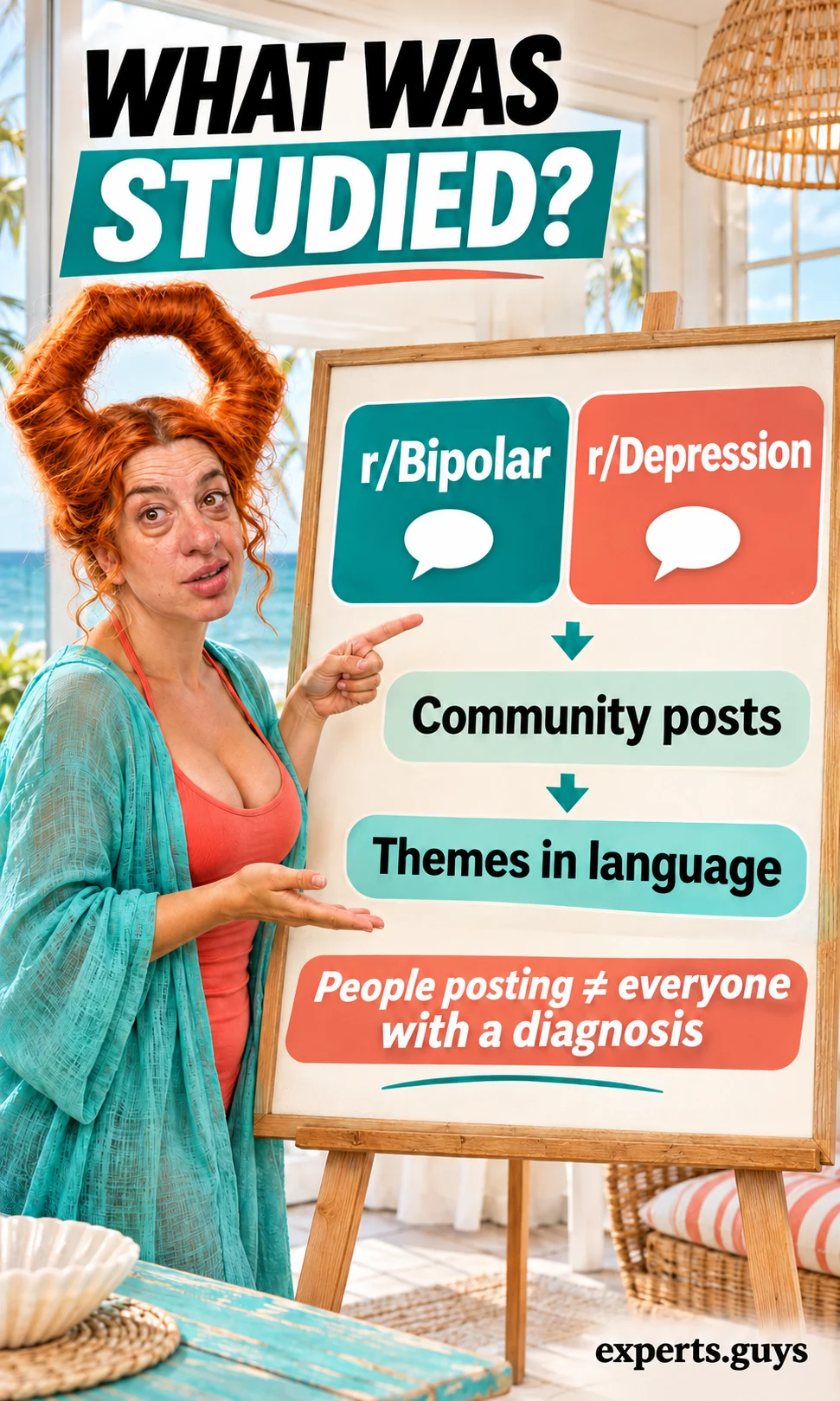
The useful finding is about shared concerns and differences in discussion emphasis. A paper by Minjoo Yoo, Sangwon Lee and Taehyun Ha, published in Information Processing & Management in 2019, examined material from r/Bipolar and r/Depression. The research abstract and bibliographic record provide the original findings and publication details; this is historical research, not a live description of either community.
Both communities discussed sleep difficulties and financial problems with negative emotional language. Medication received more attention in the bipolar community, while suicide-related discussion was more prominent in the depression community. These are observations about the material studied, not rules for what any individual with either condition feels or discusses.
The distinction matters when a familiar post feels unusually convincing. Recognizing your experience in someone else’s words can feel meaningful, but resemblance does not establish a shared diagnosis. Likewise, the study’s difference in suicide-related discussion is not a measured comparison of suicide risk.
Keep the research question attached to its answer. “What themes appear in these discussions?” is a different question from “What is causing my symptoms?” The study is useful for the first question; a personal health decision needs information that a collection of posts does not supply.
- Useful: noticing concerns that deserve clearer explanations or more supportive communication.
- Not established: the proportion of all patients who have a particular experience.
- Not justified: diagnosing yourself, ranking someone’s suffering, or changing medication because a thread sounds familiar.
This also changes how the findings should be used by a writer, researcher or support-group organizer. A recurring discussion about treatment costs can suggest that readers need clear information about accessing care. It does not show which service is available to a particular person, whether a treatment works, or whether the people who did not post had the same concern.
For readers whose immediate question is a change in an already diagnosed condition, the guide to recognizing a possible return of bipolar depression addresses that separate decision. Here, the task is to interpret a research result without turning it into a symptom checklist.
How do words become a network, and what gets lost?
A semantic network is built from a defined collection of text and rules for connecting its terms. In a co-occurrence approach, a word can become a node and two words receive a connection when they appear within the chosen unit, such as a sentence or post. The chosen unit changes what the connection means: sharing a long post is weaker evidence of a close relationship than sharing a short phrase.
Preparing text involves choices about spelling, word forms, repeated material and words to exclude. The original paper describes cleaning, tokenization and stemming before constructing word matrices and networks. Those steps make large collections easier to examine, but the resulting representation is a simplified version of the language, not a complete reading of every person’s situation.
Consider three invented sentences: “I cannot sleep,” “I do not need much sleep,” and “My friend cannot sleep.” All contain the word sleep, yet the first describes difficulty, the second describes a different experience, and the third is about another person. A display that retains only the shared word can erase that difference.
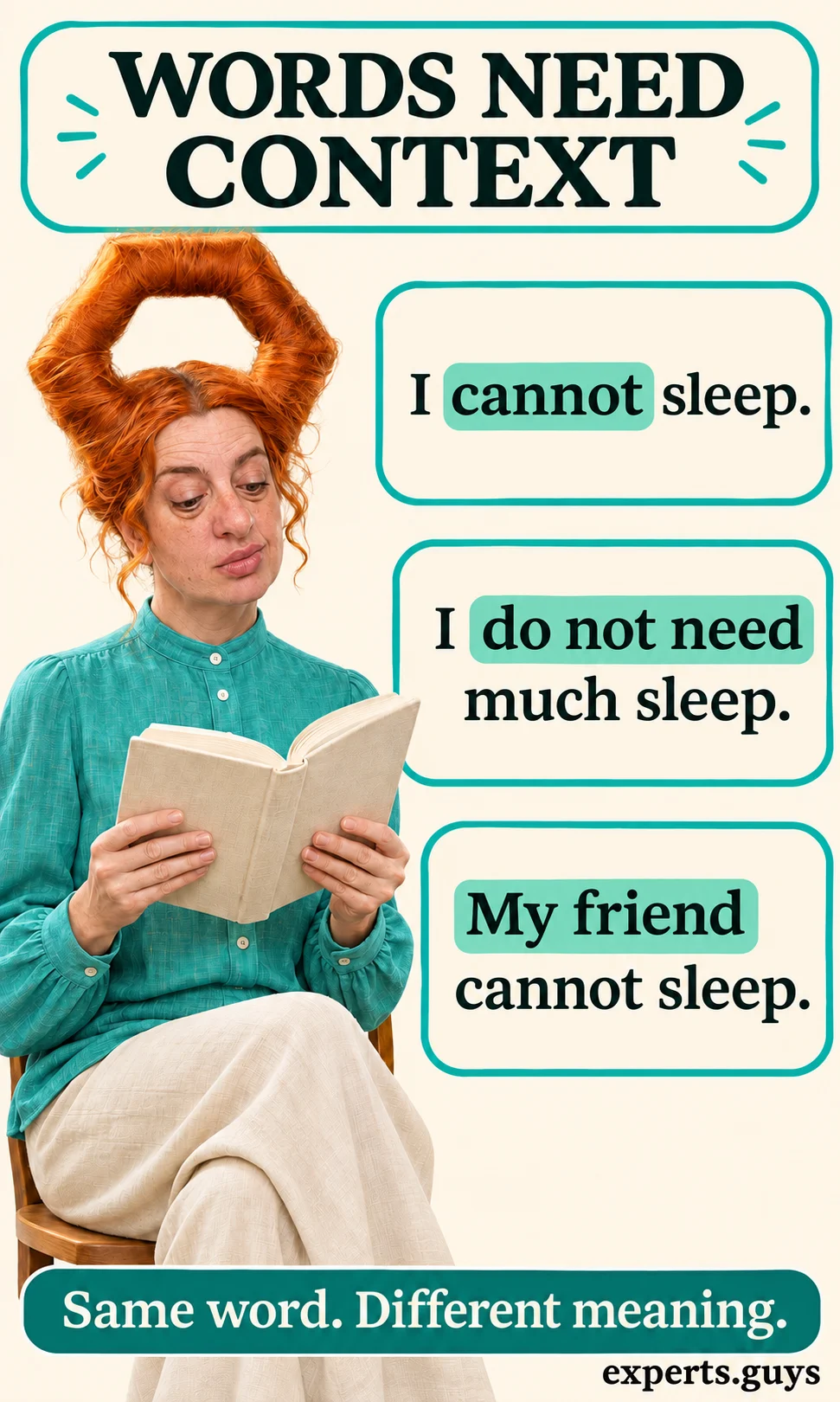
Negation deserves particular care. Removing “not” can reverse a sentence; treating “no longer worried” as equivalent to “worried” can lose improvement over time. Quoted advice, a question about a medication and a report of taking that medication are also different uses of the same term. A network is most informative when its interpretation remains connected to the underlying text.
A readable legend should explain what a node represents, how a link was counted and what visual properties mean. Node size might show frequency or a centrality measure; line thickness might show a connection weight; colors might identify clusters. None of those conventions is universal, so inspect the figure caption before assuming that large, thick or red means what you expect.
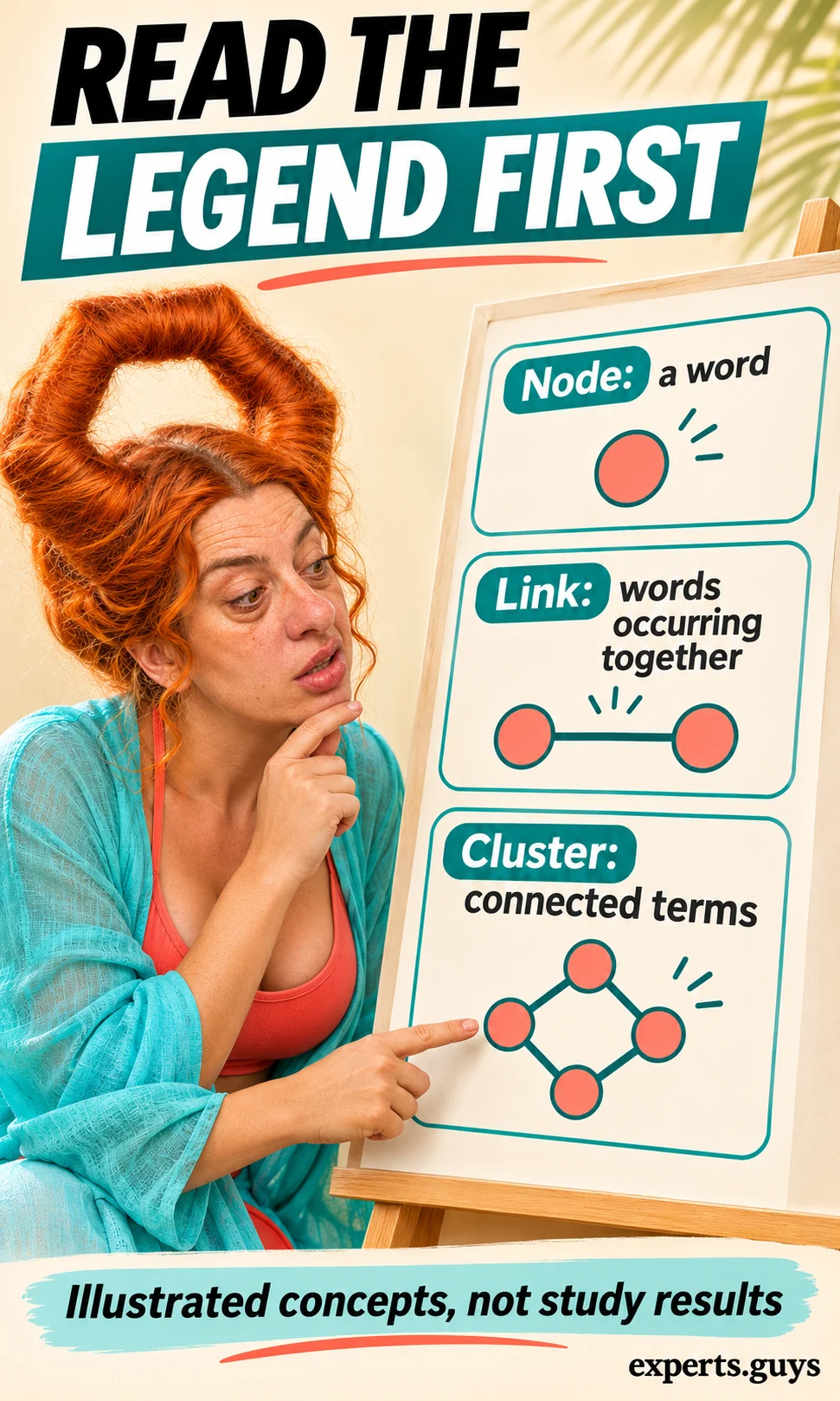
The terms below help separate what a picture encodes from what a reader may be tempted to infer. They are general reading concepts, not a reconstruction of the original study’s settings or numerical results.
| Network element | What to check | What it does not prove |
|---|---|---|
| Node | Whether it represents a word, phrase or another unit. | A person, a diagnosis or a symptom count. |
| Link | The text window and rule used to connect terms. | That one experience caused another. |
| Weight | Whether it counts occurrences, documents or a normalized relationship. | The clinical severity of the connected topics. |
| Cluster | How terms were grouped and how the label was chosen. | A medically validated subtype. |
| Centrality | Which measure of connectedness or position was used. | That the term is the most important treatment target. |
A tiny example shows why the counting rule matters
Imagine a deliberately invented collection of four short posts. “Sleep” and “work” appear together in two posts, and “sleep” appears alone in the other two. Under a rule that counts each pair once per post, the sleep-work connection has a weight of two. Repeating “work” ten times inside one of those posts would not increase that weight under this particular rule; counting every word occurrence could produce a different result.
This example is useful because it forces the denominator into view. Two connected posts out of four is a statement about this invented collection. It is not a claim that half of people with depression have work problems, and it cannot tell us whether sleep affected work or work affected sleep. The arithmetic is simple; the interpretation is where mistakes enter.
Thresholds add another layer. A researcher may hide weak connections to make a crowded picture readable, so an absent line can mean “below the display threshold,” not “never mentioned together.” A large, dense illustration can also be difficult to interpret without supporting methods. If the legend and method are missing, the responsible conclusion is that the graphic does not provide enough detail for a strong inference.
Why can a community pattern not diagnose a person?
A discussion sample and a clinical assessment answer different questions using different evidence. People choose whether to join, post, reply or remain silent. One account can contribute repeatedly, a person can participate in more than one community, and a post can describe a relative rather than its author. Those possibilities prevent a simple conversion from posts to independently assessed people.
For example, fifty mentions of a medication could come from a long exchange involving a few accounts. Another collection could contain fifty brief posts from different accounts. Even if the word count were identical, the social situations would differ; neither count by itself establishes fifty independently assessed patients.
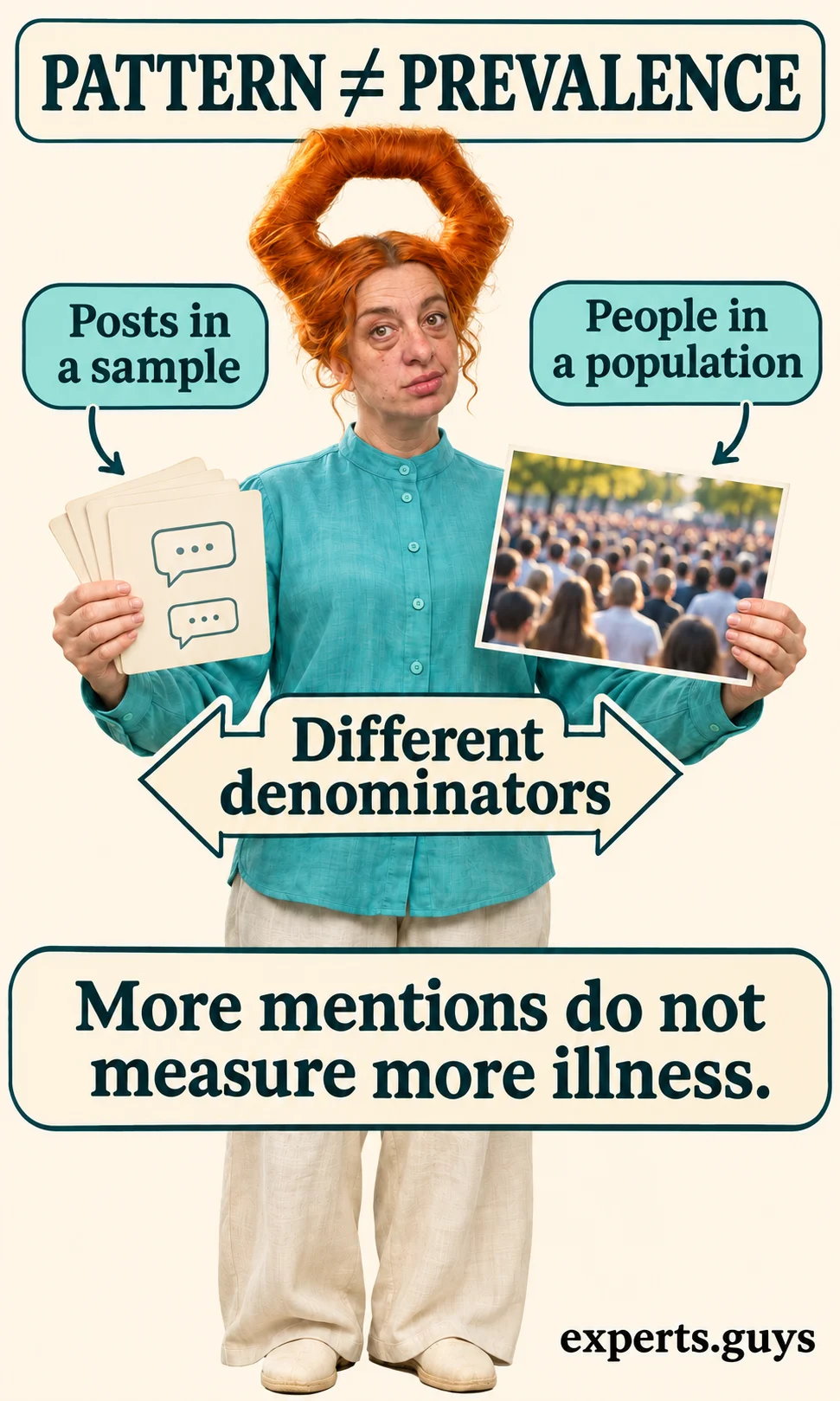
Selection affects what becomes visible. A forum can attract people who are seeking answers, struggling with access or responding to a difficult event. People who are doing well, prefer another language or avoid public discussion may be less visible. This does not make their experiences less important; it means that a visible conversation is not automatically a representative picture of everyone with a condition.
Community rules and conversational habits can shape the vocabulary too. A place that encourages treatment questions may generate more medication language than a place that discourages detailed treatment discussion. That is an alternative explanation to consider when reading a comparison, not a claim about the current rules of these particular communities. Historical results should not be presented as a real-time community profile.
The missing information is clinical, not just linguistic
Bipolar assessment considers the course, severity and impact of symptoms across a person’s life, including past periods of unusually increased activity or elevated or irritable mood. Depression alone does not establish bipolar disorder. The NIMH bipolar disorder guide explains why an evaluation can also consider medical conditions, medicines and other possible explanations.
Everyday words need that context. Difficulty sleeping with exhaustion is different from a reduced need for sleep with unusual energy, but one phrase does not settle a diagnosis. For a focused explanation of this distinction alongside low mood, see irritability, sleep and energy in bipolar depression. Avoid treating vocabulary as a shortcut around an assessment.
The same caution applies to apparently reassuring language. A person who writes briefly or positively may still need help, while a long, negative post is not a calibrated severity score. Tone, irony and the purpose of the message matter. The absence of a word from a post is not evidence that the associated experience is absent from the person’s life.
- Population error: replacing “posts in this sample” with “people with this illness.”
- Causal error: replacing “mentioned together” with “one caused the other.”
- Diagnostic error: replacing “sounds familiar” with “proves my diagnosis.”
- Treatment error: replacing “helped this poster” with “will be suitable for me.”
How can you use an online discussion without overreading it?
Treat a discussion as a possible source of perspective and questions, then match the next action to the strength of the evidence. You do not need to record your feelings, score yourself or collect more matching posts. The useful endpoint is a clearer decision about whether to keep reading, verify a claim, stop the comparison or seek personal support.
Use a claim-to-action check
Use this three-question check when a post makes a health claim or recommends a treatment. It is a reading method, not a clinical screening test. Keep one claim in view; if concentration is limited, start with the first question and stop there.
- What is being claimed? Separate “this happened to me” from “this happens to everyone” and “you should do this.” A sentence can move between these claims without explaining why.
- What evidence supports it? Identify whether the support is a personal account, a study of discussion language or evidence about an actual treatment. A link matters only if it supports the same claim.
- What action does that justify? A story may help you feel understood or form a question. It does not establish that a medication change is appropriate for you.
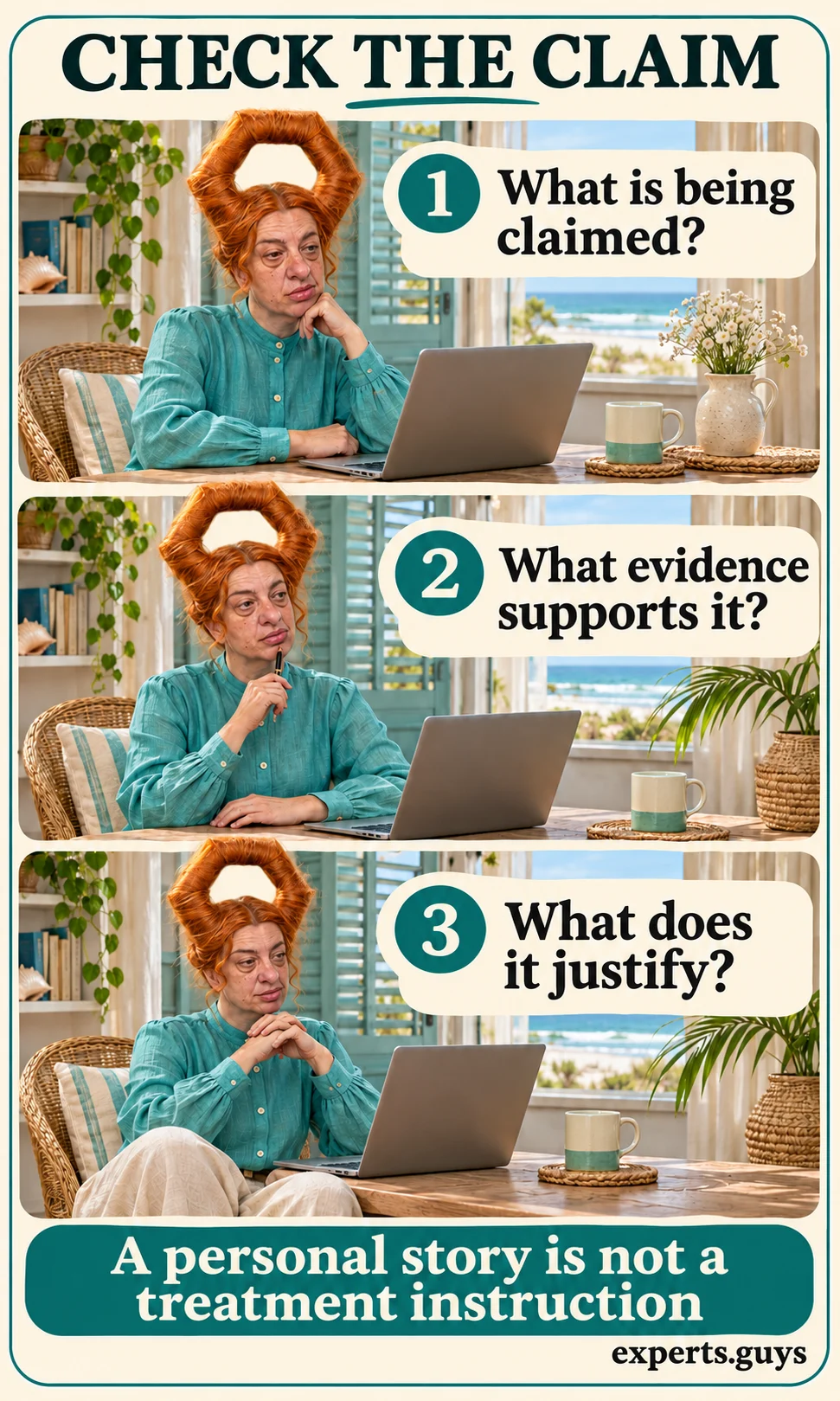
Here is an invented example: a commenter says they felt better after changing a medication, and another reader concludes that everyone should stop taking it. The first statement describes one reported experience; the second adds a general instruction. Missing information includes the original treatment reason, other changes, professional supervision and what happened later. The appropriate next step is to discuss a concern with the prescriber, not copy the instruction. Do not stop or change prescribed medication on the strength of a post.
Completion means that you can name the claim and the limit of what it supports. You do not have to prove the poster wrong or win a debate. If the linked evidence is unavailable or too technical to assess, “I cannot verify this” is a useful stopping point. Ask a suitable professional about a consequential treatment claim rather than substituting comment popularity for verification.
When reading turns into repeated self-comparison
If you keep opening more threads to decide which label fits, end that reading session before adding another comparison. The following physical sequence changes what you are doing with the screen; it is an everyday boundary, not a tested treatment for depression or bipolar disorder. Use it in a safe setting, with the device within comfortable reach, and preserve any access you need for support.
- Stop the scrolling action. Rest your hand beside the touchpad or put the handheld device down on a stable surface.
- Close the discussion. Close the laptop gently or turn its display away. Do not disconnect a device you currently need for communication or care.
- Turn your attention toward the room. Turn your head or chair only as comfortably as you can. Let the reading session end without replacing it with another diagnostic search.
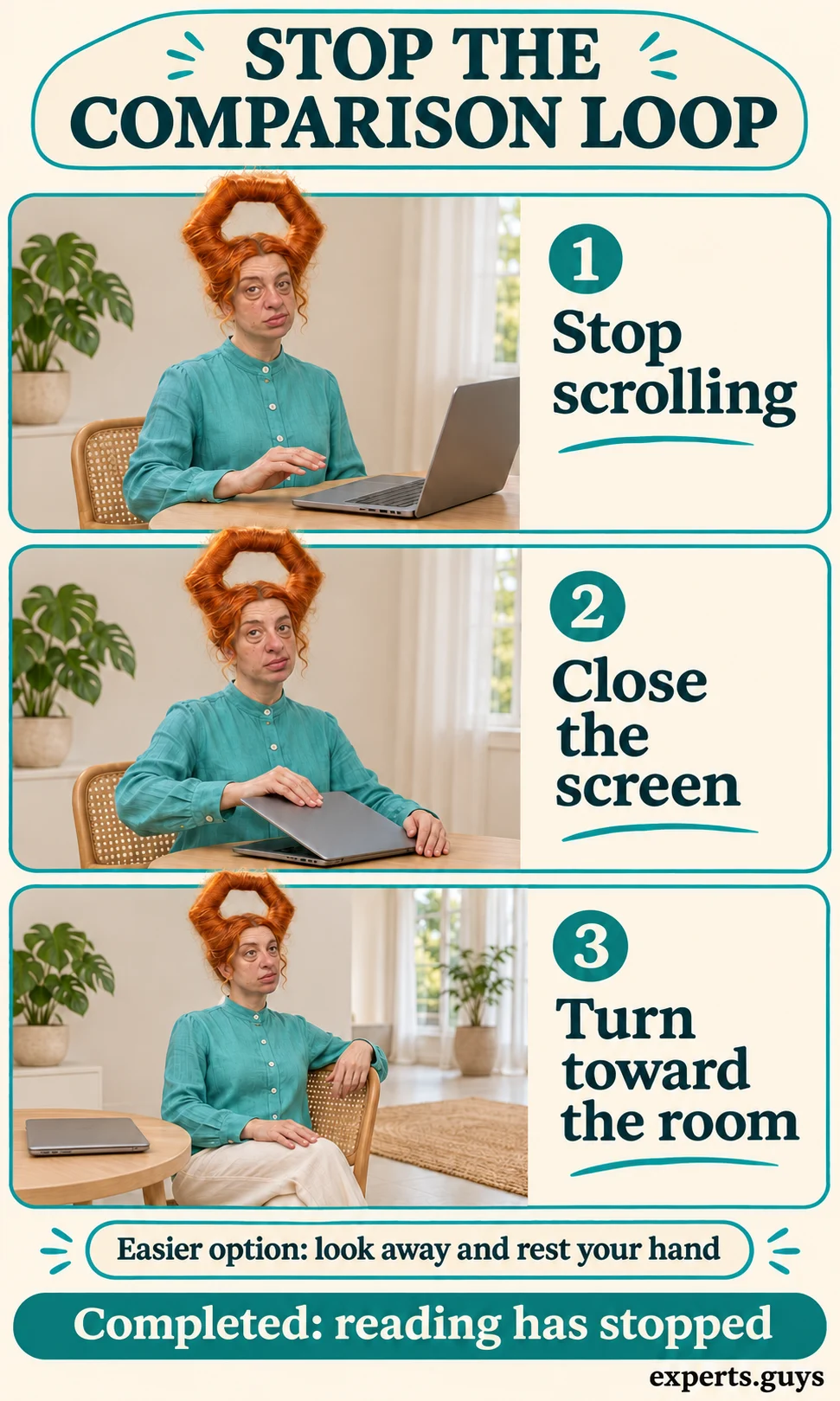
In an illustrative example, a reader has opened several threads about sleep and is repeatedly comparing individual phrases with their own night. They stop moving the touchpad, close the laptop and face the room. The observable result is simply that the search has stopped. They may still feel uncertain; a better mood is not required for this step to count.
The smaller version is to look away and rest your hand while staying seated. If closing or moving the device is difficult, ask a willing person to help, or leave it in place. A common mistake is using the pause to open a different forum immediately. If the underlying concern remains important, move toward a real conversation rather than repeating the same comparison in a new tab.
Ask for help with the actual change
When an online account raises concern about your own experience, speak about what has changed rather than presenting an internet label as a conclusion. Choose a trusted person who is available and willing to listen, and sit or stand in a comfortable position. An illustrative opening is: “I noticed a change in my sleep and energy, and I am concerned. Can you help me arrange an assessment?” If that is too much to say, start with “I need some help with a health concern” and ask someone to stay while you arrange care.
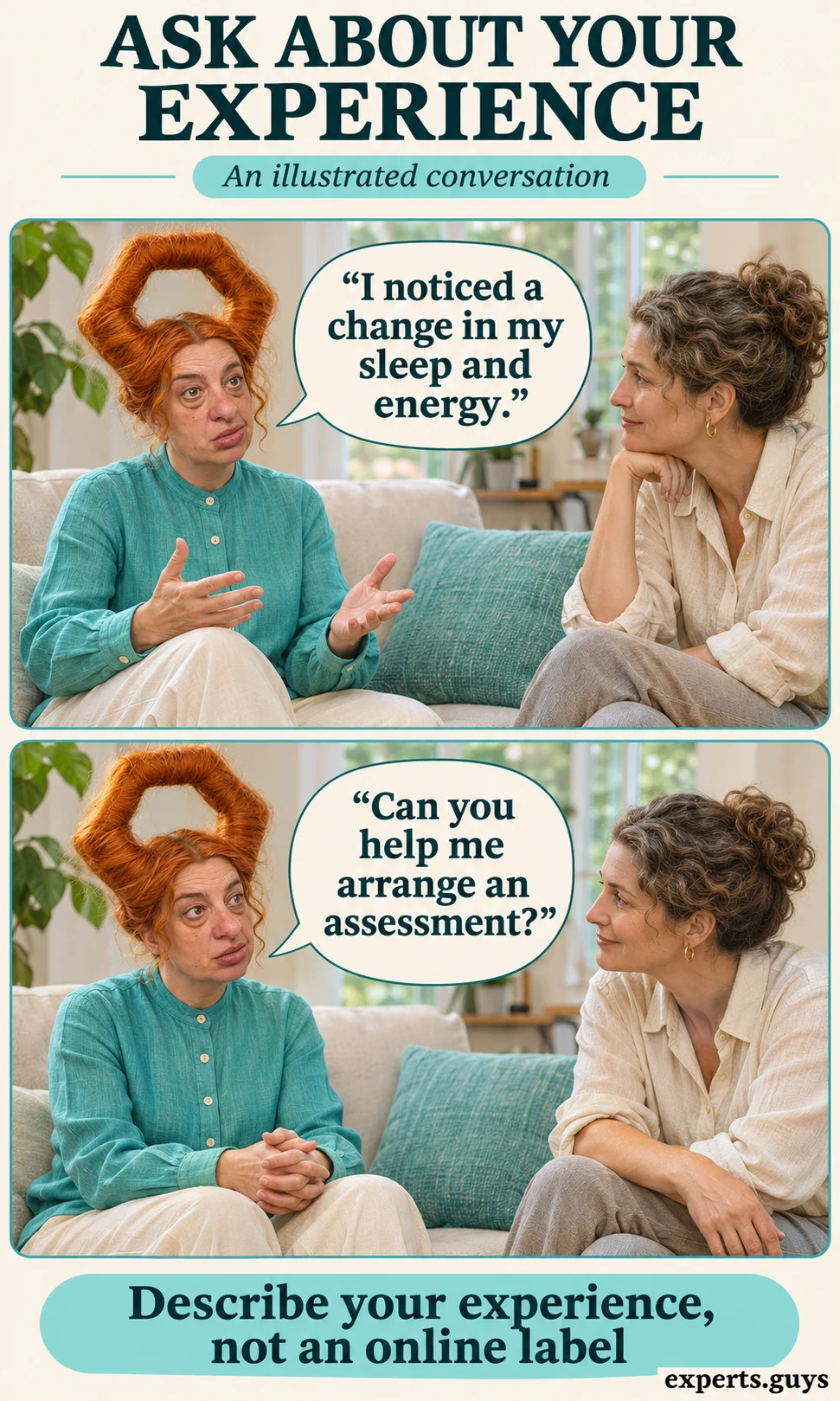
The conversation is complete when you have expressed the concern and made a specific request, even if arranging help takes another step. The other person does not need to interpret a network graphic or decide whether you meet diagnostic criteria. If they respond by debating labels, return to the request for support. If they are unavailable, choose another appropriate source of help; their response is not a measure of whether your concern is valid.
Arrange a clinical assessment for persistent, worsening or disabling mood changes. Rapidly escalating activity, very little sleep with unusual energy, or new confusion or psychotic symptoms needs prompt attention. If there is immediate danger or you cannot stay safe, seek urgent local emergency care; do not continue searching for matching posts. This article explains research interpretation and does not provide a diagnosis.
Questions readers still ask
Does joining a bipolar subreddit confirm that someone has bipolar disorder?
No. Membership and posting are not clinical verification. A participant may be seeking information, supporting someone else or using language informally. Do not infer an individual diagnosis from community participation.
Is semantic network analysis the same as sentiment analysis?
No. Semantic network analysis examines relationships among terms or concepts. Sentiment analysis classifies aspects of evaluative or emotional language. They can be used together, but a connection between words and an emotional-language label answer different questions.
Does a cluster label come directly from the people who posted?
Not necessarily. A label can be an interpretation assigned to a group of connected terms. Read the methods to see how labels were produced and checked; the label should not be treated as a clinical category.
Can researchers quote public mental-health posts without further consideration?
Public visibility does not remove privacy concerns. Exact wording may make a sensitive account searchable. Avoid sharing usernames or reproducing another person’s story unnecessarily, and consider the relevant research ethics and access requirements before collecting or publishing material.
Can a later study be compared directly with this one?
Only after checking whether the communities, collection periods, text units, cleaning rules and network measures are comparable. A visually similar graph may have been built differently. Changes in methods can look like changes in people’s experiences.
The decision to take away
Use the Reddit research to understand the conversation: which concerns recur, how language is connected and where an interpretation may go too far. Use your own lived changes to decide what support to seek. When a post moves from experience to diagnosis or treatment advice, pause at that jump and check what the evidence actually supports.










