
Baked pumpkin spice donuts can stick when the center post is poorly coated, the crumb is too fragile to lift, or the batter rises over the post. Start by checking that they are baked through, follow the recipe’s resting instructions, and loosen the inner and outer edges gently before pulling on a ring. A torn hole and a wet, collapsing center need different fixes.
Check where the donut failed
Look at the donut and the cavity together. An intact outer edge with a torn inner edge directs attention to the center post; a ring that collapses everywhere directs attention to its structure. These observations narrow the next check, but they do not prove a single cause.
This guide concerns cake-style pumpkin donuts baked in shaped cavities. A fried yeast donut follows a different process, and a muffin tin does not create the same contact around a center post. Keep the original recipe beside you rather than replacing its baking directions with a universal temperature or time.
Before trying another release, separate pan adhesion from an unfinished bake. A browned top can sit above wet batter, while a fully baked ring can still catch on the cavity. More grease on the next tray will not solve both problems.
- Torn at the hole: check the center post’s coverage and contact before lifting again.
- Wet batter or collapse: resolve the recipe’s doneness check before attempting release.
- Closed hole: check whether the portion covered the post or left insufficient room to rise.
- Peeling or chipped coating: stop using the damaged pan and check the food for coating debris.
Grease the post, not just the bottom
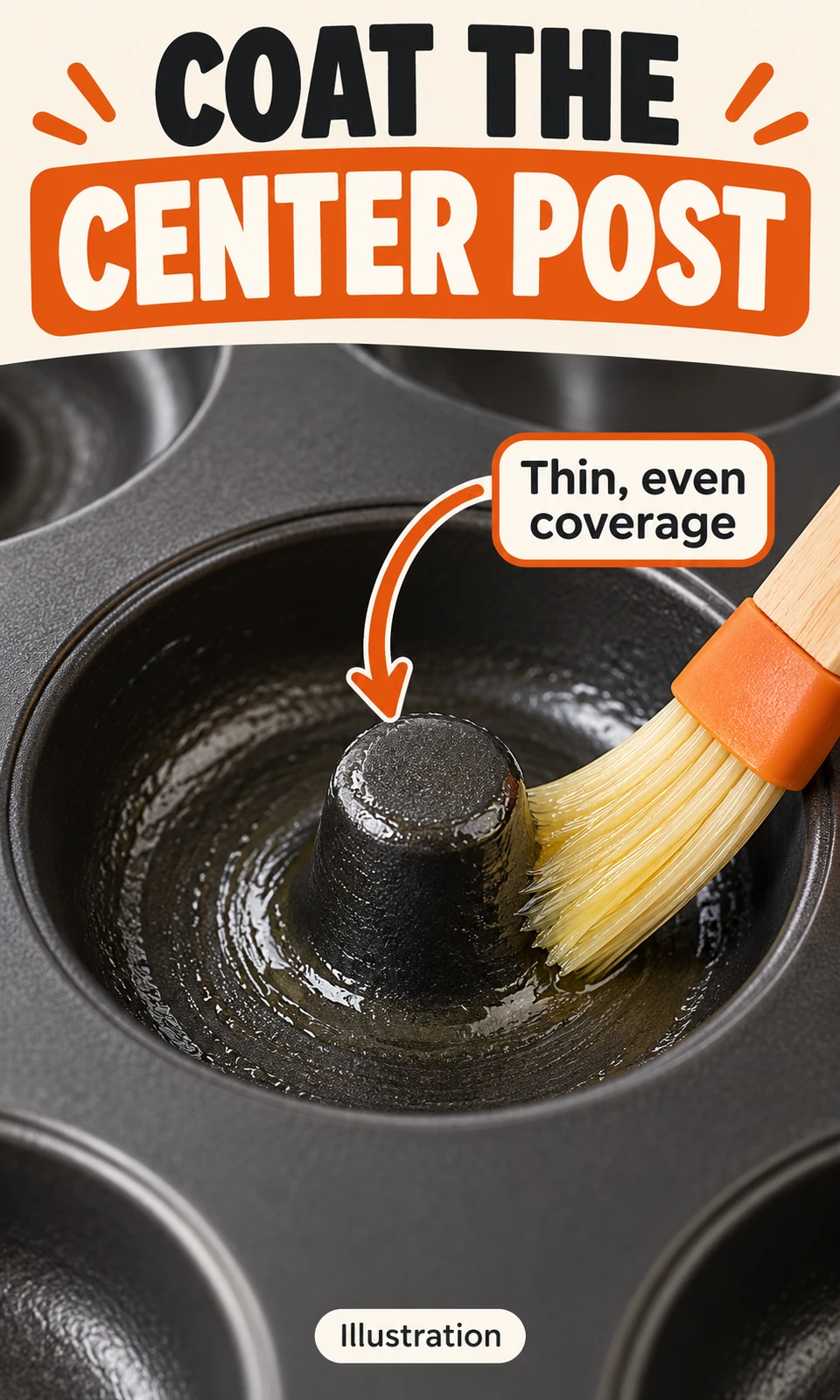
The center post is easy to miss when spray is aimed straight down into a cavity. The practical check is coverage: inspect the sides of the post as well as the curved well. Use the preparation method allowed by the pan manufacturer, with a thin, even coat rather than a puddle.
Nonstick describes a surface treatment, not a promise that every batter will release without preparation. Wilton’s donut-pan guide recommends a light coating of nonstick spray for its pans. Another manufacturer may specify a different method, so its instructions should control your choice.
A spray, wiped oil and softened butter are not interchangeable test results. Each can be applied unevenly, and a familiar method can behave differently on a worn surface. Choose an approved preparation method first, then check whether the post was actually covered before comparing fats.
Clean away old crumbs and residue before another batch. Let the pan cool enough to handle safely, wash it as directed and dry it before preparing it again. Avoid turning a release problem into coating damage by scraping with sharp metal or abrasive cleaners.
Rest before release, then check gently
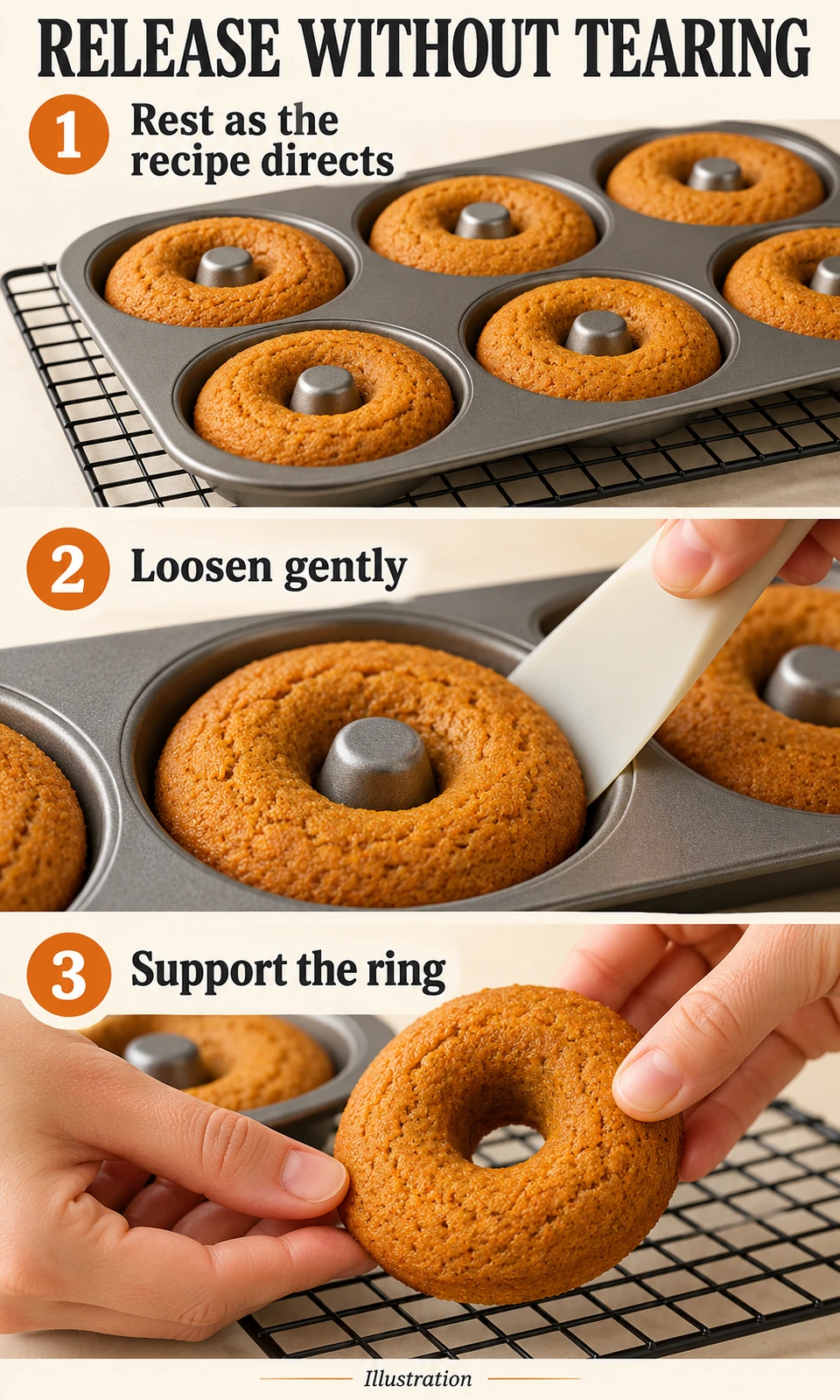
Use the cooling step in your own recipe. In King Arthur Baking’s pumpkin cake-donut method, the rings rest for about five minutes before their edges are loosened. That is a useful example, not a guaranteed release window for every formula, cavity size or silicone mold.
Pulling a ring while it is very hot adds handling stress while it may still be fragile. Waiting until it is cold does not guarantee that an attached section will let go. At the recipe’s suggested point, try gentle loosening and stop if the crumb begins to tear.
How to release a donut that is already stuck
Protect your hands from the hot pan and place it on a stable, heatproof surface. Choose a thin, flexible, food-safe utensil that is suitable for the coating, rather than using a sharp metal knife as a lever. The aim is to separate the contact gently, not to lift the entire donut from one point.
- Follow the recipe’s doneness and rest instructions before handling the ring.
- Trace the contact around the center post gently, then check the outer edge.
- Support the donut as you transfer it to a rack; do not tug through the hole.
- If it starts to break, stop forcing it. Inspect the separated pieces before deciding how to use them.
A fully baked ring that breaks during handling may still be usable as pieces. That does not apply to raw batter, food contaminated by coating fragments, or a perishable topping held outside refrigeration too long. Presentation failure and food safety are separate questions.
If the crumb is visibly wet or unset, treat that as a baking problem first. For a freshly baked batch still in its oven-safe pan, follow the recipe’s guidance for finishing the bake and checking doneness. Do not taste raw batter to decide whether it needs more time.
Why the hole baked closed
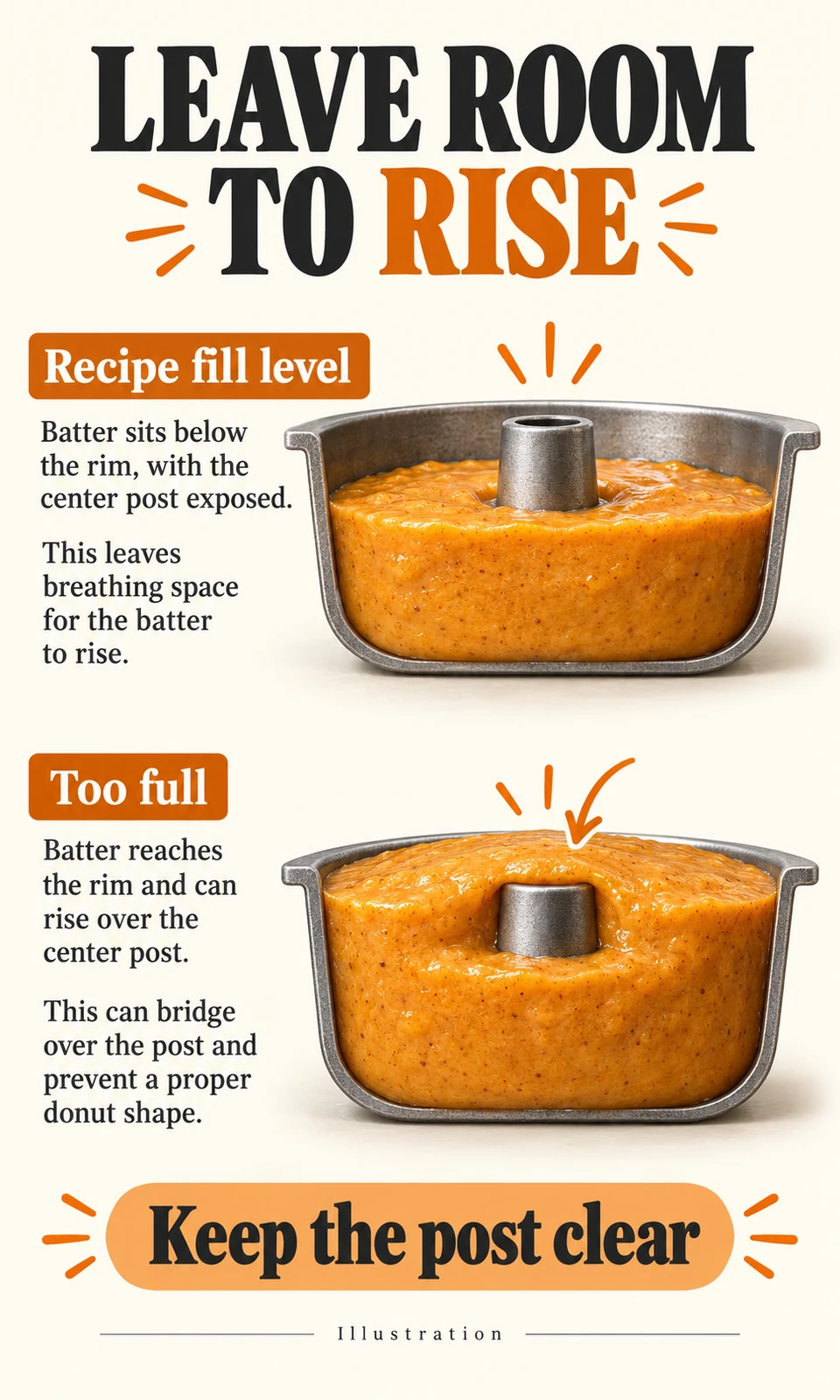
A donut cavity leaves a ring because the post occupies its center. Batter placed over a short post can form a bridge as it rises, even if the underside eventually releases. Check the portion before blaming the grease or trying to carve out every hot center.
Use the fill level in the recipe and check that the post remains clear. Wilton describes a range of roughly two-thirds to three-quarters full depending on the recipe, rather than one quantity for every cavity. A tablespoon measurement from a different pan can be misleading when the well is smaller or shallower.
Pipe or spoon the batter around the post instead of depositing a mound directly on it. If you have already made a batch with closed holes, reduce the next portion to the recipe’s intended level and keep the other variables steady. A changed batter formula needs its own evaluation, not just a smaller scoop.
Metal and silicone need different handling
Silicone can flex away from a baked ring, but that flexibility does not repair an unset crumb. Follow the maker’s preparation and support instructions, and avoid stretching the mold so abruptly that the donut breaks. For metal, preserve the surface and use gentle loosening rather than twisting a rigid cavity.
| What you see | What to check next |
|---|---|
| Inner edge tears; outer edge is intact | Center-post coverage and gentle loosening. This pattern suggests a contact point, not a confirmed cause. |
| Whole ring sticks after the crumb sets | Cavity preparation, residue and pan condition; stop scraping if the coating is damaged. |
| Donut collapses or has wet batter | Recipe measurements and doneness before changing the grease. |
| Hole is covered by baked batter | Recipe fill level and whether the center post was clear before baking. |
| Same cavity fails across batches | Inspect that cavity closely and compare with an intact pan before blaming every ingredient. |
Make one change on the next tray
A useful home comparison keeps the recipe, pan, oven setting and portion consistent while changing one factor. Start with the problem you observed: post coverage for a torn inner edge, for example, rather than simultaneously changing flour, grease and cooling time. Record what changed and whether the same cavity still failed.
If you want to compare release times, mark separate cavities and record the actual time from oven removal. A proposed two-, five- and fifteen-minute comparison can help organize observations, but it is not evidence that one of those times is best. Stop handling a ring that is visibly too fragile, and do not confuse a single tray with a result that applies to every pan.
Choose the next check for your batch
Use Donut Release Studio to match your symptom with the pan, fill level and crumb condition. It returns a short action sequence without a score or a claimed probability. You can open an A4 report with your observations and a space to record one change on the next tray.
Donut Release Studio
Find your next check before another ring tears.
Match what you can observe: the pan surface, center-post coverage, fill level and crumb. This check suggests an action; it cannot establish the cause or certify food safety.
Check the post before pulling
A ring that tears at its inner edge needs a gentle check around the center post. Confirm that the crumb is set before trying to lift it.
- Follow your recipe’s rest instructions.
- Loosen with a flexible food-safe utensil suitable for the pan.
- Support the ring and stop if it tears.
These are possible explanations, not a measured diagnosis. Use your recipe and pan manufacturer’s instructions.
Keep cream-cheese-glazed donuts refrigerated unless the specific topping has validated room-temperature storage instructions. See the article for handling limits.
Add the topping after the release problem is resolved
For cinnamon sugar, use the coating stage specified by the recipe rather than assuming every donut needs an extra butter layer. A dry surface may need a light brush of melted butter if that suits the formula; a delicate ring needs careful handling. Coat only after it can withstand the process without breaking.
Let donuts cool before adding a glaze that requires a cooled surface. A thin glaze running off a warm ring is a topping problem, even when the donut itself released perfectly. Diagnose those steps separately instead of increasing the batter’s flour to compensate for icing behavior.
For homemade cream-cheese glaze, use refrigerated storage unless the specific formula has validated room-temperature handling instructions. Applying official guidance for perishable foods, refrigerate at 4°C / 40°F or below and discard if left out for more than two hours, or one hour above 32°C / 90°F. Cooling or reheating afterward does not undo an exceeded holding limit.
Frequently asked questions
Why do my donuts stick even though I greased the pan?
The coat may have missed the center post, but grease is only one possible factor. Check whether the crumb was set, the batter covered the post, or the cavity was dirty or damaged. Compare the failed contact area before changing the preparation method.
How long should baked pumpkin donuts cool in the pan?
Follow the recipe’s release instructions. About five minutes is one published pumpkin cake-donut example, rather than a universal rule. Pan size, batter and handling condition can change what works.
Why did the holes in my baked donuts close?
The portion may have reached or risen over the center post. Follow the recipe’s fill level and keep the post clear before baking. A closed hole does not by itself establish that the crumb is underbaked.
How do I get cinnamon sugar to stick after the donuts release?
Use the recipe’s coating method. If the surface is dry, a light brush of melted butter can help when appropriate to the formula. Handle the ring gently and add the coating close to serving.
Can I use pumpkin pie filling instead of pumpkin puree?
Do not assume they are interchangeable. Pumpkin pie mix can include sugar and spices that the donut formula has not accounted for. Use the specified ingredient or a recipe written for the product you have, rather than guessing a correction.
Do baked pumpkin donuts need to be refrigerated?
The topping and recipe determine storage. Follow the recipe for plain donuts, and treat homemade cream-cheese glaze as perishable unless its room-temperature handling has been validated. Refrigeration does not rescue food already held out beyond the applicable limit.
A cleaner release starts with a narrower check
Check the bake first, the contact point second and the portion before the next tray. Keep the pan intact, prepare it as directed and support the ring instead of forcing it through the hole. For more seasonal baking ideas, browse the site’s fall baking notes and choose a complete recipe suited to your ingredients and pan.