



Bipolar relapse prevention means reducing the chance that depression, hypomania or mania returns after a period of greater stability. Ongoing treatment is the foundation; protecting sleep, keeping treatment accessible and responding to a meaningful change can support that foundation, but cannot guarantee that another episode will not happen. Start by protecting the next ordinary evening rather than trying to redesign your whole life.
This guide is for adults with an established bipolar diagnosis who want to make a prevention plan easier to carry out. It focuses on what happens when work, travel, family demands or changing energy begin to disrupt a workable routine. It is not a questionnaire for diagnosing bipolar disorder or a method for choosing medication.
If you cannot stay safe, are severely confused, have lost touch with reality or face immediate danger, use local emergency services or the nearest emergency department now. Rapidly escalating energy with very little sleep, severe depression or thoughts of self-harm need urgent professional support; do not wait for a routine appointment or try to complete the methods below first.
The practical priority is continuity: preserve the parts of an ordinary day that keep care possible. A demanding prevention programme can become another burden, so choose the smallest change that protects a necessary activity. The examples below are illustrative everyday adaptations, not independently validated treatment protocols.
| Situation | First priority | What changes the decision |
|---|---|---|
| Relatively well, but next week looks overloaded | Remove a commitment that would displace sleep or treatment | A new change in energy or functioning needs attention beyond scheduling |
| Tired after a poor night | Preserve a workable sleep opportunity and reduce optional demands | Repeated disruption, worsening symptoms or major impairment warrants prompt advice |
| Sleeping much less and unusually energized | Use the agreed early-response plan and contact the care team promptly | Risk-taking, psychosis or inability to stay safe makes the situation urgent |
| Low energy is disrupting food, company or care | Accept help with basic needs and use an easier day structure | Inability to eat, drink or manage essential care needs urgent assessment |
What can prevention realistically change?
Prevention can reduce risk and improve the response to returning symptoms; it cannot give anyone complete control over bipolar disorder. An episode is not evidence that a person failed to sleep correctly, manage stress well enough or follow a sufficiently positive attitude. A useful plan makes difficulties easier to respond to without turning every ordinary variation in mood into a warning alarm.
There are two different jobs here. Maintenance treatment addresses the illness over time. Everyday arrangements make that treatment and ordinary living more achievable when circumstances change. Confusing the jobs can produce a fragile plan: someone may organise an excellent bedtime routine while quietly running out of medicine, or attend every appointment while working a schedule that leaves almost no sleep opportunity.
The National Institute of Mental Health explains that treatment commonly combines medication and psychological care. Its overview also distinguishes maintenance treatment from treatment of an acute episode. This matters because a strategy that supported a stable month may need review when symptoms return; adding more household routines is not a substitute for phase-appropriate care.
A helpful question is, “Which part of my existing plan is about to become difficult to carry out?” That is narrower and more useful than, “How do I prevent every symptom?” The answer might be an overnight journey, a pharmacy closure, a late shift or an expanding series of social commitments. Each obstacle has a practical response that can be discussed before it becomes a crisis.
Separate a disrupted night from a reduced need for sleep
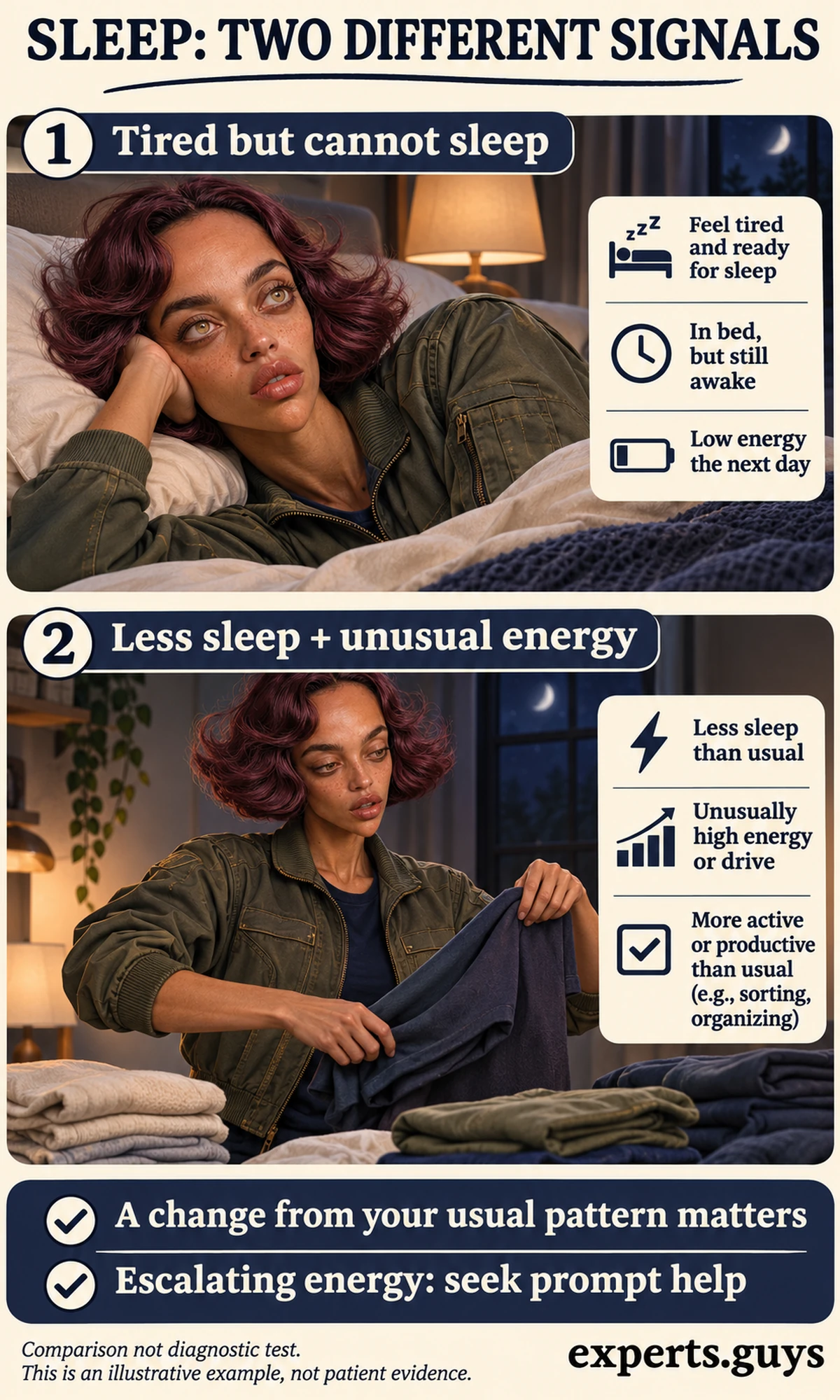
Wanting sleep but being unable to obtain it is different from sleeping much less while feeling unusually energetic or driven. Neither description alone diagnoses an episode. The useful context is whether the pattern is new for you and comes with changes in activity, judgment, speech, irritability or everyday functioning.
Think about two illustrative mornings. On one, a person has been awake with a noisy neighbour and feels exhausted. On the other, they have barely slept, feel exceptionally capable and start adding major projects. Both involve little sleep, but simply advising both people to take on a productive day misses the second person's changing pattern.
This distinction should lower the threshold for a conversation, not become a home diagnostic test. You do not need to wait until a symptom has lasted a certain number of days before asking for help. If the change resembles the beginning of an earlier episode, say that directly when contacting the team that knows your history.
The separate guide to bipolar depression early warning signs develops recognition of a depressive return in more detail. This page instead concentrates on preserving the practical conditions for stability. A brief reference to warning signs is necessary here, but repeatedly checking signs without changing a vulnerable arrangement would leave the prevention task unfinished.
Choose a flexible minimum rather than a perfect schedule
A prevention plan needs room for ordinary life. A wedding, a deadline or a delayed train does not automatically cause an episode. Equally, the fact that a busy day feels enjoyable does not mean there is no cost to the following night. The practical judgment is about which commitments can move and which parts of care need protection.
For an illustrative busy weekend, keeping an ordinary evening and medication access may matter more than preserving every household task. Laundry can wait; arranging replacement medicine may not. This is an editorial way of prioritising barriers, not a clinical ranking that applies identically to everyone. A person's own care plan, previous episode pattern and current symptoms can change the order.
Keep the plan realistic for the household you actually live in. A shared home, caring responsibility or disability may change who can do each step and where it happens. Agree on that adaptation before expecting the routine to work independently.
An observable success is an essential activity remaining possible: dinner happens, the evening has a stopping point, or a prescription is collected before the supply ends. Feeling immediately calmer is welcome but is not the test of completion. Keeping the goal concrete also makes it easier for another person to offer useful help.
How do you protect a routine when life gets busy?
Protect the transition into the evening and remove one avoidable pressure before it displaces sleep or care. The lead skill in this guide is ending optional demands deliberately: deciding what will stop, making that stopping point visible and allowing the ordinary evening to begin. It can be practised without a diary, rating scale or special equipment.
Regularity is a support, not a demand to live by a rigid timetable. NHS guidance identifies lack of sleep, stress and being too busy as possible problems and recommends a regular routine. The practical sequences below adapt that broad guidance to a familiar obstacle: the day continues expanding because no activity has an agreed ending.
Method 1: Give the evening a clear landing
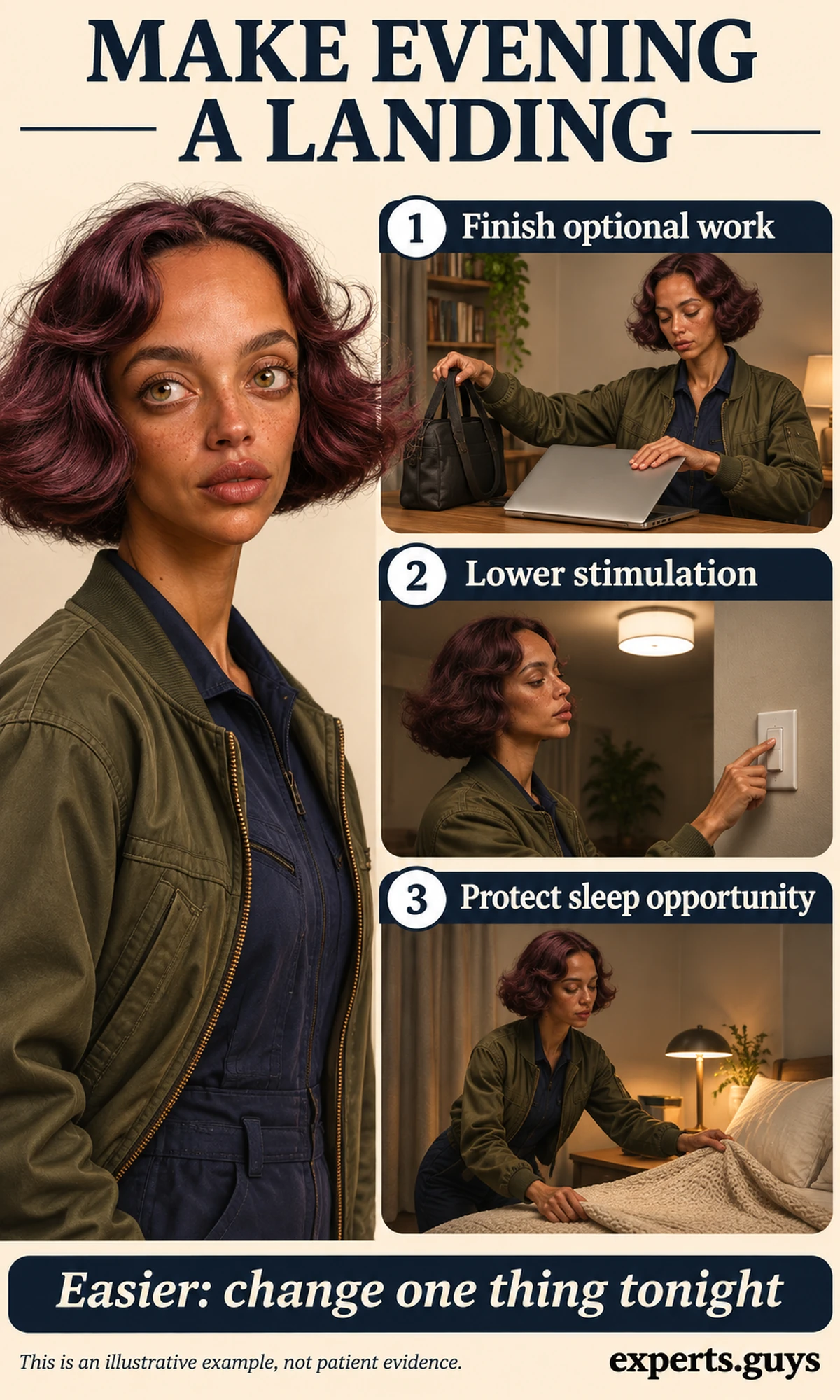
Use this when optional work, chores or social activity keeps running into the time you normally need to settle. Start in the space where the day tends to continue, such as a kitchen table used for work. You do not need to tidy the whole room, complete every task or make yourself feel sleepy on demand.
- Finish the optional activity at a workable stopping point. Close the laptop, put the work bag aside or stop preparing the next household task. Leave essential safety tasks completed.
- Reduce avoidable stimulation in the immediate space. If comfortable and safe, lower a bright light, turn off competing entertainment and move away from an animated discussion.
- Begin your familiar quiet evening and preserve the usual opportunity to sleep. The aim is to stop extending the day, not to force sleep or impose a new bedtime treatment.
Illustrative example: an unfinished work presentation keeps drawing you back to the table. Instead of polishing another optional slide, close the computer and move the bag out of the eating space. Have the ordinary evening meal and leave the remaining work for an agreed time. The completed action is a boundary around optional work; there is no claim that closing a laptop prevents a mood episode.
The common mistake is replacing one stimulating task with another: finishing work and immediately starting a late-night room reorganisation. The correction is to preserve the transition itself. If the full sequence is too much, change one thing, such as putting the work bag away, and ask a trusted person to handle the remaining nonessential task.
Adapt the setting to disability, sensory needs and household safety. Lowering a light should not make walking unsafe; someone with limited mobility can ask another person to change the environment. Do not add sleep restriction, bright-light treatment, sedatives or supplements to this sequence without appropriate clinical advice. Those are different interventions with different risks.
Method 2: Remove one commitment that would squeeze the day
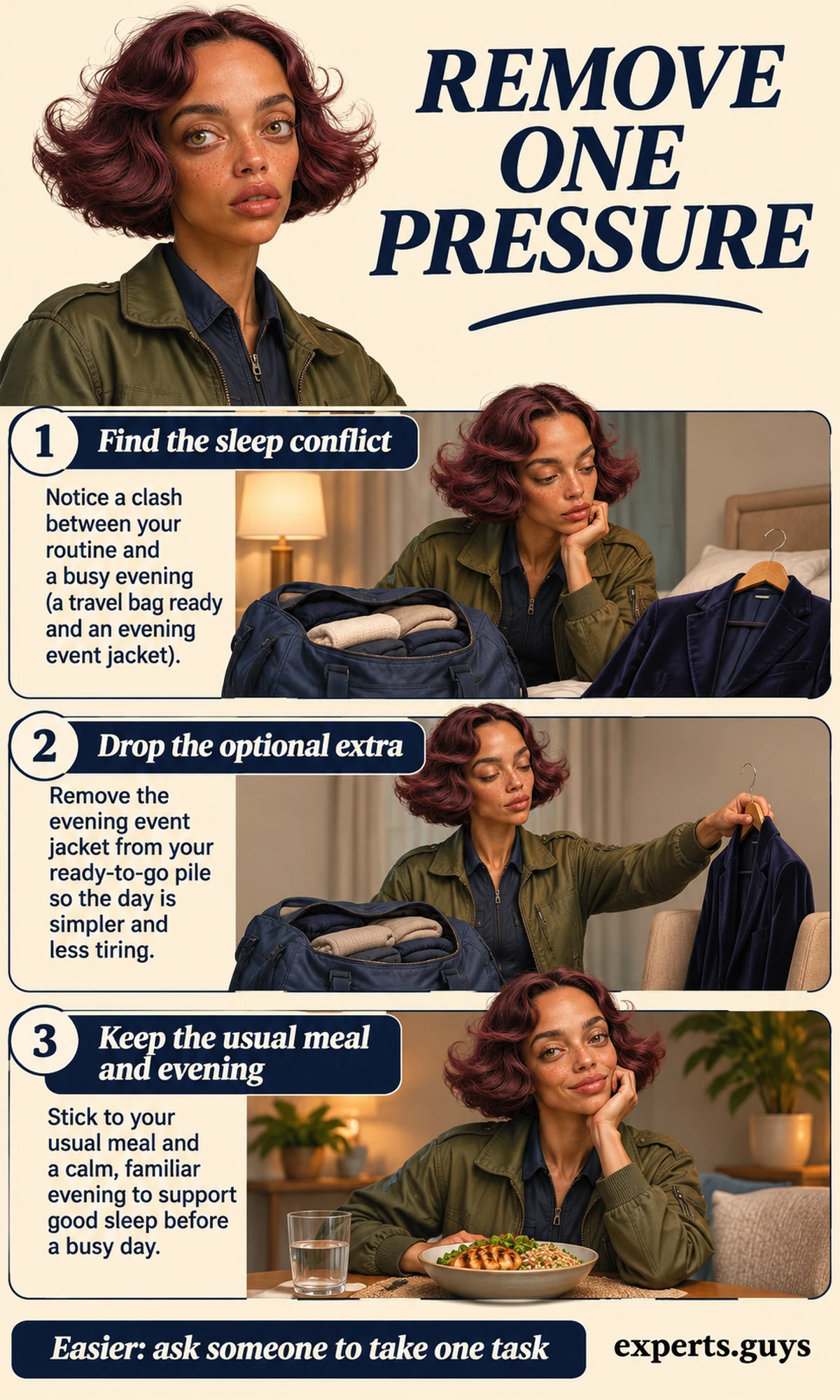
Use this before a known period of pressure, while choices are still available. The job is to remove a concrete collision rather than promise to “manage stress better.” Choose the commitment that pushes a necessary activity out of place, even if that commitment is enjoyable or seems easy to fit in.
- Find the collision. For example, an optional evening event follows a long journey and would push dinner and rest much later.
- Drop, shorten or hand over the optional extra. Make the change real by declining that event, arranging earlier departure or asking someone else to take the nonessential errand.
- Keep the ordinary meal and evening available. Stop once the collision is removed; do not fill the newly opened space with another commitment.
Illustrative example: you return from a family visit and also plan to attend a late gathering. The first arrangement cannot easily move, but the second can. You decline the gathering and have a simple meal at home. That is a practical reduction in competing demands, not proof that staying home is always the healthiest choice or that social contact is harmful.
If declining feels difficult, use a short explanation: “I can join earlier, but I need to keep my evening free.” You do not have to disclose your diagnosis to everyone. An easier version is asking someone to take one errand so that you can keep the necessary part of the day. The stopping point is one conflict resolved, not a perfectly empty calendar.
What if the disruption is part of your job?
Work constraints need realistic treatment. “Keep a routine” is incomplete advice for someone whose shifts change or whose income depends on irregular hours. The relevant discussion may involve more predictable shifts, avoiding repeated overnight work where possible, protected breaks or a change in the timing of optional duties. Feasibility, employment rights and occupational advice vary by location and role.
For a person who operates machinery, drives or carries responsibility for others, unusual sleep loss or impaired judgment also creates an immediate safety question. A prevention article cannot clear someone as fit for duty. Use the employer's safety process and the treating team's advice rather than trying to compensate with extra caffeine or assuming that feeling energetic proves alertness.
Travel creates a related constraint. A trip can disrupt sleep opportunity and medication timing at the same time. Before booking an overnight or time-zone-crossing journey, ask the prescribing team or pharmacist how the actual prescription should be handled. A general instruction to take a medicine at “bedtime” is not enough to resolve a change in local time.
The practical preference here is to simplify the schedule before adding more coping tasks. That recommendation follows the obstacle: if the problem is an overcrowded day, another lengthy daily exercise takes more time from the same day. If the obstacle is instead an emerging episode, changing the schedule is supportive while clinical care takes priority.
How do you keep treatment usable between appointments?
Prevent avoidable gaps in access and make uncertainties easy to resolve with the right professional. This section does not compare medicines or prescribe a dose. Its practical task is making sure that the plan you already have can still be followed when travel, pharmacy opening times, side effects or confusion about instructions gets in the way.
The guide to how bipolar disorder is treated owns the detailed explanation of phase-specific treatment. Keep that distinction in mind when requesting a review: ask what the medicine is intended to prevent, what monitoring is needed and what should happen if symptoms return. A prevention plan becomes more useful when those answers are specific to the actual prescription.
Method 3: Check supply before it becomes an interruption
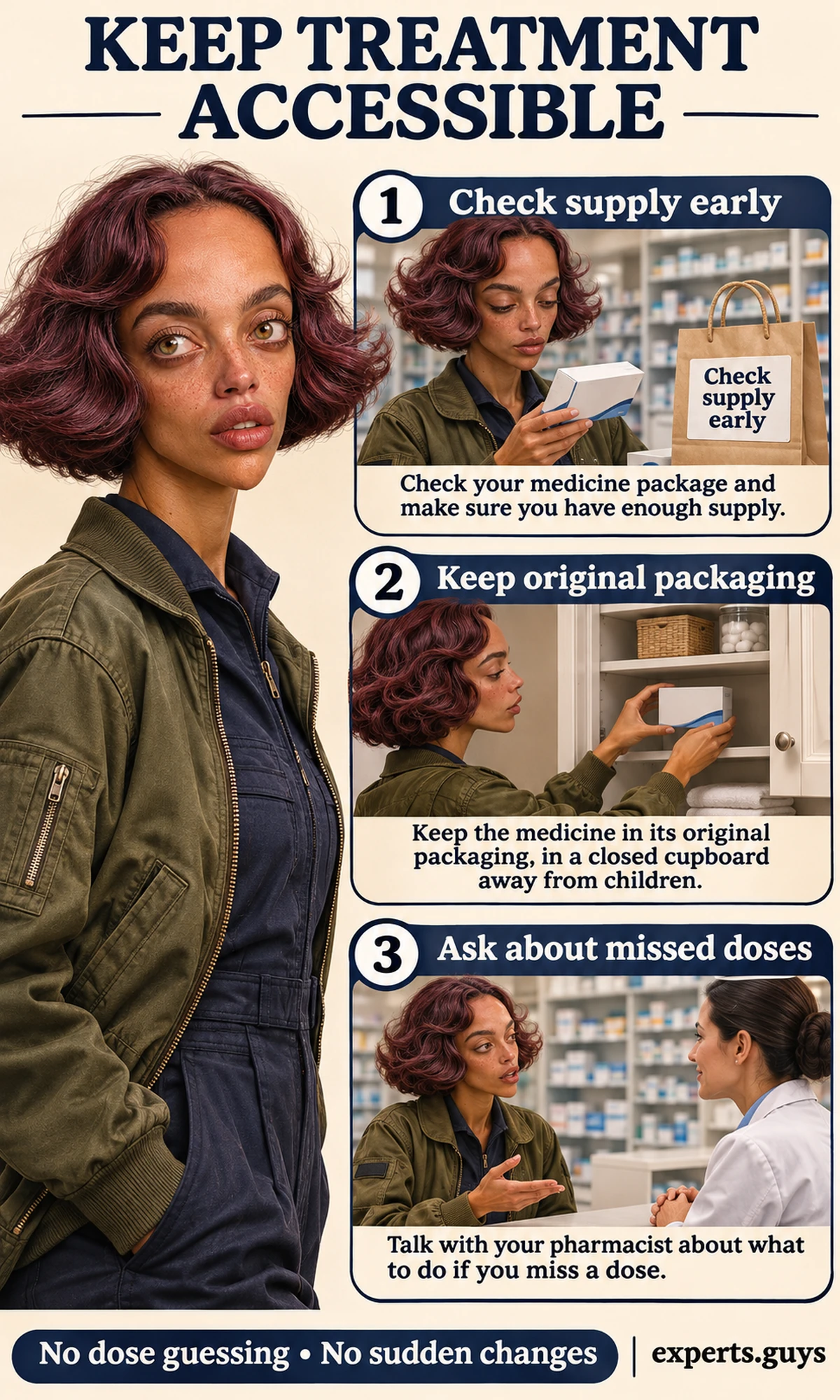
Use this before travel, a holiday closure or another predictable disruption. Have the original labelled package available so that you and the pharmacist can identify the formulation and instructions accurately. Do not use an unlabelled container or another person's medicine as a substitute.
- Check whether the current supply covers the period until your usual pharmacy or prescribing service is available again. Arrange the refill through the normal route while there is time to resolve a problem.
- Keep medicine in its original packaging and store it according to its instructions, securely away from children and anyone for whom it was not prescribed.
- Ask the pharmacist or prescriber about the exact uncertainty: a missed dose, damaged medicine, travel timing, a formulation change or a refill delay. Follow the medicine-specific answer rather than guessing.
Illustrative example: a person sees that a long weekend will overlap with their refill. They take the labelled package to the pharmacy before the closure and clarify what can be supplied. The achievement is continuity of access. It does not mean taking extra doses, ordering an unverified replacement online or building up a supply beyond the agreed prescription.
If checking and collecting are difficult, ask a trusted person to accompany you or help with the permitted collection arrangements. The easier option is assistance with access; it is not handing over control of treatment without agreement. Keep any reminder or storage arrangement compatible with the dispensing instructions and your household's safety needs.
Do not let a general rule override a medicine-specific warning
Feeling well is a reason to discuss how treatment is helping, rather than a reason to stop it abruptly. Side effects also deserve a specific response. Describe the problem to the prescriber or pharmacist so that it can be addressed; changing the time, formulation or dose yourself can create a different problem from the one you intended to solve.
Missed-dose advice varies by medicine and sometimes by formulation. The NHS lithium instructions explicitly warn against doubling a dose to make up for a forgotten one. Use the leaflet and professional advice for your own prescription, especially after more than one missed dose; some medicines need a different restart process after an interruption.
Lithium needs particular attention during illness that causes dehydration or markedly reduced food and fluid intake. NHS Specialist Pharmacy Service describes how dehydration can increase toxicity risk. New confusion, marked unsteadiness or other symptoms suggesting toxicity need urgent medical assessment; do not treat them as a routine mood change or take extra medicine. Follow the medicine's urgent safety instructions, including withholding lithium and seeking immediate help when toxicity is suspected.
Monitoring appointments are part of treatment access, not optional proof of good behaviour. If transport, cost or work hours make them difficult, raise that practical barrier before the appointment is missed. A blood test or physical-health review has a defined safety purpose; a home mood score cannot replace it.
Why psychological support belongs in prevention
Structured psychological care for bipolar disorder can address problems that a medicine supply check cannot solve, including recognising personal patterns and involving family appropriately. NICE recommends a bipolar-specific structured psychological intervention for relapse prevention or persisting symptoms. That is different from assuming that any motivational exercise or generic wellness course has the same evidence.
Ask what the intervention is intended to teach and how it fits your current phase of illness. A person with escalating activation may need a different immediate response from someone who is stable and ready to practise long-term skills. The household methods in this article support ordinary functioning; they are not a replacement for a structured intervention or evidence of having completed therapy.
A useful appointment outcome is an agreed response to a realistic disruption. For example: which service handles a refill problem, who receives a call about sharply reduced sleep, and how care continues outside normal hours. You can ask these questions aloud. There is no requirement to create a paper workbook before you are entitled to a clear answer.
What should change when energy rises or falls?
Use the agreed response plan when a meaningful change appears; choose practical support that fits its direction. Rising activity and a narrowing, low-energy day create different immediate obstacles. Applying the same instruction to “do more” in both situations can miss what the person actually needs.
Method 4: Put a pause around escalating activity
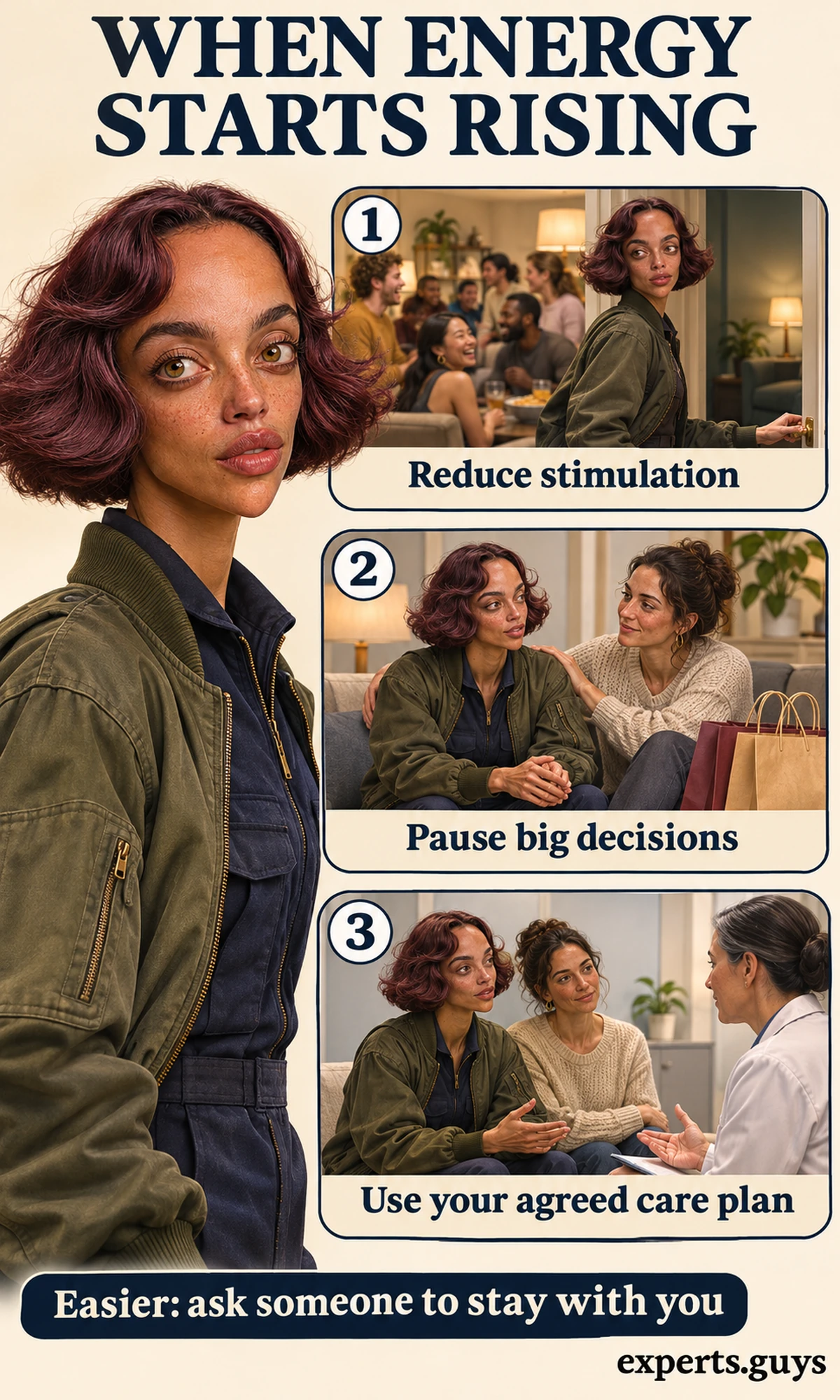
Use this alongside prompt contact with the care team when unusual energy, reduced sleep or expanding plans resemble a previous warning pattern. It is not a way to manage severe mania at home. If there is immediate danger, psychosis or severe confusion, move directly to emergency help.
- Reduce stimulation if it is safe to do so. Leave an optional busy gathering or stop adding activities; choose a quieter familiar space.
- Pause major purchases, new commitments and consequential decisions. Ask a trusted person to sit with you and help keep the pause practical, using arrangements you have agreed while well.
- Use your existing early-response care plan and contact the appropriate clinician or service promptly. A person supporting you can accompany you or help explain the change.
Illustrative example: someone who normally enjoys one evening activity starts planning several overnight projects and wants to buy expensive equipment. They sit with a trusted friend, leave the purchase uncompleted and contact the care team. The useful outcome is a delay in a consequential decision while help is arranged. It is not a home treatment that must work before further care is justified.
The easier option is asking one trusted person to stay with you while you make contact. Avoid arguing over whether you are “really ill” as the condition for accepting help. At the same time, support should not become punishment or forced surrender of money and possessions; agree protective arrangements in advance wherever possible and use urgent professional help when safety is deteriorating.
Method 5: Preserve basic needs when the day starts shrinking
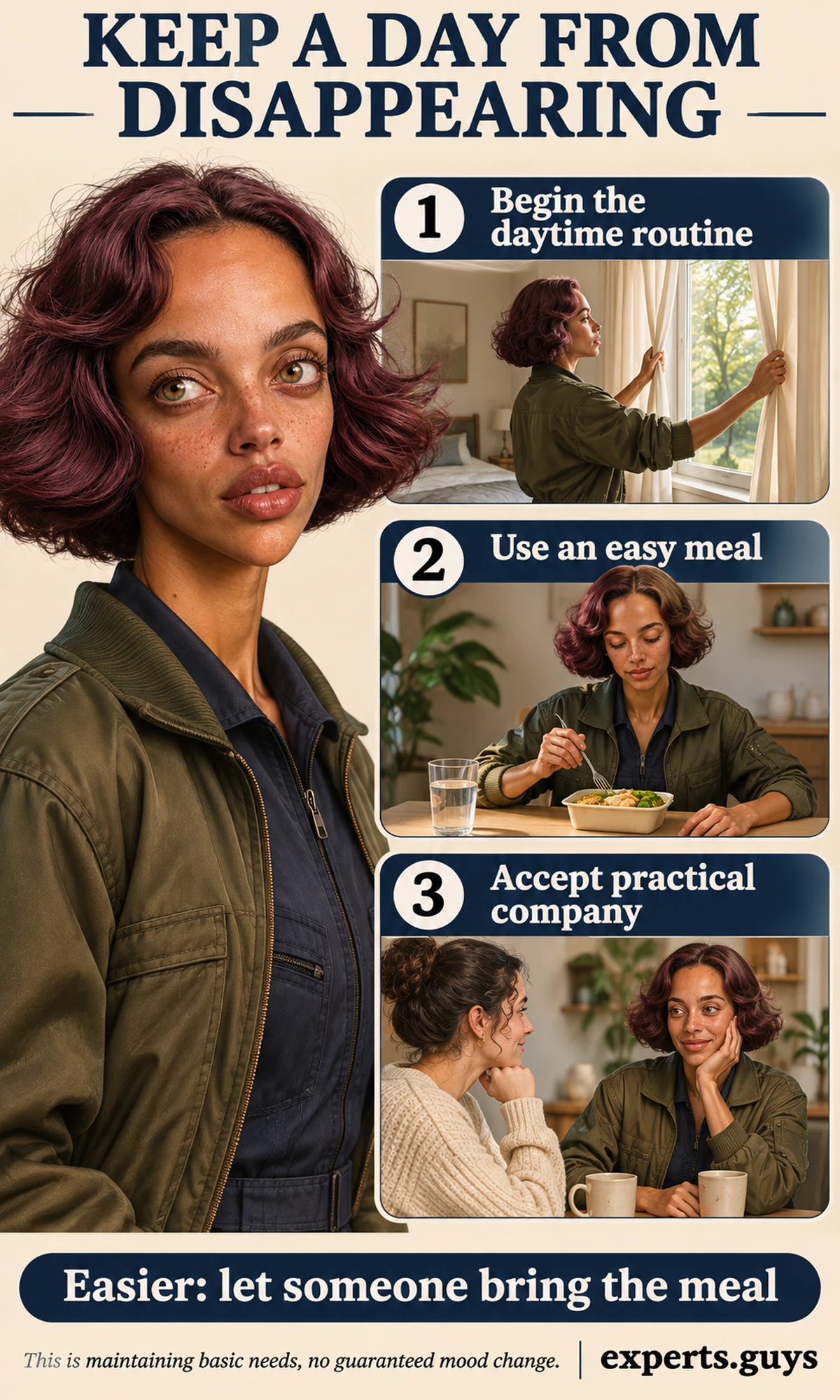
Use this when low energy is making the day disappear into bed, missed meals or isolation, while you are still able to act safely. The aim is maintaining access to food, daytime activity and practical company. It is not a test of willpower, a cure for bipolar depression or an instruction to become highly productive.
- Begin the ordinary daytime routine in an accessible way, such as opening curtains when you are up. Do not add a light box, stare at bright light or use deliberate sleep deprivation.
- Use an easy meal that fits your dietary and medical needs. A ready meal or food brought by another person can meet the task without requiring shopping and elaborate cooking.
- Accept practical company from someone you trust, if wanted and available. Sitting together for the meal is enough; you do not have to entertain anyone or explain your whole history.
Illustrative example: breakfast has been missed because cooking feels too difficult. A relative brings suitable food, helps make the room usable for eating and stays for a quiet meal. The person has eaten and has company. A lack of immediate mood improvement does not cancel that achievement, and a completed meal does not prove that the depressive symptoms are mild.
The easier version is letting someone bring the meal to an accessible place rather than insisting that you first shower, dress or tidy. If you cannot maintain food, fluids or essential care, or symptoms are worsening or disabling, seek prompt assessment. Thoughts of self-harm need urgent support even if you are still attending work or responding to messages.
Method 6: Give support one clear job
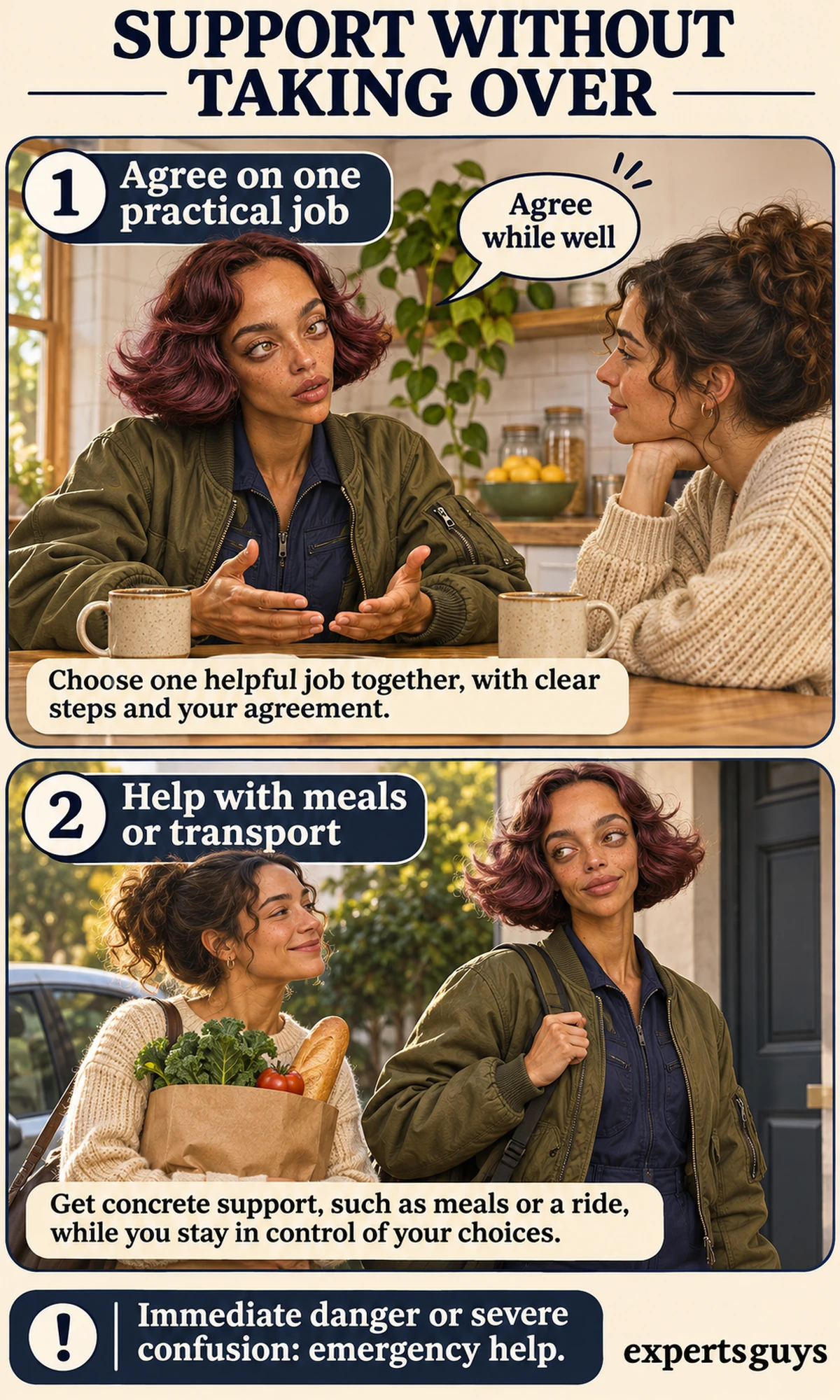
Make this agreement during a relatively stable period whenever possible. Choose someone whose involvement feels safe and respectful. Their role is to help an agreed action happen, not to diagnose every mood change or supervise your whole life.
- Agree on one practical job, such as bringing a meal, accompanying you to the pharmacy or arranging transport to care.
- Say what kind of change should activate that help and what permission you are giving. For example: “If I am missing meals and cancelling everything, please offer to bring dinner.”
- Use the agreed help when needed and review whether that job still fits. Keep emergency action separate: immediate danger or severe confusion needs urgent help rather than an extended negotiation about chores.
Illustrative example: a partner agrees to handle groceries during a difficult week. They buy the usual suitable food and ask what is manageable that evening. They do not turn the delivery into an interrogation about whether every feeling is a symptom. The result is a necessary task handed over with consent, leaving room for the person to participate in care.
An easier agreement is simply allowing someone to accompany you. If family involvement is unsafe or unavailable, ask the care team about another appropriate support route. A prevention plan should not depend entirely on one friend being reachable at all hours, and a supporter should know the professional route when their role is insufficient.
When the pattern is mixed or unclear
Low mood can occur with agitation, racing thoughts or unusually increased activity. Do not assume that visible energy rules out serious depression or that a distressed person merely needs to tire themselves out. Explain both sides of the change when contacting care: what has happened to sleep, activity, mood and safety.
Uncertainty is a reason to ask for assessment, not a reason to keep testing yourself until the picture becomes obvious. Use concrete observations and the person's known history. The goal is an appropriate response to a change, not winning an argument about the correct label from a kitchen-table conversation.
Frequently asked questions
Does an episode mean the prevention plan failed?
No. A plan can reduce avoidable difficulties without eliminating the illness. After the acute situation is addressed, review whether an obstacle, treatment problem or new circumstance calls for a change; avoid treating recurrence as proof of insufficient effort.
Is a strict daily timetable necessary?
A workable routine allows flexibility. The useful question is which changes repeatedly displace essential care or sleep opportunity. A timetable that only works on an ideal day may need simplification, especially around employment, caring responsibilities or disability.
Can a supportive person make decisions for me?
Support should normally follow the consent and boundaries agreed while you are well. Legal authority and emergency procedures depend on local rules and circumstances. An article cannot grant someone control over your treatment or finances; clarify those arrangements with the relevant care and legal services when needed.
Should I use alcohol to make myself sleep?
Do not use alcohol as a sleep treatment or combine it with sedating medicine to force sleep. Ask about a safer response to insomnia. If you may be physically dependent on alcohol, get medical advice before abruptly stopping, because withdrawal can be dangerous.
A workable next evening
Choose the vulnerable part of the next ordinary day: an evening with no stopping point, a commitment that squeezes out rest, a medicine supply problem or basic needs that require help. Make one concrete adjustment while keeping the existing treatment plan available. If the difficulty is a meaningful change in symptoms rather than a scheduling obstacle, use the care response already agreed for that change.









