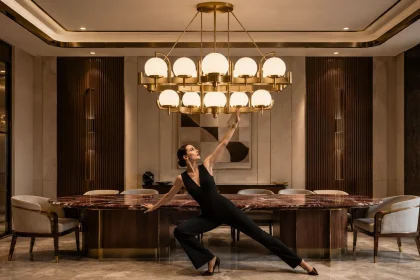

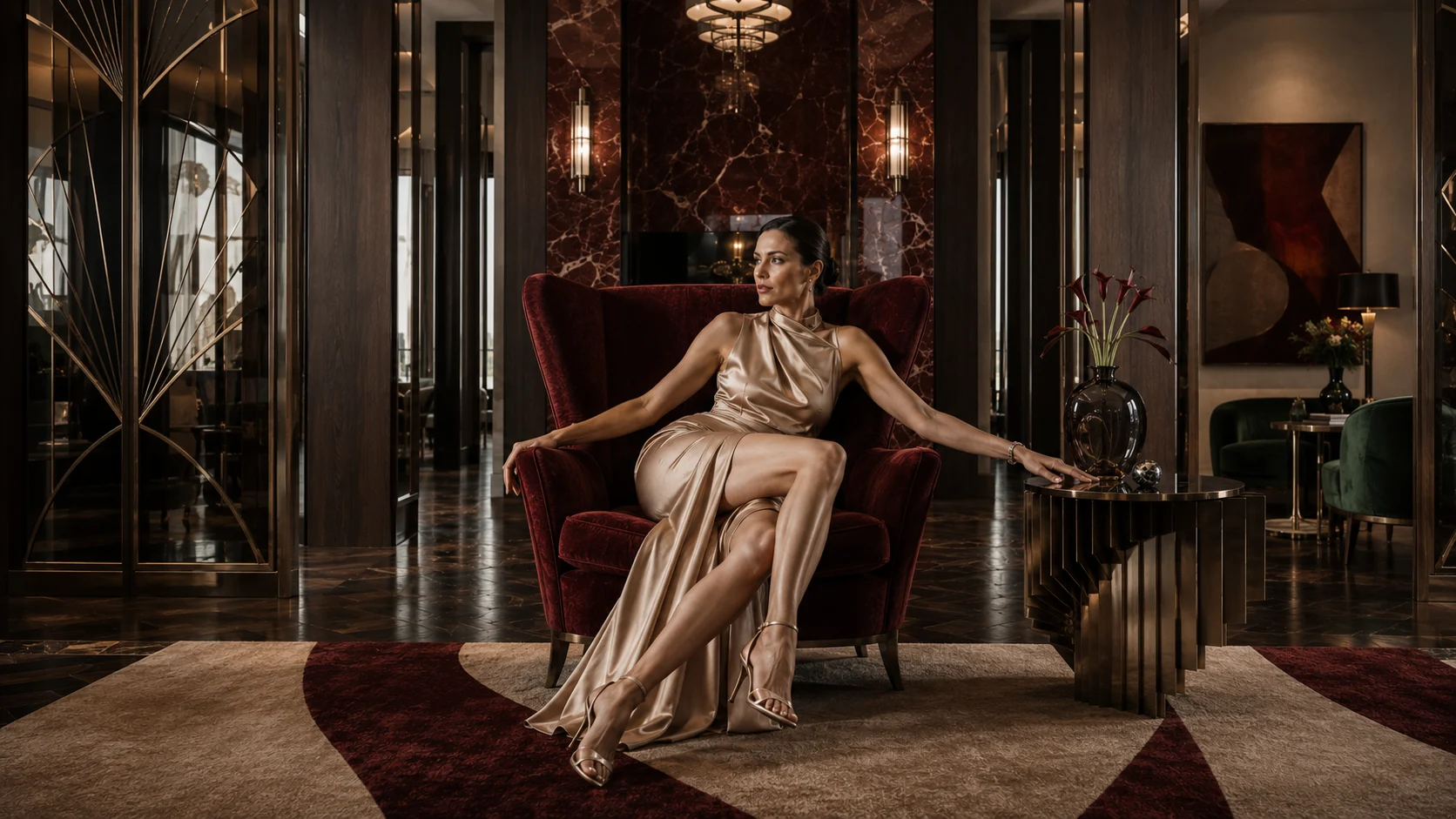

Neo Deco is bringing glamour back into contemporary interiors, although the rooms attracting attention in 2026 look considerably different from the highly literal Art Deco recreations that dominated many hotels, restaurants and themed residential projects in the past. Dark walnut, richly veined marble, velvet, leather, smoked glass and polished metal still create a sense of luxury, yet today’s most convincing examples use those materials selectively. Furniture has become softer, color has become deeper, and geometric references are often integrated into architecture rather than repeated as decoration across every available surface.
That distinction matters because Neo Deco can easily be misunderstood as a shopping style. Buying a sunburst mirror, brass lamp, black console and geometric rug does not automatically create a coherent interior. The strongest rooms develop the style through relationships between line, curve, reflection, color, material weight and lighting, so a relatively small number of elements can establish the character without making the home feel like a period set.
For homeowners who appreciate the calm material restraint of Japandi minimalist interior design but want something richer, darker and more theatrical, Neo Deco represents almost the opposite emotional direction. Japandi tends to quiet the eye through matte finishes, soft tonal transitions and visual breathing space. Neo Deco deliberately introduces visual tension through reflective surfaces, saturated color, sculptural furniture and stronger geometric rhythm, while still depending on editing and negative space to prevent the room from becoming exhausting.
The result is a style that can feel glamorous without becoming formal, expressive without losing discipline, and luxurious without requiring every object to look expensive. Understanding why that balance works is more useful than memorizing a list of Deco motifs, because the same principles can be applied to a penthouse, a compact apartment, a dining room or even one carefully designed corner of an otherwise contemporary home.
What Is Neo Deco Interior Design?
Neo Deco is a contemporary interpretation of Art Deco that retains its interest in geometry, rich materials, dramatic lighting and polished detail while adapting those qualities to modern residential life. Instead of rebuilding a 1920s interior, the style borrows selected Deco characteristics and places them inside cleaner architecture, softer furniture arrangements and a broader material palette. A modern room might combine a curved oxblood sofa, dark walnut cabinetry, red marble, smoked glass and polished nickel without using a single obvious sunburst motif.
The easiest way to understand the difference is to look at where the visual emphasis has moved. Historic Art Deco frequently relied on symmetry, decorative repetition and immediately recognizable patterns. Neo Deco can still use symmetry, although contemporary interiors often introduce controlled asymmetry through furniture placement, artwork, lighting or a single unexpected material contrast. Geometry remains important, but it may appear in a stepped doorway, fluted joinery, a fan-shaped screen or the relationship between a circular pendant and a rectangular stone island rather than through a room filled with matching geometric decoration.
The contemporary interpretation is also visible in Architectural Digest’s discussion of Neo Deco through dark woods, marble, velvet, polished metal, saturated color and softer sculptural silhouettes.
Material quality also carries more responsibility in a Neo Deco room. A slab of richly veined marble can establish more character than several decorative accessories because the stone already provides pattern, color, reflection and visual weight. Dark timber adds depth and warmth, while velvet or leather prevents reflective stone and metal from making the environment feel cold. This is one reason contemporary Neo Deco can look luxurious with fewer pieces than people sometimes expect.
Lighting completes the effect. Metal, marble, lacquer and glass respond dramatically to light, so their placement affects the entire atmosphere after sunset. When those reflective materials are surrounded by walnut, fabric, plaster or other surfaces that absorb and soften light, the room gains depth instead of glare. Neo Deco therefore works best when materials are selected as part of a lighting system rather than as isolated finishes.
The Short Version
A Neo Deco interior usually combines strong geometry, characterful wood, saturated color, tactile upholstery, selective reflective surfaces, sculptural curves and layered lighting. The style becomes convincing when those ingredients reinforce one another across the architecture and furniture. It begins to feel artificial when every object attempts to announce the Deco reference independently.
That makes editing one of the most important Neo Deco skills. A room does not need a geometric rug, patterned wallpaper, fan mirror, fluted cabinet, brass console, Deco artwork and scalloped chair at the same time. One strong architectural gesture paired with one memorable material and a carefully chosen furniture silhouette can establish the language far more effectively.
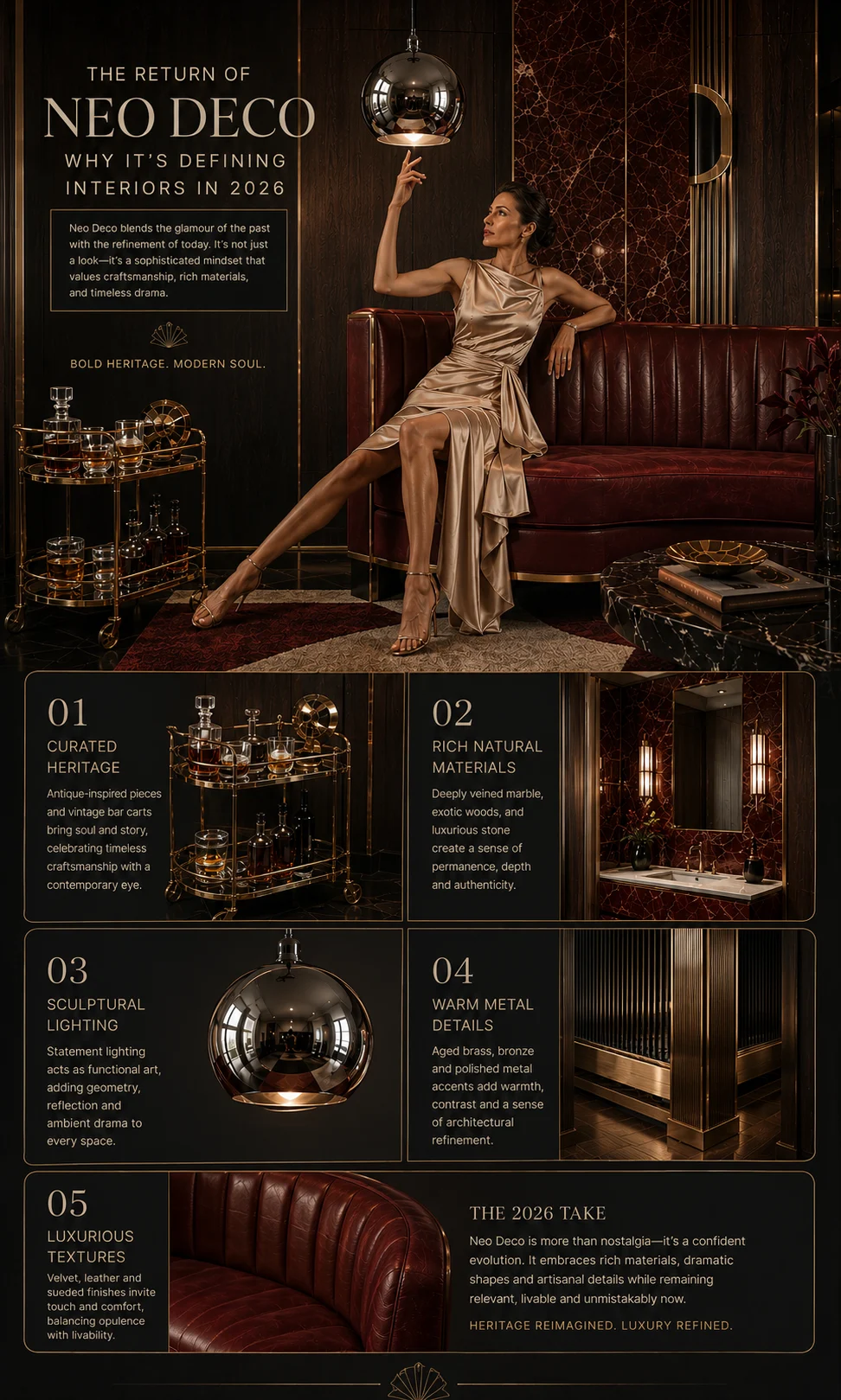
Current interest is visible in Pinterest’s trend data around red marble bathrooms, antique bar carts, pendant lighting, brass aesthetics and leather banquettes, all of which sit naturally within the developing Neo Deco vocabulary.
Why Neo Deco Is Back in 2026
The return of Neo Deco fits a broader change in residential interiors. Years of pale neutrals, quiet minimalism and highly restrained styling created rooms that were easy to coordinate, yet many homeowners are now looking for interiors with stronger identity, richer color and a greater sense of collection. Dark woods, dramatic stone, polished metal, sculptural lighting and saturated upholstery offer that personality without requiring the visual density associated with full maximalism.
Neo Deco has also been identified as a current interiors direction in Pinterest Predicts, where the trend is described through crisp chevrons, fan arches, chrome, brass and a renewed appetite for Deco-inspired residential details.
Neo Deco responds particularly well to this shift because its design vocabulary already contains strong material contrasts. Walnut can sit beside marble. Velvet can soften polished nickel. Burgundy can be paired with cream, tobacco, emerald or smoked brown without making the interior depend on dozens of unrelated colors. These combinations create rooms that photograph dramatically while still functioning as residential spaces, which helps explain why Deco-influenced forms are appearing across furniture, bathrooms, lighting, bars and decorative architecture again.
The current revival is also less dependent on historical imitation. Contemporary designers can borrow a fan arch, stepped silhouette, polished metal edge or strong geometric rhythm without committing the entire room to one period. That flexibility makes Neo Deco easier to combine with modern architecture, vintage furniture, contemporary art and existing residential layouts. It also makes the style suitable for incremental renovation because a homeowner can introduce the character through lighting, furniture, material replacement or color before committing to major architectural work.
There is another practical reason the style feels relevant in 2026: materials themselves have become more visually important. A striking marble vanity, burl cabinet, sculptural pendant or leather banquette can become the room’s focal event, reducing the need for decorative filler. Neo Deco therefore suits homeowners who want a room to feel expressive while still appreciating clear composition and controlled object density.
The Current Neo Deco Look Is Richer Than Black and Gold
Black and gold remain associated with Art Deco, but treating them as mandatory usually produces a narrow and overly literal interpretation. Contemporary Neo Deco has room for oxblood, burgundy, emerald, tobacco, smoky rose, midnight blue, cream, warm brown and mineral tones, particularly when those colors are carried through natural material rather than paint alone. A burgundy marble, for example, provides several tonal variations before another decorative color is introduced.
Metal choices have expanded as well. Brass can create warmth, while polished nickel and chrome provide a cleaner, cooler reflection that feels particularly effective beside dark wood and saturated fabrics. Mixing every available metal in the same room rarely improves the result, so one dominant metal family is usually easier to control, with a secondary finish appearing only where the architecture genuinely benefits from contrast.
This broader palette is one of the strongest reasons Neo Deco feels contemporary. The room can acknowledge Art Deco without being trapped inside a familiar black, cream and gold formula. Color becomes atmospheric rather than merely decorative, and materials carry enough tonal complexity to keep deeply colored interiors from appearing flat.
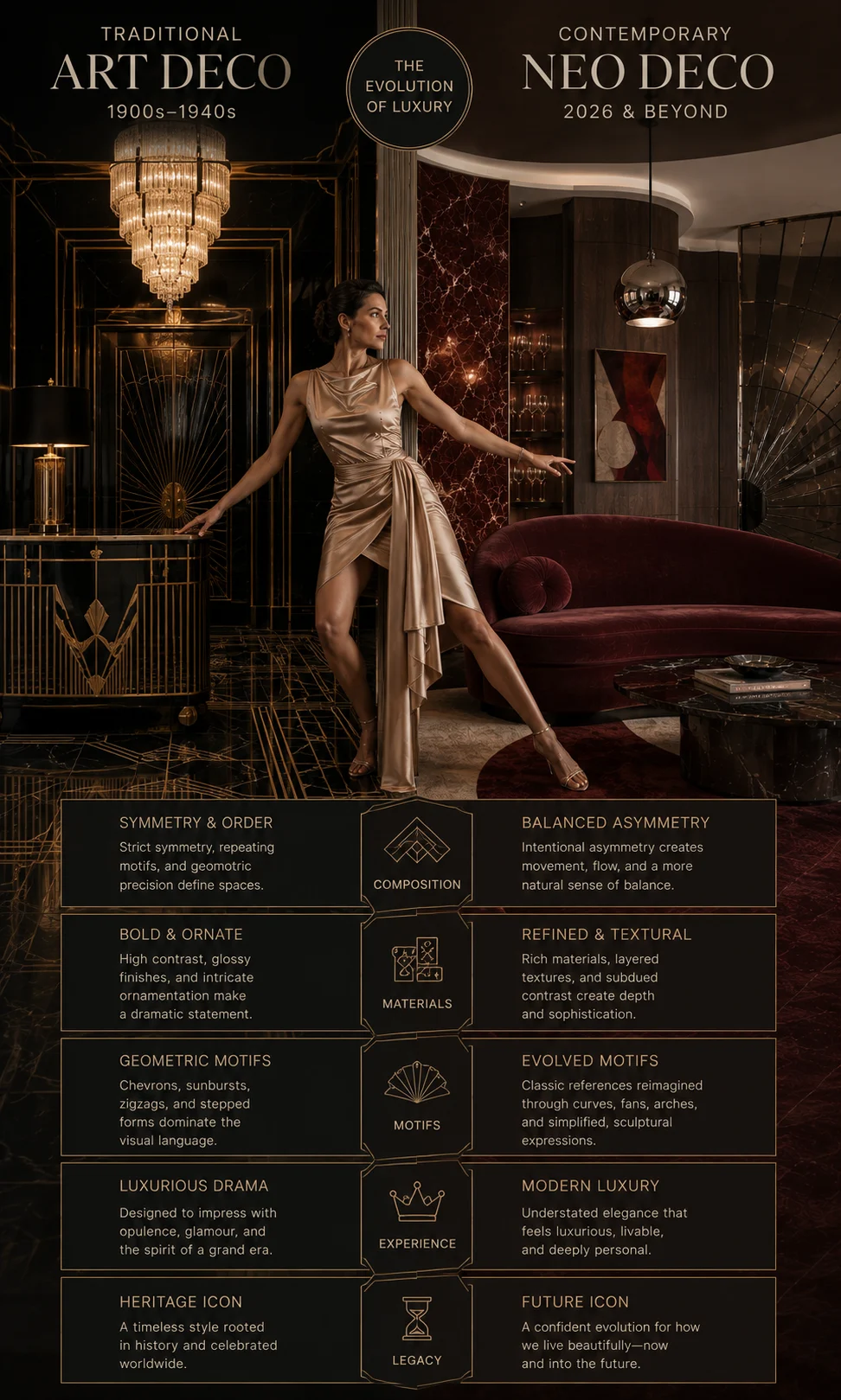
Neo Deco vs Traditional Art Deco
Traditional Art Deco emerged from a specific cultural and architectural period, so its interiors often carry recognizable historical signals: symmetrical compositions, geometric ornament, luxurious surfaces, exotic material references, polished finishes and highly designed furniture ensembles. Neo Deco borrows from that vocabulary while allowing the surrounding architecture and furnishings to belong unmistakably to the present. The difference is therefore less about whether a room contains a curved chair or brass detail and more about how strongly the period controls the entire composition.
A traditional Deco interior may coordinate furniture, lighting, wall treatment and flooring around one repeated decorative language. Neo Deco usually benefits from more breathing room between references. A fan-shaped architectural opening might be paired with a completely contemporary sofa, abstract artwork and simple cabinetry, allowing the motif to register clearly without competing against five additional Deco patterns.
The modern approach also tends to place greater emphasis on tactile contrast. Velvet beside marble, dark timber beside polished metal, or soft upholstery beside rigid geometric architecture creates enough visual tension that heavy ornament becomes unnecessary. This helps Neo Deco work in ordinary homes, where people need comfort, storage and adaptable furniture rather than a perfectly preserved period composition.
| Design Element | Traditional Art Deco | Neo Deco |
|---|---|---|
| Overall character | Formal, highly composed and strongly connected to its historical period | Glamorous, edited and adapted to contemporary residential life |
| Geometry | Geometric motifs may repeat across walls, furniture, floors and decorative details | Geometry is used more selectively through architecture, furniture or one dominant motif |
| Symmetry | Strong symmetry often organizes furniture, lighting and decorative composition | Symmetry may remain, but controlled asymmetry creates a more relaxed contemporary feeling |
| Materials | Lacquer, polished metal, marble, glass and richly decorative finishes | Dark walnut, mahogany, burl wood, marble, velvet, leather, smoked glass, nickel, chrome and restrained brass |
| Color | Black, cream, gold and jewel-tone combinations are strongly associated with the period | Oxblood, burgundy, emerald, tobacco, midnight blue, smoky rose, cream and dark timber tones |
| Furniture | Coordinated pieces with clearly recognizable period silhouettes | Softer sculptural furniture mixed with contemporary and collected pieces |
| Ornament | Decoration and recognizable motifs may appear repeatedly throughout the room | Fewer decorative references allow material, proportion and lighting to carry more of the style |
| Residential feeling | Formal, polished and intentionally glamorous | Tactile, expressive and easier to adapt to everyday residential use |
The most useful design lesson from this comparison is that Neo Deco does not require people to remove the glamour that made Art Deco compelling. It asks them to concentrate that glamour more carefully. A room with one extraordinary marble surface, one confident furniture curve and beautifully controlled lighting can communicate the style more convincingly than a room containing a catalogue of recognizable Deco symbols.
How Neo Deco Uses Geometry Without Making a Room Feel Themed
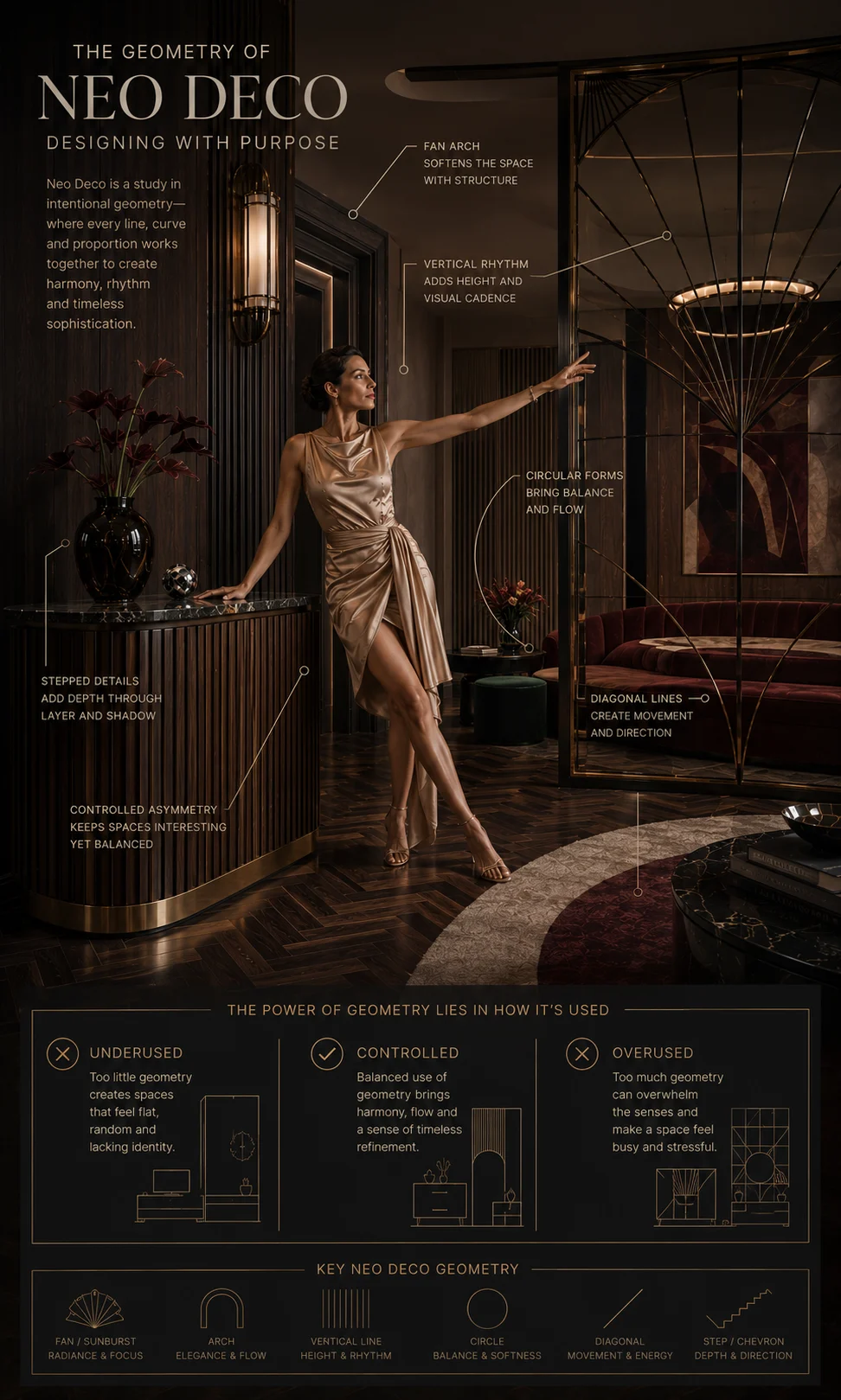
Geometry gives Neo Deco its recognisable structure, although the strongest interiors rarely apply every motif at once. Fan shapes, stepped forms, chevrons, circles, vertical repetition and rounded corners can all belong to the language, but they need hierarchy. One form should usually act as the dominant visual idea while supporting forms repeat more quietly elsewhere in the room.
Floor direction and pattern can contribute to the geometric structure too, especially when you are already considering flooring trends and material choices as part of a wider renovation.
Consider a living room with a broad fan-shaped opening between two zones. Repeating another large fan on the rug, mirror, cabinet doors, cushions and artwork would weaken the original architectural gesture because the eye no longer knows which version matters. A better approach might allow the opening to remain dominant while a circular pendant introduces a related curve and vertically fluted cabinetry supplies rhythm without copying the fan directly.
Proportion matters as much as motif choice. Large geometric forms can shape the architecture, medium forms can organise furniture and lighting, while very small geometric references are most effective as hardware, edging or detail. When every scale carries equal decorative intensity, the room becomes visually noisy even if every individual piece is attractive.
This is where Neo Deco separates itself from superficial styling. Geometry should help organise the room before it decorates the room. Doorways, joinery, furniture placement, floor direction and lighting alignment all give geometric ideas a structural role, which allows decorative objects to remain comparatively restrained.
Fan Arches
Fan forms are among the easiest Deco references to recognise, yet they become more sophisticated when translated into proportion rather than simply printed pattern. A fan can influence an opening, a headboard, a mirror or the upper geometry of a cabinet while remaining visually quiet. Repeating the same radius elsewhere through a pendant, rounded table or curved sofa helps the space feel connected without becoming literal.
Stepped Forms
Stepped geometry works particularly well in cabinetry, fireplace surrounds, shelving and ceiling details because these elements already need transitions between different depths or heights. The stepped form therefore appears functional before it appears decorative. This makes it easier to use in contemporary architecture than a purely applied ornament.
Circles and Curves
Circular lighting, disc tables, rounded seating and curved partitions soften Neo Deco’s sharper lines. Their purpose goes beyond making the room more comfortable. Curves interrupt visual rigidity and create a deliberate contrast with vertical fluting, straight cabinetry and angular floor patterns, allowing both families of form to appear stronger.
The Materials That Make Neo Deco Feel Expensive
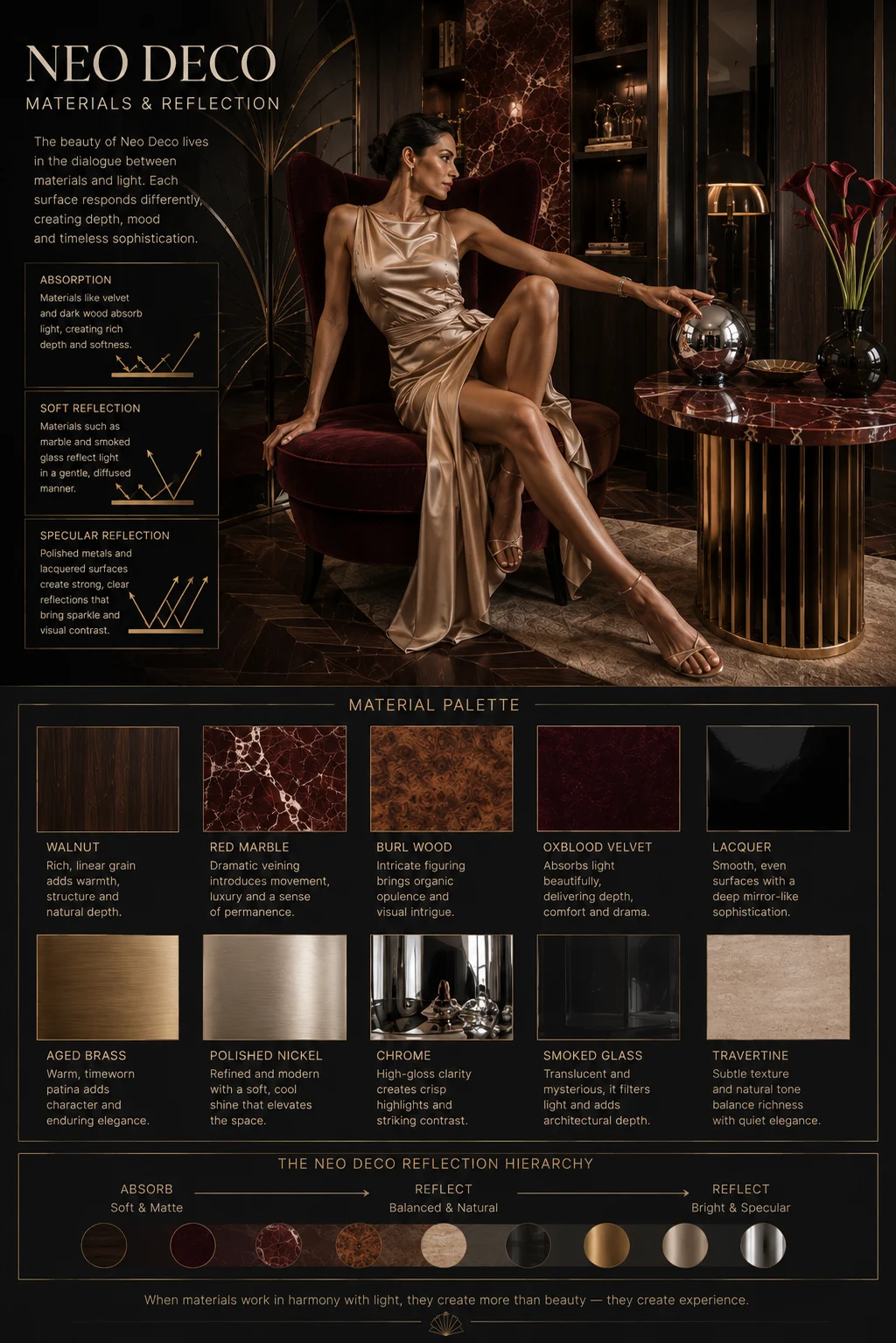
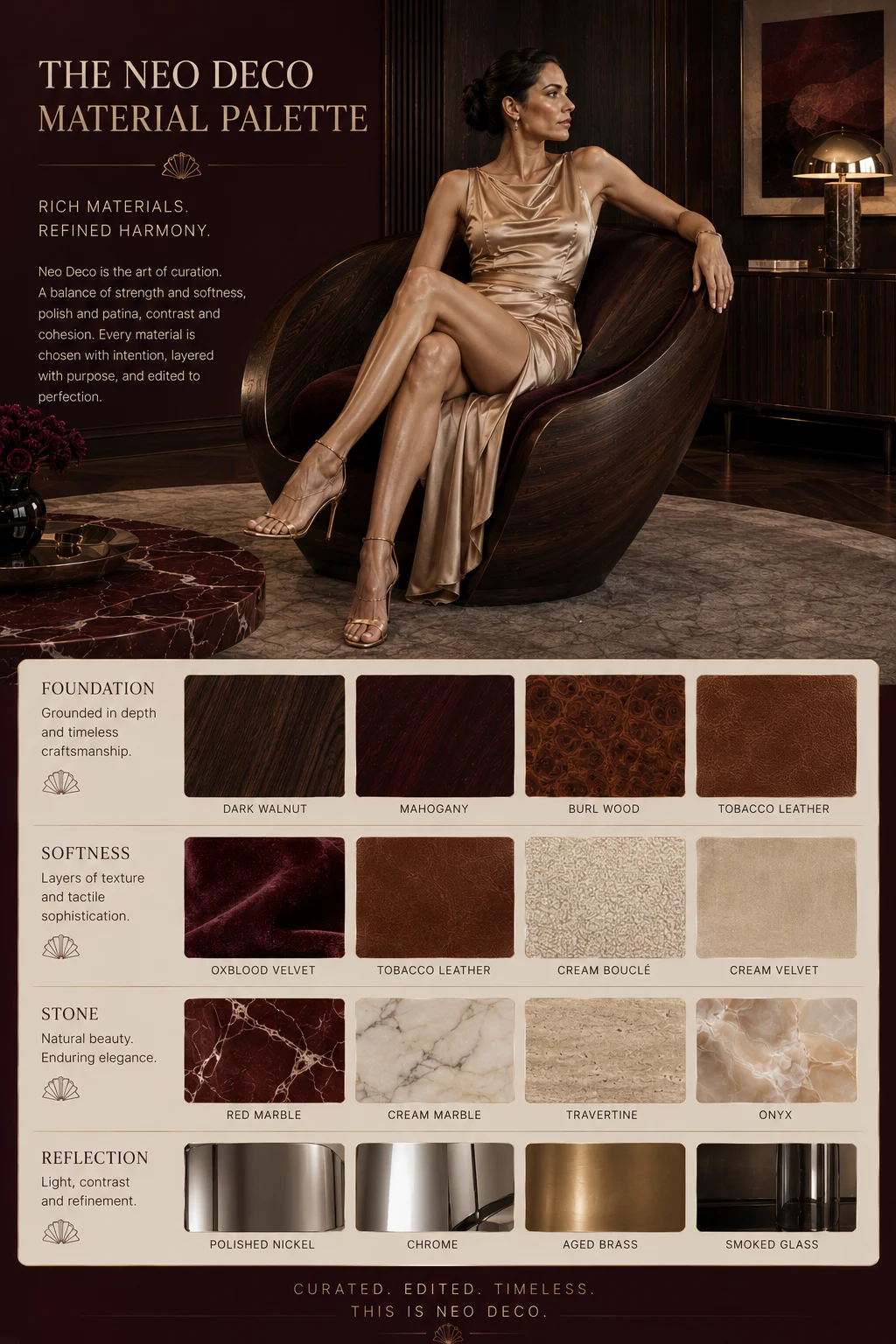
Neo Deco depends heavily on material presence because the materials themselves perform much of the visual work that ornament once carried. Dark walnut can create depth across an entire wall without requiring decorative panel patterns. Marble introduces movement and natural irregularity. Velvet absorbs light and softens hard architecture, while polished nickel or chrome introduces concentrated highlights that make darker materials feel more dimensional.
This does not mean every surface needs to be costly. The useful principle is to decide which material deserves to become the room’s hero and which materials should support it. If a dramatic red marble is already carrying considerable pattern and color, the surrounding cabinetry can become quieter. If burl wood is the focal material, a simpler cream stone might give it enough visual room to register.
The strongest combinations usually contain different responses to light. Wood, velvet and textured plaster absorb or soften illumination. Marble and leather produce more controlled sheen. Chrome, polished nickel, lacquer and glass create stronger reflections. Alternating those behaviours prevents the room from becoming visually flat while also reducing the risk that every light source creates glare.
Dark Walnut and Mahogany
Dark wood gives Neo Deco an architectural foundation that lighter minimalist interiors often lack. Walnut carries visible grain and warmth, while mahogany can introduce deeper reddish undertones that work particularly well with oxblood, cream and warm metals. Continuous cabinetry, wall panels, door frames or substantial furniture pieces allow the timber to establish visual weight before smaller decorative elements are introduced.
Burl Wood
Burl provides a more expressive grain and should usually be treated as a focal finish rather than a neutral background. Its pattern can make a small cabinet, drinks bar, console or tabletop feel highly decorative without any applied motif. Because burl already contains strong visual movement, pairing it with calmer upholstery and stone usually produces a more controlled composition.
Marble
Marble is one of Neo Deco’s most useful materials because it combines pattern, depth, color and reflectivity inside a single surface. Deep red or burgundy stone can push the room toward drama, while cream or pale stone can provide relief around dark timber and saturated fabrics. Large slabs often feel more convincing than small fragmented pieces because the natural veining becomes an architectural event rather than a decorative texture.
Velvet and Leather
Soft materials are essential when the room contains substantial stone, metal or lacquer. Velvet absorbs light deeply and gives saturated colors unusual richness, while leather introduces a different kind of sheen that feels quieter than polished stone or metal. Banquettes, lounge chairs, headboards and occasional upholstered panels allow these materials to soften the room without hiding its geometric structure.
Polished Nickel, Chrome and Brass
Metal is most effective when it behaves like punctuation. Polished nickel and chrome can create sharp modern highlights beside dark walnut and burgundy, while brass introduces warmer reflection and stronger historical associations. Choosing one dominant metal family makes the interior easier to control, especially when lighting, furniture legs, hardware and decorative edging already create multiple reflective points.
Neo Deco Color: Going Dark Without Making the Room Flat
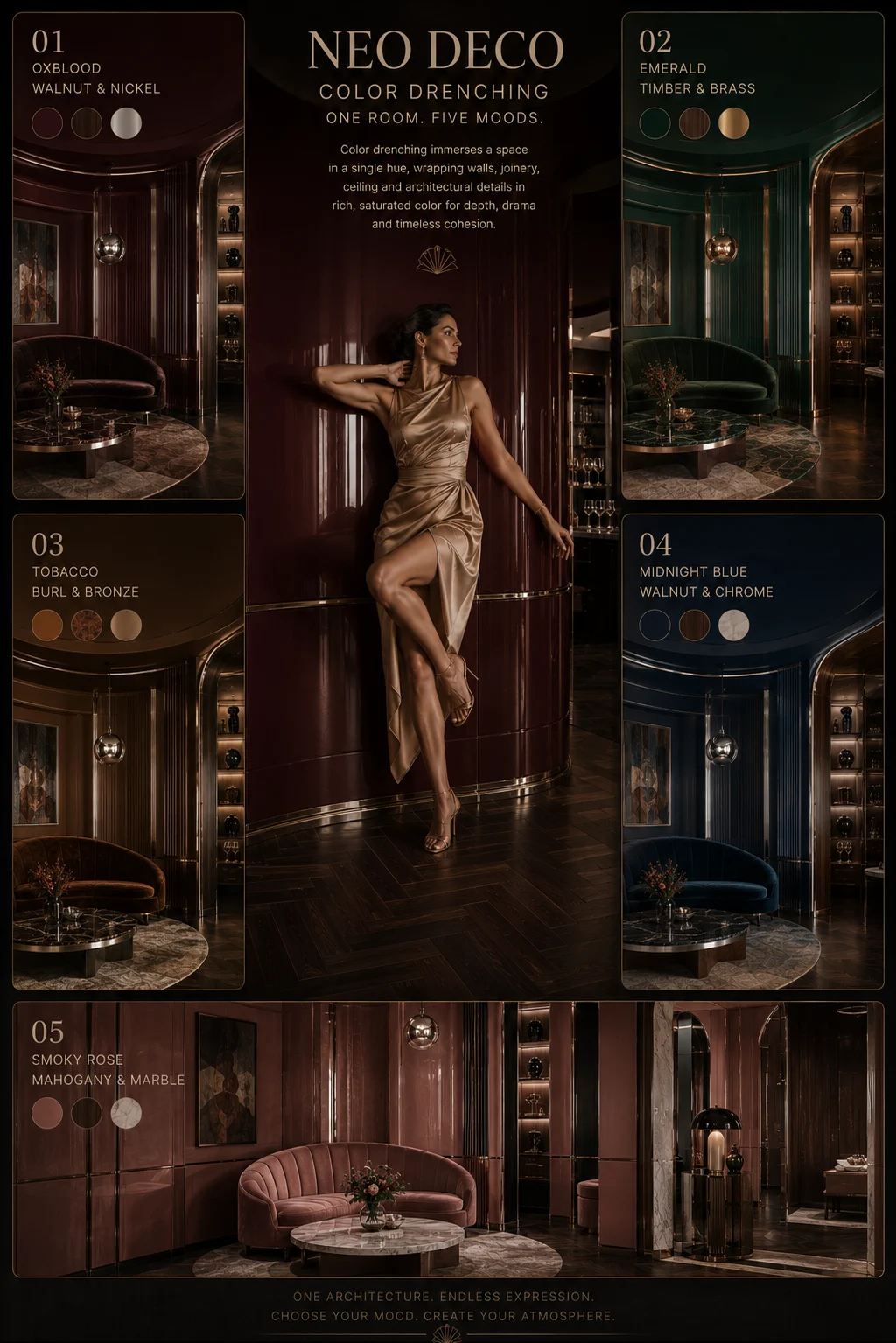
Neo Deco gives darker color considerably more room than many minimalist interiors, but successful color drenching depends on depth rather than darkness alone. Painting the walls burgundy and adding black furniture can make a room feel heavy very quickly if every surface responds to light in the same way. A stronger composition uses several values of the dominant color alongside contrasting materials, so the room continues to reveal edges, shadows and texture even when much of the palette sits in a relatively narrow tonal range.
Oxblood is particularly effective because it can move between red, brown and burgundy depending on the surrounding light. Pairing it with walnut makes the palette feel warmer and more architectural, while polished nickel introduces cooler highlights that stop the darker surfaces from visually merging. The same principle applies to emerald, tobacco, midnight blue and smoky rose. Each color becomes more convincing when its supporting timber, stone and metal have different reflective characteristics.
Color drenching should therefore be treated as a material strategy rather than a paint technique. Walls, upholstery, curtains, joinery and stone do not need to match exactly. Slight tonal shifts usually make the room feel richer because the eye can distinguish separate planes while still reading the space as one atmospheric composition.
Oxblood and Burgundy
Oxblood can create some of the most distinctive Neo Deco rooms because it has enough depth to feel dramatic without relying on black. Dark walnut cabinetry strengthens its brown undertone, while cream stone or a pale rug provides visual relief. Polished nickel works particularly well when the intention is contemporary, while aged brass produces a warmer and slightly more historical character.
The color is strongest when concentrated on large surfaces rather than scattered across numerous small accessories. A curved sofa, lacquered wall or generous curtain can establish the palette more convincingly than several burgundy cushions placed around an otherwise neutral room. Once the dominant color has enough visual presence, supporting objects can become quieter.
Emerald and Deep Green
Emerald introduces a cooler jewel-tone direction and works particularly well beside reddish woods, cream marble and restrained brass. The color can feel highly luxurious, although excessive polished brass can quickly push the room toward a more literal historical interpretation. Dark timber and matte fabric help control that effect by providing surfaces that absorb light.
Muted emerald also gives plants and natural materials more room to coexist with Neo Deco without turning the interior into a botanical theme. One architectural green wall, banquette or velvet chair can be enough to establish the color while allowing stone and timber to carry the rest of the visual weight.
Tobacco and Chocolate
Tobacco creates a quieter form of Neo Deco. It works through warmth, grain and tonal richness rather than obvious jewel color, making it useful for homeowners who appreciate the material calm of Japandi minimalist interior design but want more glamour and stronger contrast.
Burl wood, bronze, dark leather and ivory upholstery can sit naturally within this palette. The risk is that everything becomes brown, so a cooler reflective element such as nickel, smoked glass or a pale mineral surface can prevent the room from feeling visually dense.
Midnight Blue
Midnight blue can replace black when a room needs depth without losing color. It works especially well with walnut, chrome and smoked glass because the cooler palette emphasizes the clean reflective quality of metal while timber keeps the room residential.
Artificial lighting has a major effect on midnight blue. Warm lamps can shift it toward a softer ink tone, while cooler daylight reveals more obvious blue. Material samples should therefore be reviewed under both daytime and evening lighting before an entire wall or joinery package is committed to the color.
Smoky Rose and Muted Plum
Smoky rose and muted plum offer a softer alternative to oxblood while retaining enough saturation for Neo Deco. These colors work particularly well with mahogany, red marble and silver-toned metal because they create tonal continuity without becoming monochromatic.
The strongest versions are usually dusty rather than sugary. Gray, brown or wine undertones help the color remain sophisticated beside dark timber and substantial furniture. Highly pink decorative accessories can weaken the composition if they introduce a lighter, more playful mood than the architecture supports.
Why Modern Neo Deco Feels Softer
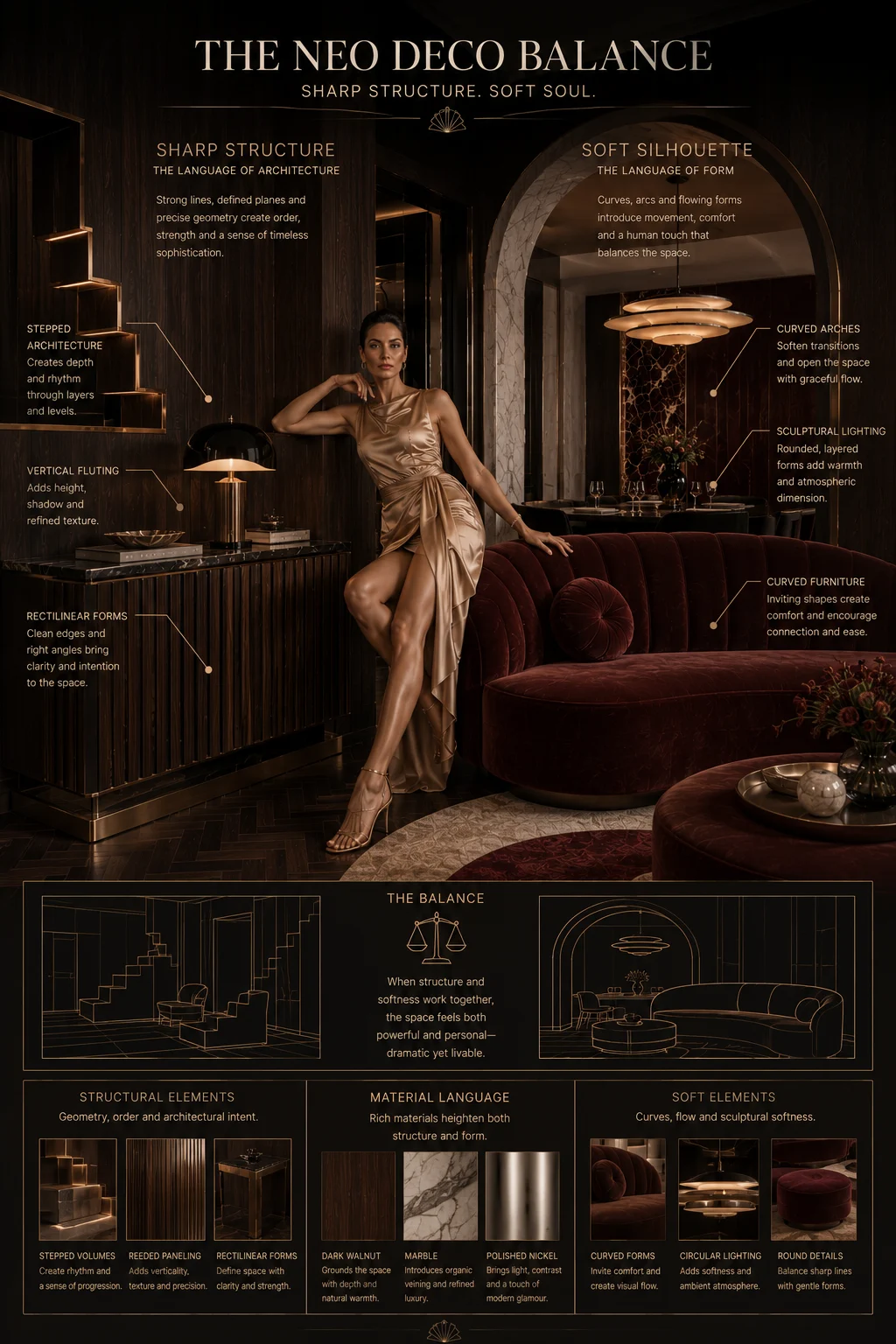
Neo Deco does not need to reproduce the rigid furniture silhouettes associated with some historic Art Deco interiors. Contemporary rooms often become more comfortable by placing rounded furniture inside strongly organised architecture. A stepped doorway, vertically fluted wall or rectilinear cabinet can provide enough geometric discipline for a curved sofa or scalloped chair to feel deliberately contrasting rather than unrelated.
This relationship between hard structure and soft silhouette is one of the most useful ways to make the style residential. Sharp lines give the eye a framework. Curves interrupt that framework and create movement. When both appear in the same visual field, each becomes easier to perceive because the difference between them creates tension.
The effect can be subtle. A rectangular stone fireplace beside a curved lounge chair may provide enough contrast without another geometric pattern anywhere in the room. Similarly, a circular pendant suspended over a strongly linear island can introduce the softer form above eye level while the cabinetry remains architectural and restrained.
Use Architecture for the Strongest Lines
Permanent elements are often the best place for Neo Deco’s sharper geometry. Doorways, wall panels, built-in cabinetry, ceiling details and flooring can establish proportion that remains consistent even when furniture changes later. Vertical reeding is particularly useful because it creates rhythm without introducing a complicated decorative pattern.
Stepped forms can also help resolve practical architectural transitions. A cabinet that changes depth, a shelving composition that moves between heights or a fireplace surround that projects gradually from the wall can all create Deco-related geometry while still serving a functional purpose.
Let Furniture Introduce the Curves
Seating is usually the safest place for stronger curves because upholstery naturally softens the visual effect. Crescent sofas, barrel chairs, rounded banquettes and generously curved headboards can make a highly structured room feel much more approachable.
The furniture does not need to become bulbous or oversized. A slight radius on a sofa back or a rounded corner on a dining chair may be enough when the architecture already has a strong identity. The goal is to create a visible conversation between line and curve rather than to collect as many curved objects as possible.
Use Circular Objects as Visual Pauses
Disc tables, round ottomans, circular mirrors and globe lights can interrupt long runs of cabinetry or strong vertical architecture. These shapes work almost like punctuation in a sentence. They give the eye somewhere to pause before returning to the larger geometric structure.
Too many circular objects can become as repetitive as too many chevrons. One dominant circular form supported by smaller related shapes usually feels more intentional than a room where every lamp, table, mirror and accessory is round.
How Lighting Changes a Neo Deco Room
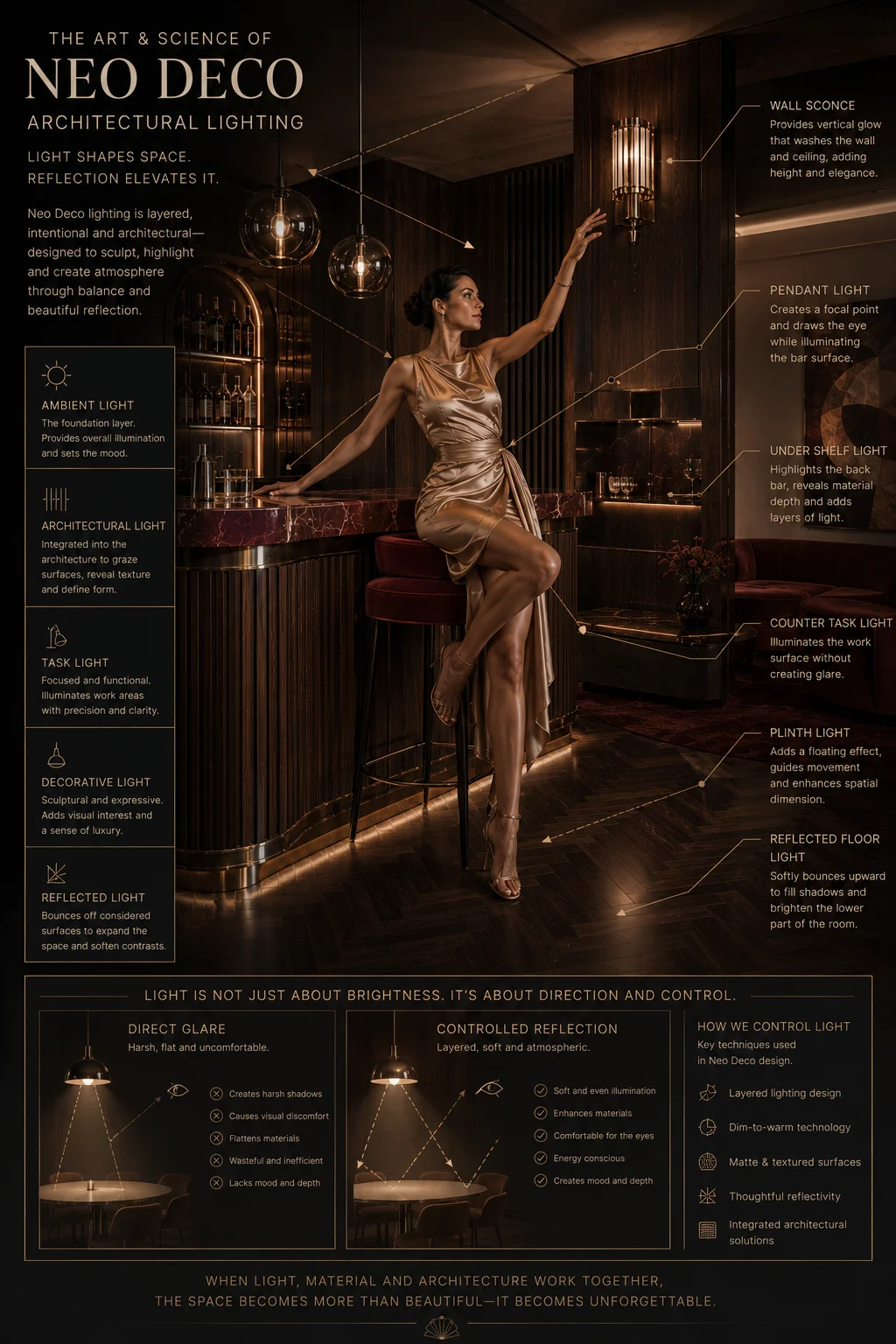
Lighting is unusually important in Neo Deco because so many characteristic materials interact strongly with it. Marble reveals veining when light crosses its surface. Chrome and polished nickel produce sharp highlights. Smoked glass creates darker reflections, while lacquer can return almost mirror-like light depending on its finish. Velvet and walnut behave differently, absorbing illumination and creating shadow that gives the brighter materials something to contrast against.
If lighting itself is your main design problem, the site’s existing guide to lighting trends and interior lighting ideas can provide an additional starting point before you specify decorative pendants, wall lights and ambient layers for a Neo Deco room.
This means a beautiful material palette can still produce an uncomfortable room when lighting is treated as an afterthought. A polished metal wall light aimed directly toward a glossy marble surface may create a bright reflection exactly at eye level. Several reflective surfaces facing one another can multiply highlights until the visual richness becomes glare.
The solution is rarely to eliminate reflective materials. Neo Deco benefits from them. The more useful approach is to create a sequence in which light moves between reflective and absorptive surfaces, allowing the room to sparkle selectively rather than continuously.
Ambient Light Establishes the Base Level
Ambient illumination determines how much of the room remains visible before decorative fixtures begin contributing character. Recessed lighting, concealed ceiling illumination or carefully positioned general fixtures should provide enough background light that decorative lamps do not need to become excessively bright.
A lower ambient level can suit dining rooms, lounges and bedrooms, while kitchens and work areas need greater visibility. The important point is that functional brightness and decorative drama should be separated rather than expecting one chandelier to perform every lighting job.
Architectural Lighting Reveals Surface
Concealed coves, shelf lighting and wall washing are particularly valuable in Neo Deco because they can reveal texture without adding another decorative object. A softly illuminated fluted walnut wall gains depth as tiny shadows appear between the vertical grooves. A marble wall can become dramatically dimensional when light moves across it rather than striking it flatly from the front.
Architectural lighting should remain relatively discreet. When every shelf, cabinet toe kick and ceiling recess contains visible LED lines, the effect can become more futuristic than Deco. A few carefully selected illuminated planes usually create greater visual depth.
Decorative Lighting Acts Like Jewellery
Neo Deco lighting fixtures can be expressive because the rest of the room does not need to be. Pendant lights, wall sconces and table lamps provide an opportunity to use polished metal, glass, alabaster, exaggerated discs or geometric silhouettes at a scale that remains easy to control.
A single sculptural pendant over a dining table may provide enough decorative identity for nearby architecture to remain quiet. Repeating the exact same motif in every fixture tends to feel more commercial and less collected.
Reflected Light Creates the Glamour
Some of Neo Deco’s atmosphere comes from light that reaches the eye indirectly after touching another surface. A pendant may create a small highlight on polished nickel, which then appears again across marble or smoked glass. These secondary reflections make materials appear richer because the room contains multiple brightness levels.
Matte timber, velvet, rugs and plaster are essential in this system because they stop the reflective sequence. Without those absorptive surfaces, every bright point can continue bouncing through the composition. Controlled glamour requires both shine and darkness.
Warm Light Is Useful, but Temperature Should Follow Material
Warm white light generally works well with walnut, oxblood, tobacco, brass and cream stone because it strengthens their warmth. Highly polished nickel, chrome and cool marble can also benefit from some neutral illumination so their material character does not become overly yellow.
Rather than selecting one color temperature for every fixture, consider the visual job of each source. Decorative lamps can provide warmth, while architectural lighting can remain slightly more neutral where material accuracy matters. The difference should be subtle enough that the room still feels coherent.
Neo Deco Living Rooms Need a Clear Visual Hierarchy
The living room is where Neo Deco can become either remarkably sophisticated or unnecessarily busy because it often contains the highest number of independent objects. Sofa, chairs, coffee tables, lamps, artwork, rugs, media furniture and decorative pieces all compete for attention. Establishing a hierarchy before choosing individual objects prevents every purchase from becoming another focal point.
Begin with the largest visual event. This might be a curved sofa, a dramatic marble fireplace, a dark timber wall or a sculptural ceiling fixture. Once that element is identified, supporting furniture should strengthen its proportion rather than compete with it. A room anchored by red marble may need quieter upholstery, while a relatively simple architectural shell can support a more dramatic sofa.
Furniture spacing matters because generous negative space increases the apparent importance of individual pieces. A sculptural chair looks more deliberate when its silhouette can be seen clearly rather than being squeezed between side tables and accessories. This is particularly important in Neo Deco, where strong outlines are part of the visual language.
Choose One Hero Furniture Silhouette
The hero piece does not need to be the most expensive item. It simply needs a recognisable shape and enough surrounding room to be perceived clearly. A crescent sofa, high-back lounge chair or curved banquette can establish the softer side of Neo Deco while straight cabinetry and architectural edges provide structure around it.
Once the hero silhouette has been chosen, additional seating can be simpler. Repeating dramatic curves across every chair usually weakens the first piece because the eye no longer understands which form should dominate.
Keep the Coffee Table Visually Lower
A lower central table protects sightlines across the room and allows larger furniture forms to remain visible. Stone, smoked glass, lacquer or dark timber can all work, although the finish should relate to the room’s existing reflection balance.
A highly polished table directly beneath a very reflective pendant can create more glare than expected. Testing the relationship between furniture and lighting is therefore just as important as choosing the table in isolation.
Neo Deco Dining Rooms Can Carry More Drama
Dining spaces naturally support stronger theatrical effects because their furniture arrangement already creates a clear center. The table establishes the primary axis, while the lighting fixture provides an obvious focal point above it. This makes it easier to introduce marble, polished metal or deep color without creating uncertainty about where the eye should settle.
A dining room can also tolerate darker wall color than many circulation areas because people spend time there in a relatively stable seated position. Burgundy, tobacco, emerald or midnight blue can create intimacy, especially when the table surface and lighting introduce enough contrast.
Use the Pendant as the Main Decorative Gesture
A sculptural pendant can carry much of the Deco reference in a dining room. Disc forms, stepped glass, polished metal or geometric compositions can appear dramatic without requiring matching sconces, mirror frames and cabinet hardware.
The fixture should relate to the table’s scale rather than simply being visually interesting. An undersized pendant loses authority above a substantial dining table, while an excessively large fixture can compress the room visually and interfere with sightlines.
Banquette Seating Adds a Strong Neo Deco Opportunity
A leather or velvet banquette can combine curve, color and tactile softness inside one architectural element. Built-in seating also gives the wall behind it a clear role, which can reduce the need for additional furniture.
Fluted wood, a restrained mirror panel or one large artwork behind the banquette can strengthen the composition without making the dining zone overly decorative.
Neo Deco Bedrooms Should Feel Quieter Than Living Areas
A bedroom can carry the same material vocabulary as the rest of the home without matching its visual intensity. Dark timber, velvet, rich color and polished metal remain useful, but fewer reflective surfaces around the bed generally create a calmer environment.
The headboard provides the most natural place for a strong Neo Deco gesture. A broad curved form, subtle fan geometry or upholstered panel system can establish the style while bedside tables and lighting remain relatively simple.
Make the Headboard the Main Architectural Moment
An oversized upholstered headboard can combine softness and geometry without using a strong pattern. Vertical channels, broad curves or a stepped outline can create enough structure to anchor the room.
If the headboard already carries a dramatic form, the wall behind it usually needs less decoration. Adding patterned wallpaper, multiple mirrors and decorative moulding can reduce the clarity of the original gesture.
Use Reflective Surfaces Away From the Pillow Zone
Polished metal and mirror can still appear in a bedroom, although placement matters. Reflective bedside surfaces or mirrors directly facing the bed may introduce unnecessary visual activity when the room is meant to feel restful.
Smoked glass, satin metal or textured stone can provide a softer alternative when some sheen is desirable without producing a strong mirror effect.
Neo Deco Bathrooms Can Handle Stronger Stone
Bathrooms provide an excellent environment for Neo Deco because stone, mirror, metal and lighting already belong naturally to the room. A richly veined red or dark marble can therefore appear intentional rather than decorative if it is allowed to dominate one important surface.
The main risk is combining too many high-reflection materials. Glossy stone, polished fittings, large mirrors and glass shower enclosures can create a very bright visual field. Introducing matte cabinetry, textured wall finish or darker timber can restore balance.
Let One Stone Become the Main Event
A dramatic vanity wall, shower wall or floor can carry enough natural pattern to define the bathroom. Continuing the same stone across multiple surfaces can create a more architectural feeling than introducing several unrelated stones.
When the hero stone is highly active, hardware and lighting should generally become simpler. The material does not need additional decorative competition.
Use Metal Consistently
Bathrooms contain many small metal components, so an inconsistent finish becomes especially noticeable. Faucet, shower hardware, mirror trim, lighting and cabinet handles do not need to match perfectly, although they should feel intentionally related.
Polished nickel and chrome provide a cleaner Neo Deco direction, while brass introduces greater warmth. Mixing both can work when one clearly dominates and the secondary finish appears in only a few controlled locations.
Can Neo Deco Work in a Small Apartment?
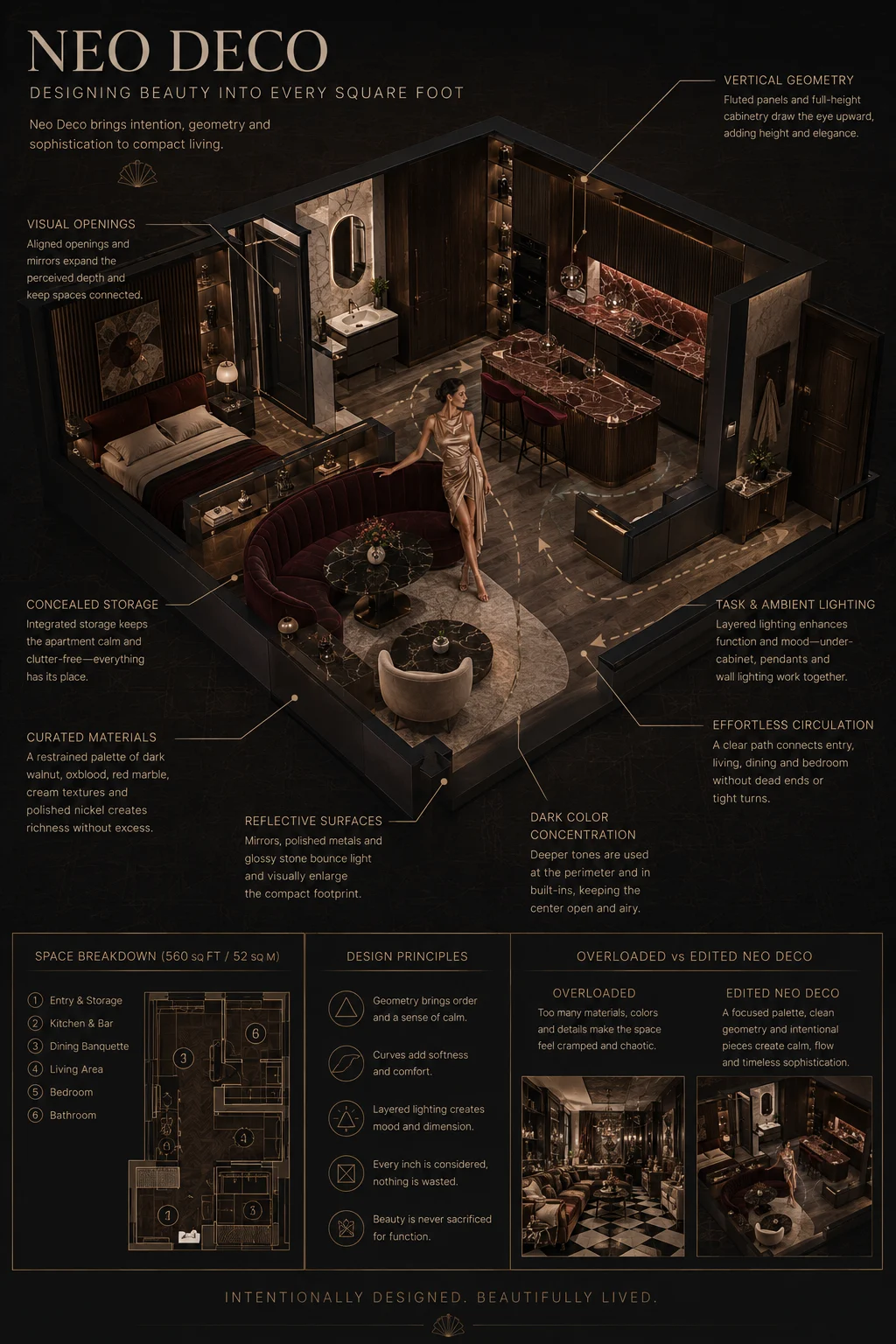
Neo Deco can work extremely well in a compact apartment when the style is concentrated into a few high-value decisions rather than distributed across many small decorative objects. A small room does not automatically require pale finishes. Dark color can actually make architectural boundaries feel less obvious, particularly when lighting and reflective surfaces are used strategically.
If floor area is the main constraint, these small apartment living room decor ideas can help you think about furniture density and practical use before adding stronger Neo Deco materials.
The important limitation is visual density. Every additional side table, decorative lamp, mirror and geometric object occupies part of the room’s visual field even when it occupies relatively little floor area. Compact Neo Deco therefore benefits from larger integrated elements such as built-in storage, banquettes and continuous wall finishes that provide character without creating another freestanding object.
Start With One Hero Curve
A single curved banquette, sofa or chair can establish enough Deco character for the entire living space. Keeping the remaining furniture simpler prevents the room from becoming a showroom of sculptural objects.
The hero curve should also support circulation. A rounded corner can sometimes improve movement through a compact room by removing the sharp projection created by a conventional rectangular furniture edge.
Use Concealed Storage as Architecture
Full-height walnut cabinetry can make a small apartment feel more deliberate because the storage becomes part of the architectural background. Handle-free or discreetly detailed doors allow the timber to read as one strong plane rather than a collection of cupboards.
Storage should be planned before decorative furniture. A room that looks elegant in photographs but lacks a practical place for everyday belongings will quickly lose the visual clarity that made the design successful.
Limit Reflective Sightlines
Mirrors can widen a compact interior, although multiple large mirrors facing one another often create visual confusion. One strategic reflective surface aimed toward a window, artwork or attractive architectural view generally produces a cleaner result.
The reflected scene matters as much as the mirror itself. A mirror that doubles a cluttered kitchen counter simply creates twice the apparent clutter.
Protect the Main Walking Path
Furniture placement should preserve an obvious route between entry, living, dining and bedroom areas. Neo Deco furniture can have strong silhouettes, so enough clearance is needed for those forms to be appreciated without turning circulation into a series of small obstacles.
In compact homes, the strongest composition is often the one with fewer pieces and slightly more breathing space around each one.
Control Where the Darkest Color Appears
A small apartment can support dark walnut and saturated color, but applying the darkest finish indiscriminately across every surface may remove useful visual hierarchy. Concentrating depth on one wall, storage volume or furniture zone allows lighter areas to provide relief.
Lighting should follow the same hierarchy. Illuminating the boundaries of the room selectively can create a greater sense of depth than flooding every surface with uniform brightness.
When Neo Deco Starts Looking Like a Theme
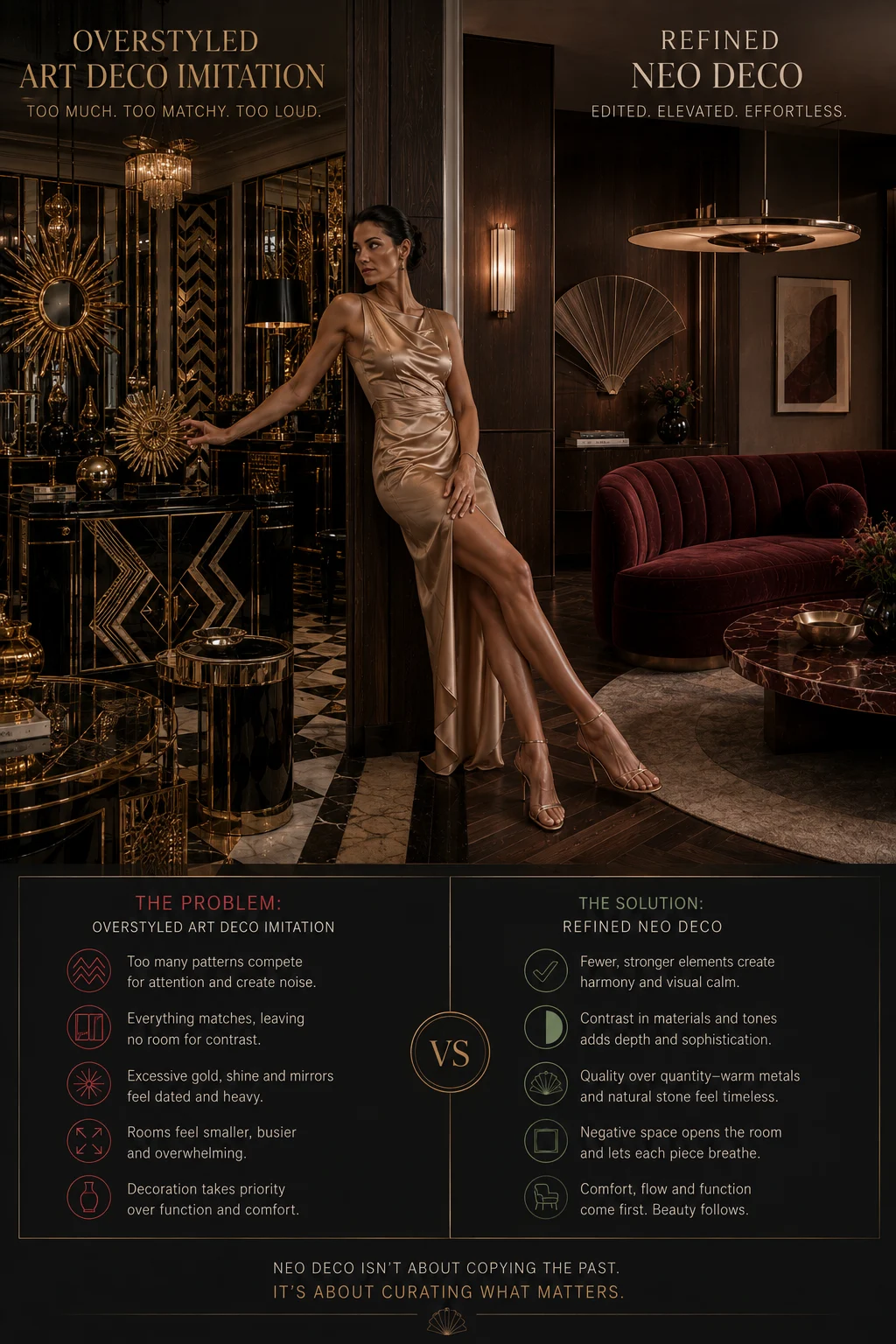
Neo Deco becomes less convincing when the room is built from symbols rather than relationships. Repeated sunbursts, chevrons, fan motifs, mirrored furniture and gold edging may all be individually associated with Art Deco, but using them together does not automatically create a more sophisticated result. It often makes the historical reference more obvious while making the actual interior less coherent.
The warning sign is repetition without hierarchy. If the rug, mirror, cabinet, cushions, wall panels and lighting all use different versions of the same motif, the room begins behaving like a visual catalogue. One or two references are usually enough when material, color and proportion already support the style.
Mistake: Gold Everywhere
Gold is strongly associated with Deco, but using it across every handle, lamp, furniture leg, mirror and decorative edge can flatten the material hierarchy. The metal stops behaving like an accent because there is no longer anything for it to accent.
Choose the dominant metal according to the room’s broader palette. Polished nickel may suit burgundy and walnut particularly well, while brass can be reserved for a smaller number of warmer details.
Mistake: Repeating the Same Motif
A fan arch can be memorable. Five fan arches become a theme. Repetition should occur through related geometry rather than literal duplication.
A fan-shaped opening might be supported by a circular pendant and curved sofa without another fan appearing anywhere else. The family resemblance is enough.
Mistake: Using Only Black, White and Gold
The familiar palette can certainly work, but relying on it as the definition of Art Deco usually limits the room before material selection has even begun. Neo Deco gains much of its contemporary character from darker woods, rich mineral colors and more nuanced combinations of warm and cool finishes.
A room with walnut, burgundy marble and nickel may feel more convincingly Neo Deco precisely because it avoids the most obvious historical shorthand.
Mistake: Too Many Small Decorative Pieces
Neo Deco benefits from objects with presence. A large stone bowl, sculptural lamp or substantial artwork can create greater visual impact than a shelf filled with many small Deco-inspired accessories.
Reducing the number of objects also makes cleaning, maintenance and everyday use easier, which is particularly important when the style is adapted to a real home rather than a hospitality interior.
Mistake: Confusing Shine With Luxury
Gloss can reveal beautiful material, although excessive reflection tends to make a room look harder rather than richer. Velvet, dark timber, rugs, plaster and other matte surfaces give polished materials the contrast that makes them noticeable.
Luxury is therefore created by the relationship between finishes, not by maximizing the number of glossy surfaces.
How to Build a Neo Deco Room
The most reliable way to build a Neo Deco room is to work from the architecture outward instead of starting with decorative accessories. This makes the room easier to control because each decision has a clear job and later additions can be evaluated against an established visual hierarchy.
A practical sequence begins with geometry and spatial organisation, then introduces the dominant timber, saturated color, hero stone or metal, sculptural furniture and lighting. Decoration comes last, after the room already reads as Neo Deco without it.
1. Establish the Geometry
Identify the strongest existing lines in the room. Doorways, windows, cabinetry, ceiling height and floor direction already create geometry before any Deco reference is introduced.
Choose one primary form to strengthen. This might be a broad curve, repeated vertical line, stepped transition or circular feature. The remaining geometry should support it rather than compete against it.
2. Choose the Dominant Wood
Dark walnut is highly adaptable because it provides warmth without looking overtly historical. Mahogany adds greater red depth, while burl should normally be reserved for focal furniture or smaller architectural moments because its grain is considerably more active.
Using one dominant wood family across the major elements creates visual continuity and makes later material choices easier.
3. Introduce the Main Color
Select a color that works with the timber rather than selecting color independently. Oxblood strengthens walnut, emerald contrasts beautifully with reddish wood, while tobacco creates a more tonal relationship.
Apply enough of the color for it to become structural. One painted wall rarely creates the same atmospheric effect as coordinated wall, upholstery or curtain choices that allow the color to appear across several material types.
4. Add One Hero Stone and One Metal Family
Stone provides natural pattern and visual weight. Metal supplies concentrated reflection. Both should therefore be chosen after the room’s darker and softer materials are established.
One dominant stone is usually easier to control than several different marbles. The same principle applies to metal. Nickel, chrome, brass or bronze can all work, but one should clearly lead.
5. Add a Sculptural Curve
Introduce one furniture silhouette capable of interrupting the architecture. This could be a curved sofa, lounge chair, dining banquette or headboard.
Give the piece enough surrounding room that its outline can be understood. Sculptural furniture loses much of its impact when crowded by small tables and accessories.
6. Build the Lighting Layers
Establish functional ambient light first, then use architectural light to reveal wall texture and materials. Decorative lighting can then act as jewellery, while reflected light becomes the final atmospheric layer.
Review the room at night before deciding that additional fixtures are necessary. Reflective surfaces may already distribute more light than expected.
7. Edit Before Decorating
The final stage should involve subtraction before addition. Look for duplicate geometric motifs, unnecessary reflective objects, repeated metal details and furniture that interrupts circulation or weakens the main silhouette.
Once those conflicts have been removed, the room may need very little decoration. Art, one or two objects and a few personal pieces usually feel more convincing when the architecture and materials already carry the style.
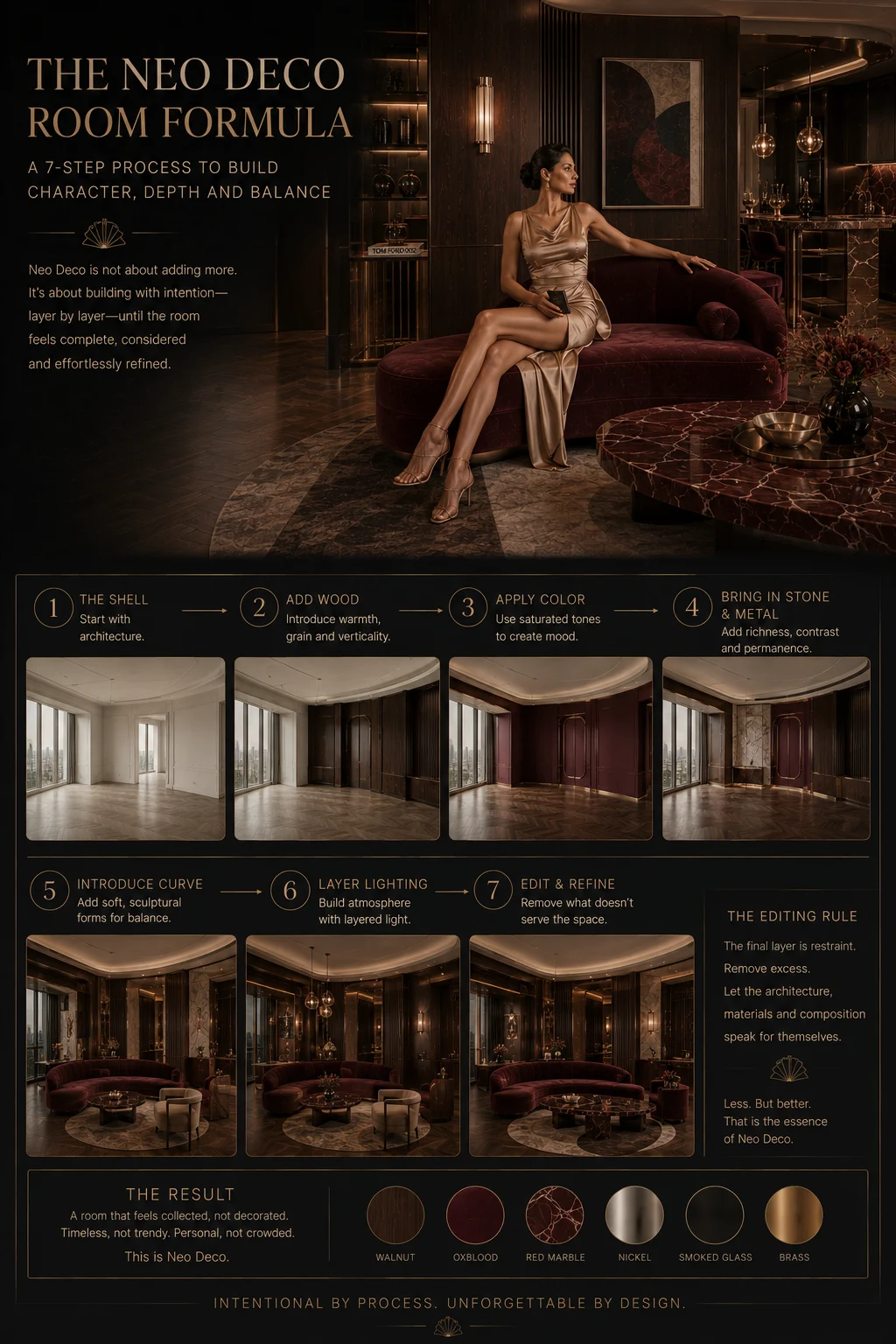
A Practical Neo Deco Material Formula
A useful starting formula is one dominant wood + one hero stone + one main metal family. Upholstery and paint can then introduce color while glass, lacquer and smaller accents adjust the level of reflection. This prevents the material palette from becoming a collection of equally demanding finishes.
Dark walnut with burgundy marble and polished nickel creates a cooler contemporary direction. Mahogany with cream marble and restrained brass feels warmer. Burl wood with tobacco leather and bronze produces a quieter, more textural interpretation. None of these combinations requires every material to appear in equal quantities.
Is Neo Deco Expensive to Create?
Neo Deco can become expensive quickly when the design depends on large quantities of natural stone, bespoke joinery, custom metalwork and highly specialised furniture. Those materials are visually powerful, however, which also means a successful room does not necessarily need many of them. Concentrating the budget on one or two highly visible elements can create stronger results than distributing the same budget across numerous decorative upgrades.
A homeowner might keep existing cabinetry and introduce the character through a dramatic stone console, richer wall color, sculptural lighting and one curved upholstered chair. Another room may benefit more from refinishing joinery in a dark timber tone and replacing several small decorative objects with one substantial artwork.
The most important budget decision is therefore not whether to buy expensive Deco-inspired items. It is identifying which surface or object has enough visual influence to change the room. Spending more on that element and less on secondary decoration usually creates a more convincing result.
Where to Spend More
Natural stone can justify greater investment when it occupies a focal position and the veining is important to the composition. Upholstered furniture may also deserve a larger share of the budget because silhouette, fabric quality and comfort have long-term consequences.
Lighting is another area where proportion and material quality can be visible from across the room. A well-selected pendant or wall light may contribute more to the finished atmosphere than several inexpensive decorative accessories.
Where You Can Save
Walls do not always need specialist finishes. Carefully selected paint can create enough saturated depth when timber, upholstery and lighting already provide texture.
Smaller metal details also do not need to be individually expensive if their finish is consistent and convincingly specified. The room should be judged as one composition rather than as a collection of premium labels.
The Best Neo Deco Rooms Still Leave Something Quiet
A memorable Neo Deco interior can contain marble, velvet, walnut, polished metal and saturated color without feeling overloaded because strong areas are balanced by visually quieter ones. A plain cream wall beside a dramatic stone surface can increase the apparent richness of the stone. An uncomplicated rug can make a sculptural sofa easier to read. A long run of unadorned timber can give one brass detail greater importance.
This restraint is what allows Neo Deco to function as a contemporary residential style rather than a historical reconstruction. The glamour remains visible, but it is concentrated. Geometry provides structure, materials create depth, curves soften the composition, and light determines which surfaces become active at different times of day.
For readers coming from minimal interiors, the useful lesson is that richness does not have to mean clutter. Neo Deco can feel highly expressive while maintaining clear circulation, controlled furniture density and carefully protected negative space. The style succeeds when the room knows where to be dramatic and where to remain quiet.
Who Neo Deco Works Best For
Neo Deco is especially well suited to people who enjoy rooms with a clear visual identity but still want contemporary comfort and flexibility. It appeals to homeowners who find conventional minimalism too restrained, yet do not necessarily want the layered density of maximalism. The style provides a middle ground where color, material and geometry can become expressive without requiring every wall, shelf and surface to participate equally.
It also works well for people who enjoy darker interiors. Walnut, burgundy, tobacco, midnight blue and emerald all perform particularly well in Neo Deco because they create depth around marble, polished metal and sculptural lighting. Someone who prefers consistently pale rooms may still use the style, although the result will usually feel softer and closer to contemporary glamour than the darker Neo Deco language explored throughout this article.
The style is also appropriate for homeowners who value furniture as a visual object. A Neo Deco room often allows one chair, banquette, console or pendant to occupy more visual importance than it would in a conventional neutral interior. This means fewer pieces can sometimes create greater impact, provided their scale, material and placement are carefully considered.
Someone seeking a particularly soft, low-stimulation environment may feel more comfortable with the warmer restraint of Japandi minimalist interior design, where texture and natural material usually carry more of the visual interest than reflection or saturated color.
Neo Deco May Suit You If You Like Strong Material Contrast
If combinations such as dark wood beside marble, velvet beside chrome, or saturated walls beside cream stone feel exciting rather than overwhelming, Neo Deco offers a structured way to use those contrasts. The style gives each material a distinct job, which helps stronger finishes coexist without making the room feel random.
This is one reason Neo Deco can work for someone moving away from very quiet interiors. The change does not require abandoning restraint. It simply relocates restraint from color and material choice toward editing, hierarchy and placement.
Neo Deco May Suit You If You Prefer Fewer, Stronger Pieces
People who dislike collections of small decorative objects may find Neo Deco surprisingly compatible with their preferences. One sculptural chair, one dramatic stone feature and one well-proportioned pendant can establish more character than a large number of accessories.
This approach also makes the room easier to evolve. Artwork, upholstery and lighting can change later without requiring the entire architectural language to be rebuilt.
Neo Deco May Be Less Suitable If You Want Everything Visually Quiet
A Neo Deco room can certainly be calm, although it generally contains more visual contrast than styles built around pale matte surfaces and very low material variation. Marble veining, polished metal, deep color and strong furniture silhouettes naturally attract attention.
Someone seeking a particularly soft, low-stimulation environment may feel more comfortable with the warmer restraint of Japandi minimalist interior design, where texture and natural material usually carry more of the visual interest than reflection or saturated color.
Neo Deco vs Japandi: Two Different Ways to Use Restraint
Neo Deco and Japandi can appear almost opposite at first glance, yet both depend heavily on editing. Japandi reduces visual pressure through warm neutral color, matte texture, lower furniture and quieter spatial pacing. Neo Deco allows darker color, stronger reflection and more theatrical furniture, but still relies on carefully protected negative space and deliberate material hierarchy.
The key difference is where each style places visual energy. Japandi tends to distribute interest through subtle grain, texture, shadow and material softness. Neo Deco concentrates energy around stronger focal events such as a marble wall, metallic light fixture, curved sofa or saturated architectural surface.
This distinction matters because homeowners sometimes try to combine the styles simply by adding brass or dark burgundy accessories to a Japandi room. The result can feel disconnected when the architecture and furniture still follow an entirely different visual logic. A successful hybrid would require more deliberate changes to scale, contrast and material behavior rather than decorative color alone.
| Design Question | Japandi | Neo Deco |
|---|---|---|
| Main emotional effect | Calm, grounded and visually quiet | Glamorous, dramatic and carefully controlled |
| Typical wood direction | Oak, ash and softer natural timber tones | Walnut, mahogany, burl wood and deeper reddish-brown timbers |
| Surface behavior | Mostly matte, softly textured and low in reflection | Matte materials are deliberately balanced with polished stone, metal, lacquer and glass |
| Color | Warm neutrals, clay, muted gray, cream and natural timber | Burgundy, oxblood, emerald, tobacco, midnight blue, smoky rose, cream and dark wood |
| Furniture | Low-profile, visually quiet and restrained | Sculptural, curved and intentionally more visually assertive |
| Geometry | Clean proportion, uncomplicated lines and strong negative space | Fan arcs, stepped forms, circles, vertical rhythm and controlled geometric motifs |
| Lighting | Warm, diffuse and generally gentle across materials | Layered lighting uses directional highlights and reflection to reveal material richness |
| Decoration | Minimal, tactile and deliberately restrained | Edited and expressive, with fewer but stronger decorative moments |
The comparison also shows why the two styles can coexist within the same home when they occupy different rooms. A quiet Japandi bedroom and a richer Neo Deco dining room can still feel related if the timber tones, lighting warmth and material quality remain coordinated. The goal is not to force one visual language across every room when different functions benefit from different levels of stimulation.
How Neo Deco Changes From Day to Night
One of Neo Deco’s strongest qualities is that the room can change character substantially after sunset. During the day, natural light reveals wood grain, stone veining and true material color. Chrome and polished nickel create sharper highlights, while smoked glass and dark paint often appear more transparent or nuanced than they do under artificial light.
At night, the hierarchy changes. Decorative lighting becomes more important, shadows deepen around curves and wall relief, and saturated colors often become richer. Marble can appear more dramatic when illuminated from one direction, while brass or nickel becomes a series of smaller highlights rather than one continuously bright surface.
This transformation means a Neo Deco room should never be judged only in daylight. Material samples that look perfectly balanced beside a window may behave very differently under warm evening lighting. Reviewing important finishes at both times of day can reveal whether a surface becomes too reflective, too dark or unexpectedly warm.
Daylight Should Reveal the Material Honestly
Where possible, daylight should reach the hero materials without being blocked by unnecessarily heavy window treatments. Red marble, walnut, burl and velvet all contain subtle tonal variation that becomes more visible under natural light.
Readers who prefer stronger connections to daylight, plants and natural environmental cues may find biophilic interior design a more appropriate direction than Neo Deco’s stronger emphasis on glamour and reflective material.
Strong direct sunlight can produce glare on lacquer, glass and polished stone, so sheer curtains or adjustable blinds may be useful in rooms with intense exposure. The goal is to soften the light without flattening the material.
Evening Light Should Create Hierarchy
At night, not every area needs equal brightness. A brighter dining table, softly illuminated wall panel and lower ambient background can produce more depth than uniform downlighting across the entire ceiling.
This is particularly important in rooms with dark finishes. Darkness itself is not the problem. A lack of visual hierarchy is. When key surfaces are illuminated and less important areas are allowed to recede, the room can feel deeper rather than smaller.
How to Maintain a Neo Deco Interior
Neo Deco materials can be durable, but different finishes require different maintenance. Dark glossy surfaces show fingerprints more readily than matte timber. Marble may require protection from staining or etching depending on the stone. Velvet can hold dust differently from leather, while polished metal may show fine surface marks that become visible under directional lighting.
Maintenance should therefore be considered during specification rather than after installation. A highly polished material may look exceptional in a rarely touched console but become frustrating on a family kitchen island. A velvet sofa can feel luxurious in a formal lounge while a performance fabric with a similar visual depth may be more practical in a heavily used living room.
Protect Natural Stone According to the Stone
Different stones have different porosity and chemical sensitivity, so maintenance guidance should follow the actual material rather than the appearance alone. Highly dramatic marble may require more care than engineered alternatives, particularly in kitchens and bathrooms where liquids, cosmetics and cleaning products are common.
The design decision should therefore consider where the material will be used and how much maintenance the household realistically wants to accept.
Choose Upholstery for Real Use
Velvet can create extraordinary color depth, although the exact fiber and construction affect durability, crushing, staining and maintenance. Commercial-grade or performance upholstery may be more appropriate for banquettes and everyday sofas than delicate decorative fabrics.
Leather can be equally effective in Neo Deco, especially in tobacco, oxblood and deep brown tones. Its natural aging can contribute to the room’s character when the finish is selected with long-term use in mind.
Keep Reflective Surfaces Selective
Polished metal and glass require more frequent cleaning when they are located in high-touch areas. Using those finishes on lighting, occasional furniture or architectural accents can preserve their visual impact while reducing daily maintenance.
Matte timber, textured paint and upholstery can occupy the larger high-contact surfaces, allowing reflective material to remain a deliberate accent.
How to Make Neo Deco Feel Personal Instead of Showroom-Perfect
Neo Deco becomes more convincing when the room contains evidence of the people who live there. Contemporary art, books, inherited furniture, ceramics and objects collected over time can prevent the style from feeling like a hotel or furniture display. These pieces do not need to match the Deco language exactly.
In fact, one object from a different period can improve the composition by breaking excessive coordination. A modern abstract painting above a curved banquette, an older timber chest beside a polished nickel lamp, or handmade pottery on a marble console can make the room feel collected rather than purchased as a complete set.
The important distinction is between personality and decorative quantity. Personal objects still need room around them. A smaller number of meaningful pieces often reads more clearly against the stronger materials and architecture already present.
Use Art to Break Perfect Symmetry
Art is one of the easiest ways to keep a Neo Deco interior from becoming overly formal. A large asymmetrical painting can disrupt a highly structured wall without requiring the architecture itself to change.
Artwork can also introduce colors that are slightly outside the main palette, preventing the room from becoming too coordinated. Those secondary colors should appear naturally rather than being repeated mechanically across cushions and accessories.
Mix Periods Carefully
A contemporary Neo Deco room does not need every furniture piece to reference Art Deco. One vintage side table, a modern sofa, a contemporary sculpture and an older chair can coexist if their scale, material and visual weight are compatible.
This is often more convincing than purchasing a full matching furniture suite because the room develops a sense of time and personal selection.
The Neo Deco Decision Test
Before adding another Deco-related element, ask what job it will perform. If the room already has strong geometry, another patterned object may add very little. If the materials already produce considerable reflection, another polished surface may create glare rather than richness. If the furniture silhouettes are already dramatic, another sculptural chair may weaken the hierarchy instead of improving it.
A useful decision is therefore based on what the room lacks, not on whether the new object belongs to the style. Neo Deco should be treated as a system of relationships rather than a checklist of products.
Ask These Questions Before Adding Another Element
Does the room need more structure, or does it already have enough geometry? Does it need another reflective surface, or does it need something softer? Is the dominant color strong enough, or is another color creating unnecessary competition? Does the room need one larger object instead of several smaller ones? Is the new piece improving circulation, comfort or visual hierarchy?
When several answers point toward subtraction, the best Neo Deco decision may be to remove something. This is one of the clearest signs that the style is being used as contemporary interior design rather than period decoration.
Neo Deco Interior Design: Final Takeaway
Neo Deco works because it preserves the confidence of Art Deco while allowing contemporary interiors to become softer, more flexible and more personal. The style still celebrates geometry, polished detail, saturated color and luxurious material, but these elements no longer need to dominate every surface.
The strongest rooms usually establish one architectural idea, one dominant wood, one memorable stone or material, one main metal family and a limited number of sculptural furniture forms. Lighting then determines how those elements appear across the day, while editing prevents the visual language from becoming repetitive.
For homeowners attracted to dramatic interiors, Neo Deco offers a useful alternative to both minimalism and full maximalism. It can be dark without feeling oppressive, decorative without feeling cluttered, and glamorous without turning the home into a historical set. The quality of the result depends less on how many Deco references appear in the room and more on how carefully geometry, material, color, furniture and light are allowed to support one another.
Neo Deco Interior Design FAQ
Neo Deco is a contemporary interpretation of Art Deco that keeps its interest in geometry, rich materials, dramatic lighting and polished detail while using softer furniture, darker natural woods, broader color palettes and more restrained ornament. It is designed to feel current and livable rather than like a reproduction of a historical interior.
No. Neo Deco borrows important Art Deco ideas such as geometric structure, luxurious materials and decorative metalwork, but it adapts them to contemporary architecture and residential life. Traditional Art Deco tends to be more formal and period-specific, while Neo Deco usually uses fewer motifs, softer furniture and more controlled asymmetry.
Oxblood, burgundy, emerald, tobacco, midnight blue, smoky rose, cream and dark natural wood tones work particularly well. The strongest palettes usually combine one dominant saturated color with timber, stone and a controlled metal finish instead of relying only on black and gold.
Common materials include walnut, mahogany, burl wood, velvet, leather, marble, lacquer, polished nickel, chrome, brass and smoked glass. A balanced Neo Deco room usually combines materials that absorb light with materials that reflect it rather than making every surface glossy.
Yes. Small apartments can use Neo Deco effectively when the style is concentrated into a few strong elements such as one curved furniture piece, concealed dark-timber storage, one hero stone and one strategic reflective sightline. Clear circulation and restrained object density are more important than keeping every surface pale.
No. Dark walnut, burgundy and deep jewel tones are highly compatible with Neo Deco, but the style can also use cream stone, lighter upholstery and warmer neutral surfaces. The important qualities are material contrast, geometric discipline, sculptural form and controlled reflection rather than darkness alone.
Use fewer recognizable Deco motifs and allow architecture, material and furniture proportion to carry the style. One fan-shaped opening or stepped detail is usually more effective than repeating sunbursts, chevrons and gold edging across many surfaces. Contemporary art and furniture from different periods can also keep the room from feeling like a historical set.
It can be expensive when it relies heavily on natural marble, bespoke joinery and custom metalwork, but those materials do not need to appear everywhere. Concentrating the budget on one high-impact material, sculptural furniture piece or lighting fixture can create a stronger result than spreading the same budget across many decorative accessories.
Begin with one strong change such as richer wall color, a sculptural pendant, a curved upholstered chair, dark timber furniture or a dramatic stone surface. Build the rest of the room around that focal decision instead of introducing many small Deco accessories at once.
Japandi generally uses softer neutral colors, matte natural materials, low furniture and quieter visual pacing. Neo Deco uses stronger color, more reflection, richer dark woods and more sculptural furniture. Both styles rely on editing and material quality, but they create very different emotional atmospheres.
Compare Local Home Specialists Near You
Tell us what kind of help you need, then compare nearby businesses by location, Google rating, review volume and contact options.
HomeFix Local Match
Turn a home problem into a practical local hiring decision. Check the clues, see the specialist types that fit, open focused surrounding-location searches, then compare the strongest three before you call.
 YOUR PROBLEM
YOUR AREA
COMPARE 3
✓ Ready to compare
YOUR PROBLEM
YOUR AREA
COMPARE 3
✓ Ready to compare
What is happening?
Choose the closest problem type, then check every clue that applies. Your selections change the specialist order.
Where should the search focus?
Use Google’s “near me” context or enter the area you actually want a specialist to serve.
Simple local search: open nearby Google results, choose the businesses that look suitable, then compare your best three here before you call.
Problem snapshot
Who should you call first?
These are the specialist types most likely to fit the clues you selected.
Search around your location
Compare your top three
Use the same factors for each option so a high star rating does not hide a weak scope, poor diagnosis, missing credentials or unclear aftercare.
Comparison result
Your result combines the Google signals you entered with the practical hiring checks you completed.
Questions to ask every finalist
Use the same questions with each shortlisted business so the comparison stays consistent.