
A leather banquette can do much more than replace a few dining chairs. When its proportions are resolved properly, it can reclaim an awkward wall, increase usable seating, define the dining zone inside an open room and give the interior a strong architectural feature without filling the floor with additional furniture.
The difficulty is that a banquette has very little ability to correct itself after installation. A dining chair can move closer to the table, turn slightly or be pulled out when somebody needs more room. A fixed banquette cannot. If its seat is too deep, the table is too far away, the back is too upright or the pedestal occupies the entry path, those decisions become part of the room.
Leather adds another level of consideration. Cognac, chocolate and burgundy leather can look exceptionally rich against walnut, brass, stone and plaster, which makes banquette seating particularly compatible with Neo Deco interior design. Yet the leather should be selected according to surface character, expected use and maintenance as well as color. A beautifully photographed hide is not automatically the best upholstery for a frequently used breakfast corner.
The most reliable design sequence is therefore to establish the body position first, table relationship second, circulation third and visual treatment afterward. Once those relationships work, the leather, stitching, lighting and decorative details can make the banquette distinctive without being asked to disguise an uncomfortable layout.
Why Banquette Seating Can Use Space More Efficiently
Banquettes work particularly well where loose dining chairs would require repeated pull-out space against a wall. Because the upholstered seat remains fixed, the wall side of the table can become considerably more controlled. That saved floor area may allow a larger table, improve circulation on the opposite side or make a previously awkward corner useful.
The benefit is easiest to understand in a narrow dining zone. Four loose chairs around a table need room not only for the chair footprints but also for people to move them backward and stand. Replace one row with fixed seating and that particular pull-out movement disappears. The opposite side still needs proper space for chairs and circulation, so the improvement should be evaluated across the whole plan rather than treated as free floor area.
A banquette can also create spatial order. In an open kitchen and living area, a continuous upholstered line tells the eye where dining begins without requiring another partition. An L-shaped seat can occupy a corner that would otherwise collect small furniture. A curved version can redirect circulation around a table while creating a much stronger visual center.
Storage can increase its usefulness further, although the ability to hide objects beneath the seat should not be allowed to dictate an uncomfortable seat height or an excessively deep base. The primary job remains seating.
What Makes a Banquette Different From an Ordinary Bench?
A bench is furniture. A well-designed banquette sits somewhere between furniture and interior architecture.
Its seat may be fixed directly to the wall, integrated into cabinetry, built around a column, wrapped into a bay window or constructed as part of a room divider. The backrest can be upholstered, timber-lined or integrated into a larger decorative wall. Electrical outlets, lighting, storage and nearby joinery may all depend on its final position.
Most importantly, a banquette is designed around a predictable relationship with the dining table. That relationship has to work every time somebody sits down.
A loose bench can move several centimeters toward or away from the table if necessary. A built-in leather banquette has no such tolerance. This makes early dimensional planning considerably more important than choosing the stitching pattern or leather tone.
The Occupied Position Matters More Than the Empty Furniture
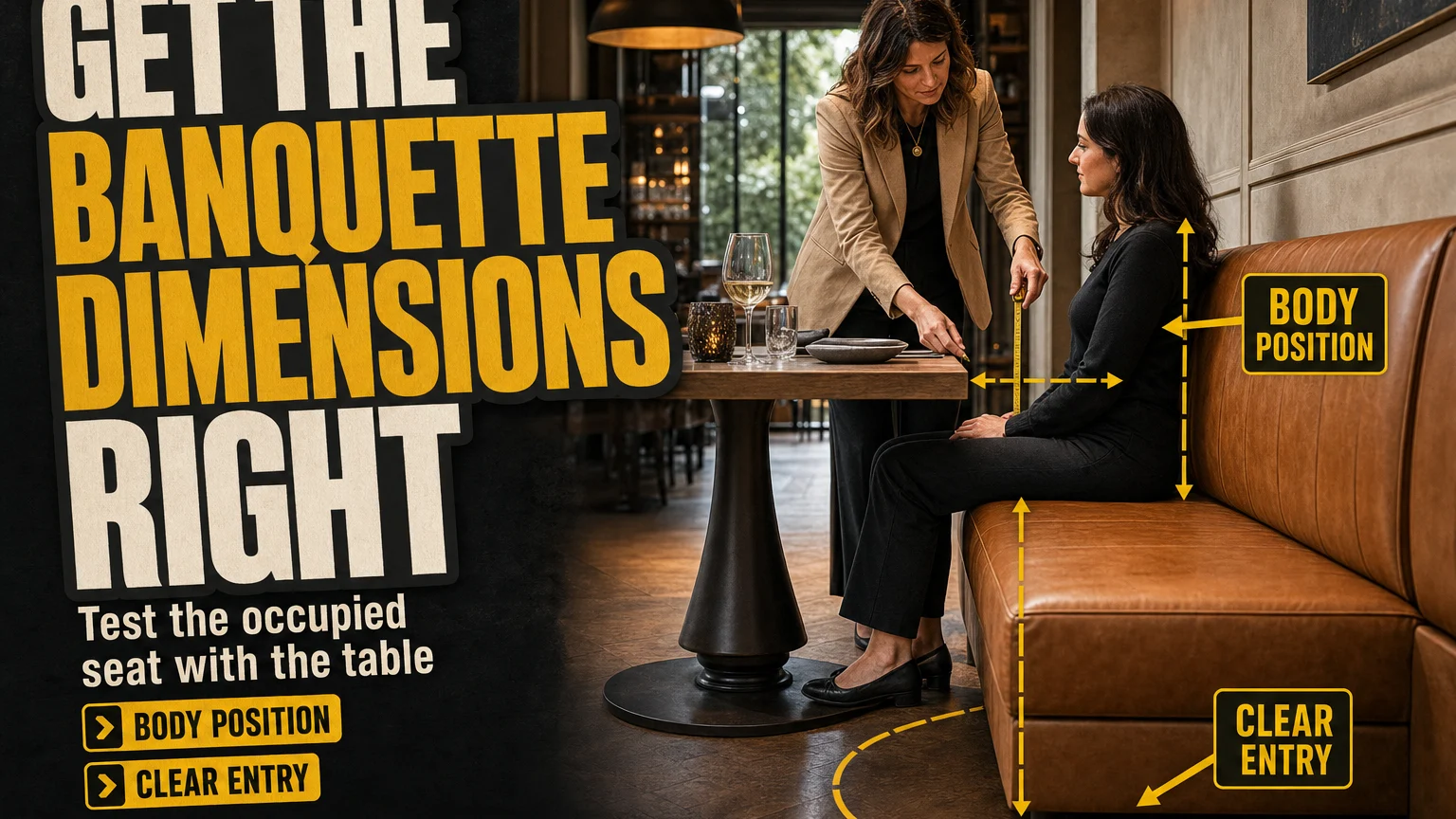
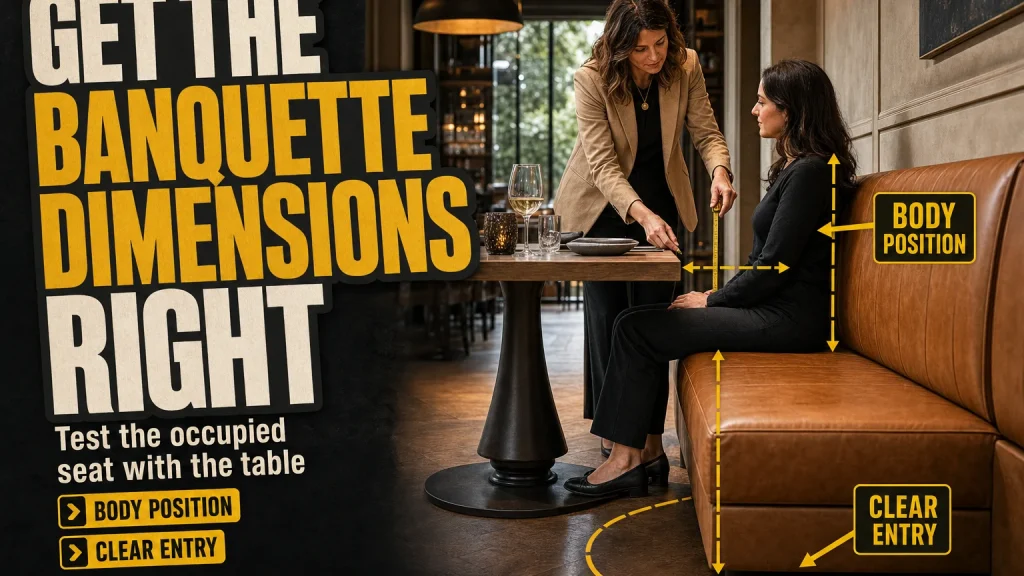
A banquette drawing should represent how the seat behaves when somebody actually sits on it. Upholstery compresses. The pelvis settles farther into the cushion. The person’s upper body may move backward against an angled backrest, and the usable distance to the table changes.
This is why the nominal depth of the joinery base tells only part of the story.
A 600 mm deep built-in unit may provide substantially less usable sitting depth once the upholstered back, foam and construction build-up are included. Conversely, a relatively shallow banquette with a thin back pad can provide surprisingly generous usable seating.
The useful design dimension is therefore the distance available after the backrest and upholstery are accounted for.
Start With Seat Height, Depth and Back Support
There is no single set of dimensions that fits every banquette, because body proportions, cushion construction, table height and intended use differ. A breakfast seat used for twenty minutes at a time can tolerate a slightly different posture from a dining banquette where people may remain seated through a long meal.
There are, however, useful starting ranges that allow the design to be tested.
Seat Height
For a dining banquette, the finished occupied seat generally needs to relate closely to an ordinary dining chair. Approximately 450 to 480 mm from finished floor to the compressed seating surface is a useful starting range for many residential designs.
The important distinction is between joinery height and finished seat height.
If a carpenter constructs a 450 mm high base and the upholsterer then adds a 70 mm cushion, the result is no longer a 450 mm dining seat. The construction drawings should therefore show the structural platform, foam thickness and intended finished height separately.
A thick soft cushion also behaves differently from firm upholstery. The unoccupied seat may appear high but settle significantly under body weight. That is why a physical sample or temporary mock-up is more useful than relying entirely on a nominal dimension.
Usable Seat Depth
For dining, an approximate 430 to 480 mm usable sitting depth is a sensible starting point. More depth is not automatically more comfortable.
An excessively deep seat can force shorter users to choose between supporting their back and reaching the table comfortably. They may end up sitting forward with no back support, which defeats much of the purpose of building a padded banquette.
The backrest thickness must be deducted from the overall structure. If the wall-to-front dimension is 600 mm and the upholstered back occupies 100 mm of that space, the usable seat behaves very differently from a 600 mm deep bench with no back padding.
Backrest Height
Backrest height involves both physical support and visual composition.
A relatively low upholstered back can make the room feel lighter and allow artwork, wall panels or plaster to remain visible above it. A shoulder-height leather back creates greater enclosure and makes the dining nook feel more substantial. Upholstery can also continue much higher as an architectural wall treatment even though the upper area is no longer necessary for seated support.
Design these two functions independently. Determine where the body requires support, then decide how far the visual upholstery should continue.
Backrest Angle
A perfectly vertical back can look neat on an elevation but may feel unnecessarily formal during a relaxed meal. Introducing a modest backward rake usually improves the posture of a dining banquette.
That change affects other dimensions. As the upper body reclines, the user effectively moves farther from the table. Increasing recline while also increasing seat depth can therefore create a banquette that looks generous but places the diner uncomfortably far from their plate.
Seat depth, back angle and table position should always be tested as one relationship.
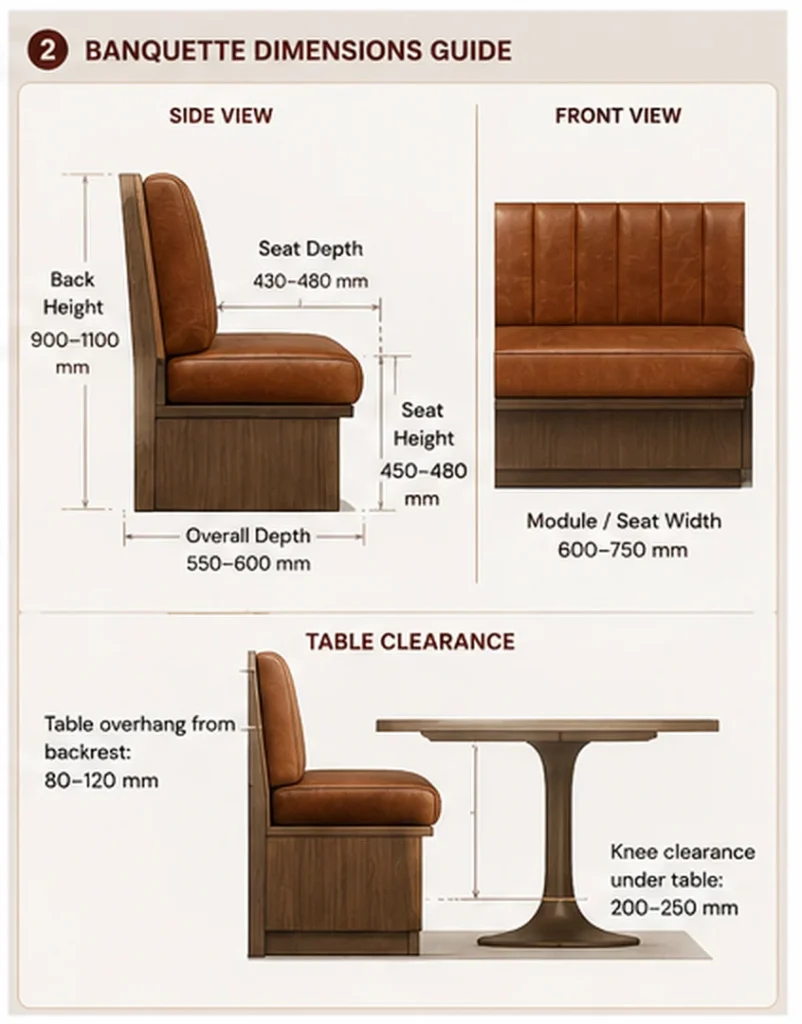
Leather Banquette Dimension Guide
The following values are planning ranges rather than universal construction standards. The final dimensions should be checked against the actual table, upholstery build-up, intended users and space available.
The table deliberately avoids treating these values as exact rules. A good banquette should be tested against the people, table and cushion system that will actually be used.
A simple temporary mock-up is extremely valuable at this stage. Plywood, foam blocks or even a chair placed against a temporary angled panel can reveal whether the table feels too far away long before expensive leather has been cut.
The Dining Table and Banquette Must Be Designed Together
The table is not an accessory to the banquette. It is half of the seating system.
An otherwise comfortable upholstered seat can become frustrating if the tabletop begins too far forward, a pedestal blocks the user’s feet or four table legs occupy the exact paths diners need for entry and exit. The table should therefore be selected or designed while the banquette geometry is still adjustable.
Table Height Has to Relate to the Finished Seat
The gap between the occupied seat and tabletop determines whether the user can sit comfortably with relaxed shoulders and usable legroom.
This is another reason to resolve the compressed cushion height early. Changing the finished banquette height after the table has been ordered may alter the entire relationship.
If the project uses a standard dining-height table, the seat should generally remain within a corresponding dining-chair range. A custom table creates more flexibility, but the design still needs to accommodate knees, thighs and the table structure beneath the top.
The Table Should Reach the Diner Without Trapping Them
The tabletop needs enough projection toward the banquette that the user does not have to lean far forward to eat. At the same time, the edge cannot sit so close that people struggle to slide into position.
Measure from the occupied torso position, not simply from the front edge of the cushion.
This becomes important with a reclined back. Two banquettes can have identical front edges but place the user’s body in different locations because one backrest allows the person to sit farther backward.
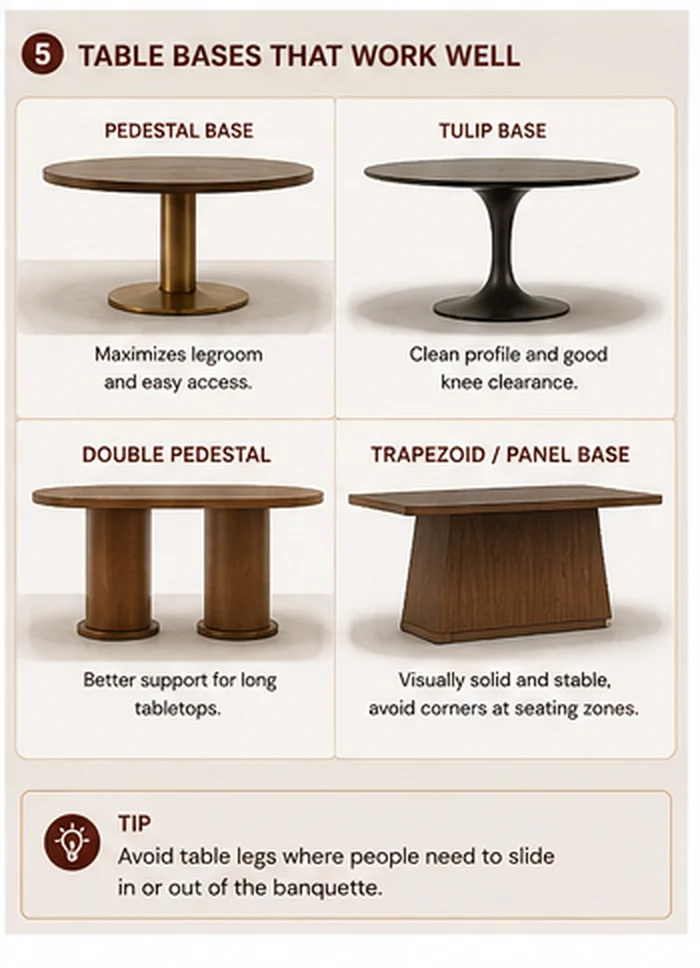
Pedestal Bases Usually Improve Access
A central pedestal can be particularly useful with fixed seating because much of the table perimeter remains free from legs. Diners can slide sideways into the banquette without navigating a support at every corner.
A tulip-style base creates a similarly open perimeter and can complement the curved forms often used in Neo Deco rooms.
Long tables may require two pedestals or another structural solution. Those supports should still be positioned away from the main entry points and knee zones.
Four-legged tables are not prohibited, but they require more careful coordination. A conventional dining table selected after the banquette is built may place a leg directly in front of the most convenient entrance.
Do Not Automatically Center the Table on the Banquette
Symmetry is visually satisfying, particularly in a Deco-influenced room, but it should not override circulation.
Consider a long straight banquette where the main entry is from the left side. Moving the table slightly to the right may create a clearer entry zone while preserving all useful seats. Centering it exactly might produce a beautiful elevation and an unnecessarily awkward daily experience.
An L-shaped banquette introduces another problem. The geometric center of the upholstered shape may not match the best location for the tabletop because the inside corner is less usable than a straight section.
The table should be positioned according to comfortable seating positions and entry routes, then adjusted visually within that functional range.
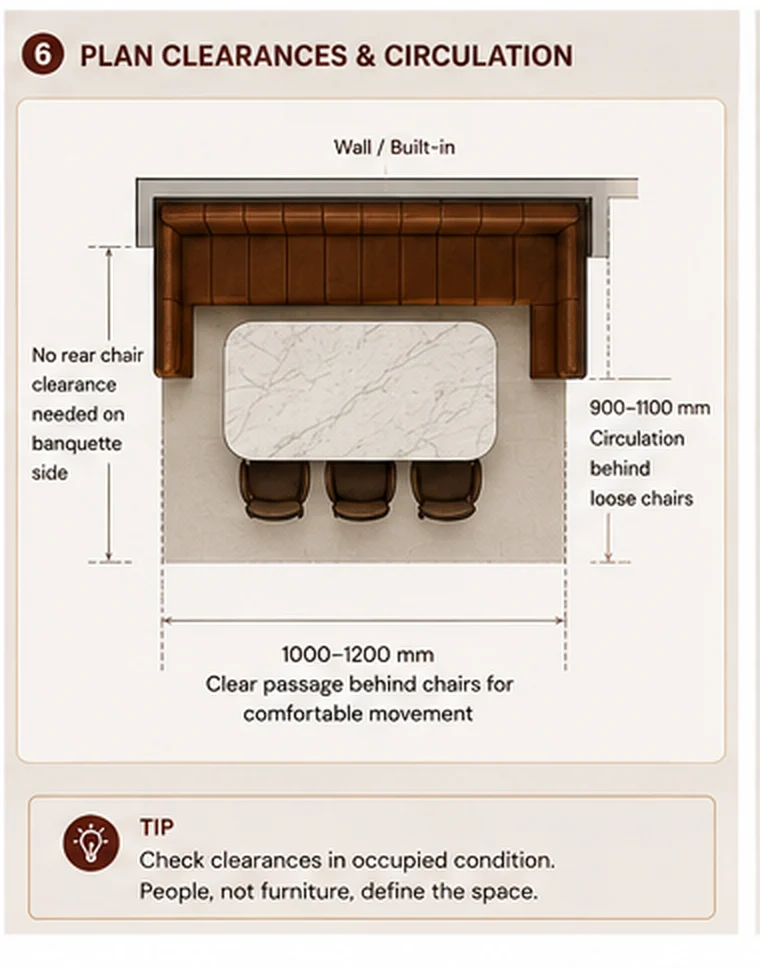
How Much Clearance Does Banquette Seating Need?
Banquettes can reduce space requirements along the fixed side of a table, but they do not eliminate the need to plan movement around the rest of the dining zone.
The open side still has loose chairs. Those chairs have an empty position, an occupied position and a pulled-out position. If people also need to walk behind them, circulation must accommodate both the chair and the passing person rather than only the furniture shown neatly under the table.
This distinction is especially important where a banquette sits opposite a kitchen island.
A dimension that looks acceptable when every chair is tucked in can become a bottleneck during breakfast, when someone is seated while another person needs to reach the refrigerator or dishwasher.
The Fixed Side Is Where the Space Saving Happens
A wall-mounted banquette does not require rear chair pull-out space because the seat itself does not move.
This can be enough to convert an otherwise undersized dining strip into a functional eating area. The gain can be used to widen the opposite aisle, increase the table depth or improve the relationship with adjacent cabinetry.
That efficiency is one of the strongest practical arguments for using a banquette in a compact home.
The Loose-Chair Side Still Needs a Real Circulation Zone
The opposite side should be tested with chairs occupied and pulled back. If the dining area is also a passage, consider what happens when somebody remains seated while another person walks behind.
Do not rely on one minimum dimension without understanding the situation. A quiet wall behind dining chairs has different needs from the main route between a kitchen and balcony.
Straight, L-Shaped, U-Shaped or Curved Banquette?
The best shape is the one that solves the room rather than the one that looks most dramatic in a reference image.
Straight Banquette
A straight banquette is usually the most efficient and easiest to construct. It works well against long walls, at the edge of a kitchen and in narrow dining rooms where replacing one row of chairs produces an immediate circulation benefit.
Access typically occurs from both ends. That is convenient until the run becomes very long. Someone sitting in the center of an extended straight banquette may need several people to shift before they can leave.
The upholstery can remain simple. A straight silhouette does not require plain detailing, but strong leather, a carefully proportioned back and a good table can provide enough character without additional geometry.
L-Shaped Banquette
An L-shaped banquette makes use of a corner and creates greater enclosure.
The main design trap is counting the inside corner as though it functions exactly like every straight seating position. In practice, two users sitting near the corner may compete for knee space, particularly around a rectangular table.
The table base can make this considerably worse. A pedestal positioned close to the inside corner may occupy the only open space left for feet.
Treat the corner as a transition first and an additional seat second.
U-Shaped Banquette
A U-shaped arrangement can create a highly social booth and accommodate considerable seating within a defined zone. It works particularly well in a dedicated breakfast nook where enclosure is part of the desired experience.
Access becomes the compromise.
People seated at the center may have to ask several others to move before they can exit. That may be acceptable for occasional entertaining or family breakfasts but less practical for a space where users frequently come and go.
The table also needs to allow access through the opening without forcing everyone to squeeze past a large base.
Curved Banquette
A curved banquette gives the strongest architectural expression and is particularly compatible with a modern Neo Deco interior.
The curve can soften a rectangular room, wrap naturally around an oval or circular table and redirect circulation around the dining zone. Leather emphasizes the effect because changing light catches the curved upholstered surface differently across its length.
Curved work requires more fabrication planning. The radius influences the timber substrate, foam shaping, stitching and table geometry. A very tight radius can create awkward upholstery segmentation, while a shallow curve may consume more floor area than a straight seat without providing enough visual or functional benefit to justify the added construction.
The curve should therefore solve something: circulation, table relationship, room geometry or architectural emphasis.
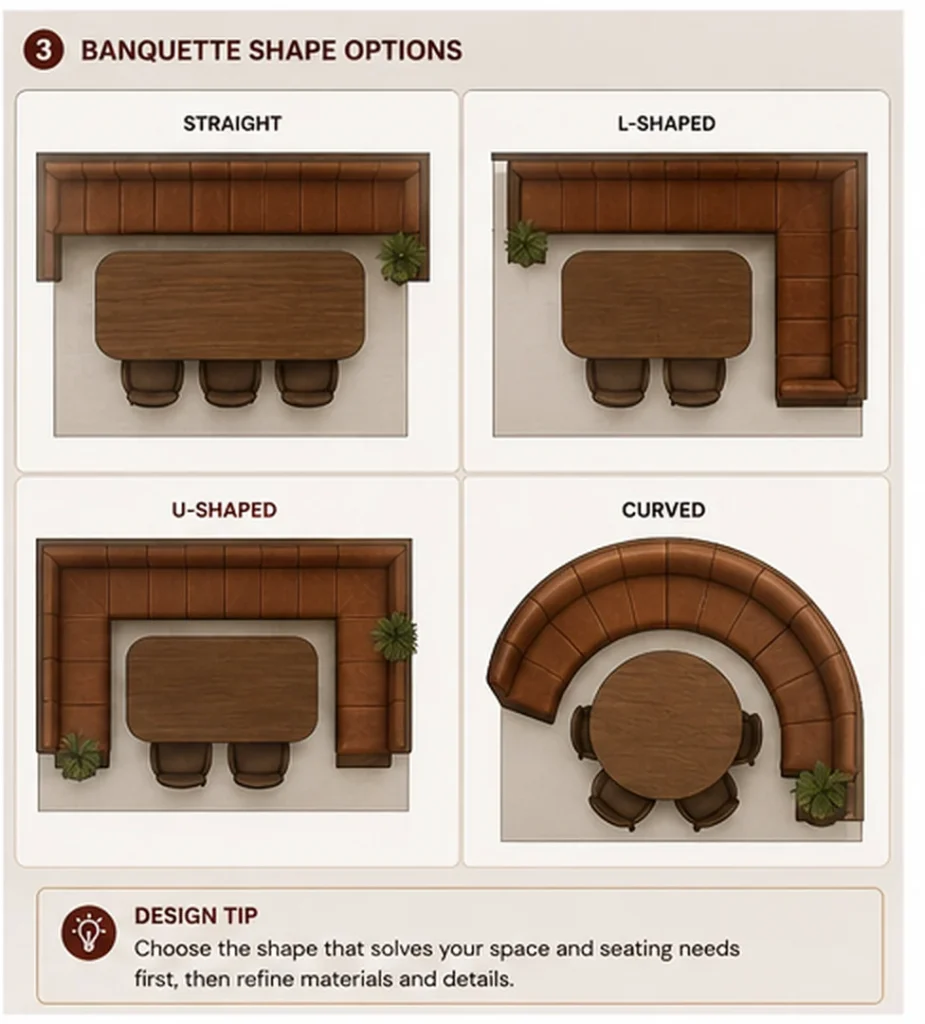
Choose the Banquette Shape by the Problem You Need to Solve
| Banquette Shape | Best Application | Main Benefit | Main Design Risk |
|---|---|---|---|
| Straight | Long wall, narrow dining room or kitchen edge | Efficient footprint and straightforward construction | Making the run so long that central diners become difficult to access |
| L-shaped | Unused dining corner | Creates enclosure while using two walls | Treating the inside corner as a fully comfortable seat without testing knee space |
| U-shaped | Breakfast nook or dedicated booth | High seating capacity and strong social enclosure | Central diners having limited entry and exit |
| Curved | Neo Deco focal zone, circular room or oval table | Creates sculptural seating and can soften circulation | Paying for complex fabrication without gaining enough functional or visual value |
Leather Selection Should Begin With Performance and Surface Character
Color is usually what attracts attention first, but “cognac leather” describes only a small part of the upholstery decision.
Two similarly colored leathers may vary substantially in visible grain, surface protection, consistency and the way they change with use. Those differences become especially apparent on a large banquette because the upholstery occupies far more visual area than a small dining chair.
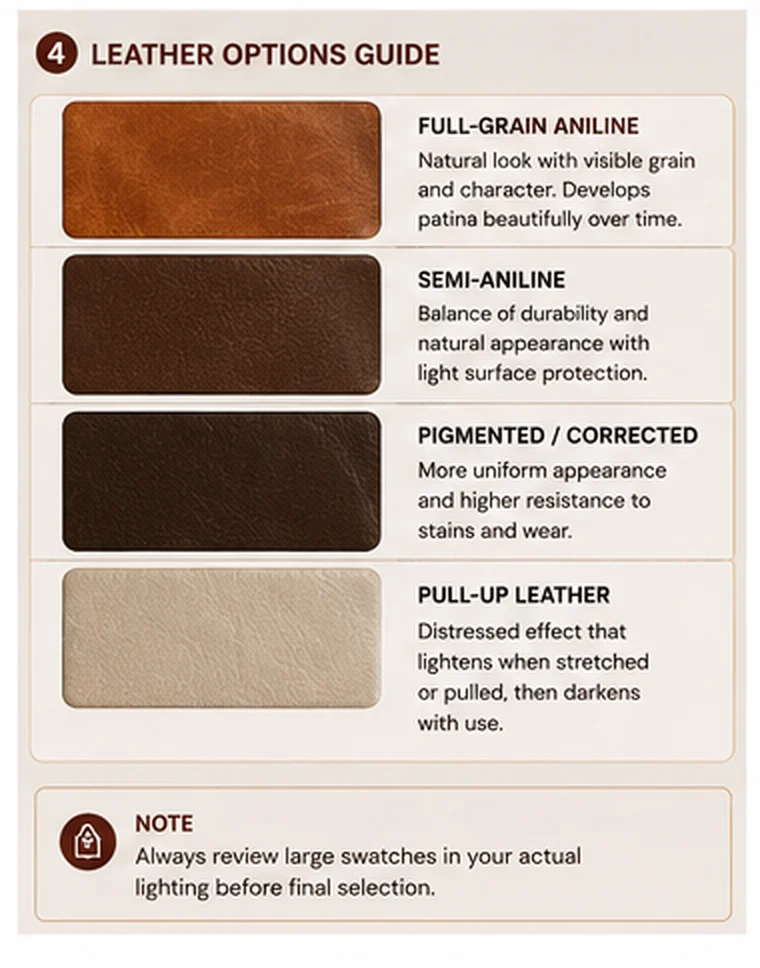
Full-Grain Leather
Full-grain leather retains its natural grain rather than having that grain mechanically corrected away. The resulting surface can show variation that gives a large banquette considerable depth and character.
That natural appearance also means variation should be expected across a long seat that requires multiple hides. Grain, tonal differences and natural markings may remain visible.
For the right interior, these characteristics become part of the material quality. For a client expecting absolute visual uniformity, they may instead become a source of dissatisfaction.
Semi-Aniline Leather
Semi-aniline leather retains visible natural grain while using a lightly pigmented protective finish.
This category can suit residential dining because it often occupies a useful middle ground between natural surface character and more practical everyday protection. The precise performance still varies by product, so the sample and manufacturer’s specification remain more important than the category name alone.
Corrected or Pigmented Leather
A more corrected surface can provide greater visual consistency across a long installation. It may be appropriate where predictable color, regular grain and resistance to frequent handling matter more than preserving every natural marking.
This can be useful in family dining areas or heavily used seating where the client wants the leather appearance but prefers less visible variation.
The trade-off is visual character. A heavily corrected finish can look more uniform, which may or may not support the desired interior.
Pull-Up Leather
Pull-up leather changes tone as the surface is stretched or flexed, producing lighter areas that can contribute a deliberately aged, richly varied appearance.
That behavior can be beautiful on a banquette where repeated use gradually records movement across the seat. It is less appropriate when the design brief expects the leather to remain visually even.
The important distinction is expectation. Patina should be something the homeowner wants rather than something they discover after installation.
Cognac Leather Works Best When the Surrounding Palette Gives It Depth
Cognac leather is popular because it connects easily with many of the materials used in contemporary luxury interiors. It can sit comfortably beside walnut, warm oak, bronze, brushed brass, cream stone, red marble and textured plaster without disappearing into any of them.
Its tone also bridges several color families. Against dark walnut it reads warmer and lighter. Against pale limestone it becomes the dominant color. Beside burgundy or red marble bathroom design-style stone tones, it can appear comparatively neutral.
This flexibility makes cognac particularly suitable for Neo Deco, where the interior may already contain polished stone and metallic detail. Leather introduces a softer material that develops character through contact rather than reflection.
The mistake is to assume every warm material must then repeat the same orange-brown tone. A cognac banquette beside orange timber, amber lighting, warm brass and terracotta plaster can become overly monochromatic. Deep walnut, cream stone or even restrained black can provide the contrast required to make the leather visible.
Dark Brown Leather Produces a More Architectural Result
Chocolate or espresso leather has less immediate brightness than cognac. It can make a built-in banquette feel heavier and more permanent, particularly when combined with dark timber.
This works well in large dining rooms where the upholstery needs enough visual mass to anchor the furniture.
In a compact room with limited daylight, however, a very dark banquette combined with dark cabinetry and flooring may absorb too much light. The surrounding wall and table surfaces then become important balancing elements.
Burgundy Leather Creates a More Dramatic Deco Direction
Burgundy leather can create a powerful relationship with brass, smoked glass and warm stone. It is especially effective where the room deliberately leans into a stronger Deco character.
It requires greater editing because red-toned upholstery already carries considerable color weight. Highly figured stone, patterned rugs and strong wallcoverings may start competing with it.
The banquette can be the color statement without every other surface reinforcing the same message.
The Stitching Pattern Controls How Large the Banquette Feels
Upholstery detailing changes visual scale.
A long plain leather back produces a quieter contemporary appearance and allows natural grain to carry most of the visual interest. Vertical channels divide the wall into repeated narrow segments and can make the back feel taller. Horizontal channels emphasize length. Large rectangular panels give the seat a more architectural rhythm.
Deep button tufting introduces another level of shadow and historical association. It may suit an intentionally glamorous interior, but it can quickly push a contemporary Neo Deco room toward a themed interpretation if several other Deco references are already present.
The strongest solution usually chooses one dominant rhythm.
If walnut wall panels already use strong vertical fluting, another layer of narrow vertical leather channels may repeat the same idea too literally. A plain upholstered back could provide the visual pause the timber needs.
This is also where Neo Deco differs from modern maximalist interior design. A maximalist room can deliberately support multiple competing patterns. A refined Neo Deco composition often benefits from fewer motifs receiving greater material emphasis.
Foam, Cushion Construction and Seams Matter as Much as the Leather
Leather is the visible finish, but the comfort of a banquette is created by what sits underneath it. Foam type, thickness, support structure and the way the upholstery is tensioned all affect how the finished seat feels after twenty minutes, how sharply the edges remain defined and whether the leather develops attractive patina or uncontrolled wrinkling.
A very soft seat can initially feel luxurious, yet deep compression may lower the user’s body too far relative to the dining table. A very firm cushion preserves the intended geometry but may become uncomfortable during longer meals. The useful target is usually a supportive seat that yields enough to feel upholstered without behaving like a lounge sofa.
This distinction is particularly important when a reference photograph shows a deeply padded restaurant booth. Hospitality seating may be designed around different turnover times, construction methods and maintenance expectations. A residential dining banquette used for long dinners needs to be evaluated according to how the household actually sits.
Fixed Upholstery Creates the Cleanest Architectural Result
A fully fixed seat allows the leather to follow the built-in form precisely. There are no loose cushions shifting away from the wall, and the joinery can appear more integrated with the room.
The upholstery team needs to coordinate carefully with the carpenter because tolerances become visible. If the timber base is uneven or the radius changes unexpectedly, the leather cannot simply be repositioned like a loose cushion.
Fixed seats also make access to concealed storage more complicated unless the opening strategy is designed from the beginning.
Loose Seat Cushions Give More Flexibility
A removable cushion can simplify maintenance and allow foam to be replaced later without dismantling the whole banquette. It can also provide a softer residential appearance.
Loose cushions introduce their own problems. They can migrate forward during use, create visible gaps between seating positions and alter the final seat height if the replacement foam differs from the original specification.
If removable cushions are preferred, their movement should be controlled through the shape of the base, concealed fixing methods or a deliberately recessed seat platform.
Plan Seams Around the Geometry
A long banquette rarely uses one uninterrupted piece of leather. Hide dimensions, curves and upholstery construction require seams.
Those seams should become part of the design rhythm rather than appearing wherever the material happened to end.
On a straight seat, vertical divisions can align with back channels or cabinetry modules. On a curved banquette, smaller controlled sections may allow the leather to follow the radius more naturally. At corners, the seam position should be reviewed from the principal sightline because a technically convenient joint can become unusually noticeable once the room is finished.
Good upholstery detailing makes material limitations look intentional.
Vertical Channels, Horizontal Channels or Plain Leather?
Upholstery pattern changes the perceived proportions of the entire dining zone.
Vertical Channels
Vertical channels visually extend the back upward and create a rhythm that naturally suits a Neo Deco interior. They can make a relatively low back feel more architectural and introduce shadow without adding another material.
Channel width matters. Narrow channels create more movement and can begin to look visually busy across a long wall. Wider channels usually feel calmer and more contemporary.
If nearby cabinetry already has narrow timber fluting, use the same rhythm carefully. Matching every vertical line may feel overly coordinated. A wider leather channel can acknowledge the timber without duplicating it exactly.
Horizontal Channels
Horizontal channels emphasize length and can make a long banquette feel even more expansive.
They are particularly useful in narrow rooms where the design intentionally wants to pull the eye across the wall. They can also create a softer, slightly more lounge-like character than vertical channels.
The relationship with the seat divisions still needs planning. If every horizontal panel is interrupted by unrelated vertical seams, the composition can become fragmented.
Plain Upholstery
Plain leather allows the grain and patina to become the decorative feature.
This is often the strongest choice when the room already contains expressive stone, fluted timber or architectural lighting. A large uninterrupted field of cognac leather can provide richness without adding another geometric pattern.
A plain back also makes the quality of the upholstery more visible. Poor tension, irregular padding or uncontrolled wrinkles are harder to hide when there are no channels or tufting to break the surface.
Button Tufting
Button tufting creates deep shadow and a more historical furniture association. It can work in a glamorous dining room, but it should be used because the room benefits from that character rather than because tufting is assumed to mean luxury.
When combined with brass, red marble, patterned flooring, sculptural lighting and ornate artwork, deep tufting may push the space beyond a contemporary Neo Deco revival into a more literal period-inspired interior.
A quieter upholstery pattern often gives the stronger materials more authority.
The Banquette Base Can Be Furniture, Storage or Architecture
The area below the seat is valuable because the volume already exists. Whether it should become storage depends on how easily the contents can be accessed and whether adding storage compromises the seating geometry.
Lift-Up Storage Works for Occasional Items
A hinged seat can provide a deep compartment for table linens, spare cushions, serving pieces or objects that do not need to be reached every day.
The drawback is obvious once a dining table is installed. Opening a large seat panel may require moving the table, removing cushions or clearing objects from the seat first. In an L-shaped banquette, one lift-up panel can also interfere with another.
Lift-up storage is therefore best for lower-frequency items rather than things someone expects to retrieve during every meal.
Drawers Are Easier for Everyday Access
Drawers built into the base can be opened without disturbing the upholstered seat. They work particularly well at the ends of a banquette or on faces that remain clear of table supports.
The available drawer depth may be reduced by structural framing, wall conditions and the toe-space beneath the seat. A large-looking base does not automatically contain a large usable drawer.
Drawer handles should also be considered carefully. Projecting hardware positioned where diners’ legs pass can become irritating. Recessed pulls, discreet edge details or push-to-open mechanisms may create a cleaner interface depending on the joinery system.
Open Niches Can Lighten a Heavy Banquette
Not every base needs to be closed storage. A controlled open niche can reduce the perceived mass of a large banquette and provide a place for books or a small decorative object.
Open storage needs editing. A beautifully detailed Neo Deco banquette can lose much of its visual strength if the base becomes an exposed collection of bags, chargers, children’s items and miscellaneous objects.
If open display is included, treat it as part of the architecture rather than overflow storage.
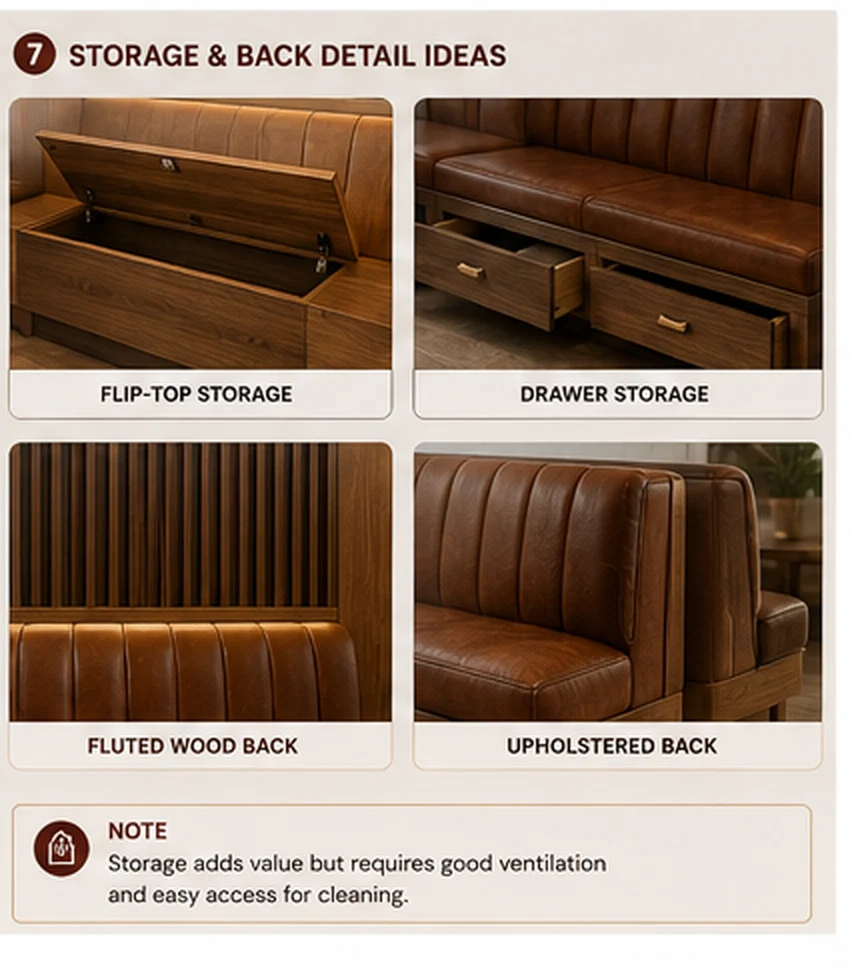
What Should Go Behind a Leather Banquette?
The back of the banquette offers another opportunity to control whether the seating reads as a piece of furniture or as part of the room.
Continue the Leather Up the Wall
Extending leather above the functional backrest creates a stronger hospitality-inspired atmosphere and can make a compact dining nook feel more enclosed.
This works particularly well when the wall has little need for artwork or shelving. The leather becomes both the seating finish and the wall treatment.
The greater the upholstered area, the more important scale becomes. Covering an entire wall in narrow channels can create a very different effect from using one broad plain leather panel behind a low seat.
Use Fluted Walnut for a Stronger Neo Deco Layer
A dark fluted walnut panel above cognac leather creates depth through two related but distinct textures. Leather is soft and reflective in a subdued way, while fluted timber creates narrow areas of shadow.
This combination works particularly well when the banquette base also uses walnut because the upper panel visually connects the seat back to the joinery below.
The room does not need every timber surface to be fluted. If the sideboard, wall panels, island and banquette base all carry the same vertical profile, the detail loses its ability to function as an accent.
Use Plaster When the Banquette Is Already Visually Strong
A quiet cream or warm mineral plaster wall can provide the negative space a substantial cognac banquette needs.
This is particularly effective with a curved seat. The upholstery already contains a strong silhouette, so adding another decorative surface immediately behind it may weaken the clarity of that form.
The decision should respond to how much visual information is already present rather than assuming a built-in seat requires a built-in feature wall.
Add Artwork Only After the Upholstery Height Is Resolved
Artwork is frequently selected before the final backrest height is known. The result can be an awkwardly compressed gap between the top of the upholstery and the frame.
Resolve the leather first. Then evaluate the remaining wall as its own composition.
A large abstract piece can balance a long straight banquette, while a more symmetrical artwork arrangement can reinforce a formal dining room. On a curved banquette, one oversized artwork usually feels more coherent than several small frames trying to follow the radius.
Lighting Above a Banquette Should Follow the Table, Not the Seat
A pendant is often positioned at the geometric center of the room. That is not necessarily the center of the dining experience.
If the table has shifted to improve access, the pendant should normally respond to the table rather than remain aligned with the architecture simply for symmetry. A light hanging beautifully over an empty section of banquette while the table sits off-axis will make the entire arrangement feel unresolved.
Pendant Lights Work Best When the Table Is Stable
A fixed banquette makes the dining table position relatively predictable, which creates an ideal opportunity for a sculptural pendant.
Round tables work naturally with a single central pendant or globe composition. Long tables may suit a linear fixture, multiple pendants or a broader chandelier.
In Neo Deco interiors, opal glass, brushed brass and softly geometric forms can reinforce the style without requiring overtly decorative motifs.
The fixture should be coordinated with the sightline across the table. Hanging it excessively low can obstruct conversation or make the room feel compressed.
Wall Sconces Can Create a More Intimate Zone
Sconces placed behind or beside the banquette can create softer evening light and emphasize the architectural wall.
They are particularly useful when the table cannot be centered under a ceiling fixture or when the dining nook sits beneath a low ceiling.
Position sconces with the seated user in mind. A fixture that looks perfect on an empty elevation may land directly beside someone’s head when the banquette is occupied.
Concealed Lighting Should Reveal Architecture, Not Become the Feature
A concealed LED line beneath the banquette, behind the backrest or within fluted joinery can create depth.
Use it sparingly.
Too many illuminated edges can make a residential dining room feel like hospitality signage rather than a home. The lighting should reveal the shape and material, allowing the leather and timber to remain the main visual elements.
Dimming is particularly valuable because the amount of light needed for breakfast is different from the level that creates atmosphere during dinner.
Leather Banquette Material Pairings That Work Especially Well
The strongest material combinations create differences in texture and visual weight rather than selecting several luxurious materials simply because each one is attractive individually.
Cognac Leather + Walnut + Brass
This is one of the most reliable Neo Deco combinations.
Cognac provides warmth and softness. Walnut introduces darker architectural depth. Brushed brass adds controlled reflection without competing with the leather grain.
A cream wall or pale floor prevents the entire room from becoming brown.
Cognac Leather + Red Marble + Dark Timber
Red marble produces a much richer result and should usually remain a concentrated accent. A small pedestal tabletop, side console or architectural inset can connect beautifully with warm leather without surrounding the dining area in patterned stone.
The same hierarchy used in red marble bathroom design applies here: one expressive stone area becomes more powerful when quieter materials surround it.
If the marble is strongly veined, simplify the upholstery pattern. Vertical leather channels, dramatically figured stone and heavily fluted timber used together can create too many competing rhythms.
Chocolate Leather + Cream Stone + Polished Nickel
A darker leather banquette can move Neo Deco away from the predictable brass-and-cognac combination.
Cream stone keeps the room bright, while polished nickel creates a cooler line against the dark upholstery. This can work particularly well in contemporary apartments where the architecture is cleaner and less overtly warm.
Leather + Lime Plaster + Oak
A softer combination moves the banquette closer to an organic modern interior while retaining leather as a sophisticated focal material.
Use quieter leather, lighter oak and a honed or matte material palette rather than strong brass and polished stone. The banquette remains architectural, but the atmosphere becomes less glamorous and more tactile.
Where Should a Banquette Be Placed?
A banquette earns its floor area when it solves a spatial relationship.
Against a Long Wall
This is the most straightforward placement and often produces the greatest space-saving benefit.
It works especially well where a dining table would otherwise leave one row of chairs permanently close to the wall. The fixed seat eliminates repeated chair movement and creates a cleaner perimeter.
The wall needs to be checked for outlets, ventilation grilles, radiators, switches and other services before construction begins. A banquette cannot simply cover active building systems because the elevation looks cleaner.
Inside a Corner
Corners can become useful social spaces when wrapped with an L-shaped banquette.
The table should remain accessible from the open sides, and the inside corner should be tested as a real seating position rather than counted automatically.
A round or softly rectangular table can improve movement because sharp table corners do not project directly into the entry paths.
In a Bay Window
A bay or window recess can become an excellent banquette location because the seating occupies space that may otherwise be difficult to furnish.
Window height and curtain operation become part of the design. Upholstery should not block required access, and the backrest should be coordinated with the sill rather than ending awkwardly across the glazing.
Sun exposure also matters for leather. Direct light can change natural materials over time, so the selected upholstery and window treatment should respond to the actual conditions.
As an Open-Plan Divider
A freestanding or semi-freestanding banquette can divide dining from living or kitchen areas without creating a full-height wall.
In this configuration, the rear elevation becomes almost as important as the seat itself.
Walnut panels, shelving, a console or integrated planting can make the outer face contribute to the adjacent room. Leaving the back unfinished because it is technically “furniture” wastes one of the strongest opportunities of the design.
Small Dining Rooms Benefit Most When the Banquette Removes Movement
A banquette does not automatically make a small dining room larger. It helps when it removes a specific piece of furniture movement that was consuming space.
Consider a narrow rectangular room with chairs on both long sides of the table. Replacing one side with fixed seating can remove one pull-out zone. That can make the remaining aisle more comfortable and allow the table to sit closer to the wall.
In an already crowded room, however, an excessively deep built-in can create the opposite effect. A generous 650 mm overall depth may consume more floor than the chairs it replaced.
This is why the usable seat depth and hidden construction need to be controlled carefully.
Compact rooms also benefit from visually lighter details. A recessed or shadowed base can make the upholstered seat appear to float slightly. A pale floor keeps the lower plane open. One large artwork may feel calmer than a wall filled with small objects.
Space saving is partly dimensional and partly perceptual.
Common Leather Banquette Design Mistakes
Mistake 1: Making the Seat Too Deep
Deep seating is associated with lounging, so it can appear luxurious on a plan. Dining requires a different posture.
If the user has to choose between touching the backrest and comfortably reaching the table, the seat is too deep for that relationship.
Mistake 2: Measuring the Timber Base Instead of the Finished Upholstery
The carpenter’s dimension is not automatically the user’s dimension.
Foam, leather, back padding and back angle all reduce or alter usable space. Every important measurement should be checked at the finished upholstery line.
Mistake 3: Selecting the Table After the Banquette Is Finished
This creates unnecessary risk around table height, projection and base location.
Banquette and table should be resolved together even when they are being produced by different suppliers.
Mistake 4: Putting a Table Leg at the Entry Point
Four beautifully proportioned legs can make a table difficult to use with fixed seating.
Map the paths people take to slide into the banquette, then keep supports away from those paths where the table design allows.
Mistake 5: Assuming Every Corner Adds a Seat
The inner corner of an L-shaped or U-shaped banquette looks usable on plan.
The available knee space may tell a different story.
Test corner positions before advertising or planning the seating capacity around them.
Mistake 6: Designing the Back Completely Vertical for Appearance
A perfectly upright leather panel can create a strong architectural elevation while producing an unnecessarily formal seated posture.
A slight rake may provide significantly better comfort without being visibly obvious from across the room.
Mistake 7: Repeating the Same Rhythm Everywhere
Vertical leather channels, fluted timber, ribbed glass, striped curtains and narrow wall panels may individually belong in a Neo Deco palette, but using all of them together weakens their impact.
Choose which element should own the rhythm.
Mistake 8: Adding Storage Without Considering Access
Storage is only valuable when it can be reached.
A lift-up lid trapped beneath a heavy table may technically provide storage while remaining irritating enough that nobody uses it.
Mistake 9: Ignoring the View From Behind
This matters whenever the banquette divides an open room.
The living room may see the rear elevation more frequently than it sees the leather seating. Design both sides.
Mistake 10: Positioning Lighting From an Empty Floor Plan
The pendant should respond to the actual table, while sconces should respond to seated head positions.
Lighting decisions made only from the room centerline can become visibly wrong after the furniture is installed.
A Better Sequence for Designing a Custom Leather Banquette
Step 1: Identify the Spatial Problem
Decide what the banquette is expected to improve: wall efficiency, seating capacity, an awkward corner, circulation, storage or architectural identity.
Without a clear problem, a built-in banquette can become an expensive way to achieve what ordinary chairs already did well.
Step 2: Establish the Finished Table
Confirm the likely table height, top dimensions and base geometry early.
If the table is custom, develop it at the same time as the seating.
Step 3: Set the Occupied Seat Position
Resolve seat height, usable depth and back support according to the table relationship.
Do this before adding decorative upholstery dimensions.
Step 4: Test Entry and Exit
Draw or mock up how each seating position is reached.
Pay particular attention to corners and long runs.
Step 5: Check the Open-Side Circulation
Place the loose chairs in their occupied and pulled-out positions and evaluate what remains behind them.
Do not design using only tucked-in chairs.
Step 6: Resolve the Structure and Storage
Determine how the seat is supported, whether the base contains drawers or lift-up storage and how those features can be accessed after the table is installed.
Step 7: Select Leather and Foam Together
Review the upholstery sample with the intended foam construction because softness affects both appearance and final geometry.
Large samples are far more useful than tiny leather chips.
Step 8: Decide the Upholstery Rhythm
Choose plain, vertical, horizontal, panelled or tufted upholstery according to what the surrounding room already contains.
Step 9: Coordinate Wall, Lighting and Services
Resolve artwork, sconces, outlets, switches and wall finishes around the final banquette height rather than around an earlier furniture assumption.
Step 10: Build a Mock-Up Before Final Fabrication
For a significant custom banquette, even a crude physical mock-up can reveal issues that drawings hide.
Sit in it. Move toward the table. Leave the corner. Pull out the opposite chair. Imagine somebody walking behind you. If those movements work comfortably, the leather and decorative details can proceed with much greater confidence.
Where to Spend More and Where to Simplify
A custom banquette has several cost drivers: curved joinery, complex foam shaping, large quantities of quality leather, deep channeling, difficult seams, concealed storage, custom tables and extensive wall treatments.
They do not all need to occur in the same project.
If the budget is concentrated on high-quality leather, the joinery form can remain comparatively simple. If a complex curved banquette is the main architectural feature, plain upholstery may save fabrication cost while making the curve easier to read.
A striking stone tabletop may justify a quieter banquette base. Beautiful walnut joinery can reduce the need for elaborate stitching. One strong choice can carry another simpler one.
This hierarchy generally produces a more convincing room than spreading the budget across numerous premium details that all compete for attention.
The Best Banquette Feels Obvious Once It Is Finished
A successful leather banquette should make the room feel as though the seating could hardly have been arranged another way.
The table sits naturally within reach. People can enter without navigating table legs. Loose chairs have enough room to move. The leather feels appropriate for the way the household lives, and the upholstery pattern strengthens the architecture without repeating every other decorative rhythm in the room.
That apparent simplicity usually comes from resolving many small relationships before construction begins.
Within Neo Deco interior design, the banquette can become a particularly strong expression of the style because it combines curved geometry, tactile material, tailored detailing and efficient space planning. The best examples feel luxurious because these elements work together, rather than because the design accumulates as many Deco references as possible.
A leather banquette should therefore be judged first by how naturally somebody sits, reaches, moves and leaves. Once that part works, the cognac leather, walnut, brass, stone and lighting have a solid framework on which to build the atmosphere.
How to Care for a Leather Banquette in a Dining Area
Dining seating encounters a different type of wear from an occasional lounge chair. People slide across the same sections repeatedly, clothing rubs against the front edge, crumbs collect near seams and food or drinks may occasionally reach the upholstery. Leather can handle regular use well when the selected finish suits the household, but care expectations should be established before the material is ordered.
The first useful distinction is the leather finish. According to the Leather Working Group’s leather terminology guidance, aniline leather retains clearly visible natural grain with little or no pigmented surface coating, semi-aniline leather uses a small amount of pigment while preserving visible grain, and pigmented leather uses a finish that conceals more of the natural surface. Those categories matter because the more natural-looking surface someone chooses, the more important it becomes to understand how that particular product responds to spills, abrasion and cleaning.
Manufacturer instructions should therefore take priority over generic internet cleaning formulas. The chemistry and protective finish on one upholstery leather may differ significantly from another leather that looks similar in a photograph.
Deal With Spills Before They Become Part of the Patina
A dining banquette should be maintained with the expectation that spills will happen.
Blotting a fresh spill according to the leather supplier’s instructions is generally preferable to allowing a liquid to soak into an absorbent finish. Avoid aggressive rubbing, particularly on delicate natural surfaces, because the attempt to remove a mark can create a larger difference in color or sheen.
The Leather Naturally furniture care guidance distinguishes between easier-care pigmented furniture leather and more delicate aniline surfaces, and recommends following the manufacturer’s directions and testing cleaning methods in a less visible area. That is more useful than assuming one household cleaner is suitable for every leather banquette.
Vacuum Seams and Creases Before Dirt Becomes Abrasive
Banquette seams naturally collect crumbs and dust because the upholstery is horizontal and frequently used.
A soft upholstery attachment can help remove loose debris without forcing it deeper into the seams. Pay particular attention to the junction between the seat and back, vertical channels and corners where leather wraps into timber.
This routine is less glamorous than discussing patina, but it can have more effect on how the banquette looks after several years.
Do Not Treat Every Mark as Damage
Natural leather can change with handling, light and repeated use. Some products are specifically selected because the gradual development of patina is part of their appeal.
That does not mean every stain should be accepted, but the design team and homeowner should agree on what “aging well” means before selecting a highly natural finish. Someone who expects perfect visual consistency may be happier with a more protected leather even if a less finished hide appears more beautiful on the sample board.
This is why the Leather Naturally guide to upholstery leather finishes is useful during specification: it explains that upholstery finishes can range from aniline through more pigmented surfaces, with different balances between natural character, consistency and protection.
Direct Sunlight Should Be Considered Before Choosing the Leather
A banquette beneath a large window can receive hours of direct light in the same location every day. Because the seating cannot be moved like a chair, that exposure becomes a permanent condition.
Review how the room behaves throughout the day rather than assessing the leather only under showroom lighting. A cognac sample that looks moderately warm indoors may become much brighter beside strong sunlight. A darker natural leather may develop more visible tonal change across exposed and shaded sections.
Curtains, blinds, architectural shading and glazing conditions can influence the decision. In rooms with intense direct sunlight, ask the leather supplier specifically about light exposure and the selected finish rather than assuming all upholstery leather behaves the same way.
The same daylight review should happen before the final color is approved. Cognac, saddle, tobacco and rust tones often overlap in product descriptions, yet their relationship with walnut, brass and stone can shift considerably once natural daylight enters the room.
Accessibility Needs a Separate Design Check in Commercial and Public Projects
Residential comfort dimensions should not be confused with accessibility requirements that may apply to restaurants, hospitality settings, workplaces or other regulated environments.
Where a project is subject to accessibility legislation or local building requirements, fixed banquette seating should be reviewed as part of the wider dining layout rather than assuming the banquette itself satisfies every user. Accessible dining positions may require appropriate clear floor space, knee and toe clearance, table heights and routes that differ from the residential planning ranges discussed earlier in this article.
For projects governed by United States accessibility requirements, the 2010 ADA Standards for Accessible Design – dining surfaces and work surfaces include specific provisions for accessible dining surfaces, clear floor space and knee and toe clearance. Those requirements apply within the scope defined by the standards and should not be reduced to one generic banquette dimension.
The broader design lesson remains useful everywhere: fixed seating should not become the reason a dining environment excludes users who need a different approach to the table. In regulated work, hospitality or public projects, verify the applicable local accessibility requirements with the qualified project team rather than relying on residential furniture conventions.
Should a Banquette Include Power or Charging?
Integrated electrical access can be useful where the banquette doubles as a work, breakfast or casual meeting area.
Its location needs to be selected carefully. An outlet placed directly behind someone’s back may be difficult to reach and uncomfortable when a plug is inserted. A socket hidden beneath the seat can become almost useless once the table is installed. Charging access at the end of the banquette or within an adjacent side panel is often easier to use without compromising the seating surface.
Electrical planning should happen before upholstery fabrication because cables, outlet boxes and access panels affect the joinery.
In an open-plan apartment, integrated power can increase the number of ways the dining area is used during the day. That added usefulness is valuable, but it should remain visually discreet. A tailored leather banquette loses some of its architectural quality when several obvious plastic outlet plates interrupt the upholstery wall.
Can a Leather Banquette Work in a Breakfast Nook?
A breakfast nook is one of the strongest applications because the banquette can occupy the perimeter while leaving the center relatively open.
The seating does not need the same formality as a dedicated dining room. A slightly lighter leather, softer upholstery profile and simple timber table can create a relaxed atmosphere without losing the built-in efficiency.
Storage is also more useful in this context. Breakfast nooks often sit beside kitchens, so drawers can hold placemats, napkins or less frequently used serving items. The access strategy remains important because a central table can obstruct large lift-up seat panels.
For a small breakfast nook, a straight or compact L-shaped configuration usually provides the simplest balance between seating and access. A U-shaped booth may increase theoretical capacity but can also make people seated in the center dependent on everyone else moving whenever they want to leave.
Can a Banquette Replace a Formal Dining Set?
Yes, provided the fixed seating matches the way the household entertains.
A banquette can make the room feel more intimate than a conventional table surrounded by matching chairs. Guests naturally orient toward one another, the upholstered wall adds acoustic softness and the table can feel more anchored to the architecture.
The compromise is flexibility. Loose chairs can be rearranged, removed, borrowed for another room or repositioned for different group sizes. A built-in banquette commits part of the room to one dining arrangement.
That commitment is worthwhile where the geometry is already strong. A long wall, awkward corner or curved architectural zone may become substantially better with fitted seating. In a multipurpose room that frequently changes configuration, conventional chairs may remain the more useful solution.
A banquette should therefore be selected because fixed seating improves the room, not because built-in furniture is assumed to be more sophisticated.
Leather Banquette vs Upholstered Fabric Banquette
Leather is only one possible upholstery strategy.
Fabric can provide greater softness, broader pattern choice and a less formal appearance. It can make a large banquette feel visually lighter, particularly in organic modern interior design where linen-like textures, pale timber and quieter colors may support the room more naturally than dark leather.
Leather has a different visual advantage. Its grain, subtle sheen and gradual development of character give a built-in form more depth, especially when used beside hard materials such as walnut, brass and stone.
The choice should also consider cleaning expectations. Different fabrics and leathers have different maintenance characteristics, and performance depends on the actual product rather than the broad material category. A high-performance upholstery textile may be more practical than a delicate natural leather in one household, while a protected leather may outperform an unsuitable textile in another.
The material should follow the use pattern, not a hierarchy that assumes leather is automatically the premium answer.
Leather Banquette vs Dining Chairs
The decision is primarily about flexibility versus spatial efficiency.
Loose chairs are easy to change. They accommodate different table positions, can be replaced individually and allow the room to evolve without altering built-in joinery.
Banquettes gain their advantage from permanence. They can move seating closer to a wall, create storage, make a corner useful and establish a strong architectural identity.
A hybrid layout often provides the best balance. Fixed banquette seating on one side gives the room structure, while loose chairs on the opposite side preserve flexibility. The chairs can be moved for additional guests or removed when a wider circulation path is needed.
This arrangement also creates material contrast. Cognac leather can become the dominant upholstered element while cream, timber or woven chairs keep the opposite side lighter.
Final Leather Banquette Checklist Before Fabrication
Before the carpenter, upholsterer and table fabricator begin final production, review the design as one complete system rather than separate packages.
- Confirm the finished occupied seat height rather than only the timber platform height.
- Confirm usable seat depth after the upholstered back is installed.
- Test the backrest angle with the intended table position.
- Verify that the table edge can be reached comfortably from the occupied seating position.
- Keep major table supports away from the primary entry paths.
- Test loose chairs in their occupied and pulled-out positions.
- Confirm circulation with people seated, not only with furniture tucked neatly into plan.
- Treat inside corners conservatively when calculating comfortable seating capacity.
- Confirm leather type, finish, grain character and expected patina using a large physical sample.
- Review the leather sample under the room’s real daylight and evening lighting.
- Coordinate seams and channels with the geometry of the seat rather than leaving them to fabrication convenience.
- Confirm how storage will open after the table is installed.
- Resolve sockets, switches, sconces and outlets before upholstery begins.
- Design the rear elevation where the banquette is visible from another room.
- Check applicable accessibility requirements separately where the project is regulated.
- Build a mock-up when the geometry, curve or investment makes a fabrication mistake difficult to reverse.
The checklist should be used before final drawings are signed off. Solving a 50 mm problem on a mock-up is relatively easy; solving it after curved walnut, foam and leather have been installed is much more expensive.
Compare Local Home Specialists Near You
Tell us what kind of help you need, then compare nearby businesses by location, Google rating, review volume and contact options.
HomeFix Local Match
Turn a home problem into a practical local hiring decision. Check the clues, see the specialist types that fit, open focused surrounding-location searches, then compare the strongest three before you call.
 YOUR PROBLEM
YOUR AREA
COMPARE 3
✓ Ready to compare
YOUR PROBLEM
YOUR AREA
COMPARE 3
✓ Ready to compare
What is happening?
Choose the closest problem type, then check every clue that applies. Your selections change the specialist order.
Where should the search focus?
Use Google’s “near me” context or enter the area you actually want a specialist to serve.
Simple local search: open nearby Google results, choose the businesses that look suitable, then compare your best three here before you call.
Problem snapshot
Who should you call first?
These are the specialist types most likely to fit the clues you selected.
Search around your location
Compare your top three
Use the same factors for each option so a high star rating does not hide a weak scope, poor diagnosis, missing credentials or unclear aftercare.
Comparison result
Your result combines the Google signals you entered with the practical hiring checks you completed.
Questions to ask every finalist
Use the same questions with each shortlisted business so the comparison stays consistent.
Frequently Asked Questions About Leather Banquette Design
How deep should a dining banquette be?
A useful starting range for usable dining seat depth is approximately 430-480 mm, but total joinery depth will usually be greater because the upholstered back and structural build-up occupy space. The final depth should be tested with the actual table, backrest angle, foam thickness and expected users rather than treated as one universal number.
What is a good seat height for a dining banquette?
Approximately 450-480 mm to the finished compressed seat surface is a useful planning range for many residential dining banquettes. Cushion thickness and compression need to be included because building the timber platform at the intended finished height can make the completed upholstered seat too tall.
Are banquettes good for small dining rooms?
Banquettes can be particularly useful in narrow dining areas because fixed seating removes the need for chair pull-out space along one side of the table. The benefit depends on keeping the banquette itself reasonably shallow and preserving adequate circulation behind loose chairs on the open side.
What table base works best with a banquette?
Central pedestal and tulip-style bases often work well because they keep much of the table perimeter clear for knees and sideways entry into fixed seating. Longer tables may need double pedestals or another support system, but the important principle is to keep major supports away from the paths diners use to enter and leave the banquette.
Is leather practical for a dining banquette?
Leather can work very well for dining seating when the selected finish suits the expected level of use and the household accepts its maintenance and aging characteristics. More natural aniline surfaces show greater grain and variation, while semi-aniline and pigmented finishes can offer different balances between natural appearance, consistency and surface protection.
Is an L-shaped banquette better than a straight banquette?
An L-shaped banquette is useful when a corner would otherwise be difficult to furnish and greater enclosure is desirable. A straight banquette is usually simpler to build and easier to access, while the inner corner of an L-shaped seat should be tested carefully because knee space can make that position less useful than it appears on plan.
Should a banquette have storage underneath?
Storage is useful when it does not compromise comfortable seat proportions or become inaccessible once the dining table is installed. Drawers are often easier for frequently used items, while lift-up seats can provide deeper storage for objects that are accessed less often.
Do leather banquettes need a sloped back?
A modest backward rake often creates a more relaxed dining posture than a completely vertical upholstered panel, but the angle cannot be chosen independently from seat depth and table position. The best approach is to test the back angle and sitting depth together with a physical mock-up.
Can a leather banquette be used in a modern interior without looking like a restaurant booth?
Yes. Plain leather, wider channels, refined walnut joinery, restrained lighting and residential materials can make a banquette feel architectural rather than commercial. Avoid relying on restaurant-style tufting, oversized upholstery and excessive decorative lighting unless that hospitality character is intentionally part of the design.