
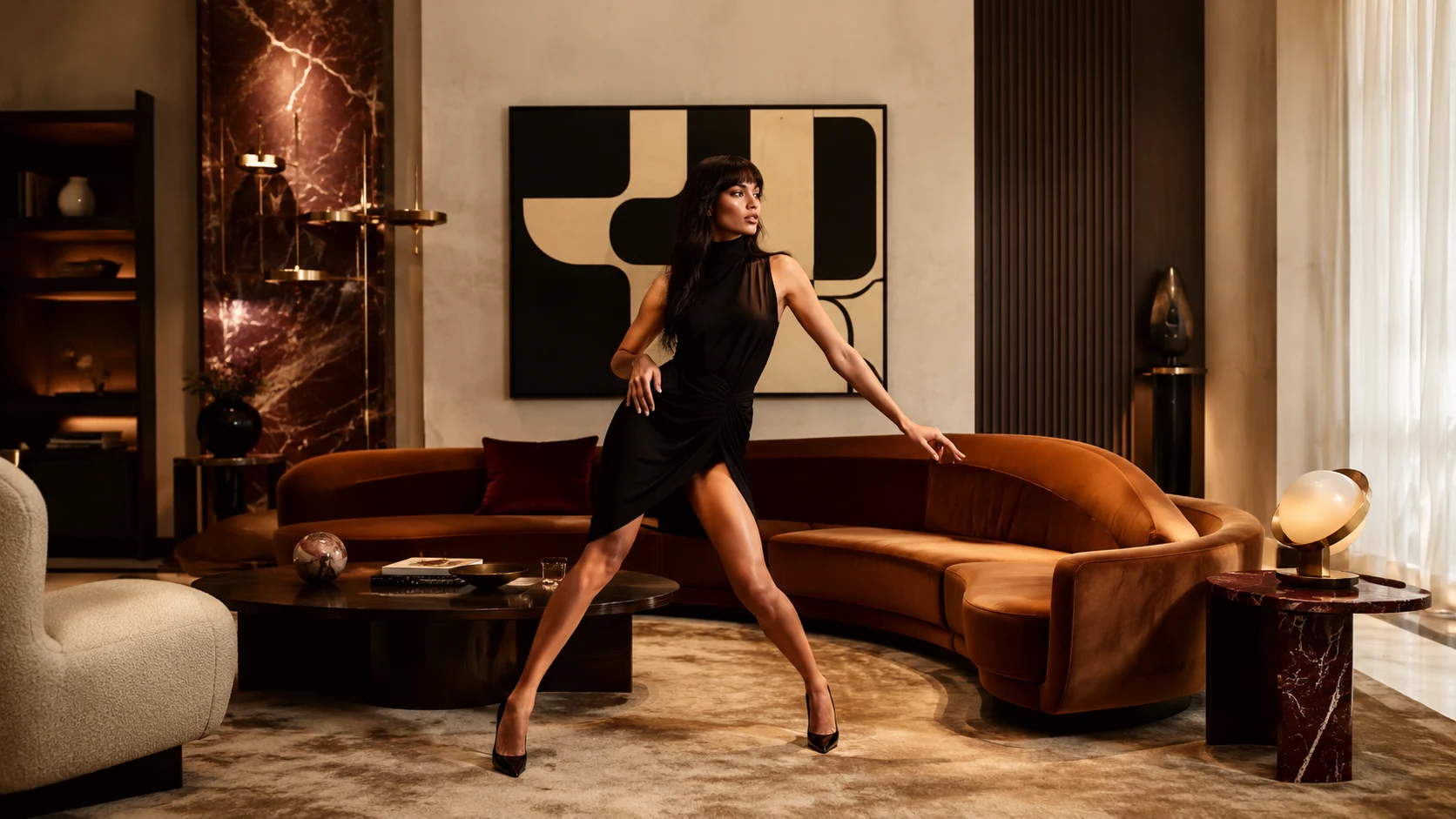

A Neo Deco living room works best when the room feels composed before it feels decorated. Curved seating, dark timber, expressive stone, brass, velvet and sculptural lighting can all belong in the style, but adding them without a clear spatial hierarchy quickly turns richness into visual competition.
The first design decision should therefore be the room’s focal structure and conversation layout. Decide what anchors the space, where people naturally face, how they move between the furniture and which element deserves to carry the strongest material expression. Once those relationships are settled, the Deco references become easier to control.
This is what separates a convincing contemporary revival from a room that simply collects Art Deco-looking objects. A Neo Deco interior can borrow symmetry, geometry, luxurious materials and polished detailing from Deco while still responding to modern living patterns. Sofas need to support conversation, side tables need to be reachable, circulation needs to remain open and lighting has to work at different times of day.
The strongest living rooms usually combine one dominant seating gesture, one architectural focal point, one hero material and several quieter supporting surfaces. The room feels luxurious because those elements relate to one another, not because every object is trying to become a statement piece.
Start With the Living Room’s Focal Hierarchy
A living room often contains several possible focal points at once: television, fireplace, artwork, view, sculptural sofa, stone wall or lighting feature. Neo Deco becomes difficult when all of them receive equal visual emphasis.
Begin by choosing which element should attract attention first when somebody enters the room. That first read establishes the hierarchy for everything that follows.
In a room with a fireplace and television on the same wall, the architectural treatment around them can become one composed focal zone. Dark fluted walnut, a restrained red marble insert or a carefully proportioned plaster frame can provide structure without requiring the entire wall to become decorative.
In a room with a strong external view, the furniture may become the architecture instead. A curved sofa can orient toward the window while an abstract artwork, console or lamp provides a secondary focal point behind it.
The important question is not simply “What is the focal point?” It is “What should the eye notice second?”
If the primary feature is a dramatic marble wall, the coffee table may need to become quieter. If the sofa carries the strongest color and silhouette, artwork can use simpler geometry. If the chandelier is highly sculptural, surrounding wall lighting should support it rather than competing for equal attention.
This sequencing makes the room easier to understand.
Build the Conversation Zone Before Styling the Room
The seating arrangement determines whether the living room works socially.
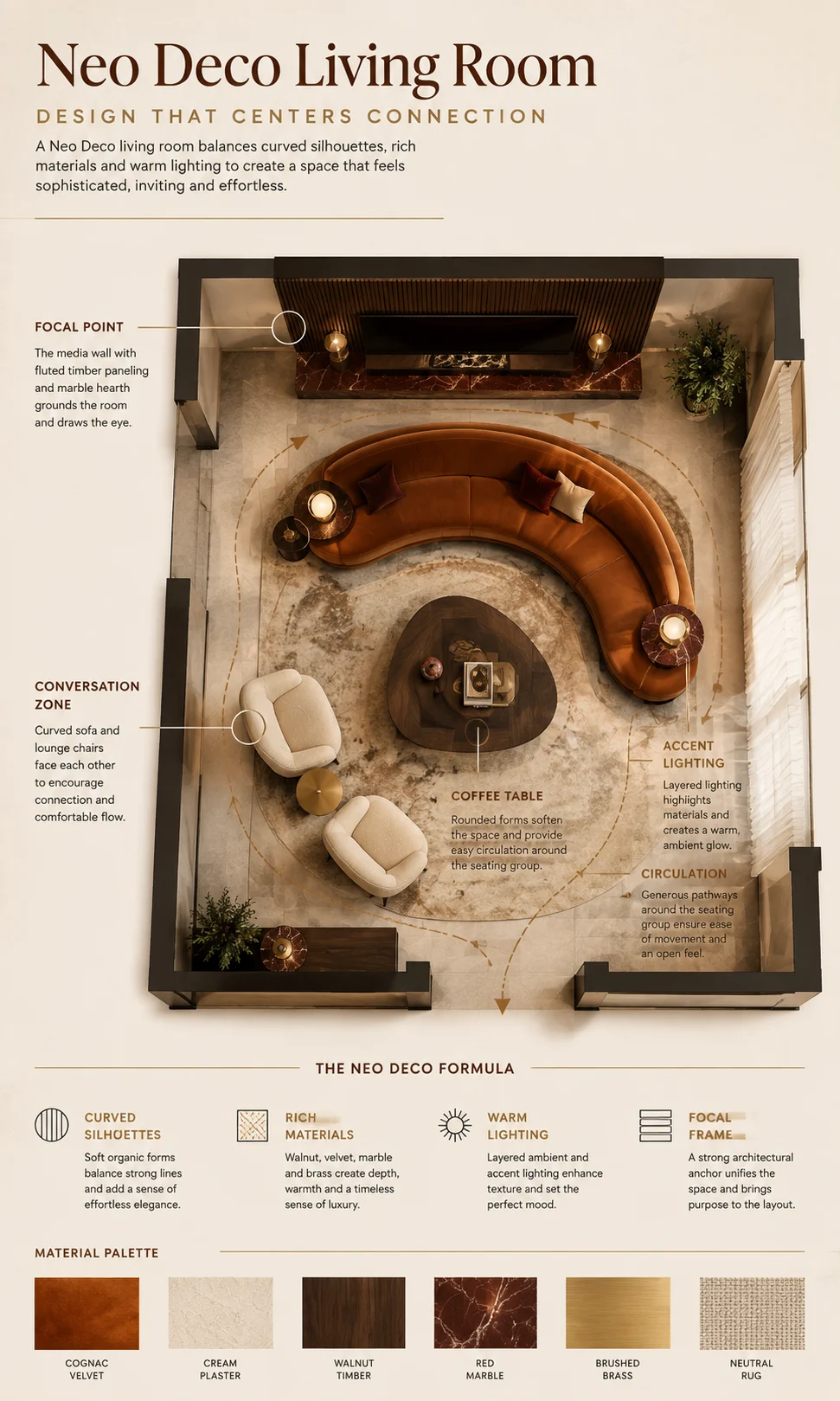
A dramatic curved sofa can look impressive across an empty room, but the practical test is whether people seated on it can comfortably interact with the rest of the furniture. Lounge chairs should feel part of the same group rather than decorative objects positioned at the room’s edges.
A useful Neo Deco layout often uses a large curved or softly segmented sofa as the main seating anchor, with one or two lighter lounge chairs completing the conversation zone. The resulting composition can remain asymmetrical while still feeling balanced.
The chairs do not need to mirror one another exactly. A pair of identical chairs creates greater formality, while two related but different pieces can make the room feel more residential. What matters is that their scale, seat height and orientation allow them to participate in the same group.
Do Not Push Every Piece Against a Wall
Leaving all the furniture at the perimeter can make a generously sized living room feel unexpectedly disconnected.
Where space allows, pull the main seating away from the wall and allow the rug, coffee table and chairs to define their own zone. Even a relatively small gap behind a sofa can make the seating feel more intentionally placed rather than simply pushed into whatever floor area remained.
A floating arrangement can also create useful circulation behind the sofa, particularly in open-plan homes where people need to move between the kitchen, dining area and living room without cutting directly through the conversation zone.
In a smaller room, pushing furniture toward the perimeter may still be necessary. The goal is not to float furniture automatically. It is to distinguish between furniture placed deliberately against a wall and furniture ending up there by default.
Face Seating Toward People as Well as Features
A television or fireplace can influence orientation, but the entire room should not become a row of seats facing one direction unless that is genuinely how the household uses it.
Angling lounge chairs slightly toward the sofa can preserve visual access to the focal wall while supporting conversation. A curved sofa has an advantage here because its geometry naturally turns some seating positions toward the center of the room.
That social quality is one reason curved furniture has become so useful in Neo Deco spaces. The curve is visually expressive, but it also changes how people relate to one another.
Use the Coffee Table to Connect the Seating Group
The coffee table is often treated as a decorative centerpiece, yet its most important role is spatial.
It should sit close enough to the principal seating positions to be useful without blocking movement through the room. Its shape should also respond to the seating geometry.
A strongly curved sofa paired with a severe rectangular coffee table can create useful contrast, but the corners need to make sense within the circulation pattern. An oval, rounded rectangle or softly irregular table usually makes movement easier around a curved seating group.
A structured table can also prevent the room from becoming too soft. Neo Deco benefits from the tension between flowing silhouettes and more disciplined geometry. If the sofa, lounge chairs, rug and table are all rounded, the room may lose the architectural precision that gives the style its Deco connection.
One Large Table or Several Smaller Tables?
One substantial coffee table creates a clear center and works well where the seating forms a compact group.
Several smaller tables can provide better reach in a long or irregular room and allow the composition to feel less rigid. They are especially useful beside a large curved sofa where one central table may not serve every seating position equally well.
The risk is fragmentation. A coffee table, two drink tables, several side tables and multiple decorative plinths can make the floor feel busy.
A good test is whether every small table has a practical relationship with a seat. If a table exists only to support another decorative object, question whether the room actually needs it.
Furniture Scale Has to Match the Room Before It Matches the Style
A curved velvet sofa can be visually perfect for Neo Deco and still be the wrong sofa for the room.
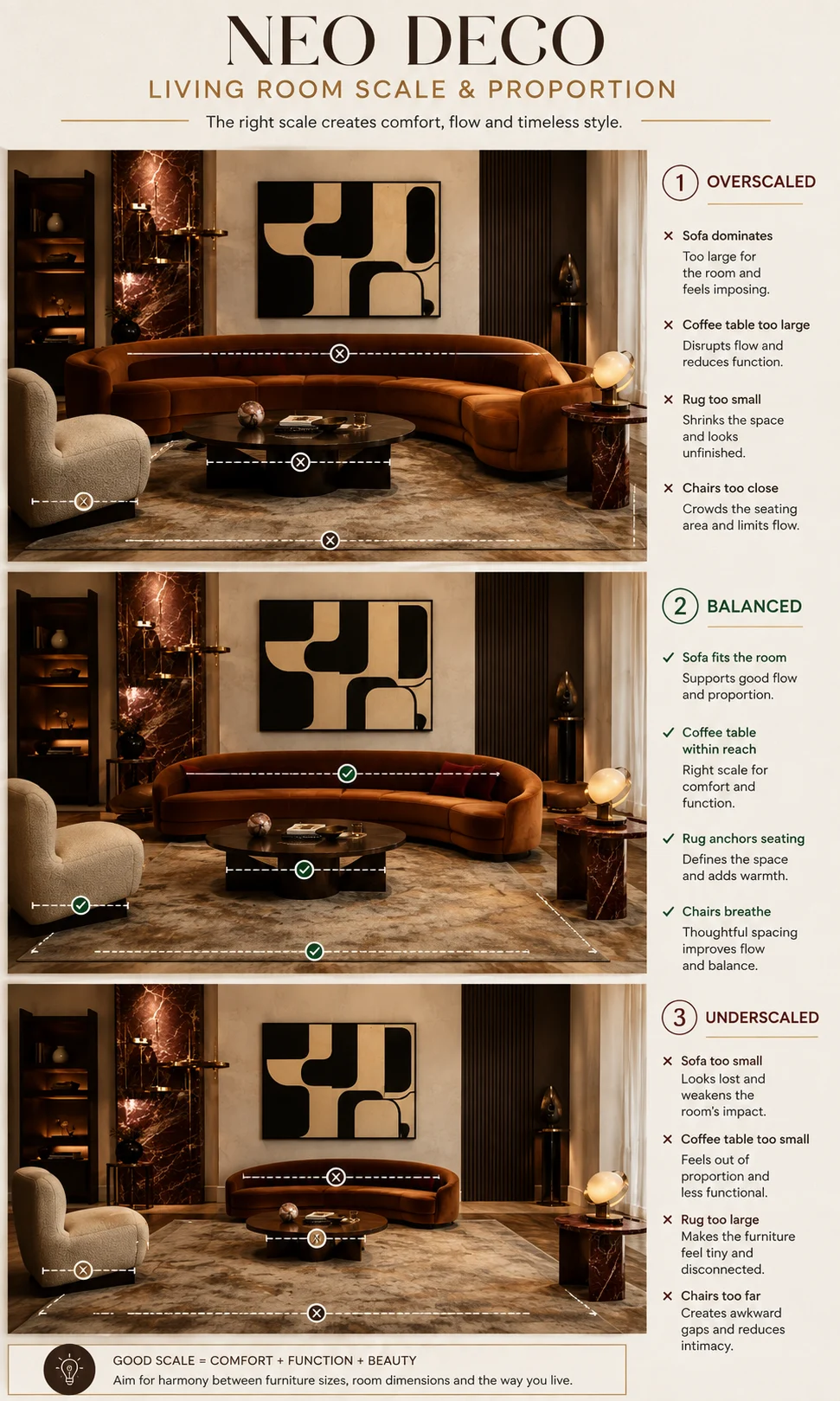
Scale determines whether furniture feels integrated with the architecture. Oversized pieces can compress circulation and make every surrounding object look secondary. Undersized furniture creates the opposite problem: a large room begins to feel sparsely furnished even when it contains many separate pieces.
The correct scale comes from the relationship between furniture, room dimensions and empty floor area.
An Oversized Sofa Can Make the Whole Room Feel Smaller
Large curved sofas are particularly deceptive because their footprint is difficult to judge from one straight dimension. The curve may project farther into the room than expected, and the space trapped behind or beside it may not be useful.
Before ordering, map the full footprint onto the floor. Painter’s tape, temporary cardboard or a scaled plan can reveal how the piece affects the route around the coffee table, access to the curtains and the relationship with adjacent chairs.
A sofa should feel generous without becoming the obstacle that everyone has to navigate.
Furniture That Is Too Small Creates Visual Weakness
A small sofa against a long architectural wall often looks lost, particularly if the wall has strong fluted timber, marble or artwork.
Adding numerous small pieces does not necessarily solve the problem. It can simply create more objects without increasing visual weight.
A better approach may be to select fewer pieces with stronger proportion: one substantial sofa, one appropriately sized coffee table and one or two confident chairs.
This principle fits Neo Deco especially well because the style benefits from edited luxury rather than accumulated furniture.
The Rug Should Belong to the Seating Group
A rug that sits only beneath the coffee table can make the furniture appear detached from one another.
The rug should visually collect the seating group. In many layouts, allowing at least the front portions of the major seating pieces to relate to the rug creates a more unified composition than placing a small rug in the middle of a large floor.
A very large rug can also become problematic if it extends into unrelated circulation zones and makes the furniture appear undersized.
Rug size should therefore be coordinated with the furniture group, not chosen independently from a standard product list.
Neo Deco Furniture Scale – What Changes the Room
| Furniture Element | Balanced Approach | If Too Large | If Too Small |
|---|---|---|---|
| Main sofa | Strong enough to anchor the conversation zone while preserving circulation | Dominates the room and compresses movement | Looks disconnected from the architecture and requires too many extra pieces |
| Coffee table | Reachable from key seats with enough room to move around it | Becomes a physical barrier within the conversation zone | Feels visually weak and may be inconvenient from outer seats |
| Lounge chairs | Substantial enough to converse with the sofa without matching its mass | Crowd the central zone and compete with the sofa | Read as decorative accents rather than usable seating |
| Area rug | Visually connects the major seating pieces | Spills into unrelated zones and weakens furniture proportion | Makes the seating look isolated around a small central island |
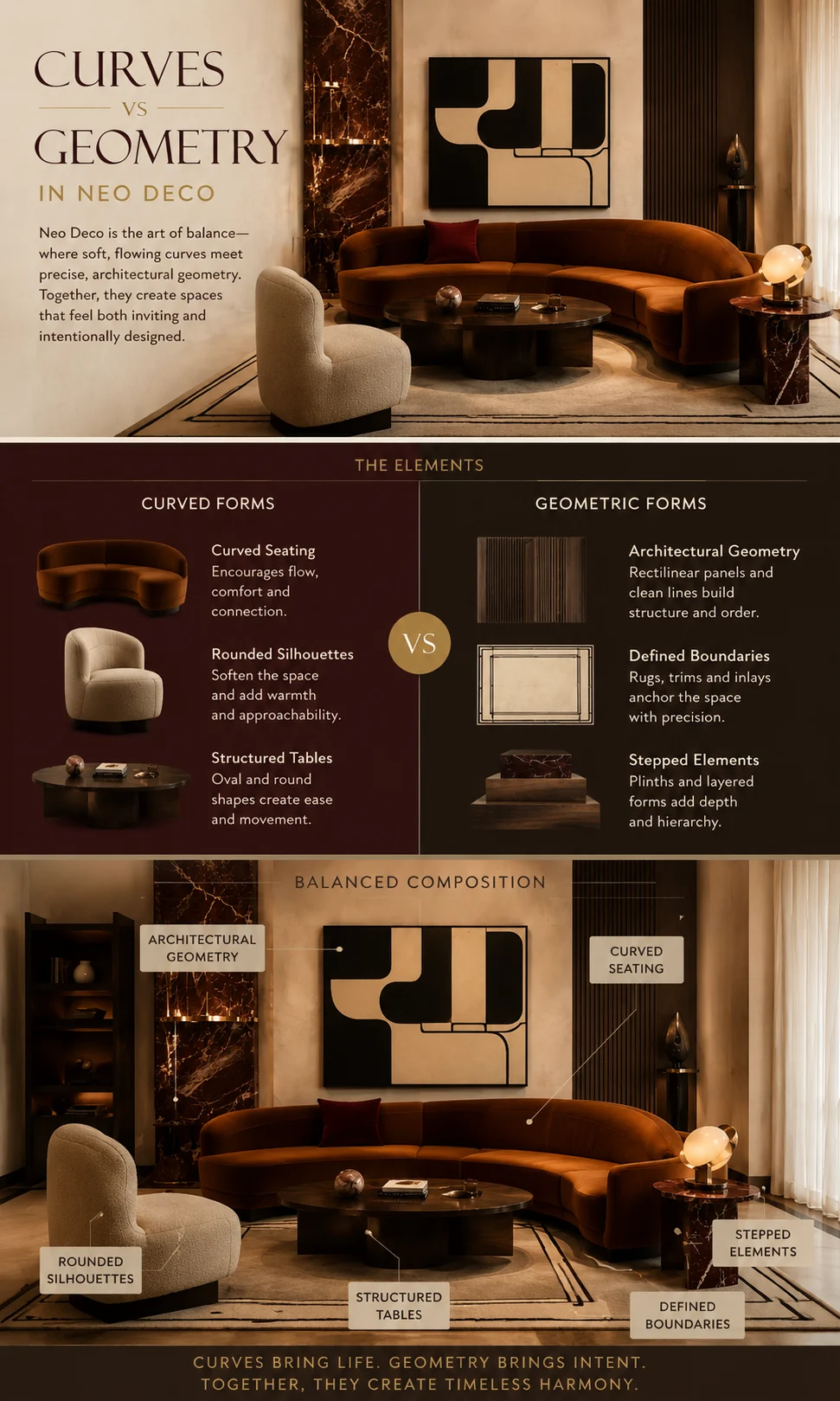
Balance Curves With Architectural Geometry
Curves are one of the easiest ways to make a contemporary room feel Deco-influenced, but a room filled entirely with curved objects quickly loses contrast.
Neo Deco becomes more convincing when soft furniture shapes sit against stronger architectural lines.
A curved sofa can face a structured coffee table. Rounded lounge chairs can sit on a rectangular rug with a precise border. A circular side table may stand beside vertical fluted timber. Arched forms can appear within an otherwise rectilinear wall composition.
The contrast gives both languages more strength.
Use Curved Seating to Create Flow
A curve can redirect movement more naturally than a sharp furniture corner.
This is especially useful in open-plan rooms where circulation enters from an angle. Instead of placing the square end of a sectional directly in the path, a rounded sofa end can guide movement around the conversation zone.
Curved seating also encourages a slightly more inward orientation. People at opposite ends are turned toward the center rather than sitting in one straight line.
This makes the form functional rather than merely fashionable.
Use Geometry to Give the Room Structure
Rectilinear wall panels, a disciplined rug border, stepped side tables, a strong fireplace surround or framed artwork can provide the order that curved seating lacks.
This is where the Deco reference becomes more architectural.
A vertical fluted walnut panel behind a curved cognac sofa creates a particularly useful contrast. The upholstery appears softer because the timber is linear, while the timber appears more precise because the sofa is fluid.
One does not need to repeat the same geometry everywhere.
Avoid Making Every Object Rounded
A curved sofa, circular coffee table, round rug, arched mirror, globe pendant, rounded chairs and circular side tables may sound coordinated when listed individually. Together, they can flatten the room because every object speaks the same visual language.
Choose where the curve matters most.
If the sofa owns the primary curve, allow the rug or table to introduce a more structured form. If a dramatic circular ceiling fixture is the room’s main gesture, the furniture can become quieter.
The room becomes stronger through contrast rather than repetition.
The Material Palette Should Have a Clear Hierarchy
Neo Deco invites rich materials, which is exactly why it requires discipline.
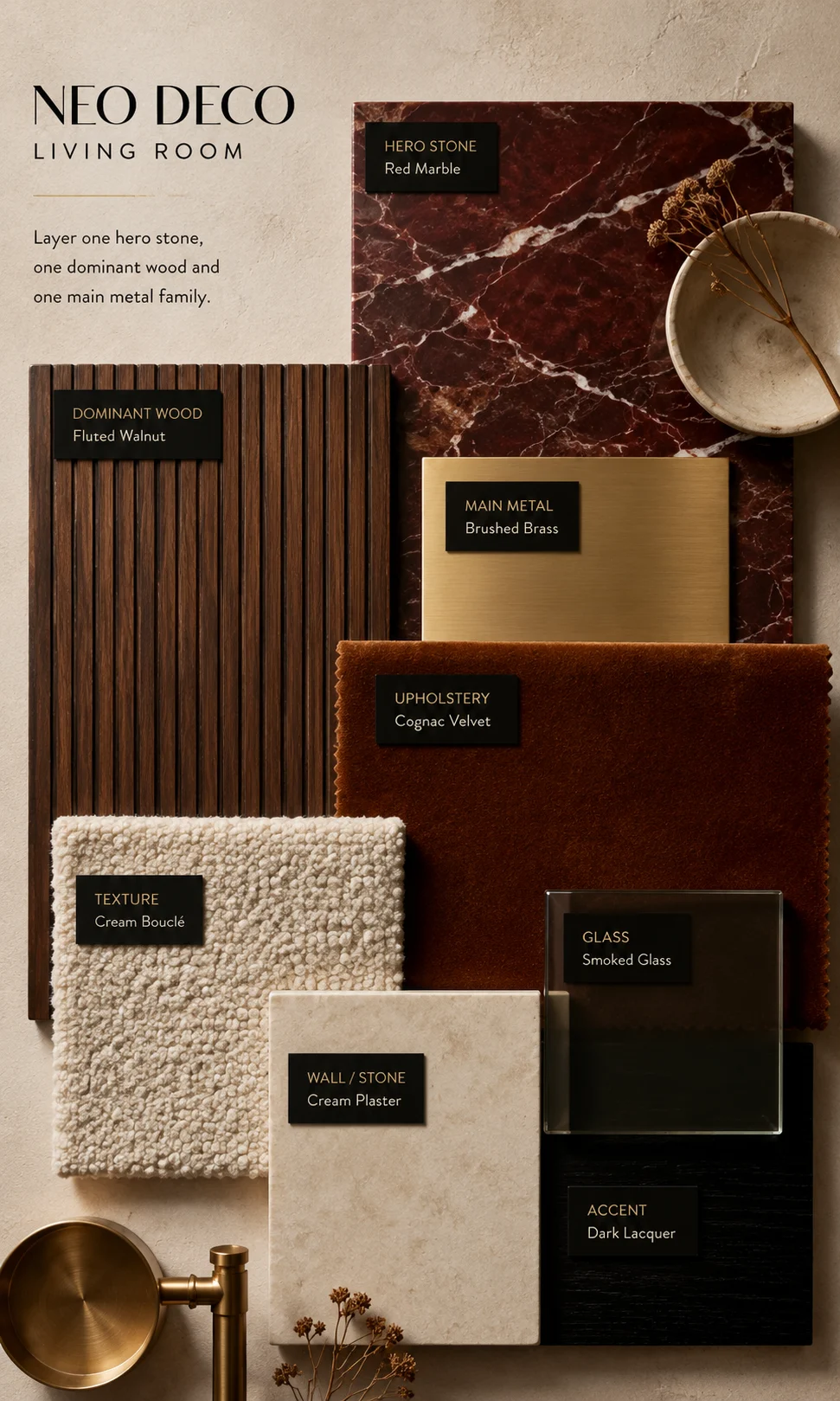
Red marble, walnut, brass, smoked glass, velvet, bouclé, lacquer and plaster can all belong in the same room, but they should not all occupy equal visual territory.
A practical material hierarchy is:
one hero stone + one dominant wood + one principal metal family + one main upholstery color + quieter supporting textures.
This gives the eye a way to understand the room.
Use One Hero Stone
Expressive red or burgundy marble can add enormous depth to a living room, particularly as a fireplace surround, side table, console top or carefully framed wall insert.
Its effectiveness decreases when the same stone appears on the fireplace, coffee table, side tables, floor border and shelving.
The strategy used in red marble bathroom design applies here as well: concentrated placement usually gives a dramatic stone more authority than continuous repetition.
A quieter cream stone can then appear elsewhere without becoming a second hero.
Let Walnut Carry the Architecture
Walnut is particularly effective because it can move between cabinetry, wall panels, furniture and trim without requiring a new color family.
Dark fluted walnut behind a sofa or fireplace creates shadow and rhythm. Smooth walnut on a coffee table introduces the same material more quietly.
The finish should change according to the role. Repeating identical fluting on every timber surface can make the design feel manufactured rather than composed.
Use Brass as a Line, Not a Blanket
Brushed brass is one of the fastest ways to introduce Neo Deco warmth.
It is also one of the easiest materials to overuse.
A chandelier, selected table detail and one or two smaller accents can establish the metal family. The room does not need gold-colored legs, trims, shelves, lamp bases, frames and handles on every object.
Controlled repetition feels intentional. Continuous repetition feels themed.
Use Upholstery to Soften the Hard Materials
Cognac velvet, leather, rust mohair or related warm upholstery can balance stone and metal.
A large sofa usually provides enough color to establish the main upholstered tone. Lounge chairs can then shift toward cream bouclé, textured neutral fabric or a deeper related color.
This keeps the conversation zone from becoming one continuous brown mass.
The same logic can connect this room with the detailing principles used in leather banquette design, where upholstery becomes strongest when texture, joinery and metal each perform a different role.
Smoked Glass and Dark Lacquer Are Useful in Small Amounts
Neo Deco needs some darkness to make brass and warm upholstery feel richer.
Smoked glass can provide that depth without creating another opaque heavy surface. It works particularly well for cabinet fronts, shelving and small table elements because it partially reflects the room while allowing visual layers behind it.
Dark lacquer produces a stronger effect. A black or deep brown lacquered cabinet, plinth or occasional table can create a clean visual stop between warmer materials.
Both should be controlled.
A room already containing dark walnut, burgundy marble and a cognac sofa may need only one black element. Adding several more dark reflective surfaces can make the palette heavier than expected, especially at night.
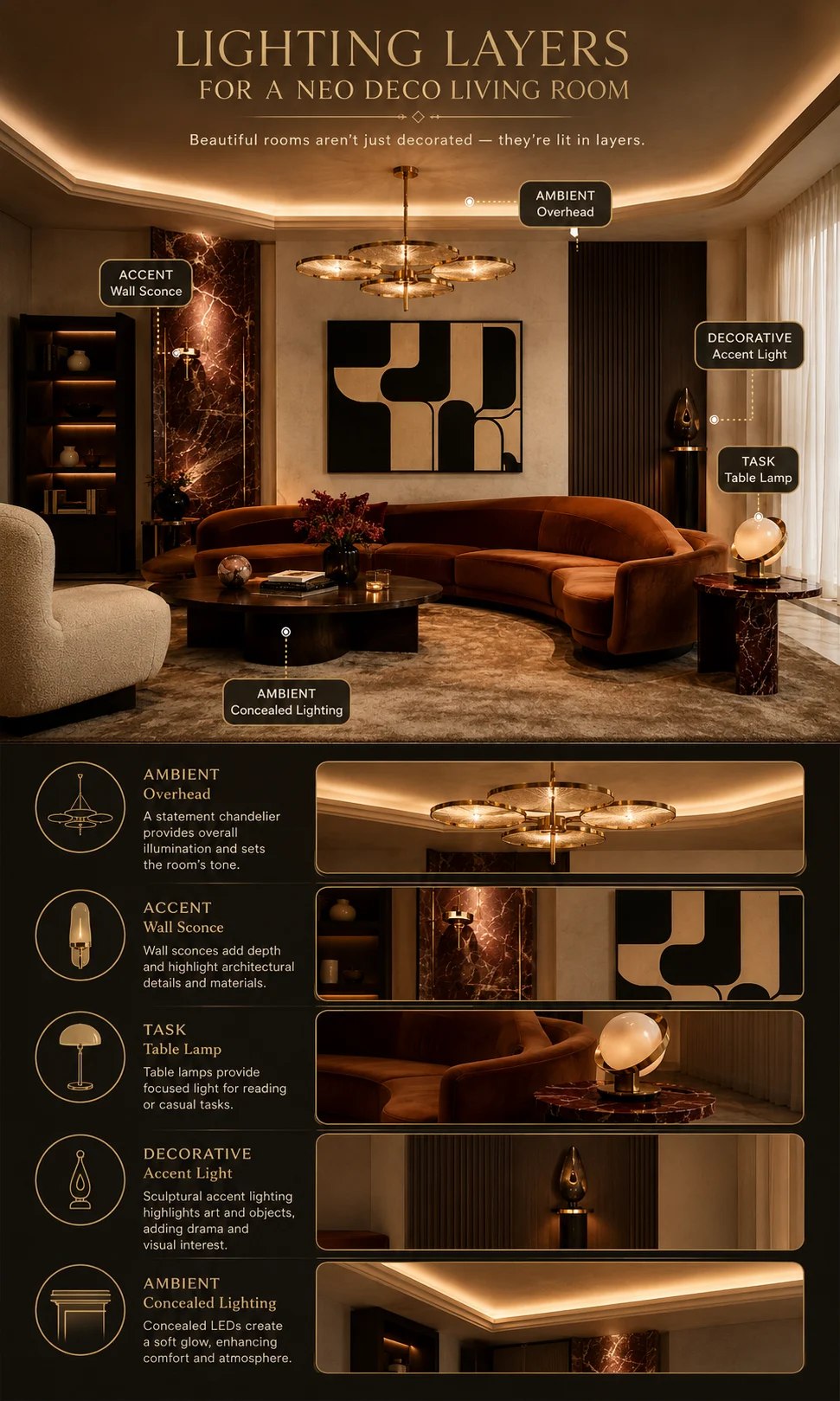
Lighting Should Be Designed in Layers, Not Around One Chandelier
A dramatic chandelier can define a Neo Deco living room, but it cannot perform every lighting job.
The room needs different levels of illumination for conversation, reading, television, entertaining and general movement. Combining ambient, accent, task and decorative lighting creates far more depth than simply increasing the brightness of one overhead fixture.
Ambient Light Establishes the General Room Level
The ceiling fixture, concealed cove lighting or another broad source provides the background illumination from which the rest of the lighting can work.
In a richly material room, ambient light should be sufficient to reveal texture without flattening it.
If the room relies entirely on numerous ceiling downlights, polished stone, glass and brass can produce a field of small reflections. Softer indirect illumination often creates a more luxurious evening atmosphere.
Accent Lighting Reveals Architecture
Wall sconces, shelf lighting and focused sources can emphasize red marble, artwork, fluted timber or another focal material.
The key is selectivity.
Lighting every feature equally destroys hierarchy in exactly the same way that making every material a statement does.
Choose the architectural surfaces that deserve additional depth.
Table and Floor Lamps Create Human-Scale Light
A table lamp introduces illumination at the height where people actually occupy the room.
This makes the space feel warmer in the evening and can provide useful light near reading chairs or sofas without illuminating the entire ceiling.
Sculptural lamps also give Neo Deco an opportunity to introduce smaller polished or opal-glass forms without requiring more decorative furniture.
Decorative Lighting Should Still Have a Job
A glowing sculptural object or small accent lamp can add atmosphere, but it should support the composition.
If the room already contains a statement chandelier, several sconces, shelf lighting, concealed LEDs and table lamps, another decorative light may simply add visual noise.
The strongest lighting schemes often appear rich because several modest sources overlap rather than because every fixture is individually dramatic.
Use Symmetry Selectively Rather Than Designing the Whole Room Around It
Art Deco is strongly associated with symmetry, but a contemporary living room does not need to become perfectly mirrored to feel Neo Deco. Strict symmetry can create an impressive entrance view, yet it can also make a residential room feel formal enough that everyday movement seems like an interruption.
A better approach is to decide where symmetry deserves to be obvious.
The fireplace wall is an ideal candidate. Matching sconces can flank artwork or a television, a marble insert can sit on a central axis, and walnut panels can establish a disciplined architectural frame. Once that focal wall is resolved, the seating can become more relaxed.
A curved sofa may sit slightly off-axis to improve circulation. One lounge chair might be paired with a floor lamp while the opposite side uses a stone table. These differences make the room feel occupied rather than staged while the focal architecture keeps the overall composition controlled.
Use Symmetry at the Focal Point
A symmetrical focal wall gives the eye an immediate place to settle.
If a fireplace is centered, keep the strongest architectural elements aligned with it. Fluted panels, wall lights or stone should reinforce that center rather than creating several competing vertical axes.
This can be particularly useful when the furniture is asymmetrical. A stable background allows the foreground arrangement to move more freely without making the room feel disorganized.
Use Asymmetry Where the Room Needs Movement
Circulation, windows, doorways and open-plan connections rarely occur in perfect pairs.
A living room should respond to those realities.
One side of the sofa may need to remain more open because it connects to the dining area. A floor lamp might occupy the quieter side while a side table sits closer to the main route. An asymmetrical furniture arrangement can therefore be more functional while still feeling balanced through material, visual weight and lighting.
Balance does not require identical objects. It requires the room to stop feeling heavier on one side than the other.
The Fireplace Wall Should Feel Architectural Before It Feels Decorative
A Neo Deco fireplace can become one of the strongest opportunities for material expression because it naturally combines vertical architecture, fire, furniture orientation and lighting.
The danger is treating every part of the wall as another decorative opportunity.
A successful fireplace composition may need only three layers: a dominant wall field, one hero material and a restrained architectural frame.
For example, warm cream plaster can create the background, burgundy marble can form the hearth or fireplace surround, and fluted walnut can define one side or the upper volume. Brass may then appear only in the sconces rather than as additional strips around every edge.
Do Not Let the Television Create a Second Unrelated Focal Point
Where a television shares the fireplace wall, it should be integrated deliberately.
A large black screen above pale plaster immediately carries visual weight, even when turned off. Surrounding it with more dark panels may either integrate the screen or make the entire wall disproportionately heavy.
One useful strategy is to place the television within a darker walnut zone while allowing the fireplace or stone to provide the stronger material feature below. Another is to offset the screen within built-in cabinetry when the room permits a less formal composition.
The solution should respond to how frequently the screen is used. Designing a spectacular fireplace that becomes uncomfortable for everyday viewing is no more successful than allowing the television to dominate every architectural decision.
Use Stone Where It Can Be Read Clearly
Highly veined stone needs enough uninterrupted area to make its pattern legible.
A narrow strip of dramatic marble repeatedly interrupted by shelving, outlets, equipment and trims may produce less impact than one cleaner stone plane.
If the room already includes a dramatic red marble side table or console, the fireplace may use a quieter cream stone instead. The hierarchy matters more than repeating the same premium material.
Artwork Should Support the Furniture Scale
Large Neo Deco furniture often needs artwork with enough visual weight to relate to it.
A wide curved sofa beneath several tiny framed pieces can make the wall feel fragmented. One substantial abstract artwork or a carefully composed pair often creates a stronger relationship with the seating.
The artwork does not need to reproduce Deco motifs. In fact, literal fans, sunbursts and geometric borders can make a contemporary room feel themed when the architecture already carries the style.
Abstract work with strong shape, controlled color or bold contrast can provide the same structural effect without becoming a costume version of Art Deco.
Match Artwork Width to the Visual Zone, Not Just the Wall
A wall may be four meters wide, but the relevant visual zone might be the sofa below it.
Centering a small artwork on the whole wall while the sofa sits off-center can make the two elements appear unrelated. Position the artwork according to the furniture grouping and the focal hierarchy rather than measuring the wall in isolation.
Likewise, an artwork should not automatically match the exact width of the sofa. Slightly narrower often feels more composed because the furniture provides a visual base beneath it.
Do Not Add Artwork to Every Empty Wall
Negative space is part of Neo Deco.
An empty plaster wall can make the nearby marble, velvet or brass appear more intentional. Filling every available vertical plane with framed art, mirrors, shelves and decorative panels removes the contrast that allows stronger features to stand out.
The room does not become unfinished simply because one wall remains quiet.
Mirrors Can Increase Light, but They Also Multiply Visual Noise
A large mirror can be useful in a darker living room because it reflects daylight and extends the apparent depth of the space.
It also reflects everything else.
Positioned opposite a busy bookshelf, chandelier and patterned rug, a mirror effectively duplicates the busiest part of the room. Positioned to reflect a window, pale wall or controlled vignette, it can make the space feel lighter without adding another strong decorative layer.
Neo Deco mirrors often use arched, stepped or softly geometric forms, but the frame should remain subordinate if the room already contains strong brass.
A large mirror with a thick bright-gold frame beside brass shelving, brass lamps and brass furniture legs can quickly move from sophisticated repetition into visual saturation.
Small Neo Deco Living Rooms Need Fewer Gestures, Not Smaller Versions of Everything
A compact room can support Neo Deco extremely well because the style does not require a large quantity of furniture. It does, however, require stronger editing.
The mistake is shrinking every object while keeping the same number of elements.
A small curved sofa, tiny lounge chair, small coffee table, narrow console, little side tables and several miniature lamps may technically fit, yet the room can begin to feel more crowded because the eye has to process so many separate pieces.
A stronger strategy is to reduce the number of objects while keeping the primary furniture confident.
Use One Strong Sofa
A well-proportioned two- or three-seat sofa can establish enough identity for the entire room.
If the sofa carries a curved silhouette and rich cognac upholstery, the room may need only one lighter lounge chair rather than a matching pair.
That preserves circulation while keeping the conversation zone complete.
Choose a Coffee Table With Visual Lightness
A compact room may benefit from an oval smoked-glass table, a low dark table with recessed base or a pair of nested tables rather than one visually heavy block.
The table still needs enough scale to belong to the sofa.
“Small room” should not automatically mean “small coffee table.” The useful question is whether the table can serve the seating while leaving a comfortable route around it.
Use the Wall for Storage Before Adding More Floor Furniture
Built-in shelving, a recessed media wall or a shallow floating cabinet can preserve more floor area than several freestanding pieces.
This is particularly useful when the cabinetry becomes part of the architecture through walnut, lacquer or integrated lighting.
The goal is not to cover the wall in storage. Concentrate it where the room genuinely needs it and allow another area to remain visually quiet.
Large Neo Deco Living Rooms Need Zones Rather Than More Furniture
A large living room creates the opposite problem.
If all seating is pushed toward the perimeter, people can end up sitting too far apart for comfortable conversation. Filling the middle with more furniture does not necessarily solve this.
Create zones according to activity.
The primary conversation group might center on the fireplace. A secondary pair of chairs can face the window. A reading chair may sit beside shelving. Each zone should feel intentional while sharing the same broader material palette.
A large rug can define the main group, while changes in lighting or furniture orientation help distinguish secondary areas.
The room should remain visually connected. Using completely different furniture languages in each zone can make one large space feel like several unrelated showroom sets.
Window Treatments Should Calm the Room
Neo Deco living rooms often contain enough hard surfaces that window treatments become an important source of softness.
Full-height curtains are particularly effective because their vertical folds create rhythm without requiring another decorative wall treatment. Sheer curtains diffuse daylight and soften the contrast between dark walnut, polished stone and exterior brightness.
Heavier curtains can add greater theatricality, but their color should be coordinated with the upholstery rather than chosen as another competing statement.
Cream, taupe, warm gray or muted tobacco can support a rich Neo Deco palette without copying the sofa exactly.
Mount Curtains to Strengthen Height
Where architecture allows, taking the curtain treatment closer to the ceiling can make the room feel more resolved and vertically proportioned.
A low curtain track positioned just above the window may visually divide an otherwise elegant wall.
This does not require hiding every architectural detail. Where coves, ceiling trim or stepped Deco forms are important, the curtain position should work with them instead of covering them.
The Rug Can Introduce Geometry Without Becoming Another Pattern Event
A rug is one of the easiest places to bring Deco geometry into the room because it establishes a broad horizontal field beneath the furniture.
The pattern does not need to be complex.
A cream rug with a dark stepped border, restrained radiating lines or a simple geometric edge can define the seating zone while allowing the sofa and stone to remain more expressive.
If the upholstery is plain and the architecture is restrained, a stronger rug may be appropriate. If the sofa, marble and wall already contain considerable visual movement, the floor should become calmer.
This is another useful example of Neo Deco hierarchy: the pattern belongs where it contributes the most rather than where an additional pattern simply fits.
Use Accessories After the Architectural Decisions Are Finished
Accessories should complete the composition, not rescue it.
If the room still feels empty without a large quantity of bowls, sculptures, trays, books and decorative objects, the underlying furniture or material hierarchy may not be strong enough.
A side table may need only a lamp. A coffee table may need one bowl and a small stack of books. A shelf can include several objects with clear negative space between them rather than being filled from edge to edge.
The objects themselves do not all need to be Deco-inspired.
Contemporary ceramics, abstract sculpture, dark glass and restrained metal objects can support the room more effectively than a collection of literal historical reproductions.
Edit Accessories by Viewing Distance
A shelf seen across the living room should read as a composition before the individual objects are identifiable.
Arrange differences in height, mass and empty space first. Fine decorative details can be considered afterward.
This is particularly important in built-in dark shelving, where illuminated objects quickly attract attention. If every shelf contains a lit sculpture, decorative bowl and stack of books, the shelving can become more visually dominant than the sofa.
Common Neo Deco Living Room Mistakes
Mistake 1: Treating Every Surface as an Opportunity
Fluted walnut on one wall can be beautiful. Adding fluting to the fireplace, sideboard, coffee table and cabinet doors weakens the original gesture.
A material detail becomes more distinctive when another surface is allowed to remain plain.
Mistake 2: Using Too Much Brass
Brass should connect important details rather than coat the room in metallic highlights.
A chandelier, sconces and selected table hardware may be enough. If every furniture leg, trim, frame and accessory is gold-toned, the eye stops recognizing any individual accent.
Mistake 3: Making the Sofa, Chairs and Coffee Table All Sculptural
Statement furniture needs quieter companions.
If the curved sofa already defines the room, a simpler coffee table can support it. If the chairs have unusually sculptural forms, the sofa can become more restrained.
The conversation group should behave like an ensemble rather than a competition.
Mistake 4: Mixing Too Many Marble Patterns
Red marble, green marble, heavily veined white stone and terrazzo can all be attractive. Using them together in one moderate-size living room creates a complex mineral palette that can overpower the furniture.
Choose one hero stone and allow quieter secondary stone to support it.
Mistake 5: Making Every Light Fixture Decorative
A room filled with statement fixtures loses the concept of a statement.
Let the chandelier carry the strongest decorative expression, then allow sconces, floor lamps and concealed lighting to perform their jobs more quietly.
Mistake 6: Using Deco Motifs Literally Everywhere
Sunbursts, arches, stepped profiles, fan patterns and geometric borders can make the style recognizable.
They do not all need to appear in the same room.
Contemporary Neo Deco is often more convincing when historical principles are translated into proportion, symmetry and material rather than repeated through literal motifs.
Mistake 7: Forgetting Circulation Around a Curved Sofa
A curved sofa can project significantly farther into the room than a straight dimension suggests.
Map its full footprint and preserve circulation around the widest part of the curve.
Mistake 8: Buying the Rug Last
The rug affects the scale of the whole seating group.
Choosing it after all furniture has arrived can leave the room with limited options, particularly if the sofa has unusual dimensions.
Mistake 9: Filling Empty Walls Because They Look Empty
Quiet surfaces are essential when other parts of the room are highly expressive.
An empty plaster plane can be one of the reasons the marble and walnut feel expensive.
Mistake 10: Trying to Make the Room Look Expensive Through Quantity
Neo Deco can support luxury materials, yet more marble, brass, lacquer and velvet do not automatically produce a better room.
The strongest result usually comes from concentrating quality where it will be noticed and allowing surrounding materials to become simpler.
Too Much vs Balanced Neo Deco
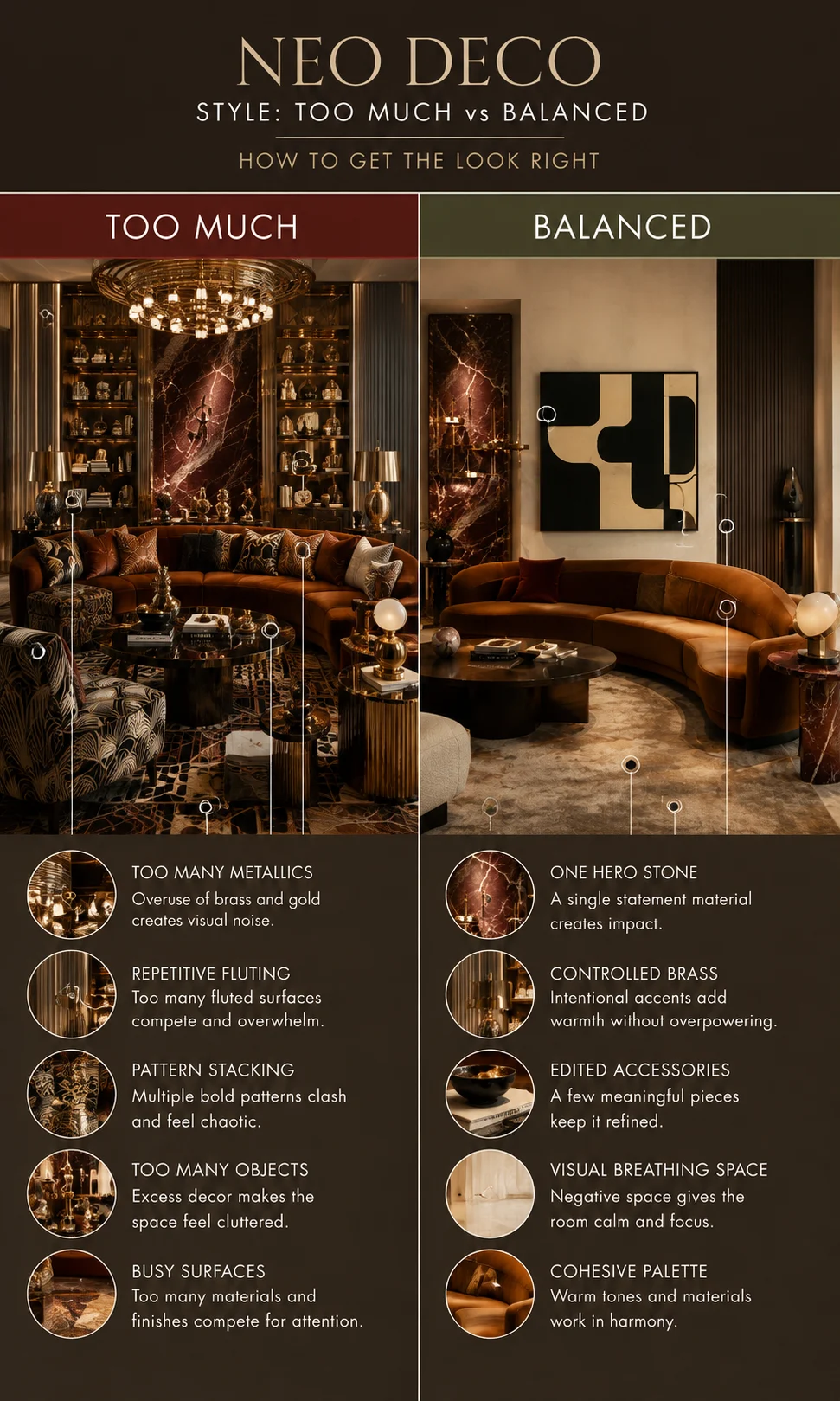
The distinction between an overworked room and a sophisticated one is rarely the presence of a single “wrong” object. It is usually the number of elements demanding attention simultaneously.
A balanced Neo Deco room may still contain a burgundy marble feature, brass lighting, cognac upholstery, fluted walnut and large geometric artwork. The difference is that those materials are assigned different levels of importance.
The stone may dominate one focal zone. Walnut establishes architecture. Leather carries the main furniture color. Brass appears as controlled highlights. The artwork creates contrast without reproducing the same palette exactly.
The quieter floor, curtains, plaster and supporting furniture give those stronger choices somewhere to exist.
That breathing space is one of the most important design tools in the style.
A Practical Neo Deco Living Room Design Sequence
Step 1: Map the Room Before Selecting the Sofa
Mark entrances, windows, doors, fireplace, television requirements and the main circulation routes.
Identify which pathways should remain outside the conversation zone.
Step 2: Choose the Primary Focal Point
Decide whether the room is led by architecture, view, fireplace, artwork or furniture.
Give that feature enough space to remain visually dominant.
Step 3: Establish the Conversation Group
Place the main sofa and chairs according to how people will interact.
Do not worry about side tables or decorative pieces yet.
Step 4: Test Furniture Scale on the Floor
Use tape or temporary templates to map large curved furniture.
Walk around the full footprint before committing to the order.
Step 5: Select the Rug and Coffee Table Together
These two elements define the central floor relationship.
Check reach from the main seats as well as circulation around the table.
Step 6: Establish the Material Hierarchy
Choose one hero stone, one dominant wood, one principal metal and the main upholstery family.
Decide which surrounding surfaces will deliberately remain quiet.
Step 7: Balance Curves With Geometry
Identify which element carries the strongest curve.
Use architecture, rugs, tables or artwork to introduce enough rectilinear structure around it.
Step 8: Design the Lighting Layers
Establish ambient, accent and task illumination before adding purely decorative lighting.
Check how the light interacts with stone, brass, glass and television screens at night.
Step 9: Resolve Curtains and Major Artwork
These large visual surfaces can significantly change the balance of the room.
They belong before the accessory stage.
Step 10: Add Accessories and Remove Some Again
Style the room, then edit it.
Look specifically for repeated metallics, repeated fluting, unnecessary objects and competing patterns. If removing an item makes the hero material or primary furniture easier to appreciate, the room was probably stronger without it.
A Quick Neo Deco Living Room Decision Guide
| Design Decision | Stronger Neo Deco Approach | Usually Needs Restraint |
|---|---|---|
| Focal point | One clearly dominant architectural or furniture gesture | Fireplace, television, artwork, chandelier and feature stone all competing equally |
| Furniture form | One dominant curved seating form balanced by structured companions | Making every furniture item rounded and sculptural |
| Stone | One hero stone used where its pattern can be seen clearly | Several unrelated dramatic marbles competing within one room |
| Metal | Controlled repetition of one main metal family | Brass or gold applied to every visible trim and furniture detail |
| Lighting | Layered ambient, accent and task lighting with one dominant decorative fixture | Several statement fixtures competing at the same visual level |
| Accessories | A limited number of substantial objects with space around them | Filling every table, shelf and wall because the room appears temporarily empty |
The table can also work as a final design audit. When several items in the right-hand column appear in the same room, removing one layer often has more impact than adding another decorative feature.
A Neo Deco Living Room Should Still Feel Good Without the Deco Label
This is one of the most useful final tests.
Imagine removing the words “Neo Deco” from the mood board. The living room should still have good circulation, useful furniture, comfortable lighting, appropriate scale, coherent materials and a clear focal hierarchy.
If the room only communicates the style through brass, fluting, arches and dramatic marble, it may have been designed from motifs outward rather than from living requirements inward.
The strongest modern revival works in the opposite direction. The room functions first. Curves improve movement and conversation. Geometry creates structure. Rich materials are concentrated where they contribute most. Lighting reveals those surfaces at night. The Deco relationship emerges through how those choices are composed.
That is also why this room-level guide remains distinct from the broader Neo Deco Interior Design: Modern Art Deco Revival parent article. The parent explains the style system, while the living-room page owns the practical decision network of focal hierarchy, conversation planning, furniture scale, circulation, rug boundaries, curves, geometry, materials, lighting and final editing.
The result should feel sophisticated enough to be memorable and comfortable enough that nobody needs to think about the design while using it.
Compare Local Home Specialists Near You
Tell us what kind of help you need, then compare nearby businesses by location, Google rating, review volume and contact options.
HomeFix Local Match
Turn a home problem into a practical local hiring decision. Check the clues, see the specialist types that fit, open focused surrounding-location searches, then compare the strongest three before you call.
 YOUR PROBLEM
YOUR AREA
COMPARE 3
✓ Ready to compare
YOUR PROBLEM
YOUR AREA
COMPARE 3
✓ Ready to compare
What is happening?
Choose the closest problem type, then check every clue that applies. Your selections change the specialist order.
Where should the search focus?
Use Google’s “near me” context or enter the area you actually want a specialist to serve.
Simple local search: open nearby Google results, choose the businesses that look suitable, then compare your best three here before you call.
Problem snapshot
Who should you call first?
These are the specialist types most likely to fit the clues you selected.
Search around your location
Compare your top three
Use the same factors for each option so a high star rating does not hide a weak scope, poor diagnosis, missing credentials or unclear aftercare.
Comparison result
Your result combines the Google signals you entered with the practical hiring checks you completed.
Questions to ask every finalist
Use the same questions with each shortlisted business so the comparison stays consistent.
Frequently Asked Questions About Neo Deco Living Rooms
What is a Neo Deco living room?
A Neo Deco living room is a contemporary interpretation of Art Deco principles rather than a literal recreation of a 1920s interior. It typically combines controlled geometry, curved furniture, rich materials, sophisticated lighting and strong focal hierarchy with the comfort, technology and circulation expected in a modern home. The most convincing rooms use Deco references selectively rather than applying decorative motifs to every surface.
What colors work best in a Neo Deco living room?
Neo Deco living rooms can support cognac, burgundy, chocolate brown, deep green, black, cream and warm neutral tones. The stronger strategy is to establish one main upholstery color and allow walnut, stone, plaster and metal to support it. Several saturated colors can work together in a deliberately layered room, but a more restrained palette usually makes expressive materials easier to appreciate.
Does a Neo Deco living room need curved furniture?
Curved furniture is useful but not mandatory. A curved sofa or rounded lounge chair can soften circulation and introduce a strong contemporary Deco gesture, while rectilinear architecture, structured rugs and geometric tables provide contrast. The room usually becomes more convincing when one or two elements carry the strongest curves instead of making every piece rounded.
Can Neo Deco work in a small living room?
Yes. Small Neo Deco living rooms often work best with fewer pieces rather than miniature versions of a large-room furniture scheme. One confident sofa, an appropriately scaled coffee table, a single lighter chair and concentrated architectural storage can establish the style while preserving circulation. Limiting the number of hero materials is also particularly important in compact rooms.
What materials make a living room feel Neo Deco?
Walnut, expressive marble, brushed brass, cognac leather or velvet, smoked glass, lacquer, cream plaster and tactile neutral textiles can all support a Neo Deco room. They do not need to appear together. A clearer material hierarchy usually comes from selecting one hero stone, one dominant wood, one main metal family and one principal upholstery direction, then allowing quieter materials to connect them.
How do you stop a Neo Deco living room from looking too busy?
Give the room a clear focal hierarchy and reduce repetition. If the marble is highly expressive, use quieter furniture nearby. If the sofa has a dramatic curved form, choose simpler tables. Keep brass concentrated at selected fixtures and details, preserve some quiet wall and floor areas, and remove accessories that do not contribute to the composition or function.
What lighting works best for Neo Deco?
Neo Deco works particularly well with layered lighting. One sculptural chandelier or pendant can provide the dominant decorative fixture, while wall sconces, table lamps, floor lamps and concealed architectural lighting handle accent, task and lower-level ambient illumination. The lighting should reveal important materials without creating competing highlights across every reflective surface.
Is brass necessary in Neo Deco interior design?
No. Brass is useful because its warm reflection works well with walnut, cognac upholstery and rich stone, but polished nickel, bronze, blackened metal and other finishes can create equally convincing Neo Deco interiors. The more important decision is choosing a coherent primary metal family and controlling how often it appears.
Can a Neo Deco living room include a television?
Yes. The television should be treated as part of the focal-wall composition rather than ignored during design. Dark timber, cabinetry or another controlled architectural background can reduce the visual contrast of the black screen, while the seating arrangement should still provide comfortable viewing. A successful solution balances the television with the fireplace, artwork or stone instead of allowing several unrelated focal points to compete.