

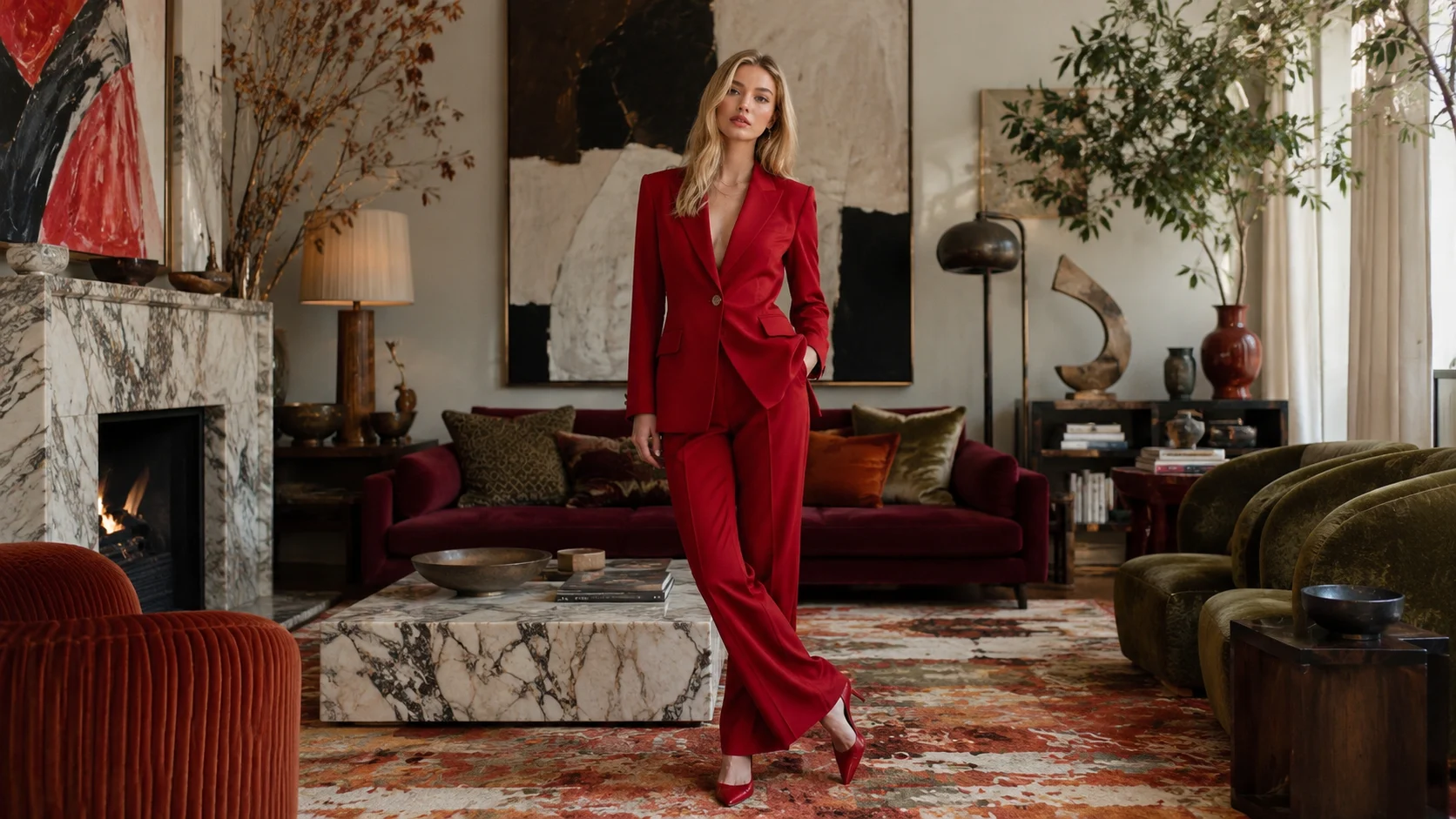

Modern maximalist interior design gives a room permission to contain strong color, large artwork, patterned textiles, sculptural furniture, books, collections and objects with personality, yet the most successful rooms still have an underlying order. A maximalist living room can hold considerably more visual information than a minimalist one without feeling accidental because the eye is guided toward certain elements first while quieter materials, repeated colors and carefully chosen gaps keep everything connected.
That distinction is important. Maximalism is sometimes reduced to the idea that “more is more,” which makes the style sound as though success depends mainly on adding things. In practice, adding is the easy part. The harder design work involves deciding which element should dominate, which patterns are allowed to compete, where repetition creates continuity, how much visual relief the room needs and when another object stops improving the composition.
A well-designed maximalist interior therefore feels abundant rather than crowded. You may notice an enormous painting before seeing the patterned sofa beneath it, then discover a striped chair, veined stone table, ceramic collection and smaller artwork as your attention moves through the room. The experience unfolds gradually because the elements have different visual weights. When everything is equally loud, that sequence disappears and the room begins to feel exhausting.
This is also what separates modern maximalism from several neighboring styles. Neo Deco interior design can use equally rich color, marble, velvet, metal and sculptural furniture, but it generally concentrates those effects into fewer, more glamorous statements. Modern maximalism is usually more comfortable with collections, mixed eras, layered pattern, unconventional art combinations and a higher density of visible objects.
The useful question, then, is not how much decoration a maximalist room can hold. It is how much visual information the room can organize successfully.
What Is Modern Maximalist Interior Design?
Modern maximalist interior design is an expressive approach that combines multiple colors, materials, patterns, artworks, furniture styles and personal objects inside a deliberately organized contemporary space. The word “modern” matters because today’s strongest maximalist interiors do not need to reproduce the dense historical decoration associated with Victorian rooms or commit completely to one traditional style.
A contemporary architectural shell can be an excellent starting point. Clean walls, large windows, straightforward flooring and relatively simple built-in cabinetry give artwork, textiles and furniture enough visual independence to become more expressive. The room may contain vintage furniture beside contemporary pieces, an abstract painting above a floral sofa, a handmade ceramic collection beside chrome lighting and a traditional rug beneath an unexpectedly modern table.
What connects those objects does not have to be a matching style. Relationships can be established through color, scale, line, material or repetition. Burgundy in a painting might reappear quietly in a rug. A circular pendant may echo the radius of an old lounge chair. Walnut cabinetry can visually connect a vintage sideboard with a contemporary dining table even when the pieces were designed decades apart.
This creates a room that feels collected rather than packaged. Furniture does not need to come from one collection, and artwork does not need to follow one subject. Some of the strongest maximalist interiors actually become more convincing when their pieces have different origins, provided there is enough visual logic to explain why they now belong together.
Modern maximalism is therefore less useful as a shopping category than as a method of composition. Buying patterned wallpaper, colorful cushions and decorative objects will increase visual density, but those purchases do not automatically create hierarchy. The designer still has to decide what the room is about.
The Short Version
A modern maximalist room usually combines controlled abundance, strong focal points, layered color, varied patterns, tactile materials, art, collections and deliberate visual relief. It succeeds when the eye can move through those layers without being asked to pay equal attention to everything at once.
The style becomes especially effective for people who already own meaningful furniture, artwork, books, travel objects or inherited pieces that do not fit neatly into one conventional design category. Instead of hiding those differences, maximalism can use them as part of the room’s identity. The important step is editing their relationships so the collection feels intentional.
That makes maximalism surprisingly demanding. A sparse room may expose every mistake because there are so few elements, but a dense room introduces a different challenge: every new object changes the balance among everything already present.
Modern Maximalism Is More About Hierarchy Than Quantity
Imagine two living rooms containing exactly twenty-five visible objects. One feels collected and sophisticated while the other feels chaotic. The object count is identical, so quantity cannot fully explain the difference.
The first room may have one dominant painting, a sofa that carries the principal color, a rug that connects several secondary tones and smaller accessories grouped into recognizable collections. Some shelves remain partially open. Furniture silhouettes can be read clearly because every corner has not been filled. The eye understands where to begin and can explore the room in stages.
The second room may contain five equally strong artworks, several unrelated furniture shapes, multiple high-contrast patterns and small accessories scattered across every available surface. Nothing is necessarily unattractive in isolation, but every item asks for attention simultaneously. Because the room lacks a clear order of importance, richness becomes competition.
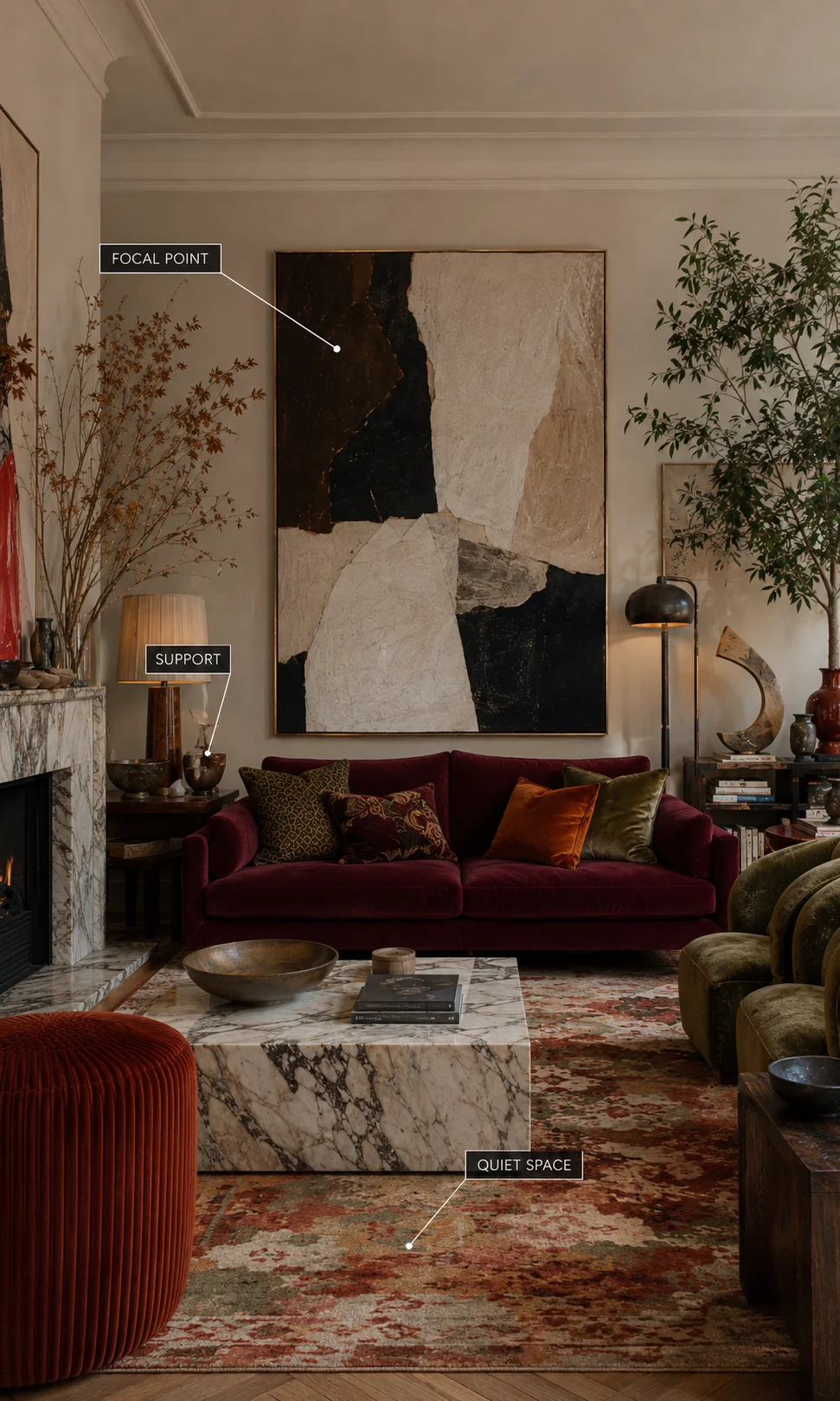
This gives homeowners a more practical maximalist test than simply asking whether they own “too much.”
Ask instead:
What do I see first?
Then look away and return to the room. If your attention consistently reaches one or two major elements before discovering smaller details, there is probably some hierarchy. If your eyes repeatedly jump between unrelated objects without finding a stable starting point, the problem may be visual competition rather than the total number of possessions.
A useful hierarchy can operate across several scales. Architecture and large furniture establish the broad composition. Artwork, rugs and lighting provide medium-scale visual events. Books, ceramics, cushions and collected objects deliver the close-range detail. The room becomes easier to read when those scales perform different jobs.
Choose the Largest Visual Event First
Before selecting accessories, identify the element with enough visual authority to organize the room. It might be an oversized painting, a deeply colored sofa, an extraordinary rug, a wall of books, a dramatic fireplace, patterned wallpaper or a group of large plants.
This does not mean the focal point must be the most expensive piece. Visual dominance depends on size, color contrast, placement, shape, lighting and surrounding space. An inexpensive painting that fills most of a wall can carry more visual weight than a costly side table surrounded by other furniture.
Once the dominant element is understood, later choices become easier because they can be judged according to their relationship with it. If an enormous botanical wallpaper already provides complicated movement, the sofa may benefit from a relatively continuous color. If the sofa itself uses a powerful geometric textile, the wall behind it may need a simpler artwork or more open space.
The strongest decision is sometimes refusing a beautiful object because another object already performs the same visual job.
Let Supporting Pieces Repeat Instead of Compete
Supporting elements do not need to disappear. They simply need to reinforce the composition rather than start several new conversations.
Color repetition is one of the easiest methods. A small plum tone in an artwork can return in the piping of a chair and appear again inside a rug. None of those pieces needs to match exactly. The repeated family is enough to help the eye connect objects across different areas of the room.
Shape can provide similar continuity. Rounded lighting, a curved chair back and a circular side table can establish a gentle recurring geometry while rectangular cabinetry and artwork maintain structure. Material repetition can connect unrelated eras as well. A vintage walnut cabinet and contemporary walnut table immediately share one visual characteristic even when their forms are completely different.
Repetition should usually become quieter as it spreads through the room. Copying the exact same motif across wallpaper, cushions, curtains, rug and artwork often makes an interior feel coordinated in the conventional sense rather than genuinely collected.
Quiet Space Is Part of Maximalism
Negative space does not belong exclusively to minimalism. A maximalist room needs pauses precisely because it contains more information.
An open section of wall can increase the apparent importance of a nearby artwork. A partially empty console allows one ceramic group to read as a deliberate collection. A relatively calm sofa can make patterned curtains and an expressive rug feel stronger. Even an uninterrupted section of timber cabinetry can provide relief between art-heavy walls.
The amount of relief depends on the intensity of the surrounding objects. A room built mainly from similar earthy tones may tolerate a higher density because the contrasts remain moderate. A room containing saturated complementary colors, black-and-white geometry, several reflective finishes and detailed artwork will usually need stronger quiet zones to keep those elements legible.
The mistake is assuming that every empty surface represents an unfinished decorating opportunity. Sometimes the empty surface is doing exactly the work the composition needs.
Modern Maximalism vs Clutter: Where Is the Line?
Clutter and maximalism can contain similar objects, which is why the distinction becomes confusing. Books, ceramics, artwork, souvenirs, textiles and small furniture may appear in either kind of room. The difference emerges from placement, repetition, accessibility, grouping and visual intention.
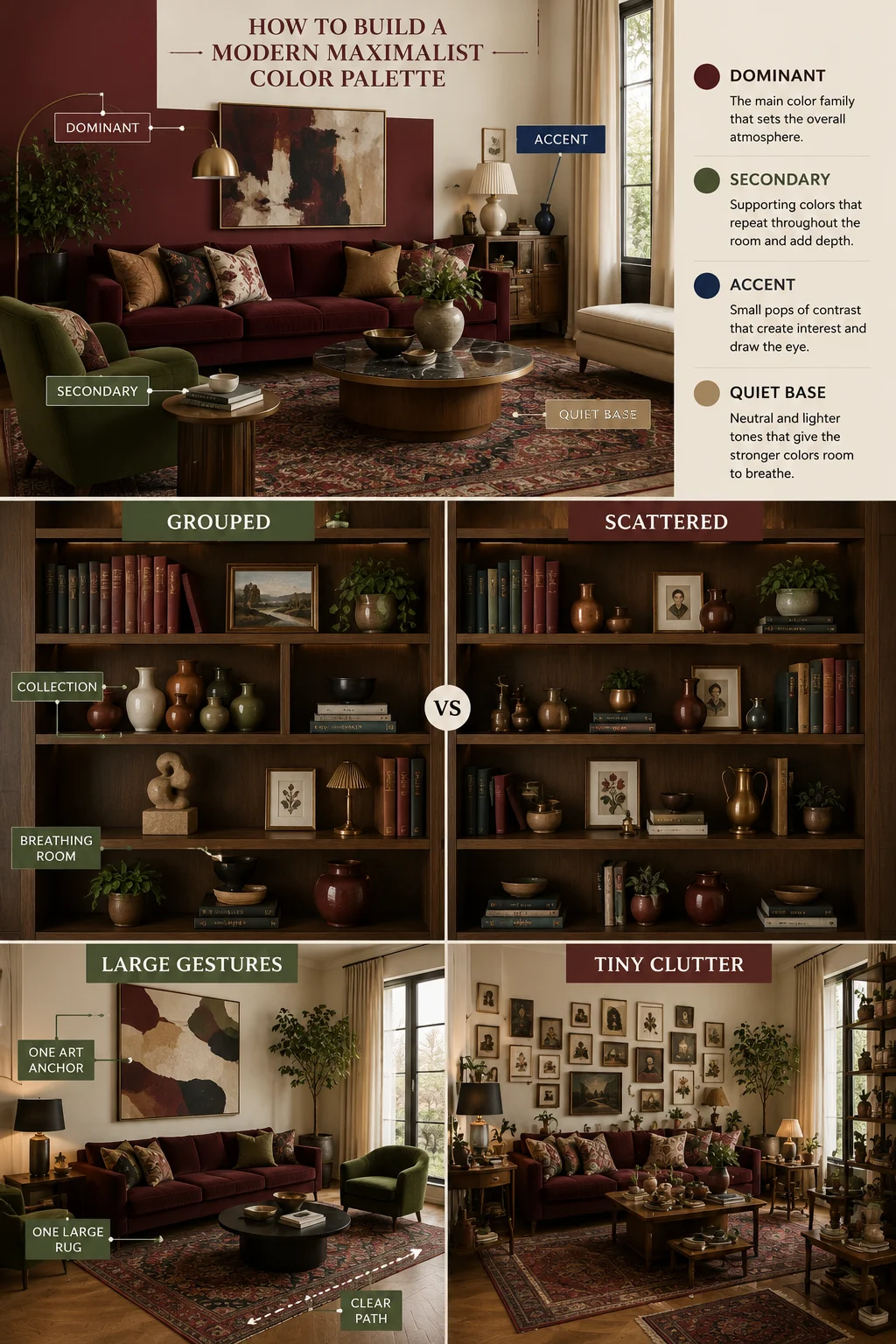
A collection of ten ceramic vessels displayed together can read as one visual event. The same ten vessels distributed randomly across a television cabinet, coffee table, window ledge, sideboard and floor may become ten separate interruptions. Grouping changes the way the eye counts information.
Function matters as well. A room that looks exciting in a photograph can become irritating if the coffee table must be cleared every time somebody wants to place a drink, if dining chairs cannot move without hitting decorative furniture or if frequently used storage is blocked by objects placed for appearance alone.
Modern maximalism should still work as a home. A visually rich hallway needs a clear walking route. A patterned bedroom still needs useful bedside surfaces. A collection-heavy living room should leave enough room for people to sit, move and reach what they regularly use.
This is where editing becomes practical rather than aesthetic. An object can be attractive, meaningful and appropriate to the style while still occupying the wrong location.
| Design Question | Modern Maximalism | Visual Clutter | Neo Deco |
|---|---|---|---|
| Primary effect | Expressive, layered and collected | Unresolved visual competition | Glamorous, polished and edited |
| Object density | Moderate to high, but organized | Density without clear hierarchy | Usually lower and more selective |
| Pattern | Multiple motifs and scales can coexist | Unrelated patterns compete equally | Geometry is generally more disciplined |
| Collections | Often displayed as part of the room’s story | Frequently dispersed without grouping | Usually fewer decorative collections |
| Focal points | One dominant event with secondary discoveries | Too many equally strong events | Strong hero materials or silhouettes |
| Negative space | Used strategically between dense areas | Often consumed unintentionally | Usually more visible and deliberate |
| Best question to ask | What should the eye discover next? | Where is the eye supposed to rest? | Which glamorous element should dominate? |
Homeowners who want stronger glamour with fewer competing objects may prefer Neo Deco interior design to full modern maximalism. Neo Deco can still produce extraordinary depth through marble, dark timber, velvet, metal and sculptural lighting, yet its visual language usually depends on concentrating attention into a smaller number of statements.
At the opposite end of the spectrum, Japandi minimalist interior design gives considerably greater importance to reduction, tonal restraint and open visual space. Modern maximalism can borrow Japandi’s respect for natural materials and craftsmanship, but its relationship with objects is fundamentally more expansive.
How to Build a Modern Maximalist Color Palette
Maximalist color does not require every color.
That misconception can make a room much harder to control because the designer begins choosing each object for novelty. A red chair is followed by a blue lamp, green wallpaper, yellow cushions and purple artwork simply because maximalism seems to authorize endless contrast. The result may be colorful, but colorfulness alone does not create a palette.
A more durable approach begins with a color family that occupies enough physical area to establish atmosphere. It could be tobacco brown and warm cream, oxblood and muted rose, forest green and parchment, midnight blue and walnut, or terracotta and dusty plum. Additional colors can then enter through artwork, textiles and smaller objects without requiring the architecture to accommodate every hue equally.
Maximalist rooms often become richer when a color appears in several values rather than being repeated exactly. Burgundy can move toward rust in one textile, toward plum in an artwork and toward brown in timber or leather. The eye reads a relationship without encountering a matching set.
This tonal variation is particularly useful when the room already contains strong patterns. Exact color repetition can make the scheme feel artificially coordinated, while related tones preserve enough variation for the space to feel collected.
Start With the Colors You Cannot Easily Change
Existing architecture should influence the palette before decorative accessories do. Flooring, stone, cabinetry, large upholstery pieces and fixed architectural finishes occupy far more visual area than cushions or ornaments, and replacing them later is more difficult.
A warm oak floor, for example, already introduces a substantial yellow-brown field. Adding burgundy, olive, tobacco and muted blue can develop from that warmth without pretending the floor is neutral. A cool gray stone floor may push the same furniture toward a completely different atmosphere.
Artwork can also function as a palette generator when it is emotionally important enough to remain in the room for years. Pulling several secondary colors from one significant artwork is often more convincing than selecting paint first and later trying to find art that fits the finished scheme.
The goal is not to make every object coordinate with the painting. The artwork simply gives the palette a point of origin.
Use Saturated Color Where It Can Carry Enough Weight
Strong color tends to look more intentional when it occupies a meaningful surface rather than appearing only as scattered accessories.
A deep green wall, burgundy sofa, blue lacquer cabinet or patterned curtain can establish an unmistakable color direction. Once a large element carries that visual weight, smaller objects do not need to keep proving that the room is maximalist.
This principle can actually reduce unnecessary decoration. A room with a powerful oxblood sofa and enormous artwork may require fewer colorful accessories than a beige room trying to create maximalist character through dozens of small objects.
Large color areas also help the eye organize smaller colors. They become the background against which secondary accents are interpreted.
Do Not Ignore the Existing Wood Tone
Timber is color.
Dark walnut brings brown, chocolate, black and sometimes reddish undertones into a room. Oak introduces gold and straw. Mahogany can carry red or orange. Burl may contain several tones within one highly active grain.
Treating wood as though it were visually neutral can lead to a palette that feels unexpectedly warm or disconnected once all the furniture arrives. In a maximalist room, where several timber pieces may come from different periods, the problem becomes even more noticeable.
Different woods can coexist successfully when another element creates continuity between them. A rug may contain both warm brown and darker chocolate. Leather can bridge reddish timber and neutral upholstery. Repeating one dominant wood elsewhere in the room can prevent several isolated timber tones from feeling accidental.
The objective is rarely to make every wood identical. A collected interior benefits from variation. The task is giving that variation enough context to make sense.
How to Mix Patterns Without Making the Room Feel Restless
Pattern mixing is one of the visual signatures most strongly associated with maximalist interiors, yet using several patterns successfully depends on more than choosing prints with compatible colors. Scale, density, direction, contrast and placement all influence whether two patterns cooperate.
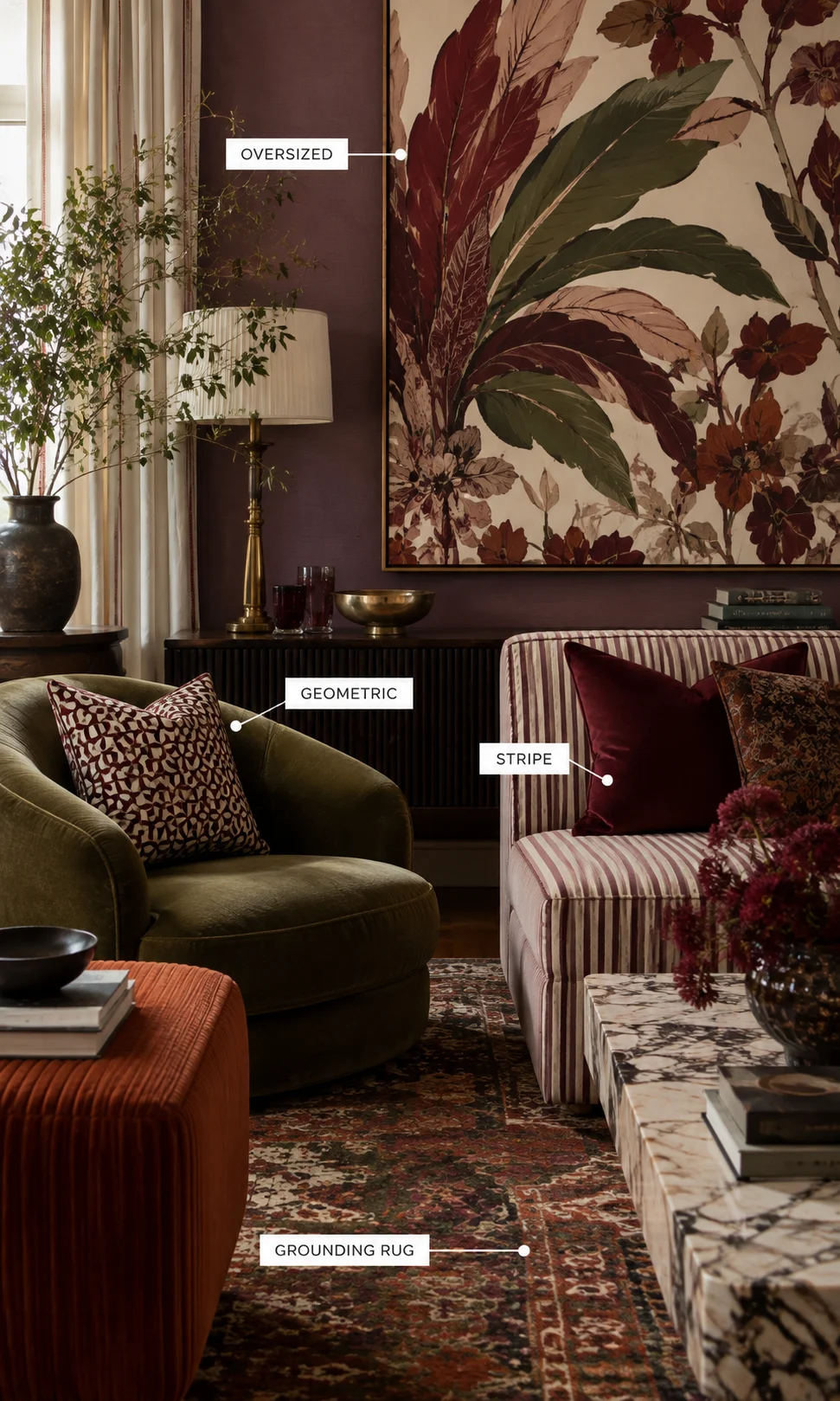
Consider an oversized botanical wallpaper and a tightly detailed floral chair. Even if their colors are nearly identical, both may produce similar levels of visual activity because each contains complex organic movement. Adding a broad stripe between them can be more effective than adding another floral because the stripe changes the visual rhythm.
Scale creates another layer of distinction. A very large botanical motif can behave almost like artwork when seen across an entire wall. A medium geometric textile operates at furniture scale. A narrow stripe or tiny print can provide close-range detail. The patterns become easier to combine because the eye does not process them as competing versions of the same information.
The same logic applies to rugs. If curtains already contain a complex repeating motif, a rug with another equally detailed pattern can overwhelm the lower and upper portions of the room simultaneously. A broader abstract design or worn traditional rug may provide pattern while remaining visually different enough to avoid direct competition.
Change the Scale Before You Change the Color
When two patterns seem uncomfortable together, homeowners often assume the colors are wrong. Scale may be the real problem.
Two small, high-contrast motifs positioned close together can produce an almost vibrating surface because the eye repeatedly switches between tiny edges. Keeping one pattern and replacing the other with a much larger motif can immediately make both easier to read.
This is especially useful in compact rooms where patterned surfaces are physically close. A patterned armchair may sit only a few feet from curtains, rug and cushions. If every textile uses a medium-scale motif, the room can feel much busier than its object count suggests.
Changing scale gives each surface a clearer role.
Repeat One Ingredient, Not the Entire Recipe
Patterns need a relationship, but that relationship can be surprisingly small.
A botanical curtain and geometric rug might share one muted green. A striped chair can repeat the cream ground of patterned wallpaper. An abstract painting may contain the burgundy that appears only as a narrow line inside a rug.
Those small connections allow radically different motifs to coexist because the eye discovers an underlying continuity.
Trying to make every pattern share all the same colors produces a different effect. The room starts to resemble a coordinated fabric collection, which can reduce the sense that its pieces were accumulated gradually.
Modern maximalism becomes more convincing when the relationship is present without being excessively obvious.
Know Which Pattern Is Supposed to Win
One pattern should usually have more authority than the others within a single visual field.
If the wallpaper is extraordinary, let people notice it before the chair fabric. If a patterned antique rug is the emotional centerpiece of the room, surrounding textiles can carry quieter motifs or larger uninterrupted color areas.
This does not require weakening every secondary pattern until it becomes bland. Contrast can remain high. The important difference is scale and placement. A dramatic pattern covering an entire wall already has physical dominance, so another intense motif may work successfully when confined to a small chair or cushion.
When every large surface carries equally forceful pattern, the architecture disappears beneath decoration. Sometimes that theatrical effect is intentional, but it is difficult to sustain across an entire home without creating visual fatigue.
A useful design exercise is to photograph the room in black and white. Removing color temporarily makes differences in pattern density, contrast and scale much easier to see. If every surface still shouts at the same intensity, the composition probably needs another level of hierarchy.
Layer Materials Before Adding More Objects
A maximalist room can become noticeably richer without adding another decorative object. Material contrast often creates more depth than extra accessories because different surfaces respond to light, touch and distance in different ways. Velvet absorbs light and deepens color. Polished stone reflects surrounding tones. Walnut introduces grain and natural movement. Lacquer creates a clean shine, while bouclé and heavy woven fabrics soften harder architectural surfaces.
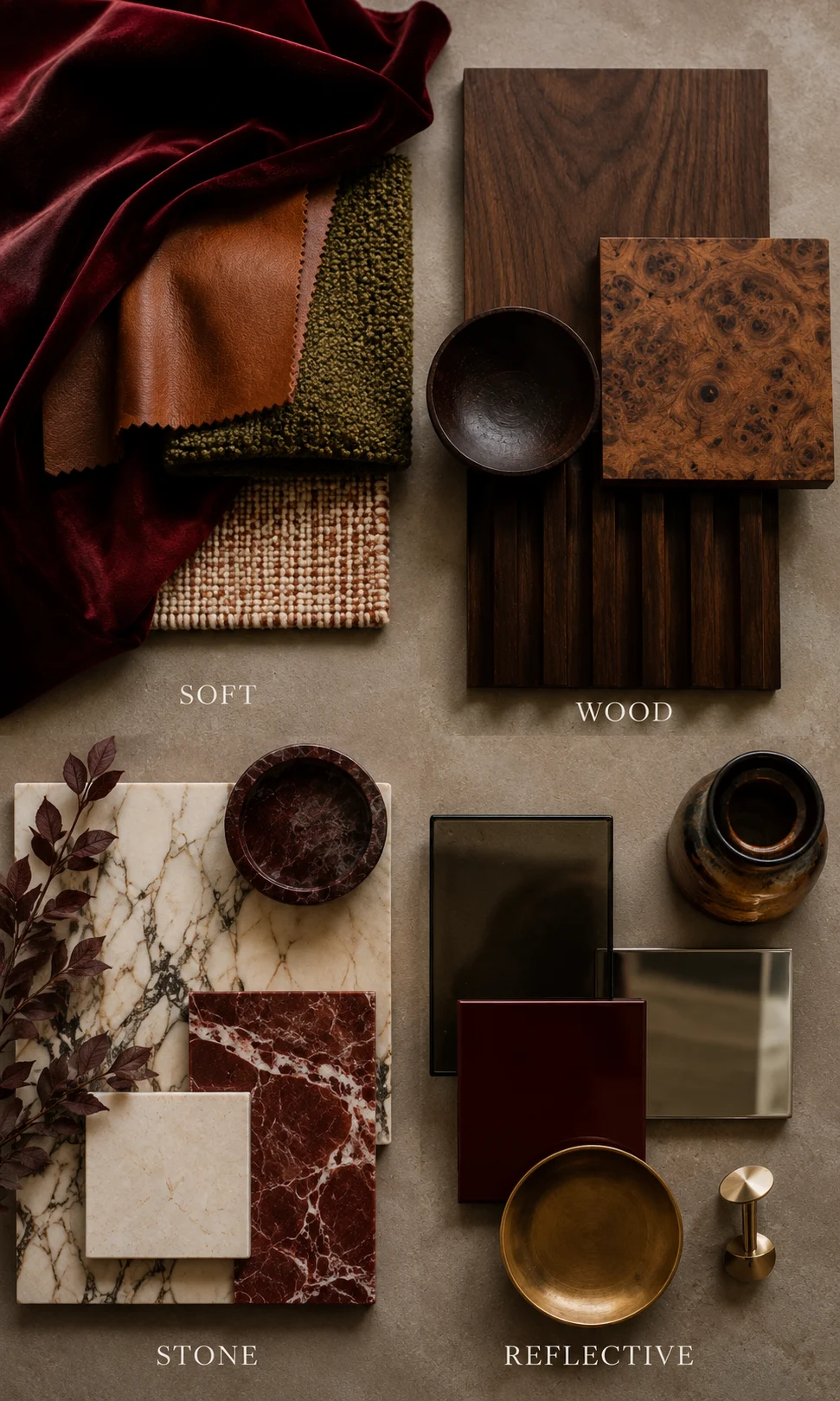
This is useful when a room already contains plenty of furniture and art but still feels flat. The instinct may be to buy more things, although the real weakness can be that most existing pieces have similar surface qualities. A room filled with painted timber, matte cotton and flat wall finishes may contain many objects while still lacking material tension. Introducing one glossy lacquer cabinet, deeply veined stone table or velvet chair can change the experience more dramatically than another collection of small accessories.
Modern maximalism works especially well when materials are allowed to contrast rather than imitate one another. A highly figured burl wood cabinet can sit beside polished nickel lighting. A thick wool rug can ground a smooth marble table. A soft velvet sofa can make a rigid sculptural chair appear even more architectural. These relationships produce visual richness before color or pattern enters the discussion.
Think in Material Families
One practical way to control a maximalist material palette is to divide surfaces into broad families: soft, wood, stone and reflective. The room does not need equal amounts of all four, but using several families gives the eye enough variation to make the interior feel layered.
Soft materials include upholstery, curtains, rugs, cushions and textile wall coverings. Wood brings grain, warmth and natural variation. Stone adds weight and mineral pattern. Reflective materials include glass, metal, lacquer and polished finishes that respond more actively to light.
The strongest rooms usually distribute these material families across different scales. A velvet sofa may provide the largest soft surface, while a rug contributes a second texture underfoot. Walnut cabinetry introduces a substantial natural material, and smaller brass, glass or lacquer accents create highlights rather than dominating the room.
Problems often begin when one material family becomes too repetitive. A room full of shiny metal, glass, marble and lacquer can feel visually hard even when the colors are beautiful. A room built entirely from soft fabrics and matte timber can move in the opposite direction and lose definition. Maximalism benefits from contrast because contrast allows individual materials to remain legible.
Let Natural Materials Calm Stronger Decoration
Natural materials are particularly useful when pattern and color are already intense. Timber, stone, wool, leather and woven fibers introduce complexity through texture rather than through another graphic motif.
A walnut cabinet has visible movement, but its grain generally behaves more quietly than patterned wallpaper. Marble may contain dramatic veining, yet a large stone surface can still function as a visual anchor because the pattern belongs intrinsically to the material. Leather develops variation through age and use, which can give a highly decorated room a less manufactured quality.
This is one reason collected maximalist interiors often feel convincing when they contain furniture from different eras. Natural materials provide continuity even when silhouettes change. An old walnut sideboard and a contemporary walnut dining table already share something fundamental, allowing the room to tolerate greater stylistic variation elsewhere.
Use Reflective Surfaces as Highlights
Reflective materials deserve more restraint because they react strongly to both light and surrounding color. A polished chrome lamp can pick up burgundy from nearby upholstery, green from plants and warm cream from the wall within one small object. This makes reflective surfaces visually active even when their shape is simple.
Rather than spreading glossy finishes everywhere, place them where they can provide contrast against softer or more matte surroundings. A smoked-glass side table beside a bouclé chair, polished nickel lamp against a dark painted wall or lacquered cabinet beside a wool rug can create the necessary tension.
The question is whether the reflective surface adds a new material experience or simply adds another bright object. In modern maximalism, the former usually has greater value.
Use Art as Architecture, Not as Leftover Decoration
Artwork can carry enough visual weight to organize an entire maximalist room. Large works influence proportion, color balance, furniture placement and even how empty wall space is perceived. Treating art as something added after the furniture is finished can therefore miss one of maximalism’s strongest opportunities.
A large painting behind a sofa can become the visual ceiling of the seating composition. A floor-to-ceiling gallery wall can turn an otherwise ordinary corridor into a deliberate architectural event. Sculpture can alter circulation because viewers naturally move around it, while an oversized textile or tapestry can soften a hard room without introducing conventional upholstered furniture.
The useful distinction is between art that participates in the composition and art that simply occupies unused wall area. If a piece is important enough to display, its size, framing, surrounding space and relationship with nearby furniture should help determine where it belongs.
Gallery Walls Need Hierarchy Too
A gallery wall can contain many pieces without becoming visually random when one or two works establish scale and the smaller pieces respond to them.
Start with the largest or most important artwork rather than beginning with small frames and filling gaps. That primary piece creates the visual reference against which everything else is judged. Secondary works can then vary in size, orientation and frame material while remaining connected by spacing, color or subject relationships.
Perfectly equal spacing produces a cleaner grid and may suit a more structured maximalist room. Irregular spacing creates a more collected effect, especially when frames differ in age and finish. Neither approach is inherently stronger. The important question is whether the arrangement feels deliberate enough that the eye reads it as one installation rather than several unrelated pictures.
Avoid treating every tiny gap as something that needs another frame. Wall color is part of the gallery composition. The spaces between artworks help separate images and determine whether the installation feels energetic or compressed.
Mix Frames Without Losing Control
Matching frames can simplify a complicated art collection, although maximalism does not require them. Dark timber, brass, painted wood, lacquer and simple black frames can coexist when another relationship connects the works.
One approach is to repeat certain frame finishes without using them everywhere. Perhaps the largest painting uses dark walnut, two smaller pieces use aged brass and several drawings use narrow black frames. The repetition establishes rhythm while preventing the wall from appearing commercially coordinated.
Frame width matters as much as material. Several ornate, heavy frames positioned together can become a competing pattern of their own. Introducing thinner frames between them gives the artwork more room to remain visible.
Mix Furniture Eras Instead of Buying a Matching Set
Modern maximalism becomes particularly interesting when furniture does not appear to have been purchased at the same time.
A contemporary modular sofa can sit opposite a 1970s lounge chair. A traditional sideboard can support an abstract sculpture. A clean-lined dining table can be surrounded by chairs with more decorative silhouettes. These combinations work when the room contains enough repetition in color, material, proportion or shape to explain the relationship.
Matching furniture sets often remove this tension. They make decorating easier because scale, materials and finishes have already been coordinated, but they can also make a maximalist room feel less personal. A collected interior needs some evidence of decisions made at different times.
The goal is not maximum historical variety. A room containing Victorian, Bauhaus, mid-century, Memphis, contemporary and rustic farmhouse pieces simply because each is different can lose its identity. Choose a few recurring characteristics that allow different eras to communicate.
Use Shape to Connect Unrelated Furniture
Shape is one of the simplest bridges between furniture periods.
A curved contemporary sofa can relate to a vintage barrel chair because both use rounded geometry. A rectilinear cabinet can connect with a modern coffee table through strong horizontal lines. Repeated cylindrical forms in stools, lamps and side tables can quietly unite pieces from completely different decades.
These shape relationships are often easier to perceive than stylistic labels. A visitor may not know when a chair was designed, but the eye still notices repeated curves and angles.
This is particularly useful when inherited furniture is involved. Instead of asking whether an older piece matches the room’s style, identify its strongest visual characteristics and repeat one of them elsewhere. The result feels integrated without disguising the object’s age.
Allow One Awkward Piece to Become the Character Piece
Maximalism gives unusual furniture more room to succeed because the room already accepts visual diversity. An unusually shaped chair, heavily carved cabinet or brightly colored vintage piece may become one of the most memorable elements when the rest of the composition supports it.
Trying to make an unconventional piece disappear usually weakens this advantage. Instead, give it enough surrounding space to be read clearly and repeat one of its colors or materials elsewhere. The piece then becomes intentional rather than accidental.
There is still a limit. Several highly unconventional furniture pieces competing in one small room can turn character into noise. One memorable object often has more power than five.
Lighting Determines Whether Maximalism Feels Rich or Flat
Lighting changes the way every other design decision is perceived. Dark paint can appear sophisticated under layered warm lighting and lifeless under one harsh ceiling fixture. Velvet can look deep and tactile when light grazes the surface, while marble requires enough directional light for its veining and polish to remain visible.
A maximalist room therefore benefits from several lighting heights and functions. Ceiling lighting provides general illumination. Floor and table lamps create local pools of light. Picture lights or directional fixtures can emphasize artwork. Decorative lamps can become objects within the composition even when they are switched off.
The objective is not to make every corner equally bright. Uniform lighting can flatten a room full of complex materials because the eye no longer receives strong differences between foreground, background and focal areas.
Light the Focal Point More Clearly Than the Background
If an artwork, sofa or architectural feature is intended to dominate, lighting can reinforce that hierarchy. A picture light above an important painting, directional ceiling spot aimed at a sculptural object or floor lamp beside the principal seating area can increase its visual importance without changing any furniture.
Peripheral areas can remain slightly softer. Shelving, secondary artwork and accessories do not necessarily need the same intensity as the focal composition.
This approach is particularly effective in evening interiors. During daylight, windows may dominate the room’s hierarchy. After sunset, artificial lighting has to rebuild that hierarchy deliberately.
Decorative Lamps Can Carry Pattern Without Fabric
Lighting is also another opportunity to introduce visual character without adding more textiles.
A pleated shade brings rhythm. Murano-style glass adds color and translucency. A polished metal lamp introduces reflection. A sculptural ceramic base adds volume and texture. A dark dome lamp creates a strong silhouette against a lighter wall.
Because lamps occupy relatively small footprints, they can carry distinctive shapes that would feel excessive at sofa or cabinet scale. This makes them useful for increasing personality while preserving practical floor space.
How to Apply Modern Maximalism Room by Room
Modern maximalism does not need to appear with identical intensity throughout the home. In fact, varying the density from room to room can make the overall interior more comfortable because highly expressive spaces are balanced by areas with greater visual rest.
A living room may carry the largest concentration of art, textiles and collections because people spend time there and guests experience it repeatedly. Bedrooms often benefit from a softer interpretation with fewer high-contrast surfaces around the bed. Dining rooms can tolerate more drama because tables and chairs already create a strong organizing geometry.
| Room | Strongest Maximalist Opportunity | What to Control | Useful Visual Anchor |
|---|---|---|---|
| Living room | Art, rugs, collected furniture and layered lighting | Too many competing focal points | Sofa, major artwork or fireplace |
| Bedroom | Textiles, headboard, wallpaper and bedside objects | Excessive pattern directly around the resting zone | Bed and headboard wall |
| Dining room | Sculptural lighting, art and dramatic color | Overcrowded circulation around chairs | Dining table and pendant |
| Entryway | Wallpaper, console styling and one memorable artwork | Small accessories scattered across limited surfaces | Console or mirror |
| Home office | Books, artwork, shelving and personal objects | Visual noise within the direct working field | Desk or shelving wall |
| Bathroom | Stone, tile, mirror and lighting | Too many unrelated decorative finishes | Vanity or feature wall |
Living Room
The living room is usually the easiest place to explore full modern maximalism because it naturally contains multiple design layers: seating, tables, lighting, rugs, books, artwork and decorative objects.
Start with the largest composition rather than individual accessories. The sofa, rug and principal artwork should establish enough structure that smaller pieces can be added without changing the room’s basic identity. If those three elements already compete heavily, additional decoration will become difficult to control.
Bookshelves can provide substantial maximalist character because they combine practical storage with personal objects. Instead of styling every shelf identically, vary the amount of open space and object height. Some shelves may hold books almost completely, while others contain a sculpture or ceramic group. This irregular rhythm prevents the shelving from turning into repetitive display boxes.
Bedroom
A maximalist bedroom can use strong color and pattern while still preserving a calmer immediate area around the bed.
The headboard wall is a natural place for concentration. Wallpaper, a large textile, oversized artwork or an upholstered headboard can establish the room’s primary statement. Bedding can then introduce secondary pattern at a smaller scale.
If the walls and bedding are already highly active, bedside tables often benefit from tighter editing. One lamp, a small stack of books and a personal object may provide enough detail. Filling every bedside surface with decorative pieces makes the sleeping area less functional and visually heavier.
Dark maximalist bedrooms can feel especially enveloping when wall color, curtains and textiles belong to related tonal families. The room still feels rich, but the lower contrast reduces some of the visual stimulation.
Dining Room
Dining rooms often accommodate dramatic maximalism well because the table creates an immediate center of gravity.
A large pendant or chandelier can establish vertical focus above the table. Artwork, patterned upholstery or richly colored walls then reinforce the central composition rather than creating separate destinations around the room.
Keep chair circulation in mind. Decorative floor objects, oversized planters and extra occasional furniture can become frustrating when people regularly move chairs backward. Maximalist design becomes stronger when visual abundance does not interfere with the room’s principal activity.
A dining room is also a useful place for one oversized artwork because much of the furniture remains relatively low, leaving large wall areas available for a stronger visual statement.
Entryway
An entryway offers a smaller area in which maximalism can be concentrated deliberately.
Wallpaper can transform the space quickly because there are fewer large furnishings competing with it. A console, mirror or artwork can become the principal anchor, while a lamp, tray, vessel or small collection supplies secondary detail.
Because entryways are usually circulation spaces, floor area matters more than decorative density. A dramatic wall treatment often works better than several pieces of floor furniture that reduce the walking path.
An expressive entry can also prepare visitors for a maximalist home without requiring every adjacent room to reach the same intensity.
Home Office
A home office already contains visually dense objects such as books, files, screens and storage, so maximalism needs slightly different editing here.
Keep the immediate work zone relatively organized and move greater visual richness toward the background or side walls. Shelving behind the desk can support books, art and collected objects without occupying the visual field directly around the keyboard and monitor.
A strong wall color, framed artwork and one sculptural lamp can add substantial character while leaving the working surface practical. The room should support concentration even when the broader design language remains expressive.
How to Know When a Maximalist Room Is Finished
The hardest maximalist decision is often knowing when to stop.
An unfinished room and an edited room can both contain empty space, which is why the presence of an unfilled wall, shelf or tabletop does not automatically mean something is missing. The better test is whether the composition already communicates a clear hierarchy and whether an additional object would introduce a genuinely new relationship.
Before adding something, identify what job it is supposed to perform. Is it introducing a color that needs repetition? Filling a scale gap? Improving function? Completing a collection? Bringing height to a low composition? Connecting two existing materials?
If the answer is simply that an empty space exists, the object may have no meaningful job.
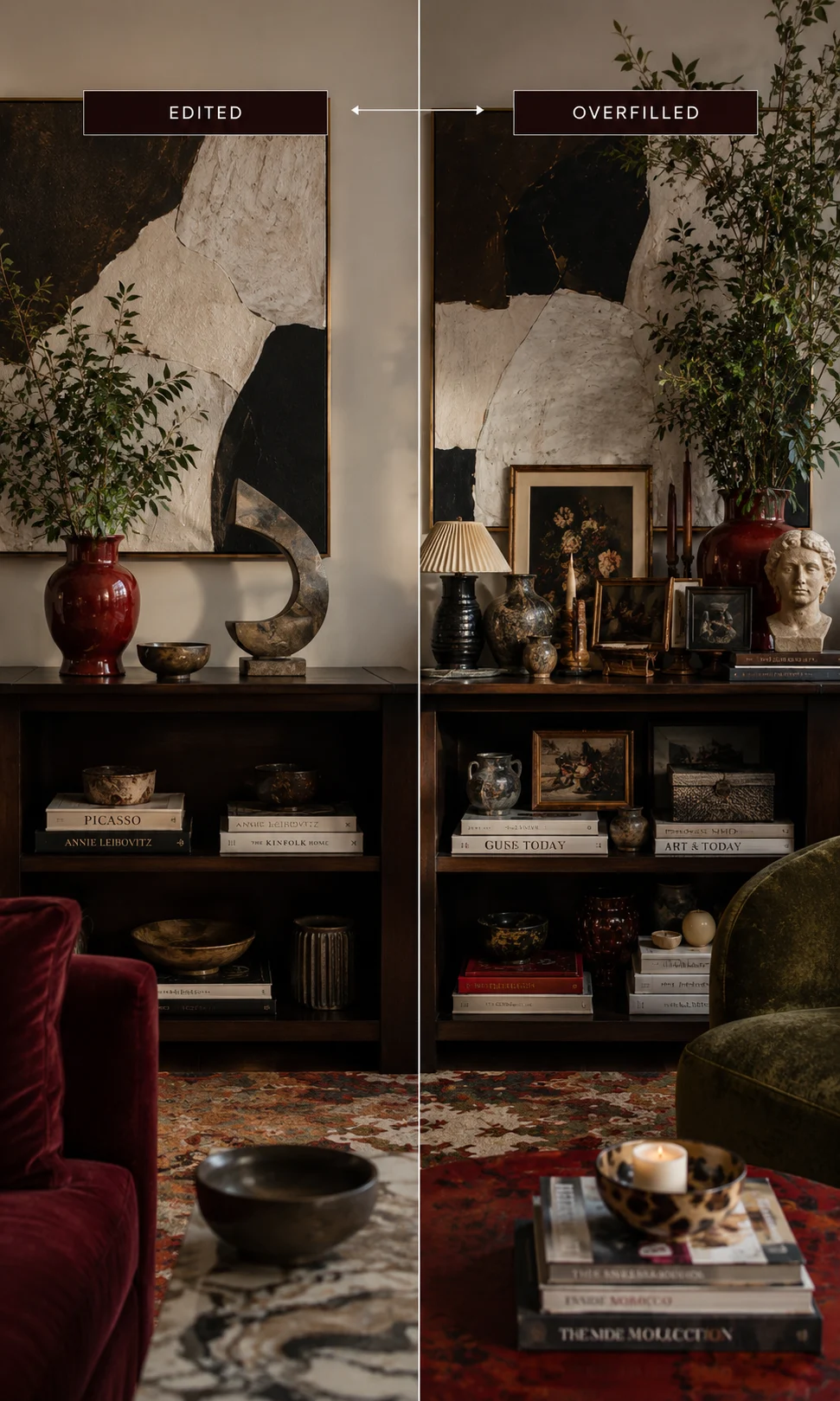
The One-More-Object Test
Imagine placing the proposed object into the room and ask what would change.
If it strengthens an existing relationship, the addition may be worthwhile. A rust ceramic that repeats a small tone in the rug can connect two areas of the room. A tall lamp beside low furniture can improve vertical balance. A large artwork on an otherwise unstructured wall can create a focal point.
If the object merely adds another interesting thing, its contribution is weaker. This becomes particularly important with small accessories because individual pieces require little physical space while collectively creating substantial visual density.
Photographing the room can help because a flat image reduces the emotional attachment you may have to individual objects. Areas where several accessories merge into one indistinct mass become easier to identify.
Group Before You Remove
When a room feels too busy, removing possessions is not always the first solution.
Try consolidating related pieces. Five ceramics spread across a room may become one collection when grouped together. Several small artworks may work better as one gallery arrangement. Books distributed across many surfaces can gain more visual strength when concentrated onto a shelf or table.
Grouping reduces the number of separate visual events without reducing the number of meaningful objects.
This is one of the most useful differences between clutter management and maximalist editing. The goal is to improve how the eye reads the collection rather than automatically reduce possession count.
Remove Competing Focal Points First
When editing becomes necessary, start with objects that compete directly with the primary focal point rather than removing the smallest accessories randomly.
If a major artwork already anchors the sofa wall, a second large artwork placed immediately beside it may be weakening both pieces. If the rug carries enormous pattern, a highly graphic coffee table can interrupt it. If sculptural lighting already dominates one corner, another equally dramatic object beside it may create unnecessary competition.
Removing or relocating one major competitor can sometimes solve the room more effectively than clearing twenty small objects.
Common Modern Maximalist Mistakes
A maximalist room can tolerate a great deal of difference, but that flexibility makes certain mistakes easier to overlook. The most common problems usually involve hierarchy, scale or repetition rather than a specific color or style.
Buying Everything Bold
If every purchase is selected because it is the most colorful, sculptural or patterned option available, the final room has no supporting cast.
Some pieces need to be visually quieter so stronger elements can retain authority. A plain velvet sofa may provide the best setting for extraordinary artwork. A simple timber cabinet may allow a collection of ceramics to become more noticeable. A relatively restrained curtain can frame a dramatic wallpaper rather than compete with it.
Maximalism needs strong elements, but strength becomes meaningful only when differences in intensity remain visible.
Using Only Small Decorative Objects
A room filled with dozens of small accessories can still feel weak because none has enough scale to organize the composition.
Before adding more small objects, consider whether the room needs one larger event: an oversized artwork, significant rug, tall plant, large lamp, substantial cabinet or sculptural chair.
Large objects can actually reduce perceived clutter because they create fewer, stronger visual units.
Matching Too Carefully
Excessive coordination can remove the collected quality that makes modern maximalism interesting.
Using the identical burgundy across curtains, cushions, rugs and artwork can look controlled, but it can also make the room feel like a single retail collection. Related shades usually create more depth. Plum, oxblood, rust and tobacco can belong together without being identical.
The same principle applies to furniture. Repeating a material or shape is usually more convincing than repeating an entire product family.
Ignoring Function
A beautifully styled surface stops being successful when it has to be cleared every day.
Coffee tables need room for drinks and books. Dining chairs need clearance. Bedside tables should accommodate practical objects. Entryways need somewhere for keys or bags when appropriate. Shelving should remain accessible if it contains frequently used items.
Modern maximalism becomes more livable when decoration and function occupy the same composition rather than fighting for the same space.
Filling Every Vertical and Horizontal Surface
A gallery wall, patterned floor, decorated console, layered coffee table and fully styled shelving unit can each work individually. Combining maximum density on every plane at once is much harder.
Choose where visual concentration should occur. A dense gallery wall can sit above a quieter sofa. A dramatically patterned rug can work beneath simpler furniture. Fully styled shelving may benefit from a calmer adjacent wall.
When one surface becomes intense, another can provide relief.
Modern Maximalism or Neo Deco: Which Direction Fits You Better?
Modern maximalism and Neo Deco can share luxurious materials, deep color, statement lighting, dramatic artwork and sculptural furniture, yet they usually produce different emotional experiences.
Modern maximalism is the stronger choice when you enjoy collections, art from different periods, pattern mixing, vintage furniture, books, personal objects and rooms that reveal themselves gradually. It allows a larger number of visible relationships and generally feels more personal, layered and exploratory.
Neo Deco tends to suit homeowners who want stronger geometry, polished glamour and fewer competing objects. Marble, lacquer, brass, dark timber and velvet may still create substantial richness, but the composition is usually more disciplined and relies on a smaller number of high-impact statements.
Homeowners who want stronger glamour with fewer competing objects may prefer Neo Deco interior design to full modern maximalism.
Neither direction is inherently more sophisticated. The practical difference is the amount and type of visual information you enjoy living with.
A Simple Modern Maximalist Decision Framework
Before buying another object, changing a wall color or adding another pattern, evaluate the room through five questions.
1. What is the strongest element already in the room?
If you cannot identify it, the first task may be establishing a focal point rather than increasing decoration.
2. What relationship will the new element create?
A useful addition should connect through color, material, shape, function, scale or personal meaning.
3. Does the room need more information or more contrast?
Sometimes a different material or larger scale solves the problem more effectively than another object.
4. Where does the eye currently rest?
If no quiet area exists, adding more visual intensity may weaken everything already present.
5. Would removing one competitor make the new element stronger?
Maximalist editing sometimes involves replacement or regrouping rather than continuous accumulation.
Taken together, these questions shift the decorating process from “Do I like this object?” toward “What happens to the entire room if this object enters it?” That second question is where modern maximalism becomes design rather than collection.
Build Maximalism From the Floor Up
A richly layered room becomes easier to control when the largest horizontal surfaces are considered before smaller decorative decisions. Flooring and rugs occupy an enormous percentage of what the eye sees, even though homeowners often focus first on walls, sofas and artwork. In maximalist interiors, the floor can function as a visual anchor that quietly connects colors appearing elsewhere in the room.
A patterned rug is particularly useful because it can contain more colors than almost any other single object without requiring each of those colors to appear equally elsewhere. Burgundy, olive, rust, cream and tobacco might all coexist in one worn traditional rug, giving the room a ready-made palette from which upholstery, artwork and accessories can develop. The relationship does not need to be exact. A small muted green inside the rug may be enough to justify a much deeper olive chair elsewhere.
The scale of the rug also affects whether the room reads as one composition. A rug that is too small can divide furniture into unrelated islands, especially when the room already contains many visually distinctive pieces. In a living room, allowing the principal seating to connect physically with the rug usually creates a stronger base for maximalist layering because the sofa, chairs and table begin to read as a group before any smaller objects are considered.
Use the Rug as a Connector, Not Another Competitor
A richly patterned rug can hold considerable visual information, but it should still have a job within the hierarchy. If the walls already carry highly detailed wallpaper and the upholstery contains several strong prints, the floor pattern may need a broader motif or a more faded appearance. A distressed traditional rug can work well because its pattern remains present while wear and tonal variation soften the contrast.
If the furniture and walls are comparatively restrained, the rug can become one of the strongest statements. In this situation, larger motifs, saturated color or a graphic contemporary design may help organize the room.
The important question is whether the rug completes an existing relationship or creates another independent focal point. Maximalism allows several memorable elements, but they should not all demand attention in the same way.
Do Not Treat Existing Flooring as Invisible
Timber, terrazzo, stone, concrete and patterned tile already contribute color and movement. Covering them automatically with a dramatic rug may create unnecessary competition.
A herringbone timber floor, for example, already contains direction and repeated geometry. A heavily geometric rug placed over it can either reinforce that rhythm or make the floor feel visually unsettled, depending on scale and orientation. Strongly veined marble introduces its own pattern, while terrazzo adds many small points of color before furniture enters the room.
When the permanent flooring has character, allow some of it to remain visible. Negative space can exist on the floor just as effectively as it can on a wall or tabletop.
Do Not Forget the Ceiling
The ceiling is frequently the largest undecorated plane in a maximalist interior, which makes it an opportunity rather than an obligation. Treating it thoughtfully can make the room feel enveloping, especially when walls, art and furniture already create a strong lower-level composition.
Painting the ceiling the same color as the walls can reduce visual boundaries and create a cocooning effect. A darker ceiling can make a tall room feel more intimate, while a lighter related tone may preserve height without returning to plain white. Wallpaper, decorative plaster, timber treatment or architectural molding can also bring the ceiling into the overall composition.
The ceiling becomes more important when the room contains a sculptural pendant or chandelier. In that case, the surface behind the light fixture effectively becomes part of the visual presentation. A dramatic fitting against an unrelated bright-white ceiling may feel detached from an otherwise deeply colored room.
Use Ceiling Detail to Complete the Architecture
Maximalism can reveal weak architectural transitions because the decorative layers are so intentional. If the room contains elaborate textiles, substantial art and carefully selected furniture while the ceiling junctions remain visually unresolved, the space may feel styled rather than fully designed.
Cornices, moldings, ceiling roses and trim can help connect contemporary maximalism with older architecture. In newer homes, simple architectural detailing can provide enough structure without imitating a historical interior.
The purpose is not to decorate every ceiling. It is to decide whether the ceiling should disappear, frame the room or participate actively.
Window Treatments Can Carry More Visual Weight Than You Expect
Curtains occupy large vertical surfaces, often extending from near the ceiling to the floor, which means their material and pattern can influence a maximalist room almost as strongly as wallpaper.
A solid velvet curtain introduces color, softness and acoustic absorption without adding another motif. A patterned curtain can become a major visual feature when walls are quieter. Linen with decorative trim can provide a more restrained interpretation while still contributing detail.
The relationship between curtain pattern and wall pattern deserves particular attention. When both are complex and high contrast, they can merge into a continuous decorative field. That may be intentional in a highly immersive room, but it reduces the amount of visual rest available around windows.
Use Height Before Adding More Pattern
Hanging curtains high can make them function architecturally rather than appearing like fabric attached only to the window opening. The long vertical line strengthens room height and gives the textile enough scale to compete successfully with large artwork and furniture.
This can be especially effective in maximalist interiors because large gestures often organize small details better than another layer of decoration. A floor-to-ceiling curtain in a single deep color may create more impact than a shorter curtain carrying an additional complicated pattern.
Let Hardware Participate Quietly
Curtain rods, rings and finials become visible details in highly considered rooms. Dark metal, brass, timber or painted finishes can echo lighting, furniture or hardware elsewhere.
The connection should remain subtle. A brass curtain rod does not require every metal in the room to be brass. It only needs enough visual relationship to prevent the fixture from feeling accidental.
Storage Is One of the Hidden Foundations of Good Maximalism
Rooms that look richly layered while remaining functional usually have somewhere for less attractive everyday objects to disappear.
Maximalism celebrates visible possessions, but that does not mean every possession benefits from display. Remote controls, charging cables, paperwork, miscellaneous packaging, cleaning products and daily household clutter can dilute the impact of objects that were deliberately selected for visibility.
Closed storage therefore becomes surprisingly important. Cabinets, drawers, storage benches, boxes and baskets allow the room to display more meaningful objects because functional clutter can be controlled.
A room may contain a hundred visible books, artworks and ceramics while still feeling calmer than another room containing twenty random everyday objects. The difference lies partly in whether what remains visible deserves visual attention.
Display Collections, Hide Administration
One useful editing rule is to distinguish between things that express identity and things that simply support daily administration.
Books, ceramics, records, photographs, travel objects and art may deserve visibility because they contribute meaning. Receipts, cables, instruction manuals, spare batteries and miscellaneous household items rarely benefit from becoming part of the decorative composition.
This distinction prevents maximalism from becoming an excuse for leaving every object exposed.
Built-In Storage Can Carry the Quiet Areas
A large wall of cabinetry can become one of the calmest surfaces in a maximalist room when its doors remain relatively simple. This creates a strong architectural pause between denser areas.
Alternatively, open shelving can become highly expressive while lower closed cabinets absorb practical storage. The combination allows the upper portion to perform visually while the lower portion performs functionally.
Style Shelves as Compositions, Not Inventory
Shelving presents one of the biggest opportunities for maximalist display because it naturally accommodates books, sculpture, ceramics, framed images and personal collections. It also creates one of the easiest ways to make a room feel visually overfilled.
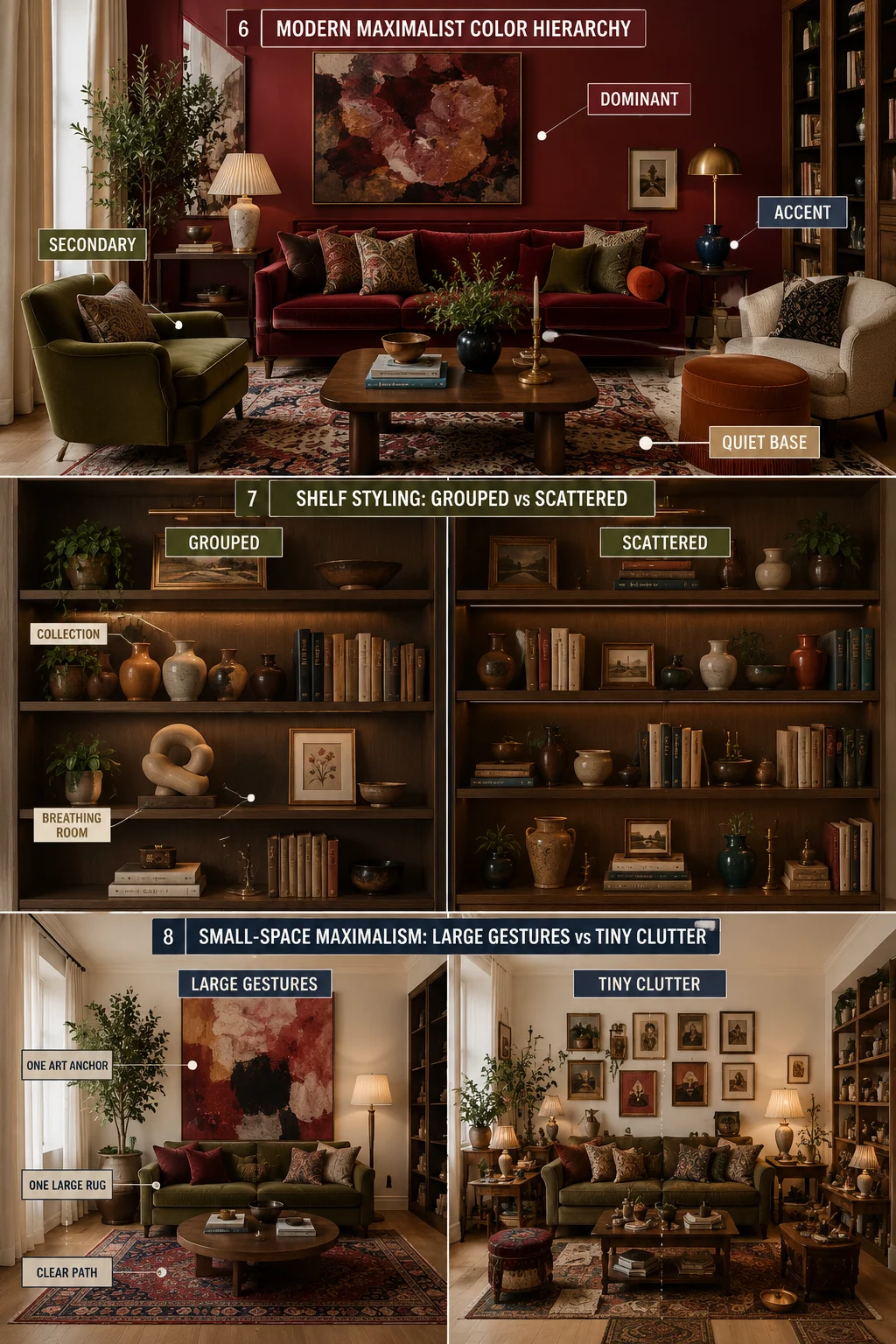
The strongest shelving usually varies density. One shelf might hold books across most of its width. Another may contain a large ceramic object with substantial empty space around it. A third can combine a horizontal book stack with a small framed picture or vessel.
If every shelf uses the same formula, the styling becomes repetitive. If every shelf is completely full, the unit may read as storage rather than composition.
Change Orientation to Create Rhythm
Books do not need to stand vertically everywhere. Horizontal stacks can create platforms for smaller objects and break long rows into more varied shapes.
The technique works best when the stacks have a reason to exist. A small ceramic or framed photograph placed on a horizontal group creates a recognisable visual unit. Randomly alternating every few books simply to make the shelf look styled can feel forced.
Respect the Largest Object
If a shelf contains one large sculpture or vessel, allow surrounding objects to respond to it rather than crowding its edges. A strong object needs enough adjacent space for its outline to remain visible.
This is another example of why empty space does not contradict maximalism. It gives important objects the visual territory they need.
Avoid Styling Every Book by Color
Color-organized books can create a strong graphic effect, but it can also reduce a personal library to a decorative surface if the system makes books difficult to find or ignores how they are actually used.
A more natural maximalist library often contains visible irregularity. Repetition can come from the shelving material, book height groups, artwork or objects rather than forcing every spine into a color sequence.
Collections Should Tell You Something About the Owner
One of maximalism’s greatest strengths is its ability to accommodate personal history. A room becomes more memorable when objects have relationships beyond color coordination.
Travel objects, inherited furniture, handmade ceramics, records, photography, books and art can create a sense that the room existed before the styling session and will continue changing afterward. This makes the interior feel human in a way that a fully coordinated showroom rarely achieves.
The challenge is preventing personal meaning from becoming visually unreadable. A collection deserves to be displayed in a way that allows people to understand it as a collection.
Give Repeated Objects a Shared Territory
Repeated forms become more powerful when displayed together. Ten small vessels across one console can read as a ceramic collection. The same objects spread across ten different surfaces become ten isolated decorative moments.
Grouping creates a visual boundary around the collection. The eye can understand it as one larger event and then move elsewhere.
The approach is especially helpful with small objects because it increases their collective scale.
Mix Personal Objects With Designed Objects
A maximalist room becomes more convincing when meaningful possessions coexist with carefully selected furniture and lighting rather than being segregated into a sentimental corner.
An inherited bowl may sit beside a contemporary lamp. A travel photograph can join a gallery wall containing purchased art. A vintage chair from a family home can become part of a contemporary seating arrangement.
The room gains depth because objects with different histories are allowed to participate in the same composition.
How to Use Florals and Botanicals Without Turning the Room Into a Theme
Botanical pattern appears frequently in maximalist interiors because large leaves, flowers and organic forms create movement that contrasts naturally with furniture geometry. The risk begins when botanical motifs are repeated so literally that the room becomes themed.
A floral wallpaper does not automatically require floral cushions, floral curtains, botanical artwork and leaf-shaped accessories. One large botanical statement can be enough. Other elements can support it through color, scale or organic curves without repeating the exact subject.
A deep green chair can relate to foliage in wallpaper without carrying another print. A curved lamp can echo leaf movement without being shaped like a plant. A rust-colored rug can repeat the warm flower tones while using a completely different motif.
This keeps the relationship sophisticated rather than literal.
Real Plants Behave Differently From Botanical Pattern
Plants introduce changing shape, shadow and movement. A real indoor tree can soften a room containing many rigid furniture edges because its silhouette is irregular and never completely static.
Large plants often work better than many small plants in already dense maximalist rooms. One substantial tree or architectural plant creates a clear green mass, while numerous small pots distributed around the room can become another layer of scattered accessories.
The same hierarchy principles still apply.
Make Metallic Finishes Work Together Without Matching Them
A maximalist interior can contain brass, chrome, nickel, bronze and blackened metal without requiring every fixture to match. The key is preventing the mix from appearing accidental.
One metal can remain dominant while the others appear as secondary accents. A room might use aged brass primarily in lighting, then introduce polished nickel through one table and dark bronze through hardware. Another room may reverse that balance.
The surrounding materials influence how different metals relate. Warm walnut and burgundy can make brass feel especially integrated, while chrome or nickel may create a sharper contrast. Smoked glass can bridge polished and dark finishes because it carries both reflection and visual depth.
Repeat Finish Temperature Rather Than Exact Finish
Metals can be understood broadly as warm, cool or dark. Repeating temperature is often enough to create continuity.
Several warm metals can coexist without being identical. The same applies to cool silver-toned finishes. Introducing one contrasting metal can then feel deliberate rather than mistaken.
The principle mirrors maximalist color planning: related rather than exact repetition tends to create more depth.
Use Black and Dark Brown to Give Busy Rooms Structure
Black, charcoal and very dark brown can function almost like punctuation in a maximalist room. They create hard visual edges that prevent complex colors and patterns from blending into one continuous field.
A black picture frame, dark timber cabinet, charcoal lamp or deep brown side table can establish a boundary around softer surrounding elements. The effect is especially useful when the palette contains many mid-tone colors such as muted green, rust, rose, tobacco and cream.
Dark accents do not need to dominate the palette. Small repeated areas can be enough to create structure.
Dark Furniture Can Anchor Highly Patterned Rooms
When walls and textiles contain significant pattern, simple dark furniture silhouettes can restore definition. A dark walnut console against botanical wallpaper gives the eye a strong horizontal line. A black metal lamp can remain readable against a richly colored wall because its silhouette stays clear.
This type of anchoring can make highly expressive decoration feel more architectural.
Maximalism Can Work in Neutral Colors
A neutral maximalist room may sound contradictory, yet maximalism does not depend on saturated color. Visual abundance can come from texture, shape, objects, artwork and material variation instead.
Imagine a room built from cream plaster, travertine, walnut, chocolate leather, tobacco velvet, smoked glass, handmade ceramics, boucle, linen and sculptural artwork. The palette remains restrained, but the material and object relationships are highly layered.
Neutral maximalism can be useful for homeowners who enjoy collecting and visual complexity but feel fatigued by strong color contrast.
The design challenge shifts. Without saturated color to create obvious focal points, hierarchy relies more heavily on scale, texture, shape, lighting and tonal contrast.
Use Tonal Range to Prevent Beige From Becoming Flat
A neutral maximalist room benefits from a wide tonal range. Pale cream, warm taupe, caramel, walnut, chocolate and charcoal create more depth than repeating one beige throughout.
Texture also becomes more important. Rough plaster against polished stone, linen beside velvet and matte timber beside smoked glass can create richness even when the colors sit close together.
Modern Maximalism in a Small Apartment
Small homes do not need to become minimalist simply because floor area is limited. The challenge is making visual richness work without reducing circulation or overwhelming the limited architectural volume.
The strongest strategy is usually concentration rather than distribution. Instead of placing small decorative moments in every corner, create one or two dense zones and allow the rest of the room to support them.
A gallery wall above the sofa can carry substantial personality. A bookcase can become the collection zone. One patterned rug can establish the main palette. A large lamp can provide sculptural impact without requiring several small decorative objects.
Go Larger With Fewer Pieces
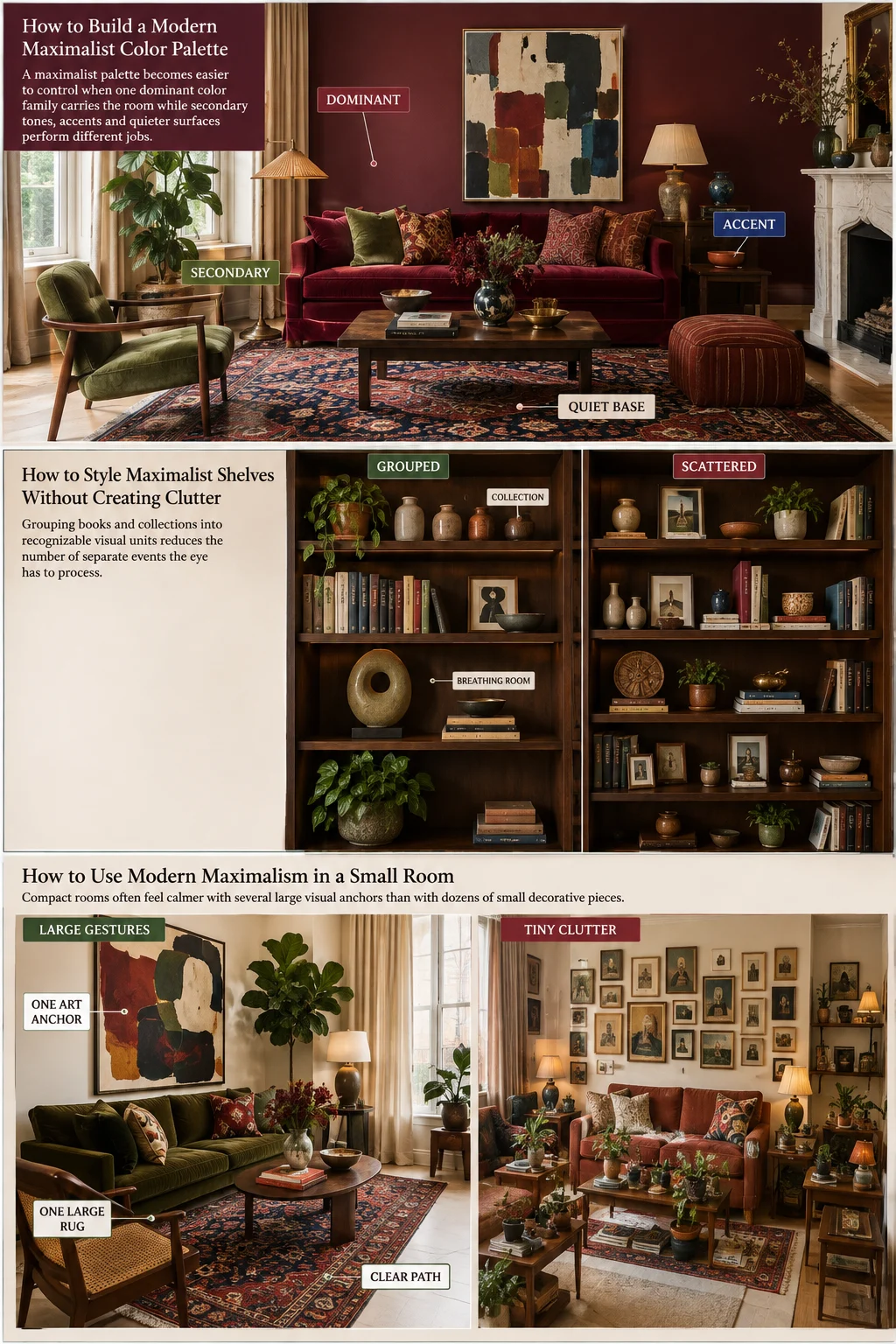
Counterintuitively, a small room often feels calmer with a few larger objects than with many miniature pieces.
One substantial artwork can make the wall feel more resolved than ten unrelated small frames. One large plant may work better than six small pots. A generous rug can unify the furniture more effectively than several small floor coverings.
Scale gives the eye a stable structure.
Use Vertical Space Deliberately
Tall shelving, floor-to-ceiling curtains and vertically arranged artwork can shift some visual interest upward without consuming additional floor area.
However, filling every vertical surface to the ceiling can make a compact room feel compressed. Choose which walls deserve full-height treatment and allow another wall to remain quieter.
Protect Circulation First
A maximalist apartment should still allow doors to open fully, chairs to move comfortably and major pathways to remain clear.
If a decorative object repeatedly needs to be moved out of the way, it probably occupies the wrong location regardless of how well it fits the style.
Modern Maximalism in an Open-Plan Home
Open-plan spaces introduce a different challenge because living, dining and kitchen areas may be visible simultaneously. If each zone develops its own maximalist palette without coordination, the entire space can become visually fragmented.
The goal is not to make every zone identical. Instead, establish a few recurring elements that travel through the open plan.
A deep burgundy may appear strongly in the living room, more subtly in dining upholstery and as a small artwork detail near the kitchen. Walnut may repeat through a cabinet, dining table and shelving. One metal finish can reappear at several points without becoming a matching set.
These repeated relationships create continuity while allowing each zone to maintain its own emphasis.
Give Each Zone One Dominant Event
The living area might be organized around artwork and sofa. The dining zone can be organized around a pendant and table. The kitchen may rely on stone and cabinetry rather than adding another large collection of decorative objects.
This prevents the entire open space from becoming one undifferentiated field of competing focal points.
How to Create Modern Maximalism on a Budget
Maximalism does not require filling a room with expensive statement furniture. In fact, buying everything new at once can undermine the collected quality that makes the style convincing.
A more economical approach is to invest selectively in the largest visual anchors while allowing smaller layers to develop gradually.
Artwork does not need to be museum-level investment art. Large-format prints, photography, textiles, student work, vintage finds and personal pieces can all provide strong visual scale when framed thoughtfully.
Vintage furniture can be particularly useful because it introduces shapes, finishes and patina that are difficult to reproduce with coordinated new collections.
Spend More Where Scale Makes the Biggest Difference
If the budget is limited, prioritize pieces that influence a large portion of the room:
- appropriately sized rug
- principal lighting
- major artwork
- sofa or main seating
- window treatment
- meaningful storage
Small accessories are easy to accumulate later. Large anchors are harder to correct after the room has been built around them.
Use Paint as Architecture
Deep wall color can transform a room without requiring expensive objects. Painting walls, trim or ceilings in a strong related palette can give inexpensive furniture a much richer context.
A well-selected paint color also reduces pressure to make every accessory decorative. The architecture itself begins carrying part of the visual intensity.
Buy Slowly Enough to Edit
Maximalism rewards gradual accumulation because every new piece changes the relationships among existing pieces. Buying an entire room’s worth of accessories in one weekend gives little opportunity to observe what the room actually needs.
Leave space for discoveries. The room should be able to accept a future artwork, inherited object or travel find without requiring a full redesign.
How to Create Maximalism in a Rental
Renters can create substantial maximalist character even when permanent architectural changes are limited.
The most effective layers are usually portable: rugs, curtains, lamps, art, bookshelves, freestanding cabinets, bedding and furniture. These elements can produce a highly expressive room without altering tile, cabinetry or flooring.
Large-scale textiles become especially valuable. A generous rug can change most of the visible floor. Full-length curtains alter an entire wall. An oversized artwork or removable textile hanging can establish a focal point without requiring permanent wall treatment.
Work With the Existing Architecture Instead of Fighting It
Rental finishes may not fit the ideal palette, but treating them as part of the existing material system often produces a more coherent result than attempting to disguise everything.
A cool gray floor might be connected with smoky blue, plum, black and walnut. Warm beige tile may work better with rust, olive, cream and tobacco.
The room becomes stronger when the design acknowledges the fixed conditions rather than pretending they do not exist.
How to Keep a Maximalist Home Easy to Clean
A practical maximalist room should be maintainable. Dense decoration becomes frustrating when cleaning requires moving dozens of small objects from every horizontal surface.
Grouping helps here too. A collection placed on a tray can be lifted as one unit. Books organized into deliberate stacks are easier to dust around than scattered objects. Closed storage reduces the number of surfaces holding everyday clutter.
Furniture layout also affects maintenance. Leaving enough space to vacuum around seating and reach corners keeps the room functional over time.
Use Fewer Tiny Objects in Dust-Prone Areas
Small accessories create more edges and surfaces for dust to accumulate. This does not mean eliminating small collections, but concentrating them in selected display zones makes maintenance easier.
Glass-front cabinets can also preserve visible collections while reducing cleaning frequency.
A beautiful maximalist room should remain enjoyable after the photograph is taken.
Seasonal Changes Should Replace, Not Simply Accumulate
Maximalist interiors make seasonal decorating tempting because the style already accommodates layers. Continually adding seasonal objects without removing anything can quickly overwhelm established hierarchy.
A better approach is substitution. Change cushion covers, rotate artwork, exchange a vase arrangement or introduce a seasonal textile while temporarily storing another object.
This maintains the room’s density rather than increasing it indefinitely.
Seasonal rotation also gives existing possessions renewed attention. A collection does not need to remain visible year-round to remain meaningful.
The Difference Between Collected and Staged
A staged maximalist room can look beautiful while still feeling strangely impersonal. Every object appears to have been chosen to complete a color palette, yet little suggests why those particular objects belong to the homeowner.
Collected interiors usually contain some irregularity. A book may be visibly worn. A chair may come from a different decade than the sofa. An artwork may introduce an unexpected color. A ceramic piece may be imperfect but personally significant.
These inconsistencies create credibility when the broader composition remains controlled.
Do Not Remove Every Imperfection
A room can be highly designed without looking untouched.
Patina, aged leather, worn timber, handmade ceramics and vintage textiles can give maximalism depth because their surfaces contain history. Combining them with newer polished objects creates material contrast that cannot be achieved by color alone.
The goal is not disorder. It is allowing enough evidence of use and time that the interior feels inhabited.
A Layer-by-Layer Method for Designing the Room
When maximalism feels difficult to plan, build the room in layers rather than trying to solve every decorative decision simultaneously.
Layer 1: Architecture
Identify:
- wall color
- flooring
- ceiling
- windows
- built-in storage
- fireplace
- permanent stone or tile
These elements establish the largest visual field.
Layer 2: Major Furniture
Place:
- sofa
- bed
- dining table
- main chairs
- large storage
- principal desk or console
Check circulation and scale before adding decorative complexity.
Layer 3: Primary Visual Anchor
Choose the strongest focal event:
- oversized artwork
- patterned wall
- major rug
- fireplace
- book wall
- sculptural lighting
- significant furniture piece
This gives later layers something to support.
Layer 4: Color Repetition
Identify two or three colors already present in the focal composition and allow them to reappear elsewhere at different intensities.
The repetition should connect areas rather than create perfect matching.
Layer 5: Material Contrast
Check whether the room contains enough difference among:
- soft
- wood
- stone
- reflective
- matte
- rough
- polished
If the room feels visually flat, material contrast may solve the problem before another object is needed.
Layer 6: Pattern
Add patterns at different scales.
Do not decide each print independently. View wallpaper, rug, upholstery and curtains together so their densities can be compared.
Layer 7: Art and Collections
Introduce personal objects where they create recognisable groups or meaningful focal moments.
Avoid distributing small objects evenly throughout the room.
Layer 8: Lighting
Use lighting to reinforce hierarchy and reveal materials.
Confirm that important artwork, seating and functional areas remain usable after sunset.
Layer 9: Editing
Photograph the room.
Look for areas where:
- several strong elements merge
- objects lose their individual silhouettes
- every surface has been filled
- circulation is restricted
- the eye cannot identify a starting point
Then regroup, relocate or remove before purchasing anything else.
The Three-Distance Test
One useful way to evaluate maximalism is to view the room from three distances.
From the Doorway
At the doorway, the room should have a clear overall composition. You should notice the strongest color field, furniture group or artwork before becoming aware of smaller accessories.
If the view immediately breaks into many unrelated details, the large-scale hierarchy may need work.
From the Seating Position
Once inside the room, medium-scale relationships become more important. Upholstery, lamps, tables, rugs and secondary artwork should begin revealing themselves.
This is where repeated colors, material contrast and furniture relationships become noticeable.
At Arm’s Length
Close to the objects, the smallest details matter. Book titles, ceramics, textile weave, artwork texture, hardware and personal objects provide the final layer of discovery.
A strong maximalist room therefore works at several distances. Large-scale composition brings people in, medium-scale relationships keep the room coherent and small details reward closer attention.
The Five-Minute Editing Exercise
If a room feels wrong but the problem is difficult to identify, avoid beginning with a shopping list.
Stand at the main entrance and identify the first object your eye reaches. Decide whether that object deserves to lead the room. Then identify the second and third visual events. If all three occupy similar size, color contrast and complexity, hierarchy may be too weak.
Next, look for one surface where visual density could be reduced without making the room empty. Remove or regroup only that area.
Finally, compare the room before and after using a photograph rather than memory.
This small exercise is more useful than clearing every surface because it targets the relationships causing the problem rather than assuming maximalism itself is the issue.
Can Modern Maximalism Still Feel Timeless?
Maximalist rooms can feel highly current when they rely too heavily on one fashionable print, viral furniture silhouette or temporary color trend. They become more durable when their strongest layers are connected to materials, artwork and possessions that have value beyond a trend cycle.
Natural timber, stone, wool, leather and handmade objects tend to develop character over time. Original art and meaningful collections retain personal relevance even when popular palettes change. Vintage furniture has already existed through previous trend cycles, which can make it less dependent on what is currently fashionable.
Timelessness does not require neutrality. A deep burgundy room can remain convincing for years when the color belongs to a broader composition rather than being applied simply because burgundy happened to be popular at the time.
Use Trends as Small Layers
If you love a current motif or color, introduce it where future change is relatively easy:
- cushions
- small lamps
- portable artwork
- throws
- ceramics
- removable wall elements
Keep expensive architectural choices tied to the larger identity of the home.
This allows maximalism to evolve without requiring repeated complete redesigns.
A Maximalist Room Should Become Better With Time
The most convincing maximalist interiors rarely appear completely finished on installation day. They have enough structure to accept future objects without losing their identity.
A new painting may replace another rather than simply join it. A chair discovered years later may become the character piece. Bookshelves can change as the library grows. Textiles can be rotated. Objects may move between rooms.
This flexibility is part of the style’s appeal. Modern maximalism can accommodate changing taste more naturally than an interior built around a rigid matching scheme because difference is already part of its visual language.
The requirement is continuing to edit as the collection changes.
More does not automatically mean better, and less does not automatically mean more refined. The quality of a maximalist room depends on whether each layer contributes to the hierarchy, atmosphere, function or personal story.
A Final Room Audit Before You Call It Finished
Before considering the room complete, walk through the following questions slowly rather than treating them as a score.
Can I identify the focal point within a few seconds?
If several objects compete immediately, decide which deserves the strongest position.
Does every pattern operate at the same scale?
If so, change one pattern’s scale or replace one with a quieter surface.
Are the materials varied enough?
If the room contains many objects but still feels flat, introduce material contrast rather than additional accessories.
Do meaningful collections read as groups?
If small possessions are scattered everywhere, consolidate them into clearer territories.
Is there somewhere for the eye to rest?
Look for wall, floor, furniture or textile areas that provide lower visual intensity.
Can people still use the room comfortably?
Check chair movement, walking routes, table surfaces, storage access and everyday activities.
Would one large object solve what several small ones are trying to do?
This is particularly important for art, plants, lighting and rugs.
Does the room tell a personal story?
If everything looks perfectly coordinated but interchangeable, introduce objects with actual history, meaning or individuality.
Is anything present simply because the surface was empty?
Empty space can be deliberate.
If I add one more object, what improves?
When you cannot answer that question clearly, the room may already be finished.
Modern Maximalism Is Ultimately an Editing Style
The surface appearance of maximalism suggests accumulation, yet its deeper discipline is editing. A successful room contains enough difference to feel expressive while maintaining enough structure that each difference remains understandable.
That structure may come from one enormous painting, repeated burgundy, dark walnut furniture, a traditional rug, careful lighting or a series of related curves. It may come from grouping collections rather than scattering them. It may come from allowing a blank section of wall beside a crowded gallery or choosing a plain velvet sofa beneath complicated wallpaper.
Modern maximalism becomes strongest when the homeowner stops asking whether an object is beautiful in isolation and begins asking what relationship that object creates inside the room.
A beautiful chair can still be wrong for the composition. An inexpensive lamp can solve a major visual imbalance. An empty wall can be working harder than another picture would. A worn inherited cabinet can become the object that gives an otherwise polished room its identity.
The style rewards people who enjoy objects, color, art and discovery, but it rewards restraint at exactly the moments when another attractive thing threatens to compete with what is already there.
When those decisions are made well, the finished room feels generous rather than crowded, expressive rather than chaotic and deeply personal rather than commercially coordinated. That is the point at which modern maximalism stops being an aesthetic of “more” and becomes a method for deciding which forms of more actually make the room better.
How to Plan a Maximalist Room Before You Buy Anything
The easiest way to overspend on maximalist interiors is to treat shopping as the design process. A colorful chair, patterned cushion or sculptural lamp can be attractive enough to justify itself individually, yet every purchase changes the balance of the room. Planning the composition first gives you a stronger reference point for judging whether the next object actually contributes something useful.
Begin by photographing the room from the main entrance and from the position where you spend the most time. These two views reveal the largest visual relationships: where the architecture directs attention, which furniture blocks sightlines, how much open wall remains and which existing pieces already behave like focal points. A room can feel completely different from the doorway than it does from the sofa, so both perspectives matter.
Next, identify the items that are unlikely to change. Flooring, cabinetry, a large sofa, inherited furniture or significant artwork should be treated as existing conditions rather than temporary obstacles. Building the new design around those elements usually produces a more coherent result than pretending they are neutral.
Once those fixed elements are understood, assign a role to the largest remaining surfaces. One wall might carry the main artwork. Another may remain comparatively restrained. The rug can become the principal pattern at floor level. Curtains may provide height and softness without introducing another competing motif. Planning at this scale keeps small accessories from becoming the only source of personality.
Create a Visual Weight Map
Instead of listing everything you want to buy, sketch where the strongest visual moments will occur.
A simple room plan might contain:
- one dominant wall
- one secondary furniture statement
- one strong rug
- one collection zone
- one quieter surface
- one major lighting moment
The purpose is not to limit expression. It is to prevent every wall and surface from being assigned the same level of importance.
If the fireplace wall already contains large artwork, dramatic stone and a sculptural lamp, the opposite wall may need less visual activity. If the rug is highly patterned, several furniture pieces can remain more continuous in color. A visual weight map makes these decisions easier before money is spent.
Build the Palette From What Already Exists
Rather than inventing a palette from online inspiration, study the colors already present in fixed materials.
A warm oak floor, for example, may already contribute honey, ochre and brown. A gray stone floor may contain cool blue, beige or charcoal veining. Existing upholstery might introduce burgundy, olive or tobacco.
Choose two or three dominant families from these existing conditions and then introduce one or two contrasting accents. This creates enough structure for maximalism without forcing every object to match.
How Much Maximalism Is Enough for Your Home?
Maximalism does not need to operate at the same intensity in every room. One of the most practical ways to make the style livable is to vary the amount of visual density according to how each space is used.
A living room can support stronger artwork, collections and decorative lighting because it is a social space. A bedroom may use deeper color and rich textiles while keeping bedside surfaces calmer. A home office may place expressive shelving behind the desk while maintaining a clearer immediate work zone.
Thinking in terms of intensity creates a more balanced home than applying one formula everywhere.
| Maximalism Level | What It Looks Like | Best Suited To | Main Risk |
|---|---|---|---|
| Light Layering | Strong artwork, expressive textiles and a few collected objects within a relatively calm architectural shell. | Bedrooms, compact apartments and people moving away from minimalism gradually. | The room may stop short of feeling intentionally maximalist if scale remains too timid. |
| Balanced Maximalism | Several patterns, rich materials, art, books and mixed furniture anchored by a clear hierarchy. | Living rooms, dining rooms and homes with established collections. | Secondary pieces may begin competing if every surface is activated equally. |
| Immersive Maximalism | Patterned walls, layered art, dramatic ceilings, strong rugs, collections and expressive furniture throughout the visual field. | Dedicated rooms, creative spaces and homeowners who genuinely enjoy high visual stimulation. | Without careful editing, the room can lose focal hierarchy and become tiring over time. |
The useful decision is not which level sounds most adventurous. Consider how long you spend in the space, how much visual stimulation you enjoy and how frequently the room must support practical activities. A highly immersive dining room may feel exciting because it is experienced for limited periods, while the same density around a work desk may become distracting.
How to Combine Maximalism With Existing Architectural Styles
Modern maximalism does not require a modern building. The style can adapt to apartments, period homes, suburban houses and newly built interiors because it is fundamentally a method of layering rather than one fixed architectural language.
The architecture should still influence how maximalism is expressed. Decorative moldings, fireplaces and tall ceilings can support larger artwork and deeper wall color. Clean contemporary rooms often benefit from stronger textiles, sculptural furniture and large art because the architecture itself contributes less ornament.
The most convincing interiors acknowledge the building rather than applying maximalism as a decorative costume.
Period Homes
Older homes often contain architectural detail before any decoration is added. Moldings, timber floors, fireplaces, paneling and tall windows already create rhythm.
In these rooms, modern maximalism can come from contrast. Contemporary artwork against traditional paneling, modern lighting beside antique furniture or deeply colored upholstery inside a formal architectural shell can create tension without overwhelming the building.
Avoid treating every historical feature as something that requires traditional furniture. The architecture can provide the historical layer while newer objects provide contrast.
Contemporary Homes
Modern architecture typically offers cleaner surfaces and larger uninterrupted areas, which makes scale especially important.
One huge artwork may work better than many small pieces because the wall has enough area to support it. Long sofas, substantial rugs and sculptural lighting can prevent the room from feeling under-furnished even when the object count remains moderate.
Contemporary architecture also provides an excellent neutral framework for mixed furniture periods because the shell itself does not strongly dictate one decorative era.
Small Urban Apartments
Compact apartments often benefit from visually strong vertical surfaces because wall treatments consume no additional floor area.
Wallpaper, artwork, bookshelves and floor-to-ceiling curtains can generate substantial character without reducing circulation. Storage should remain particularly disciplined so expressive possessions do not become mixed with everyday administrative clutter.
How Maximalism Changes When You Have Children
A family home can use maximalist design without turning every surface into a fragile display.
The practical adjustment is deciding where density belongs. Wall art, rugs, washable textiles, bookshelves and high shelving can carry much of the visual richness while frequently used lower surfaces remain more forgiving.
Durability matters more when furniture experiences heavy daily use. A beautiful fabric that cannot tolerate cleaning may become stressful rather than luxurious. Rich color and pattern can actually help family spaces because small marks may be less visually obvious than they would be on extremely pale, uniform surfaces.
Choose Display Zones That Can Evolve
Children’s artwork, books and collected objects can become part of the maximalist narrative when they are given recognizable territories.
A rotating gallery rail, framed art zone or dedicated shelf allows personal objects to change without spreading unpredictably throughout the room. This preserves the collected character while keeping the larger composition readable.
The goal is not to make a family room look untouched. A successful maximalist home should be able to absorb evidence of everyday life.
How Maximalism Works With Pets
Pets change material priorities more than they change the design philosophy.
Textiles should be selected according to actual use. Very loose weaves can catch claws, extremely delicate rugs may be difficult to maintain and certain light fabrics may reveal wear quickly. Dense upholstery, patterned textiles and rugs with tonal variation can be easier to live with because normal wear becomes less visually dominant.
Furniture placement also matters. Decorative objects should not occupy the exact paths pets repeatedly use, and unstable sculptures should not sit where they can be easily knocked over.
Maximalism remains fully possible. The design simply needs to recognize that a home is an active environment rather than a static photograph.
How to Mix Expensive and Affordable Pieces
A convincing maximalist room does not require every object to carry the same financial value. In fact, mixing price levels can make the interior feel more personal because attention shifts toward composition and character rather than brand consistency.
An expensive sofa can sit beside a vintage side table found inexpensively. Original artwork can share a gallery wall with prints and photography. A high-quality rug may anchor a room filled with secondhand furniture. An inexpensive ceramic can become visually important because its scale or color happens to solve the composition.
The useful question is where quality has the greatest functional impact.
Invest in the Things You Touch and Use Most
Sofas, dining chairs, mattresses, rugs and frequently used cabinetry experience repeated physical contact. Construction quality matters because failure affects comfort and longevity.
Decorative pieces have different requirements. A sculptural side table used occasionally may not require the same investment as the sofa used every day.
This distinction allows the budget to support the room’s real priorities.
Spend for Scale When the Room Needs It
Sometimes a larger inexpensive artwork solves a wall more effectively than several small expensive pieces. Likewise, one appropriately sized rug can transform a seating area more successfully than multiple premium accessories placed around it.
Maximalism depends heavily on visual scale, so budget decisions should consider how much physical territory an object influences.
How to Shop Secondhand for Modern Maximalism
Secondhand furniture is particularly valuable for maximalist interiors because it introduces variation naturally.
Vintage shops, estate sales, auctions and resale platforms can reveal shapes and materials that are difficult to find within current coordinated furniture collections. A room gains credibility when its objects do not all share the same manufacturing moment.
Look beyond superficial upholstery when the frame, proportion or construction is strong. A chair with an excellent silhouette can often be reupholstered. Timber pieces may be refinished or simply cleaned while preserving patina.
The goal is not to collect vintage objects simply because they are old. Each piece should still contribute something specific.
Look for Character Through Silhouette
When evaluating furniture quickly, step back and ignore the finish for a moment.
Does the chair have an unusual curve? Does the cabinet create a strong horizontal line? Does the table have enough scale to anchor the seating around it?
Silhouette often matters more than decorative surface because shape remains visible from across the room.
Do Not Buy a Piece Only Because It Is Unique
Rarity does not guarantee usefulness.
An unusual item can still have the wrong scale, poor proportions or no meaningful relationship with the room. The same editing discipline applies to secondhand shopping as it does to buying new furniture.
How to Make a Maximalist Room Feel More Expensive
Perceived quality often comes from scale, material consistency and lighting rather than from the number of expensive objects.
A substantial rug that properly connects the furniture can make a room feel more resolved. Full-height curtains create architectural presence. Large artwork looks intentional because its scale responds to the wall. Layered lighting reveals material depth in ways that a single ceiling fixture cannot.
Poor scale tends to make rooms look pieced together regardless of budget.
Use Fewer Decorative Categories
A room containing many objects does not need many different kinds of objects.
For example, a homeowner might focus heavily on:
- books
- ceramics
- framed artwork
- textiles
Those categories can appear repeatedly and develop into recognizable collections.
Adding candles, figurines, trays, signs, miniature sculptures, decorative boxes, artificial plants and miscellaneous ornaments simply to increase density can weaken the sense of authorship.
Repeated categories create identity.
Upgrade the Background Before the Accessories
If a room feels inexpensive despite having many attractive objects, examine the background.
Wall color, lighting, curtain length, rug size and furniture placement influence the presentation of everything else. Correcting these larger relationships may make existing possessions look significantly stronger without adding anything new.
The Difference Between Layering and Filling
Layering creates relationships between objects at different depths and scales. Filling simply occupies available space.
A layered sofa composition may include the sofa itself, artwork behind it, a floor lamp beside it, a rug beneath it and a table in front. Each item sits in a different spatial plane.
A filled sofa composition may contain eight cushions, several throws, objects on every nearby table and artwork covering every remaining section of wall. The total object count increases, but the spatial experience does not necessarily become richer.
This distinction is particularly useful when the room begins feeling busy. Instead of immediately reducing the number of objects, ask whether the problem is that too many objects occupy the same depth or surface.
Use Foreground, Middle Ground and Background
Professional interior photography often feels dimensional because objects appear at several distances.
A plant or side chair may occupy the foreground edge. The principal sofa or table sits in the middle ground. Artwork and architecture form the background.
Designing with similar depth can make maximalist interiors feel more immersive without concentrating every object in one place.
How to Balance Symmetry and Asymmetry
Perfect symmetry can provide useful structure in a visually dense room, although too much symmetry may make a collected interior feel formal or predictable.
Asymmetry creates energy. A large lamp on one side of a sofa might be balanced by a tall plant on the other rather than another identical lamp. Two different chairs can occupy opposite sides of a room when their visual weights are comparable.
The goal is balance rather than duplication.
Use Symmetry for the Architecture
Fireplaces, windows, built-in shelving and major furniture arrangements can provide structural order.
Use Asymmetry for the Personality
Artwork, accessories, books, plants and smaller furniture can break that order in controlled ways.
This combination works particularly well in modern maximalism because the architectural structure prevents the decorative irregularity from becoming visually unstable.
What to Do When the Room Feels Too Busy
When a maximalist interior starts feeling uncomfortable, do not dismantle the entire design immediately.
Diagnose the type of competition first.
| What Feels Wrong | Likely Cause | Try This First |
|---|---|---|
| The eye jumps everywhere | Too many equally dominant focal points. | Choose the strongest focal point and reduce contrast, scale or lighting around its nearest competitors. |
| The room feels flat | Too many similar materials or objects at the same visual depth. | Introduce material contrast or stronger foreground, middle-ground and background relationships. |
| Every surface looks crowded | Small objects have been distributed too evenly. | Group related objects into collections and leave at least one nearby surface more open. |
| Patterns feel restless | Patterns share similar scale, contrast or density. | Replace one with a larger or quieter motif rather than changing every pattern. |
| The room looks coordinated rather than collected | Colors, finishes or furniture pieces match too precisely. | Introduce one object from a different period or vary the tone while keeping a related material or shape. |
| The room feels dark and heavy | Too many dark surfaces without enough light response or tonal relief. | Add directional lighting, a pale reflective material or a larger medium-tone surface instead of automatically repainting everything white. |
This diagnostic approach prevents unnecessary redesign. A single competing artwork, wrong rug scale or group of scattered accessories can make an otherwise successful room feel unresolved.
What to Do When the Room Does Not Feel Maximalist Enough
The opposite problem also occurs. A homeowner may introduce a few colorful cushions and artworks but still feel that the room lacks the depth associated with maximalism.
The solution is rarely to buy twenty more small objects.
First, examine scale. Is the artwork large enough for the wall? Does the rug connect the furniture? Are the curtains tall enough to influence the architecture? Is there at least one furniture piece with genuine visual presence?
Then examine material contrast. A room may contain color but still feel flat because every surface is matte fabric and painted timber. Introducing stone, glass, metal, velvet or lacquer can increase richness substantially.
Finally, look for personal content. Books, meaningful art, collected ceramics, records or inherited furniture can create the sense of accumulation that purely decorative purchases often fail to achieve.
How to Photograph Your Room to Find Design Problems
A photograph can be a surprisingly useful editing device because the camera compresses the room into one flat frame.
In daily life, you experience the room gradually and already know why each object matters. A photograph removes some of that familiarity. Small accessories merge visually, competing patterns become easier to compare and empty areas become more obvious.
Take one photograph from the doorway, one from the main seating position and one from the opposite corner.
Then reduce the images to black and white.
Without color, the strongest contrasts become easier to identify. If several unrelated objects appear equally dark or equally graphic, they may be competing more strongly than you realized.
Crop the Photograph
Cropping can reveal whether one part of the room works better than the whole.
If a cropped seating arrangement feels coherent while the full image feels chaotic, the problem may sit at the edge of the composition rather than within the main design.
This helps isolate changes instead of encouraging a complete redesign.
How to Transition From Minimalism to Maximalism Slowly
Homeowners who have lived with minimalist interiors for years may enjoy maximalism aesthetically but find a sudden jump in visual density uncomfortable.
The transition can happen gradually.
Start with one substantial piece of art or a stronger rug. Then deepen the color palette. Introduce one patterned textile. Add a vintage or sculptural furniture piece. Allow books or a meaningful collection to become visible.
Live with each change long enough to understand what the room still needs.
This creates a more personal maximalist interior because every layer earns its place over time.
Keep One Minimalist Habit
Even in a maximalist home, one minimalist habit is extremely useful: avoid purchasing objects without knowing where they will live.
Maximalism does not require impulse accumulation. The room can remain expressive while purchases stay deliberate.
How to Transition From Traditional Maximalism to Modern Maximalism
Traditional maximalism may contain ornate furniture, heavy curtains, decorative molding, patterned rugs and historical artwork. Modernizing it does not require removing all of those layers.
Instead, introduce contrast through cleaner contemporary pieces.
A traditional room can absorb a simple sculptural sofa, modern artwork or polished contemporary lighting. Heavy pattern may be balanced by one large uninterrupted color field. An ornate cabinet can become more prominent when surrounding furniture uses simpler geometry.
Modern maximalism frequently succeeds through this conversation between periods rather than replacing the older layer completely.
How to Make the Style Feel Personal Instead of Trend Driven
The strongest defense against a room becoming dated is personal specificity.
A fashionable wallpaper may eventually become associated with a particular period, but a room built around your artwork, books, inherited furniture and meaningful collections has a deeper identity.
This does not mean avoiding trends. Current colors, furniture shapes and materials can bring energy into the interior. The difference is whether the trend becomes the room’s entire reason for existing.
Use fashionable elements as part of a broader story.
If burgundy is currently popular and you already own walnut furniture, red-toned artwork and an old Persian rug, the color may fit naturally into your home. If every burgundy object was purchased simultaneously because a social-media feed showed the same palette repeatedly, the result is more vulnerable to feeling dated once attention shifts elsewhere.
The Long-Term Advantage of Modern Maximalism
A well-built maximalist interior is capable of evolving without needing to start again.
The room already accepts difference. A future artwork can enter without requiring every other object to match it. Furniture can be replaced gradually. Collections can grow or contract. Colors can shift through textiles, art and smaller movable elements.
This makes maximalism particularly compatible with homes that are genuinely lived in over long periods.
The design discipline lies in maintaining the relationships as those changes occur.
Every few months, look at the room as though you were seeing it for the first time. Identify the focal point. Check whether collections remain grouped. Notice whether new possessions have occupied every quiet surface. Confirm that circulation still works and that lighting continues to support the strongest elements.
Editing becomes maintenance rather than a one-time final step.
The Modern Maximalist Principle That Matters Most
Modern maximalism becomes easier to understand once you stop treating it as permission to add unlimited things.
The style is an exercise in deciding what deserves attention, how strongly it deserves attention and what should support it.
A room can contain dramatic wallpaper, burgundy velvet, patterned rugs, marble, timber, old furniture, contemporary art, books, plants and personal collections while still feeling composed. The common thread is not that every element matches. The common thread is that the relationships have been considered.
Some relationships are created through repeated color. Others emerge from shared materials, complementary scale, similar curves or deliberate contrast. Empty space strengthens those relationships by preventing everything from merging into one visual field.
This is why the most sophisticated maximalist room may contain fewer objects after editing than it did before. Removing one competing focal point can make ten remaining objects feel stronger. Grouping six ceramics can transform six visual interruptions into one collection. Replacing several small artworks with one significant piece can make the entire wall feel more expressive.
The final goal is not a room that proves how many things can fit inside it. It is a room in which abundance feels intentional enough that every layer has room to be noticed.
Compare Local Home Specialists Near You
Tell us what kind of help you need, then compare nearby businesses by location, Google rating, review volume and contact options.
HomeFix Local Match
Turn a home problem into a practical local hiring decision. Check the clues, see the specialist types that fit, open focused surrounding-location searches, then compare the strongest three before you call.
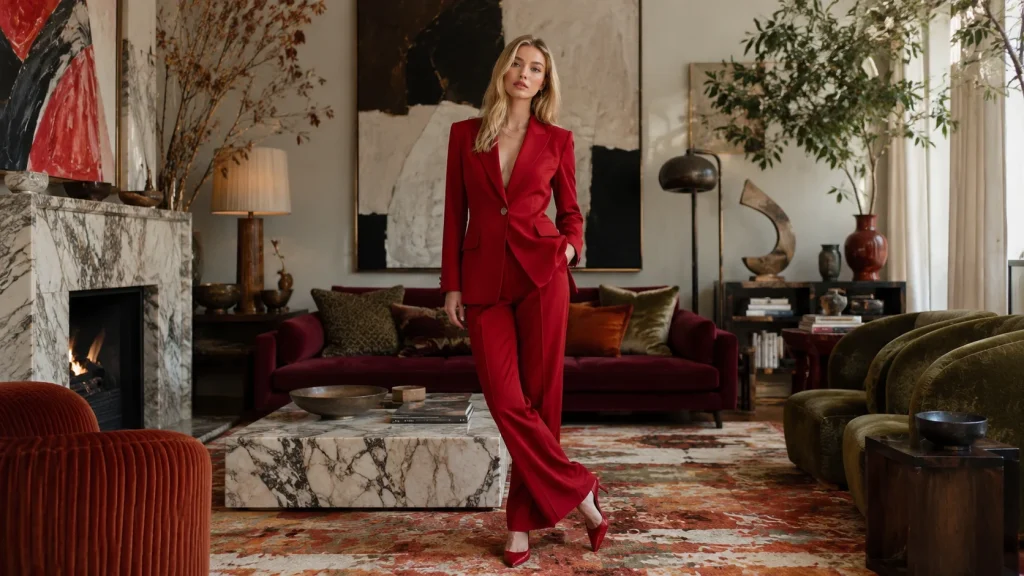 YOUR PROBLEM
YOUR AREA
COMPARE 3
✓ Ready to compare
YOUR PROBLEM
YOUR AREA
COMPARE 3
✓ Ready to compare
What is happening?
Choose the closest problem type, then check every clue that applies. Your selections change the specialist order.
Where should the search focus?
Use Google’s “near me” context or enter the area you actually want a specialist to serve.
Simple local search: open nearby Google results, choose the businesses that look suitable, then compare your best three here before you call.
Problem snapshot
Who should you call first?
These are the specialist types most likely to fit the clues you selected.
Search around your location
Compare your top three
Use the same factors for each option so a high star rating does not hide a weak scope, poor diagnosis, missing credentials or unclear aftercare.
Comparison result
Your result combines the Google signals you entered with the practical hiring checks you completed.
Questions to ask every finalist
Use the same questions with each shortlisted business so the comparison stays consistent.
Frequently Asked Questions About Modern Maximalist Interior Design
Modern maximalist interior design combines expressive color, pattern, art, furniture, materials and personal objects within a deliberately organized contemporary space. Successful rooms still use hierarchy, repetition, scale and quieter visual areas so abundance feels intentional rather than chaotic.
Start with a dominant focal point, repeat selected colors or materials across the room, vary pattern scale, group related objects and preserve some quieter surfaces. Each major object should either strengthen an existing relationship or introduce a useful new function, scale or material contrast.
Yes. Small rooms can support maximalism when visual hierarchy remains clear and circulation is protected. Concentrating impact through wallpaper, artwork, textiles and one strong furniture piece is often more effective than distributing many small decorative objects across every available surface.
There is no useful fixed number because scale, contrast, location and color relationships matter more than the pattern count. An oversized botanical, medium geometric motif, narrow stripe and patterned rug can coexist successfully when each operates at a different visual scale and one pattern remains dominant.
Group related objects, establish clear focal points, keep functional surfaces usable and retain visible breathing space between dense areas. When the room feels overloaded, remove or relocate competing focal points before automatically eliminating meaningful collections.
No. A maximalist room can use muted olive, tobacco, cream, burgundy, brown or other restrained colors while creating richness through material layering, art, texture, furniture variation and collections. Visual abundance does not require a rainbow palette.
Modern maximalism generally accepts more collected objects, pattern mixing, art combinations and furniture from different eras. Neo Deco usually creates richness through stronger geometry, polished materials and fewer high-impact pieces, making it a useful alternative for homeowners who prefer glamour with more visual restraint.
Final Thoughts
Modern maximalism is most convincing when abundance has structure. The room can contain burgundy velvet, patterned rugs, abstract paintings, vintage furniture, marble, books, ceramics, timber and objects gathered over years without requiring those things to become equally loud.
Begin with hierarchy. Establish the strongest visual event, then allow color, material, pattern and smaller objects to support or complicate it deliberately. Change pattern scale rather than simply matching prints. Use texture before adding more accessories. Group collections so they read as larger visual units, and protect enough negative space for important pieces to remain visible.
The final editing question is particularly useful: if another object enters the room, what does it improve? When the answer involves function, scale, repetition, material contrast or personal meaning, the addition may strengthen the composition. When the answer is simply that an empty area was available, leaving that space alone may be the more maximalist decision because it gives everything else greater presence.
A successful modern maximalist interior does not ask the eye to admire everything simultaneously. It creates a sequence of discoveries, allowing the room to feel richer the longer someone spends inside it.