Clinical psychology applies psychological science to understand mental health difficulties and guide care through assessment, an individual explanation, and treatment. A clinical psychologist can help clarify what is happening, what may be keeping a difficulty going, and which changes are worth trying. If you are attending an appointment, start with one concrete question you want the assessment to answer.
Clinical psychology is a field of practice; clinical depression is a health condition. A psychologist may work with depression, anxiety, trauma-related difficulties, or adjustment to physical illness, depending on their training and service. This guide explains how to participate in an assessment and make sense of its findings, rather than offering another collection of general coping exercises.
What does a clinical psychologist actually do?
The central job is to connect a person’s difficulties with an appropriate explanation and plan. Assessment gathers information, formulation brings that information into a working explanation, and intervention acts on the agreed priorities. These stages can overlap: new information during treatment may change the original understanding.
Clinical psychologists can provide psychological therapy, specialist assessment, consultation, and research-informed advice. Their role extends beyond individual therapy to work with families, teams, and services. An individual practitioner’s expertise still matters; one clinician may work mainly with children, another with adult mental health, and another with neurological or physical health conditions.
A psychiatrist is a medical doctor specialising in mental health; a clinical psychologist’s core qualification is in psychology rather than medicine. Counseling and psychotherapy describe forms of help that several professional groups may provide. Titles, licensing, referral routes, and prescribing authority vary by location, so avoid treating a job title as a universal list of permissions.
For an assessment appointment, the most useful starting point is the decision that needs clarification. “I need help” is enough to begin, but “I want to understand why I freeze when asked to speak” gives the conversation a direction. The following example is an editorial illustration, not a patient case or a diagnostic shortcut.

| Appointment focus | Main purpose | What to clarify |
|---|---|---|
| Clinical psychology assessment | Understand psychological difficulties, patterns, strengths, and possible treatment needs | Is this an assessment only, or can this service also provide treatment? |
| Psychological therapy | Work on an agreed difficulty using a suitable therapeutic approach | What approach is proposed, and how does it connect to the assessment? |
| Medical or psychiatric assessment | Consider medical explanations and medical treatment needs | Does the concern require a physical assessment or a medication review? |
| Specialist psychological testing | Answer a defined question using selected tests alongside other information | What will the test help decide, and is this clinician trained for that assessment? |
Name the assessment question before collecting information
Use this when your appointment feels vague or you have several concerns competing for attention. You need only the appointment details and a spoken sentence or short phone note. The purpose is to clarify the task, not to decide your own diagnosis.
- Name the difficulty in everyday language: “I go blank when people ask me to speak.”
- Turn it into a question: “What might be contributing to this, and what kind of help fits?”
- Ask whether the appointment can address that question and what kind of feedback you will receive.
In the meeting example, the immediate result is a clearer assessment purpose, not proof of social anxiety or any other condition. Avoid arriving with a demand for one particular label, because several explanations may need consideration. If forming a question is difficult, describe one recent incident aloud and ask the psychologist to help define it.
Not every psychological concern requires extensive testing, and an assessment does not always end with a diagnosis. A useful explanation may include what is known, what remains uncertain, and whether more information would change the plan. For choosing and booking a provider, use the separate guide to mental health counseling; this page concentrates on the assessment itself.
What information makes an assessment useful?
An assessment becomes more useful when it includes a specific example and its context, not just a list of labels. What happened, what you experienced, and what followed can reveal distinctions that a broad phrase such as “I cannot cope” leaves unclear. The clinician brings the assessment framework; you do not have to organise your life into a clinical theory.
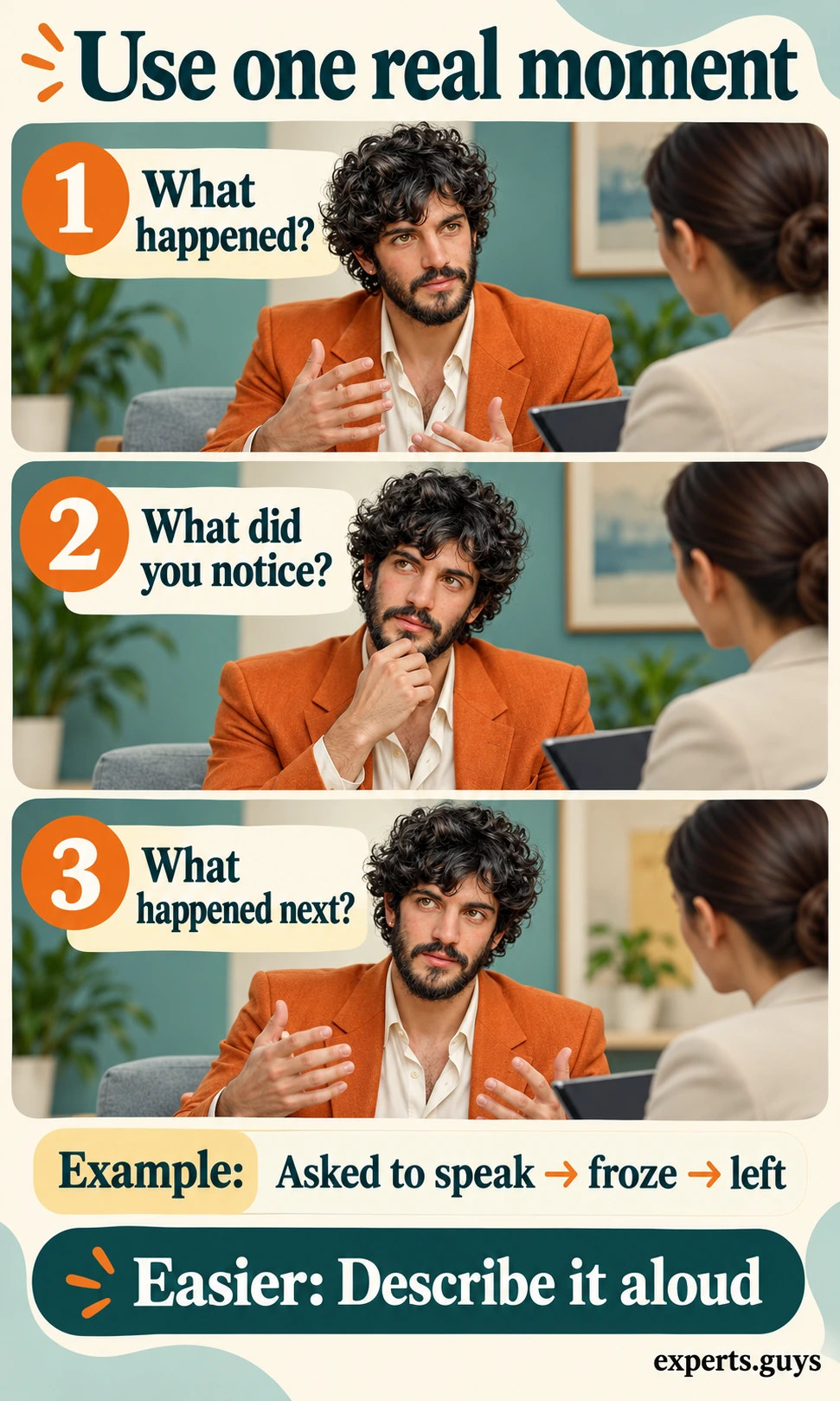
Explain one recent moment from beginning to end
Choose a manageable example that shows the difficulty you want help with. This is a communication aid for the appointment, not an instruction to relive traumatic experiences or provoke symptoms. Specific details about when symptoms occur and how they affect you help give the conversation a clear starting point.
- Describe the situation without guessing another person’s motives: “My manager asked for an update.”
- Explain what you noticed: “My chest felt tight, I lost my words, and I thought I would sound foolish.”
- Say what followed: “I stayed silent and left the meeting early.”
That sequence gives the psychologist something concrete to explore, while “my manager hates me” mixes an observation with an interpretation. Include uncertainty when you do not remember; a best guess should not become a false fact. If the example feels overwhelming, give only the outline, ask to pause, or use a less distressing situation first.
Add context that could change the interpretation
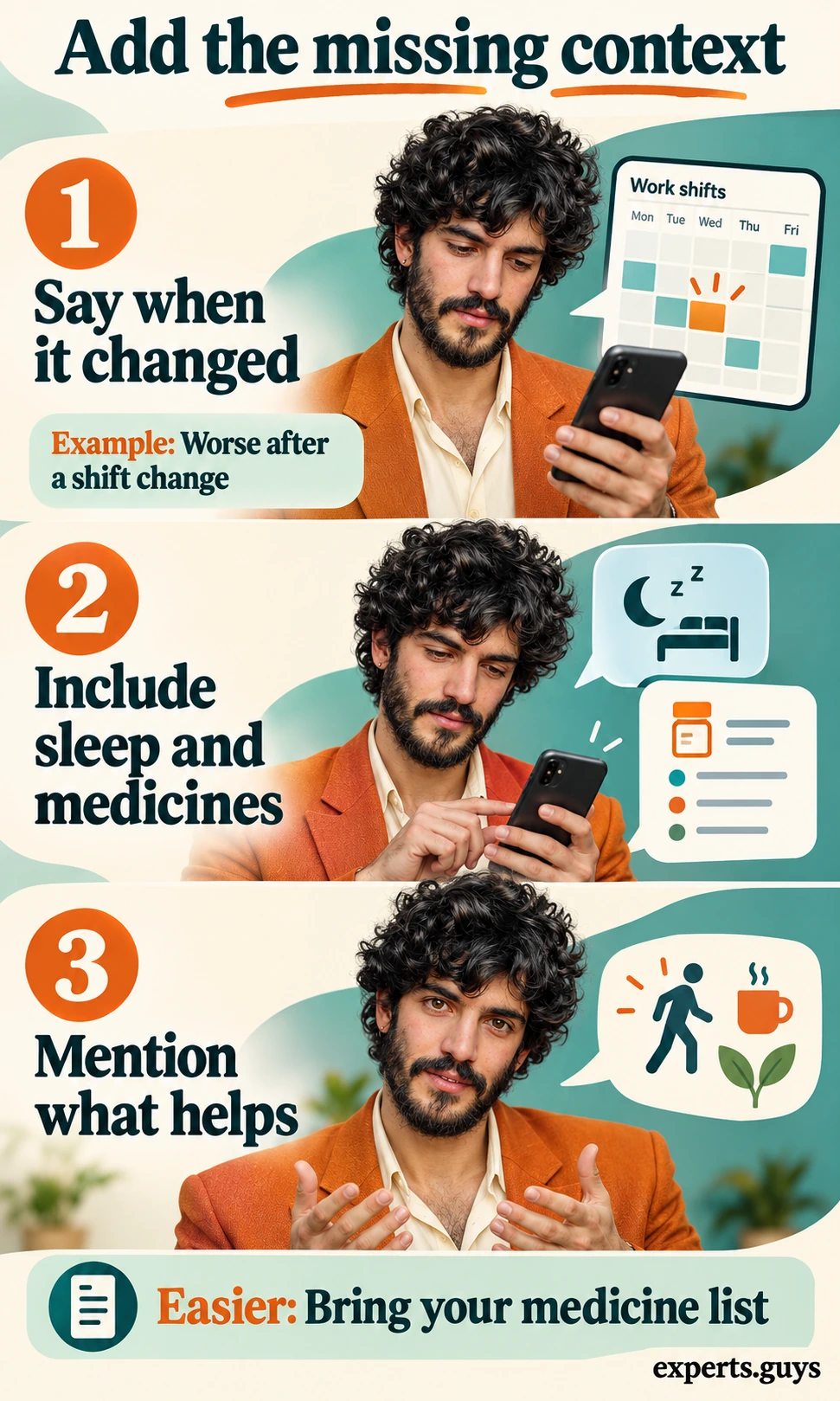
Timing and circumstances can change how a difficulty is understood. An assessment can include physical health, relationships, living circumstances, strengths, and support. These factors belong in the conversation because psychological distress does not occur separately from daily life.
- Say when the difficulty began or noticeably changed; an approximate period is fine.
- Mention relevant sleep changes, health problems, medicines, supplements, and alcohol or other substance use without changing any treatment yourself.
- Describe an exception or source of support: when is it easier, and what seems different then?
For example, “This became worse after my shift pattern changed, and it is easier in smaller meetings” adds useful context without proving a cause. You can check an existing phone calendar or medicine list if memory is uncertain; there is no need to start a long diary. If you cannot assemble everything, bring what you already have and tell the clinician what is missing.
A common mistake is leaving out an awkward detail because it seems unrelated or embarrassing. Another is assuming that a change in timing proves one event caused the whole problem. A useful checkpoint is whether the psychologist has enough context to ask more precise questions, including whether a separate medical assessment is needed.
How do you interpret tests, diagnoses, and a formulation?
A test result describes something measured; a diagnosis identifies a recognised condition when the relevant criteria are met; a formulation offers an individual working explanation. These outputs answer different questions and may be used together. None should be reduced to a judgment about your character or effort.
| Output | What it can contribute | What it does not establish alone |
|---|---|---|
| Test or questionnaire result | Information about a particular ability, symptom pattern, or experience | The full explanation for your difficulties |
| Diagnosis | A recognised clinical description that can guide care | Every reason the difficulty developed or persists |
| Formulation | A working account of relevant experiences, context, patterns, and strengths | A proven single cause or an explanation that can never change |
Ask what a test result can and cannot tell you
Formal tests are selected to answer particular questions, and an assessment can also use interviews, observations, and relevant records. Testing is one possible component of a broader psychological assessment. You do not need to study for these tests or search for preferred answers.
- Ask: “What does this measure, and what question is it helping answer?”
- Tell the assessor about factors that affected participation, such as language difficulty, poor sleep, or misunderstanding an instruction.
- Ask: “How does this result fit with the other information, and what is still uncertain?”
Imagine receiving a questionnaire result that sounds serious while your main concern is functioning at work. Ask the clinician to explain both the result and how it relates to that concern instead of interpreting the number alone. If the explanation is too technical, request an everyday example; the checkpoint is understanding what the result changes about care.

Avoid comparing screenshots of scores from different online quizzes as though they were interchangeable. Different measures can assess different things, and the conditions of assessment matter. A clinician can explain whether further assessment is useful; collecting more scores is not automatically a better answer.
Check whether the working explanation fits your experience
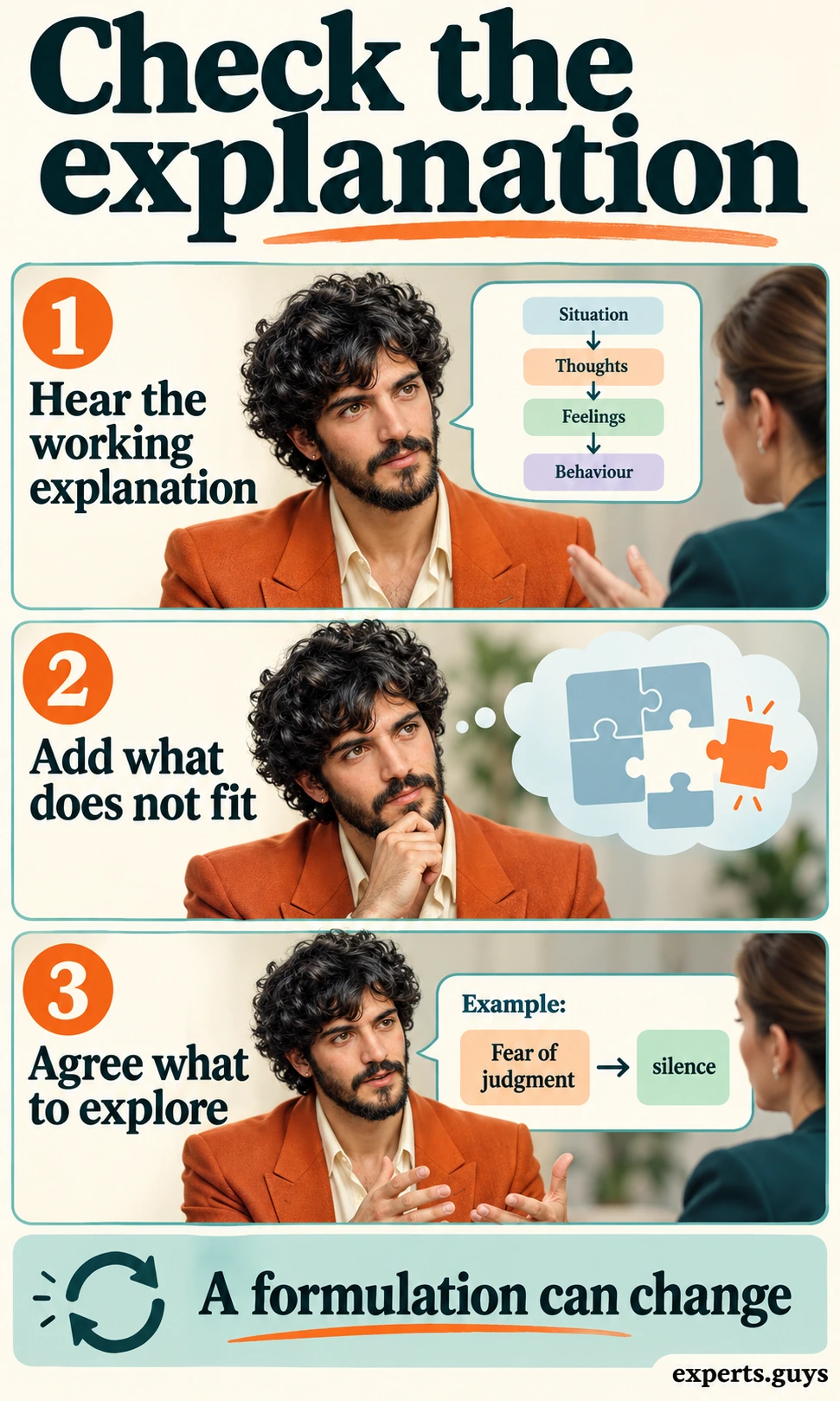
A formulation links relevant factors into an explanation that can guide treatment. It may consider what made you vulnerable, what happened around the onset, what now maintains the difficulty, and what helps protect you. A formulation is a shared explanatory model, so you can discuss whether it fits instead of treating it as a verdict about who you are.
- Listen for the proposed connection: “Are you suggesting that fear of judgment makes me withdraw?”
- Add a concrete exception or correction: “That fits large meetings, but I also freeze when I am exhausted with people I trust.”
- Ask what the correction changes and what you will explore together next.
In this illustrative case, fatigue may deserve attention alongside fear of judgment. The point is not to win an argument about the formulation; it is to make the explanation more accurate and useful. If you cannot judge it immediately, say which part is unclear and return to it after receiving a plain-language summary.
A diagnosis and a formulation can both be useful without being identical. Someone seeking clarification about depression labels can read types of depression for the separate diagnostic distinctions. Here, the practical question is how the explanation connects to the next care decision.
How do assessment findings become a workable next step?
A useful assessment should connect findings with an understandable plan, including the next action and how it will be reviewed. The plan may involve psychological therapy, further assessment, a different service, or coordinated care. What matters is that the recommendation addresses your question and reflects your circumstances rather than ending with an unexplained label.
Turn a broad hope into a goal you can discuss
“I want to feel normal” expresses a real need, but it does not specify what daily change would matter most. Choose an observable change to discuss with the psychologist, while leaving the treatment method and pace open for joint agreement. This is goal clarification, not a self-directed treatment programme.
- Name something that matters to you: being heard at work, keeping a friendship, or managing essential tasks.
- Describe one relevant change: “I want to contribute one point in a team meeting.”
- Ask how the proposed treatment would support that change and whether the goal needs adapting.
The meeting example does not mean you should force yourself into a distressing situation tomorrow. The clinician might suggest a different first step after considering the assessment, your readiness, and practical barriers. If the goal is too demanding, narrow the discussion to one part of the difficulty; success here means agreeing a relevant direction, not achieving immediate symptom relief.

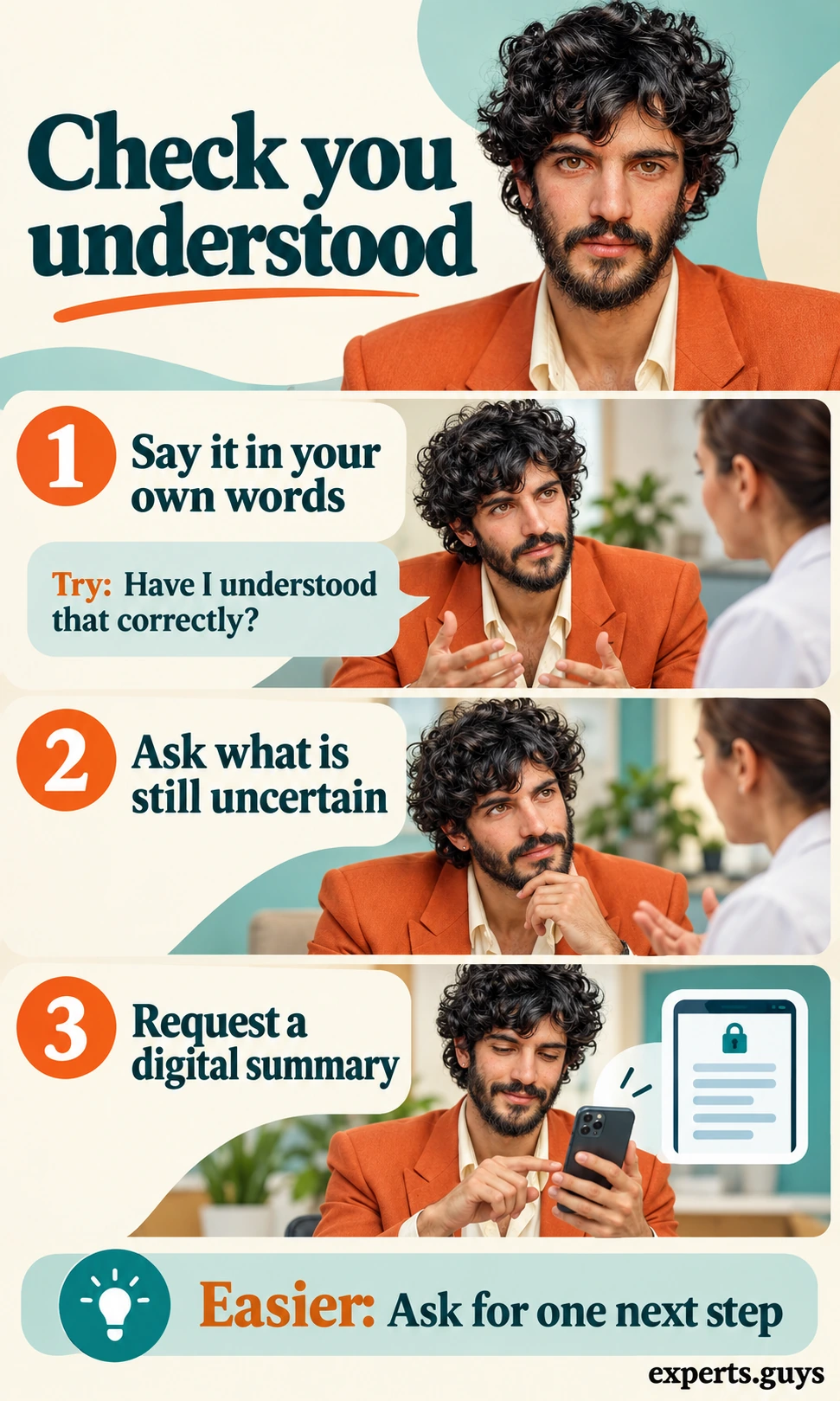
Use a spoken summary to check the feedback
When feedback includes several new terms, repeat the main message in your own words before the conversation ends. This adaptation of teach-back is a way to detect misunderstandings, not an exam of your memory. Checking understanding and agreeing what happens next are parts of shared decision-making.
- Say: “My understanding is that we are exploring X, and the next step is Y. Have I understood that correctly?”
- Ask which conclusions are firm and which remain uncertain.
- Request a digital summary through the service’s usual secure channel, including the next step and who to contact with questions.
For example, “You are not saying this test explains everything; you are combining it with the interview” may reveal a misunderstanding before it shapes later decisions. Do not secretly record the session or assume a general messaging app is the clinic’s approved route. If you feel overloaded, ask for the single next action first and arrange how remaining questions will be answered.
Raise a mismatch between scores and everyday life
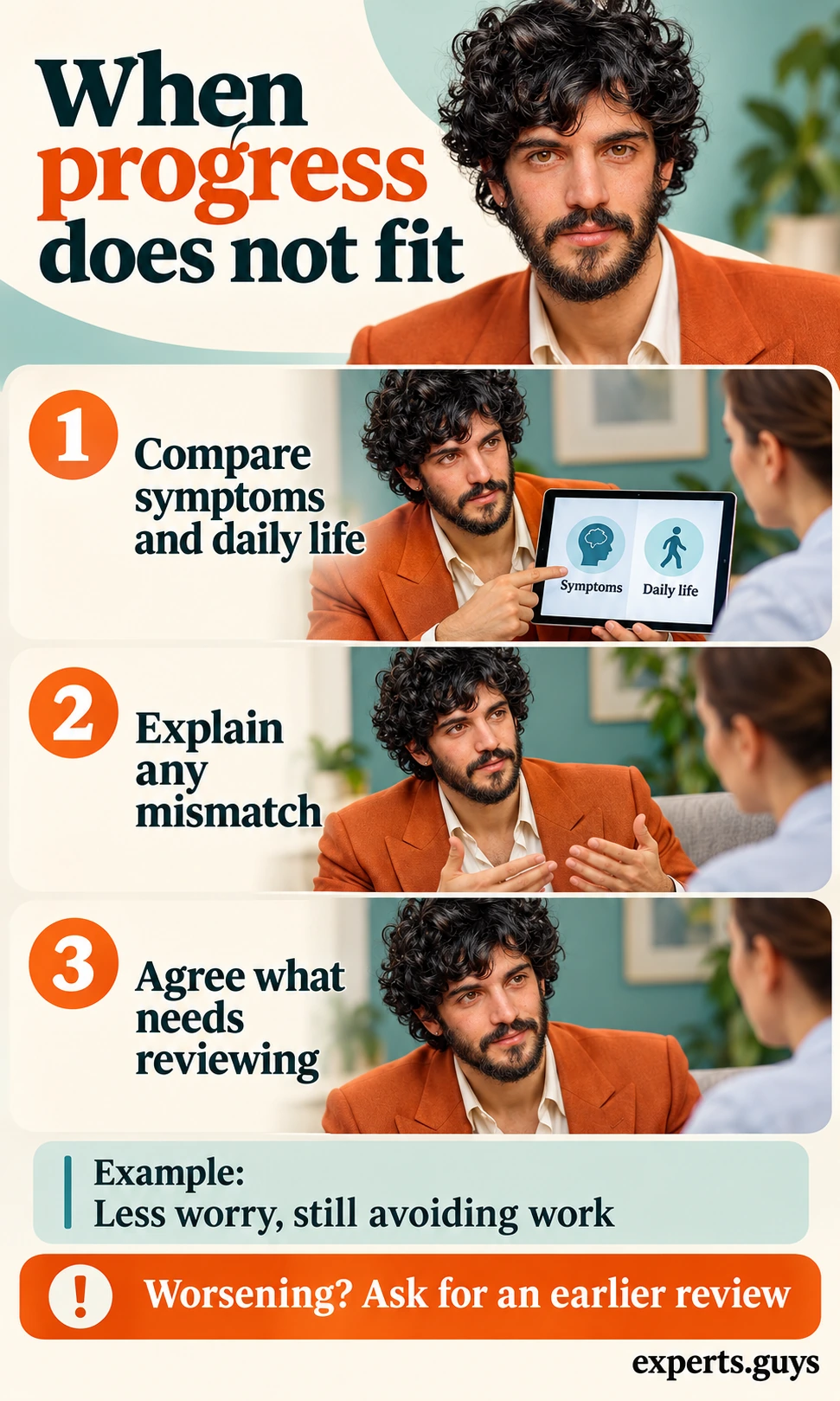
Improvement is worth discussing in more than one form: symptoms, functioning, and the goals that matter to you may not change together. For depression care, treatment review can include appropriate outcome measures. That does not make a questionnaire the sole judge of whether a plan is working.
- At the agreed review, compare how you feel with one relevant daily-life example.
- State a mismatch plainly: “I worry less, but I still avoid every work meeting.”
- Ask whether the goal, approach, pace, practical barriers, or assessment needs reviewing.
Avoid concluding that you failed because one part improved and another did not. Equally, do not minimise worsening symptoms just because a score looks better. Ask for an earlier review if things are deteriorating; use urgent services for immediate danger rather than waiting for the scheduled appointment.
You can ask about therapy goals, the proposed approach, and what happens when treatment is not helping. There is no single session count that proves every therapy has succeeded or failed. The useful outcome is a shared explanation of what to continue, what to change, and when to reassess.
| What is missing | A useful question | What a clearer answer includes |
|---|---|---|
| Purpose of a test | “What decision depends on this result?” | The question being assessed and relevant limits |
| Connection between findings and treatment | “How does this approach address the explanation we discussed?” | A reason for the recommendation and reasonable alternatives |
| Feedback you can understand | “Can you explain that without the technical terms?” | An everyday explanation and an opportunity to correct it |
| A review arrangement | “When will we review this, and what if I get worse sooner?” | A review plan and an appropriate earlier contact route |
The examples and images on this page are illustrative educational material, not actual patients, test reports, or evidence of treatment outcomes. They show ways to participate in care without diagnosing yourself or changing medication. The right assessment and intervention still depend on your individual situation and the clinician’s scope of practice.
Frequently asked questions
Do I need a diagnosis before seeing a clinical psychologist?
Not necessarily. An appointment may be intended to clarify a difficulty before a diagnosis is established. Referral requirements differ between services, so check what the appointment covers and what information the service needs.
Can a clinical psychologist prescribe medication?
Do not assume prescribing authority from the title. Most clinical psychologists do not prescribe; some jurisdictions allow appropriately trained psychologists to prescribe under specific rules. Medication questions should go to a clinician with the relevant prescribing authority.
Does a referral mean I will have an intelligence test?
No. The assessment question determines what information or testing is relevant. Ask the service what is planned rather than assuming every clinical psychology appointment involves the same tests.
What if I disagree with the assessment report?
Identify the specific statement you question and explain the factual correction or missing context to the clinician. Ask how the service handles corrections and differing views. Disagreement may lead to clarification, further discussion, or a second opinion; it does not automatically make either view correct.
Will everything I say remain confidential?
Ask the service to explain confidentiality, its limits, record access, and who may receive the report before sharing sensitive details. Rules can differ by jurisdiction, age, and circumstances, and safety or legal obligations may limit confidentiality. Do not assume that an employer-funded or externally commissioned assessment has the same reporting arrangements as private therapy.
Your next step
Choose the part of the assessment process that is unclear now. If you have not attended yet, bring one question and one manageable example; if you already have feedback, ask what the finding changes about the plan. Leave with an agreed next action and a way to clarify questions, rather than a collection of unexplained terms.