“Congruent depression” is not a standard standalone diagnosis; in a clinical discussion, the intended phrase may be depression with mood-congruent psychotic features. Here, “congruent” describes how the content of a symptom relates to the person’s mood, rather than whether their depression is justified. Ask which meaning is intended before drawing conclusions from the label.
What does “congruent” describe in a depression assessment?
The word means that two things fit together, but the surrounding words determine which two things are being compared. With mood-congruent psychotic features, the comparison is between depressive mood and the themes of a delusion or hallucination. A clinician might identify themes of guilt, worthlessness or deserved punishment that fit the depressive episode.
This is a description of symptom content, not confirmation that the belief is true. For example, a person might become convinced that they caused a catastrophe despite evidence that they did not; a depressive theme may help describe the experience, but it does not establish its factual accuracy. The NHS explanation of psychotic depression describes how delusions and hallucinations can reflect a deeply depressed mood.
The distinction matters because the same adjective appears in discussions of memory and ordinary emotional reactions. Remembering sad events while feeling low is a different phenomenon from experiencing a delusion. Feeling distressed after a loss is another question again, and a real-life reason for distress does not decide whether someone also needs depression treatment.

A clinical phrase also has a scope: it may describe one observed feature, a working impression or an established diagnosis. Reading one word without its sentence can erase those differences. The safest useful outcome is a plain-language explanation from the person who wrote the note, rather than a new label assigned by a website.
Clarify a note in one conversation
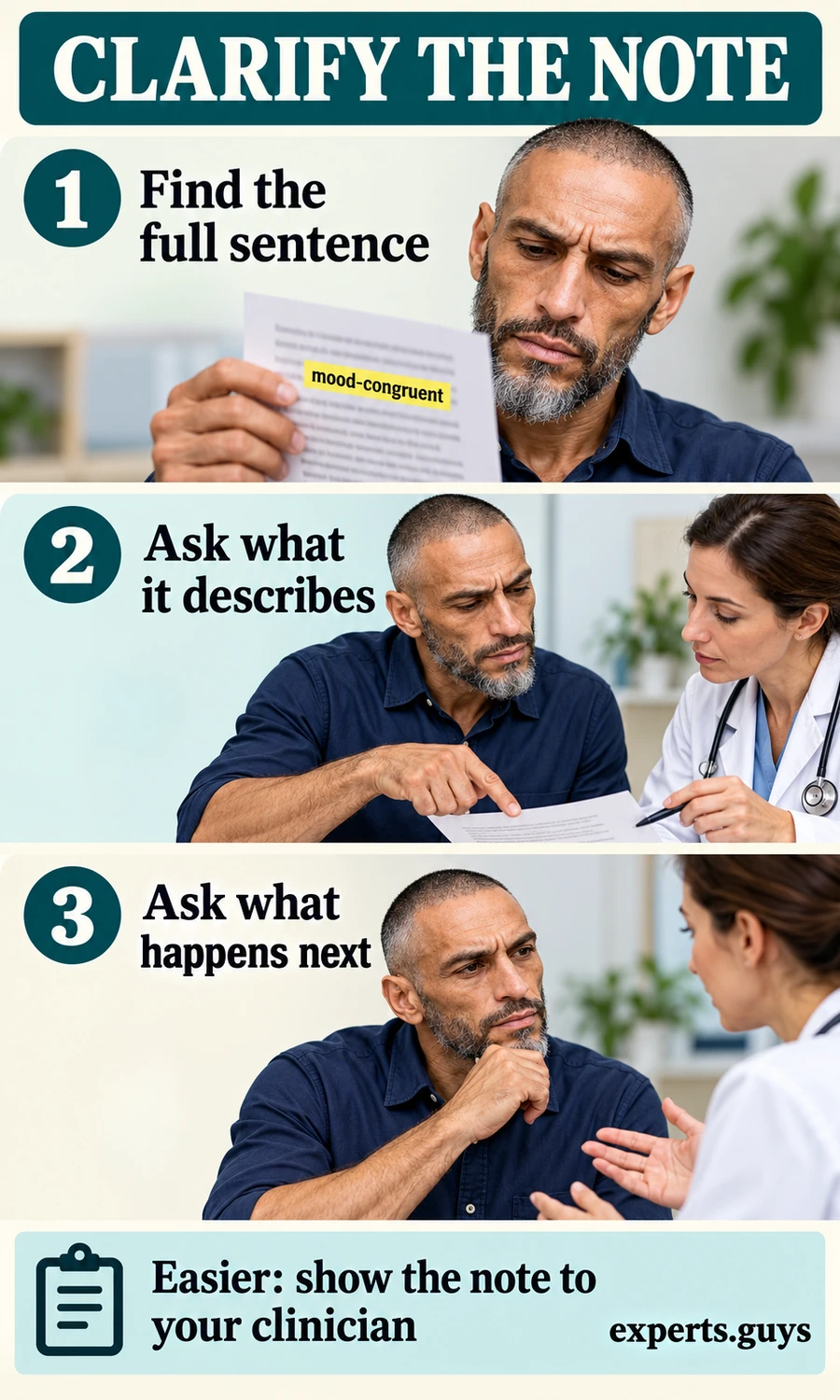
Use the note itself if unfamiliar wording is making you anxious. This short communication method is an editorial adaptation of guidance on asking a health professional questions, not a diagnostic exercise. You need only the sentence and a way to contact the clinic; you do not need a symptom diary.
- Find the full sentence. Keep the words before and after “congruent” visible.
- Ask what it describes. Say, “Does this refer to my mood, a memory pattern, or a psychotic symptom?”
- Ask what happens next. Say, “Is this a confirmed finding, and does it change the assessment or treatment plan?”
Illustrative example: A reader sees “mood-congruent” in a visit summary and asks the clinician to explain the complete sentence. The useful result is knowing what the note refers to and whether follow-up is needed, not obtaining reassurance from an isolated term. If speaking is difficult, show the sentence to the clinician or ask a trusted person to help; completion means the question has been communicated, even if the answer needs another appointment.
Keep this page’s role narrow: it decodes ambiguous wording in a depression discussion. For the comparison across manic and depressive episodes, the separate article on mood congruence and incongruence in bipolar disorder covers that broader context. Neither page can determine the meaning of an individual clinical note without the assessment behind it.
How is a depressive thought different from a psychotic symptom?
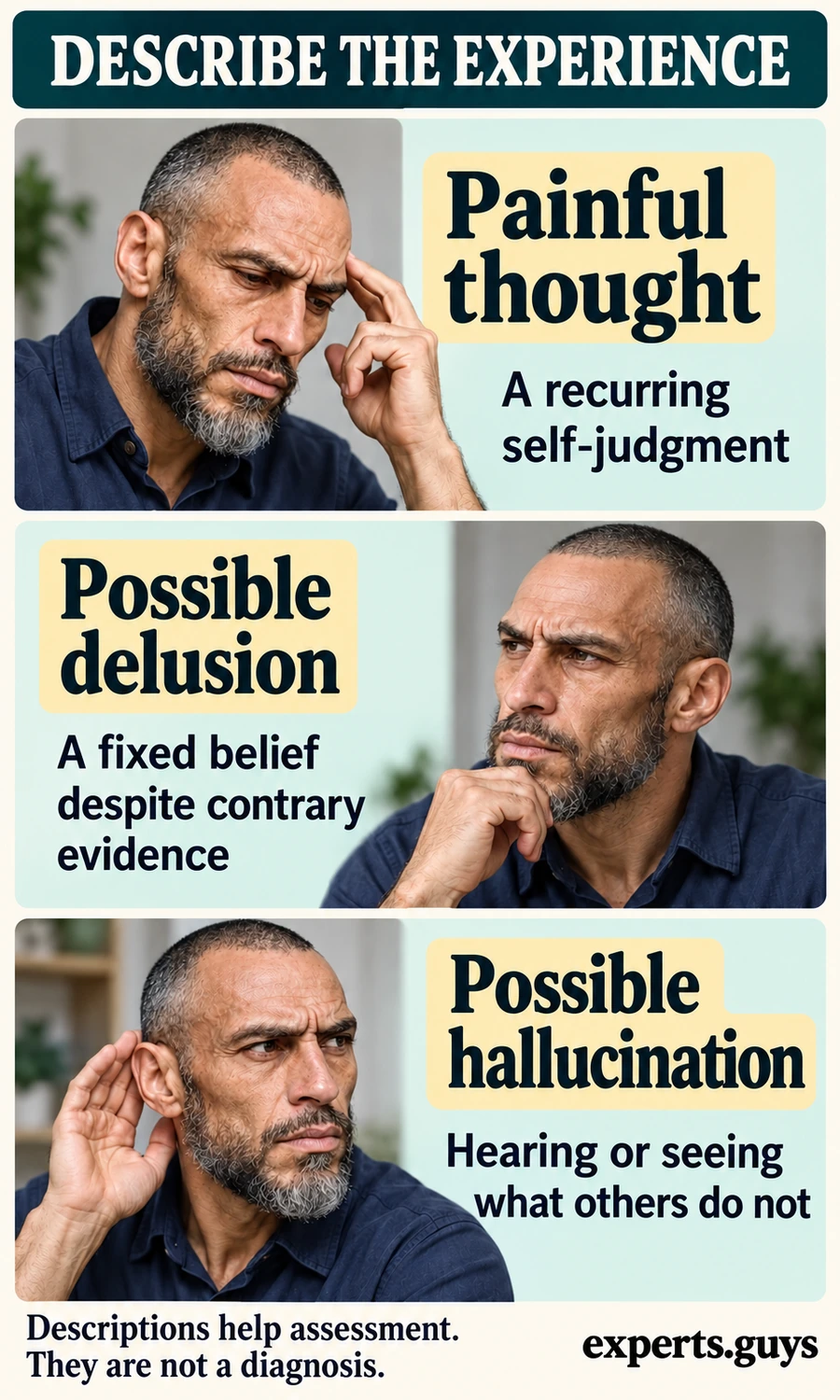
The distinction is not simply how upsetting a thought feels. Clinicians consider the form of the experience, the person’s relationship to it, the wider symptoms and the context. Strong guilt can occur without psychosis, while hallucinations or delusions require assessment even when their content seems related to depression.
| Experience | Illustrative description | What needs clarification |
|---|---|---|
| Depressive thought | “I keep thinking I disappoint everyone.” | How persistent and impairing is the self-judgment? |
| Possible delusional belief | “I am certain I caused a disaster,” despite contrary evidence. | How firmly is it held, and what is its context? |
| Possible hallucination | Hearing a voice that others do not hear. | What was perceived, when, and under what circumstances? |
These examples are conversation aids, not a home test. Insight can vary, so being able to question an experience does not reliably rule psychosis in or out. Clinicians also consider cultural context and possible contributors such as sleep loss, substances, medicines and physical illness; psychosis has several possible causes.
A person’s actual words usually tell a clinician more than a borrowed diagnosis. “I heard a voice twice yesterday while fully awake” communicates an experience; “I have congruent depression” may conceal what has changed. You do not have to decide whether the voice was a hallucination before asking for help.
Make a clear first contact
- Say what changed: describe the thought, belief or perception in ordinary words.
- Say when it began: include whether it is happening now or has happened repeatedly.
- Explain its daily impact: mention disrupted sleep, eating, work or safety, and ask how urgently you should be assessed.
Illustrative example: “Since yesterday I have heard a voice when nobody is speaking, and it is keeping me awake. Can someone assess me today?” This is a request for clinical triage, not a claim about the cause. The smaller version is to ask a trusted person to help make the call; the step is complete when you have communicated the concern and received a next action, or moved to an urgent service if timely help is unavailable.

You may be asked about recent medication changes, alcohol or other substances, and periods of unusually increased energy or reduced need for sleep. These questions help establish the wider picture and are not an accusation or a conclusion about your diagnosis. If low mood is the main concern without unusual perceptions, the depression symptoms guide provides broader symptom context, while the appointment remains the place to interpret your own experience.
Is mood-congruent memory the same as psychotic depression?
No: mood-congruent memory concerns which emotional material is more readily recalled, whereas psychotic depression involves depression accompanied by psychotic symptoms. When someone feels low, negative memories may come to mind more easily than positive ones. That pattern alone does not establish hallucinations, delusions or a diagnosis of psychotic depression.
The proposed relationship is between current mood, emotional processing and retrieval, not a claim that every sad recollection is false. Research on mood-congruent memory describes a pattern whose expression depends on factors such as the task, the person and how emotional material is processed. It should not be turned into a rule that depressed people always remember inaccurately or that remembering something positive proves they are well.

Consider the difference between “The upsetting parts of yesterday are easiest to remember” and “I hear a voice accusing me of something.” Both deserve to be described accurately, but they ask different clinical questions. This distinction also explains why a memory exercise cannot substitute for assessment of a new perceptual experience.
Forgetting appointments or struggling to concentrate introduces a further issue: the difficulty may concern attention and recall rather than the emotional tone of a memory. The dedicated article on depression and memory problems explores that practical problem. Here, the takeaway is to identify the meaning being used instead of treating every memory complaint as evidence of psychosis.
Does “mood-congruent” change the care someone needs?
The description can help clinicians characterize an episode, but it does not select a treatment by itself. Care depends on the full diagnosis, symptom severity, safety, medical history and the person’s preferences. Symptoms whose content does not match the mood also deserve attention; “congruent” is not a synonym for mild, harmless or easy to manage.
| Current situation | Next action |
|---|---|
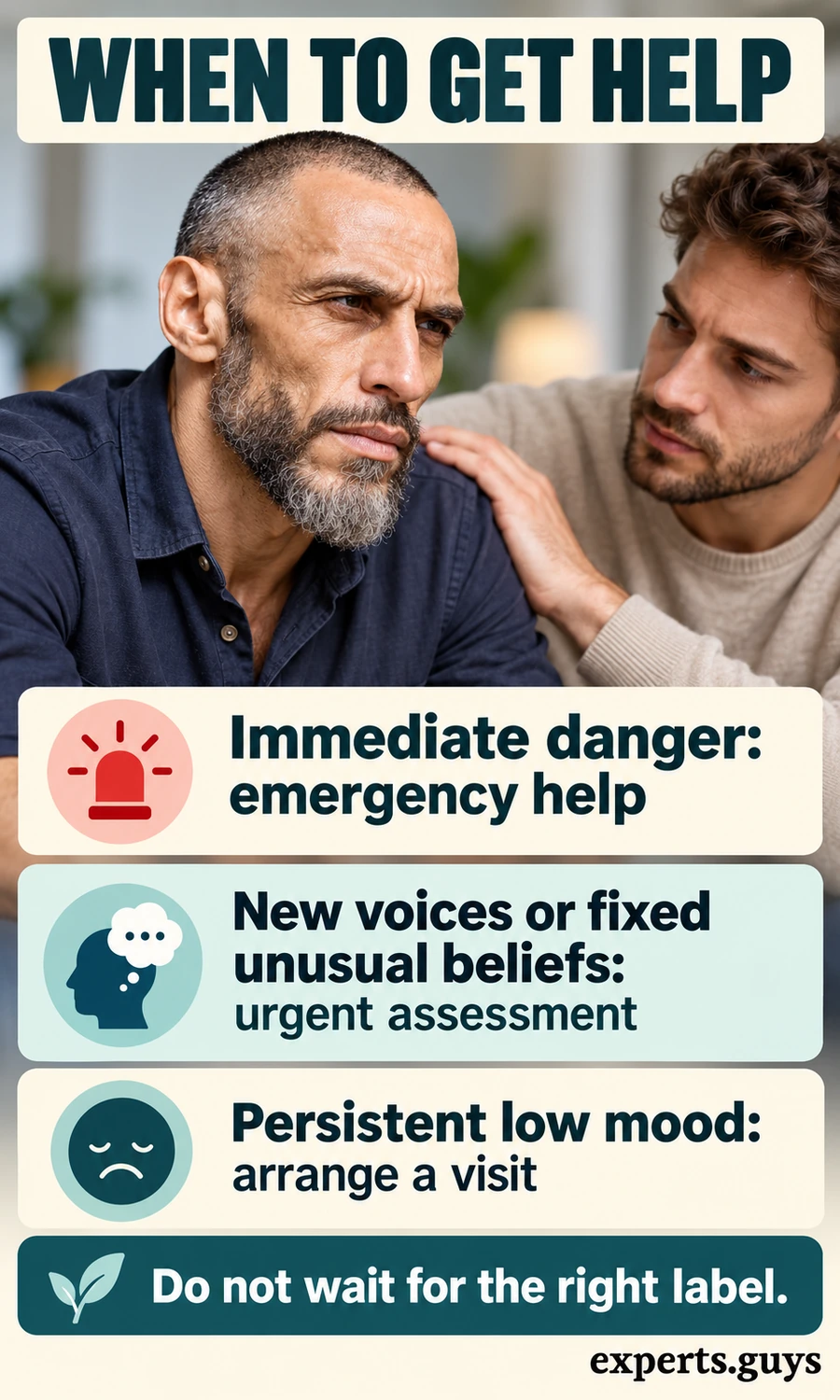
| Immediate danger, inability to remain safe, or life-threatening self-neglect | Contact local emergency services or attend an emergency department. |
| New voices, fixed unusual beliefs, or increasing difficulty judging reality | Seek urgent clinical assessment rather than waiting to settle the terminology. |
| Persistent, worsening or disabling low mood without an immediate emergency | Arrange an appointment and explain the symptoms and their impact. |
| Unclear wording in an otherwise established care plan | Ask the treating team to explain the note and any action it requires. |
For depression with psychotic symptoms, NICE recommends specialist mental-health care and considering an antidepressant together with an antipsychotic. The recommendation is about a clinically assessed condition, not a treatment to start because of a search term. Specialist decisions may also include psychological and social support, and in some severe circumstances consideration of electroconvulsive therapy.
The evidence does not justify choosing a medicine from the congruent/incongruent distinction alone. The plan also needs an explanation of likely benefits, adverse effects, monitoring and alternatives. Do not start, stop or adjust prescribed treatment on the basis of this article; bring concerns to the prescriber so changes can be planned safely.
Leave the appointment with an understandable plan
- Ask what is being treated. Request a plain-language explanation of the working diagnosis and the symptoms being targeted.
- Ask about benefits and risks. Include alternatives and what monitoring the proposed treatment needs.
- Confirm follow-up and urgent contact. Ask when the next review is and whom to contact if symptoms worsen before it.
Illustrative example: “I understand that the plan addresses both low mood and the voices. What should I watch for, and who do I call before the next review?” If remembering the discussion is difficult, ask for a written plan or invite a trusted person with your agreement; completion means you understand the next step, not that symptoms have already improved.

This final procedure supports communication rather than treatment selection. There is no need to calculate a “congruence score” or repeatedly rate yourself to use it. The useful endpoint is an agreed clinical next step with a contact route if the situation changes.
Frequently asked questions
Does feeling depressed after a difficult event mean the depression is “congruent”?
That may be an informal use of the word, but it is not the same as describing mood-congruent psychotic features. A stressful event does not determine the diagnosis or make support unnecessary. Describe the symptoms and their impact rather than deciding whether you have a sufficient reason to feel them.
Does the phrase prove that someone has bipolar disorder?
No. Mood congruence describes a relationship between symptom content and mood; it does not establish bipolar disorder by itself. A clinician needs the broader history, including any manic or hypomanic episodes, to assess that diagnosis.
Should I change my medication if the wording in my notes changes?
No medication change follows automatically from a change in wording. Ask the prescriber whether the assessment or treatment recommendation has changed. Follow the agreed plan and seek urgent help if a new safety concern arises.
Your next step
If the concern is an unfamiliar term, bring the full sentence to the clinician who used it. If the concern is a new experience, describe that experience and seek the appropriate level of care. Understanding the wording should make the next conversation clearer, without delaying help.