Coping skills for teens work best when they match the moment: a classroom reset for overwhelm, a pause before a heated reply, or a clear request when schoolwork becomes too much. Choose one of the 13 skills below for the situation in front of you; you do not need to practise all of them or keep a written diary. These are everyday coping options, not a diagnosis or a replacement for mental-health care.
| What is happening? | Start here | What a useful result looks like |
|---|---|---|
| I cannot follow class | Classroom reset or quieter break | I can take in one instruction. |
| A chat is getting heated | Pause before sending | I choose my reply instead of reacting instantly. |
| Schoolwork feels impossible to organise | Deadline triage | I know the next priority and what needs help. |
| People keep pushing my limits | Clear boundary | I state what I can safely do. |
| I need someone alongside me | Specific support request | A safe person understands what I need. |
A coping skill is an action that helps you respond to a difficult feeling or situation. Some skills change your immediate focus; others change a demand, a conversation or your access to support. Feeling completely calm is not the only useful outcome: being able to ask a question or avoid an impulsive reply also counts.
Stress can show up in the body as well as in thoughts, including a racing heart, tight muscles or a stomach that feels unsettled. When you are overloaded, a long list of advice can become another demand. Start with the current obstacle and use the smallest version that helps you move safely through it.
The examples below are illustrative school and friendship situations, not reports from patients or a tested 13-step programme. They adapt broad youth guidance on stress, communication and practical problem-solving into everyday choices. Phone screens are examples rather than instructions for a particular app, and every method has a spoken or low-tech alternative.
What can I do when stress hits during class or a chat?
1. Reset your attention in class
Use this when a tense moment makes it hard to follow the lesson, while you are physically safe. Turning attention toward neutral details gives you a concrete task instead of another demand to calm down. You do not need to close your eyes or control your breathing.
- Rest your feet on the floor or a comfortable support and notice the chair beneath you.
- Look for three ordinary objects, such as a clock, a window frame and a bag. Silently name what you actually see.
- Find the next instruction on the board, or quietly ask which step the class is on.
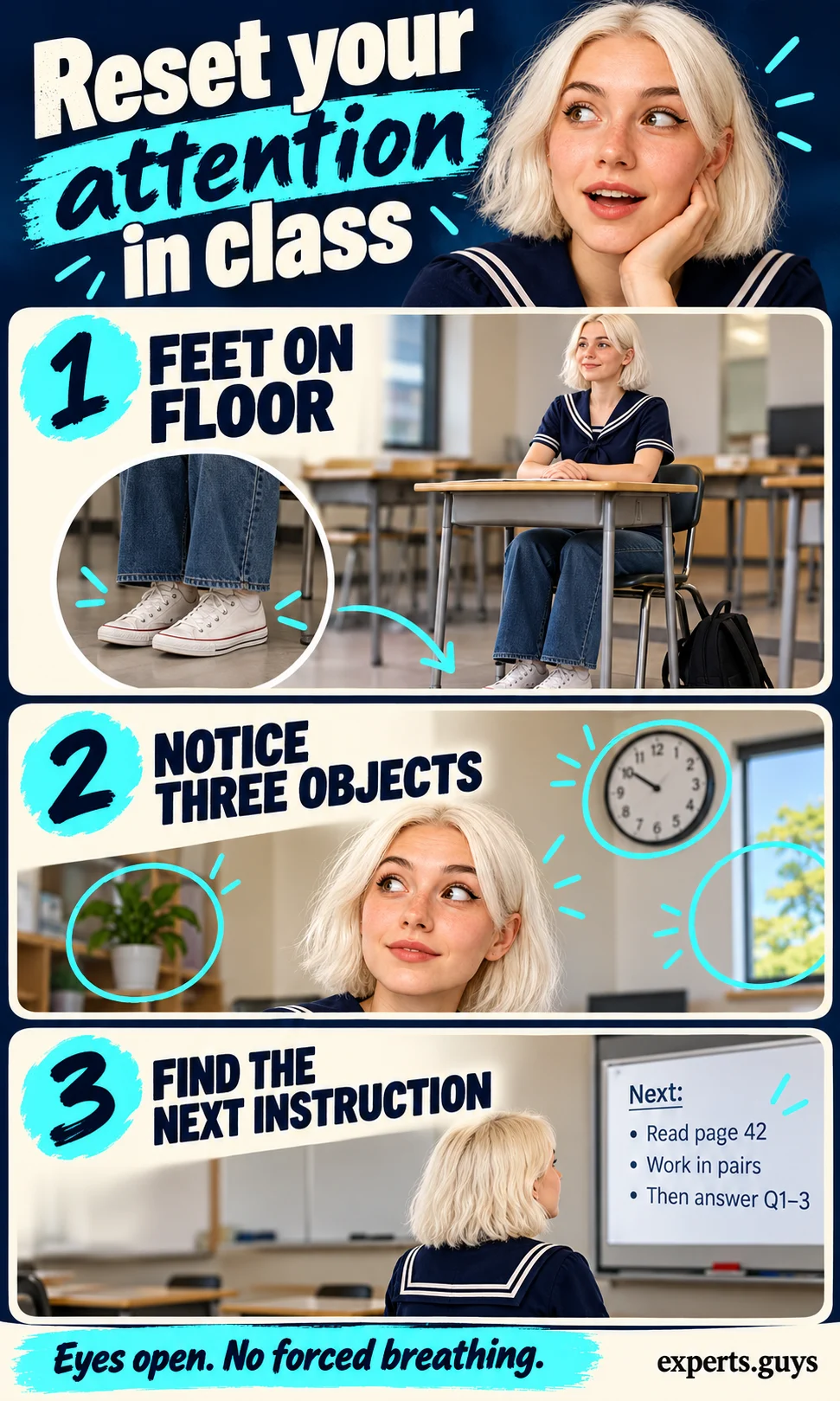
For example: After being called on unexpectedly, you might notice the blue bag, the square window and the clock, then return to the sentence being discussed.
Adjust and check: Trying to force every anxious feeling away turns this into another test. Aim to reconnect with one instruction; if looking around is uncomfortable, notice one safe object or the support beneath your hands instead. Stop if the exercise makes you feel more disconnected, and tell a safe adult if you cannot rejoin.
2. Pause before sending an angry reply
Use a pause when a normal disagreement is moving faster than you can think. An unsent message can still be changed; a posted message may be copied or forwarded. This is a communication safeguard, not a requirement to tolerate bullying.
- Leave your reply unsent and move away from the send button.
- Put the phone face down somewhere safe, staying reachable through an agreed route if needed.
- When you can name your purpose, return with one clear sentence or decide that no reply is necessary.
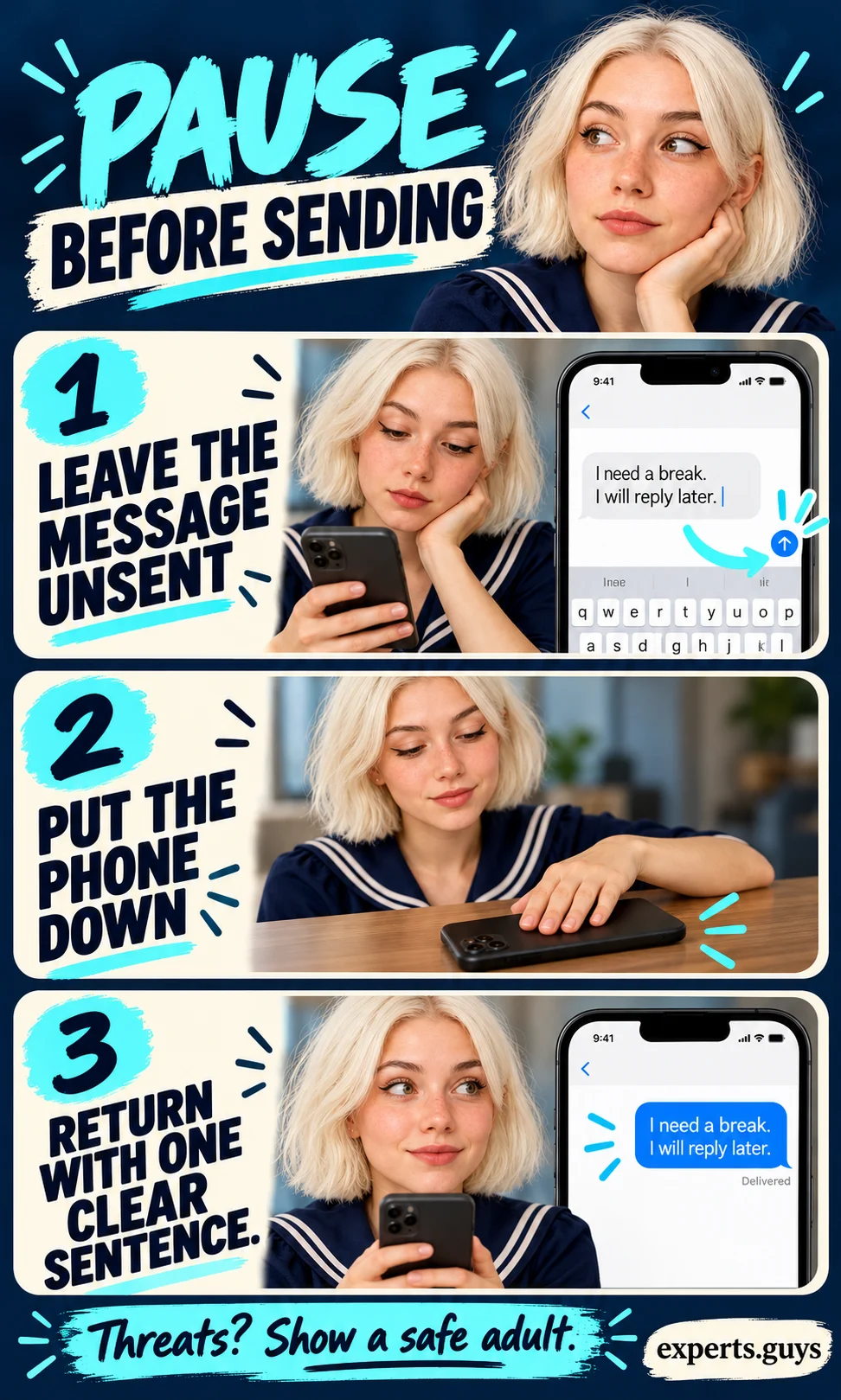
For example: Instead of answering every accusation in the group chat, try: “I need a break. I will reply later.” You can also wait before sending even that sentence.
Adjust and check: Rereading the thread during the pause keeps the argument in front of you. Put the screen out of sight; if you need the phone for schoolwork, close only the chat. Check whether your next message states a need without insults, and show threats or harassment to a safe adult rather than negotiating alone.
3. Take an agreed quieter break
Use this when noise, crowding or several people talking makes participation harder. Reducing the immediate input may make the next conversation or lesson more manageable. A quieter break works best when the location and return arrangement are agreed in advance.
- Ask a teacher or another responsible adult for the agreed quieter space.
- Move to that safe space and reduce extra input; you do not have to use your phone.
- Check with the adult before returning, or explain what still needs adjusting.
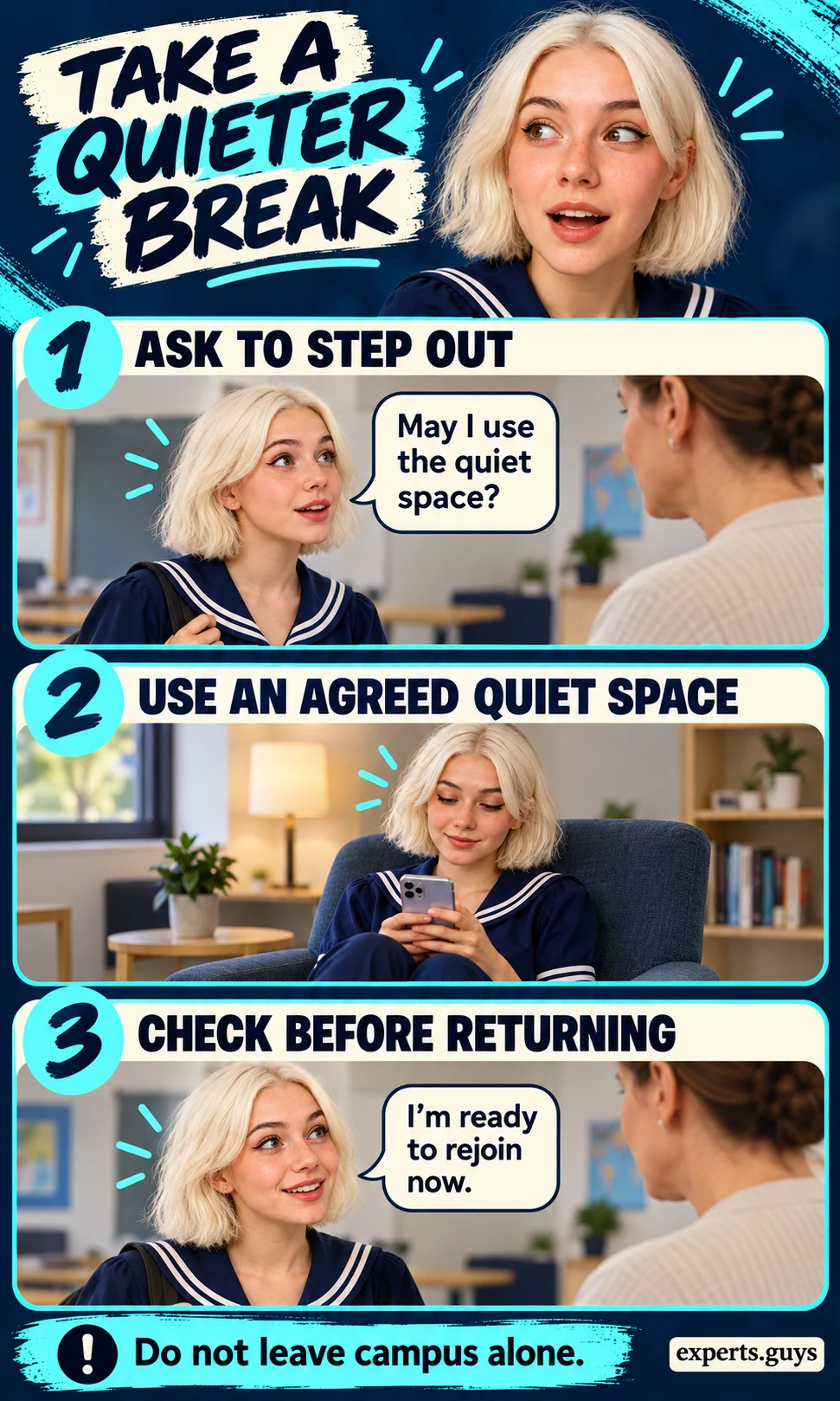
For example: “May I use the quiet space?” is enough to begin if your teacher already knows the arrangement. A seat near the edge of the room may be the available alternative.
Adjust and check: Leaving without anyone knowing where you are can create another problem. Stay within the agreed area and do not leave campus alone. Improvement means you can take in the next instruction; frequent overload deserves an accommodation discussion, not pressure to keep enduring it.
4. Name the feeling and the need
Use this when everything feels “bad” but you cannot explain what would help. A more specific word can make your request easier for someone else to understand. You can say it aloud or think it silently; no diary is required.
- Choose the closest ordinary word: embarrassed, disappointed, lonely, angry or unsure.
- Ask what you need in this situation, such as privacy, clarification, company or space.
- Turn the need into one request to a safe person.
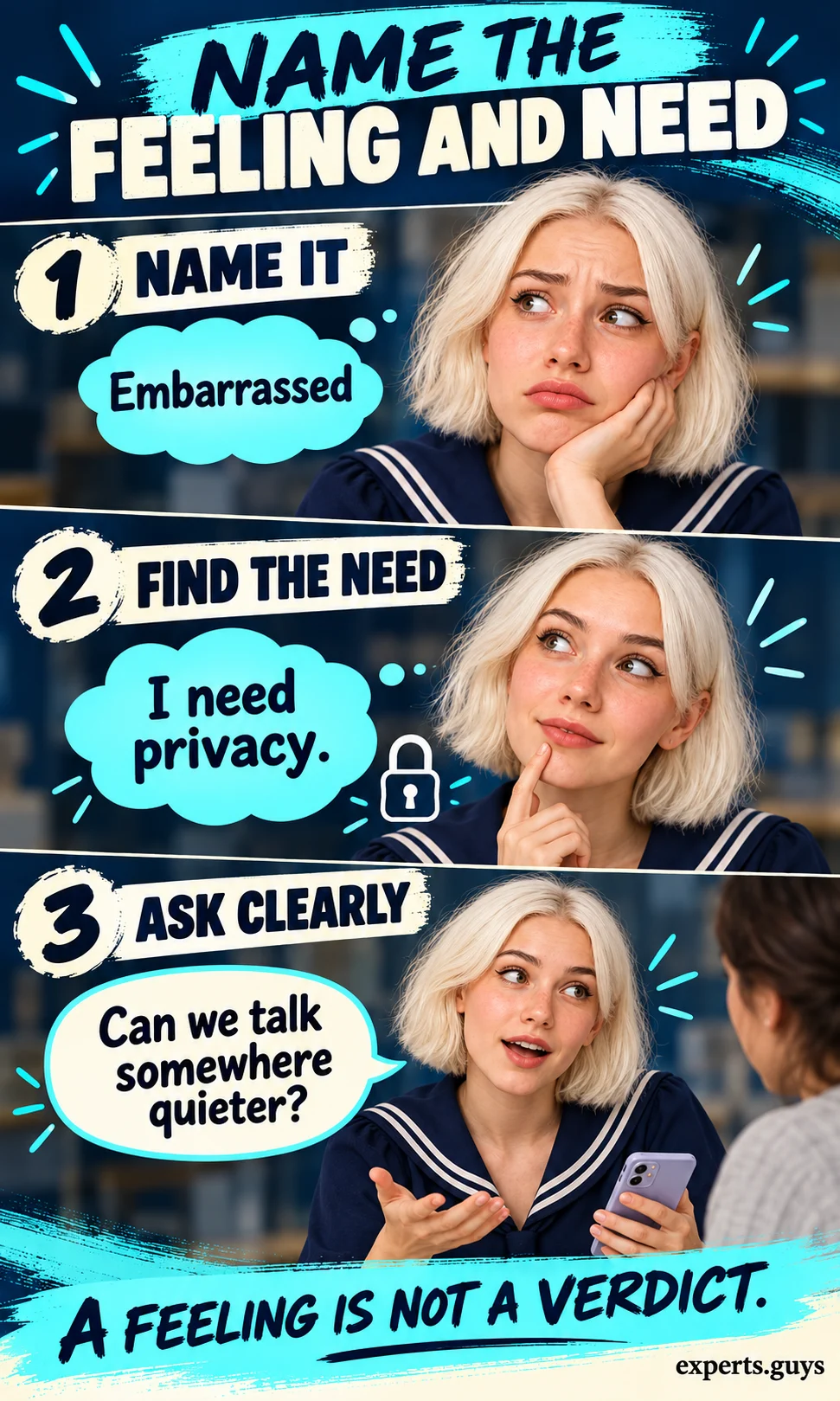
For example: After a joke about you lands badly, “I feel embarrassed and need privacy” can become “Can we talk somewhere quieter?”
Adjust and check: Do not spend the whole break searching for a perfect emotion label. “I am upset and do not know why yet” is a valid starting point. Check whether the request makes your need clearer, and remember that feeling rejected does not by itself establish what another person intended.
| If the reset feels harder | Change this | Check |
|---|---|---|
| Too much to notice | Use one neutral object | Can you follow one instruction? |
| The room remains overwhelming | Use an agreed quieter space | Can an adult reduce the input? |
| You are physically unwell | Tell an adult and seek appropriate assessment | Do not assume new or severe symptoms are only stress. |
How can I cope with school pressure without endless planning?
5. Sort competing school deadlines
Use this when several assignments all feel equally urgent. The immediate job is to identify a real priority and any workload that needs renegotiating. A school portal or calendar can supply the facts without building an elaborate tracking system.
- Check the actual due dates and requirements in the school portal or messages.
- Choose one priority using the deadline and the consequence of delay; ask a teacher if these conflict.
- If the workload is unrealistic, request one specific change and wait for confirmation.
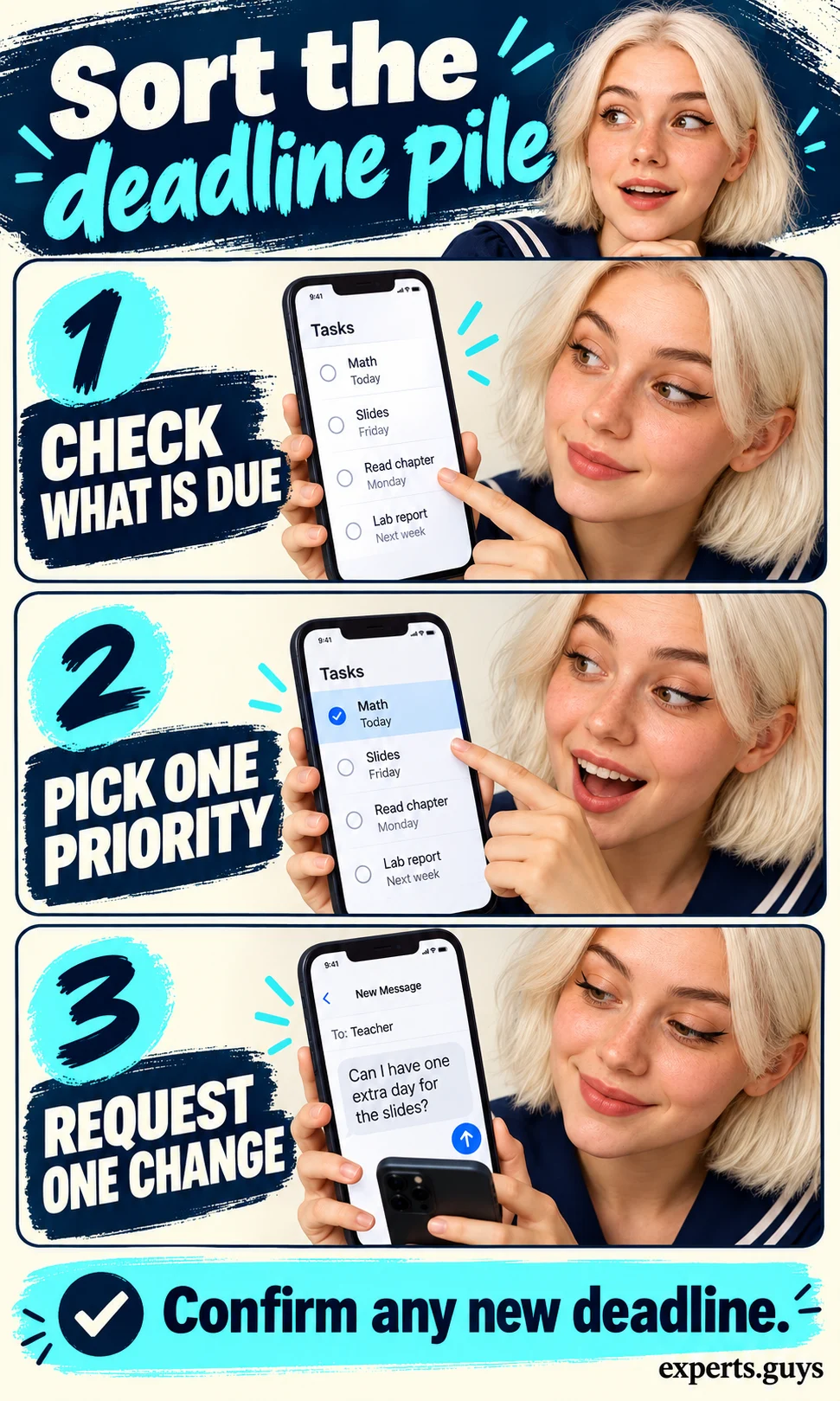
For example: Math is due today and slides are due Friday. Start with the math, then ask, “Can I have one extra day for the slides?” if the remaining workload will not fit.
Adjust and check: A requested extension is not an approved extension. Keep the original deadline until the teacher confirms a change. If checking the whole portal feels too much, ask someone to look at the next due item with you; success means you know what comes first and what remains unresolved.
6. Rehearse the first sentence
Use this before a presentation or a safe conversation that feels intimidating. Practising the opening removes one decision from the moment you begin. It is preparation, not a promise that you will feel no nerves.
- Choose the opening sentence and keep it on a phone or laptop if school rules allow.
- Say it to one supportive person, then practise the next line if that feels manageable.
- Try the next suitable step, such as speaking to a small group or using the opening in class.
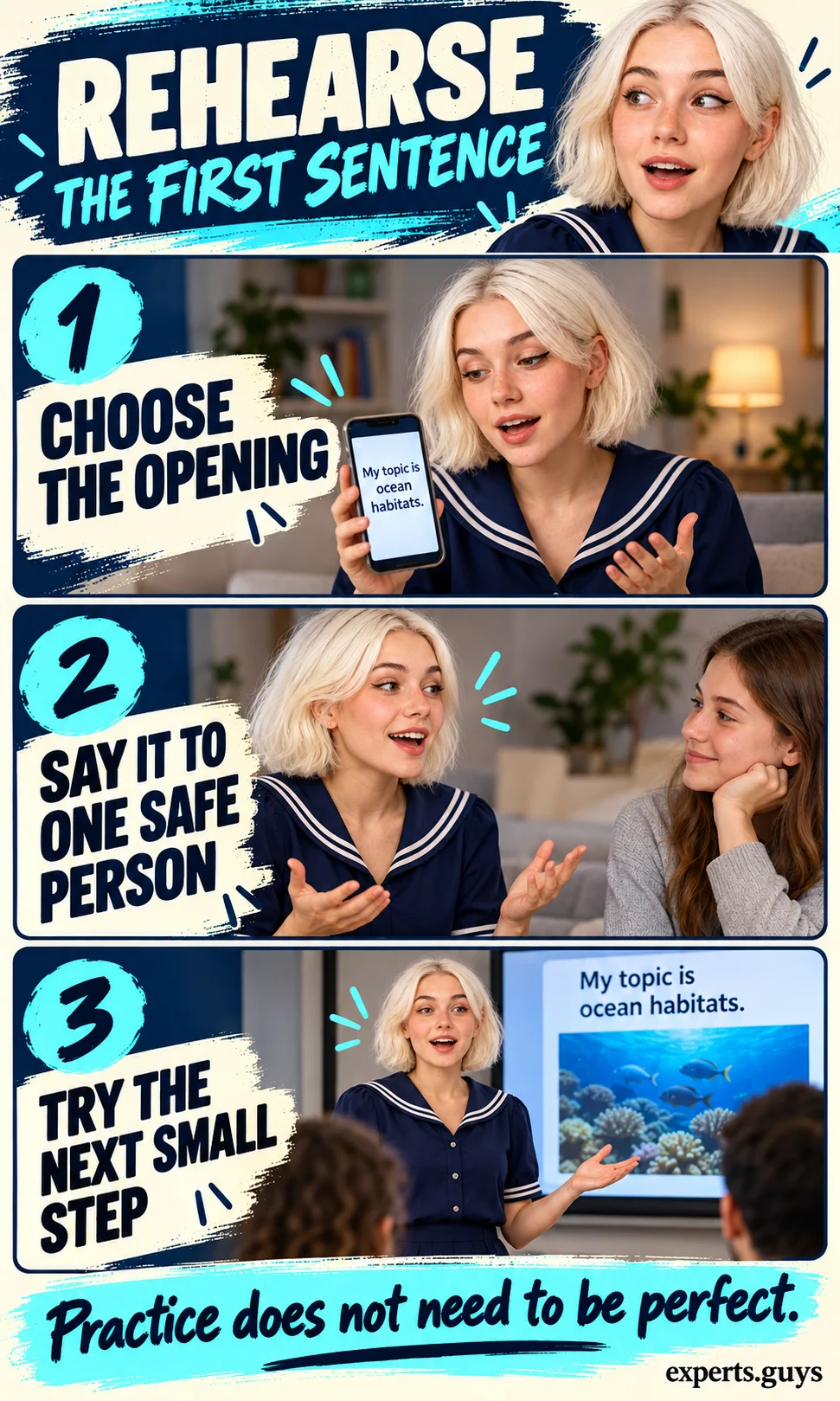
For example: “My topic is ocean habitats” gives you somewhere to start. Your next step might be explaining one slide to a friend before presenting it to the class.
Adjust and check: Restarting every time your voice shakes can turn rehearsal into perfection checking. Let a practice run be imperfect and ask for a smaller audience or other agreed adjustment if needed. Progress is getting through the opening with support, not eliminating every sign of anxiety.
7. Separate your part from what you cannot control
Use this when a group assignment or another person’s response keeps occupying your attention. Sorting responsibility helps you identify an action without pretending the whole situation is your job. You can do the comparison mentally or on a screen.
- Name the specific problem rather than the entire week.
- Separate what you can do from what you cannot make someone else do.
- Choose one action on your side, and ask for help where responsibility is unfair or unclear.
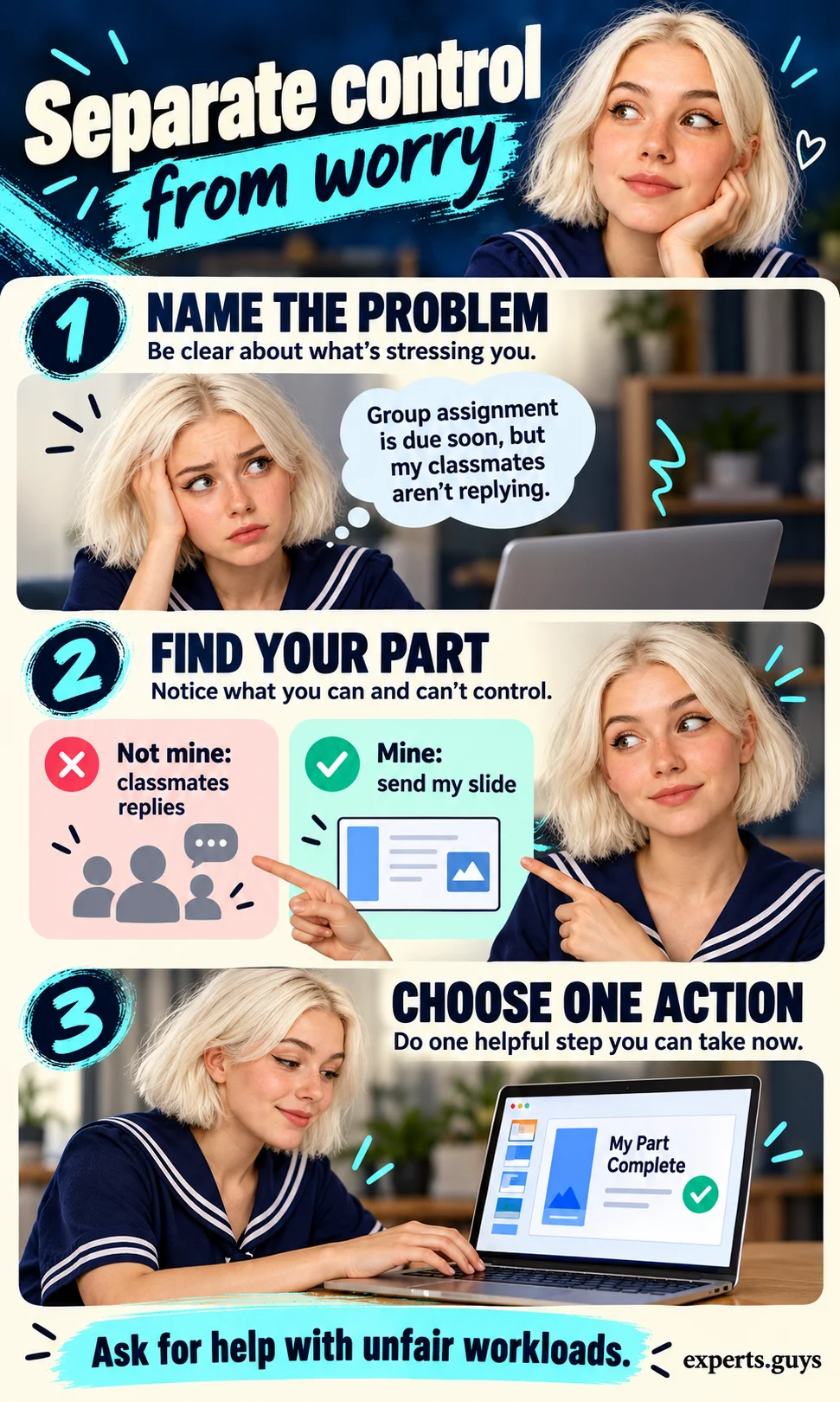
For example: You cannot make classmates reply tonight. You can send your own slide and tell the teacher which part of the group work is still unassigned.
Adjust and check: “Not in my control” does not mean “I must accept mistreatment.” If someone is threatening you, adult protection matters more than this exercise. For an ordinary project, check whether you can name your next action without taking over everybody else’s work.
8. Set a good-enough finish point
Use this when repeated polishing keeps a completed assignment from being submitted. The finish point should come from the actual requirements, not from guessing what a perfect student would do. This protects essential checks while giving optional changes a stopping point.
- Read the required criteria, such as answering the question, including evidence and attaching the right file.
- Fix an essential missing item before spending time on optional appearance changes.
- When the requirements are met, submit and check that the upload was received.
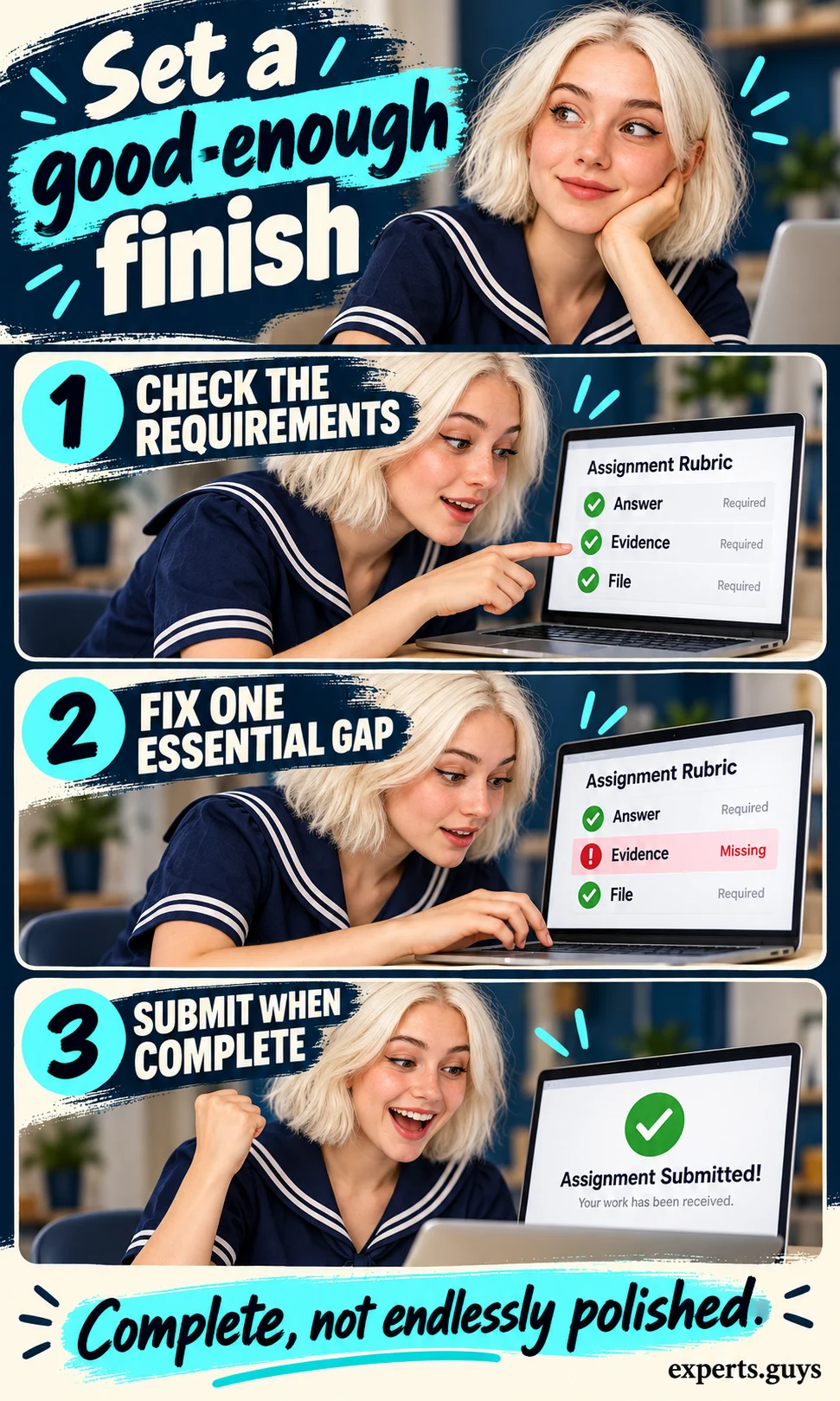
For example: An essay with its answer and evidence in place may need the correct file attached more than a fifth font change. The illustration’s first panel identifies requirements; its second shows a gap to correct.
Adjust and check: “Good enough” is not permission to skip required work or ignore safety checks. Ask the teacher what the minimum acceptable version includes if the brief is unclear. The checkpoint is a complete submission, not whether you feel perfectly certain about your grade.
What helps with friendship conflict and asking for support?
9. Say a clear boundary
Use this when someone asks for more time or work than you can give. A boundary explains what you will do; it cannot guarantee that another person will like the answer. Keep it short enough to repeat without constructing a defence.
- State the limit clearly and respectfully.
- If the person keeps pushing, repeat the same limit once rather than adding more explanations.
- End the exchange safely when needed and involve a trusted adult if pressure becomes threatening.
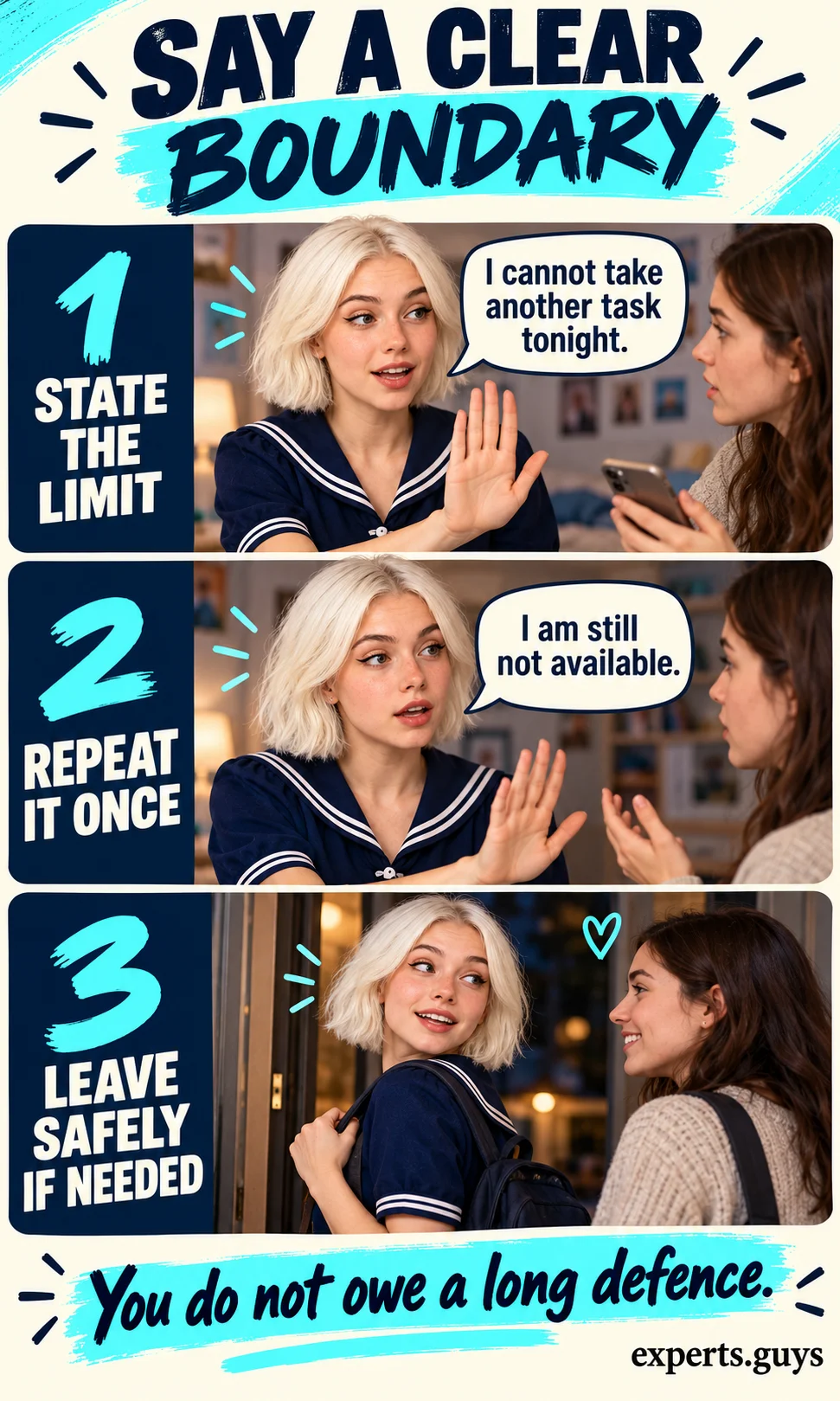
For example: “I cannot take another task tonight” is a complete boundary. If pressed, “I am still not available” keeps the meaning intact.
Adjust and check: Adding a new excuse each time can invite an argument about every excuse. If speaking feels difficult, use a short message or have a safe adult nearby. Judge success by whether you communicated your limit safely, not by whether the other person immediately agreed.
10. Repair a safe disagreement
Use this after an ordinary disagreement with someone who can talk without intimidation. A repair separates your responsibility from the whole conflict. You can acknowledge your behaviour without accepting blame for things you did not do.
- Wait until you can both speak more calmly and choose a suitable moment.
- Name the part you genuinely own without adding an accusation to the apology.
- Ask for one specific change in how the conversation continues.
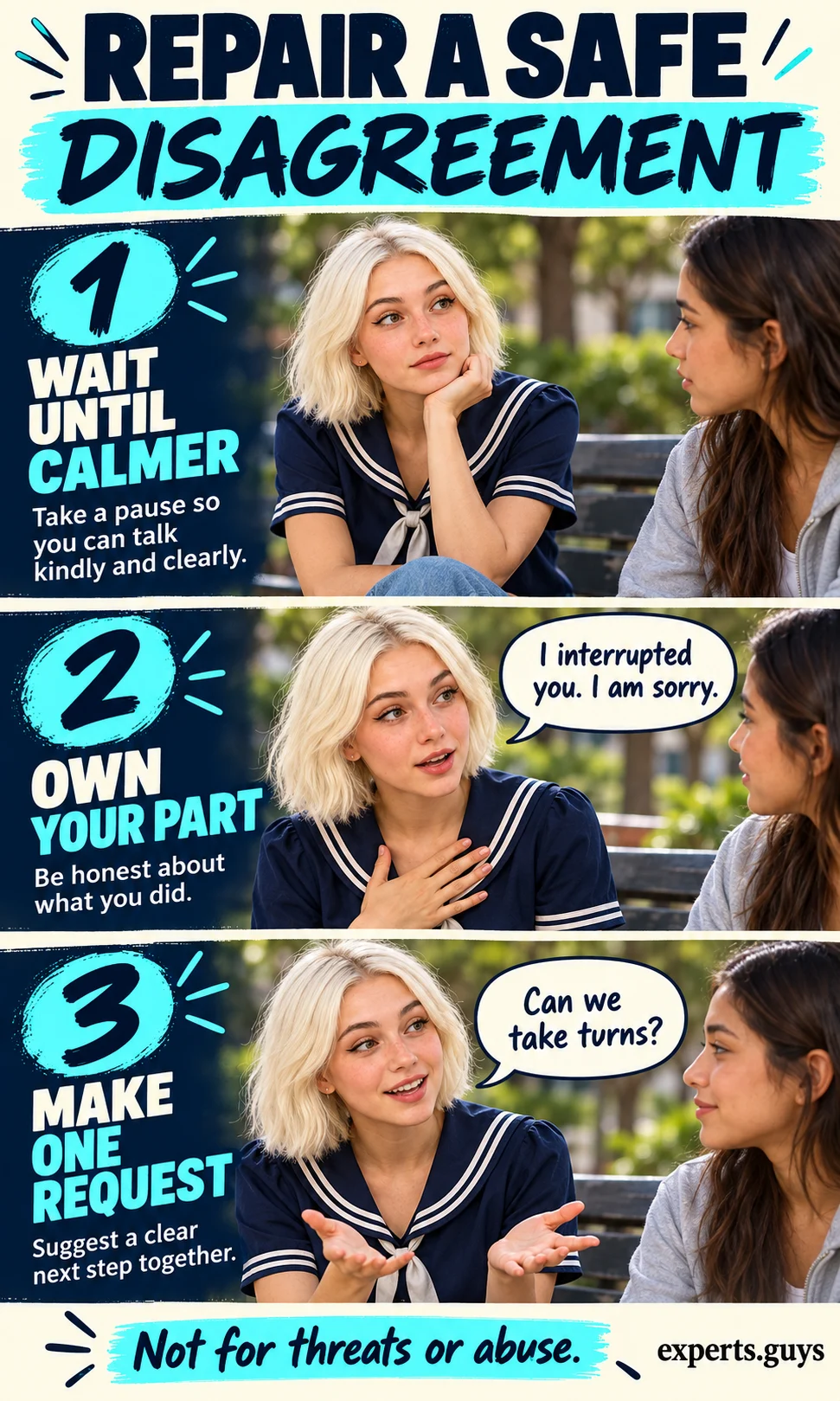
For example: “I interrupted you. I am sorry. Can we take turns?” is more usable than arguing over which person is always the problem.
Adjust and check: An apology followed by “but you made me” usually restarts the blame. If speaking face to face is too much, ask whether a short message would be welcome. Look for a safer next exchange; threats, coercion and abuse call for protection rather than a mutual repair exercise.
11. Ask for the kind of support you need
Use this when you want company or help but people keep guessing what to do. Naming the kind of support can make the conversation more useful. A trusted adult is particularly important when distress affects school, daily life or safety.
- Choose someone who treats you safely, such as a parent, teacher, relative or school counsellor.
- Name the difficulty in a sentence, spoken or sent privately.
- Ask for listening, help deciding, or company while you take the next step.
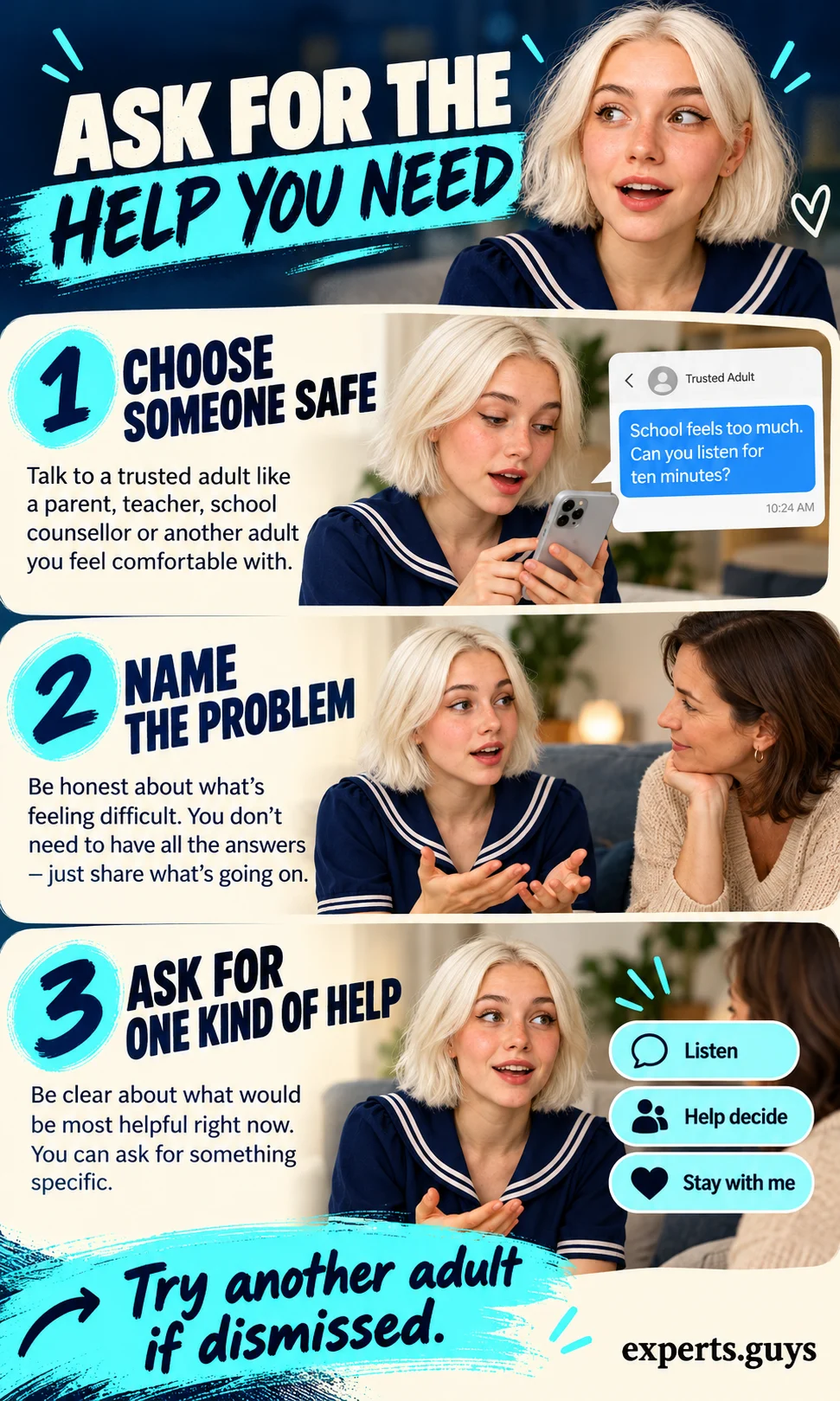
For example: “School feels too much. Can you listen for ten minutes?” is an example request, not a required duration. “Can you sit with me while I explain this?” is another option.
Adjust and check: Do not wait until you can explain everything neatly. If one adult dismisses you or is unsafe, try another responsible adult. The useful outcome is being heard and agreeing what happens next; a friend should not be made solely responsible for your safety.
How can I make digital life and after-school time less overwhelming?
12. Reduce comparison triggers in your feed
Use this when a particular account or topic repeatedly leaves you judging your body, achievements or life. Changing what reaches you is a practical boundary, not proof that social media caused a mental-health condition. Keep useful contact routes available.
- Notice which account or topic repeatedly makes the experience worse.
- Use that app’s mute or unfollow option, whose location varies by service.
- Leave the feed and return to a chosen offline activity or supportive conversation.
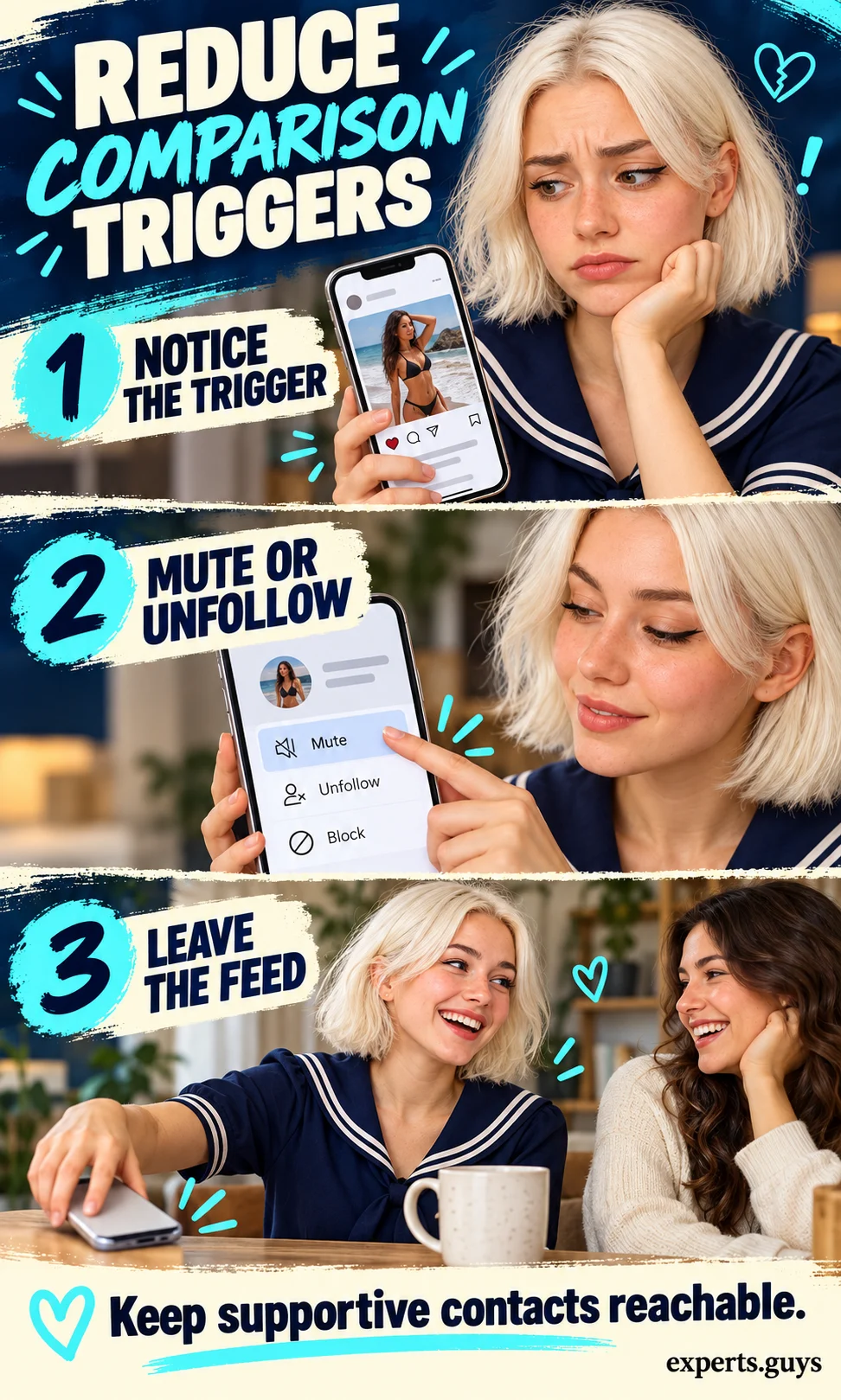
For example: If a stream of grade-comparison posts keeps pulling you into checking, mute that account and put the phone down before joining someone nearby. You do not have to announce the change publicly.
Adjust and check: Replacing one stressful feed with another does not give you much distance. If you cannot change account settings, take a break from that feed and ask a safe adult about the options. Check whether unwanted content is showing up less; persistent harassment needs additional support.
13. Build a return point into an after-school pause
Use this when you arrive home full of tension and immediately face another demand. A short transition creates room between two parts of the day. Its length should fit your household and needs, not an invented therapeutic timer.
- Agree a brief pause and a clear return point, such as the end of a chosen song.
- Do one low-demand activity you find settling, such as listening to that song in a comfortable place.
- At the return point, rejoin one next task or tell the adult what still feels difficult.
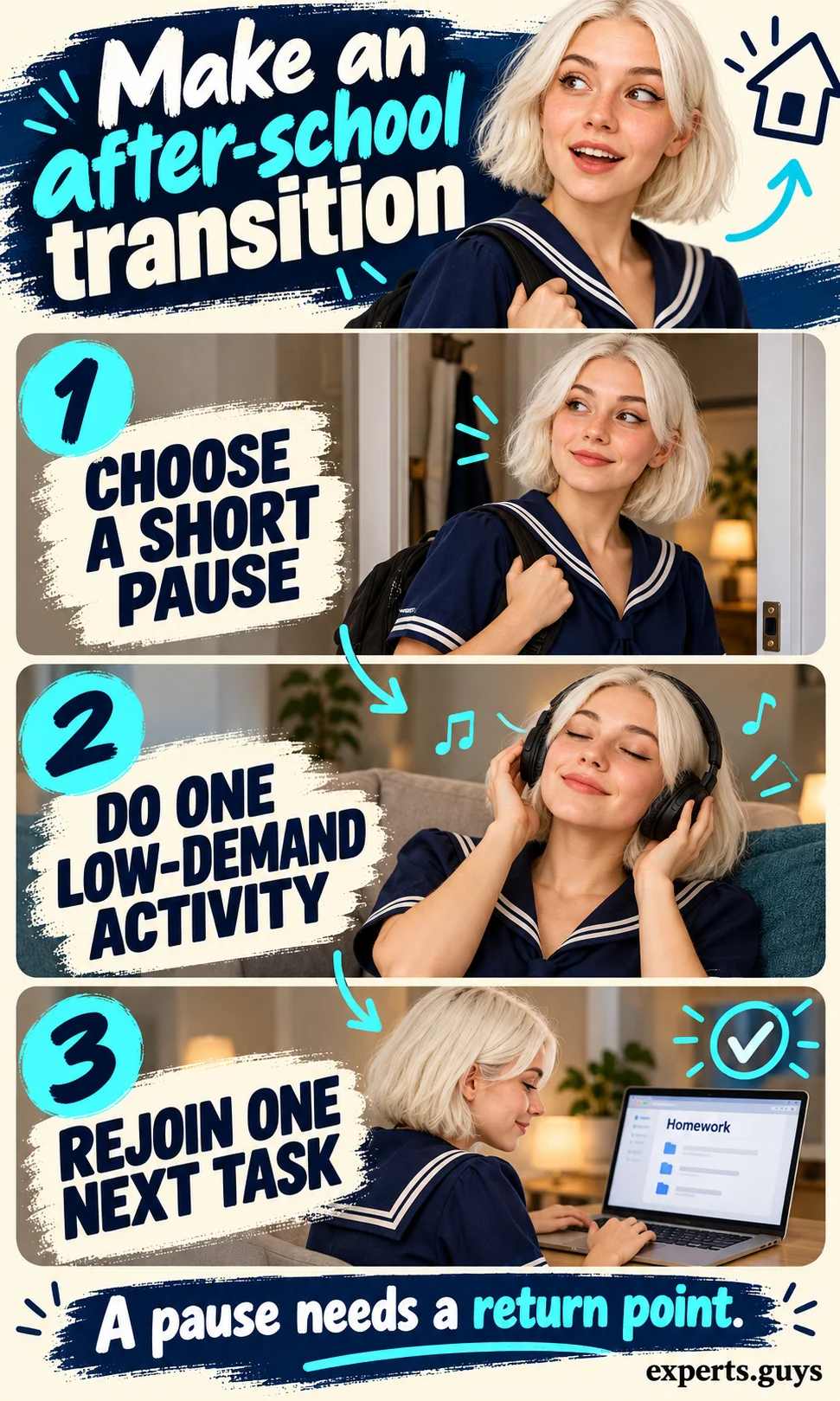
For example: “I need a short quiet break, then I can talk about homework” makes the transition visible to other people. A pause can happen in a shared room if there is no private space.
Adjust and check: An open-ended scrolling session can make returning harder. Choose something with a natural ending, and shorten or change it if it leaves you more wound up. A useful pause helps you rejoin the evening; repeated exhaustion or inability to function needs a broader conversation.
When coping skills are not enough
If low mood, irritability, loss of interest or changes in sleep and eating persist for weeks or affect school and relationships, involve a trusted adult and arrange a health assessment. Do not wait for a time threshold when symptoms are severe, getting worse or affecting safety. NIMH’s teen depression guidance explains the signs that need attention and the available treatment routes.
You can explain the difficulty without producing a detailed symptom diary. Say what has changed, roughly when it started and which part of daily life is becoming difficult. If speaking is hard, show a short phone message; if the first adult cannot help, ask another safe adult to stay involved.
For ongoing depression-related difficulty with meals, sleep or daily activity, our guide to six coping skills for depression in teens and adults covers that different daily-life task. This page concentrates on school situations, communication and digital pressure. Neither page asks you to manage a serious mental-health problem alone.
Frequently asked questions
Do I need a phone to use these coping skills?
No. You can name a feeling silently, rehearse an opening aloud or ask a teacher directly. Phones are optional for messages and school information; follow school rules and use a safe alternative when a device is unavailable.
What if my parents are not safe people to talk to?
Choose another responsible adult, such as a teacher, school counsellor, relative or healthcare professional. You do not have to confront an unsafe person before asking for help. If danger is immediate, move toward a safe person or place and contact local emergency services.
Can I use these skills if I am autistic or have ADHD?
Some may be useful, but your sensory, communication and attention needs should shape the choice. A quieter space, clearer instructions or adult help organising demands may matter more than repeating a coping exercise. Ask for appropriate accommodations rather than treating overload as a personal failure.
How long should I keep trying a skill that does not help?
There is no required number of attempts. Stop if a method increases distress, feels unsafe or makes you feel more disconnected. Try a simpler version or another kind of support, and involve a trusted adult when difficulty persists or interferes with daily life.
Can a friend be my only support?
Friends can listen and keep you company, but they should not carry sole responsibility for a serious mental-health or safety concern. Bring a responsible adult into that situation. You can ask your friend to sit beside you while you make the first contact.
Does feeling calmer mean the original problem is solved?
Not necessarily. A pause can help you respond, while an unfair workload, repeated harassment or a difficult home situation may still require action by adults. Check what changed in the situation as well as how you feel.
Your next step
Choose the skill that matches today’s situation and use its smallest workable version. Afterwards, ask whether you can do the next useful thing, such as rejoin class, make a request or leave a message unsent. If the obstacle remains, change the support or the situation rather than blaming yourself for not becoming calm enough.
Sources and further reading
- AACAP: Stress Management and Teens – broad stress-management, assertiveness, rehearsal and realistic-expectation guidance.
- UNICEF: Supporting teens during stressful times – listening, achievable demands and calmer conflict conversations.
- UNICEF: Supporting overwhelming feelings – identifying what can change and what cannot.
- Newcastle Hospitals: Coping with panic attacks for young people – grounding principles; the classroom version here is an editorial adaptation.
- US Surgeon General: Social media and youth mental health – digital boundaries, benefits, risks and evidence limits.
Images are AI-created instructional illustrations using a recurring model. They do not depict a patient, a clinical assessment or a demonstrated treatment result.