




Recovery from borderline personality disorder (BPD) can involve substantial improvement, but fewer symptoms and a more manageable everyday life are not identical outcomes. A useful conversation about progress separates what has eased, what remains difficult and which practical support is needed next. Neither a difficult week nor one unfinished goal tells the whole story.
Someone might have fewer crises and still find work difficult. Another person might be meeting responsibilities while feeling disconnected and exhausted. Those descriptions answer different questions. Treating one visible result as the final verdict can overlook both meaningful gains and continuing needs. This guide explains recovery language and offers a way to discuss practical goals without assigning yourself a score, making a diary or copying someone else’s timetable.
The central recommendation is to make the word “better” specific. Better in which part of life, under what conditions, and with what support? That is a more useful starting point than deciding whether a person has earned an all-or-nothing recovery label. The examples below are fictional educational illustrations, not patient histories, treatment prescriptions or promises about an individual outcome.
Recovery is a useful question, not a character test
The name borderline personality disorder can be misheard as a statement that a person’s character is permanently defective. It is not a moral assessment. The NIMH overview of BPD describes difficulties involving emotions, self-image and relationships, and explains that effective treatment is available. A diagnosis provides a clinical framework; it does not determine someone’s worth or reveal every part of their life.
Recovery language becomes unhelpful when it is used to judge effort from the outside. “You should be over this by now” assumes a timetable without knowing the person’s circumstances. “You worked today, so you are fine” treats one activity as a full assessment. The opposite mistake is to ignore an improvement because another problem remains. Both shortcuts replace a complicated account with a verdict that may not match what the person is experiencing.
A fairer question is what the person means by recovery and what their care team means when using the term. A research paper may define an outcome narrowly so it can be measured consistently. A person may use the same word to describe greater choice, more stability, renewed connection or a life that feels more their own. These meanings can inform each other, but they should not be silently substituted for one another.
Separate symptoms, daily life and connection
The first skill is to unpack a broad claim into the question it answers. “What has eased?” concerns symptoms or distress. “What is easier to manage?” concerns daily activities and responsibilities. “What support feels available?” concerns the person’s experience of connection. These are conversation prompts, not a clinical scale. They help prevent the word recovery from carrying more information than the speaker has actually provided.
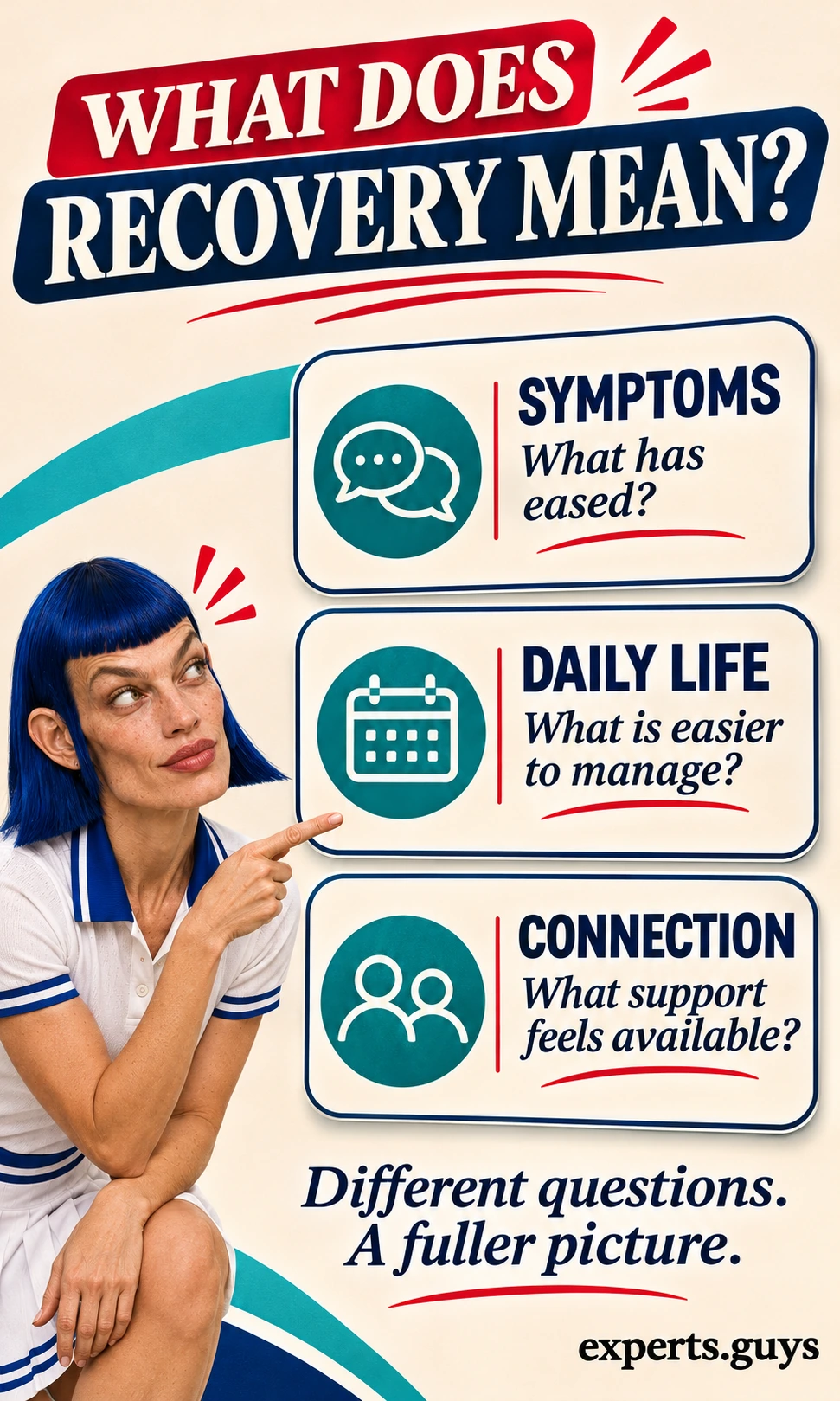
For example, someone might say, “I no longer lose an entire evening to the same argument.” That describes a particular change. It does not establish that their work situation, finances or relationships are now easy. It also does not need to establish those things for the change to matter. You can acknowledge the gain while asking which part of life still needs attention, rather than making the person defend a global claim that everything is better.
The categories are not independent boxes with a required order. A practical obstacle can affect access to support; an unavailable work schedule can make an activity harder to sustain. The purpose of separating the questions is clarity, not a theory that each part of life changes on its own. If a description does not fit these prompts, use language that does. The person should not have to compress their experience to satisfy an illustration.
| Question | Illustrative description | What remains open |
|---|---|---|
| What has eased? | A particular source of distress or disruption is less prominent. | Whether other symptoms or difficulties have changed. |
| What is easier to manage? | A chosen activity or responsibility is more manageable. | What support makes it possible and whether the arrangement is sustainable. |
| What support feels available? | The person describes a useful source of connection. | Whether that support matches their needs and respects privacy. |
| What does a research term mean? | A paper uses a defined outcome over a specified period. | Whether the definition fits the question being asked about one person. |
What long-term studies actually measured
A 2010 ten-year follow-up study by Zanarini and colleagues followed 290 people originally assessed as inpatients with BPD. Over the study, 93% attained symptom remission lasting at least two years, while 50% attained the study’s broader recovery outcome, which also required good social and vocational functioning. These were cumulative findings under defined research criteria, not the proportion guaranteed to recover within a personal deadline or evidence that one treatment caused the outcomes.
The useful lesson is to read the outcome definition before using the headline. “Remission” and “recovery” were different measures in that study. A separate ten-year Collaborative Longitudinal Personality Disorders Study report also examined symptoms and functioning and found that improvement in symptoms did not automatically mean equally strong functional improvement. The studies describe particular groups, methods and periods; neither is a personal forecast or a contemporary comparison of available treatment programmes.
The dates matter. These are historical follow-up studies that help clarify an enduring measurement distinction, not newly collected outcomes for today’s services. Different studies can use different definitions and include different people. A percentage without its population, outcome and follow-up period is incomplete information. It should not become a target imposed on one person’s life or a reason to conclude that a slower course reflects insufficient effort.
Why a study percentage is not your deadline
Imagine a headline says that people improved “over ten years.” That does not necessarily mean every improvement happened at the ten-year point. It also does not mean nothing useful happened before then. In a follow-up study, the phrase describes the observation window. The researchers’ timing, assessment intervals and outcome requirements are part of how the result was produced. Removing those details can turn a description into an instruction the study never gave.
There is another distinction between having attained an outcome at some point and meeting it at every later assessment. A headline can hide that difference. If you are using a finding to understand what might be possible, it is reasonable to ask what was counted. If you are using it to decide what a particular person should achieve by next month, the finding is being asked to do a different job.
You do not need to calculate your own probability from a paper. A useful reading ends with an accurate statement of the result and its limits. “This study distinguished symptom change from broader functioning” is a defensible takeaway. “This gives me an exact recovery date” is not. If the numbers make you feel compared or graded, return to the practical question the headline cannot answer: what difficulty needs attention in your own circumstances now?
Mixed progress does not cancel itself out
The second skill is to describe a gain and an unmet need in the same account. “There have been fewer crises, and keeping up with work is still difficult” is more informative than either “Everything is fine” or “Nothing has improved.” It does not force an optimistic interpretation. It simply retains two relevant facts instead of allowing one to erase the other. This is useful when a review or family conversation keeps collapsing into a single verdict.
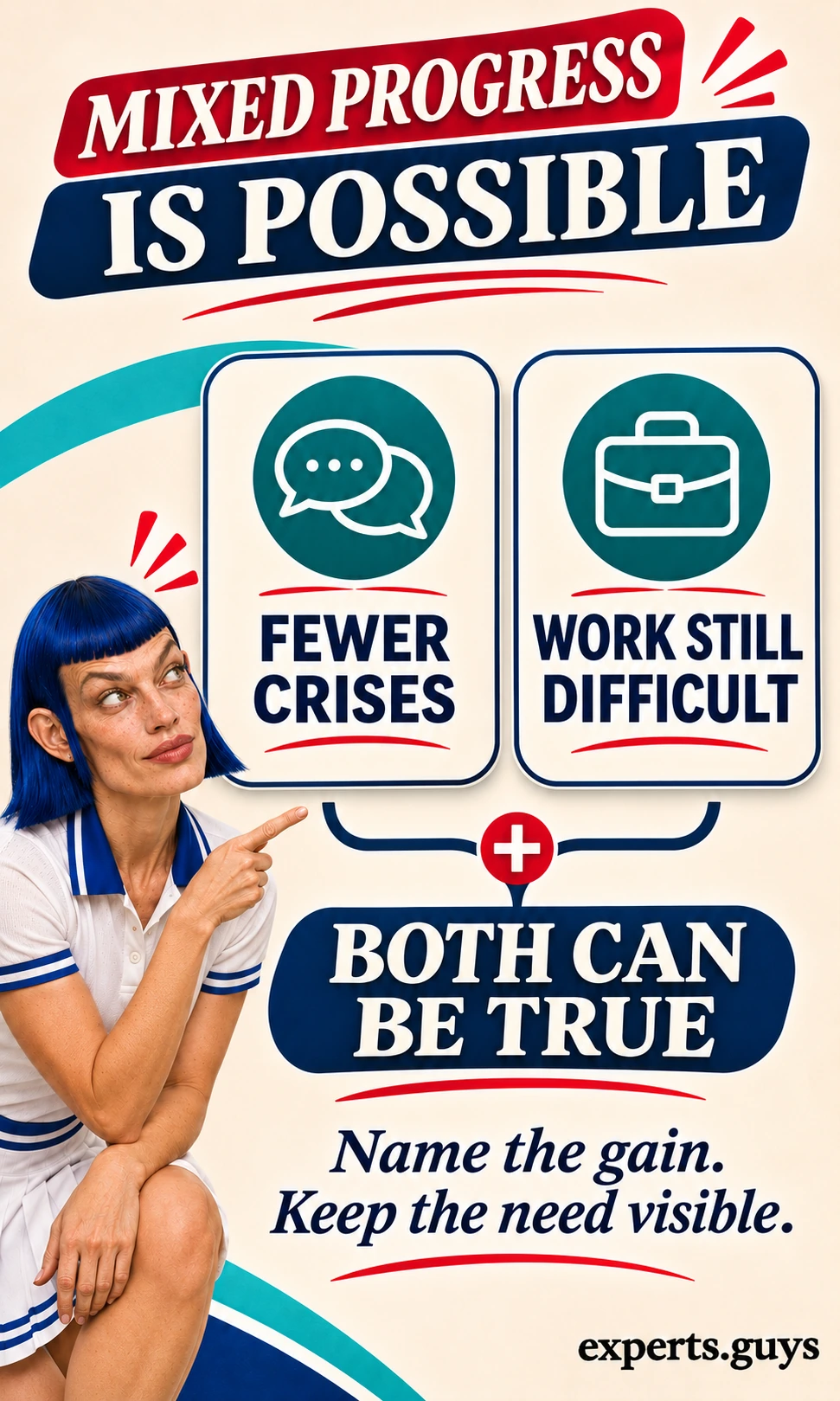
To use the skill, choose the part that has changed and name the part that has not. Keep the comparison specific enough that the two statements make sense together. For example, fewer arguments at home and continuing difficulty travelling to work concern different activities. If you are uncertain whether something changed, say that rather than supplying a confident answer. The skill is an accurate account, not a requirement to find a positive result in every situation.
A common mistake is to add a dismissive “but” that makes the first statement disappear: “Yes, that improved, but you still cannot do this.” The problem is not a forbidden word; it is the implication that the remaining need invalidates the gain. A clearer conversation asks what each statement means for the next decision. One may support continuing something helpful, while the other identifies an obstacle that the current arrangement has not addressed.
The observable result is a fuller sentence, not proof of recovery. Someone hearing it should understand both why an improvement matters and why further support may still be needed. You can say the sentence aloud without preparing a written history. A supporter can reflect it back and ask whether they understood correctly, rather than interpreting the gain as permission to withdraw all help or the remaining difficulty as evidence that nothing worked.
A worked example: fewer crises, an unchanged work barrier
Consider Maya, a fictional person who says that urgent conflicts are less frequent but that she is still missing an early shift. Her manager sees the absence; a family member notices calmer evenings. If each observer treats their own view as the complete picture, one may conclude that no progress exists while the other assumes the work problem should have disappeared. Neither conclusion follows from the limited information each person has.
Maya’s immediate practical question might be what makes the shift difficult. In this example, suppose an unreliable connection between two buses is part of the problem, and assume there is no immediate safety concern. That logistical fact does not establish the cause of every absence or remove any clinical needs. It does show why “Try harder because you are doing better” is an incomplete response to the situation described.
The useful discussion can preserve the emotional improvement while identifying the transport constraint. Possible arrangements would depend on the actual job, available routes, cost and workplace process. The article cannot choose an accommodation or promise that an employer will agree. The example teaches a narrower point: a practical barrier should be named as a practical barrier, rather than automatically reclassified as a symptom or a failure of motivation.
Now change the assumption. Suppose Maya says the journey is available, but intense distress makes leaving home difficult. The next conversation would concern a different obstacle and the support appropriate to it. Identical missed shifts can therefore call for different questions. The recovery label alone does not identify the barrier. Clarifying the obstacle helps avoid solving a transport problem with reassurance or treating distress as though it were only a scheduling issue.
Make one goal meaningful: activity, obstacle, support
The third skill turns a broad wish into a practical topic for discussion. Start with an activity that matters to you: something you want to do, resume, sustain or make more manageable. Then name the obstacle as accurately as you can. Finally ask what support or change in conditions could make the activity more possible. You do not need a score, an elaborate plan or a claim that the activity proves recovery.
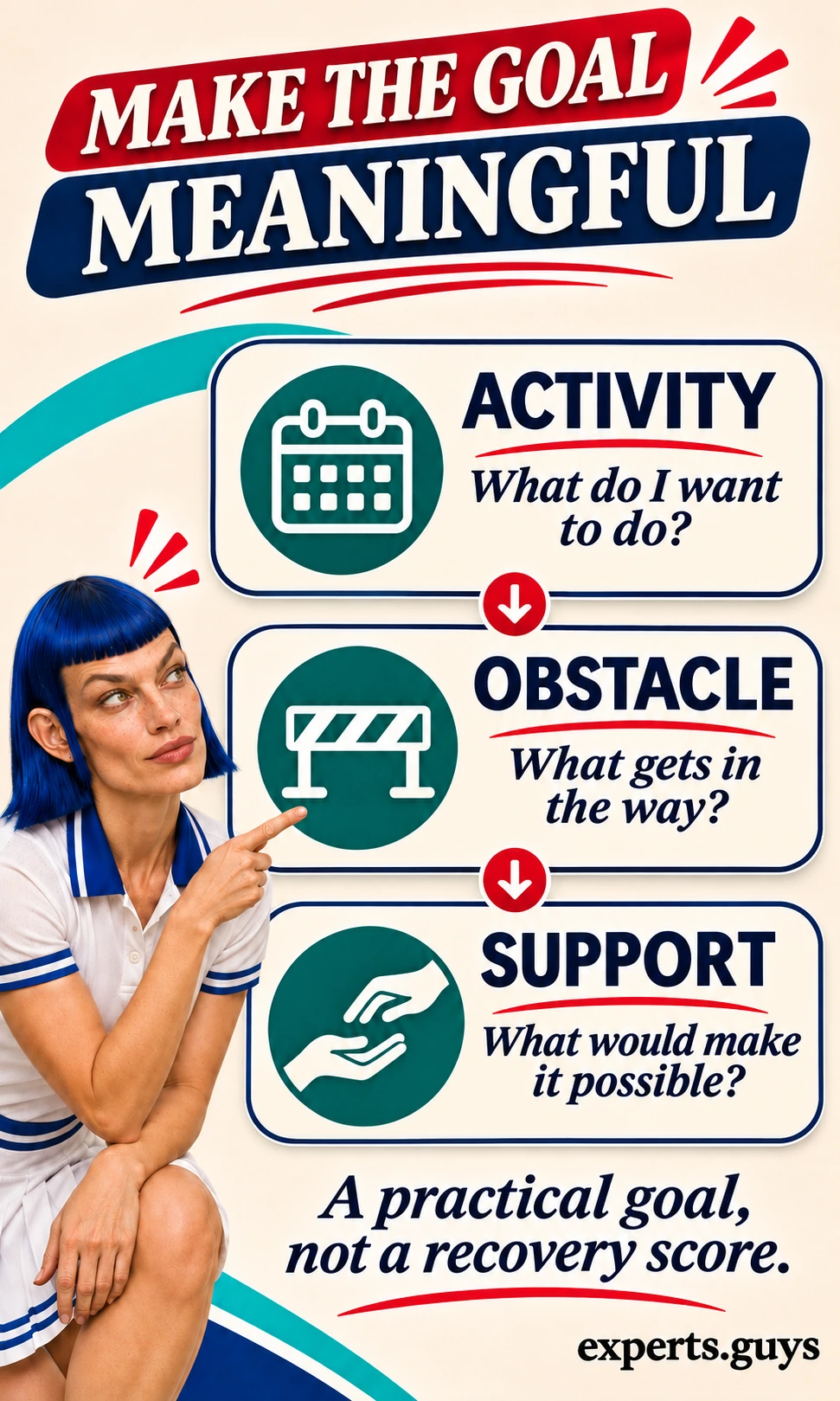
For example, “I want to be more independent” can mean many things. “I want to attend the evening class I chose” identifies an activity. The obstacle might be cost, transport, a timetable conflict, distress, accessibility or uncertainty about the class. Those possibilities are not interchangeable. Naming one prevents a helpful-sounding suggestion from answering the wrong problem. If you do not yet know the obstacle, identifying that uncertainty is a useful part of the conversation.
The support question should match the obstacle. Information about an accessible entrance answers a different need from a change in class time or a discussion within treatment. Some barriers have practical solutions; others require specialist input or remain outside your control. The exercise does not promise that every obstacle can be removed. It gives the next conversation a concrete subject and makes clear which assumptions need checking before a suggestion is useful.
Keep the activity chosen by the person rather than treating it as a test set by an observer. Full-time work, a romantic relationship, a crowded social life and complete self-sufficiency are not universal personal requirements. Someone may have caring responsibilities, a disability, a different preferred way of living or limited available opportunities. A meaningful goal needs to fit the actual life, rather than an idealised picture of what a recovered person ought to look like.
Use an achievable description without creating a performance test
A practical goal is easier to discuss when the action is recognisable. “Understand the joining arrangements for the class” describes a different stage from “Attend every session this term.” Neither is inherently the correct first goal. The relevant stage depends on what is currently uncertain and what resources are available. Smaller wording is useful when it identifies a genuine next decision, not when it disguises a demand that someone constantly demonstrate progress.
Be careful with conditions outside the person’s control. “Get hired this week” depends partly on employers and available jobs. “Ask what the application requires” identifies an action, but even that may need access or support. The purpose of distinguishing these is not to make someone responsible for every obstacle. It is to avoid interpreting an unavailable outcome as conclusive evidence about their willingness or clinical improvement.
The same goal can need different support over time. A person might initially want company for an unfamiliar activity and later prefer privacy. Another might need an ongoing adaptation. Continued support does not automatically make the activity less meaningful, and removing support is not the only possible measure of success. If an arrangement is useful and sustainable, the relevant question is whether it serves the person’s needs—not whether it resembles an observer’s preferred version of independence.
| Broad statement | Question to clarify | Why the distinction matters |
|---|---|---|
| I want to be independent. | Which chosen activity do you want to do or manage? | Independence can mean different things and need not require removing all support. |
| I cannot attend the class. | What is the current obstacle: access, cost, timing, distress or something else? | A suggestion is useful only if it addresses the actual obstacle. |
| Nothing has changed. | Is one part unchanged while another part has become easier? | A mixed account can preserve both a gain and an unmet need. |
| I must match someone else’s milestone. | Is that activity meaningful in your own life and circumstances? | A public story is not a personal timetable or a universal goal. |
Keep treatment goals and everyday goals connected
The American Psychiatric Association’s 2024 BPD guideline summary recommends a person-centred treatment plan, collaborative discussion and a structured psychotherapy approach supported by evidence. That provides a clinical context for discussing goals. An everyday activity can help explain what matters to the person, while clinical assessment determines how symptoms, risks, other conditions and treatment options should be addressed.
A conversation about an activity is not a replacement for that work. You might say, “This is the part of my week I want help to make possible,” rather than arriving with a treatment conclusion drawn from an article. A clear practical description can also reveal a mismatch: the care conversation may be focusing on one difficulty while the person is most concerned about another. Naming the mismatch makes it available for discussion without assuming that either perspective is the complete account.
This page does not choose medication or offer a self-directed therapy programme. A prescription, a particular therapy name or attendance at a session cannot by itself demonstrate broader recovery. If the distinction between diagnoses is the main source of uncertainty, the separate BPD and bipolar comparison addresses that question. Here the practical concern is how the intended help connects with the life the person wants to lead.
A setback needs context before it becomes a verdict
Suppose an activity that had become manageable is difficult again after a change in circumstances. There may be something important to review, but the single word failure does not identify it. The activity–obstacle–support questions still apply. What changed about the demand? Is the earlier support still available? Does the current difficulty resemble the earlier one, or is there a new issue? These are ways to clarify a discussion, not an algorithm for deciding what caused a setback.
The response should fit the concern. An unavailable bus route, a conflict at home, a worsening symptom and an immediate safety threat do not call for the same action. Avoid forcing every change into a recovery narrative simply because BPD is part of the person’s history. Ordinary practical problems remain ordinary practical problems when that is what the evidence shows; clinical deterioration should not be dismissed as a character flaw or an inevitable stage.
If there is immediate danger, serious injury, an overdose or an inability to stay safe, contact local emergency services or an emergency department now. An existing crisis plan can provide agreed routes for urgent support. Do not delay an appropriate response while deciding whether the event counts as a setback, a relapse or proof about the diagnosis. Those labels do not take priority over the actual level of risk.
How supporters can recognise progress without taking control
A useful response asks what the change means to the person. “You said the journey was easier this week; what made the difference?” leaves room for their explanation. “You are cured now” attaches a conclusion they may not share. Even a well-intended celebration can create pressure if it implies that future difficulties would disappoint the supporter or invalidate the earlier gain. Keep the recognition attached to what the person actually described.
Support can also become intrusive when it turns every interaction into a review. A person may want to enjoy a meal, talk about an ordinary interest or have privacy rather than answer questions about progress. Ask what involvement is welcome and what role you can realistically sustain. Family members and friends can be supportive without becoming informal clinicians or requiring access to every treatment discussion.
If the main difficulty is responding to conflict, that is a separate skill from interpreting recovery. Understanding a person’s progress does not reveal the intention behind an action. Progress also does not require accepting harmful conduct, and a boundary does not have to be withdrawn because someone has improved. Both people remain entitled to safety, privacy and a clear account of their own responsibilities.
Do not move the measure halfway through the conversation
A discussion becomes confusing when the standard changes without anyone saying so. Suppose the original question was whether a person could attend an activity they chose. They attend, then hear that the visit does not count because they needed company. The new judgment concerns independence, while the original goal concerned attendance. Support needs can be worth discussing, but changing the question after the event can make a real achievement disappear through a change of definition.
The correction uses the first skill again: identify which question is being answered. “Attending was the goal we were discussing; whether I want to go alone is another question” keeps the distinction clear. It does not require declaring the broader task finished. It allows both conversations to happen without pretending that the second standard was always part of the first. This matters especially when several people are involved and each has a different expectation.
The reverse problem is also possible. An observer may celebrate attendance while the person says that the experience remained overwhelming or inaccessible. The fact that an activity happened should not silence information about its cost. Ask what was manageable and what support was missing, using the person’s description rather than assuming that presence means comfort. A fuller account can recognise the event while identifying why repeating it under the same conditions may be difficult.
Another person’s milestone is not your starting point
Recovery stories often arrive at the most visible part: a qualification, a new relationship, an anniversary or a return to work. The practical conditions behind the milestone may be absent from the account. Comparing that ending with your current difficulty omits the resources, opportunities, support and earlier decisions that made the other person’s event possible. Their experience may be encouraging without supplying a fair timetable for yours.
You can take an idea from a story without adopting the whole goal. If someone describes enjoying a course, the useful question might be whether learning interests you and what would make a suitable activity accessible. The answer might be a different setting or no course at all. The activity–obstacle–support skill remains yours to adapt. It is not a requirement to reproduce another person’s chosen life as evidence that your own progress is legitimate.
A fuller picture leaves room for both hope and need
Hope does not require a promise that every part of life will improve at the same pace. Nor does acknowledging an unfinished problem require dismissing a gain. A useful account can say what has become easier, what remains difficult and which conditions would make the next meaningful activity more possible. That account is more informative than a label used without a definition.
The practical endpoint of the three skills is clarity: identify the question behind the recovery claim, retain both sides of mixed progress, and connect a chosen activity to its actual obstacle and support. These are tools for understanding and discussion. They do not grade effort, predict a course or certify recovery. The person remains more than the measure being used to describe one part of their experience.
Frequently asked questions
Does remission mean that every difficult feeling has disappeared?
Not necessarily. A research or clinical term needs its definition; it should not be assumed to mean a life without distress, disagreement or support needs. Ask what outcome is being described rather than filling in the meaning from the word alone. Everyday uses of the term may also differ from the criteria used in a particular study.
Does needing ongoing support make progress less real?
No such conclusion follows simply from the presence of support. A useful adaptation may be part of what makes an activity manageable. The relevant questions include whether it fits the person’s needs, is sustainable and respects their choices. Removing all help is not the only possible personal goal, and an article cannot determine an individual’s clinical support requirements.
Can I use the study percentages to decide whether my treatment has failed?
A group follow-up result cannot settle that individual question. The study’s population, outcome definition and observation period differ from an assessment of your current care. Bring the actual concern into a treatment review: what remains difficult, what help has been available and which goal is not being addressed. Do not change prescribed treatment based on a headline.
What if I do not want work or a relationship to be my main goal?
A research definition does not have to become your preferred life plan. A meaningful goal may concern another activity or way of living. Your priorities, responsibilities, health, access and preferences matter when discussing support. Clarifying what you want is different from promising that any particular service or arrangement will be available.
Can someone look more capable while still needing help?
Completing one activity provides information about that activity, not a complete account of the person’s experience. Ask what was manageable and what it cost rather than deciding from appearance alone. Equally, do not assume concealed illness merely because someone is productive. The person’s account and appropriate assessment matter more than an observer’s confident guess.
Should a recovery checklist tell me when I can stop care?
No generic checklist in an article can make that decision. Changes to care should be discussed within the relevant treatment and support arrangements, taking account of the actual needs and risks. The prompts here clarify a conversation; they are not discharge criteria, a screening tool or a substitute for an individual review.









