
A good travel watch should make a trip easier rather than give you another object to manage. For some travelers, that means a GMT watch that keeps home time visible while local time changes around them. For others, a slim quartz watch, solar watch, smartwatch, or inexpensive everyday watch can be a better travel companion because it is comfortable, dependable, easy to use, and less stressful to carry.
The biggest mistake is choosing a watch because it looks like a “travel watch” instead of asking what the trip actually requires. Crossing several time zones every month creates a different problem from taking one beach vacation, while an overnight business trip has different demands from hiking somewhere with limited access to charging. Water exposure, wrist swelling, bracelet adjustment, battery dependence, destination security, formal clothing, and the number of time zones you need to track can all change which watch makes sense.
There is also no universal feature list that every traveler needs. A mechanical GMT may be excellent for someone who frequently flies internationally, yet unnecessary for a traveler who changes the time once at the beginning of a holiday and does not need to monitor home time. The best travel watch is therefore the watch whose movement, time display, fit, durability, power source, water capability, and replacement risk match the way you will actually travel.
The Best Travel Watch Depends on How You Travel
Start by thinking about the trip before thinking about brands, movements, or complications. A person flying between New York, London, and Singapore for work may value rapid local-time adjustment and a permanent home-time reference, while someone spending ten days at a resort may care much more about water resistance, comfort, and not worrying about scratches. A traveler moving through cities with different security conditions may deliberately prefer a discreet watch even when a more expensive model offers better specifications.
Travel frequency matters as well. If you cross time zones several times each month, small inconveniences such as repeatedly stopping the movement, resetting the minute hand, reconnecting a smartwatch, or calculating home time can become genuinely irritating. If you travel once or twice a year, simplicity may have greater value because you are unlikely to benefit enough from a specialized travel complication to justify additional cost or complexity.
The same principle applies to trip length. A smartwatch that comfortably lasts through a weekend may become inconvenient during remote travel if charging opportunities are uncertain, while a quartz or solar-powered watch can continue working with little attention. Mechanical watches avoid electronic charging but introduce their own considerations, including power reserve, accuracy variation, magnetism, servicing, and the need to understand how the time-setting mechanism works.
First Decide What Time Information You Actually Need
Before comparing GMT watches, world timers, digital watches, or smartwatches, decide how many time references you genuinely need on your wrist. This single question eliminates many unsuitable options immediately because a watch designed to display several zones solves a different problem from a watch that simply needs to show local time accurately. The more clearly you define the time information you use during a trip, the less likely you are to pay for complexity that does not improve the experience.

Local Time Only
Many travelers need only the current time where they are standing. If that describes you, a conventional three-hand watch can be perfectly suitable because you can set it when you arrive and leave it alone for the rest of the trip. A reliable quartz, solar, or mechanical watch can all perform this job, so the decision shifts toward comfort, durability, water resistance, appearance, and how much attention you want to give the watch while away.
This is particularly sensible for vacations where communication with another time zone is not important. You may not need a fourth GMT hand, rotating 24-hour bezel, world-time city ring, or connected software if you rarely check the time back home. A simpler dial can also be easier to read quickly when you are moving through airports, stations, unfamiliar streets, or outdoor environments.
Local Time Plus Home Time
Travelers who regularly call family, coordinate with colleagues, or manage appointments across two time zones have a stronger reason to consider a GMT watch. A typical GMT display uses an additional hand that makes one rotation every 24 hours, allowing a second time zone to remain visible alongside normal local time. This creates a useful at-a-glance relationship between where you are and the time somewhere important to you.
The important detail is that not every GMT movement adjusts in the same way. Some allow the normal local-hour hand to jump forward or backward independently without stopping the watch, which is especially convenient after landing in another time zone. Others adjust the 24-hour GMT hand independently instead, a layout that can still display two zones effectively but is usually less convenient for someone repeatedly changing local time during travel.
That difference is easy to overlook because both watches may simply be advertised as “GMT.” The practical experience can be quite different once you are using the watch in airports and hotel rooms, particularly when several time-zone changes occur during one itinerary. Understanding which hand adjusts independently is therefore more useful than relying on the GMT label by itself.
Several Cities at Once
A world timer becomes more useful when your problem is no longer just “Where am I versus home?” and instead becomes “What time is it across several parts of the world?” These watches typically combine local time with a rotating or indexed city scale representing major time zones, making them useful for people who coordinate internationally even when they are not physically traveling. The trade-off is usually a busier dial and a little more interpretation compared with the simple two-zone relationship of a GMT.
World timers can be particularly helpful for international business, distributed teams, frequent conference calls, and travelers whose itinerary involves several regions in a short period. They are less compelling when you only care about one destination and one reference time, because much of the additional display may go unused. Legibility should therefore be considered alongside functionality, especially if you prefer to read the time instantly rather than decode a more complicated dial.
Automatic Time-Zone Changes and Travel Notifications
Smartwatches and connected watches solve the travel-time problem differently. Instead of asking the wearer to move hands or calculate offsets manually, they can often update local time through a connected phone, network, GPS, or other synchronization method depending on the device. They may also add alarms, calendar events, navigation, flight information, communication, health tracking, contactless payments, and other functions that a conventional watch cannot provide.
That convenience comes with a different ownership burden. Battery life, charging access, roaming or connectivity conditions, device compatibility, software support, heat, water exposure, and the possibility of losing access to certain functions away from your normal setup all matter more than they do with a simple quartz or mechanical watch. A smartwatch can be the most capable travel watch available for the right traveler, but capability and independence are not the same thing.
Quick Decision: How Much Time-Zone Capability Do You Need?
- One destination time only: a normal analog, quartz, solar, digital, or mechanical watch may be enough.
- Local time plus home time: a GMT watch is usually the most direct conventional solution.
- Frequent international flying: prioritize a GMT movement that lets you change the local-hour hand quickly.
- Several world cities at once: consider a world timer or a digital/smart system with multiple saved zones.
- Automatic time changes and connected features: a smartwatch may be the most convenient option.
- Remote travel with limited charging: quartz, solar, or mechanical options may reduce dependence on power access.
- You rarely check another time zone: do not buy a complicated travel watch simply because it is marketed for travelers.
Traveler GMT vs Caller GMT: The Difference That Matters on a Plane

The terms traveler GMT, flyer GMT, caller GMT, and office GMT describe an important difference in how a GMT watch is adjusted. A traveler-style GMT normally allows the conventional 12-hour local-time hand to move forward or backward in one-hour jumps while the minute and seconds indications continue running. The 24-hour GMT hand can therefore remain tied to home time while the local hour changes as you cross into a new zone.
A caller-style GMT usually reverses that relationship by allowing the 24-hour GMT hand to be adjusted independently while the normal hour hand remains linked to the main time-setting system. This is useful when the wearer stays in one location but regularly needs to monitor another city, client, office, or market. It can still be used while traveling, although changing local time is generally less direct because the watch was not primarily arranged around repeated arrival-and-departure adjustments.
Neither mechanism is automatically superior. The better system depends on which time zone you expect to change most often, and that is why movement architecture deserves more attention than the word “GMT” printed on a product specification. A frequent flyer should verify exactly which hand moves independently before buying, because two watches with similar-looking dials can behave very differently in actual travel use.
When a World Timer Is Better Than a GMT

A GMT watch is usually strongest when you need to compare two specific time zones, while a world timer becomes more useful when the real problem involves several cities at once. Someone coordinating offices, clients, flights, or family across North America, Europe, and Asia may gain more from seeing a broader global time relationship on one dial than from maintaining a single second-zone reference. The extra information can make a world timer extremely effective for international coordination, although the added city ring, 24-hour scale, and smaller markings can make some models slower to read at a glance.
| Travel Need | Usually Best Fit | Why | Main Trade-Off |
|---|---|---|---|
| One local time | Simple analog, quartz, solar, digital, or mechanical watch | Minimal adjustment and maximum simplicity | No dedicated second-zone display |
| Local time plus home time | GMT watch | Keeps two time references visible together | Movement type matters when changing local time |
| Frequent international flying | Traveler or flyer GMT | Local hour can usually be changed quickly without resetting everything | Often costs more than a basic GMT implementation |
| Several cities at once | World timer | Shows a broader global time relationship at once | Busier dial and more interpretation |
| Automatic updates and travel functions | Smartwatch or connected watch | Can update time automatically and add navigation, alerts, payments, and communication | Charging and device dependence |
World timers are especially valuable before and during complex trips rather than only after arrival. A traveler can glance at the watch before calling another country, judge whether a connection will occur during business hours, or understand how several destinations relate to one another without repeatedly converting times mentally. Their usefulness therefore depends less on how many borders you cross and more on how many different places you need to think about simultaneously.
There is still a practical limit to what a traditional world-time dial can communicate cleanly. City names may be abbreviated, daylight-saving changes can complicate interpretation, and some systems are built around the world’s standard one-hour time-zone pattern rather than every real-world offset. If your travel regularly involves places that sit outside those whole-hour assumptions, the complication needs closer examination before purchase.
The Travel-Watch Blind Spot: Half-Hour and 45-Minute Time Zones
Many GMT buying guides quietly assume that every destination differs from another by a whole number of hours. Real-world time zones are more complicated, and destinations including India and Nepal use offsets that include additional minutes rather than ending neatly on the hour. That matters because many conventional mechanical GMT displays are designed around a 24-hour hand and scale that are easiest to read in whole-hour increments.
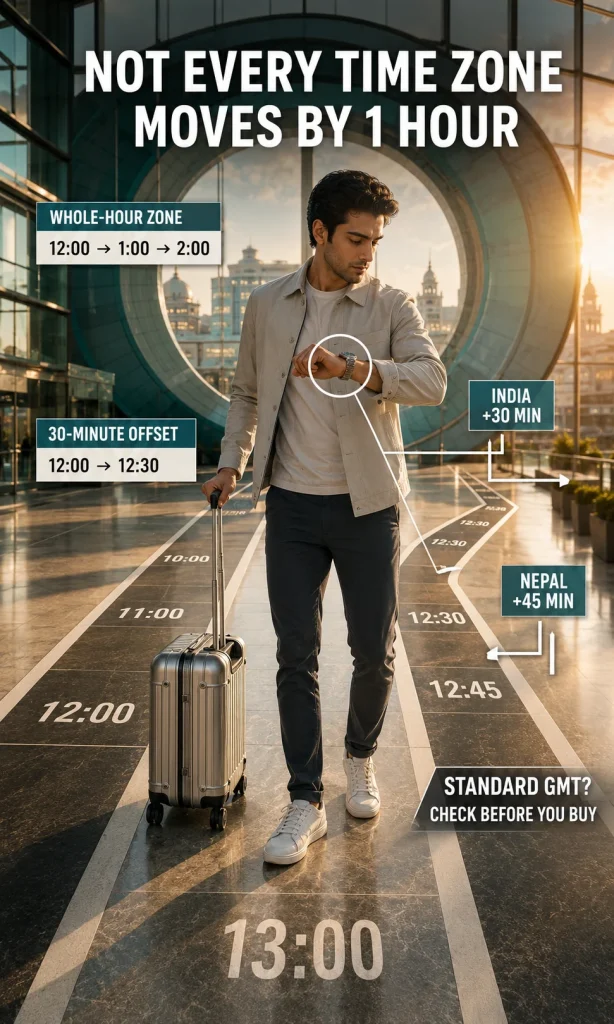
A traveler going from London to New York can usually use a conventional GMT with very little interpretation because the offset follows a whole-hour relationship. A traveler coordinating with India may need to account for an additional 30 minutes, while Nepal introduces a 45-minute offset that cannot be represented precisely by every traditional GMT setup. The watch can still be useful, but the user may have to perform a mental correction rather than seeing the second time zone perfectly at a glance.
This is one reason a complication should be judged against actual destinations instead of admired only on a specification sheet. If you regularly travel to or communicate with fractional-offset regions, verify how the watch handles those zones before assuming that every GMT or world timer will display them intuitively. A digital watch, smartwatch, phone-connected system, or a specifically designed mechanical solution may be more convenient when exact odd-offset tracking is important.
A similar issue appears when daylight-saving rules change at different times in different countries. A mechanical GMT does not normally know that one location has moved its clocks while another has not, so the wearer remains responsible for understanding the current offset. Connected devices can automate more of this work, while traditional watches trade that automation for simplicity, independence, mechanical appeal, and potentially much longer operation between interventions.
Choose the Watch for the Trip You Are Actually Taking
Travel-watch recommendations become more useful when they begin with the environment rather than the price bracket. The watch that works beautifully for five days of meetings and restaurants may be an uncomfortable choice for a humid trekking trip, while the bulky adventure watch that feels reassuring outdoors may become awkward under a shirt cuff at a formal dinner. The trip itself should therefore determine which specifications move to the top of the list.
City and Business Travel
City and business travel usually rewards versatility. A moderate case size, restrained dial, comfortable bracelet or strap, useful second-time-zone function, and enough water resistance for rain and ordinary daily exposure will often matter more than extreme shock resistance or diving capability. If the same watch must move from an airport lounge to a client meeting and then to dinner, thickness and styling deserve almost as much attention as movement specifications.
Frequent business travelers should also consider how quickly the watch can be adjusted after landing. A traveler GMT becomes particularly convenient because local time can usually be moved independently while the reference time remains intact, reducing the amount of resetting required during a multi-city itinerary. A smartwatch may provide even greater convenience when calendar alerts, navigation, calls, messages, contactless payments, and automatic time changes form part of the travel routine.
Beach and Resort Travel
A beach trip shifts the decision toward water exposure, salt, sunscreen, sand, heat, and the security of the strap or bracelet. A watch that looks ideal in an airport may become frustrating if you must remove it every time you enter a pool, or if its leather strap spends several days absorbing moisture. The better choice is one whose manufacturer-rated water capability, crown design, strap material, and maintenance requirements match the swimming and water activities you genuinely expect to do.
Water resistance should not be interpreted from the printed depth number alone. The rating describes a tested resistance condition, while real use depends on the watch design, seal condition, crown position, age, servicing history, and the manufacturer’s own instructions for swimming or diving. Travelers should therefore match the intended activity to the manufacturer’s guidance instead of assuming that any watch carrying a particular meter rating is automatically suitable for every type of water use.
Hiking and Adventure Travel
Outdoor travel increases the importance of legibility, secure attachment, impact tolerance, temperature conditions, water exposure, and the consequences of damaging the watch far from home. A highly polished case may quickly accumulate visible marks, while a complicated mechanical watch can create more anxiety than enjoyment if every rock, backpack buckle, or equipment strap feels like a threat. For some trips, a durable quartz, solar, or digital watch becomes the better ownership decision even if the traveler normally prefers mechanical watches.
The best outdoor travel watch is also one you can operate when tired, cold, wet, or moving. Tiny pushers, difficult crowns, crowded subdials, and highly reflective displays may become more annoying outside the controlled environment of a showroom. Large luminous markers, clear contrast, simple controls, and a strap that remains secure when the wrist changes size can provide more practical value than complications that looked impressive before departure.
Fit and Comfort Become More Important Away From Home
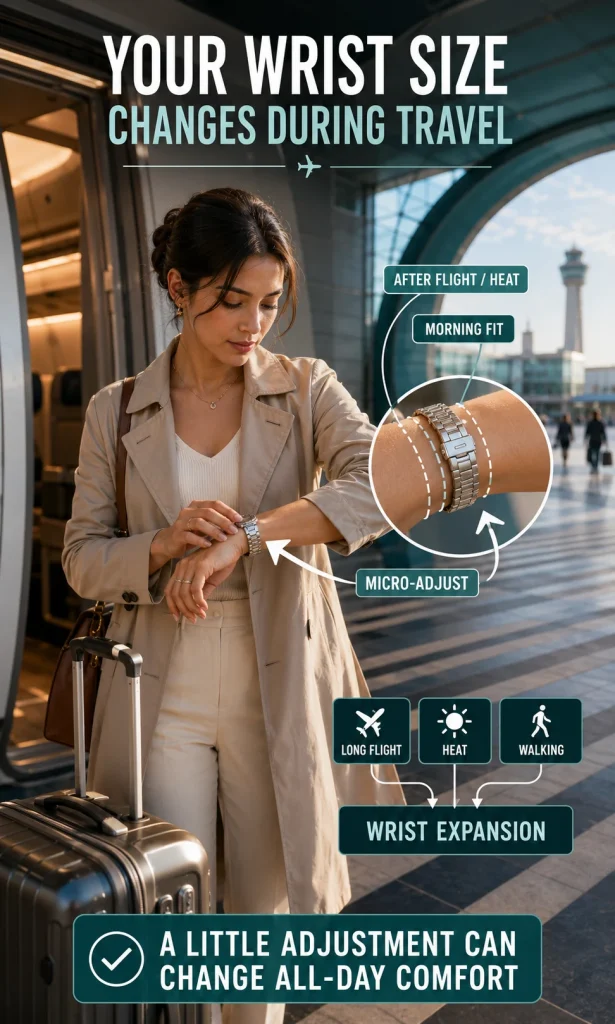
Travel can expose watch-fit problems that seem minor during an ordinary day. Long flights, heat, humidity, walking, salty food, exercise, and changes in hydration can alter how tight a bracelet feels, which is why a watch that fits perfectly in the morning may become uncomfortable several hours later. A bracelet or clasp with useful adjustment range can therefore be a genuine travel feature rather than a small convenience.
A comfortable travel watch should have enough room for normal wrist changes without becoming loose enough to rotate around the arm. Case diameter alone does not determine that comfort, because lug-to-lug length, thickness, case shape, bracelet articulation, clasp position, total weight, crown placement, and how the watch sits relative to the wrist bone all affect the experience. Readers who already struggle with sliding, spinning, crown pressure, bracelet imbalance, or lug overhang should correct those problems before assuming that a different travel complication will solve them.
The more valuable question is therefore not simply whether the watch fits while standing in a shop. Ask whether you can comfortably wear it through an airport, several hours in a plane seat, a long walking day, changing temperatures, and dinner afterward without repeatedly removing or adjusting it. If the answer is uncertain, adjustment capability deserves to move much higher on the buying checklist.
How Much Water Resistance Does a Travel Watch Really Need?
Water resistance matters during travel because exposure is often less predictable than it is at home. A watch may encounter rain on a walking tour, splashing beside a pool, humidity at the beach, repeated hand washing, kayaking, snorkeling, or a sudden change of plans that puts you in the water. The useful question is therefore not “What is the biggest water-resistance number I can afford?” but “What will I realistically do while wearing this watch?”
For ordinary city travel, a watch that is appropriately rated and maintained for everyday water exposure may be sufficient, provided you follow the manufacturer’s instructions. Swimming, snorkeling, boating, and diving create progressively different demands, while seals and gaskets can deteriorate as a watch ages. A printed depth rating should never be treated as a permanent guarantee that an older watch remains equally resistant years later.
The crown and pushers deserve particular attention because they are potential entry points for water. A screw-down crown can provide additional reassurance on watches designed for wet use, but it still needs to be fully secured before entering the water. Unless the manufacturer specifically permits it, avoid operating crowns or pushers while the watch is submerged because movement at those interfaces can compromise sealing.
Water resistance also interacts with strap choice. Leather can be attractive for business travel and dinner, yet repeated exposure to sweat, rain, pools, and seawater can shorten its useful life or make it uncomfortable. Rubber, fabric, properly designed synthetic straps, and metal bracelets are often easier to live with on wet trips, although each has different drying, cleaning, comfort, and security characteristics.
Saltwater deserves its own habit because dried salt can accumulate around the bracelet, clasp, bezel, crown, and small case openings. If the manufacturer says the watch is suitable for the activity you performed, rinsing it afterward with fresh water and drying it carefully can help remove salt and residue. The same principle applies to sunscreen, sand, sweat, and dirt, which can collect in bracelet joints and around the case during a long trip.
A Practical Water-Use Decision
| Trip Activity | What to Prioritize | What to Verify Before Travel |
|---|---|---|
| City travel and normal rain | Everyday water protection and a secure crown | Manufacturer guidance and current condition of the watch |
| Pool and resort use | Swimming suitability, comfortable wet strap, secure clasp | Whether the manufacturer permits swimming with that model |
| Snorkeling and frequent water exposure | Stronger water capability, good visibility, secure attachment | Water-use instructions, seal condition, crown and pusher rules |
| Scuba diving | A watch specifically intended for diving | Manufacturer diving guidance, servicing history and current pressure integrity |
The table is deliberately activity-based because the same printed water-resistance figure does not tell the entire ownership story. A recently serviced watch used exactly as its manufacturer intends is a different proposition from an older watch with unknown seal condition, even when the two case backs show similar ratings. When water exposure is central to the trip, condition and manufacturer guidance deserve as much attention as the specification itself.
Mechanical, Quartz, Solar or Smartwatch for Travel?

Movement choice changes how much attention a watch needs while you are away. Mechanical watches offer traditional craftsmanship and independence from electronic charging, quartz watches prioritize accuracy and low maintenance, solar watches can extend that independence by replenishing power from available light, and smartwatches exchange greater power dependence for a much wider set of connected functions. None of these systems is universally best because each solves a different travel problem.
Mechanical Watches
A mechanical watch can be a satisfying travel companion when you value the watch itself as part of the experience. Automatic movements can continue running through normal daily wear, while hand-wound movements require deliberate winding according to their design and power reserve. Mechanical GMT and world-time complications can also provide genuinely useful travel functions without requiring a phone connection or electronic charging cable.
The trade-off is that mechanical accuracy is normally measured differently from quartz accuracy, and behavior can vary according to movement, regulation, position, temperature, magnetism, shock, and other factors. A traveler who needs extremely precise timekeeping with minimal intervention may prefer quartz or electronically synchronized alternatives. Someone who enjoys mechanical watches may consider those characteristics entirely acceptable in exchange for the construction, tactile interaction, and long-term ownership appeal.
Power reserve becomes more noticeable when travel routines change. If you remove an automatic watch for a couple of days while swimming, sleeping, hiking, or wearing another watch, it may stop before you put it back on. A watch with a longer reserve can reduce resetting, although a shorter reserve is not necessarily a problem if you wear the watch continuously.
Quartz Watches
Quartz is one of the most practical travel choices because it combines strong accuracy with very little day-to-day attention. A basic quartz watch can sit unused for extended periods and still be ready when the next trip begins, assuming its battery remains healthy. That reliability can make quartz especially attractive for travelers who want to think about flights, luggage, meetings, and activities rather than watch maintenance.
Quartz also makes an inexpensive travel-watch strategy easier. Some travelers deliberately leave an expensive mechanical watch at home and take a modest quartz watch because losing or damaging it would be less financially and emotionally disruptive. The decision becomes even more appealing for destinations or activities where a highly recognizable luxury watch would make the wearer uncomfortable.
Battery condition should still be considered before a long trip. If the watch has been running on the same battery for an uncertain period, replacing or checking it before departure may be more sensible than discovering a failure halfway through the itinerary. Watches with additional functions such as alarms, illumination, chronographs, sensors, or frequent digital use can also consume power differently from a simple three-hand quartz watch.
Solar Watches
Solar-powered watches occupy an appealing middle ground for travelers who value low maintenance but dislike conventional battery-replacement cycles. Light reaching the dial or photovoltaic system is converted into electrical energy and stored, allowing many designs to operate for extended periods when sufficiently charged. For frequent travelers, this can reduce the number of power-related tasks associated with ownership.
Solar does not mean a watch can be ignored indefinitely. Storage conditions, charging behavior, the age and condition of the rechargeable cell, and the specific manufacturer’s guidance still matter. A watch left for a long period in complete darkness may eventually need deliberate exposure to suitable light before travel, so checking its charge state ahead of departure is better than assuming it will always be ready.
Smartwatches
A smartwatch can be extraordinarily useful for travel because the watch becomes more than a time display. Depending on the device and services available, it may provide boarding information, navigation prompts, calendar alerts, alarms, translation support, weather, mobile payments, health tracking, communication, and automatic local-time changes. For a traveler already using those functions every day, replacing them with a traditional watch can actually create more inconvenience rather than less.
The limitation is that a smartwatch exists inside a larger technical system. Charging equipment, battery health, compatible phones, account access, software, network availability, roaming conditions, payment support, regional restrictions, and the possibility of device failure all affect what the watch can do away from home. A traveler heading somewhere remote should therefore distinguish functions that work independently from those that depend on a phone or live connection.
Battery duration should be evaluated using the way you intend to travel rather than an ideal laboratory figure. Long navigation sessions, cellular use, bright displays, workouts, GPS tracking, notifications, and unfamiliar network conditions can affect practical endurance. If you would become anxious watching the battery percentage fall throughout a long travel day, a simpler watch may provide a better experience even though it offers fewer features.
How Durable Does a Travel Watch Need to Be?
Durability should be matched to realistic exposure rather than imagined extremes. A traveler spending most of the trip in airports, offices, hotels, restaurants, and museums usually does not need the same case construction as someone carrying climbing equipment, paddling, camping, or working around abrasive surfaces. Buying for the harshest scenario you can imagine can leave you with a watch that is unnecessarily bulky or uncomfortable during the other 95 percent of the trip.
Crystal material is one part of this decision because different materials balance scratch resistance, impact behavior, cost, and replacement differently. Sapphire is widely valued for scratch resistance, while other crystal types can make sense where cost, impact considerations, or easy replacement matter more. The best choice depends on what kind of damage you are trying to avoid rather than whether one material sounds more premium on a specification list.
Case finishing changes how that damage appears. Highly polished surfaces can show fine marks quickly under certain lighting, while brushed or textured finishes may visually disguise everyday wear more effectively. If scratches would bother you throughout the vacation, choosing a less visually delicate finish can improve the trip even when both watches are structurally capable of handling the same environment.
Bracelet and strap durability deserves equal attention because the watch remains on your wrist only if the attachment system remains secure. Check spring bars, screwed links, quick-release mechanisms, clasp engagement, strap condition, keeper loops, and any obvious wear before departure. A perfectly functioning watch head offers little protection if an old strap tears or a poorly seated spring bar releases during an activity.
Travel Durability Checklist
- Check that the crown operates and closes correctly before departure.
- Inspect the strap or bracelet for cracks, stretched links, damaged screws, loose pins, or worn spring bars.
- Confirm that the clasp closes securely and cannot be released accidentally during normal movement.
- Consider whether polished surfaces will make ordinary travel marks more noticeable than you are comfortable with.
- Match crystal and case construction to the realistic environments you will encounter.
- Test illumination or nighttime legibility if you expect early flights, dark cabins, camping, or overnight transport.
- Carry any specialized strap-changing or bracelet-adjustment equipment only if you know how to use it safely.
- If the watch has known water-resistance, accuracy, crown, battery, or servicing concerns, resolve them before the trip rather than treating travel as the test.
A useful pre-trip inspection does not require dismantling the watch. The goal is to catch obvious ownership problems while you still have access to your normal watchmaker, replacement straps, batteries, tools, receipts, and warranty information. Travel magnifies small failures because repairing a loose bracelet screw or replacing an unusual battery is much harder when you are unfamiliar with the local area.
Should You Travel With an Expensive Watch?

The best watch for a trip is not always the most valuable watch you own. A luxury watch may provide a GMT complication, excellent construction, emotional significance, and pleasure every time you look at your wrist, yet those benefits can be outweighed if wearing it makes you constantly monitor your surroundings or worry about loss. Travel comfort includes psychological comfort as well as physical fit.
Think about replacement consequence rather than price alone. Losing a modest watch that belonged to a family member could be more upsetting than damaging a more expensive but replaceable model, while a heavily insured luxury watch may still involve considerable inconvenience, paperwork, claim uncertainty, and disruption if it disappears. The useful decision is whether you can enjoy wearing the watch without allowing its value to dominate the trip.
Destination and itinerary matter because risk is not uniform throughout a journey. A watch that feels appropriate inside a business hotel and private meeting may feel different during late-night transport, crowded nightlife, beaches, festivals, outdoor markets, or unfamiliar neighborhoods. Travelers who would rather avoid that uncertainty can choose a discreet watch whose appearance and replacement cost allow them to concentrate on the trip.
Documentation can also matter when traveling with valuable personal property, particularly when customs, insurance, or ownership questions could arise. Keep purchase records, serial-number information, photographs, insurance details, and any relevant documentation available in a secure form rather than relying on memory after something has happened. Requirements differ by country and situation, so travelers carrying particularly valuable watches should verify current customs and insurance requirements before departure rather than assuming one procedure applies everywhere.
Airport Security and Your Watch

Airport screening procedures are not identical in every country, airport, lane, or security situation. In some screenings you may be able to continue wearing a watch, while in others an officer may ask for it to be removed or placed with other personal items. Follow the instructions given at the checkpoint instead of treating a past airport experience as a universal rule.
A valuable watch should remain under your control as much as the screening process allows. Avoid casually placing an expensive watch into an exposed tray long before you reach the scanner, and do not pack valuable watches in checked baggage simply to avoid dealing with them at security. If removal is requested, handle the watch deliberately and retrieve it promptly with the rest of your belongings.
This is also a good reason to avoid rushing through the checkpoint while wearing several watches or carrying an unnecessarily elaborate watch roll. The more individual valuable objects you must remove, track, repack, and recount, the greater the chance that one will be forgotten during a stressful transition. A simple travel setup can therefore improve security as well as reduce luggage.
One Travel Watch or Several?

Taking one watch keeps the trip simple. You have one object to secure, one watch to remember at hotels, one set of adjustment habits, and no need to decide which watch belongs in a suitcase or watch roll while another is on your wrist. A versatile watch can often cover sightseeing, casual meals, flights, and moderate outdoor activity with fewer compromises than people expect.
Several watches make more sense when the trip contains genuinely different environments. Someone attending formal meetings before spending several days diving may prefer separate watches because the attributes that make one ideal under a shirt cuff are not necessarily the attributes desired underwater. The same logic can apply when a highly valuable watch is wanted for a specific event but a less conspicuous watch is preferred during general sightseeing.
The deciding question is whether the second watch solves a real problem. If it merely duplicates the first watch with a different dial color, you are adding luggage, security concerns, and another object to remember without gaining much functional value. If it changes water capability, formality, visibility, replacement risk, connected functionality, or another important travel requirement, carrying two can be entirely rational.
How Many Watches Should You Pack?
| Travel Situation | Likely Best Approach | Reason |
|---|---|---|
| Short city break | One versatile watch | Fewer valuables and almost no functional reason to switch |
| Business trip | One understated all-day watch | Can move from flights to meetings and dinner without repacking |
| Mixed formal and water activities | Potentially two watches | Distinct environments may justify genuinely different capabilities |
| Adventure or high-damage-risk trip | One durable, replaceable watch | Reduces worry and avoids unnecessary valuable equipment |
| Watch-focused vacation or special event | Two may be reasonable | The watches themselves are part of the purpose of the trip |
The strongest one-watch travel setup usually comes from moderation rather than maximizing every specification. A watch that is reasonably thin, comfortable for long wear, appropriately water resistant, easy to read, secure on the wrist, and suitable with both casual and slightly dressier clothing can cover a remarkable range of situations. Travelers with persistent comfort problems should also resolve why a watch slides, spins, pinches, or presses into the wrist before departure, because poor fit becomes more noticeable during long travel days.
Best Travel Watches by Traveler Profile
The most useful way to choose a travel watch is to match the watch architecture to the traveler’s recurring problem rather than ranking watches from first to tenth. A frequent international flyer, a resort traveler, and someone taking one annual city break may all search for the “best travel watch,” yet the best answer for each person can be completely different. The profiles below turn the earlier technical discussion into a practical buying decision.
Best for Frequent Time-Zone Changes: A Traveler GMT
A traveler GMT is the strongest conventional choice when you regularly land in a new time zone and want to keep home time visible. The independently adjustable local-hour hand makes arrival changes faster because you can move local time without rebuilding the entire display every time the aircraft crosses another zone. This benefit becomes increasingly noticeable on multi-city trips where repeatedly resetting a conventional watch starts to feel tedious.
Look beyond the GMT label when shopping because the movement architecture matters more than the complication name. Confirm that the normal local-hour hand is the independently adjustable hand if frequent physical travel is the reason you are buying the watch. Also check whether the hour can move backward as conveniently as it moves forward, because an itinerary rarely progresses neatly in only one direction.
Best for Several International Cities: A World Timer
A world timer suits travelers whose real job is monitoring a network of places rather than comparing one destination with home. The city ring and 24-hour display can provide a broader view of international time relationships, which is useful for global business, international families, and itineraries involving several regions. The extra information comes with additional visual complexity, so dial legibility deserves careful inspection before purchase.
Try reading the proposed watch quickly rather than studying it slowly in a product photograph. If you must search for the correct city every time you glance at the dial, the complication may be technically impressive but poorly suited to the way you work. Travelers who frequently use fractional-offset time zones should also confirm how those destinations are represented instead of assuming every world-time system handles them identically.
Best Low-Maintenance Travel Watch: Quartz
A simple quartz watch remains one of the strongest travel choices for someone who values reliability over complication. It can provide excellent practical accuracy, requires very little attention during normal use, and is available across a wide range of case sizes, water capabilities, materials, and prices. For many travelers, the absence of mechanical complexity and daily charging is itself a major advantage.
Quartz can also reduce the emotional cost of travel. A modest watch that you are comfortable scratching, replacing, or wearing in unfamiliar environments may create a more relaxed trip than a watch that makes you continually check your wrist and surroundings. The right travel watch should support the experience rather than become another source of vigilance.
Best for Long Trips With Minimal Power Worry: Solar
A solar watch makes sense when the traveler wants the low-maintenance character of quartz while reducing dependence on conventional battery changes. With suitable exposure to light and a healthy rechargeable energy-storage system, many solar watches can operate for extended periods without requiring routine intervention. That makes the format particularly attractive for frequent travel, extended trips, and people who dislike adding another charging cable to their luggage.
It is still worth checking the watch before departure rather than assuming “solar” means unlimited power under every condition. A watch stored for months in darkness may require deliberate charging, and the manufacturer’s charging guidance should determine how it is prepared. If the watch includes a power-level indicator or low-charge warning, learn how that signal works before you need it on the road.
Best for Connected Travel: Smartwatch
A smartwatch is difficult to beat when navigation, notifications, boarding information, alarms, health tracking, contactless payments, communication, and automatic local-time changes are part of the traveler’s normal routine. It can consolidate functions that would otherwise require repeated interaction with a phone, particularly during airport transfers and unfamiliar walking routes. For a traveler already invested in the surrounding device ecosystem, those conveniences may outweigh the attraction of a traditional travel complication.
The decision becomes weaker when battery management is likely to dominate the trip. Think about the longest day you expect to spend away from a charger, then consider how navigation, GPS, cellular activity, workouts, display brightness, and notifications may affect real endurance. A smartwatch that performs brilliantly for twelve hours but leaves you hunting for power late in the evening may be less useful than its specification sheet suggests.
Best for Water-Heavy Trips: A Purpose-Built Water Watch
A trip centered on pools, snorkeling, boating, beaches, or diving shifts the priority from time-zone complications toward water use and security on the wrist. The watch should be specifically suitable for the activities you expect to perform, with a strap or bracelet that remains comfortable when wet and a fastening system you trust. Manufacturer guidance, current seal condition, crown operation, and service history matter more than simply choosing the largest depth number printed on the dial or case back.
For scuba diving, use a watch that the manufacturer actually intends for diving rather than interpreting a generic water-resistance rating creatively. For swimming and snorkeling, make sure the watch is approved for that use and that the strap material can tolerate repeated moisture, sunscreen, salt, and cleaning. A mechanically complicated GMT is not automatically a better travel watch if the trip’s dominant challenge is spending six hours a day in the water.
Best for Discreet Travel: A Simple, Replaceable Watch
Some itineraries are more enjoyable when the watch attracts very little attention. A simple analog, digital, quartz, or solar watch with no obvious luxury cues can provide accurate timekeeping without creating the same concern about theft, loss, scratches, or insurance complications as a highly valuable piece. The best choice is not necessarily inexpensive in absolute terms, but its financial and emotional consequence should feel proportionate to the journey.
This profile is particularly useful for travelers who know they will spend much of the trip in crowded transport, nightlife districts, outdoor markets, festivals, beaches, or unfamiliar areas where they would prefer not to think about the watch’s value. A less conspicuous watch can also make spontaneous activities easier because you do not need to decide whether every excursion is safe enough for an expensive piece. That freedom is a legitimate travel feature even though it never appears on a movement specification.
Best One-Watch Travel Solution: A Moderate All-Rounder
The strongest single travel watch is usually balanced rather than extreme. It should be comfortable enough for an entire day, legible in different lighting, appropriate for the expected water exposure, secure on the wrist, easy to adjust, and visually versatile enough for the clothing you plan to wear. A second-time-zone function is useful only when you will genuinely use it, while modest dimensions and good fit benefit almost everyone.
Avoid designing the choice around the most dramatic event on the itinerary unless that event places a genuine technical requirement on the watch. Someone spending nine days sightseeing and attending dinners does not necessarily need a huge expedition watch because one afternoon involves a short hike. Likewise, a traveler who will spend most days diving should not compromise the primary water requirement merely to obtain a thinner watch for one restaurant reservation.
Which Travel-Watch Type Fits You Best?
| Traveler Profile | Strong Starting Point | Feature to Prioritize | Common Buying Mistake |
|---|---|---|---|
| Frequent international flyer | Traveler GMT | Independent local-hour adjustment | Buying a caller GMT without checking how it adjusts |
| Global business traveler | World timer or multi-zone digital system | Fast reading of several cities | Choosing a dial too crowded to read comfortably |
| Low-maintenance traveler | Quartz or solar | Accuracy and power reliability | Paying for complications that will rarely be used |
| Connected traveler | Smartwatch | Battery endurance and offline capability | Assuming every function works without the phone or network |
| Beach or water traveler | Purpose-suitable water watch | Activity suitability and secure attachment | Treating the depth rating as the entire water decision |
| Discretion-focused traveler | Simple replaceable watch | Low recognition and acceptable loss consequence | Taking an expensive watch that creates constant anxiety |
The table should be treated as a starting filter rather than a rigid ranking. Two travelers with identical itineraries may still choose differently because one values mechanical construction while another prioritizes accuracy, connectivity, or low replacement cost. The purpose is to expose which requirement should drive the purchase before price and appearance begin influencing the decision.
What to Check Before Buying a Travel Watch Online
Online watch shopping makes comparison easier, but it also removes the ability to feel how the watch behaves on your wrist. Product photographs can make a thick watch appear slim, conceal how far the lugs extend, and give little sense of how a bracelet drapes around a smaller wrist. Dimensions and adjustment details therefore matter more when you cannot physically try the watch before committing to it.
Check More Than Case Diameter
Case diameter is only one dimension of fit. Lug-to-lug length determines how far the watch spans across the wrist, thickness affects how high it sits and whether it passes under clothing, while total weight changes how noticeable it becomes during a long day. Case shape, curved lugs, bracelet articulation, and crown position can make two watches with the same nominal diameter feel completely different.
If the retailer provides only diameter and omits lug-to-lug, thickness, or weight, look for reliable manufacturer documentation before making assumptions from photographs. Travelers with smaller wrists should pay particular attention to lug overhang, while people sensitive to crown pressure should consider where the crown sits relative to the wrist bone. Fit problems that are tolerable for thirty minutes can become much more irritating during a fourteen-hour travel day.
Check the Bracelet and Clasp Adjustment Range
Bracelet adjustment can become surprisingly important during travel because wrists do not remain exactly the same size all day. Heat, long flights, exercise, hydration changes, and humidity can make a previously comfortable bracelet feel restrictive. A clasp with useful micro-adjustment or an extension mechanism can therefore provide more practical travel value than a decorative complication.
Check whether adjustment requires tools and whether enough range is available for your wrist. Some bracelets rely mainly on adding or removing full links, while others include half links, micro-adjust holes, sliding systems, or tool-free adjustment. A watch that technically fits but cannot accommodate normal wrist expansion may become something you repeatedly remove throughout the trip.
Confirm Exactly How the GMT Works
Do not assume that the phrase “GMT movement” tells you which hand adjusts independently. If frequent physical travel is the primary reason for purchase, look for documentation showing whether the local 12-hour hand can jump independently while the GMT reference remains fixed. If the independent hand is instead the 24-hour hand, the watch may behave more like a caller GMT even though both watches display two zones.
Also check how the date behaves when the local-hour hand moves across midnight. A convenient travel mechanism should make forward and backward changes predictable, particularly when you fly east and west during the same trip. This detail can be difficult to infer from a product page that focuses mainly on movement name, jewel count, or power reserve.
Check Fractional Time-Zone Compatibility
If destinations such as India or Nepal are part of your normal travel pattern, determine whether the watch can display their offsets precisely in the way you expect. Traditional GMT systems often make whole-hour differences straightforward while requiring mental adjustment for time zones containing an extra 30 or 45 minutes. A watch can therefore be an excellent GMT mechanically while still being an imperfect match for your actual destinations.
World timers deserve the same scrutiny because a city ring does not automatically mean every global offset is represented equally. Digital and connected systems may handle these zones more intuitively, while specialist mechanical designs can address them in different ways. The destination list should therefore influence complication choice before purchase rather than after arrival.
Check Water Guidance, Not Just the Number
Read the manufacturer’s actual usage guidance for water exposure instead of treating a meter rating as a universal activity chart. Determine whether the specific model is intended for swimming, snorkeling, diving, showering, or only incidental exposure, then consider whether its current condition supports that use. Buyers of pre-owned watches should be especially careful because the printed rating tells you what the watch was designed to resist, not whether ageing seals are still performing as new.
The strap also needs to match the environment. Leather may be appropriate for dry business travel but less convenient for repeated swimming, while some fabric straps retain water longer than rubber or metal alternatives. Choose the entire wrist setup for the trip rather than evaluating the watch head in isolation.
Check Power and Charging Before You Buy
Mechanical buyers should understand the power reserve and whether the watch will stop during the way they intend to wear it. Quartz buyers should know the battery arrangement and, where relevant, how low-power warnings behave, while solar buyers should understand charging recommendations and storage behavior. Smartwatch buyers should focus on realistic battery endurance under navigation, cellular use, workouts, GPS, notifications, and other travel-intensive features rather than reading only the most optimistic endurance claim.
Think about what happens if you cannot charge the watch when expected. A smartwatch may still be the right choice if the functions are important enough, but the charging plan becomes part of travel preparation just like a phone charger or power bank. A traditional watch reduces that dependency, although it may sacrifice functions that connected travelers use constantly.
Check Warranty, Service, and Return Conditions
A watch purchased specifically before a major trip should not leave you trapped with poor fit after one brief indoor try-on. Check the retailer’s return window, bracelet-sizing policy, strap condition requirements, warranty coverage, and whether wearing or resizing the watch changes your return rights. International buyers should also consider who is responsible for shipping, taxes, service logistics, and warranty claims if the seller is located in another country.
Service access matters more for unusual movements or proprietary systems. A technically fascinating watch can be less convenient as a travel companion if only a small number of service centers can repair it or if replacement straps, links, chargers, or accessories are difficult to obtain. Ownership should remain practical after the excitement of the initial purchase has passed.
A Final Pre-Purchase Travel-Watch Checklist
- Identify how many time zones you genuinely need to monitor.
- Decide whether you physically change zones often enough to benefit from a traveler GMT.
- Check whether your destinations include half-hour or 45-minute offsets.
- Confirm case diameter, lug-to-lug length, thickness, weight, and crown position.
- Check bracelet articulation, clasp adjustment range, and whether resizing requires tools.
- Match water capability to the activities you will actually perform.
- Choose a strap material suitable for heat, sweat, water, sunscreen, and the clothing you will wear.
- Compare mechanical power reserve, quartz battery condition, solar charging behavior, or smartwatch endurance.
- Decide how much financial and emotional loss you are comfortable carrying.
- Verify warranty, return conditions, service access, and replacement-part availability before the trip.
- Confirm that the watch remains easy to read and operate when tired, moving, wet, or in low light.
- Reject any feature that sounds impressive but does not solve a real problem in your itinerary.
A good buying decision should leave you able to explain why each major feature belongs on the watch. If you cannot describe when you will use the GMT hand, rotating bezel, world-time scale, smartwatch connectivity, extreme water rating, or oversized case, that feature may be solving a theoretical problem rather than your travel problem. The strongest travel watches tend to feel simpler once the trip begins because their features have already been matched to the situations in which they will be used.

Frequently Asked Questions
Is a GMT watch actually necessary for travel?
A GMT watch is useful rather than necessary. It becomes particularly valuable when you regularly need local time and a second reference such as home time visible together, especially when you cross time zones frequently. Travelers who only need the current local time may be better served by a simpler quartz, solar, mechanical, digital, or smartwatch solution.
What is the difference between a traveler GMT and a caller GMT?
A traveler GMT normally allows the conventional local-hour hand to be adjusted independently, which makes changing local time after a flight more convenient. A caller GMT usually makes the 24-hour GMT hand independently adjustable instead, which works well for monitoring another place while remaining in one location. Both can display two zones, but the traveler version is generally better aligned with repeated physical travel.
Can a GMT watch show India or Nepal time correctly?
Some GMT systems handle fractional time-zone offsets more naturally than others. Conventional mechanical GMT arrangements are often easiest to use with whole-hour differences, which can require additional interpretation for destinations using 30-minute or 45-minute offsets. If these regions are important to your travel, verify the exact display behavior before buying rather than assuming every GMT works identically.
Is a smartwatch better than a mechanical watch for international travel?
A smartwatch is often better when automatic time changes, navigation, notifications, payments, communication, and connected travel functions are priorities. A mechanical watch is more independent of electronic charging and may appeal to travelers who value traditional watchmaking and a simpler wrist experience. The better option depends on whether connected functionality or independence is more valuable during the trip.
How much water resistance does a travel watch need?
The appropriate level depends on what you plan to do while wearing the watch. City travel, swimming, snorkeling, boating, and scuba diving create different requirements, so the manufacturer’s guidance for the specific watch should determine suitability. Current seal condition and servicing history also matter because an older watch may not retain the same resistance it had when new.
Should I take an expensive watch on vacation?
Take an expensive watch only when its enjoyment outweighs the additional responsibility of carrying it. Consider destination, itinerary, insurance, proof of ownership, replacement consequence, storage, transport, and whether wearing the watch will make you unusually conscious of your surroundings. A less valuable and less recognizable watch can be a better travel choice when it allows you to relax and participate freely in the trip.
Can I wear my watch through airport security?
Airport screening requirements can vary by country, airport, lane, and screening situation, so follow the instructions given by security personnel at the checkpoint. You may sometimes be able to leave a watch on, while another screening may require it to be removed with other personal items. Valuable watches should remain under your control as much as the process allows rather than being packed into checked luggage simply to avoid handling them at security.
Should watches go in checked luggage?
Valuable watches are generally better kept with you rather than placed in checked baggage. Carrying them does not remove every risk, but it gives you more control over the item during the journey and reduces exposure to baggage loss or handling problems. Travelers should still follow applicable airline, security, customs, and insurance requirements for the journey.
Is one travel watch enough?
One versatile watch is enough for many trips and reduces the number of valuables you need to secure and remember. A second watch becomes more reasonable when it performs a genuinely different job, such as separating a formal watch from a purpose-built diving or adventure watch. If the second watch only changes appearance without solving another travel requirement, the additional luggage and security burden may offer little practical value.
Your Travel-Watch Action Checklist
Before buying or packing a watch, begin with the itinerary and identify what could actually make the watch inconvenient during the trip. Decide how many zones you need, whether your wrist is likely to need adjustment, what water exposure will occur, how long you can go without charging, and how comfortable you are carrying the watch’s value. Those answers will narrow the field more effectively than starting with a list of popular models.
Once the watch type is clear, check the details that are easy to miss online. Confirm dimensions, weight, clasp adjustment, strap behavior, exact GMT architecture where applicable, water-use guidance, power requirements, service access, and how the watch behaves in the destinations you visit most often. These practical details are often what separates a watch that merely looks suitable for travel from one you continue reaching for every time you pack a bag.
The best travel watch is ultimately the one that asks for the least unnecessary attention while giving you the information and capability you genuinely need. It should feel comfortable enough to forget about, useful enough to justify its place on the wrist, and appropriate enough that you do not spend the trip protecting it from every ordinary experience. When those requirements are aligned, a simple quartz watch can be every bit as successful a travel companion as an elaborate GMT, world timer, or smartwatch.