




Bipolar disorder involves episodes of changed mood, energy, and activity that differ noticeably from a person’s usual pattern. Warning signs can include much less need for sleep, unusually fast thinking or risky decisions, and periods of low mood or lost interest, but no single sign establishes a diagnosis. Look at what changed together, how long it lasted, and what happened to daily life.
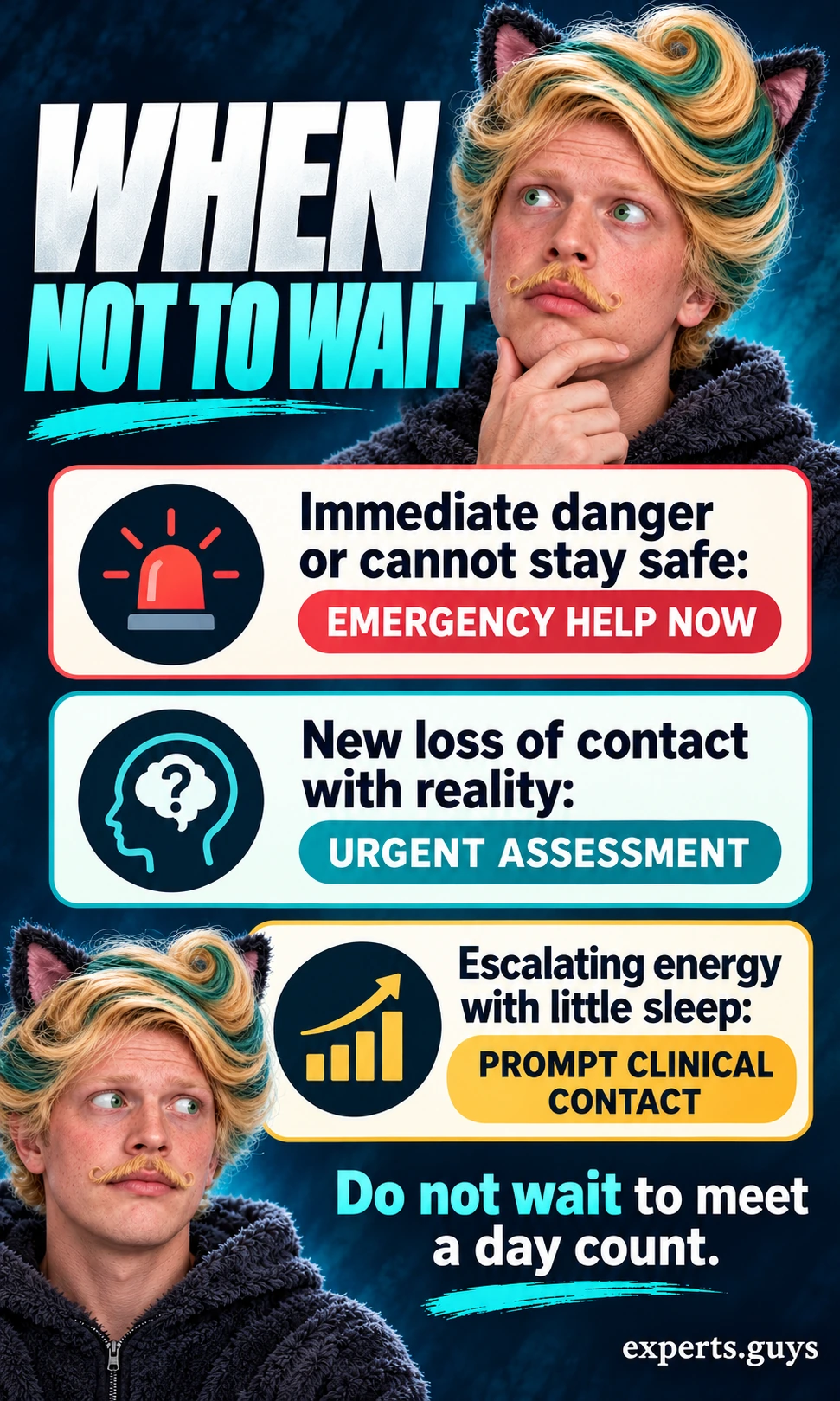
Get help now if safety is at risk. If someone may act on suicidal thoughts, is in immediate danger, or cannot stay safe, contact local emergency services or go to an emergency department. New hallucinations, delusions, severe confusion, or rapidly escalating behavior need urgent assessment; do not wait for an episode to last a particular number of days.
This guide is for adults noticing possible symptoms in themselves or someone close to them. The aim is to recognize useful observations and choose an appropriate next step, not to diagnose a person from a checklist, a photograph, an unusual outfit, or a difficult conversation.
Which 12 changes are worth noticing?
The signs below are grouped for recognition, not scored. Some belong mainly to mania or hypomania, others to depression, and several occur in other conditions too. Compare the person with their own ordinary functioning: a naturally talkative person and a usually quiet person do not start from the same baseline.
A useful description names an action you could actually observe. “He has started several projects overnight and is sleeping far less” gives more information than “he is acting strange.” A change can matter even when the person experiences it as enjoyable, productive, or completely reasonable.
- Sleep and activation: reduced need for sleep, increased activity, faster speech, racing thoughts, distractibility, unusually elevated or irritable mood, inflated confidence, and risk taking.
- Depressive changes: persistent low mood or loss of pleasure, altered sleep or appetite, reduced energy or thinking speed, and worthlessness or thoughts of death.
- The deciding context: whether several changes belong to the same period, how different they are from usual, and whether functioning or safety has changed.
1. Much less sleep without the expected tiredness
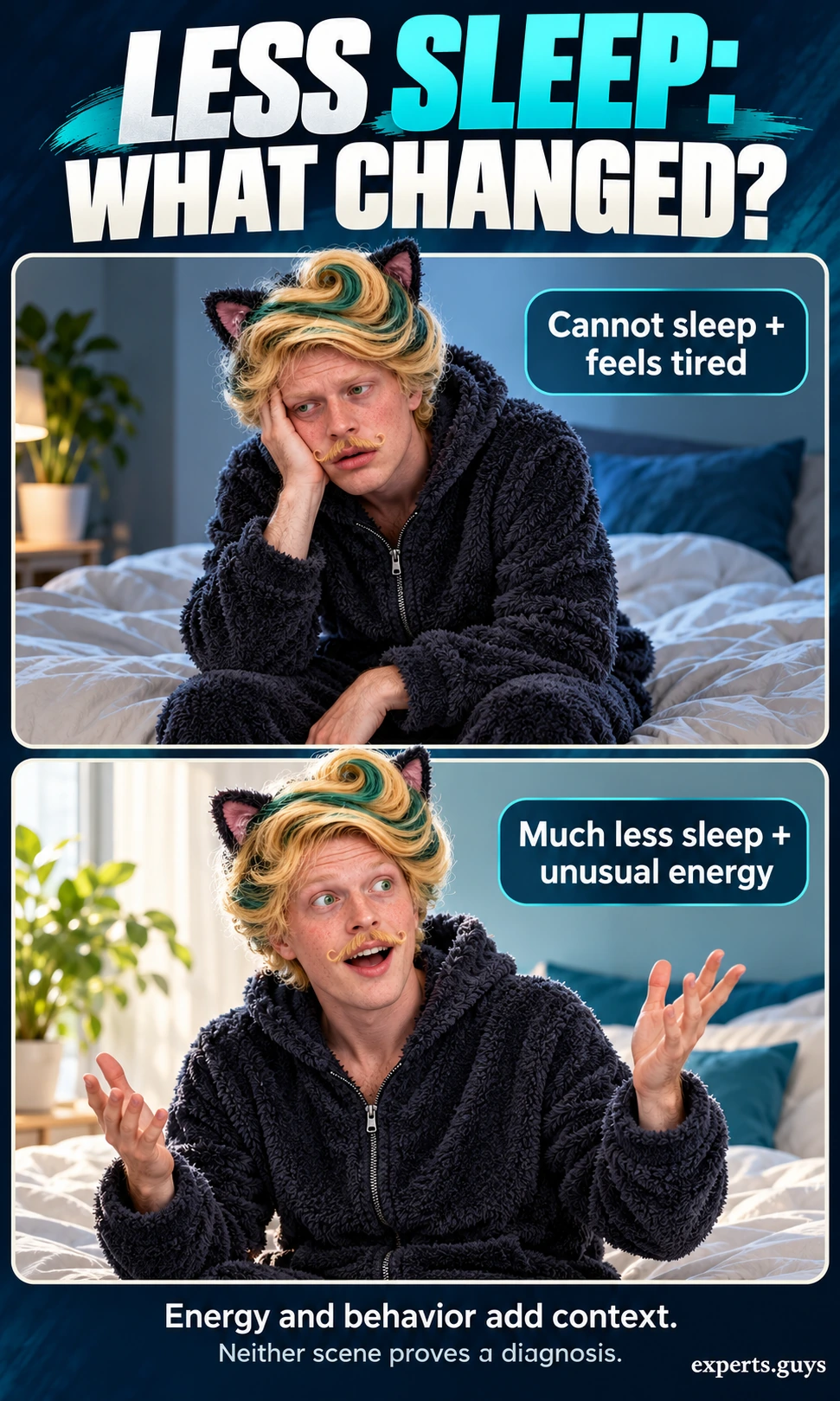
The important clue is reduced need for sleep, not simply a short night. Someone may sleep far less than usual yet feel unusually rested, driven, or energetic. Insomnia often has a different experience: wanting sleep, being unable to get it, and feeling exhausted afterward. Neither pattern alone tells you its cause; ask what happened to activity, speech, and judgment alongside the sleep change.
2. A marked rise in activity or drive
Notice a sustained surge in projects, social activity, work, or movement that differs from ordinary enthusiasm. The quantity of work is not the only issue: the person may find it difficult to slow down, keep starting new tasks, or take on commitments that do not fit available time. A busy week with a clear deadline is useful context, not automatic evidence of an episode.
3. Talking substantially faster or more than usual
Speech can become unusually rapid, persistent, or difficult to interrupt. A listener may struggle to follow frequent topic changes or get a turn in the conversation. Language, culture, excitement, and personality affect conversation style, so the useful comparison is a recent change in this person, rather than a judgment about how much talking is acceptable.
4. Thoughts that feel unusually fast or crowded
A person may describe ideas arriving too quickly to follow, or thoughts changing before one can be finished. This inner experience is not always obvious from the outside. Worry can also feel repetitive or fast; ask about the content and the accompanying sleep and energy pattern instead of treating the phrase “racing thoughts” as a diagnosis.
5. Attention repeatedly pulled away
Sounds, nearby movement, or new ideas may keep interrupting a conversation or familiar task. This is particularly useful to describe when it is a clear departure from the person’s usual attention. Longstanding distractibility needs its own history; a single distracted afternoon after poor sleep cannot identify bipolar disorder.
| Observation | More useful detail | What it cannot establish |
|---|---|---|
| Little sleep | Whether the person feels exhausted or unusually energized afterward | The cause of the sleep change |
| Fast speech or many projects | Whether this is new and occurs with other changes | Mania from productivity alone |
| Withdrawal or unfinished tasks | Whether interest, energy, concentration, or basic functioning changed | Bipolar depression from behavior alone |
These distinctions are consistent with the NIMH explanation of bipolar symptoms and assessment. The reason to describe combinations is that mood, energy, thinking, and behavior can change together during an episode; a symptom label on its own loses that context.
6. Unusually elevated or persistently irritable mood
An elevated episode does not always look cheerful. Irritability, impatience, or feeling unusually “up” can accompany increased activity and energy. Anger alone is nonspecific, and disagreement is not a symptom by itself. Notice whether the mood change is sustained and part of a wider departure from usual sleep, pace, and behavior.
7. Confidence that has become unrealistic
A change may involve feeling exceptionally powerful, talented, important, or certain that an implausible plan cannot fail. Confidence is not a disorder; the relevant issue is an unusual shift in judgment and its consequences. A fixed false belief or loss of contact with reality needs urgent clinical assessment rather than an argument about who is right.
8. Out-of-character risk taking
Examples include spending beyond one’s means, unsafe driving, or commitments made without the usual consideration of consequences. The concern is a change in judgment, not a moral judgment about someone’s choices. Explain what happened and what risk it created. Do not wait for financial loss, an accident, or another serious outcome before seeking help with escalating behavior.

9. Persistent low mood or loss of pleasure
Depression may involve sadness, emptiness, hopelessness, or a marked loss of interest in activities that normally matter. Someone may continue meeting obligations while feeling little enjoyment, so attendance at work does not rule out difficulty. Ask how the activity feels to the person rather than assuming that an outward smile means everything is well.
10. A substantial change in sleep or appetite
During depression, sleep and appetite can increase or decrease. Look for a departure from usual patterns that occurs alongside changes in mood, enjoyment, energy, or functioning. These symptoms also have physical, environmental, and medication-related explanations. Sleeping longer does not prove depression, just as sleeping less does not prove hypomania.
11. Everyday tasks or thinking becoming much harder
Reduced energy, slowed movement, difficulty concentrating, or indecision can make ordinary tasks unusually demanding. Restlessness can occur instead of obvious slowing. A useful example is a familiar activity that the person usually manages but now finds difficult to start or follow; describing that difference is more informative than calling them lazy or unmotivated.

12. Worthlessness, excessive guilt, or thoughts of death
These experiences deserve direct attention, especially when hopelessness is increasing. Thoughts of suicide are not something to score against the other eleven signs. Seek urgent support; immediate danger, intent to act, or inability to stay safe requires emergency help. A person does not need a confirmed diagnosis to deserve help with these thoughts.
For a fuller explanation organized by episode type, use the related guide to mania, hypomania, and depressive symptoms. Here, the practical question is which observation needs clarification and what its effect has been, rather than how many boxes someone matches.
When do these signs suggest an episode rather than an isolated change?
A possible episode is a distinct period of change, not merely a collection of traits remembered from unrelated times. Ask whether the sleep change, extra activity, unusual confidence, and consequences occurred together. Combining a sleepless night last year with a difficult week this month can create a misleading picture.
| Pattern | Clinical time frame | Important distinction |
|---|---|---|
| Mania | Usually at least 1 week, or any duration when hospital care is necessary | Marked impairment or possible psychosis; urgent care may be needed sooner |
| Hypomania | At least 4 consecutive days | Noticeable change without the marked impairment, hospitalization, or psychosis of mania |
| Major depressive episode | At least 2 weeks | Low mood or lost interest with other symptoms and meaningful distress or impairment |
These are clinical assessment thresholds, not instructions to wait. The American Psychiatric Association overview explains the episode distinctions. Clinicians also evaluate symptom combinations, severity, alternative causes, and the person’s history; duration alone does not confirm an episode.
Bipolar I involves at least one manic episode. Bipolar II involves hypomania and major depression without a history of mania; it is not simply a less important condition. A history of depression by itself cannot establish which diagnosis applies, and an enjoyable period does not automatically qualify as hypomania.
Low mood and activation can occur together
Feeling hopeless does not rule out unusually fast thoughts or increased energy. Some episodes have mixed features, meaning depressive and manic symptoms overlap. Describe both sets together instead of deciding that one cancels the other out. New or worsening activation alongside severe distress deserves prompt assessment, especially if sleep or safety is deteriorating.
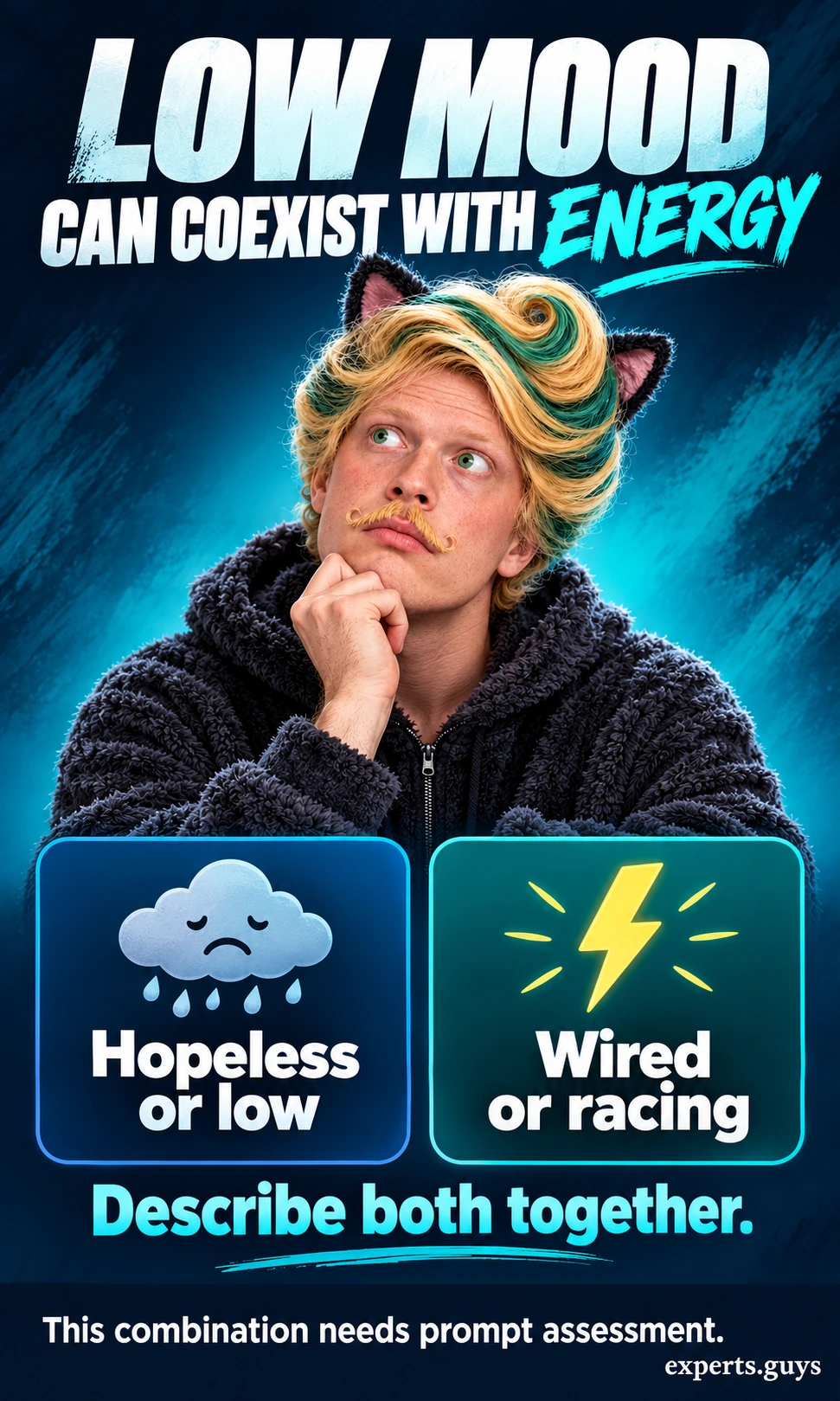
This is also why “happy one moment, sad the next” is an incomplete description of bipolar disorder. Episode patterns involve more than moment-to-moment emotion. Rapid cycling refers to four or more mood episodes in a year, not simply changing feelings several times in a day. Symptoms and their course still need individual assessment.
What else might explain the change?
Thyroid conditions, medication effects, substances, sleep disruption, and other mental health conditions can resemble or complicate these symptoms. Some conditions can coexist with bipolar disorder. An assessment considers these possibilities together, rather than assuming the presence of anxiety or attention difficulties excludes an episode. The guide to depression, anxiety, and bipolar patterns explains that overlap in more detail.
A family history can be relevant without determining the answer. Likewise, a marked change after starting or changing medication is information for the prescriber, not a reason to make your own dose changes. Give the approximate timing and the name of the medicine if known; say when you are uncertain.
How can you explain a change without keeping a diary?
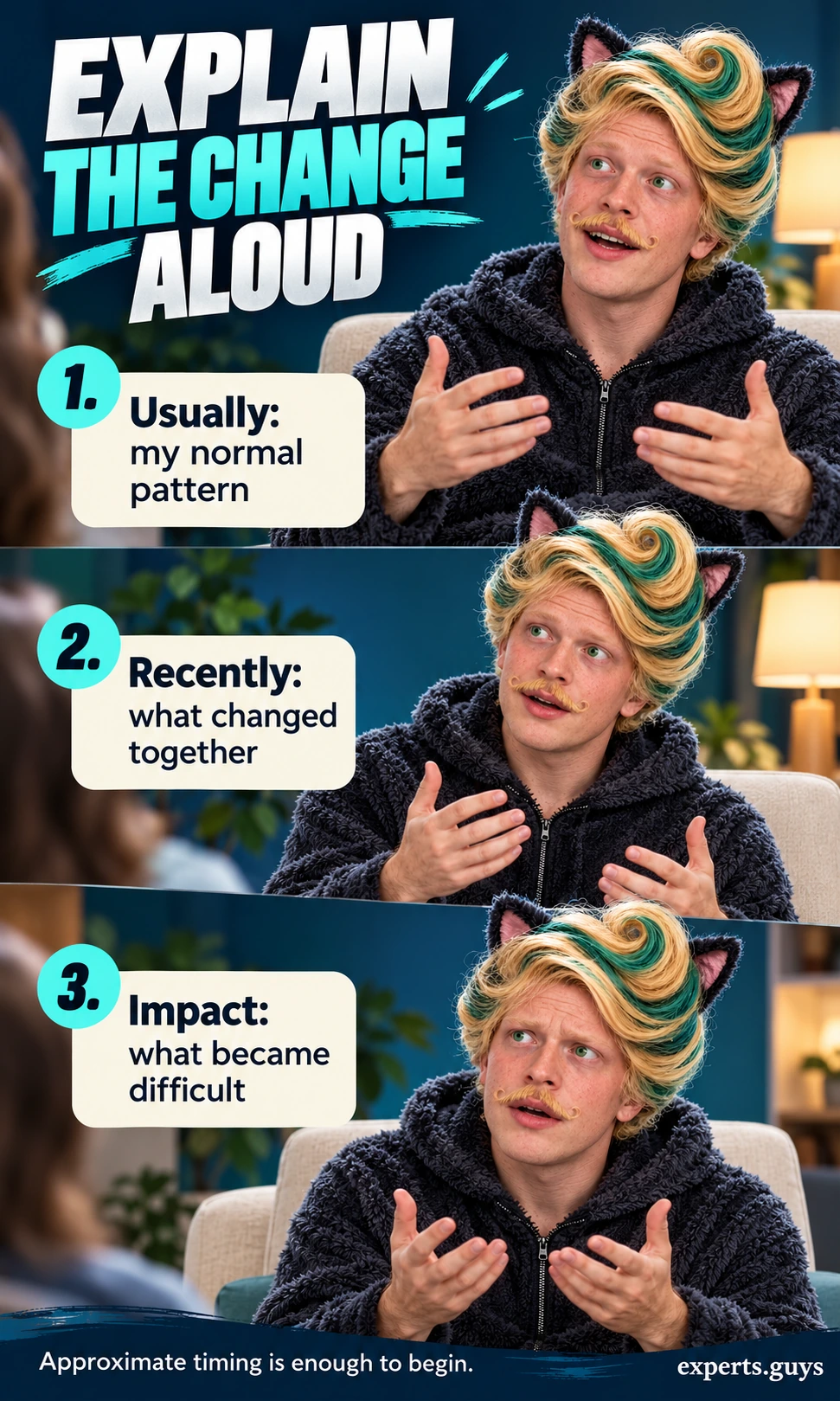
Use a short spoken contrast: what is usual, what changed in the same period, and what difference it made. This is a communication aid, not a screening test or a method of proving a diagnosis. It helps turn a vague concern into an example that a clinician or trusted support person can understand.
The usual–recent–impact handoff
- Usually: Describe one relevant ordinary pattern, such as sleep followed by daytime energy. Use your own baseline, not someone else’s routine.
- Recently: Describe the changes that occurred together and approximately when they began. Include a change someone else noticed if you agree it is accurate.
- Impact: Name a concrete consequence, such as taking on unaffordable commitments, missing meals, or struggling with a familiar task. Say if there is a safety concern.
Example: “Usually I sleep through the night and can leave projects until tomorrow. Since the weekend I have slept much less, felt unusually energetic, and started several things overnight. I have committed to work I cannot realistically finish.” This is an illustrative description, not a diagnostic formula or a recommended sleep target.
If explaining feels difficult: Start with one sentence: “My sleep and energy have changed together, and I need help understanding it.” If you want, a trusted person can add an observation with your permission. You can remain seated, pause, use an interpreter, or use your usual communication aid; no notebook, app, printer, or account is required.
Common correction: Replace labels such as “I was definitely manic” with what you experienced and what happened. Do not force an exact date when you only remember an approximate period. The handoff is complete when the listener understands the change and the next contact step; remembering every symptom is unnecessary.
If you already have a bipolar diagnosis, an agreed relapse plan takes priority over this example. The separate personal early-warning guide covers recognizing recurring signals. This page’s spoken handoff is for explaining a concern now, rather than building another monitoring routine.
What is the next safe step while arranging assessment?
Match the response to the current risk. New, sustained changes that affect daily life warrant a clinical appointment; suspected mania, severe depression, psychosis, or rapidly escalating behavior needs urgent assessment. If immediate safety is uncertain, use emergency help. You do not need to finish reading, count symptoms, or complete a tool first.
Make the immediate setting quieter
If the person is willing and the situation is safe, reduce stimulation while arranging care. This practical setup may make communication easier; it does not stop an episode or replace treatment. NICE guidance on mania and hypomania recommends a calming environment with reduced stimulation. The household sequence below is an adaptation of that principle, not a separately validated treatment.
- Reduce noise: Switch off a television or other unnecessary sound if the person agrees. Leave enough light to move safely.
- Choose a quieter space: Offer a comfortable seat and an unobstructed exit. If moving is difficult, make the existing space quieter instead.
- Keep the conversation simple: Where wanted and available, have one trusted person speak calmly about the next care step. Avoid a crowd of people asking questions at once.

Correction and stopping point: Do not block the doorway, force the person to sit, or argue them into accepting a diagnosis. If the interaction increases distress, step back and seek appropriate help; do not attempt physical restraint. The observable goal is less competing noise and a clearer next contact step, not a promise that mood or behavior will settle.
Defer major purchases, driving when judgment is impaired, and other consequential decisions while getting help. Do not stop or alter prescribed medication on the basis of this article. Longer-term treatment decisions belong in a care plan; the guide to bipolar treatment and follow-up explains those choices without turning this recognition checklist into a medication guide.
Frequently asked questions
Do all 12 signs have to be present?
No. This is an educational grouping, not a diagnostic checklist. Clinicians assess the relevant symptom combination, duration, severity, history, and alternative explanations; some listed changes may be absent.
Can someone seem well between episodes?
Yes. There can be periods of stable mood and functioning between episodes, although some people continue to have symptoms. Feeling well today does not erase a relevant past episode.
Can a blood test or brain scan confirm bipolar disorder?
There is no routine blood test or brain scan that establishes the diagnosis. Tests may help investigate other explanations, while diagnosis depends on a clinical assessment and the history of symptoms.
Is an online symptom score enough?
No. A positive screening result needs further assessment, and a negative result cannot reliably exclude the condition. Do not use a score to delay help when behavior, functioning, or safety has changed.
Does unusual fashion or an expressive personality count as a sign?
No. Appearance and personal style do not establish a mental health condition. The relevant observations concern a distinct change in mood, energy, activity, and functioning over time.
Your next-step checklist
- Choose one concrete change to describe, using the person’s usual pattern as the comparison.
- Explain which changes occurred together, their approximate timing, and their impact.
- Arrange assessment at the level of urgency the situation requires; safety concerns override day counts.
- Use an existing care plan if you have one, and avoid changing medication independently.
Evidence: National Institute of Mental Health, Bipolar Disorder, U.S. Department of Health and Human Services, National Institutes of Health; American Psychiatric Association, Bipolar Disorder Expert Q&A; and NICE guideline CG185. Sources checked October 30, 2026. This article provides general education and does not establish an individual diagnosis.









