
No cheese is literally tasteless, but plain ricotta, mascarpone and fresh mozzarella are useful starting points when you want a gentle dairy flavor. The best choice depends on whether you need soft curds, a smooth spread or a cheese that melts, because mildness alone does not tell you how an ingredient will behave.
For the least intrusive addition, choose the cheese for its job first, then check the particular pack for flavorings, salt and maturity. A spoonful that disappears pleasantly into a dessert can be the wrong choice for a sandwich, while a restrained pizza cheese may still be too salty for the filling you had in mind.
The practical recommendation here is to stop shopping for a mythical zero-flavor cheese. Choose a mild cheese whose texture helps the dish, and leave out the aged, smoked or heavily seasoned versions when their character would compete with your other ingredients.
Which mild cheese fits the result you want?
Start with plain ricotta for soft curds, mascarpone for smooth richness, and fresh mozzarella for a delicate sliced cheese. If your main requirement is a stretchy melt with less free water, look specifically for low-moisture mozzarella instead of assuming the water-packed ball is interchangeable.
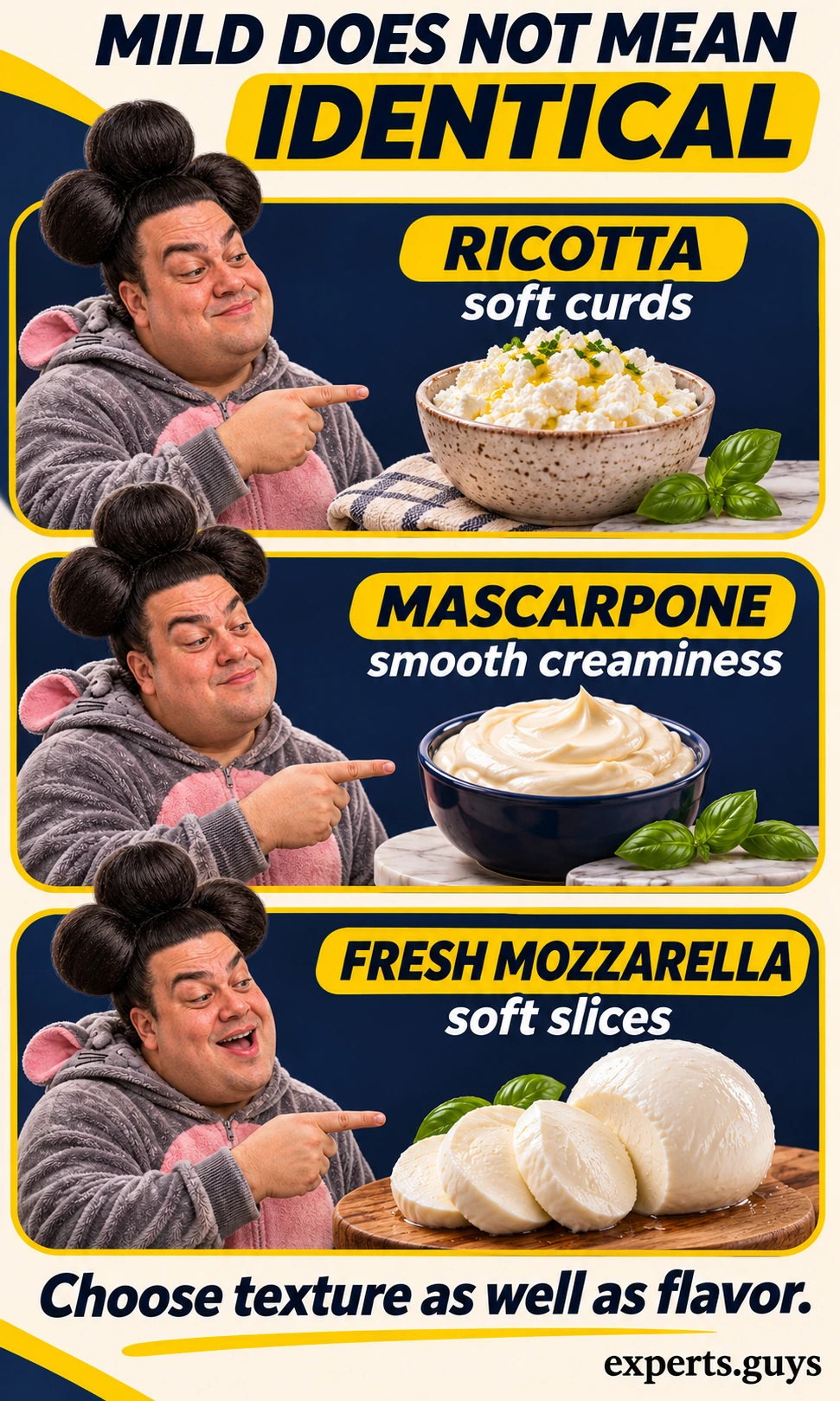
These are useful cooking categories rather than a laboratory ranking of blandness. Milk source, brand, salt, production method and your own expectations all change the experience. A cheese can taste mild to someone who enjoys aged blue cheese and seem quite noticeable to someone who dislikes dairy aromas.
| Your goal | Starting choice | Important trade-off |
|---|---|---|
| Soft spoonable filling | Plain ricotta | Curds remain; wet products may need a recipe that accommodates moisture. |
| Smooth, rich dessert base | Plain mascarpone | Richness changes the dish even when the aroma stays gentle. |
| Tender slices in a cold dish | Fresh mozzarella | Packing liquid and surface moisture need attention. |
| Stretch on toast or pizza | Low-moisture mozzarella | Choose the plain version; salt and browning still vary by product. |
| A mild sliced sandwich cheese | Young plain Havarti | Creamy character is still present; aged or flavored versions change the brief. |
Ricotta: gentle flavor with a curd texture
Ricotta is useful when you want the cheese to contribute body without making every bite taste strongly aged. Its fine curds are part of the attraction in a filling or a spooned topping. Choose it because those curds suit the food, rather than expecting it to behave like a glossy sauce or an elastic melted layer.
Plain and unflavored matter here. A tub mixed with herbs, citrus or sweeteners is a different ingredient, even if the base cheese is mild. Read the ingredients instead of relying on a white appearance or a picture of a simple serving on the front of the pack.
Mascarpone: low-key aroma, substantial richness
Mascarpone makes more sense when you want a smooth base for fruit, a dessert cream or a rich finishing element. The California Milk Advisory Board’s cheese guide describes mascarpone as mild and sweet, ricotta as very mild and semisweet, and water-packed mozzarella as having a delicate fresh-milk flavor. Those descriptions support a shortlist, not an objective winner.
A mild ingredient can still dominate through richness. If you replace a lighter filling with mascarpone, the result may feel much heavier even though the aroma stays restrained. That is why “less cheesy” and “lighter” should be treated as separate requests when you choose a substitute.
Fresh and low-moisture mozzarella solve different problems
Fresh mozzarella is an appealing option when the cheese itself will be visible in slices or pieces. Low-moisture mozzarella is the more direct starting point when the job is an elastic layer on cooked food. The package wording is more useful than the shared name: fresh, water-packed and low-moisture describe a difference that matters in the kitchen.
For a practical shopping check, pick up the plain version, identify its physical form, and compare equivalent nutrition quantities. If one label gives sodium per serving and another per 100 grams, convert them to the same basis before deciding which is lower. Do not compare two differently sized servings as though they were equal portions.
- First, read the product name for plain, smoked, herbed, aged or flavored wording.
- Next, identify the form: a tub of curds, a smooth cream, a ball in liquid or a firm block.
- Then compare sodium on the same weight basis and check whether the label states an age.
- Finally, match the pack to the texture and heating behavior required by your recipe.
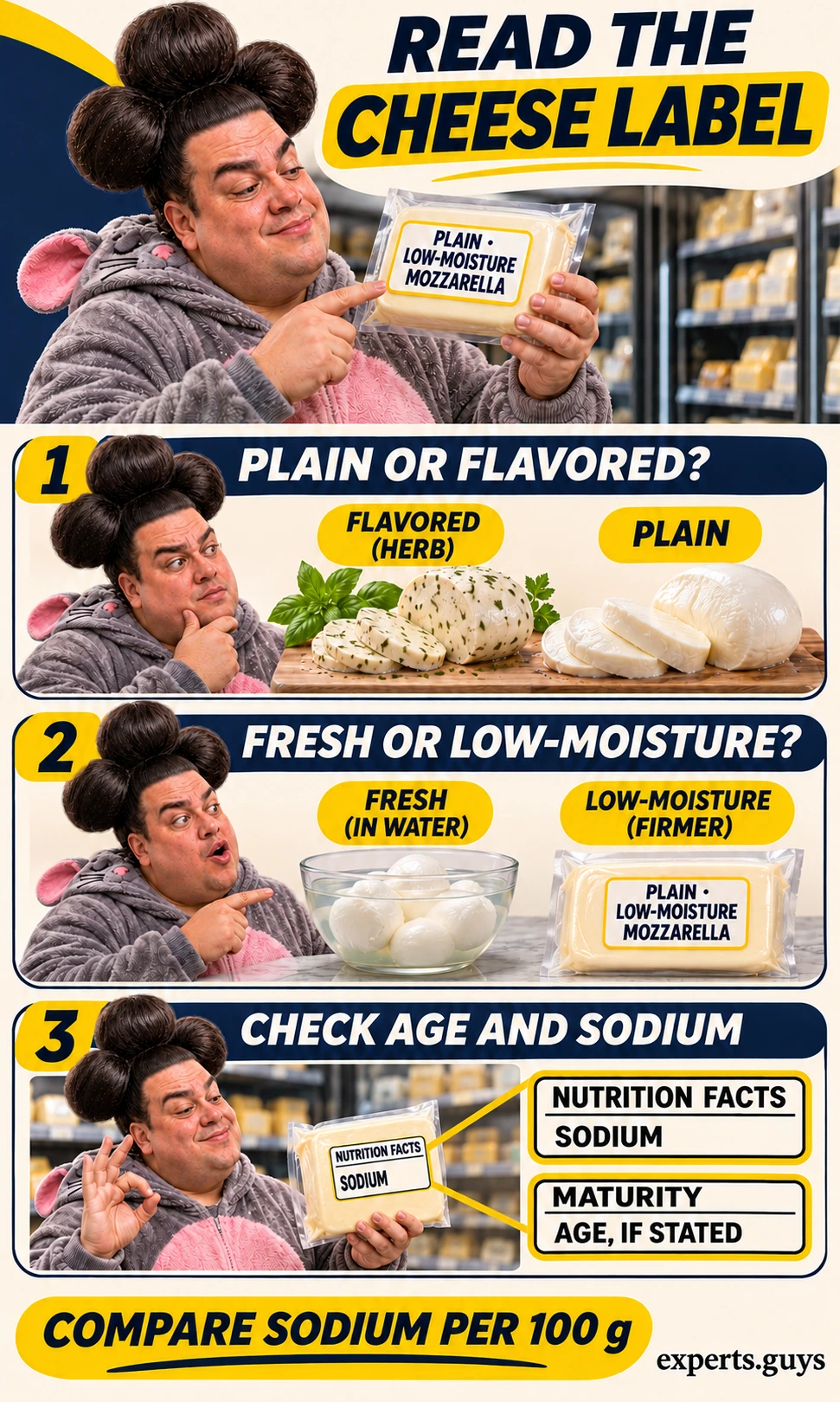
An illustrative label comparison makes the point: a pack with 120 milligrams of sodium in 30 grams contains 400 milligrams per 100 grams; a different pack with 150 milligrams in 50 grams contains 300 milligrams per 100 grams. The second serving has a larger printed sodium number but the lower concentration. These invented numbers explain the arithmetic and describe no actual brand.
The calculation is sodium in milligrams divided by serving weight in grams, multiplied by 100. Use the same approach for two packs of the same cheese when the serving sizes differ. It helps you compare labels; it does not predict which pack will taste milder, and it does not turn a preference article into a low-sodium diet plan.
Buy for the usable portion, not the biggest pack
A low price per kilogram is useful only if you can use the cheese appropriately within its storage instructions. For a first purchase, a smaller pack reduces the cost of discovering that you dislike the texture. Once you know which style works in your regular meals, a larger size may make more sense.
For a ball sold in liquid, look for drained weight when the label provides it. That is a more helpful basis for estimating the amount of cheese available than assuming every gram of the packaged contents becomes a topping. For a tub of curds, think about the amount your actual recipe calls for rather than treating the tub size as a serving instruction.
The useful comparison is between two products that can perform the same job. Comparing an inexpensive watery ball with an expensive firm block purely by price misses the preparation difference. Equally, a premium label cannot make a smooth cream suitable for a recipe that depends on a shreddable ingredient.
Where does Havarti belong?
Young plain Havarti can work when you want an easy sliced cheese rather than a fresh curd or cream. Arla describes its Havarti as mild and creamy, which is a more useful expectation than calling the whole category tasteless. The particular product matters, especially when dill, smoke or maturation is part of its identity.
Choose a small pack if you are uncertain about its flavor. Buying a large block because a variety appears on a bland-cheese list creates unnecessary commitment. For a sandwich, you are choosing a combination of slice texture, aroma and compatibility with the filling, not merely trying to minimize one sensory attribute.
Why can mild cheese seem to have no flavor?
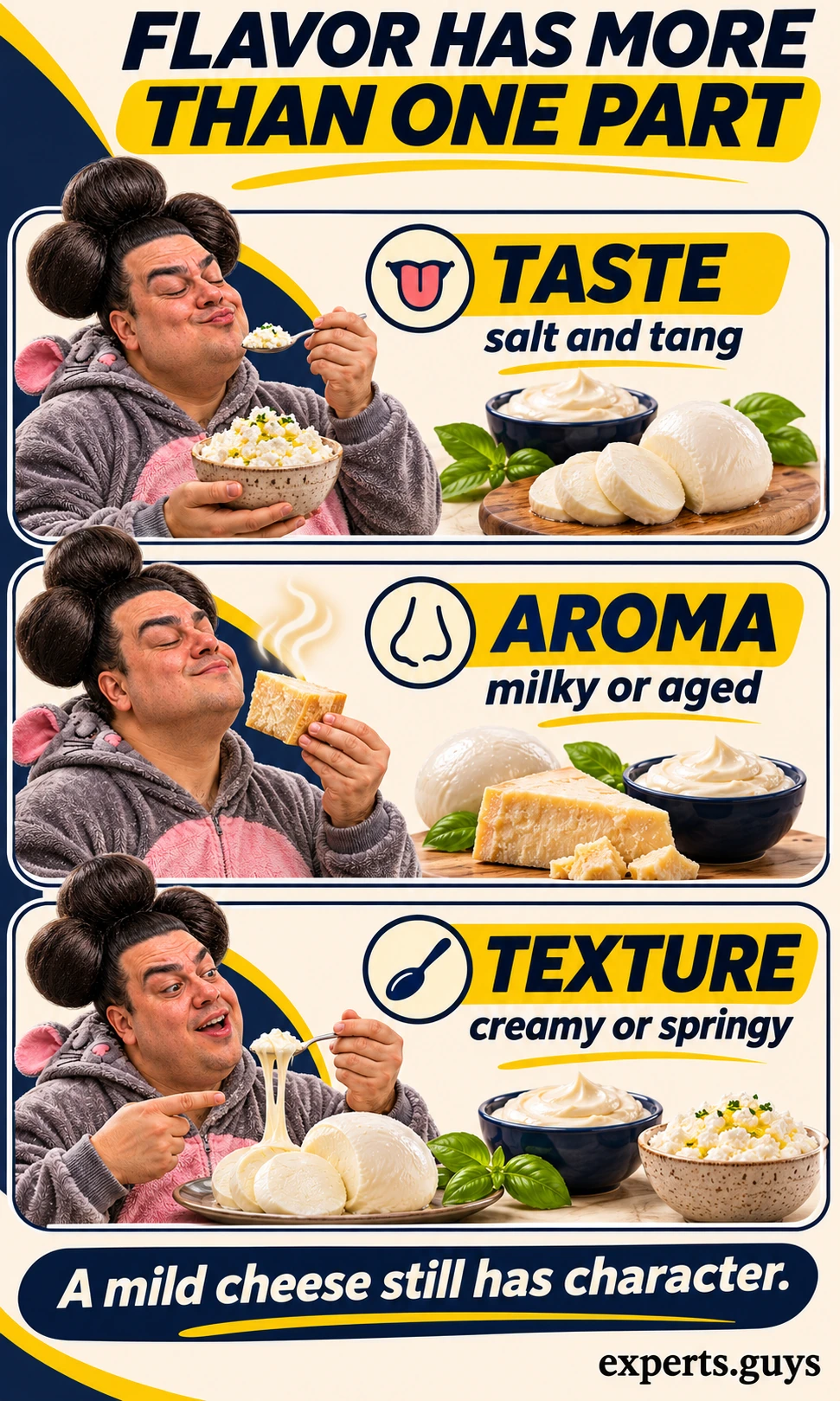
A subtle cheese can disappear when stronger ingredients, an unsuitable serving context or a disappointing texture become the main thing you notice. Separate taste, aroma and texture before deciding that the cheese itself has failed. Each points toward a different choice, and adding more seasoning does not answer all three problems.
Taste includes sensations such as saltiness and acidity; aroma supplies much of the recognizable dairy or aged character; texture changes how the bite feels. The cheese-tasting guidance from Real California Milk treats these as distinct parts of appreciation. A soft, milky cheese should not be judged only by whether it delivers the intensity of an aged one.
A restrained flavor may be doing the intended job
Imagine a fruit dessert in which you want the berries to remain the main flavor. A smooth, quiet dairy base may be successful precisely because you notice the fruit first. Calling that base tasteless would miss its contribution to the texture and balance of the spoonful.
The same logic changes in a sandwich built around cheese as the main filling. If you want a clear cheese character, choosing the quietest option and then complaining that it disappears is a mismatch between the goal and the ingredient. You may want young Havarti or another mild but noticeable sliced cheese rather than a dessert-style cream.
This is an editorial judgment about fit, not a sensory score. The useful question is whether the cheese should lead, support or supply texture. Decide that before you substitute, because increasing the amount can alter moisture and structure without delivering the kind of flavor you were seeking.
Strong accompaniments can hide a delicate cheese
Chilli oil, smoked meat, garlic sauce and heavily seasoned crackers can become the main event around a mild cheese. If the finished combination tastes good, nothing needs correcting. If you cannot tell whether you like the cheese, judge a plain bite first rather than drawing a conclusion from the strongest topping on the plate.
For this comparison, put a small plain portion on a clean plate and keep the rest of the package cold. Taste it before adding sauce, then consider whether the texture suits you. A glass of water and a plain accompaniment, if wanted, are enough; there is no need for a score sheet, diary or elaborate tasting setup.
- Use only a small serving, with clean utensils, rather than leaving the whole tub on the counter.
- Try the cheese plain before the sauce or strongly flavored topping.
- Notice whether you dislike the dairy character, the curds or the amount of moisture.
- Choose the next product for the thing you actually want to change.

An easier version is to compare one small plain bite with the next bite as you normally serve it. If the plain bite has a gentle character but the finished dish overwhelms it, the cheese is not necessarily defective. You have learned something about the combination, and can decide whether that quiet supporting role is desirable.
For an illustrative snack decision, suppose you dislike lumpy textures but enjoy a mild creamy flavor. Ricotta could disappoint even if its flavor is restrained, while a smooth alternative could fit better. The result you are checking is comfort with the texture, not evidence that one cheese is universally better.
Cold serving is not an excuse for unsafe holding
Serving temperature can change your impression, but do not leave fresh cheese out for hours to chase more flavor. The FDA’s perishable-food guidance calls for refrigeration at 4°C / 40°F or below and limits unrefrigerated time to two hours, or one hour above 32°C / 90°F. Count preparation and serving time together.
Keep the main pack refrigerated and serve a small portion. Follow the product’s storage and use-by instructions, and do not taste food to decide whether questionable storage was safe. This article’s plain-bite comparison applies to properly stored cheese that is suitable for eating, not a suspicious product you are trying to rescue.
If your real difficulty is the feeling of the bite rather than its intensity, the broader explanation of how food texture changes enjoyment provides useful context. Here, keep the decision specific: curds, smooth cream, soft slices and a stretchy melt are different experiences even when all are described as mild.
How do you keep a mild cheese useful in cooking?
Preserve the function your recipe needs: a filling should hold the intended texture, a spread should remain appropriate for spreading, and a melted topping should deliver the right amount of stretch and moisture. Choose a cheese for that function before adjusting its flavor. Replacing it solely because another variety is milder can create a worse dish.
For example, replacing all the low-moisture mozzarella on a pizza with mascarpone changes much more than intensity. You are changing the type of topping and should expect a different result. A small amount used deliberately can be a recipe choice; treating the cheeses as identical ingredients is the mistake.

| Requirement | Useful direction | Substitution to question |
|---|---|---|
| Distinct curds in a filling | Ricotta | Smooth cream cheese may change both tang and texture. |
| Rich, smooth base | Mascarpone | A wet curd cheese may not provide the same finish. |
| Elastic melted layer | Low-moisture mozzarella | Fresh mozzarella introduces a different moisture situation. |
| Firm pieces that keep their identity | A cheese selected for that behavior | Do not choose by mildness and assume every cheese melts. |
Control surface moisture when using fresh mozzarella
When fresh mozzarella sits in liquid, lift out only what you need with a clean utensil. Place it on a clean plate, cut pieces suitable for the recipe, and gently blot wet cut surfaces with clean kitchen paper. The checkpoint is the absence of obvious surface puddles, not a dried-out or squeezed-flat cheese.
Spread the pieces across the topping instead of piling them in one wet patch. This is a practical way to manage free surface liquid; it does not turn fresh mozzarella into the low-moisture product. If the recipe depends on a firm, shreddable cheese, buying that product is usually the simpler correction.

Avoid wringing the cheese in a towel or trying to remove every trace of moisture. You are preparing a fresh ingredient, not converting its manufacturing process. If handling wet slices is awkward, use a slotted spoon to lift small pieces, keep them on a plate and blot gently without squeezing.
A useful result is a topping arranged in discrete pieces without packing liquid being poured onto the base. If a pizza still becomes wet, the sauce, vegetables, topping quantity and baking method may also contribute. Cheese preparation resolves one variable; it is not a universal cure for a soggy crust.
The homemade pizza dough guide covers the dough and baking side of the job. Keep those decisions separate from the cheese choice so you can identify whether the problem begins with the base or the topping. There is no need to repeat the complete dough process in a cheese-selection article.
Read the recipe’s cheese instruction as a functional clue
Words such as grated, sliced, dolloped and folded tell you something about how the cheese is expected to enter the dish. If the instruction says to scatter grated cheese evenly, a spoonable cream changes that step. If it says to leave visible curds, choosing the smoothest product defeats part of the intended texture.
Use those words together with the named cheese and quantity. A recipe that gives a weight of low-moisture mozzarella has already made a more specific choice than a loose instruction to add cheese. Respect that specificity when predictability matters, especially if you have not made the dish before.
For an illustrative toast choice, suppose the goal is a coherent melted layer with a gentle flavor. A plain shreddable mozzarella fits that brief more directly than spoonfuls of fresh ricotta. If the goal instead is a cool, curd-textured topping on finished toast, ricotta may fit better. The bread can be identical while the intended cheese structure changes.
This gives you a way to evaluate a substitution before committing the full quantity. Ask whether the replacement can enter the dish in the same physical form and whether you still want the resulting texture. If the answer is no, look for a recipe written for the replacement instead of trying to force equivalence.
Combine curds and stretch only when both are useful
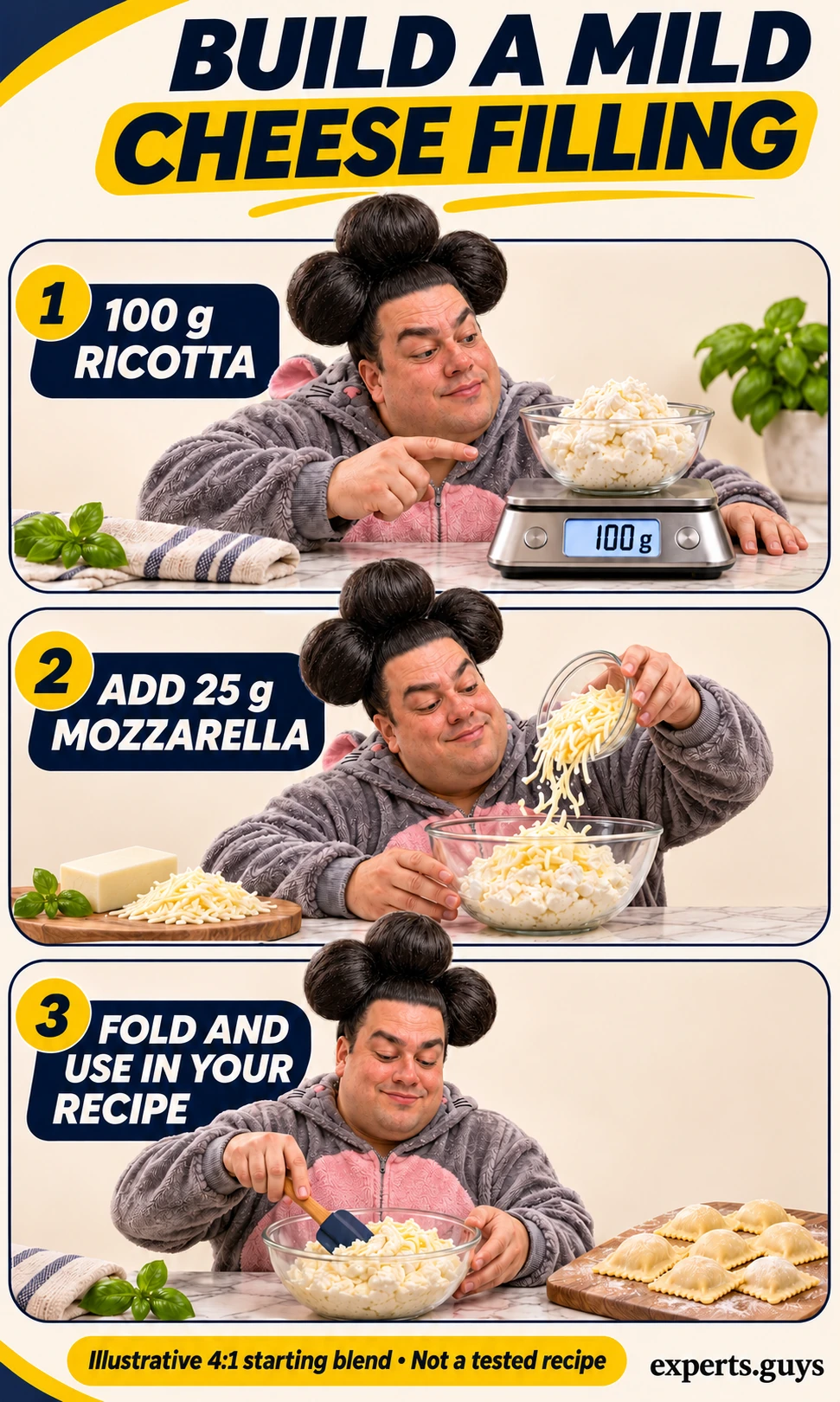
A filling can need ricotta’s curds and a little mozzarella’s melted character at the same time. As an illustrative starting blend, place 100 grams of plain ricotta in a bowl, add 25 grams of grated low-moisture mozzarella and fold them together. This 4:1 ratio is a transparent example, not a tested recipe or a guaranteed filling formula.
Use that mixture within a recipe that gives appropriate filling quantities and cooking instructions. Before cooking, the visible checkpoint is a mixture with curds and shreds distributed through it. Do not expect a uniform cream, and do not infer that raw appearance predicts the final cooked texture perfectly.
The common mistake is to add cheese repeatedly while trying to fix a filling that is already too wet or too heavily packed. More mozzarella changes the balance and may be the wrong response. Begin with a recipe suited to the available ricotta, and use the blend only when you actually want the two textures together.
For an easier approach, skip the blend and use the single cheese specified by a reliable recipe. That is often the better choice for a beginner or for a dish with a filling that must behave predictably. A comparison article should help you choose ingredients; it should not pretend to validate every possible substitution.
A worked choice: two different meanings of “less cheesy”
Consider an illustrative household meal with a fruit dessert and a baked pasta dish. For dessert, the request is a smooth dairy element that lets the fruit lead. For pasta, the request is a soft filling that is gentle in flavor but still contains recognizable curds. These are two separate texture requirements, so one tub need not solve both.
Mascarpone is a reasonable direction for the first goal, while plain ricotta is a reasonable direction for the second. If the pasta recipe also needs an elastic melted topping, the low-moisture mozzarella belongs in that role. The decision uses the architecture of the dish, rather than a claim that any one cheese has no taste.
Change the recommendation if the constraints change. If you need a lower-fat product, a specific sodium limit, a dairy-free ingredient or a medically required restriction, read the actual label and choose a recipe that fits. A mild flavor description establishes none of those properties, and a preference-based substitution should not be presented as nutrition advice.
Which cheeses and shortcuts should you rule out?
Rule out the idea that every pale, soft or expensive cheese is neutral, and rule out substitutions that ignore the recipe’s structure. Halloumi, Grana Padano and aged cheeses have useful identities of their own. They should not be grouped into a list of tasteless products simply because someone has described a disappointing serving.
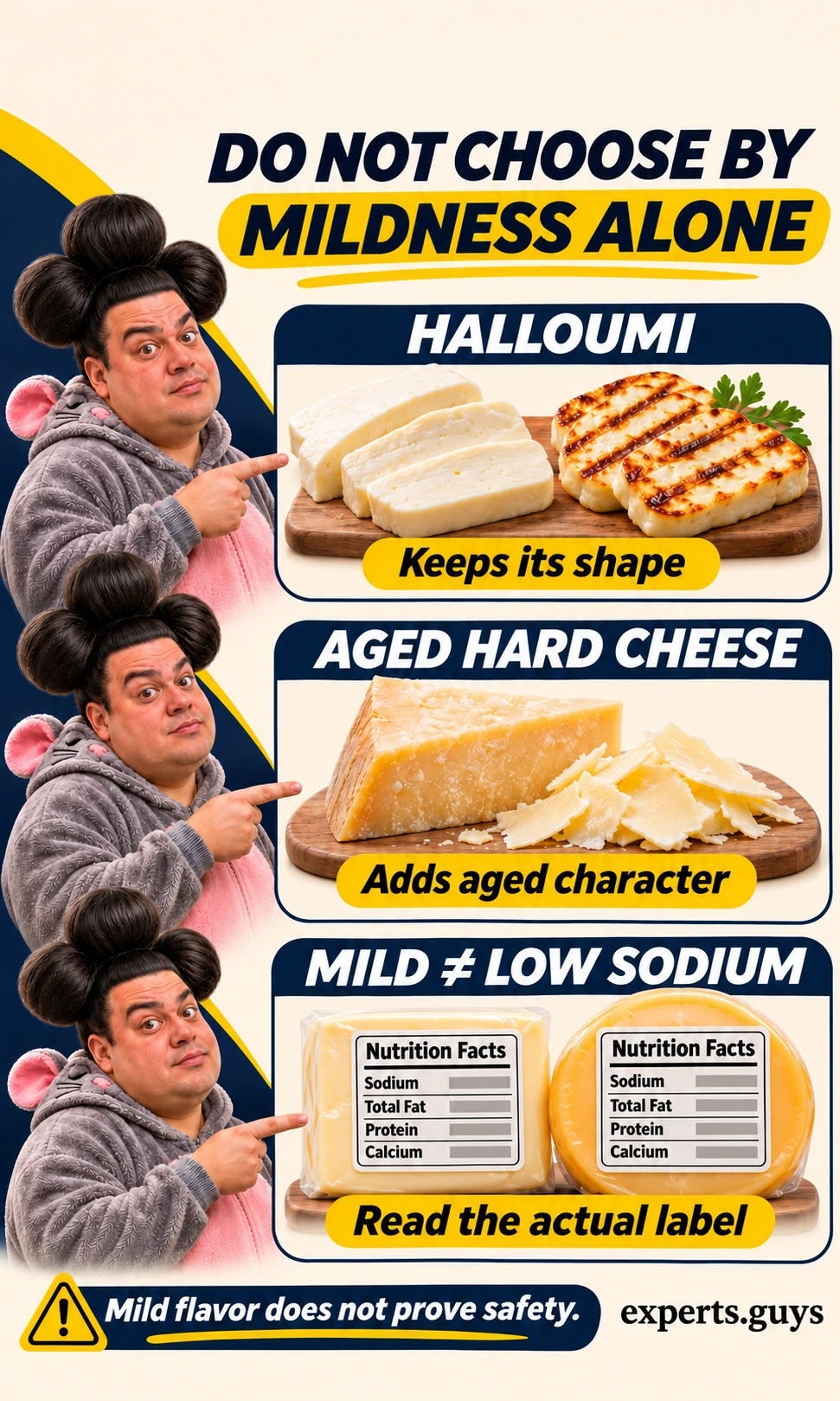
Halloumi is not a crumbly fresh-cheese substitute
The Halloumi product specification describes a firm, elastic cheese that does not spread or melt at high temperatures. That makes it a different candidate from a tub of soft curds or a cheese intended to create a flowing melted layer. Check a product’s directions and flavor description if you want a frying cheese; do not buy it as an assumed neutral replacement for mozzarella.
The distinction matters even when you like both products. In a dish that needs separate cheese pieces, shape retention may be desirable. In a dish that needs stretch, the same characteristic may be a drawback. Calling the result tasteless would conceal a more useful explanation: the cheese was being asked to perform the wrong job.
Grana Padano belongs to a different flavor brief
Grana Padano can add a recognizable aged-cheese note, so it is not the first direction when you want the dairy component to disappear. Maturity changes its character. The consortium’s tasting explanation describes a progression from milky and creamy aromas toward more complex butter, dried-grass and broth-like notes as aging advances.
Choose it when that added character is wanted, and check the age rather than expecting every piece to taste the same. There is no need to discard a cheese because it is mature; maturity can be an intended part of the product. Equally, an aged hard cheese is not a direct functional replacement for fresh mozzarella just because both can appear on cooked food.
Low salt, low fat and low flavor are different labels
A lower-sodium product can still have a distinctive aroma or tang, while a mild product can contain more sodium than you expect. Compare the nutrition panel when sodium matters. The word mild describes an intended flavor impression, and should not be used as shorthand for a health claim.
Likewise, a product marketed as light or reduced fat may differ in texture and cooking behavior. If a recipe’s success depends on a specific kind of cheese, check whether its instructions allow that substitution. You may prefer the result, but the package claim alone does not promise an identical filling, spread or melted layer.
For the same reason, a white color does not establish a neutral flavor. Appearance can help identify a type of cheese, but it cannot replace the name, ingredient list and stated style. An herb-flecked pack is obviously flavored; a plain-looking product can still have a noticeable tang or aged character.
Distinguish a preference from a product problem
If a properly stored cheese has the expected appearance and texture but its normal dairy character does not appeal to you, a different style may be the right next purchase. Trying to hide every trace of that character under sauce can move the dish further from your original aim of a gentle, simple meal.
If the problem is an unexpected change from the product you normally buy, check the pack and handling history instead of assuming all batches are interchangeable. A change in recipe, age, flavoring or product format can explain a different experience. A safety concern calls for a safety decision, while a preference calls for an ingredient decision.
Keep those conclusions modest. One disappointing pack is not evidence that a whole variety is flavorless, and an enjoyable meal does not establish a universal recommendation. The useful outcome is finding a particular style that fits your food and your preferences, with enough understanding to choose it again.
Do not use tasting as a food-safety check
Unexpected mold on a fresh cheese, a damaged pack, uncertain refrigeration or a recall concern is a reason to stop and resolve safety first. Adding herbs or cooking a questionable product is not a flavor fix. Read the label, follow recall instructions where applicable, and discard a product when its handling history makes it unsuitable.
People who are pregnant, older or immunocompromised need particular care with fresh soft cheeses. FDA advice accompanying its soft-cheese investigation tells higher-risk consumers to avoid queso fresco-type cheeses, including soft ricotta/requeson. Pasteurization does not by itself remove every handling or contamination risk; use current food-safety guidance for your situation.
If a prepared dish seems flat but the cheese choice fits, move to the component that actually needs attention. For instance, the guide to bland mashed potatoes addresses moisture and finishing in mash. Adding a different cheese to the pot should not replace finding out whether the potato preparation itself caused the disappointment.
Questions before you buy
Is cream cheese the same as mascarpone?
No. Both can provide a smooth texture, but they are different products and should not be assumed to have identical flavor or recipe behavior. If a dessert depends on a specified cheese, use that ingredient or a substitution explicitly supported by the recipe.
Does white cheese always taste milder than yellow cheese?
No. Color is not a reliable scale of flavor intensity. Check the type, age and flavorings, and choose the product for its job rather than treating its color as a promise of blandness.
Can a dairy-free cheese alternative replace a mild dairy cheese?
Sometimes, but check the particular product and recipe. Alternatives differ in ingredients, flavor and heating behavior. A product designed for spreading is not automatically suitable for an elastic melted topping, and a dairy-free label does not establish that it suits every allergy.
Does freezing turn cheese tasteless?
Freezing is not a reliable way to remove flavor, and thawing can change texture. Follow the manufacturer’s guidance and consider the intended use. A product that becomes less pleasant for eating plain may still require a different decision from one being used within an appropriate cooked recipe.
Will children always prefer the mildest cheese?
No. Preferences depend on texture, familiarity and the rest of the meal as well as flavor intensity. Offer an age-appropriate serving without treating acceptance as a test or assuming that a stronger cheese is automatically unsuitable.
Your next choice
For your next purchase, name the result you want before you name the cheese: soft curds, smooth richness, tender slices or a stretchy topping. Pick a small plain pack that matches that job, check the label and use it in a suitable recipe. That gives you a practical way to find a gentle cheese you enjoy without expecting it to be flavorless.