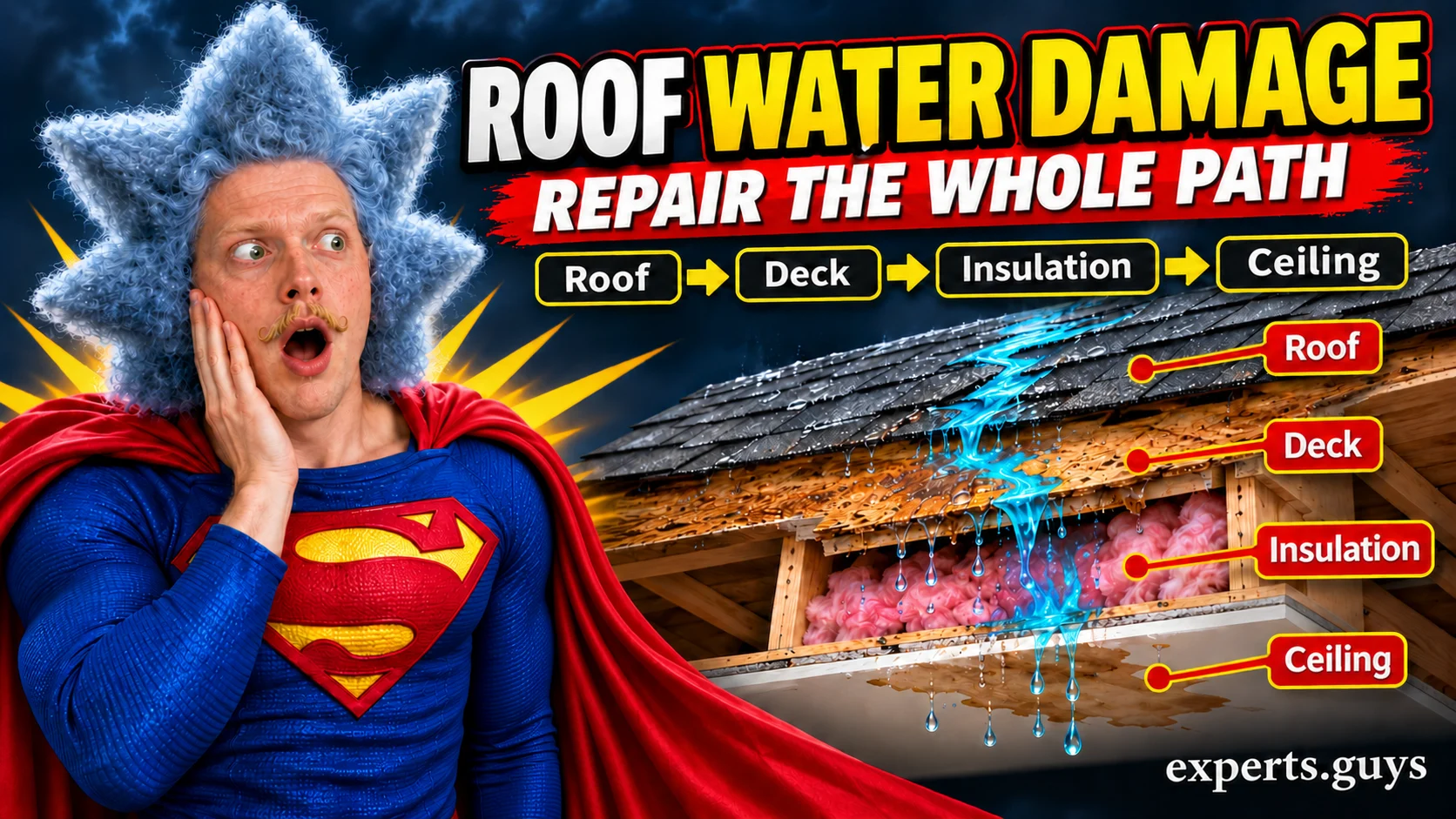
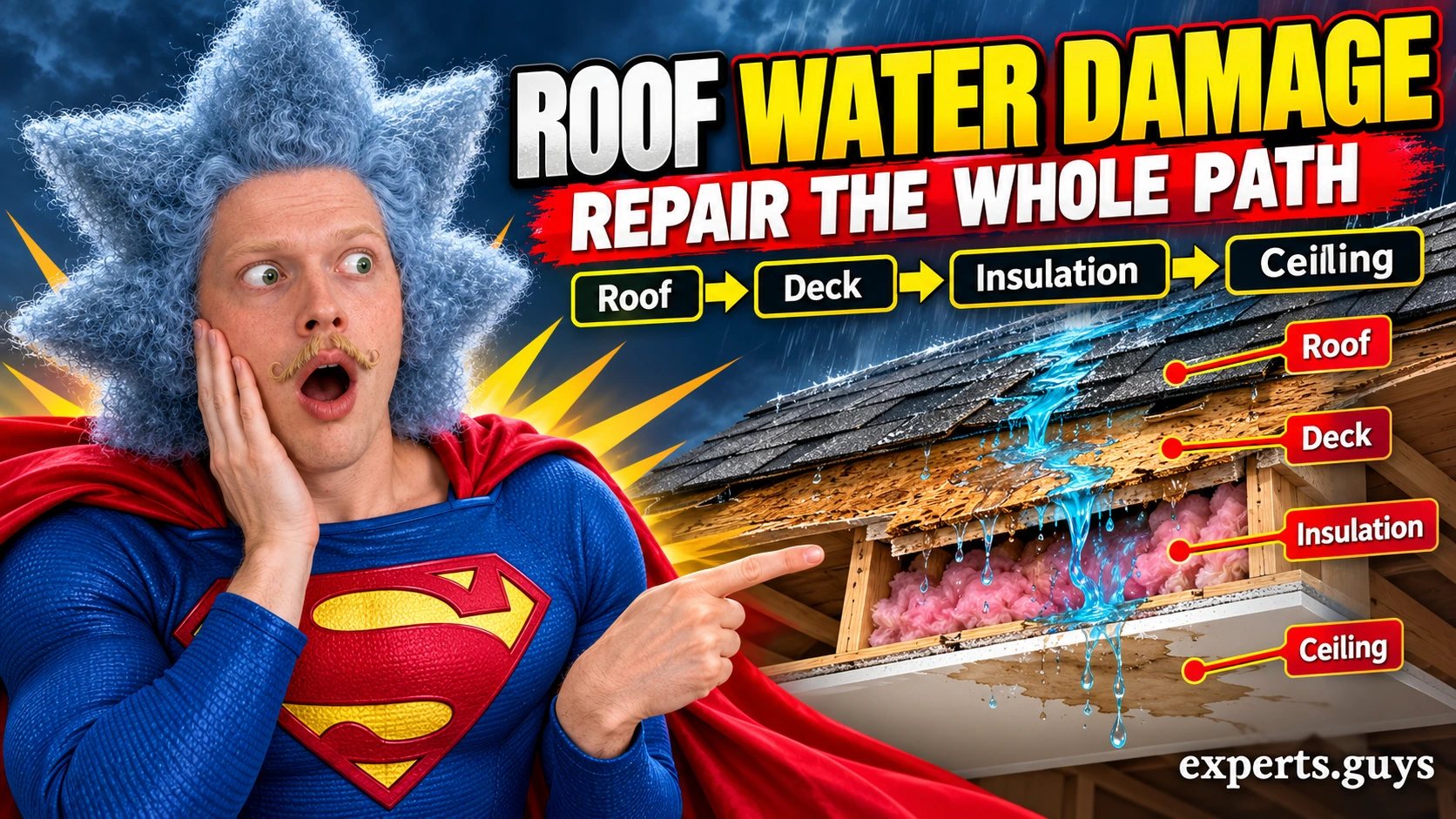
Water damage roof repair means fixing the point where water enters and dealing with the roof deck, insulation or ceiling materials it has affected. A complete repair scope separates those jobs, assigns responsibility for each and states what must be checked before anything is covered again. Start by asking what the quoted roof repair includes below the visible surface.
Keep people clear of a sagging or bulging ceiling, falling material, or water near electrical fittings. Do not puncture the ceiling, touch wet fittings, enter an unsafe attic or climb onto a wet roof. Arrange urgent qualified assessment; if collapse or electrical danger appears imminent, leave the affected area and contact local emergency services.
What should a roof water damage repair actually include?
A roofer may stop the entry leak without repairing the room below. A restoration contractor may dry an interior without rebuilding flashing outside. Neither arrangement is automatically wrong, but the boundary must be explicit: an unassigned task can remain unfinished even when each individual contractor has completed the work they quoted.
Think of the scope as two connected boundaries: the roof detail that failed and the materials reached by water. They need not occupy the same footprint. Water can travel along a surface or framing before it becomes visible, so a ceiling stain is a starting clue rather than a measured outline for the entire repair.

Use the following division to check responsibilities before comparing prices. Not every leak damages every layer; the purpose is to establish what was assessed, what needs work and what remains uncertain.
- Entry repair: name the defect and permanent repair detail, including any temporary weather protection and its follow-up.
- Concealed materials: identify whether decking, framing and insulation were assessed, and how inaccessible areas will be handled.
- Interior recovery: state who handles drying, necessary material replacement, ceiling finish and cleanup.
- Completion evidence: agree who provides concealed-work photographs, drying information and any required inspection or warranty documents.
For asphalt-shingle roofs, distinguish the covering from its supporting deck. Shingles shed weather; the deck supports the roof covering and its fasteners. Replacing the visible covering does not repair a rotten substrate. The asphalt roofing industry’s reroofing bulletin specifically requires damaged boards to be replaced before new shingles are applied.
A small brown mark does not automatically require new decking, and a dry-looking board is not automatically sound. An appropriate contractor must distinguish staining from decay, distortion, separated plywood layers or damaged fastener support. A low moisture reading cannot reverse physical deterioration. Ask what condition supports retaining the material, rather than using colour alone to decide.

This guide focuses on pitched residential roofs, with asphalt shingles as the main example. Metal, tile and low-slope membrane systems require their own repair details. For the separate question of why water entered, use the guide to causes of water damage from roofs; do not make a quote comparison stand in for a source investigation.
Read a vague quote in three passes
This review suits a quote that says only “repair roof leak” or “replace damaged area.” Use the quote and any contractor-supplied component photos at a comfortable table; no roof access or note-taking routine is needed. The aim is to make the contractor’s promise specific enough to check.
- Locate the defect. Find the named roof detail and location. “Repair sidewall flashing at the rear bedroom” is more testable than “seal roof.” If the cause remains uncertain, ask what investigation is included before a permanent repair is selected.
- Name the layers. Identify the covering, flashing, underlayment and supporting material included in the repair. Ask which items are reused, repaired, replaced or excluded, and how adjoining existing materials will be connected.
- Assign each trade. Check who handles temporary protection, roof work, drying and interior restoration. Ask who coordinates the handoff when two companies are involved.

Correction: do not treat a list of materials as a repair method. “Shingles and sealant” still leaves the failed junction and connection to the existing roof unexplained. For an easier first pass, review just the roof line item and ask: “Which defect does this repair, and what would you show me when it is complete?” Finish when the wording identifies the location, repair and responsible party, or clearly labels the investigation still needed.
How should hidden damage change the scope and price?
The first quotation may be provisional because some decking cannot be assessed until the covering is removed. That uncertainty should produce a clear allowance or change process, rather than an unlimited promise to repair whatever is found. GAF’s roof-decking explanation describes hidden deterioration and access complexity as reasons the final work can expand.
A unit rate is useful only when its unit and included work are clear. A price per sheet means something different from a price per square foot, and either can exclude framing, removal, disposal or difficult access. Do not assume an allowance is a fixed-price repair, or that a fixed roof price includes every concealed material below it.
Make the concealed-damage allowance usable
- Find the included quantity. Ask whether decking replacement is included at all, and if so how much. If it is excluded, ask how the likely additional work is addressed before the roof is opened.
- Check the extra-work unit. Confirm the rate, material specification and what labour or disposal it includes. Framing repair should be identified separately when it is outside that rate.
- Agree the evidence and approval point. Request photographs and an explanation when damage is exposed, with the added quantity, cost and schedule effect agreed before additional permanent work is covered. Also agree how the opening will be protected if approval takes time.
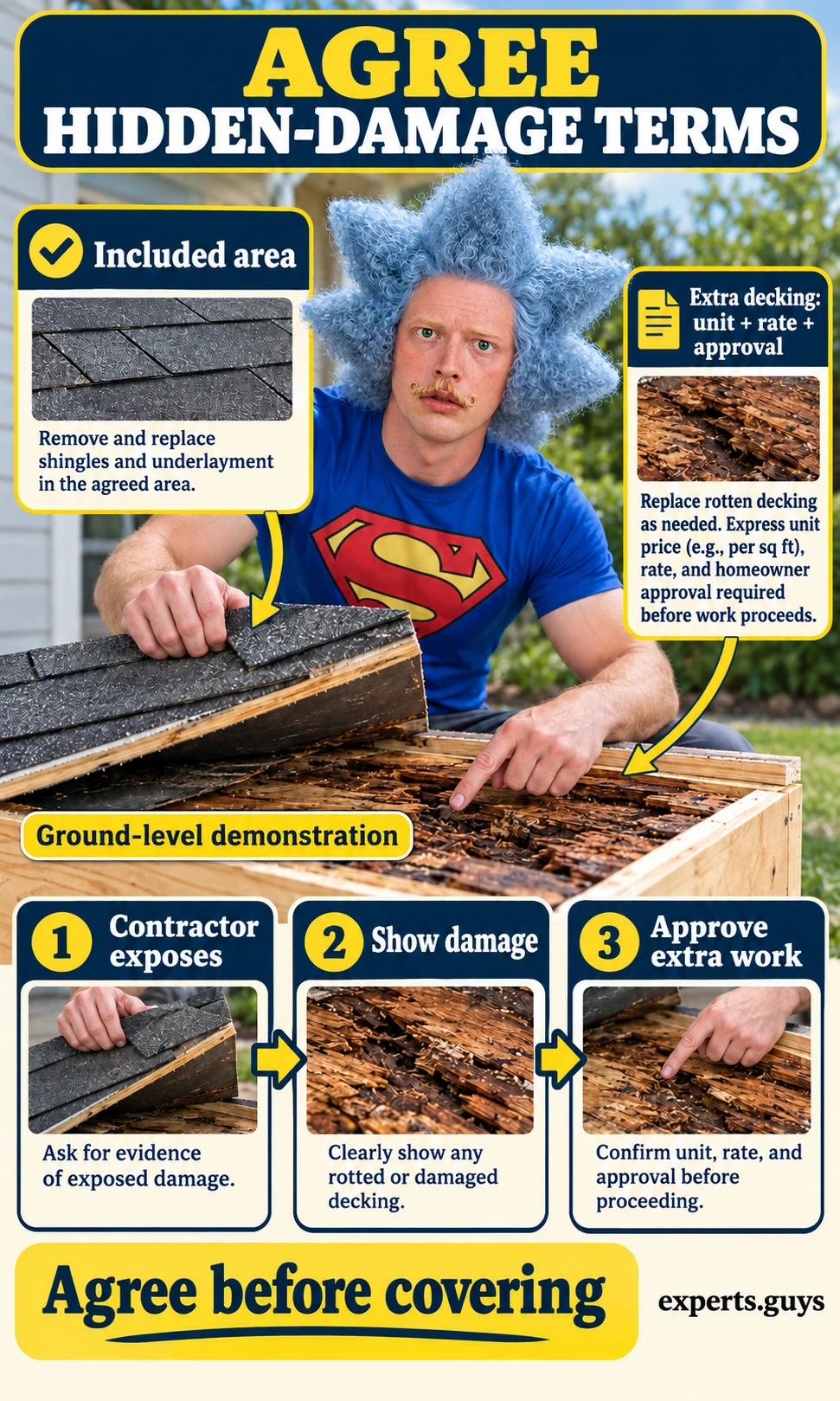
Easier version: ask the contractor to explain just one hypothetical extra decking sheet from discovery to approval. That short example exposes unclear inclusions quickly. The common mistake is asking only “how much extra?” without asking “for what unit and which work?” The review is complete when both sides can explain the same example consistently; it does not require you to judge the timber yourself.
An illustrative U.S. example: one estimate includes the roof junction repair but excludes all decking; another includes a stated decking allowance and a separate unit rate beyond it. Those totals are not comparable until the allowance, material and excluded work are aligned. This is an example of scope reasoning, not a market price, a recommended allowance or a prediction of your hidden damage.
Local requirements, permit rules, product instructions and existing construction can change the repair. Ask who checks those requirements and who arranges any applicable inspection. Do not transfer a decking thickness, fastening schedule or flashing detail from an online illustration to a different roof assembly.
When can the ceiling be closed and finished?
Closing the ceiling is a coordination decision, not simply the next day on the schedule. The entry repair must be addressed, and the affected cavity materials must be assessed for condition and dryness. Make the roofer’s completion and the interior contractor’s closure decision separate, named handoffs, so one contractor is not relying on an assumption about the other’s work.
| Question | Useful evidence | What it does not prove |
|---|---|---|
| Was the water-entry defect repaired? | Location-specific repair detail and completion record from the roofer. | A cosmetic ceiling patch cannot establish this. |
| Are retained materials suitable? | Condition assessment of affected decking, framing and interior materials. | Dryness alone does not establish structural soundness. |
| Has the cavity dried appropriately? | Material-specific drying checks, comparison basis and access limitations. | Dry room air or a dry surface is not the whole cavity. |
| Are unresolved items assigned? | Named party, outstanding work and any required inspection. | A finished appearance is not a complete handover. |
Drying evidence should identify the material, assessment location and basis for the conclusion. A number without its meter scale or comparison context can mislead. Ask the person responsible for drying to explain what was checked behind the finish and what could not be reached. The detailed measurement method belongs in the separate guide to interpreting moisture readings after water damage.

Begin drying promptly rather than waiting for the cosmetic repair appointment. The EPA’s home moisture guidance uses 24-48 hours as an early drying window that often helps prevent mold. It is not a guaranteed mold-free deadline or a promised drying duration; concealed layers, water history and access change the response.
Material decisions also differ. For clean-water incidents, EPA’s material-response guidance allows intact, unswollen wallboard to be considered for drying in place, while wet cellulose and fiberglass insulation are generally discarded and replaced. That guidance is not permission to retain sagging ceiling board or to apply clean-water methods where contamination is suspected. Let the assessment, not the paint schedule, decide what stays.
Keep any opening or removal of older materials within a suitably assessed work scope because hazardous materials may require controls. If mold, contamination or electrical involvement is suspected, tell the responsible contractor before air-moving or opening work begins. Do not run an HVAC system suspected of mold contamination; that can spread contamination. A ceiling replacement contract should say how these findings interrupt ordinary finish work.
How do you compare quotes and check the completed repair?
Compare the work promised before comparing the totals. The FTC’s contractor guidance recommends multiple written estimates that describe the work, materials, timing and price. Credentials, insurance and applicable local registration still need checking; a detailed quote does not itself establish competence.
Compare three quotes without treating blanks as zero
- Match the rows. Put the quotes side by side and find the same five categories: roof repair, decking extras, drying, ceiling finish and handover. Reading them aloud with another person is a workable alternative to arranging documents.
- Clarify blanks. Ask whether each missing item is included, excluded, unnecessary after assessment or still unresolved. Do not silently turn a blank into “included.”
- Compare totals with the boundaries visible. Review the price only after you understand each exclusion, allowance and handoff. Keep unresolved items attached to the comparison rather than selecting a winner from an incomplete table.

Correction: more checked boxes do not mean a better contractor. One quote may properly exclude drying because a separately appointed restoration company owns it. For a smaller first step, compare only the roof-repair description across two quotes. Completion means you can explain why their scopes differ and what must be clarified; it does not mean every contractor must perform every job.
If you prefer an on-page comparison, select the wording that actually appears in each quote below. The comparison highlights unanswered categories; it does not diagnose the roof, value the repair or rate contractors. You can carry out the same review directly from your quotes without using it.
ROOF REPAIR QUOTE REVIEW
Repair Scope Compare
Find unanswered scope questions across three quotes before comparing their prices.
Select only what the quote actually says. A missing line is an open question, not a zero cost. This comparison does not diagnose damage, certify a repair or rank contractors.
Find and compare appropriate local help
Search by the trade you need. Check local registration where required, insurance, relevant repair experience, scope, availability and warranty terms. Use the three quote labels above for candidates you find.
Enter an area to show search links. Searches support worldwide locations.
Entries stay in this page session and reset on reload. There is no account, upload or automatic saving. Local searches send the trade and area to Google only when you open a link. No prices, ratings or provider availability are supplied.
Review the handover from a safe place
- Before covering: ask for the agreed concealed-work evidence, including the relevant location and any additional work approved. Check that it corresponds to the quoted repair rather than a generic close-up.
- Drying evidence: confirm that the responsible person addressed the affected materials and any limits of access before the ceiling was closed. Ask who owns any unresolved cavity concern.
- Finished detail: reconcile the completed roof detail and interior finish with the scope. Obtain applicable inspection records, warranty terms and a clear route for reporting recurrence.

Use contractor evidence rather than climbing up to reproduce the inspection. An easier review is a short ground-level handover in which the contractor explains one roof-detail photograph, one concealed-work image and the drying conclusion. Photographs can show what was done, but cannot independently prove structural adequacy or watertightness. Finish with every unresolved item assigned to someone, not with an assumption that a tidy room answers everything.
If staining or dampness returns, identify it as a recurrence and refer it back through the agreed callback process. A stain remaining visible after drying can be cosmetic; a changing mark or fresh moisture needs reassessment before repainting. Do not conduct your own roof hose test or wait beneath a damaged ceiling to watch for drips.
Compare Local Home Specialists Near You
Tell us what kind of help you need, then compare nearby businesses by location, Google rating, review volume and contact options.
HomeFix Local Match
Turn a home problem into a practical local hiring decision. Check the clues, see the specialist types that fit, open focused surrounding-location searches, then compare the strongest three before you call.
 YOUR PROBLEM
YOUR AREA
COMPARE 3
✓ Ready to compare
What is happening?
Choose the closest problem type, then check every clue that applies. Your selections change the specialist order.
Where should the search focus?
Use Google’s “near me” context or enter the area you actually want a specialist to serve.
Simple local search: open nearby Google results, choose the businesses that look suitable, then compare your best three here before you call.
Problem snapshot
Who should you call first?
These are the specialist types most likely to fit the clues you selected.
Search around your location
Compare your top three
Use the same factors for each option so a high star rating does not hide a weak scope, poor diagnosis, missing credentials or unclear aftercare.
Comparison result
Your result combines the Google signals you entered with the practical hiring checks you completed.
Questions to ask every finalist
Use the same questions with each shortlisted business so the comparison stays consistent.
Frequently asked questions
Does one roof leak mean the whole roof needs replacing?
No. The decision depends on the defect, extent of deterioration, condition of the surrounding roof and whether a reliable repair can connect to it. Ask for the location-specific reason behind a repair or replacement recommendation; the existence of one ceiling stain alone does not settle it.
Can the roofer exclude the ceiling repair?
Yes, if that boundary is clear and someone else owns the interior work. Check who is responsible for drying and material assessment before the ceiling finish is reinstated. A roof-only contract should not be mistaken for a complete interior restoration contract.
Should I accept a quote that relies on sealant?
Ask which detail the sealant serves, whether the repair is temporary or permanent, and whether it follows the relevant roofing product instructions. The word “seal” alone does not explain how the failed junction will be repaired. Appropriate use of a specified product differs from an unexplained surface patch.
How long should a roof water damage repair take?
Access, weather, concealed damage, drying and inspection requirements determine the sequence. Ask for separate milestones for protection, permanent roof work, cavity assessment and interior finishing. A start date is not a justified promise that hidden materials will be ready for closure on a fixed day.
Will insurance pay for all the work?
Coverage depends on the policy, cause of damage, exclusions and claim assessment. Keep mitigation and repair records and ask the insurer what documentation it needs. A contractor estimate does not establish coverage, and urgent measures to reduce further damage should not be confused with a coverage decision.
A complete repair has a clear boundary
A useful roof water damage scope connects the entry repair to affected materials, concealed-damage terms, drying and the final handover. Begin with the least clear line in the quotation and ask the contractor to explain its location, included work and completion evidence. That single clarification makes the next comparison more meaningful.