




Therapy for low mood can help you work on the thoughts, routines and relationship difficulties that make everyday life harder. The right approach depends on your symptoms, their impact and what you want help doing; persistent or disabling symptoms need assessment, and some conditions need medication alongside therapy. Start with one manageable action below, or arrange care if your symptoms are worsening.
What can therapy for low mood help with?
“Therapy of mood” is not the name of one standard treatment. Talking therapies use different methods to address distress and difficulties with daily functioning. A useful starting question is: “What has become harder for me, and what would a small improvement look like?”
For example, an illustrative goal might be answering one essential message instead of avoiding the inbox all week. Another person may want support with bereavement, persistent self-criticism or conflict after a life change. These goals help make the conversation concrete without asking you to diagnose yourself.
Self-help practice and professional treatment can complement each other, but they have different jobs. A short exercise lets you practise one skill; a therapist can assess patterns and adapt the work with you. Medical assessment also matters when physical illness, medicines or another mental-health condition could be contributing.

You do not need to arrive knowing which therapy is “best.” Describe what is happening, including any periods of unusually high energy or much less need for sleep. The NIMH overview of psychotherapy explains why treatment should be matched to individual needs and medical circumstances.
- Hard to get started? Ask about approaches that work directly with activity and avoidance.
- Harsh thoughts keep repeating? Ask how therapy would help you examine thoughts without forcing positivity.
- Loss or relationship changes dominate? Ask whether relationship-focused work fits your situation.
- Sleep, safety or functioning has changed sharply? Ask for clinical assessment rather than relying on an exercise.
Make the first conversation easier
Bring one example from an ordinary day rather than a complete account of your life. The preparation below is an editorial conversation aid, not a clinical assessment form. You can read it from your phone, hand over a note or ask someone you trust to help you prepare.
- Name one difficulty: “I leave messages unopened because everything feels too much.”
- Describe a useful goal: “I would like to reply to one essential message without spending the evening worrying.”
- Agree one next step: ask what you will practise, what help is available and when you will review it.
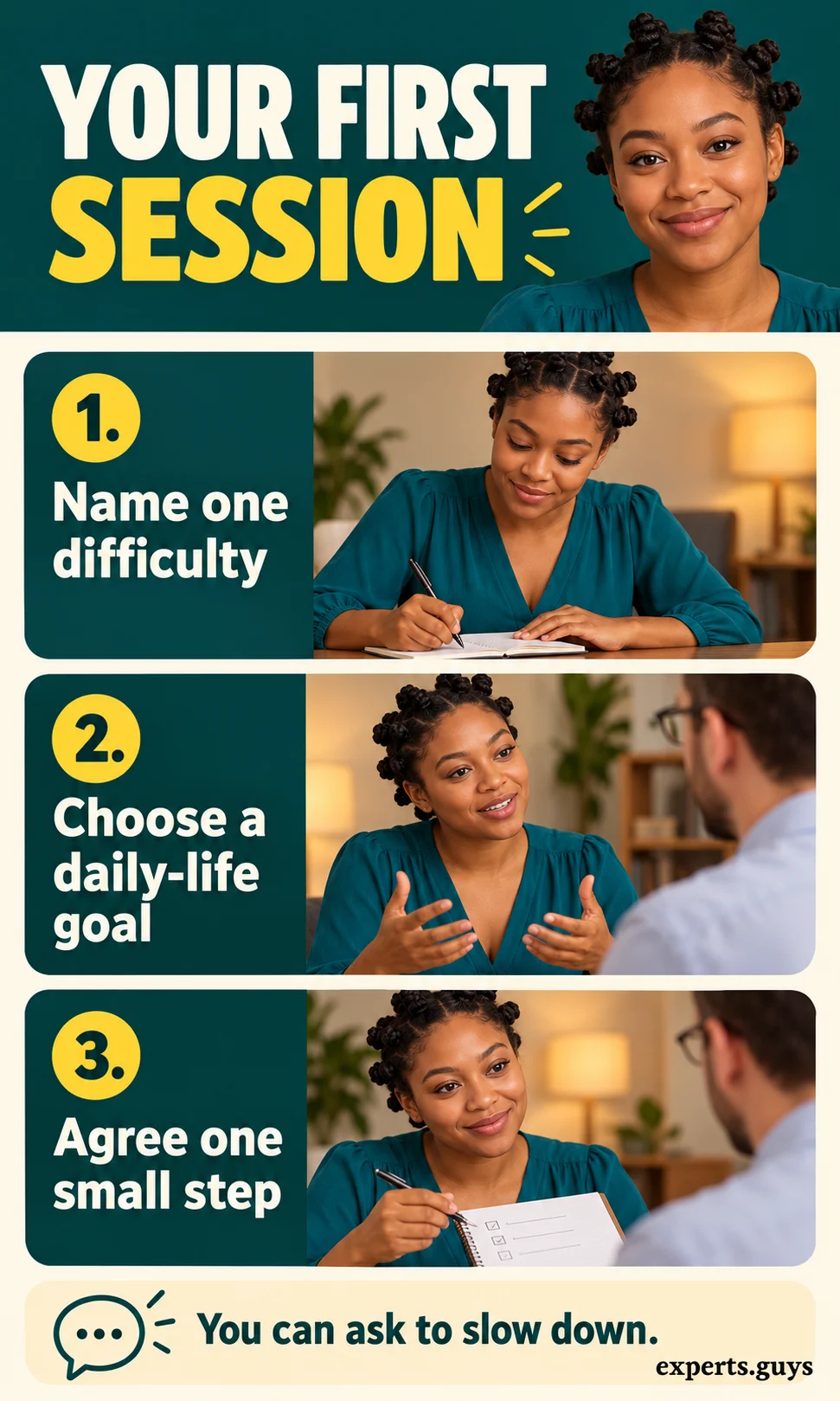
If that feels too demanding, bring just the first sentence. Completing this preparation means communicating a difficulty, not explaining it perfectly or agreeing to a treatment immediately. Your next step can simply be asking the clinician to slow down and explain the options.
Several talking therapies used for depression differ in what they emphasise. The comparison below is an orientation aid, not a way to assign yourself treatment. Availability, previous treatment, severity and preference all affect the choice.
| Approach | What the work focuses on | A useful question to ask |
|---|---|---|
| Cognitive behavioural therapy (CBT) | Links between thoughts, feelings and actions. | How would we work on my recurring self-criticism? |
| Behavioural activation | Avoidance and gradual engagement with meaningful activities. | Can we adapt activities to my current energy? |
| Interpersonal therapy (IPT) | Relationship difficulties, losses and changes in roles. | Could this help with the change I am going through? |
| Counselling or other talking therapy | Exploring difficulties and finding ways to respond, depending on the approach. | What is your method, and how does it fit my needs? |
For more detail on the differences, see our guide to types of psychotherapy for depression. Use it to prepare questions, rather than treating a longer list of therapies as a ranking. The aim is an appropriate plan you can understand and participate in.
What can you practise between therapy sessions?
Choose the exercise that matches the difficulty in front of you, and try only one to begin with. These are brief, adapted self-help practices, not full courses of CBT or treatment for a diagnosed condition. Completion means practising the chosen step; it does not require an immediate lift in mood.
When starting feels impossible: shrink one task
Choose one useful task with a clear stopping point, such as washing a single cup. The NHS five-minute approach makes starting less demanding by limiting the initial commitment. Avoidance can bring short-term relief while leaving daily difficulties in place; a small action gives you a way to begin without waiting for motivation.
- Choose: put one cup beside the sink; leave the rest of the dishes out of the task.
- Try: set a timer for up to five minutes and wash the cup, stopping earlier if needed.
- Decide: when the cup is done or the timer ends, stop and choose whether to rest or continue briefly.
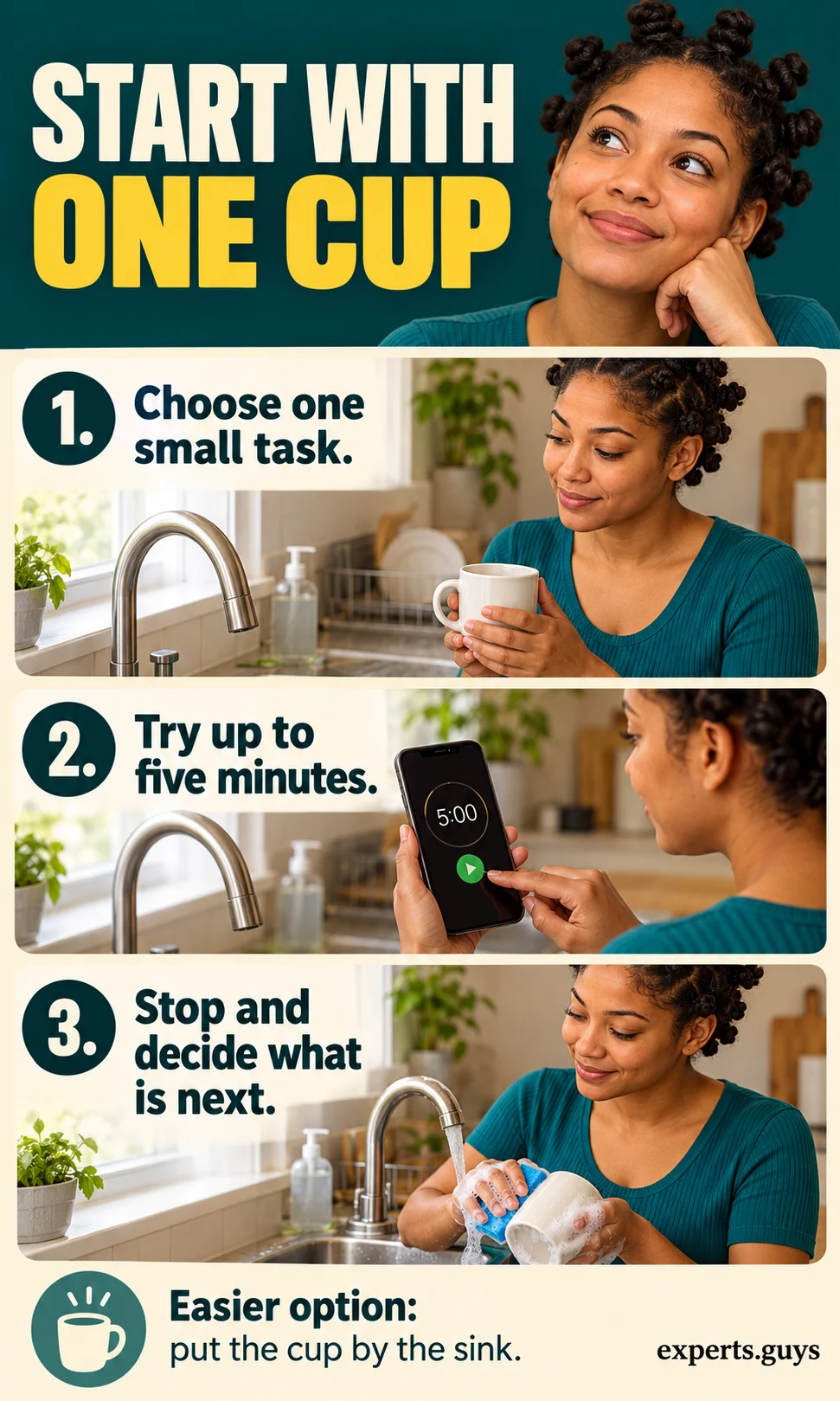
Illustrative example: you wash one cup and leave the rest for another time. If washing is too much, placing the cup by the sink is the smaller version. Repeat or simplify the step next time; do not push through pain, marked exhaustion or worsening symptoms to meet a timer.
When self-criticism takes over: check one thought
Use one recent, ordinary thought, such as “I never finish anything.” The purpose is to examine whether the statement describes the whole situation, not to argue yourself into feeling happy. The NHS guidance on reframing thoughts supports checking evidence and considering a more balanced interpretation.
- Notice: write or say the thought in one sentence.
- Check: find one specific fact that adds context; for example, “I answered one email this morning.”
- Balance: try a fairer sentence: “One hard task is not everything; I have completed something today.”

In this illustrative example, the balanced sentence recognises both the unfinished task and the completed email. If checking evidence becomes another exhausting argument, just name the thought and leave the rest for a session. Practising the distinction is enough; real difficulties still deserve practical help, and this exercise is not appropriate for trying to resolve hallucinations or delusions on your own.
When a practical problem keeps circling: choose one next action
Choose a problem you can influence, such as not understanding a charge on a bill. Structured problem solving separates a specific difficulty from a broad worry and helps turn options into an action. The bill example below is an editorial adaptation; the aim is a manageable next step, not resolving every financial concern at once.
- Name it: “I do not understand this one charge,” rather than “My whole life is a mess.”
- Compare options: call the billing office or ask someone trusted to help read the bill. Choose the option you can realistically attempt.
- Take one step: ask about that charge, then use the answer to decide what needs doing next.
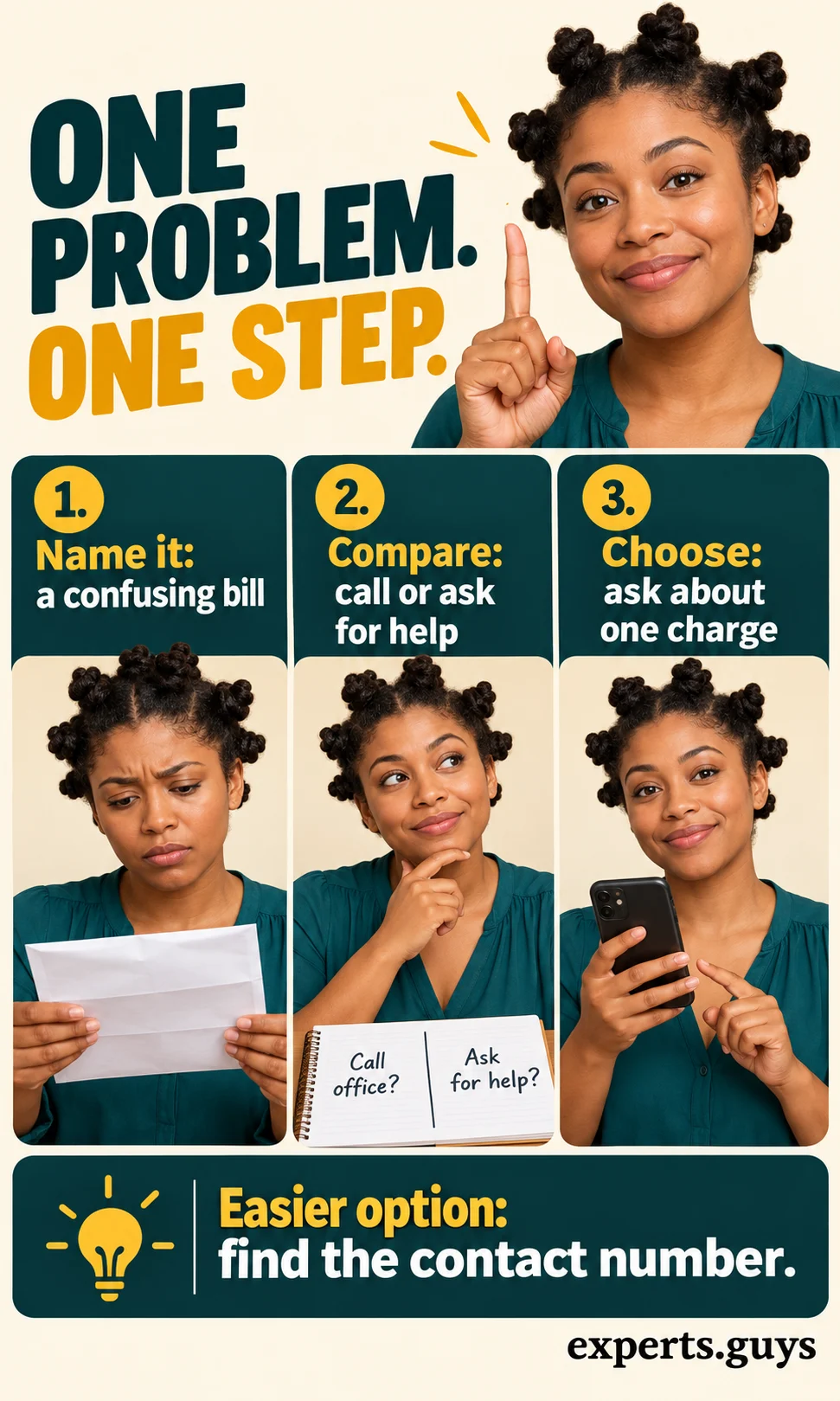
If making a call is too much, find the contact number and pause there. Completion is the chosen action, even if the answer reveals another step or a waiting period. If the issue cannot be solved alone, practical assistance may be more useful than repeating the exercise.
A worksheet can hold an example when concentration is limited, but filling pages is not the goal. Our depression worksheets with practical examples offer further formats for working on one difficulty. Pick a relevant format only if it makes the next action easier; skip recording that adds effort without changing what you do.
How do you choose a therapist and judge whether it helps?
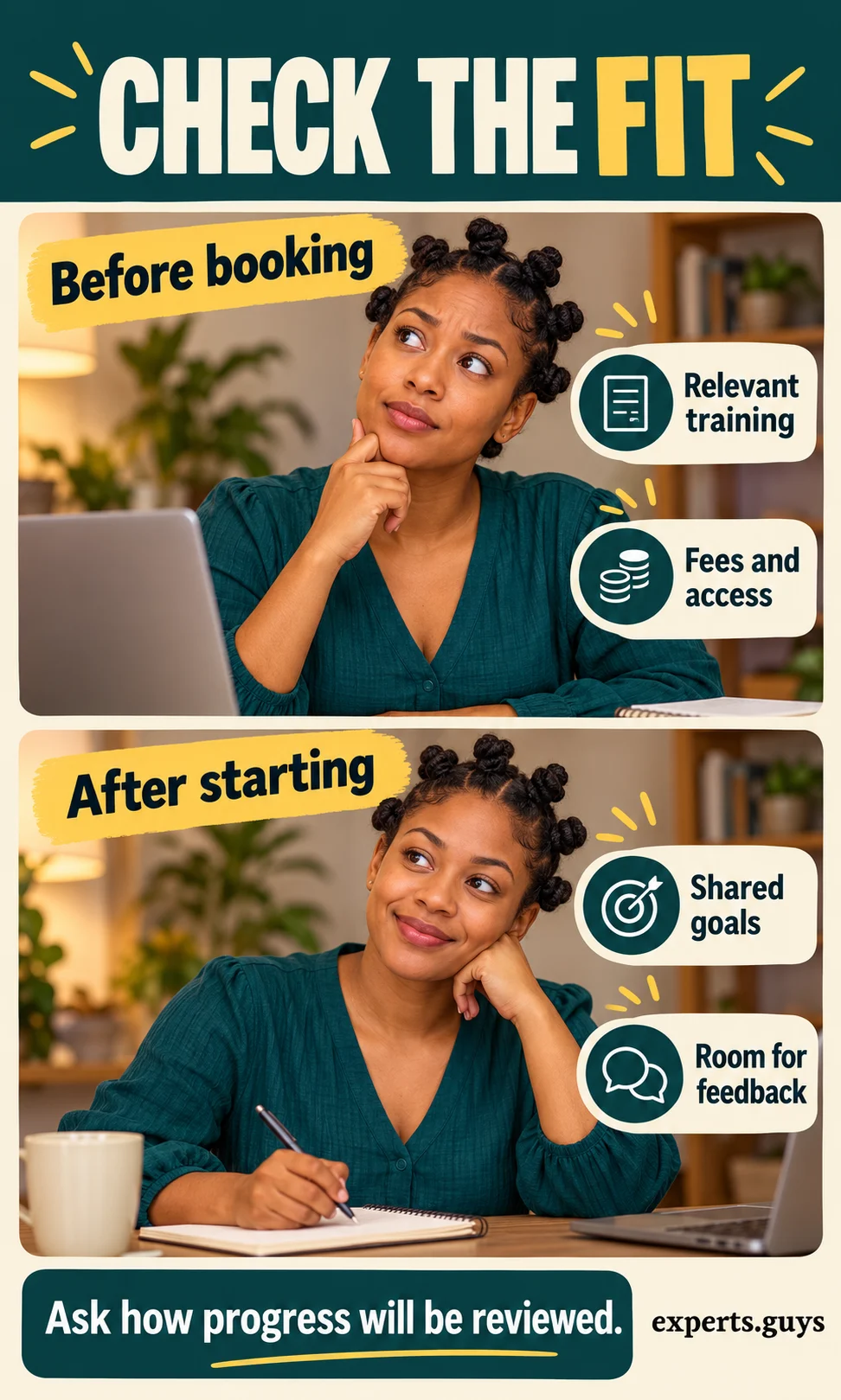
Look for relevant training, an approach you can understand and a service you can realistically attend. Ask how the clinician has worked with the difficulty you describe, rather than assuming a general wellness title means specialist experience. Rules for professional registration differ by country, so check the relevant local register where one exists.
Before booking, clarify the fee, session format, cancellation policy and any accessibility needs. If appointments are online, ask whether the professional can work with someone in your location and how urgent concerns are handled. These practical questions help you judge access; they do not determine which treatment is clinically appropriate.
At the start, agree a daily-life goal and a time to review the plan together. You might discuss whether opening essential messages has become more manageable, alongside symptoms and any treatment side effects. An exercise tick-box shows participation only; it is not proof of recovery or a reason to ignore deterioration.
- Ask about the plan: “Why does this approach fit the difficulty I described?”
- Ask about pace: “Can we make the between-session practice smaller?”
- Ask about review: “How will we decide whether to continue, adapt or try another approach?”
- Ask about confidentiality: “What stays private, and what are the limits?”
An illustrative feedback sentence is: “I understand the exercise, but I cannot manage its length after work.” That gives the therapist something specific to adjust, such as the task size, timing or support needed. If you feel unable to raise a concern, write one sentence beforehand or ask about another clinician; you do not have to present a perfect argument.
Review treatment collaboratively rather than judging it by one good day or one difficult session. NICE guidance for adult depression emphasises shared decisions and reviewing response, including reasons a treatment may not be helping. Do not wait for a planned review if symptoms worsen significantly or safety becomes uncertain.
| What you notice | What to discuss next |
|---|---|
| The practice is consistently too demanding. | Ask for a smaller or supported version and explain the barrier. |
| You do not understand the purpose of the sessions. | Ask how the approach relates to your goal and how progress will be reviewed. |
| There is little benefit across the agreed review period. | Reassess the approach, engagement barriers and clinical picture together. |
| You are rapidly deteriorating or feel unsafe. | Seek prompt or emergency help according to the level of risk. |
When does low mood need medical or urgent care?
Arrange an assessment if low mood persists, worsens or interferes with eating, sleeping, work or relationships. A period of two weeks is relevant to assessing major depression, but it is not a rule that you must wait before asking for help. The NIMH depression guidance also explains that medical conditions and medicines can produce similar symptoms.
Tell the clinician about the full pattern, including previous periods of unusually high energy, impulsivity or little need for sleep. Bipolar disorder needs a different treatment approach, and antidepressants are not used alone for bipolar depression because of the risk of triggering mania or rapid cycling. Do not start, stop or change prescribed medication based on this article.
| Situation | Care direction |
|---|---|
| Persistent, worsening or disabling low mood | Book a primary-care or mental-health assessment. |
| Very little sleep with unusually high energy, agitation or risky behaviour | Seek urgent clinical advice, especially if this is new or escalating. |
| New hallucinations, delusions or severe confusion | Seek urgent medical assessment; use emergency care if there is danger or inability to stay safe. |
| Immediate danger or likely action on thoughts of harm | Contact local emergency services or go to an emergency department now. |
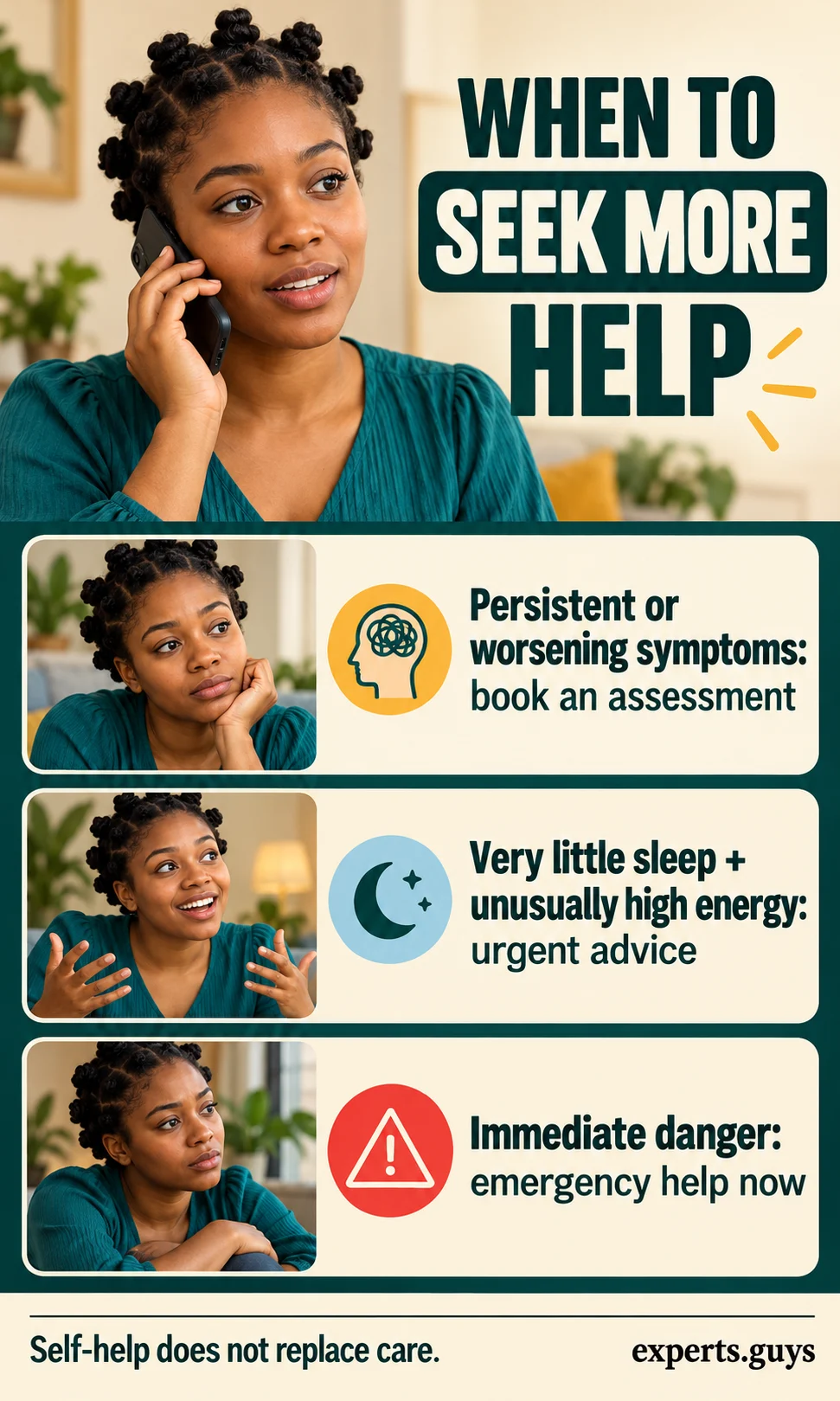
This guide focuses on adults and cannot determine a diagnosis or the right level of treatment for an individual. Our explanation of types of depression provides context for terms you may hear at an assessment. If unusually high energy is part of the pattern, the article on bipolar disorder and anxiety addresses a related but different care situation.
Frequently asked questions
Do I need to describe everything at the first appointment?
No. You can begin with one difficulty and say that you need time to explain more. Let the clinician know about urgent safety concerns or major changes in sleep and behaviour, even if the rest of your history comes later.
Can I use these exercises while taking prescribed medication?
These small practices may support daily functioning alongside a care plan. Ask your treating clinician how they fit your situation. They are not a substitute for prescribed treatment, and medication changes need guidance from the prescriber.
What if I finish a task but still feel low?
That does not mean you completed it incorrectly. The immediate goal is practising a manageable action, not producing a particular feeling. Tell your clinician if low mood persists or worsens, even when you are following the plan.
What if therapy is hard to afford or access?
Ask the service about lower-cost places, group formats or supported self-help options that fit your needs. Public services, community organisations and training clinics vary by location. Ask about support while waiting, and seek urgent care if your condition becomes unsafe.
Your next decision
If you are safe and want help with one daily difficulty, choose one small practice and define where it ends. If symptoms persist, disrupt life or suggest another condition, arrange assessment and bring a concrete example. Therapy should offer an understandable plan, room for feedback and a next step that fits your capacity.
Health information for adults; not a diagnosis or an individual treatment plan. All pictured scenes are AI-created illustrations, not documented patients or clinicians.









