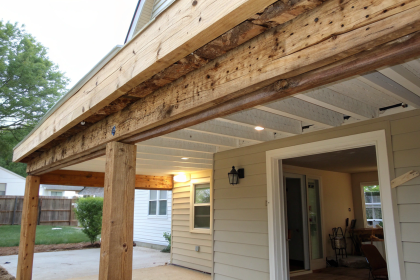
Termite damage removes wood as insects feed, while water damage changes materials through wetting, swelling, staining or moisture-related decay. Mud-lined galleries or correctly identified termites are more useful pest clues than blistered paint or a hollow sound, which can have several causes. Check the evidence for insects and moisture separately, because both problems can affect the same piece of timber.
Which clues actually distinguish termites from water damage?
Start with what the clue can establish. A brown stain supports a history of wetting; it does not identify the insect status of the wood behind it. An earthen gallery supports termite damage; it does not tell you whether a pipe is still leaking. The useful comparison is between evidence of the cause, evidence of present activity and evidence of lost material.
The table gives a starting direction for accessible damage in a home. It is deliberately cautious about appearance: a photograph can help explain a pattern, but cannot establish the condition of concealed framing. If a floor is sagging, a ceiling is bulging or a support has visibly failed, keep people away from the affected area and arrange a building assessment before trying to identify the cause at close range.
| Visible clue | What it supports | What it cannot establish alone |
|---|---|---|
| Mud-lined tunnels in exposed timber | Subterranean termite damage is a strong possibility. | Whether the infestation remains active or how far it extends. |
| Live insects identified as termites in the wood | Termite activity at that location. | The complete colony boundary or remaining structural capacity. |
| Uniform, faceted pellets below a small opening | A possible drywood termite clue requiring identification. | Present activity, extent or severity from the pile alone. |
| Swollen trim, cupping or separated layers | Material distortion consistent with wetting. | Whether insects or decay are also present. |
| Blistered paint, staining or hollow sound | A reason to investigate the assembly. | A reliable choice between termites and water. |
A clue is strongest when its physical explanation fits the location. Soil-like material inside an exposed feeding channel tells you something different from ordinary dirt on a floor. Water staining that continues from a window joint to the trim below is more useful than a dark patch with no visible route. Neither observation requires you to break open sound material.
- Cause: what could have produced the pattern?
- Activity: what shows that the cause is operating now?
- Condition: what material has been lost, distorted or weakened?
Separate an insect channel from softened wood
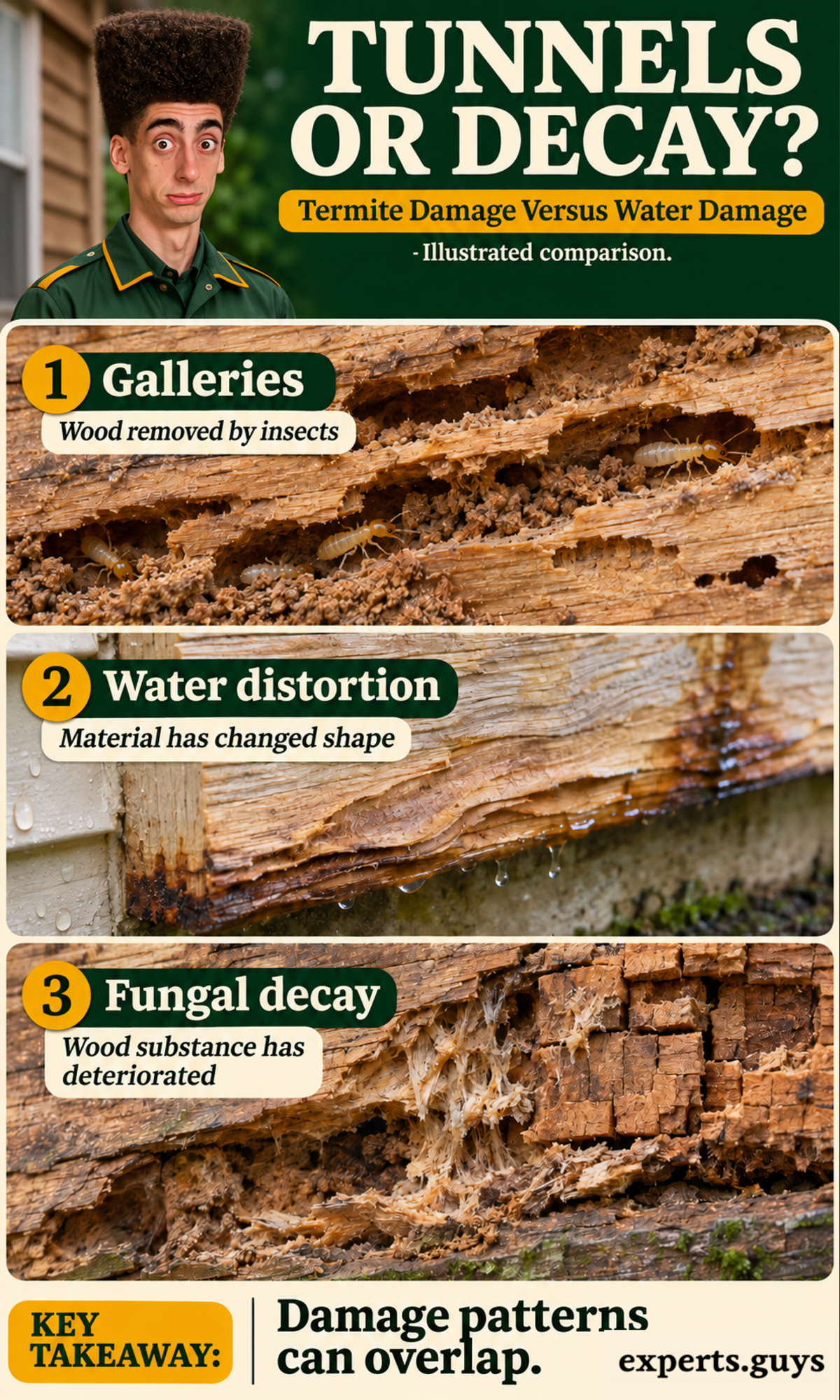
Subterranean termites commonly feed along the grain and may leave earthen material inside galleries. Drywood termites can produce different chamber patterns and distinctive fecal pellets, so there is no single tunnel shape that covers every termite type. The comparison should identify a plausible mechanism, rather than turn one photographed wood pattern into a universal identification chart.
Water exposure can make a board change shape without an insect having eaten it. Fungal decay is another mechanism: organisms deteriorate the wood itself under suitable conditions. A swollen manufactured board, a piece of decayed solid timber and a timber containing insect galleries may all feel compromised, but the repair has to address different causes. The Forest Products Laboratory chapter on wood biodeterioration distinguishes fungi, insects and other wood-degrading organisms.
Compare only what is already visible. A raised board edge is a shape change. A cavity with a remaining thin surface is missing internal material. Crumbling, fibrous or cracked wood may suggest deterioration, but you should not scrape it apart to make it resemble a reference picture. The result of this comparison is a better question for the assessment, not permission to declare a support sound.
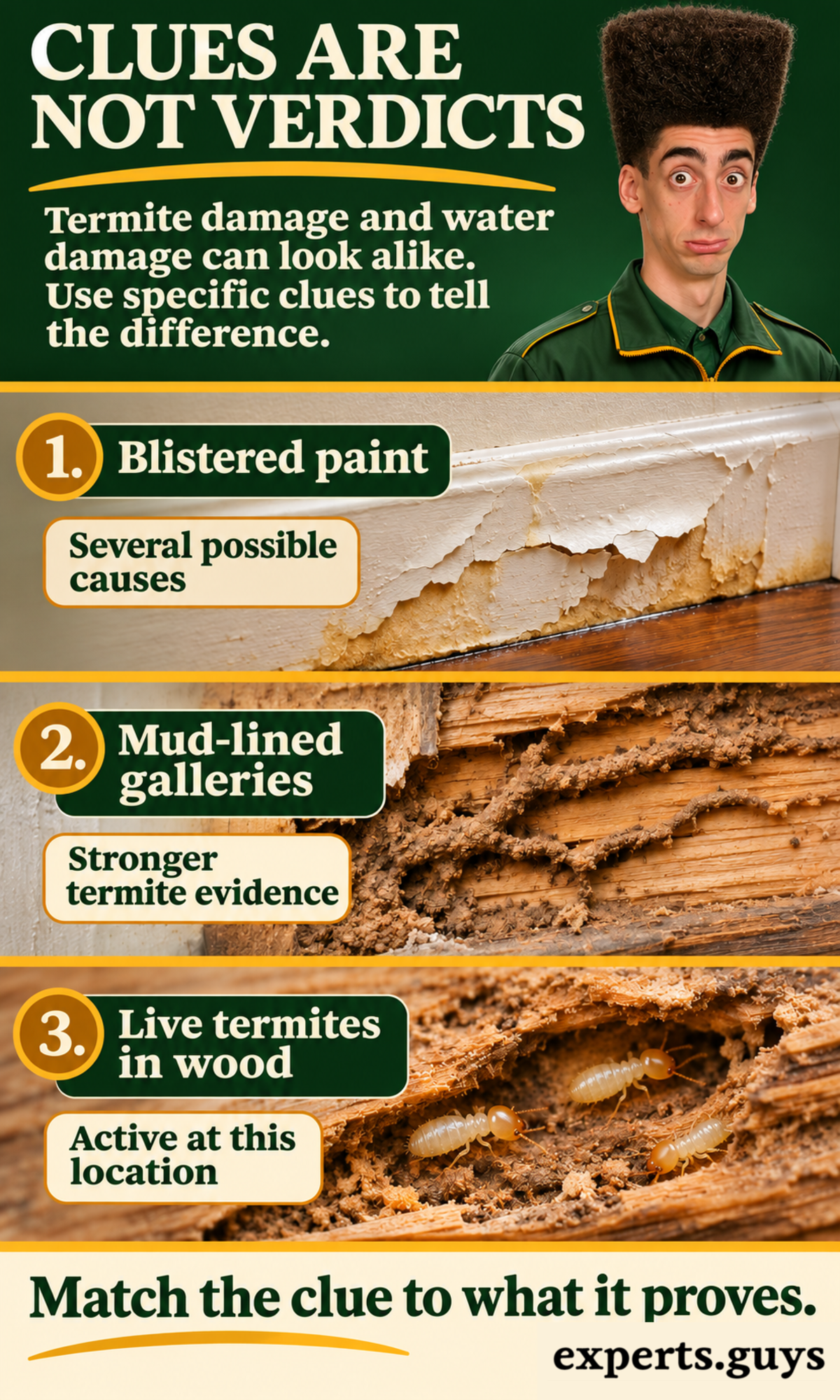
Why tapping and paint bubbles are weak tie-breakers
A hollow sound describes a response to tapping; it does not identify what made the space. Hollow doors, gaps behind trim, layered construction and deterioration can complicate that response. Similarly, paint can lift when the coating loses adhesion or the material underneath changes. Repeating either check harder does not make its conclusion more specific.
Use a change in sound or surface appearance to choose where a closer visual inspection is warranted, rather than to rank the damage as definitely termite-related. Avoid tapping fragile finishes or pressing on an area already showing movement. For the location-specific warning signs, see the separate guide to early termite clues inside walls; those signs still need interpretation in the surrounding assembly.
One practical way to avoid jumping to conclusions is to describe the material before naming the cause. “The painted edge is swollen and there is soil-like material inside the exposed channel” is more useful than “the skirting has termites.” The first description allows a moisture problem and an insect problem to be investigated together. The second can steer the entire repair toward one contractor before the evidence is complete.
Old damage and active termites are different findings
Finding correctly identified live termites feeding in the damaged wood establishes activity there. Finding galleries without live insects may show previous attack, including attack that was treated. It may also mean that activity is hidden elsewhere. Mississippi State Extension’s explanation of infestation signs makes that distinction between damaged timber, earthen material and live termites.
A tube’s presence matters, but a homeowner cannot reliably date it by colour or dryness. Likewise, loose pellets are not a dependable clock. Ask what evidence supports the finding of current activity, what locations were accessible and what remained concealed. That makes the limitation concrete without dismissing a potentially important sign.
Takeaway: treat an ambiguous surface change as a prompt to investigate. Give more weight to identified insects and characteristic material evidence, while keeping activity and structural condition as separate questions.
Can water damage and termites happen in the same place?
Yes. Finding one does not rule out the other. Moisture can create conditions that favour some termites and decay, while the building may also have an independent leak. Drywood termites introduce a different complication because they can occupy relatively dry timber. The job is to test two explanations, not choose whichever label first seems convincing.
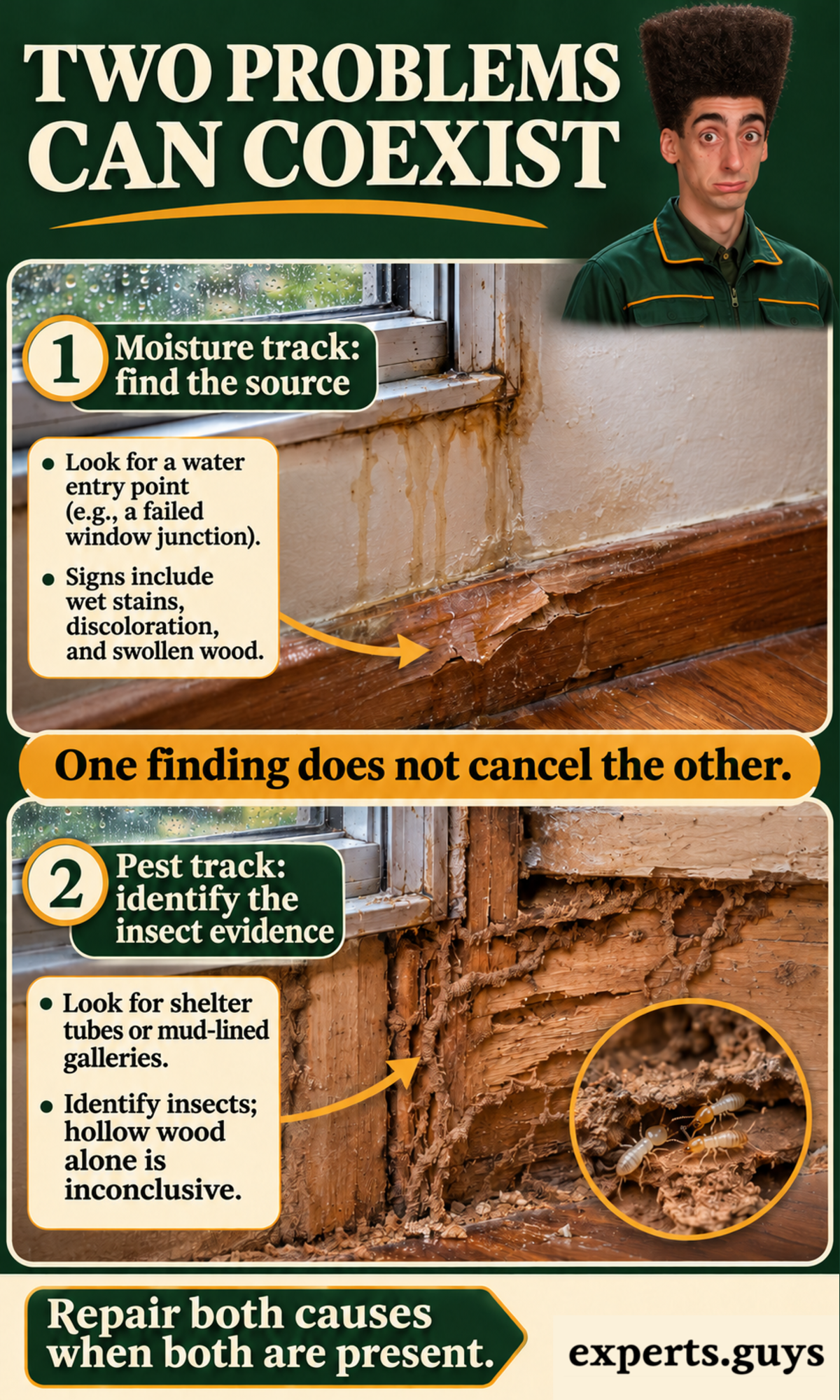
Follow two explanations through one damaged corner
Consider an illustrative window corner with a stain below the sill, swollen skirting and an exposed channel containing earthen material. The stain and swelling support a moisture investigation. The channel supports a termite investigation. Nothing about discovering the channel makes the water route irrelevant, and stopping the water does not tell you whether a colony has been addressed.
Start by identifying the building elements involved: the window junction, the finish, the trim, any exposed timber and the floor edge. Those elements may have different conditions and different owners in the repair. A joiner can replace visible trim without repairing the junction above it; a pest treatment can address insects without restoring the remaining timber’s capacity. Define each job before combining them into a single quote.
For subterranean termites, moist conditions and protected access routes are relevant to understanding the risk. Dampwood termites are associated with very moist wood. These relationships explain why a damp location deserves attention, but they do not mean every wet board contains termites or that every termite problem has an obvious indoor leak. The UC IPM guide to termite types and shelter tubes explains the differences.
What a dry surface does and does not tell you
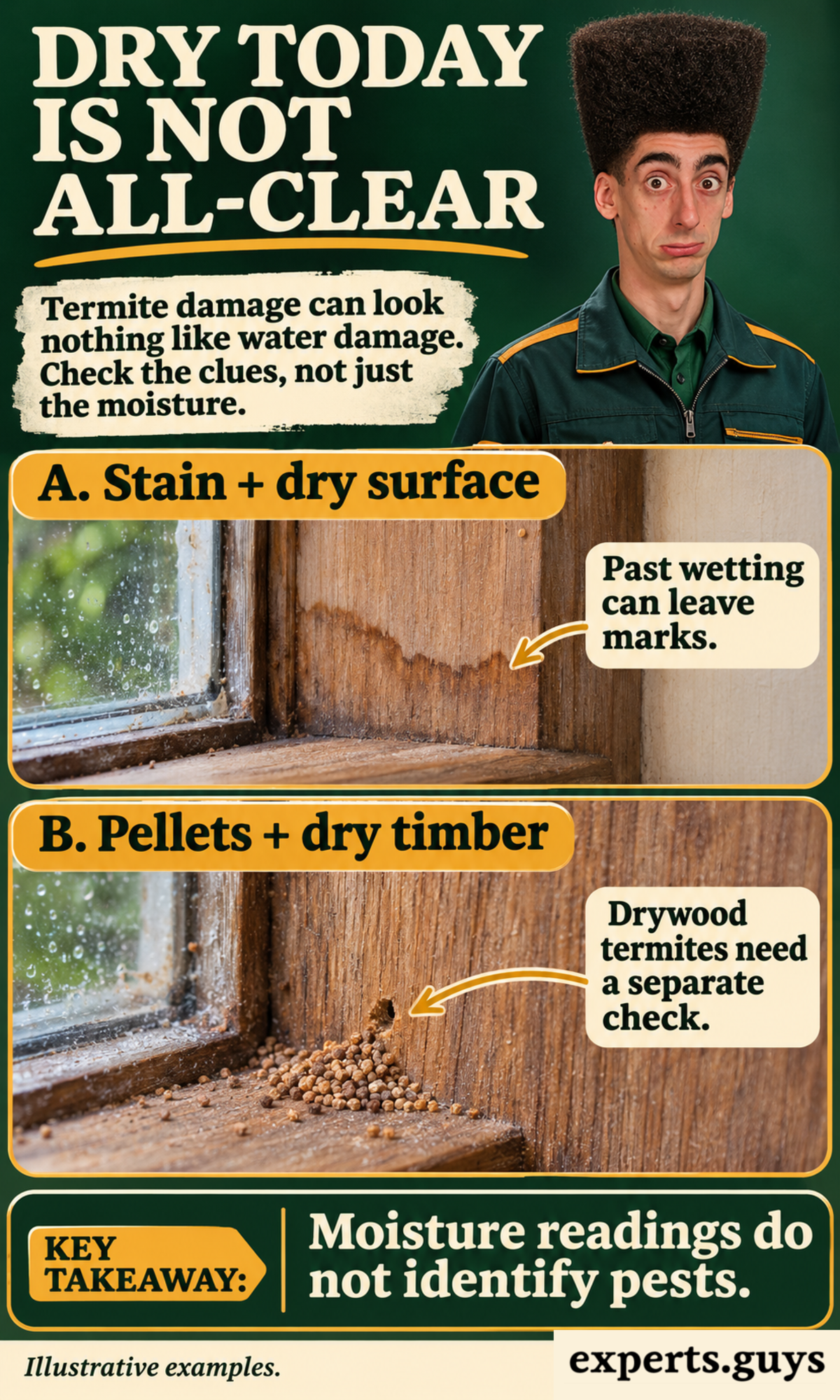
A surface can dry while a stain remains. A concealed layer may also have a different moisture condition from the visible finish. Most importantly for this comparison, a moisture reading is not an insect identification. A reassuring reading cannot erase galleries, identified pellets or live termites; a high reading cannot prove that termites caused the damage.
Ask the person interpreting a reading which material and meter scale it represents, and how it compares with an appropriate unaffected area. The detailed method belongs in the guide to interpreting moisture readings after water damage. Here, its role is narrower: moisture evidence answers the wetting question, while pest evidence answers the insect question.
Do not assign a universal “termite-safe” moisture percentage. A wood moisture value, a relative meter scale and a reading through a finished wall do not mean the same thing. Even an accurately measured dry piece of timber is not proof that every concealed part of the assembly is dry or free of insects.
Drywood pellets need their own interpretation
Drywood termite pellets are small, hard and characteristically faceted. A pile can be confused with other debris unless its structure and source are identified. The UC IPM drywood termite guidance explains that pellets alone do not establish whether an infestation is currently active or how extensive it is; movement can also dislodge material left inside wood.
If pellets are already visible, keep the opening and nearby material undisturbed for assessment rather than spraying into the hole. An accessible deposit can be useful evidence without becoming a do-it-yourself activity experiment. If an inspector later specifies a controlled follow-up check, follow that instruction rather than assuming that any new speck independently proves a colony’s status.
Where mold fits into the comparison
Mold, decay and water damage are related terms, but they are not interchangeable findings. Surface growth does not identify an insect, and a musty smell does not measure remaining strength. Moisture can support several problems at once, which is why a repair should not stop at removing the most visible surface symptom.
If surface growth is the main uncertainty, the comparison of mold damage and termite damage addresses that adjacent question. This page’s decision is whether the wood needs a moisture response, a pest response or both. It does not use mold colour or odour to settle that choice.
Takeaway: keep the moisture explanation open until the source and affected layers are understood. Keep the termite explanation open until the material evidence and activity question have been assessed, even when the surface feels dry.
What can you check safely before disturbing the damage?
Use an accessible visual check to preserve evidence and identify the next decision. You do not need to dismantle a wall, probe a joist or test a floor’s strength. The useful outcome is a clear view of existing damage and a sensible boundary around what cannot be established from the room.
Use light across an existing edge
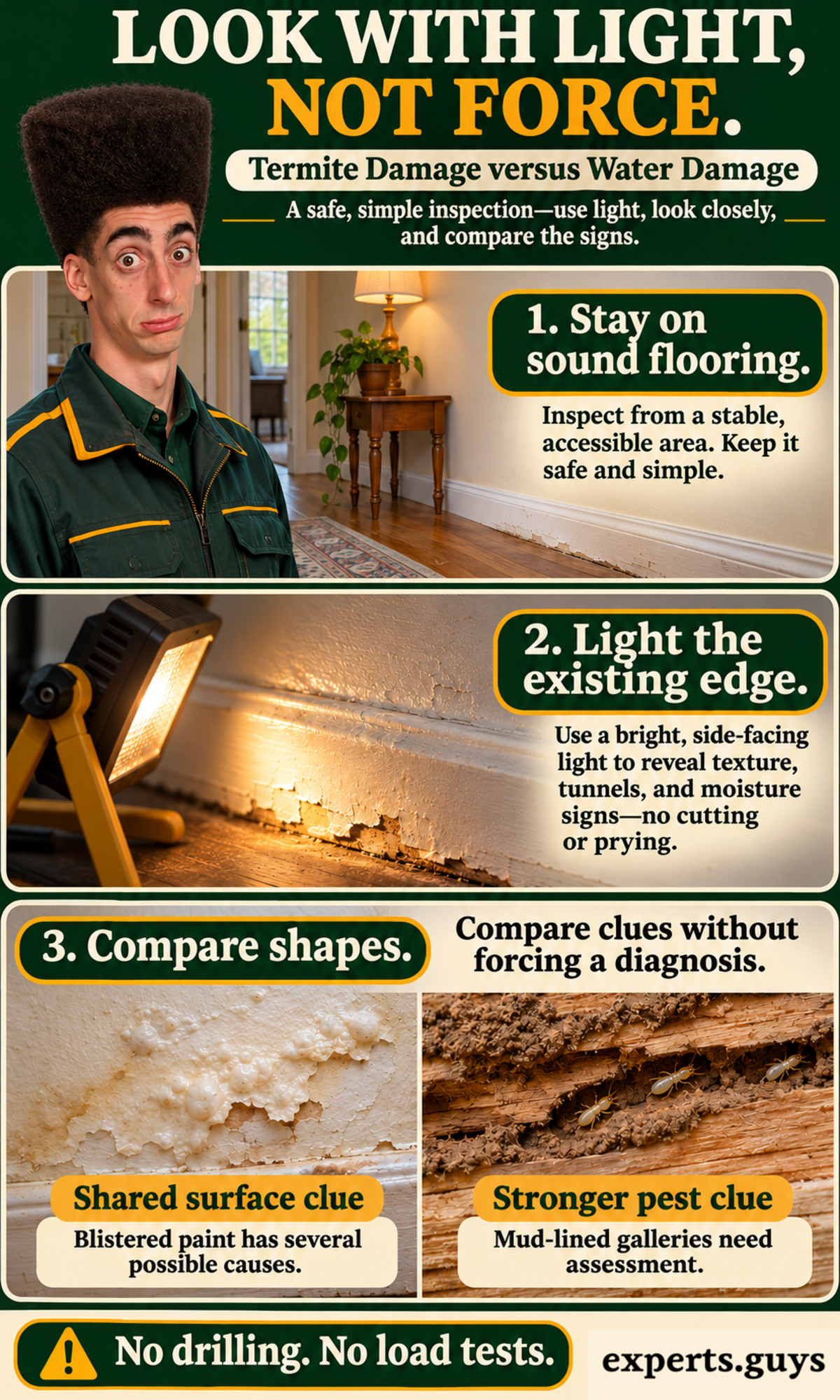
This check suits an accessible baseboard, cabinet edge or exposed timber face where the floor is sound and there is no electrical, contamination or falling-material hazard. A freestanding light is useful if holding a torch would make balance or access awkward. Position yourself where you can see without leaning on the damaged assembly; leave heavy furniture and fixed panels in place.
- Choose safe access. Stay on sound flooring and look from the room side. Do not enter a crawl space or climb to a damaged ceiling for this comparison.
- Direct light along the visible surface. A shallow angle can help show a raised edge, coating blister or an already exposed cavity. Keep hot lamps away from timber and finishes.
- Compare the visible forms. Look for distortion, missing material, earthen deposits or a clear water trail. Use the light to improve visibility, not to make an inaccessible joint seem inspected.
- Stop at the existing boundary. If the clue disappears behind trim, that is a limit of the check. Leave removal and any service-location checks to the planned assessment.
For example, light across a swollen lower trim edge may reveal a continuous raised profile. At a different edge it may reveal a thin remaining skin over a cavity. These observations lead to different questions about the material, even if both have peeling paint. Neither requires pressing a screwdriver into the surface to obtain a more dramatic result.
The common mistake is to keep increasing force when the view remains uncertain. Pulling at loose trim can break evidence, expose contaminated material or disturb concealed services. If reaching the spot is difficult, use an unobstructed view from a safe position or leave it for the inspection. A limited view is an honest result; a forced opening is a different and potentially hazardous job.
Leave tubes, pellets and damaged material in place
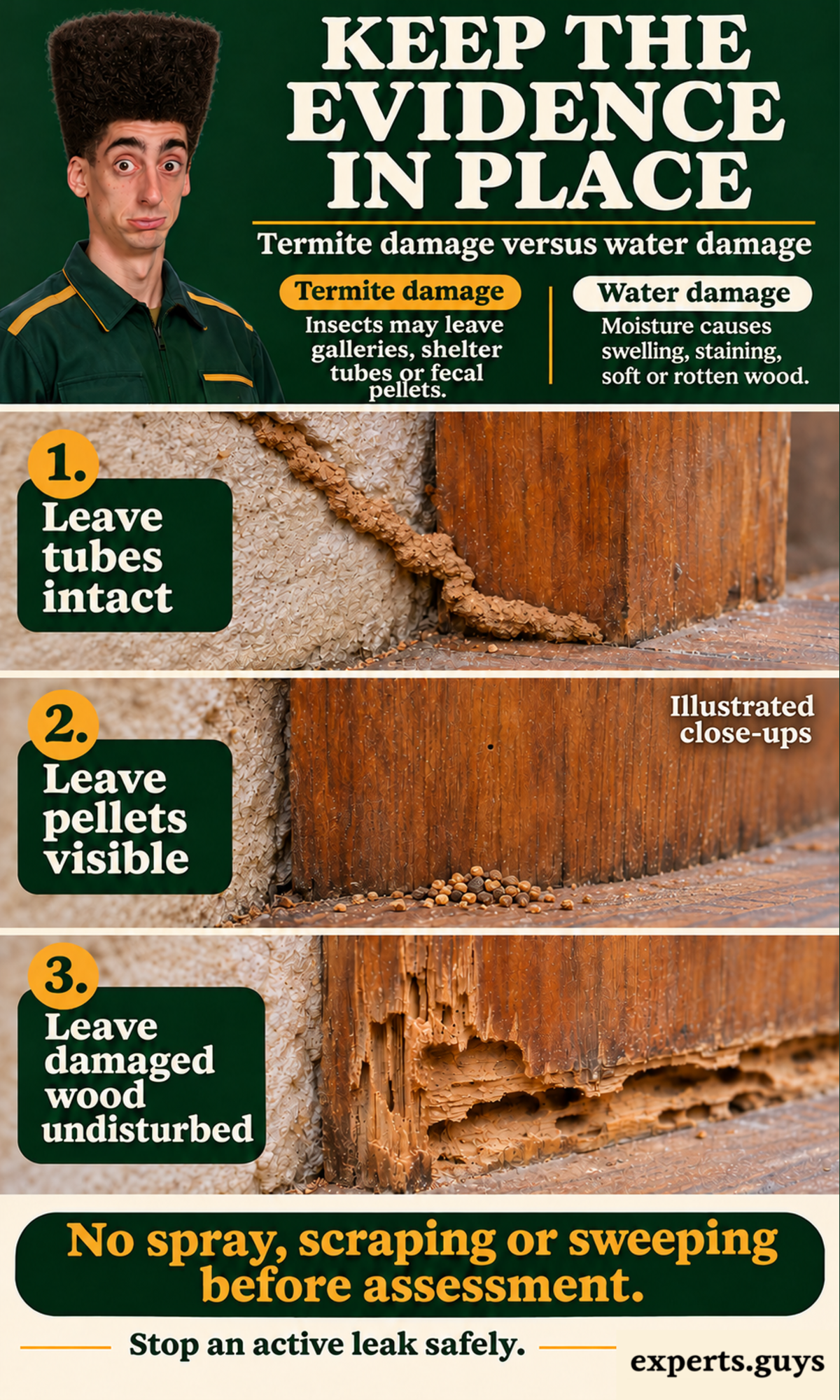
Preserving accessible evidence is often more useful than cleaning the area to make it look ready for a visit. Leave suspected shelter tubes intact, avoid sweeping away a pellet pile and do not scrape galleries clean. Do not apply a household insect spray or inject a product into a suspected opening before identification. The purpose is to keep the relationship between the clue and its source visible.
This does not mean allowing an active leak to continue. Stop a clearly accessible water supply only when it is safe and familiar to operate, and arrange prompt leak control when it is not. Do not touch electrical fittings or enter standing water to reach a valve. Safety and source control take priority over preserving a neat evidence scene.
Keep normal use away from a damaged edge so it is not kicked, loaded or accidentally covered. Do not seal a suspect tube into a painted patch or caulk a pellet opening simply to see whether something appears elsewhere. If access must change during urgent work, tell the relevant contractors where the evidence was and what was disturbed.
Recognise when the visual check has reached its limit
Stop if you encounter movement, a sagging floor, loose overhead material, standing water near electrical equipment, suspected sewage contamination or a substantial concealed-damage concern. These are reasons to change the task, not reasons to inspect more closely. A sagging area needs its condition assessed regardless of whether insects, decay or another cause eventually explains it.
A wall that looks normal from the room may still contain an affected layer. That possibility is a reason to specify inspection access and its limits; it is not a reason to assume every adjacent room is damaged. Keep any opening purposeful: what uncertainty will it resolve, what services or materials must be considered first, and who will restore the assembly afterward?
The EPA’s home mold-cleanup guidance distinguishes ordinary small cleanups from situations involving extensive water damage or contaminated water. If those conditions are present, this comparison should help describe the problem to the appropriate team rather than encourage opening and drying the assembly yourself.
Takeaway: improve the view without changing the evidence. A successful preliminary check can end with “the cause is still uncertain, but this is the affected edge and this is why further access is needed.”
Who should investigate first, and when can repairs begin?
Prioritise an immediate hazard or continuing water source, then coordinate pest and building-condition work. A contractor’s specialty determines which question they can answer. There is no benefit in asking a painter to settle insect activity or assuming a pest-treatment visit includes a structural repair design.
Choose the first visit by the unresolved job
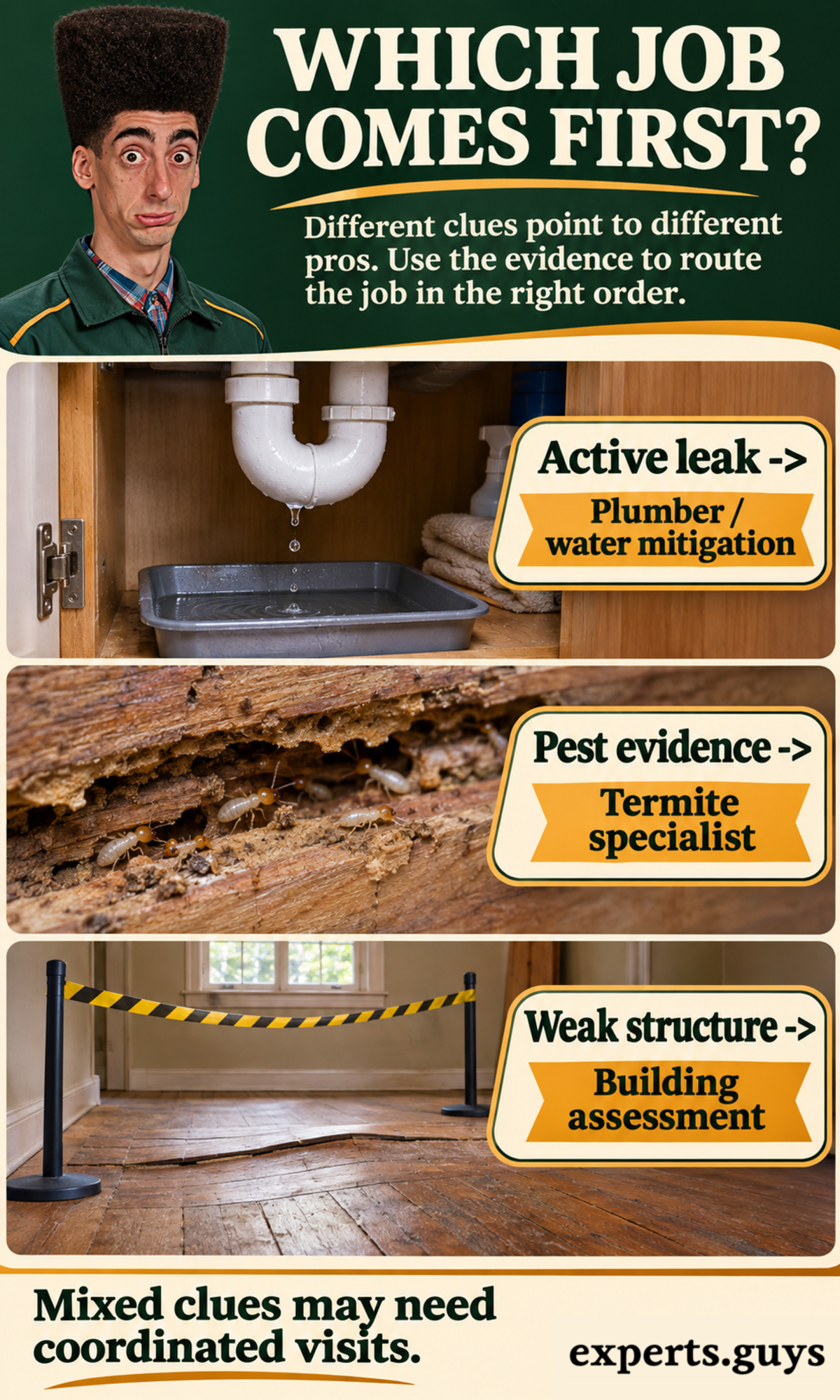
If water is actively escaping, prompt source control prevents additional wetting while the other questions are investigated. If the only clear finding is insect evidence in otherwise accessible timber, a termite specialist is the sensible starting point. If the building is moving or visibly weakened, restrict access and obtain a building assessment without waiting for a species identification.
| Situation | Initial job | Question to resolve |
|---|---|---|
| Active plumbing leak | Plumber, with water mitigation if needed | Where is water entering, and which layers were affected? |
| Suspected tubes, pellets or insects | Termite specialist | What is the evidence, is activity confirmed, and what remains concealed? |
| Sagging or visibly failed support | Building professional qualified for the structural assessment | What access restrictions and repair design are necessary? |
| Leak evidence plus pest evidence | Coordinated moisture and termite assessment | Which work must be observed before the next team removes or closes material? |
The handoff matters when several people visit. Tell each team that both moisture and termite evidence are in question, rather than presenting the second problem as already ruled out. Agree on who examines the exposed area before it is removed, and who decides when it is ready to close. Coordination can be more valuable than another general “full service” description.
Ask for findings that match the proposed work
A useful termite assessment identifies the observed evidence, the suspected or identified termite type, the basis for any activity finding and the areas that could not be accessed. If treatment is proposed, the explanation should connect the method to that finding. Product names or an assurance that everything will be sprayed do not explain why the scope fits.
A moisture assessment should identify the likely source, the affected materials and the basis for the drying decision. A building-condition assessment should identify what is damaged and what repair or further access is necessary. These findings can come from one suitably qualified provider or several coordinated providers, but a single invoice should not blur their separate responsibilities.
Ask whether the price includes investigation, access, treatment, replacement material, disposal and reinstatement. A low treatment price may exclude carpentry. A carpentry price may exclude opening enough of the assembly to understand the problem. Compare the same job boundaries before judging whether one proposal is better value.
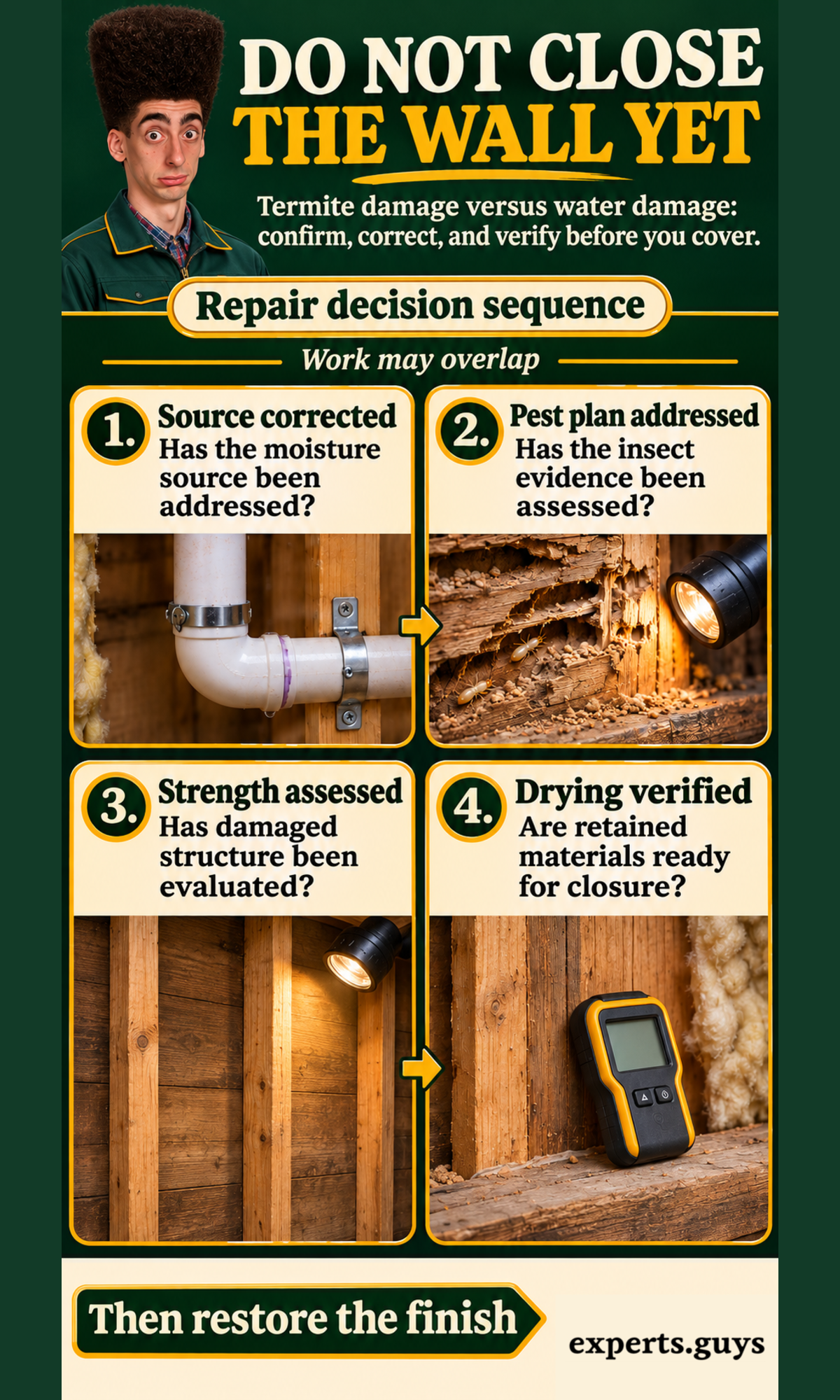
Use four repair gates before closing the finish
The order of visits can overlap, but closing the wall or installing finish material should not conceal unresolved work. Treat the following as completion questions for the repair team, rather than a schedule that promises every home will be ready in the same number of days.
- Source corrected: has the relevant leak or moisture entry route been addressed, rather than merely drying the visible surface?
- Pest plan addressed: has the insect evidence been assessed and any necessary management plan coordinated with the opening and replacement work?
- Strength assessed: has damaged load-carrying material been evaluated and repaired or replaced as required, rather than hidden behind filler?
- Drying verified: are the retained materials and assembly suitable for the planned closure, coating or flooring installation?
Passing one gate does not pass the others. Drying cannot replace missing wood. Replacing a visible board cannot demonstrate that a concealed insect problem is controlled. Conversely, old termite damage does not automatically mean every adjacent finish must be removed; the inspection findings and remaining condition should determine the access and repair scope.
Repair the affected assembly, then choose the appearance
The visible damage area, the inspection opening and the replacement area may have different boundaries. A small damaged strip might require a wider opening to see its back or the adjacent support. That does not automatically justify replacing the whole room, but the contractor should explain why each extra area is necessary and how it will be reinstated.
Where the floor support is affected, use the guide to subfloor drying and repair decisions for the deeper material question. This comparison stops at deciding which causes and conditions must be resolved. It does not substitute a photograph-based judgment for the capacity of a joist, wall stud or subfloor panel.
Do not use a fixed waiting period as the only permission to redecorate. Access, material, water source, extent of damage and management plan all change the work. The useful endpoint is an explained repair decision: what was found, what was corrected, what remains in place and why closing the finish will not conceal an unresolved job.
Compare a definite repair with an investigation allowance
Imagine two illustrative proposals for the same window corner. The first includes removal of a visibly damaged length of skirting, a termite assessment and reinstatement of the finish. The second includes that work plus an allowance for opening the wall below the window if the initial inspection indicates concealed damage. The second proposal is not automatically excessive, and the first is not automatically incomplete. The important difference is whether the need for further access has been resolved or remains an explicit possibility.
A fair comparison identifies the decision that releases the allowance. Will the contractor open the wall only if damaged timber continues behind it? Who decides whether a supporting member needs further assessment? What happens if the newly exposed material is sound? Those questions convert a vague contingency into a limited next stage. They also help prevent an assumption about hidden damage from quietly becoming an instruction to replace everything.
The same distinction applies to treatment and reinstatement. An allowance for investigating insect evidence is not a finding that treatment is necessary. A treatment recommendation is not a measured quantity of replacement timber. A priced decorative finish is not confirmation that the concealed assembly is ready to receive it. Keep those descriptions separate until the findings allow them to be joined into a final scope.
If access changes the scope, the revised explanation should name the new finding and the additional work it requires. For example, damage continuing into a previously concealed floor edge raises a different question from damage confined to removable decorative trim. This is where an apparently small repair can reasonably expand. The expansion should follow the discovered condition, rather than the visual drama of the original stain.
Takeaway: commission the missing answer before the cosmetic work. If the proposal addresses only insects, only drying or only appearance, ask who is responsible for the other findings before approving closure.
Questions about uncertain damage
Does sawdust near wood always mean termites?
No. Carpenter ants excavate wood and can leave coarse shavings, while other wood-damaging insects produce different debris. Drywood termite pellets are a more specific material than ordinary sawdust, but still need correct identification. Consider the debris together with its opening, the surrounding timber and any insects present. A pile on the floor does not, by itself, identify the pest that produced it or establish the condition of the wood. Leave accessible evidence undisturbed rather than choosing a pesticide from the appearance of loose dust.
Do flying termites outdoors prove that the house is infested?
No. An outdoor swarm can come from a colony outside the building. Termites emerging directly from the structure, or significant indoor swarming, are a different and more concerning finding. Identification also matters because winged ants can be mistaken for termites. The useful question is where the insects emerged and whether there is evidence connecting them to the building. Killing the visible swarmers does not resolve the status of the colony that produced them, so it should not be treated as proof that the problem has ended.
Can the visible damage show how long termites have been there?
Not reliably. Visible damage is discovered at a particular time; that is not necessarily when feeding began. The amount exposed depends on access, the material and where the insects were active, while earlier repairs or treatment can further complicate the picture. A small visible opening can conceal more damage, and an extensive exposed gallery may be historical. Ask for a finding about current evidence and the assessed extent rather than a precise infestation age inferred from a photograph, stain colour or the apparent dryness of a tube.
Does every termite finding require whole-house fumigation?
No. The appropriate management depends on the termite type, distribution, accessibility and findings at the property. Localised work and whole-structure treatment address different situations; neither should be selected simply because a board looks severely damaged. Ask the provider to explain why the proposed approach fits the identified problem, what it covers and what follow-up is needed. Pest management and rebuilding also remain separate decisions: even when treatment is justified, the proposal should state who assesses and repairs damaged material. Follow applicable local requirements and product directions for any treatment.
Choose the next action from the strongest evidence
For an accessible damaged corner without an immediate hazard, start with a lighted view of the existing edge and leave insect clues undisturbed. Use the strongest visible finding to choose the initial assessment, while keeping moisture and pest questions separate when both are plausible. The decision is complete when the repair scope accounts for the cause, current activity and condition of the affected materials.
Compare Local Home Specialists Near You
Tell us what kind of help you need, then compare nearby businesses by location, Google rating, review volume and contact options.
HomeFix Local Match
Turn a home problem into a practical local hiring decision. Check the clues, see the specialist types that fit, open focused surrounding-location searches, then compare the strongest three before you call.
 YOUR PROBLEM
YOUR AREA
COMPARE 3
✓ Ready to compare
What is happening?
Choose the closest problem type, then check every clue that applies. Your selections change the specialist order.
Where should the search focus?
Use Google’s “near me” context or enter the area you actually want a specialist to serve.
Simple local search: open nearby Google results, choose the businesses that look suitable, then compare your best three here before you call.
Problem snapshot
Who should you call first?
These are the specialist types most likely to fit the clues you selected.
Search around your location
Compare your top three
Use the same factors for each option so a high star rating does not hide a weak scope, poor diagnosis, missing credentials or unclear aftercare.
Comparison result
Your result combines the Google signals you entered with the practical hiring checks you completed.
Questions to ask every finalist
Use the same questions with each shortlisted business so the comparison stays consistent.