
PeopleReady connects workers with temporary assignments through JobStack and local staffing teams. To get from registration to a workable first shift, confirm the actual assignment, its requirements and its payment schedule before committing travel time or money.
If you searched for “People Today Ready Staffing,” the company name you need is PeopleReady. This guide focuses on taking a first assignment in its U.S. staffing system, rather than applying for a corporate office career or assuming that every listed opportunity is immediately available to you.
What has to happen before you can take a PeopleReady shift?
A registered account is the starting point; it is not a complete work arrangement. The useful sequence is application, onboarding, a suitable assignment and a job confirmation. Each stage resolves a different question: who you are, whether the required employment steps are complete, what work is offered and where you are actually expected to report.
PeopleReady’s official find-work page describes opportunities across several industries, including hospitality, construction, retail, manufacturing and logistics. A local listing still determines the actual duties. A broad industry label cannot tell you whether a role involves standing at an event entrance, moving merchandise or using equipment that needs specific training.
Choose this route when you want to evaluate individual hourly assignments and can work within their stated conditions. If your priority is a fixed weekly schedule, ask specifically about that requirement before building your plans around flexible shifts. Being able to choose among available jobs and having a guaranteed number of paid hours are different benefits.
The first useful distinction is between an opportunity you can inspect and a commitment you can act on. For a new worker, confusing those stages can mean arriving at the wrong place, expecting work before onboarding is complete or reserving a day for a shift that has never been confirmed. Use the following checkpoints to establish what the next action actually is.
| Stage | Meaning and next check |
|---|---|
| Application | You have entered the hiring process. Next: complete required onboarding and identify suitable work. |
| Onboarding | Required employment steps are addressed. Next: resolve outstanding requirements or review, then check assignment-specific conditions. |
| Visible listing | You can inspect an opportunity. Next: establish duties, timing, requirements and whether the job is available to you. |
| Job confirmation | You have actionable assignment details. Next: check reporting point, contact, equipment and later changes. |
| Completed shift | Work has been performed. Next: check correct hours, the assigned pay schedule and payment processing. |
Start the application through the official route
Begin with the official website’s job-seeker route or its link to JobStack for Work. Follow the published onboarding sequence: apply, provide the required information and documents, complete Form I-9 and the safety acknowledgement, then move toward finding assignments. Keep employment documents within the approved application process; an unsolicited message is not sufficient proof that its sender represents the company.
Before entering personal information, check that you reached the service from the official website rather than a lookalike advertisement or forwarded link. If a message introduces an unfamiliar destination or request, return to the original official route and establish its purpose there. This is a way to verify the channel, not a claim that every unfamiliar page is fraudulent.
For U.S. employment verification, USCIS explains employees’ document choices. Use qualifying List A documentation, or the appropriate List B and List C combination; do not assume everybody must supply the same pair of documents. The applicable instructions also address help with completing the form and special document situations.
A common mistake is to treat creating a password as the end of onboarding. Instead, inspect the outstanding requirements and establish whether anything still needs completion or review. For example, if you can sign in but an employment-verification task remains unresolved, repeatedly browsing jobs cannot finish that task. The practical result you need is a completed requirement, not another successful login.
Do not create a second account merely because the first one appears stuck. Start by identifying whether you have a sign-in problem, an unfinished requirement or a question about a particular assignment. These problems need different information, and duplicate profiles can make it harder to explain which application you intend to use. Use the service’s current recovery or assistance route for the actual problem.
A smartphone is helpful but is not the only entry route. PeopleReady’s associate app resources direct people without a smartphone toward online job applications or their local team. If you need a supported route, explain the task you cannot complete rather than assuming that you must purchase a device before asking about available options.
The checkpoint for this method is simple: you know which application belongs to you, what remains outstanding and how you will access assignment information. It does not require a notebook, screenshot collection or another registration. If one required step cannot be completed through your available route, resolve that specific access barrier before treating yourself as ready for dispatch.

Separate a visible job from a confirmed assignment
JobStack is a way to discover and accept work, but different screens represent different stages. PeopleReady’s JobStack assignment guide describes reviewing listing details, accepting suitable work and receiving confirmation. Use the current instructions and confirmation you receive; this article’s illustrations are conceptual explanations, not reproductions of the app interface.
Inspect the date, start time, reporting location and duties before accepting. Then check the confirmation attached to that job. A familiar company name or a nearby map pin is not enough to establish the reporting instruction. A business may have more than one entrance or work area, and the person coordinating temporary workers may be somewhere other than the public reception desk.
Suppose an illustrative listing describes an evening event shift, while the confirmation tells workers to use a service entrance. The listing explains the opportunity; the confirmation makes arrival actionable. If the two appear to conflict, resolve the specific difference before leaving. Do not silently choose the instruction that happens to be more convenient or assume an old assignment’s directions still apply.
This distinction also helps when evaluating another staffing service. A profile, an application and an assignment may have separate meanings even if all appear within one website. The myKelly guide to job and employee-resource routes covers that different service’s access structure; it is useful context for keeping tasks separate, rather than a source of PeopleReady login instructions.
- Still browsing: inspect the opportunity; do not travel on the strength of a search result.
- Ready to accept: check duties, timing, qualifications and access before committing.
- Confirmed: use the assignment-specific reporting details and check for changes.
- Conflicting information: resolve the date, time or location difference before leaving.

How do you choose a shift that is workable for you?
Choose by the whole assignment: duties, qualifications, paid time, access and your ability to attend. An attractive hourly rate cannot compensate for an impossible arrival time or a requirement you cannot meet. My recommendation for a first shift is to prefer a clearly specified assignment over a superficially better offer whose essential conditions remain unknown.
For the wider choice of an agency arrangement, start with the overview of how staffing agencies work. This is an editorial decision rule, not a claim that one job category is universally better. A more experienced worker with reliable transport may reasonably accept a longer journey or a more demanding role. A new worker still learning the dispatch process benefits from reducing avoidable uncertainty, especially when purchasing equipment or arranging childcare would create a cost before the work begins.
Match duties and access before accepting
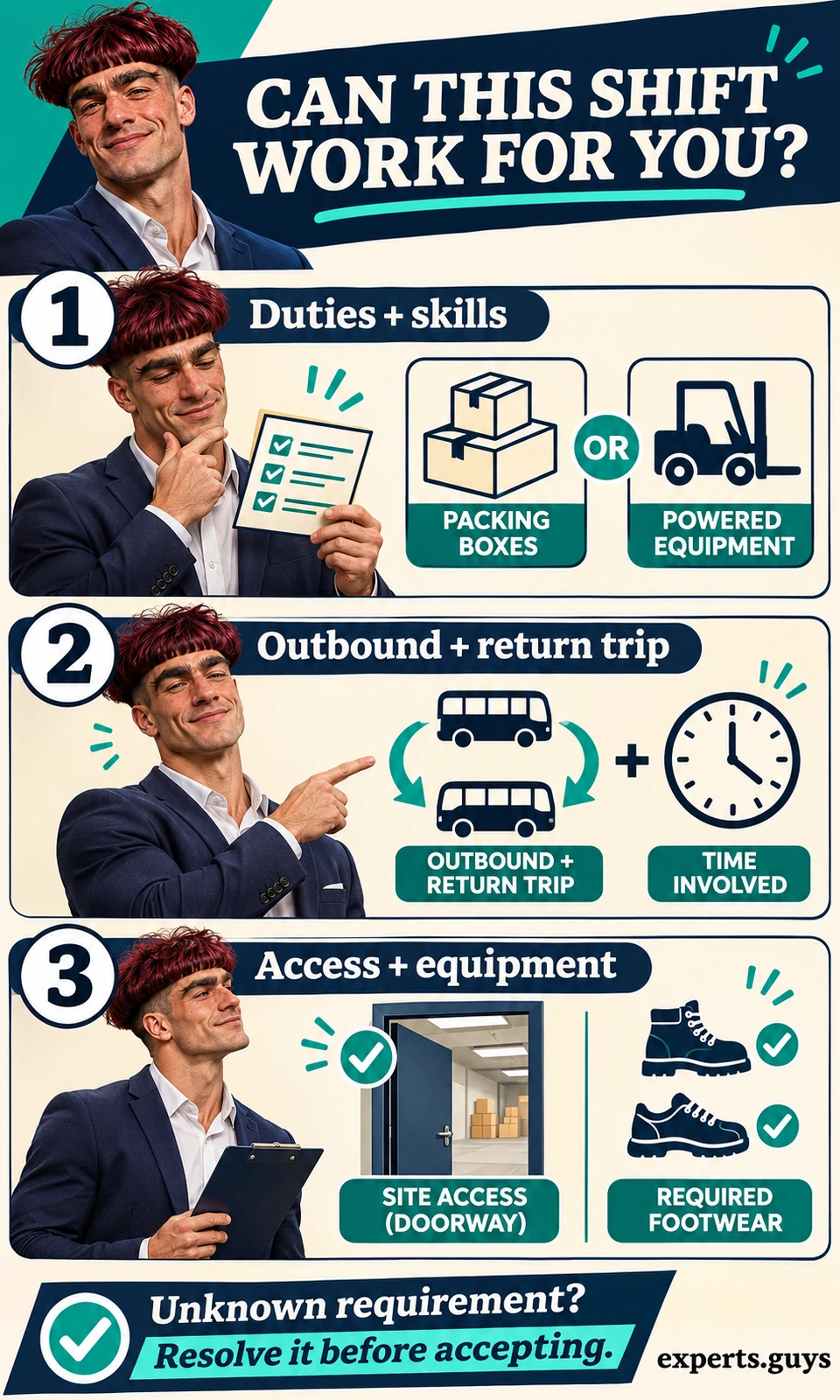
Use three passes through the assignment. First establish what you would physically do and which skills or credentials it requires. Next establish whether the work period, reporting point and return journey are feasible. Finally resolve any equipment, clothing or access requirement that could prevent you from starting, even if you reach the site on time.
For example, “warehouse support” is not a full task description. Ask whether the work involves packing at a station, repeated lifting, loading vehicles or operating machinery. These are different demands. Do not infer that experience with one qualifies you for all the others, and do not offer a skill you do not have simply to unlock a listing.
Treat transport as a round trip tied to the actual shift. Check that your chosen service runs early enough for the required reporting time and late enough for the expected finish. If the finish may vary, establish what that means for the return trip. A route that works at midday can fail after an evening shift even when the distance is short.
Consider access needs in concrete terms. A person may be able to perform the core task but need a clear explanation of the entrance, communication method or standing requirements. State the relevant need when arranging the assignment. Do not accept an unresolved task mismatch and hope that a different job will be available when you arrive; that creates uncertainty for everyone involved.
If a requirement is unclear, narrow the question. “Does this role include operating powered equipment?” is more useful than “Is the job easy?” Likewise, “Which entrance will temporary staff use at the start time?” resolves an actual arrival problem. Completion means that your decision rests on a defined job, not on assumptions borrowed from a job title.
Compare the trip as well as the hourly rate
Use a small calculation when two otherwise suitable shifts compete for the same time. Multiply the stated rate by the expected paid hours, then subtract the direct travel cost you would pay. If you want to compare the time commitment, divide that remainder by paid hours plus commuting time. This is a personal comparison, not a payroll rate or an estimate of take-home wages.
Consider an illustrative choice with no overtime, premiums or unpaid breaks included. Shift A offers eight paid hours at $18 per hour, a $12 round-trip fare and one hour of total commuting. Its gross pay is $144; after that fare, $132 remains before deductions. Spread over nine committed hours, that is about $14.67 per hour of your time.
Shift B offers six paid hours at $20 per hour, a $4 round-trip fare and half an hour of total commuting. Its gross pay is $120, leaving $116 before deductions. Spread over 6.5 hours, that is about $17.85 per committed hour. B has the stronger time comparison, but A still provides more dollars from that particular shift.
Neither result automatically selects the better job. If you need the larger gross amount and can manage the longer day, A may fit. If the shorter commitment lets you meet an existing responsibility, B may fit better. The calculation reveals the trade-off instead of hiding it behind the larger hourly number. Both options still require safe duties and a real confirmation.
| Comparison | Shift A | Shift B |
|---|---|---|
| Paid work | 8 hours × $18 = $144 | 6 hours × $20 = $120 |
| Round-trip cost | $12 | $4 |
| Remainder before deductions | $132 | $116 |
| Work plus commuting time | 9 hours | 6.5 hours |
| Remainder per committed hour | About $14.67 | About $17.85 |
| Trade-off | More dollars from this shift | Less committed time |
Do not subtract costs twice or call the remainder net pay. Taxes and other payroll deductions are outside this example, and personal costs such as childcare can change the comparison further. Expected paid hours can also differ from the time between arrival and departure. Establish the relevant break and timekeeping instructions instead of assuming that every minute on site is calculated the same way.
If arithmetic is a barrier, compare the two largest differences without a spreadsheet: which assignment pays more in total, and which consumes more time and travel money? You can ask someone you trust to help with the multiplication without sharing private payroll information. The useful outcome is an informed choice, not a score or a completed worksheet.

What should you confirm before travelling and starting work?
Confirm the reporting instruction and job requirements, then obtain the site-specific direction needed to start safely. The staffing office and the host business perform different roles. A confirmation can tell you where to arrive; it cannot demonstrate how to perform every task safely at an unfamiliar workplace.
For the broader distinction between short assignments and a continuing schedule, the short-term labor staffing guide provides related context. Here the narrower job is the handoff from an accepted assignment to the right person on site. Keeping that handoff explicit matters even when an assignment lasts only part of one day.
Prepare for the assigned site, then check in
Before leaving, open the current confirmation and establish the reporting point, start time, contact and required clothing or equipment. Use those instructions to prepare what the assignment actually requires. The office clothing shown in the illustrations identifies the recurring guide character; it is not a universal dress recommendation for warehouse, construction, hospitality or other site work.
Resolve missing protective equipment before travelling when possible. Tell the local team exactly what the assignment requires and what you do not have, leaving time for an arrangement to be made. Do not assume that an item is optional because the app let you accept the job, or that you should buy a substitute without understanding the specification and provision arrangement.
At arrival, identify yourself to the designated contact and follow the assignment’s check-in instructions. Ask who will supervise your actual task, how you will receive the necessary orientation and how work time will be captured. A location check or an app action can support arrival administration; neither should replace introducing yourself to the person responsible for directing the work.
For an illustrative office-support assignment, the worker arrives at the named reception point and asks for the designated supervisor. Before sorting incoming parcels, the worker is shown the permitted work area and the handling process. If the task unexpectedly changes to moving heavy equipment, the worker pauses to clarify the change rather than treating every new request as part of the original assignment.
OSHA’s temporary-worker guidance explains that the staffing agency and host employer share responsibility for workplace safety. General onboarding does not replace the training required for particular equipment, hazards or tasks at the site. If you are directed toward unfamiliar hazardous work without adequate instruction, stop before beginning and raise the issue with the supervisor and staffing team.
If access is the obstacle, describe the last point you reached. “I am at the confirmed entrance, but the gate is locked and I cannot reach the named contact” gives a coordinator something concrete to resolve. Do not wander into restricted work areas to find someone. Completion is a clear handoff to the right supervisor, with the task and timekeeping process understood.

Handle changes without creating a second problem
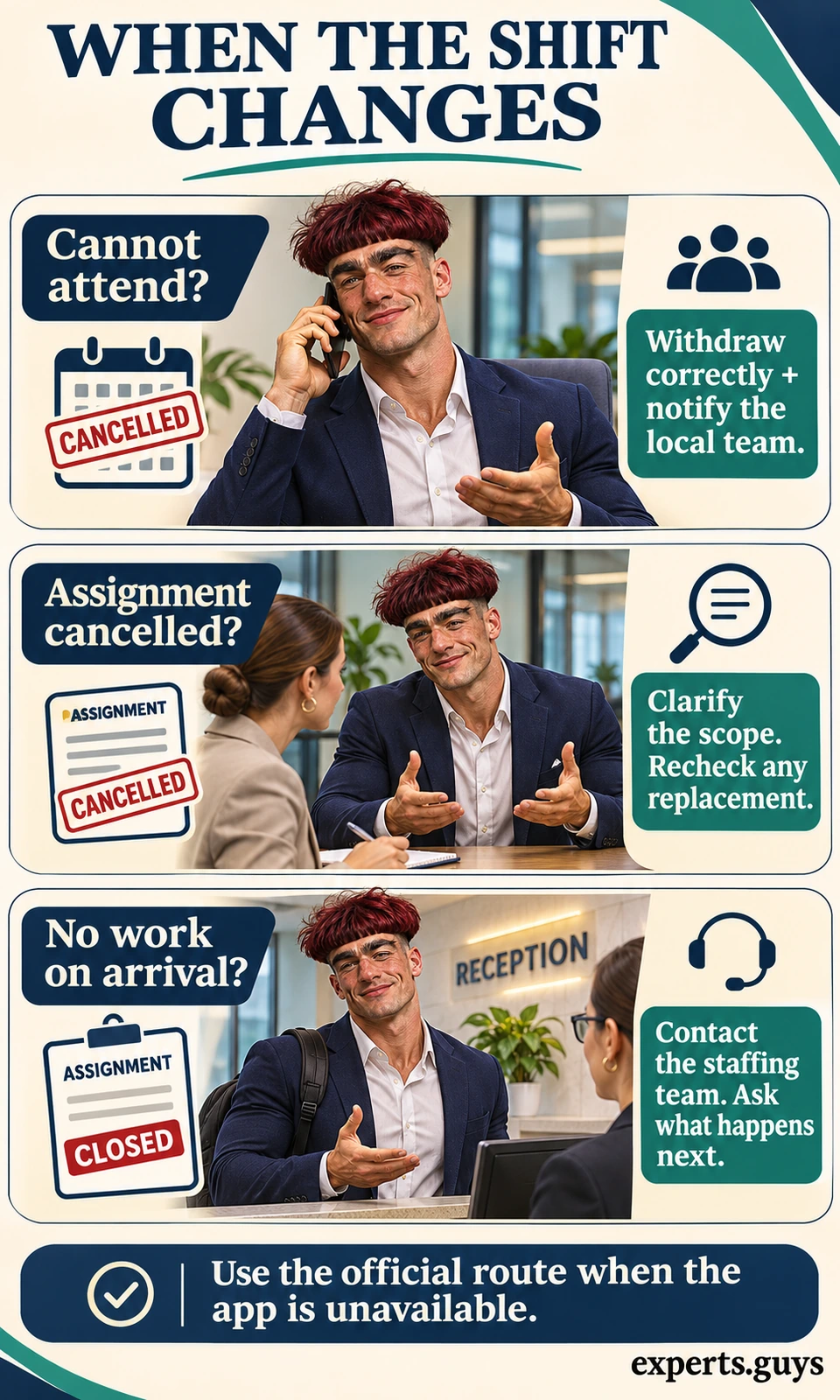
When you cannot attend, the assignment is cancelled or the arrival instructions no longer work, establish the current status before taking another action. Follow the app’s current withdrawal process where available and notify the local team promptly. A message sent to a coworker or a personal decision not to travel does not necessarily update the people managing the assignment.
If you cannot make a shift, provide the assignment date and reporting location, explain that you cannot attend and confirm how to withdraw correctly. Give notice as soon as you know; do not wait for the start time just because the shift is short. The goal is to resolve the commitment and allow the staffing team to respond, rather than merely remove it from your own plans.
If you receive a cancellation, establish whether it applies to one shift or the full assignment. Ask whether a replacement is being offered and, if so, obtain its own details before accepting it. A different site, start time or task can invalidate the transport and suitability checks that made the original job workable. Treat replacement work as a new decision, not an automatic continuation.
If you arrive and the host has no work for you, contact the staffing team with the assignment details and the name or role of the person who gave that instruction. Ask what to do next and how the situation affects time or pay under the applicable arrangement. Do not promise yourself a minimum payment, or assume no payment is possible, without establishing the relevant policy and jurisdiction.
A limited phone connection calls for an access alternative, not an improvised change of commitment. Use the official local contact route when the app cannot complete the task. For injury or immediate danger, deal with the urgent safety need first and use the appropriate emergency response; routine cancellation administration must not delay that response.
How do hours, payroll and available money connect?
Hours worked, hours confirmed, payroll processing and money available in your chosen payment method are related but separate stages. A delay at one stage cannot be diagnosed simply by looking at the last one. Start with the shift and the relevant payment expectation, then identify which stage actually needs attention.
PeopleReady’s public pages do not use consistent wording about which pay frequency is most common. Its associate FAQ describes mostly weekly pay, while its pay-help information describes many assignments differently. The practical conclusion is to use the specific assignment’s schedule and confirmed local guidance, rather than treating an advertising phrase such as “fast pay” as your own deposit date.
The official pay-timing explanation describes next-day pay as a 24–48-hour window, weekly pay on a designated day and possible additional direct-deposit processing. It also identifies weekend timing qualifications. A stated payment window and the time funds become usable in an account are not necessarily identical.
Check the hours first, then the correct pay stage
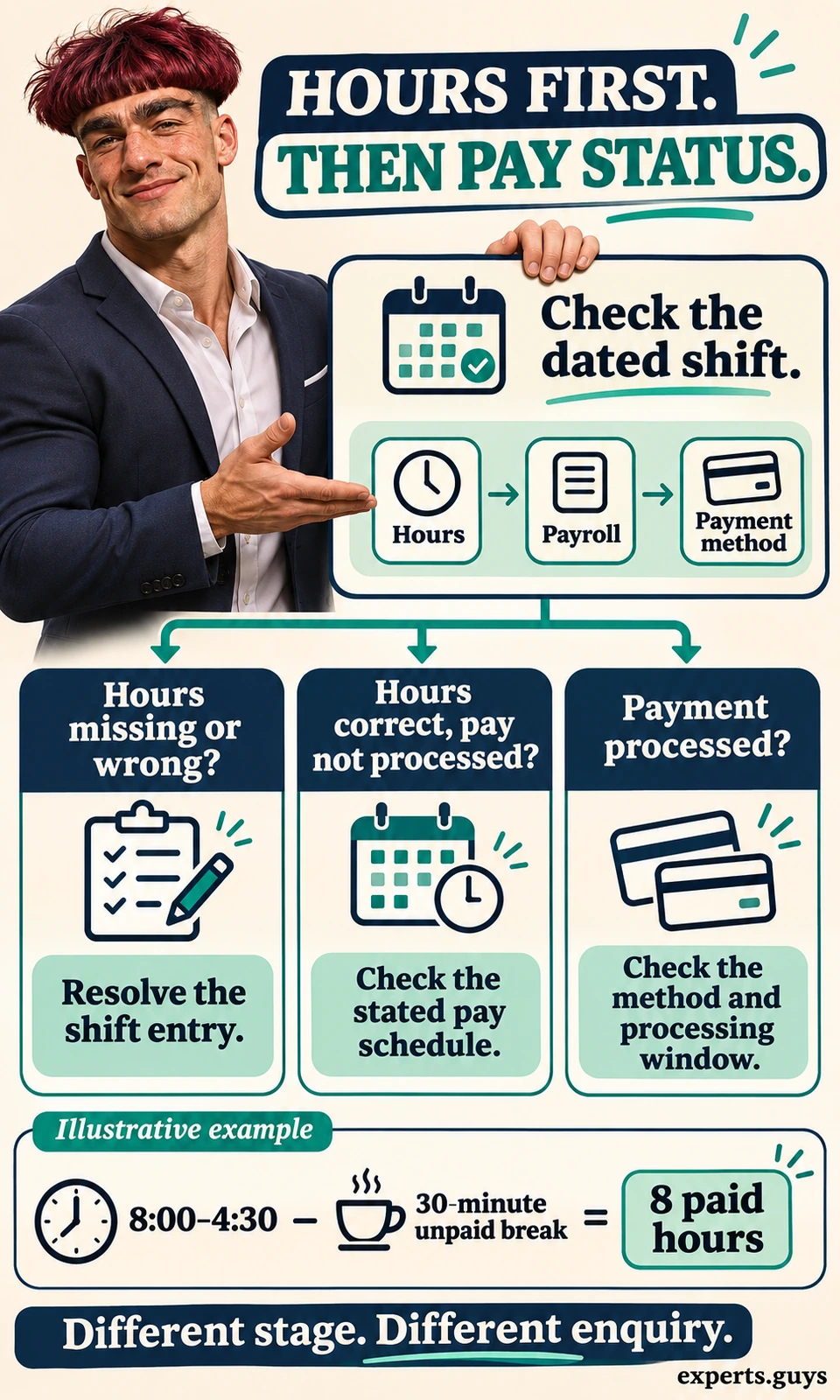
At the end of the assignment, follow the established process for confirming your time. Check the correct date, start and finish times, and the treatment of breaks against what actually happened. Where JobStack presents hours for confirmation, inspect them before agreeing. If something is wrong, use the designated correction route instead of approving an inaccurate entry to clear the screen.
For example, imagine an illustrative shift that began at 8:00 a.m., ended at 4:30 p.m. and included a 30-minute unpaid break under the applicable arrangement. That produces eight paid hours. If the displayed total is seven, the useful enquiry is about that dated shift and the one-hour difference. “My pay looks low” leaves several possible causes unresolved.
If hours are missing, establish whether the host or local team has entered them and what confirmation is still required. If the hours are present but incorrect, explain the discrepancy. If the hours are correct and payroll is processed, establish the payment method and its relevant processing window. These are different branches of the same procedure; changing the bank details cannot repair an incorrect time entry.
Use the Associate Resource Center to reach current payroll, earnings-document and other worker resources. Direct a payroll question to the PeopleReady team responsible for it, while using the host supervisor for relevant facts about work performed. Do not share banking passwords or unnecessary identity documents to explain an ordinary hours discrepancy.
When escalating a missing payment, identify the assignment, the hours status, the stated pay schedule and what payment information is visible. Ask which stage remains unresolved and what the next update should be. This makes the request actionable without requiring a diary, repeated screenshots or an unsupported accusation that a payment has been withheld.
A useful resolution may be a corrected time entry, confirmation that payroll is still within the stated window or identification of a payment-method issue. These outcomes are different, and none establishes that every future shift will follow the same timing. If the stated window has passed, follow up on that specific payment rather than repeatedly reopening the original job application.
Use the first assignment to evaluate the arrangement
After a completed shift, assess what you now know about the work itself. Were the duties consistent with the description? Could you reach the reporting point reliably? Did you receive clear direction and understand the hours process? These observations are more useful for your next decision than an unsourced company-wide rating or an assumption that one shift represents every branch.
Separate a fixable coordination problem from an ongoing mismatch. An entrance instruction can be corrected for a repeat assignment. A return journey that never works with the finish time is a more fundamental obstacle. Likewise, one resolved time-entry error and a continuing unexplained pay problem call for different decisions. Use the actual pattern you encounter without turning a single event into a universal conclusion.
This guide deliberately stops at making and completing an assignment decision. It does not rank branches, guarantee a hiring outcome or replace the broader question of whether a staffing arrangement fits your longer-term employment goals. If your next question is whether temporary work can support a longer transition, the guide to using a staffing agency for a career change addresses that wider goal. Company-specific assignment instructions still belong with the actual provider.
Questions about PeopleReady work
Is People Today Ready Staffing a separate company?
The intended company name in this guide is PeopleReady. Use the official company website to reach its job-seeker services, and check the organization named in an actual vacancy before sharing employment information. Similar wording in a search result does not establish that another company, recruiter or website is part of PeopleReady.
Does an office-support listing mean a corporate PeopleReady job?
No. An assignment supplied to a customer and a position working within the staffing company are different opportunities. Read who is hiring, where the role sits and how the application is described. An office setting alone cannot establish the employment route. Use the corporate-careers route when that is the job you actually want.
Can I assume every job uses the same checks?
Do not use another worker’s experience or a different listing as a universal eligibility rule. A particular assignment may have conditions connected to its duties and site. Ask what applies to that assignment and which requirements remain outstanding for you. This guide does not establish a company-wide rule about criminal records, screening outcomes or eligibility for regulated work.
Does a repeated assignment guarantee a permanent position?
Repeated work establishes that those shifts were arranged; it does not by itself establish an offer of continuing or permanent employment. If that outcome matters, ask whether the particular opportunity has a defined conversion route and who would make the decision. Keep your immediate assignment decision separate from an expectation about a future job.
Should I keep applying if no suitable shifts appear?
First identify whether the obstacle is unfinished onboarding, no available match or an account-access problem. Repeating an application cannot create local demand or change a task requirement. If onboarding is complete, ask the local team about suitable opportunities and consider a different search route when the available work does not fit. Do not claim skills or availability you cannot provide.
Do the illustrated job cards show real vacancies?
No. They explain the sequence and decisions using conceptual cards and an explicitly illustrative shift comparison. They are not current vacancies, account screens, pay statements or evidence of a worker’s experience. Use the actual listing and confirmation for a real decision, especially where its date, duties, hours or payment terms differ from the examples.
Your next step
Choose the next action from your current stage. If you have not applied, begin through the official job-seeker route. If you have an offer of work, resolve its duties, reporting details and pay schedule. If you have already worked, address the hours or payment stage that is actually unresolved. A first shift becomes workable through those concrete handoffs, rather than through the promise of flexibility alone.