
A short-term labor staffing agency places workers into temporary assignments, often for a single shift, a busy week or a defined project. Before accepting, compare the confirmed paid hours with the travel cost and the whole block of time the job requires, because a high hourly rate can still make a short assignment poor value. The duties must also be suitable and safe; a favorable calculation cannot fix an unsuitable job.
For a one-day worker, the central problem is often a fixed journey attached to uncertain hours. A return fare costs the same whether the client needs six hours of help or releases people after three. A business buying a short booking faces a related constraint: arrival, induction and handover consume part of the available time, even when every worker arrives punctually.
The recommendation is to compare the complete shift before choosing the largest advertised rate. Give more weight to a workable return journey and a clear duration when transport is expensive or your finish time is constrained. Choose differently when a longer, suitable booking offers enough confirmed work to justify the journey, while keeping future promises separate from today’s terms.
Which assignment details do you need before comparing offers?
Establish the actual duties, paid duration, reporting entrance, expected finish and pay arrangements. A registration or available-shift alert does not necessarily mean you have been assigned to that job. Ask which confirmation establishes the booking and whether screening or client approval remains outstanding before spending money to travel.
Identify who can confirm each part of the booking
In a common temporary arrangement, the agency employs and pays the worker while the client directs work at its site. Direct-hire recruitment is different: the agency introduces someone whom the client hires. The broader guide to how staffing agencies work explains the models; here the decision concerns the cost and timing of an individual temporary shift.
Ask the agency about the booking, rate and payment route, and establish who at the host can explain the work and release time. Do not assume the agency office’s closing time is the end of your shift or that a client’s verbal extension automatically updates the booking. The information needs to describe the same assignment.
| If the offer says | What you need to establish |
|---|---|
| Immediate start | Whether you are assigned now or still awaiting screening or client approval. |
| Six-hour shift | Paid hours, break treatment, expected finish and any actual minimum-hours term. |
| General labor | Specific tasks, environment, physical demands and required training or authorization. |
| Daily pay | Approval cutoff, processing date, payment method and any optional-service fee. |
| Flexible work | Whether this particular assignment fits your availability and travel constraints. |
| Report to the warehouse | Exact entrance, named contact and agency route if the handover fails. |

Use a short verbal read-back: name the task, repeat the reporting time and entrance, then ask who approves the hours. Add the pay rate, expected paid duration and any actual minimum-hours term. This essential confirmation supports the comparison; it is not a reason to recreate the agency’s administration or fill out a personal worksheet.

If “general labor” is the only task description, ask what you will actually do and what training, authorization or protective measures are required. A branch filling manual packing shifts is not automatically offering skilled-trade placements. The guide to employment agencies by industry helps distinguish recruitment routes when the task category is unclear.
Keep genuine terms separate from reassuring labels
“Flexible” might mean several shifts are available, not that you can leave an accepted shift whenever you choose. “Daily pay” does not establish when your deposit will arrive. “Immediate start” may still depend on checks or a customer confirming numbers. Replace the label with the precise fact that changes your decision.
Verify the recruiter through an independently located official website or branch number before providing sensitive onboarding information. Be cautious about an advance fee for guaranteed placement or a check you must deposit before forwarding money: the FTC’s job-scam guidance explains those patterns. Use the employer’s verified onboarding route rather than treating an urgent message as proof of a real booking.
Once the assignment is identified, compare what is actually offered. A possible second week, discretionary bonus or hoped-for permanent role should not be used to make an otherwise unworkable first shift look affordable. Discuss those possibilities separately when their conditions can be explained.
How do you compare the real value of two short shifts?
Compare gross pay less necessary personal costs, then consider how much of your day each offer consumes. Keep the result separate from take-home pay and legal wage calculations. Its purpose is to reveal a trade-off the advertised hourly rate leaves out, not to decide whether the employer has complied with wage law.
Work through the whole-trip calculation
Use the same inputs for both offers:
- Use the agreed rate and expected paid hours for gross pay.
- Subtract necessary personal costs consistently across both offers.
- Include the round trip and any actual unpaid time in committed hours.
- Keep legal pay, tax and unconfirmed benefits outside this comparison.
Call the result a personal comparison value, not your hourly wage or take-home pay.
Use the same currency and assumptions for both offers. Do not subtract income tax from one and leave the other before tax. Do not count a reimbursed fare as a permanent personal expense, and do not assume a reimbursement until the terms establish it. A reusable item bought for several future jobs should not automatically be charged in full to every shift.
Consider an illustrative comparison with no unpaid breaks, overtime, bonuses or other costs. Offer A pays $20 for each of six paid hours, giving $120 gross. Its round-trip travel costs $18 and takes two hours, leaving $102 before tax over eight committed hours: $12.75 per hour of your time. Offer B pays $18 for six hours, gives $108 gross and has a $6, one-hour round trip. It also leaves $102 before tax, but over seven hours: about $14.57 per committed hour.

Offer B is the stronger time-and-cost choice under those assumptions, even though its advertised rate is lower. That is an editorial comparison, not proof that B is universally better. A longer assignment with useful experience, dependable repeat hours or an accessible workplace may justify a different decision. Keep those benefits explicit instead of hiding them inside a made-up score.
Use comparable costs rather than the largest imaginable expense
Count costs caused by taking the assignment. If you would already have made the same journey for another reason, the extra cost may differ from the full fare; be honest about the trip that actually changes. If a day pass covers two assignments at no additional charge, do not charge its full price repeatedly when comparing the combined day.
Do not assume that owning a car makes travel free. Parking, tolls and costs reasonably attributed to the journey can affect the choice. Equally, avoid adding an invented universal mileage figure to every worker’s calculation. Use a consistent personal estimate and recognize when uncertain costs make a very small difference between offers unpersuasive.
Reimbursement needs consistent treatment. Subtract only the net out-of-pocket amount if the reimbursement is confirmed, applies to you and covers that cost. If it arrives later, it may reduce eventual cost without solving the immediate need to pay the fare. That timing difference belongs in the cash-flow decision below.
Reusable purchases need care. Boots bought for several assignments should not automatically be treated as a new full-price expense on every shift. A worker considering a single booking may still need to decide whether its earnings justify an immediate purchase. Keep that first-day affordability question separate from the recurring daily comparison.
Avoid double-counting unpaid time
A job advertised from 8 a.m. to 2 p.m. occupies six clock hours, but may not mean six paid hours. If the confirmed arrangement includes a half-hour unpaid meal break, use 5.5 paid hours and 0.5 other unpaid hours, plus travel. Do not enter six paid hours and add the break again unless those six hours really exclude it.
A gap between bookings creates another judgment. If you return home and the gap is genuinely usable, you may value it differently from time spent stranded near a remote site. The simple comparison cannot determine how useful that interval is to you. Describe the constraint rather than hiding unexamined hours inside a favorable rate.
If arrival instructions require additional time, ask what happens during it and how it is treated for pay. Required training is different from choosing to arrive early for a comfortable margin. The distinction matters to payroll as well as the comparison; do not automatically put required activities into an unpaid category.
Compare priorities without inventing a score
The per-committed-hour figure answers one question: what remains before tax and entered costs for each hour reserved? It does not measure fatigue, accessibility, skill development, predictable scheduling or supervision quality. A lower figure can be acceptable when another concrete benefit matters more, but name that benefit and its limits.
An adult student may choose a nearby morning shift that leaves time for an afternoon class, even when a distant longer shift offers more gross money. Someone with an open day may prefer the longer booking. Neither choice establishes that one agency is better; each reflects a different usable time window.
The comparison below lets you change paid hours, travel and other unpaid time for two offers. It calculates entered assumptions, saves no personal information and makes no claim about tax, overtime, legal entitlements or available jobs. Both result cards stay visible so you can compare money left and total time, not only the ratio.
To test a changed schedule, replace the expected paid hours with the shorter scenario. Keep a confirmed minimum-payment term separate if it changes the amount payable. Do not insert an unsupported cancellation probability to create a precise-looking earnings forecast; the actual cancellation process is more useful than a guessed percentage.
Can you reach the shift, get home and cover the upfront cost?
A workable shift needs an outward route, a return route and enough immediate money to use them. Check those conditions before relying on a favorable calculation. An assignment can leave a positive amount eventually and still be impossible to reach without spending money you do not currently have.
Check the return route against the finish window
Start with the exact reporting entrance and the expected finish, then check both travel directions using the relevant transport service. Include the walk between a stop and the workplace, access through a large site, and the timing of the last usable return service. A route that works at midday may fail after an evening shift.
If the finish is variable, ask whether you can leave at the agreed time and whether any shuttle or pickup arrangement has a fixed departure. Do not rely on a stranger’s informal promise of a ride as the only way home. If a carpool is part of the arrangement, confirm its terms directly with the agency, including what happens if the driver or shift changes.

For example, a worker can arrive by public transport but the final service home departs before the site usually releases staff. The correction is to resolve the finish or a viable alternative before accepting, then include the real alternative fare in the comparison. “I will work it out later” leaves the most expensive uncertainty unresolved.
If transport access is the constraint, ask for a site on a usable route or a shift within the service window. If mobility or step-free access matters, check the entrance as well as the route: a station’s accessibility does not establish access to a loading yard or staff door. Completion means having a feasible outward and return journey under the agreed schedule, rather than merely knowing the site’s postcode.
Treat a fixed departure as a condition, not a preference
If you must leave for a class, a care commitment or another job, state the latest departure before accepting. Ask whether that constraint fits the actual task. Event teardown with an uncertain finish creates a different commitment from packing with an agreed release time, even when both are described as temporary work.
Allow for the difference between finishing the task and leaving the site. Equipment return, a permitted change of clothing, exit procedures and reaching the stop can affect the journey. Their pay treatment depends on the facts and applicable rules; their effect on whether you catch a bus is a separate practical issue.
Do not create a universal buffer in minutes. A small shop and a large industrial estate have different exits and distances. Use the actual route and ask about handover when timing is tight. The observable result is a plausible arrival and departure under the agreed schedule, not a timetable that works only on paper.
Two short bookings do not automatically make one good day
Two individually attractive shifts can be incompatible when the first finish and the second reporting time leave no workable transfer. Check whether the first assignment has an agreed end and whether you can reach the next reporting entrance. A second booking does not create permission to leave the first one early, and an expected quick journey is not a guarantee when the route depends on infrequent transport.
For example, a morning booking ending at noon and an afternoon booking starting at one may look separated by an hour. That hour must accommodate leaving the first site, reaching transport, the actual trip and finding the next entrance. If the normal route already uses most of it, an uncertain first release creates a real conflict. Resolving the schedule is more useful than adding the two advertised earnings together.
Cost treatment also changes for a combined day. If one travel pass covers both sites, charge its cost once when comparing the whole day. If moving between sites requires an additional fare or a different return route, include that actual extra cost. The comparison should describe the route you will take, rather than two independent round trips you do not intend to make.
The gap may also affect meals, rest or a fixed commitment. Do not assume every idle minute is freely usable simply because it is outside a paid shift. Conversely, avoid labeling the entire gap as unavailable if you can genuinely use it for something you already planned. The important distinction is usable time versus time constrained by the bookings, not a universal rule for all workers.
If you cannot establish compatible times, choose the assignment that fits your day rather than accepting both and hoping. If they do fit, assess the combined day and each booking’s specific terms separately. The illustration of the return journey supports this check: entrance, finish and transport must connect for every leg, including the final trip home.
Separate earning money from receiving it
Ask what must happen before payroll can release money: approval of hours, a processing cutoff, the normal payment date and the payment method. “Daily pay” can describe a cycle or access option without guaranteeing a bank deposit after your first shift. Optional accelerated payment or card services may have terms that affect usable cash.
Consider an illustrative timing example: a worker pays an $18 fare on Monday, completes a shift that day and has a Friday payday. The job may leave positive money after the fare, but the worker still needs the $18 before traveling. This is a timing distinction, not an agency’s actual pay cycle or a guarantee of Friday payment.

Resolve the obstacle by establishing the real schedule and any verified transport support. Then decide whether the upfront cost is affordable without treating an unconfirmed advance as available money. If it is not, ask about a nearer assignment or genuine support; paying an intermediary who promises to unlock the job creates another risk.
A confirmed reimbursement can improve the eventual outcome while leaving the same Monday cash requirement. A pay card already funded is different from a card funded only after approval. Look at the timing of usable money, not just the existence of a payment product or reimbursement policy.
This does not require a spending diary or personal worksheet. The useful result is knowing what must be paid now, what is expected later and which missing term prevents you from relying on the arrangement. A favorable earnings estimate is incomplete until the immediate access problem is resolved.
What changes when a short booking ends early or needs a crew?
Short bookings are especially sensitive to fixed travel and startup demands. Test fewer paid hours without assuming the same legal payment result everywhere, and let a host budget necessary induction before estimating task capacity. These are two sides of the duration problem, not reasons to skip safety or pay for required work.
Compare the planned shift with an early finish
Return to Offer A: six expected paid hours at $20, an $18 round-trip fare and two travel hours. The original comparison leaves $102 before tax over eight committed hours, or $12.75 per hour of personal time. Change only the paid-work assumption to three hours and keep the journey unchanged.
Three hours produce $60 gross in this illustrative scenario. After the same $18 fare, $42 remains before tax; three work hours plus two travel hours occupy five hours, giving $8.40 per committed hour. Reduced duration changes the comparison sharply because the trip does not shrink with it.

This is not a finding that the worker is legally owed only three hours. A contractual minimum, reporting-pay requirement or another applicable rule may change the amount payable. Ask what applies to early release and cancellation in the actual location and arrangement rather than converting the scenario into a statement of entitlement.
The U.S. Department of Labor’s FLSA overview explains federal wage and overtime protections for covered nonexempt workers; state or local rules may add protections. The personal time-value figure cannot establish minimum-wage compliance. Legal hours worked, deductions and compensable activities follow their own rules, outside this simple ratio.
The comparison mistake is preserving full expected earnings while admitting that the client might need only a few hours. Correct it by showing the shorter scenario, then asking about the actual minimum. If you cannot afford that downside and no dependable protection is established, a nearer or longer confirmed shift may be more workable.
Distinguish cancellation from waiting at the site
A booking withdrawn before departure creates a different position from being told to wait after arriving. Establish which instruction you received, whether you are still expected and whom to contact. Do not make an expensive journey on an earlier message when a later instruction appears to cancel it.
If already there, remain in an authorized safe area while the agency and host resolve the handover. Ask how attendance and required waiting are being treated; lack of active output does not automatically make time unpaid. Do not enter operating areas or start an unfamiliar task to rescue the original calculation.
| What changed | Resolve this question |
|---|---|
| Cancelled before departure | Is the booking withdrawn, and does any applicable cancellation term apply? |
| No supervisor on arrival | Where should you wait safely, who is meeting you, and how is attendance handled? |
| Sent home early | Who approved release, what time was worked, and is any minimum or reporting payment applicable? |
| Moved to another site | Are the task, travel, supervision and payment terms clear before relocation? |
| Return transport no longer works | Can the finish be confirmed or a viable return route arranged before you commit further cost? |
The goal is a clear instruction before incurring the next cost. If a replacement assignment is offered, compare its location, duties and times as a new offer. A fare already spent may be unavoidable, but does not make every further journey sensible. Reassess the remaining day rather than accepting automatically because the first plan failed.
A host should buy a workable block of capacity
For a business, the question is not simply how many people can arrive. It is whether the booked people, qualifications, supervisor and available time fit the intended work. A crew without a ready workstation, materials or named lead can lose much of a short booking even when recruitment worked as requested.
Use an illustrative capacity calculation: eight workers booked for four hours provide 32 scheduled person-hours. If each needs half an hour of necessary induction within that booking, four person-hours go to induction, leaving 28 for the task before other demands. This allocates time; it does not predict output or justify deducting induction from pay.
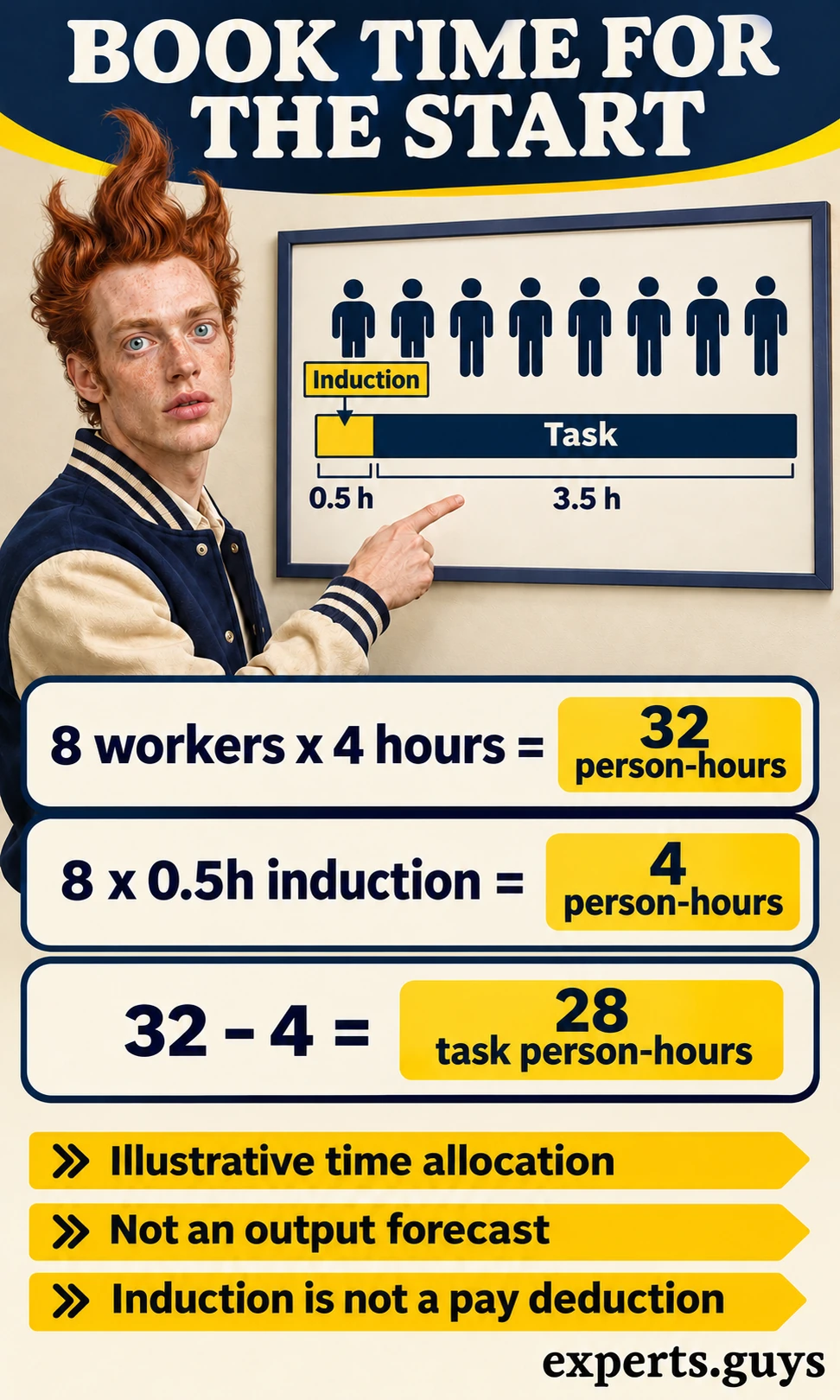
Briefing several workers together can change how a supervisor uses time, but everyone still needs effective instruction. Do not assume group delivery removes the allocation or that doubling the crew doubles output. Congestion, shared equipment and supervisory capacity can limit what additional people achieve.
Before ordering, specify the task, area, necessary qualifications, duration, reporting contact and approval route. Check actual booking minimums, bill-rate terms and cancellation arrangements rather than assuming worker pay is the client’s total cost. A longer suitable booking may make more sense when repeated arrivals and briefings otherwise consume much of the work window.
The OSHA temporary-worker guidance explains shared safety responsibilities between agencies and hosts in the United States. Short duration does not remove site-specific hazards. Prepare the safe work area and supervision before arrival; shrinking induction to improve a capacity figure defeats the purpose of planning it.
A multi-day booking needs repeatable conditions
Several shifts at one site can reduce repeated uncertainty about where to report, but daily travel costs remain. Do not multiply a favorable first-day result by five unless those five shifts and their conditions are actually offered. A possible extension is different from a confirmed booking.
Ask whether the site, schedule and duties remain the same, and whether every return trip is workable. A distant three-day booking may be worthwhile with enough dependable paid hours. It becomes less attractive if each evening requires an expensive ride or a fixed commitment prevents completing one of the days.
For the host, continuity can reduce repeated handovers when the same appropriately qualified workers are available, but availability must be established. For the worker, familiarity can have practical value without guaranteeing future work. Compare actual duration and access conditions rather than treating temporary labor as one uniform product.
Frequently asked questions
Can I compare offers paid in different currencies?
Only after putting both offers and their costs into the same currency on a consistent basis. This comparison does not retrieve exchange rates or conversion fees. If currency conversion matters, use a verified rate and the actual fee terms rather than treating two identical numeric amounts as equivalent.
Can Shift Value handle a flat payment for completing a task?
The interface is designed for a stated hourly rate and paid hours. A flat-fee task can have different duration, classification and payment conditions, so do not treat its fee as an hourly rate. Establish the actual arrangement and compare it separately if the time commitment remains uncertain.
What does a negative result mean?
The costs entered exceed the gross pay entered for that scenario. It is a warning about those assumptions, not a finding that the employer owes negative wages. Check for a duplicate cost, a confirmed reimbursement or an incorrect duration before making a decision based on the result.
Can a business use the result as its total staffing cost?
No. The result compares worker pay, entered personal costs and committed time. A client bill rate, agency booking minimum, contractual charges and the host's own supervision or equipment costs are different inputs. The crew example allocates time and does not calculate a staffing invoice.
How should a refundable deposit affect the comparison?
A genuinely refundable amount can create an upfront cash requirement even if it is not an eventual cost. Confirm the reason, refund conditions and timing before relying on recovery; do not silently count it as either permanently lost or immediately available. An advance fee for a promised job is a separate warning sign.
Choose the shift that fits the whole day
Start with the term that most changes the decision: uncertain paid duration, an unusable return route or an upfront fare you cannot cover. Resolve it before accepting, then compare the actual offers using consistent assumptions. A higher rate is useful when the rest of the assignment makes that money realistically accessible.