
NIMH depression guidance explains how persistent changes in mood, interest and daily functioning can point to depression, and which treatments may help. The useful next step is to identify your pattern and compare treatment options, rather than diagnose yourself from a symptom list. This guide turns that information into seven practical checks you can use on your phone.
NIMH means the National Institute of Mental Health, a US research agency within the National Institutes of Health. Its public information explains research and care options; it does not provide a personal diagnosis. ExpertsGuys is an independent publisher and is not affiliated with or endorsed by NIMH.
This page focuses on interpreting guidance and making decisions about adult care. It does not teach a new treatment or provide a diagnostic score. The examples and phone workflows are editorial illustrations, not NIMH-validated assessments or reports of actual patients.
What does NIMH’s symptom guidance mean for your situation?
A symptom becomes more informative when you know its duration, frequency and effect on ordinary life. Losing interest in almost everything for weeks carries different meaning from feeling disappointed for one evening. The NIMH depression overview explains the clinical pattern, but an individual assessment also considers other explanations.
| What you notice | What it can mean | Useful next step |
|---|---|---|
| A brief low period | One difficult day does not establish a depressive episode. | Notice whether the change persists or interferes with daily life. |
| Persistent low mood or loss of interest | A pattern lasting most days for at least two weeks needs assessment in context. | Describe duration and one functional change. |
| Fewer symptoms, but substantial difficulty | You need not meet a self-counted threshold to deserve help. | Explain the difficulty rather than waiting to qualify. |
| Immediate safety risk or severe deterioration | This overrides optional self-checks. | Use urgent or emergency care according to the situation. |
Check 1: Compare the pattern with your usual baseline
Use this check when several changes feel connected but you cannot describe what is different. Its purpose is to turn a vague concern into a concrete description, not to count enough symptoms to prove a diagnosis. You only need your own recollection; a private phone note is optional.
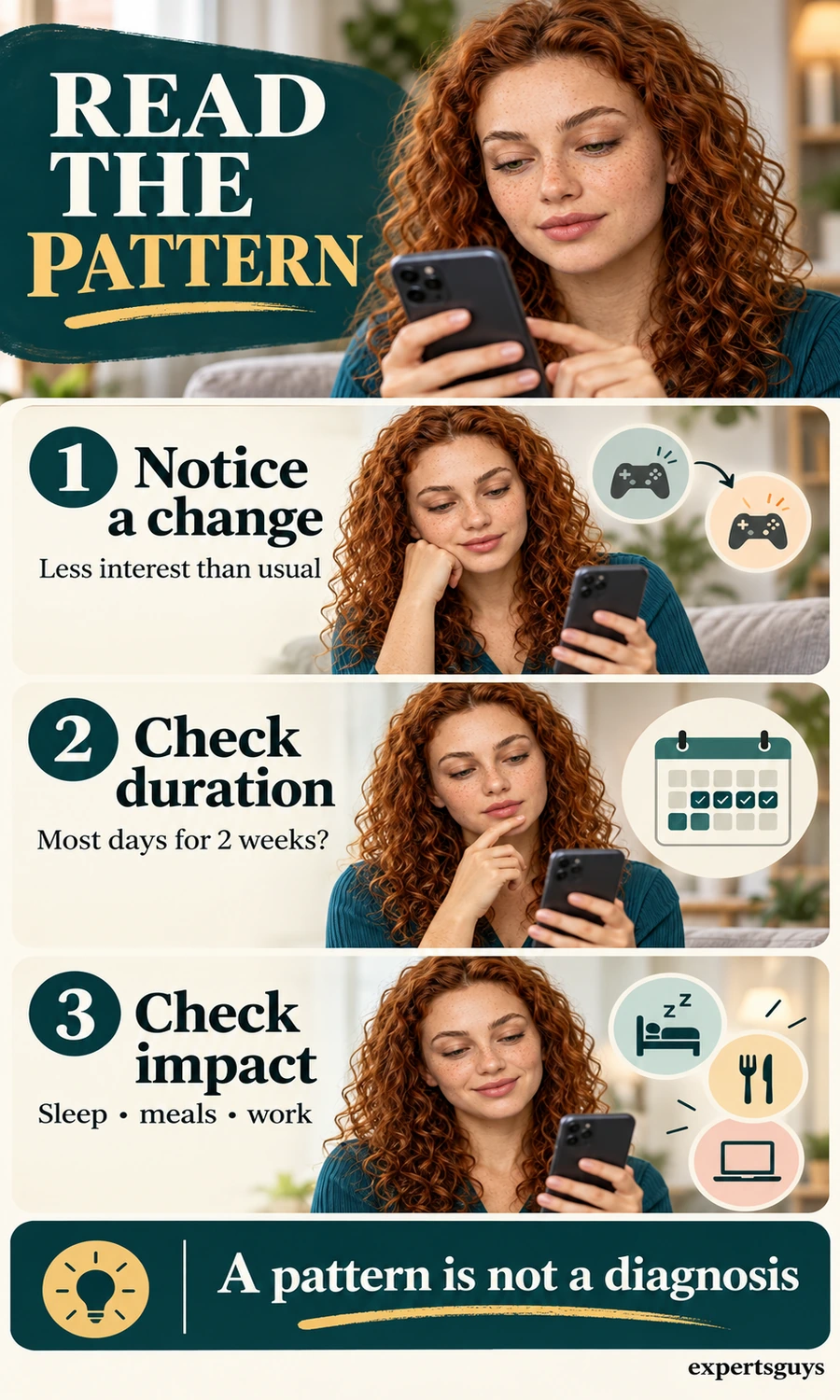
- Name the change: choose the clearest difference from your usual self, such as loss of enjoyment or difficulty getting through familiar work.
- Check the time pattern: consider when it began, whether it happens most days and whether it lasts much of the day.
- Check the impact: identify one ordinary activity that has become harder, such as meals, sleep or completing a work task.
An illustrative description is: “For about three weeks, I have stopped enjoying my usual shows and have struggled to finish meals.” That gives a more useful starting point than “I am failing at everything.” If dates are unclear, use “around the beginning of the month” instead of inventing precision.
The common mistake is treating two weeks as a mandatory waiting period. Persistent distress deserves attention even when you have fewer symptoms or cannot date them accurately. Your checkpoint is whether you can explain the change and its effect; you do not need a complete diary before arranging assessment.
Check 2: Look for context that could change the interpretation
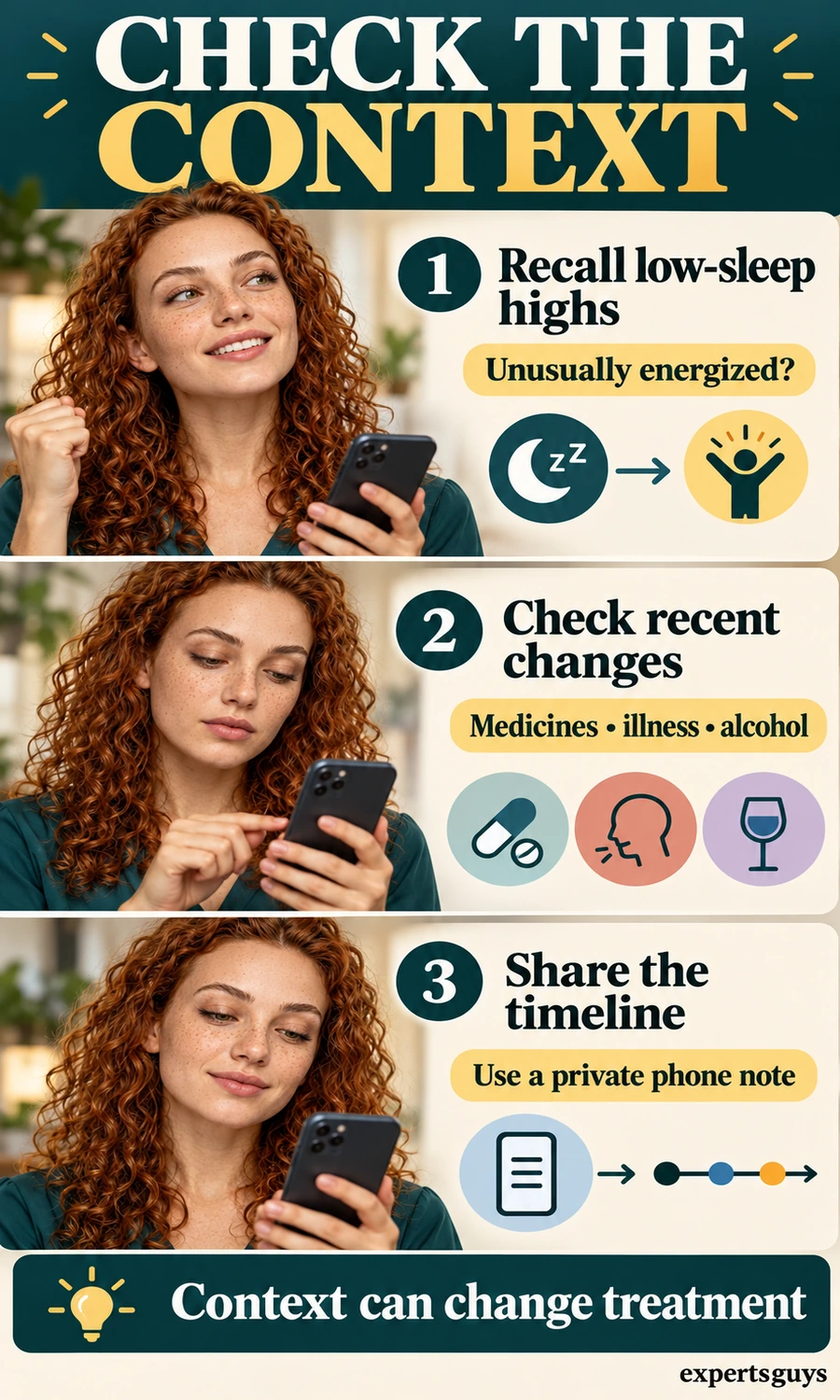
Use this check before assuming every period of low mood has the same cause. A history of unusually elevated or irritable mood, increased activity and needing much less sleep can change the assessment, particularly when it was unlike your usual self. Sleeping poorly while exhausted is different from sleeping little and feeling unusually energized.
- Recall unusually energized periods: consider whether other people noticed a marked change in activity, speech or risky behaviour.
- Identify recent changes: include illness, prescribed medicines, supplements, alcohol or other substances, and pregnancy or postpartum timing where relevant.
- Bring the sequence: explain what happened first and what changed afterwards, using a private phone note or a brief spoken summary.
For example, “My sleep changed after a new medicine, then my concentration worsened” describes a sequence without claiming the medicine caused it. A screenshot of your current medication list can be easier than typing every name, provided it is kept private. Do not stop medication to test a theory yourself.
The mistake to avoid is mentioning only the current low period while leaving out past highs because they felt productive. If you cannot remember, a trusted person may help describe changes you missed, with your permission. The result should be a clearer history, not a self-assigned bipolar diagnosis; our depression, anxiety or bipolar disorder comparison explains that distinction further.
How can you compare treatment options without guessing?
Depression care commonly includes psychotherapy, medication or both, with other options considered when needed. The appropriate choice depends on clinical severity, past response, safety, preferences and practical access. Being able to attend or follow a plan matters alongside the treatment’s potential benefit.
Check 3: Compare the plan with your actual constraints
Start with one concrete priority, such as returning to work tasks or reducing disruption to sleep. Then identify the constraint most likely to prevent you following through. This is a shared-decision exercise, not a way to select or exclude a medicine without assessment.
| Decision factor | Useful question | Why it matters |
|---|---|---|
| Daily goal | Which activity do I want to manage better? | Gives the review a concrete focus. |
| Treatment burden | Can I attend and follow this plan? | A theoretically suitable option must also be feasible. |
| Past experience | What helped or caused problems before? | Previous response can inform the discussion. |
| Trade-offs | Which effects would make the plan hard to continue? | Raises concerns before they become a reason to abandon care. |
| Follow-up | When and how will we reassess? | Turns a starting choice into a monitored plan. |
- Name the priority: choose the daily difficulty you most want treatment to improve.
- Compare the work involved: ask what appointments, between-session practice, medication routines or monitoring the proposed options require.
- Agree on the review: confirm how you will judge benefit, who to contact about difficulties and when the plan will be reassessed.
For someone working shifts, “I can reliably attend an evening video session but not a weekly daytime appointment” is useful decision information. A simpler alternative is to bring just your biggest obstacle rather than prepare a full comparison. The checkpoint is a workable plan with a review date, not finding a supposedly perfect treatment online.

Check 4: Ask what the therapy will actually do
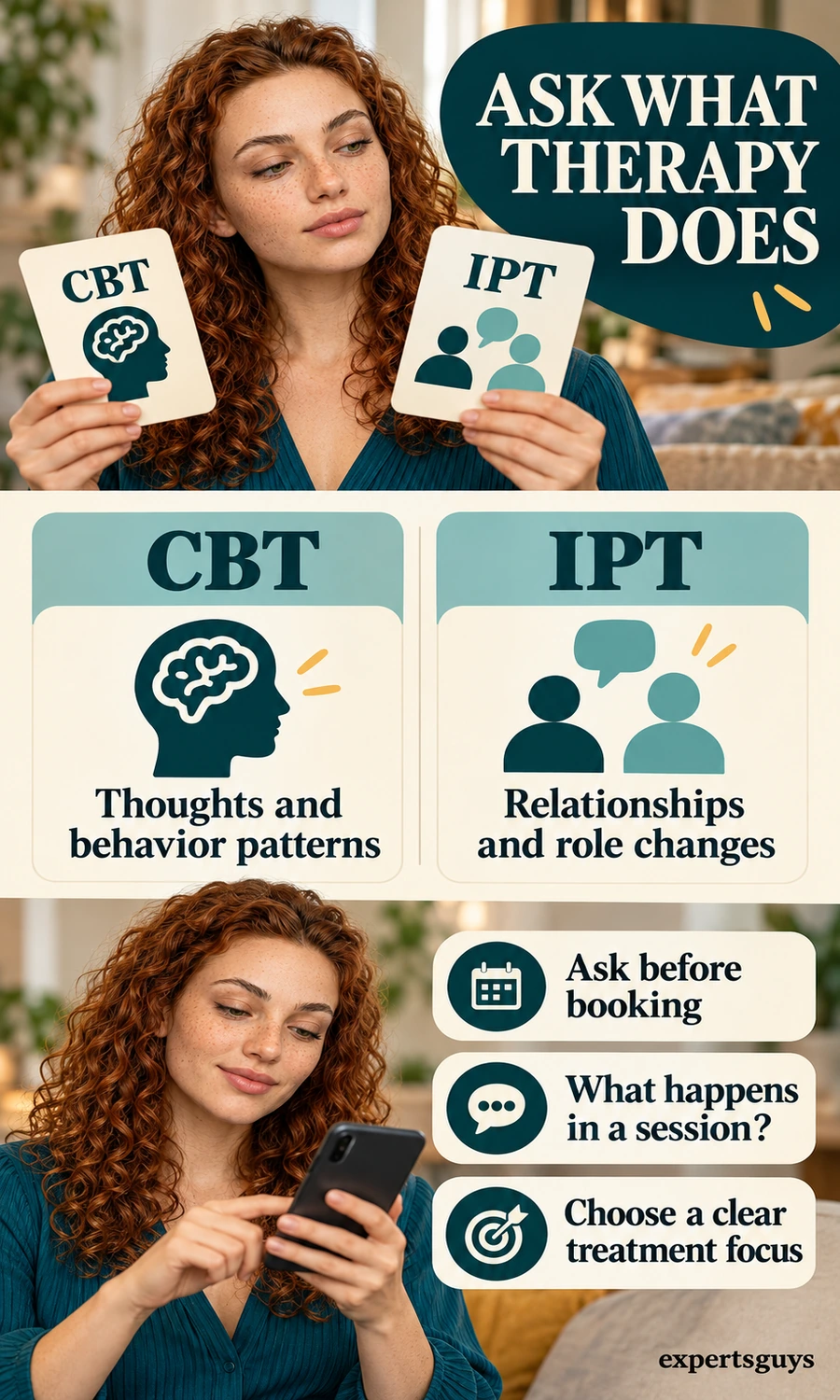
A therapy label should tell you something about the work, not merely sound reassuring. Cognitive behavioural therapy, or CBT, addresses patterns of thinking and behaviour; interpersonal therapy, or IPT, focuses on relationships and life changes linked with mood. Neither label alone tells you whether a particular clinician and format will suit your needs.
Before booking, choose one example of what you want help with and ask how it would be approached in a session. Then ask what practice, if any, happens between sessions and how progress will be reviewed. This lets you compare the proposed process instead of relying only on a provider’s description of being supportive.
- State the focus: for example, “Since changing jobs, conflict at home has become harder to manage.”
- Ask for a concrete explanation: “What would we work on in a typical session?”
- Check the practical fit: ask about session frequency, qualifications, confidentiality, fees and how an unhelpful plan is adjusted.
The common mistake is assuming CBT means simply replacing negative thoughts with positive ones. Another is treating a warm first conversation as evidence that all practical questions are settled. If a long call feels difficult, send the questions through the provider’s approved contact channel; you should be able to describe the proposed approach afterwards in ordinary language.
The NIMH psychotherapy guide supports asking about approach, goals and progress assessment. Our mental health counseling guide covers the broader care setting. Keep this check focused on treatment fit rather than trying to perform therapy on yourself.
How do you judge whether the treatment plan is helping?
Progress is easier to discuss when you separate benefit, side effects and practical obstacles. A single good or bad day cannot settle whether a plan works. Conversely, serious deterioration should never be dismissed as something you must tolerate until the next routine appointment.
Check 5: Review daily function alongside mood
For antidepressants, improvement can take several weeks, and sleep or concentration may change before mood. NIMH describes a usual onset window of four to eight weeks, but that is not an instruction to wait that long without follow-up. The review schedule should be agreed when treatment starts, with earlier contact for concerning changes.
| Change | Useful interpretation | What to discuss |
|---|---|---|
| Some tasks easier; mood still low | Partial progress may be occurring. | Which changes are consistent and what remains difficult. |
| New unwanted symptom | It may need separate assessment. | Onset, severity and relationship to treatment changes. |
| No noticeable benefit | Timing, implementation and treatment fit need review. | What was actually tried and for how long. |
| Marked worsening or safety concern | Routine monitoring is insufficient. | Seek prompt assessment; use emergency care for immediate danger. |
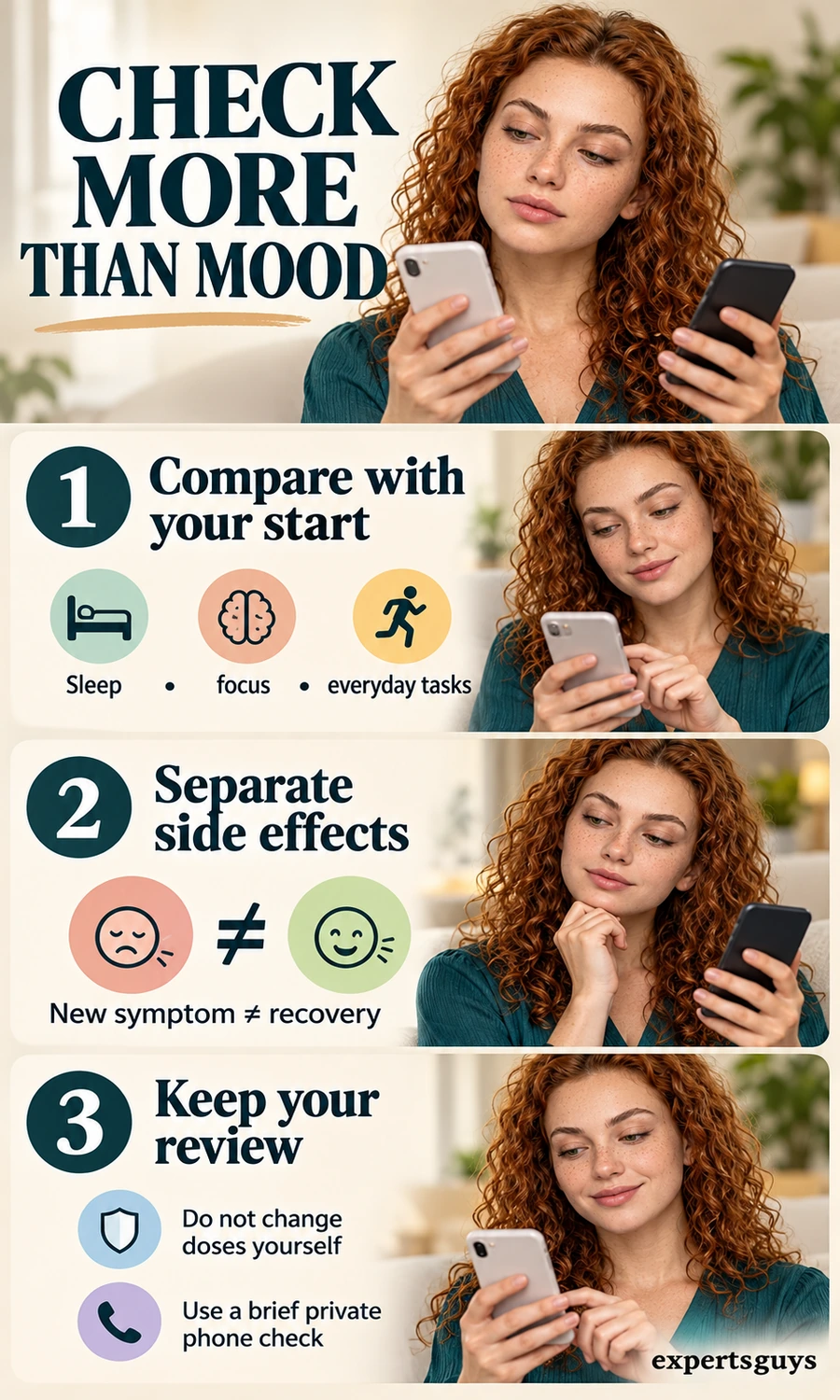
- Compare with your starting point: select one ordinary activity, such as following a short work email, plus sleep and mood.
- Separate new problems: mention side effects or unusual changes rather than folding them into a single “better” or “worse” rating.
- Keep the review: use your agreed appointment and contact route; do not adjust the dose based on this check.
An illustrative phone entry is: “Sleep slightly steadier; email still difficult; nausea began after starting treatment.” A short entry before the review is enough if repeated logging feels burdensome. The useful outcome is a clearer conversation about what has changed, not a streak, score or target you must hit. If the specific concern is feeling emotionally flat, our antidepressant emotional blunting guide explores that distinction.
The common error is calling every increase in energy a recovery. Marked agitation, new suicidal thoughts, or much less need for sleep with unusual energy needs prompt clinical attention; immediate danger requires emergency care. Do not abruptly stop or change a prescribed medicine on your own.
Check 6: Identify the obstacle before declaring treatment a failure
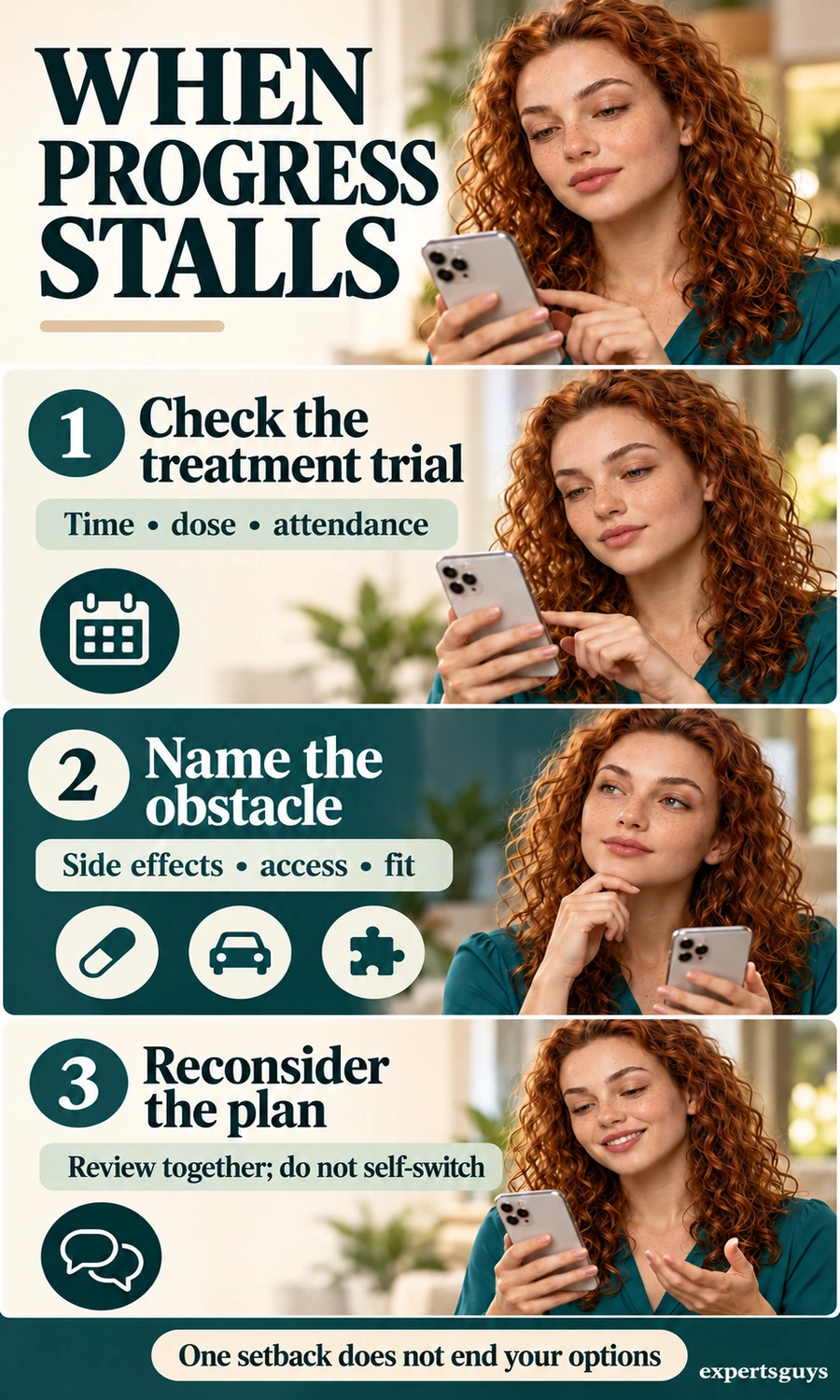
If improvement is absent or limited, separate an adequate treatment trial from a plan that never became feasible. Missed sessions because of work, intolerable side effects and an unhelpful treatment focus are different problems. Naming the actual obstacle makes the next discussion more specific.
- Check what was tried: confirm duration, prescribed dose and actual use for medication, or attendance and agreed work for therapy.
- Name the barrier: describe the main side effect, access problem or mismatch in focus without blaming yourself.
- Review the next decision: discuss whether to address the barrier, reassess the diagnosis or consider another treatment approach.
For example, “I could attend only two sessions because the hours clashed with work” describes an access problem; it does not establish that all therapy is ineffective. If reconstructing the whole history is difficult, start with the most recent plan and the reason it became difficult. A useful review ends with an agreed change or a clear reason to continue, plus another checkpoint.
One unsuccessful attempt does not establish that every treatment will fail. Specialist options can include repetitive transcranial magnetic stimulation, or rTMS, and electroconvulsive therapy, or ECT, in appropriate circumstances. These differ substantially in procedure, risks and indications; they are not interchangeable home treatments, and ECT may also be considered when a rapid response is medically necessary.
What should you do with NIMH research and clinical-trial claims?
A research headline asks whether an approach may work under study conditions. A treatment decision asks whether it is appropriate and available for a particular person now. An NIMH-funded finding, a registered trial and an approved treatment are different things.
Check 7: Separate an interesting study from a treatment promise
Use this check before paying for a service or volunteering for research because of an exciting headline. Keep the original study or trial page open alongside the headline. Your aim is to identify what is actually being offered and what remains uncertain.
- Check the people: was the work done in humans, and do the participants resemble the group described in the headline?
- Check the comparison: what was the treatment compared with, what outcome changed and how long was follow-up?
- Check the commitment: for a trial, ask about visits, random assignment, possible placebo, risks, costs and what happens to usual care.
For example, a report about changes on a symptom scale does not establish lasting recovery for every participant. A study involving a narrow group may not answer the same question for someone with different conditions or medicines. If the information is too technical, ask the study team for its plain-language explanation rather than treating an unclear answer as reassurance.
The common mistake is equating a trial listing with a recommendation or guaranteed access to an experimental treatment. Participation is voluntary, and benefits are uncertain. Before deciding, you should understand the consent information and how withdrawal and ongoing care work; the NIMH participant information explains those rights and expectations.

Frequently asked questions
Is there an official NIMH test that diagnoses depression online?
A symptom questionnaire can support screening, but it does not replace an assessment. A website using NIMH in its title is not automatically an official government service. Check who operates the page and avoid treating a score as a personal diagnosis.
Does a normal blood test rule out depression?
No. Tests may help investigate medical explanations for symptoms, but depression is not ruled out by a normal routine blood result. Assessment also considers the symptom pattern, history, distress and effect on daily life.
Can NIMH choose a therapist or prescribe treatment for me?
Its public information service does not provide individual medical advice or treatment referrals. NIMH also conducts research, which has separate eligibility and consent processes. Reading a fact sheet does not enrol you in care or a study.
Does US guidance apply if I live elsewhere?
General explanations of symptoms and treatment approaches can still be useful. Drug approvals, professional licensing, costs and access pathways differ between countries. Use local clinical guidance for those decisions rather than assuming a US service or approval is available where you live.
Does feeling better mean I can stop medication?
Feeling better is a reason to review progress, not to stop abruptly. Continuing treatment and any later reduction need an individualized plan with the prescriber. This page does not provide a tapering schedule.
Your next useful step
Choose the check that matches your current uncertainty: pattern if you are unsure what changed, treatment fit if you are comparing care, or progress if you already have a plan. Finish with one concrete output, such as a clear symptom description or a specific review question. You do not need to complete every check before taking the next appropriate step.
Sources and further reading
- NIMH: Mental Health Medications – treatment timing and medication cautions.
- NICE: Depression in adults – shared decisions, treatment review and limited response; UK clinical guidance.
- NIMH: Brain Stimulation Therapies – distinctions between specialist procedures.