“Congruent depression” is not a standard standalone diagnosis; people may be referring to mood-congruent memory or to mood-congruent psychotic symptoms during a depressive episode. The first concerns which memories fit a mood, while the second concerns the content of symptoms such as delusions or hallucinations. The useful first step is to clarify what the phrase describes, rather than assume the two are the same.
A difficult memory, a harsh judgment about yourself and a voice-like experience can all be described with similar words in everyday conversation. They still raise different clinical questions. This guide helps you separate the wording, understand the limits of self-interpretation and explain the change that is troubling you.
Is congruent depression a diagnosis or a description?
Congruent means matching or consistent with something. In this context, the missing detail is what is matching the mood: a remembered event, a thought, or a psychotic symptom. A phrase that leaves that detail out cannot tell you which condition, if any, is present.
In memory research, mood congruence concerns the emotional relationship between a current mood and material that comes to mind. In clinical descriptions of psychosis, it concerns whether the content of a delusion or hallucination fits the mood episode. Those are different uses of a similar term, not stages on a path from remembering something sad to developing psychosis.
Depression also does not become a separate “congruent” illness because someone has understandable reasons to feel low. Real losses, financial strain or relationship difficulties can coexist with a depressive disorder, and their presence does not settle the diagnosis. For the broader distinction between diagnoses and descriptive labels, see types of depression.
If the phrase appeared in a conversation or a clinical note, ask: “Does mood-congruent refer to my memories, my thinking, or psychotic features?” You can also ask what that wording changes in the assessment or care plan. This clarification is useful even if you are not ready to describe every detail of the experience.

Why can low mood make painful memories feel like the whole story?
Low mood can make painful material more accessible, while specific positive experiences may be harder to bring to mind. That describes a possible pattern of recall, not proof that your past was entirely negative. It also does not mean that painful events were invented or that legitimate concerns should be dismissed.
Imagine remembering an awkward conversation much more readily than several ordinary, comfortable conversations from the same week. The remembered event may be accurate, but “that conversation went badly” and “every interaction goes badly” are different claims. This is an illustrative example of how a narrow sample can become a broad conclusion, not a test for depression.
A small study of autobiographical recall compared 12 unmedicated participants with major depression and 14 controls. Positive and neutral cues prompted positive memories less often in the depression group, which also produced fewer specific memories. The small sample and laboratory task limit what the results can tell us about an individual; they do not show that every depressed person has the same recall pattern.
Notice the difference between which memory arrives, how specific it is and how often you keep returning to it. Repetitive thinking has its own explanation in depressive rumination and overthinking, while difficulty retaining or retrieving information belongs in depression and memory problems. The takeaway here is narrower: a memory that fits your mood is not, by itself, evidence of a psychotic symptom.

When does mood congruence describe psychotic symptoms?
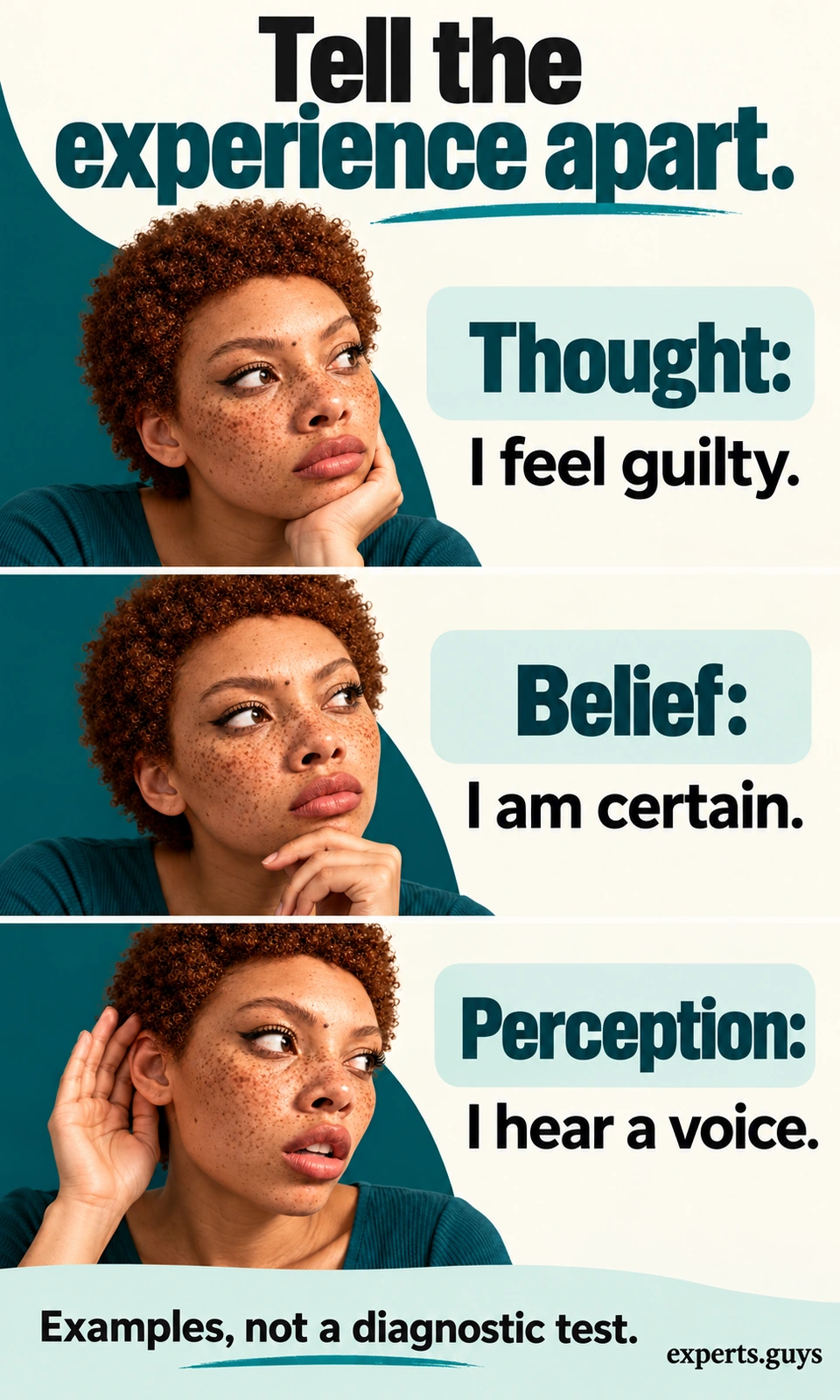
In depression with psychotic symptoms, “mood-congruent” describes how the symptom’s content relates to the depressive mood. Themes may include guilt, worthlessness, illness or deserved punishment. The NHS explanation of psychotic depression describes this relationship, but recognizing a theme does not allow someone to diagnose themselves from an example.
| Experience | Illustrative wording | What needs clarification |
|---|---|---|
| Painful recollection | “That mistake keeps coming to mind.” | What is recalled, how often it returns and how it affects daily life. |
| Self-critical thought | “I feel like I let everyone down.” | The meaning, distress and context; a thought alone does not establish psychosis. |
| Possible delusional belief | “I am certain I caused an unrelated disaster and deserve punishment.” | Whether the belief is fixed and unsupported, assessed in its full personal and cultural context. |
| Possible hallucination | “I hear an accusing voice when nobody is speaking.” | The nature, timing and context of the experience; voices can have different causes. |
The distinction is not simply “negative thought” versus “very negative thought.” A clinician asks about the kind of experience, how firmly a belief is held, what evidence and context surround it, and whether perception seems altered. Certainty by itself does not prove a delusion, and some people experiencing psychosis retain doubt or partial insight.
Mood-incongruent means the content does not fit the mood episode in the expected way. It does not mean the person is pretending, and mood-congruent does not mean a belief is factually correct. A single theme, such as feeling threatened, is not enough to classify an experience without understanding what the person believes is happening and why.
The wider history matters because psychosis can occur in severe depression, bipolar disorder and other mental or physical conditions. Sleep loss, medicines and substances can also be relevant, as the NIMH overview of psychosis explains. New experiences deserve assessment rather than an automatic conclusion of either depression or schizophrenia.
Decide on help by the change and the risk
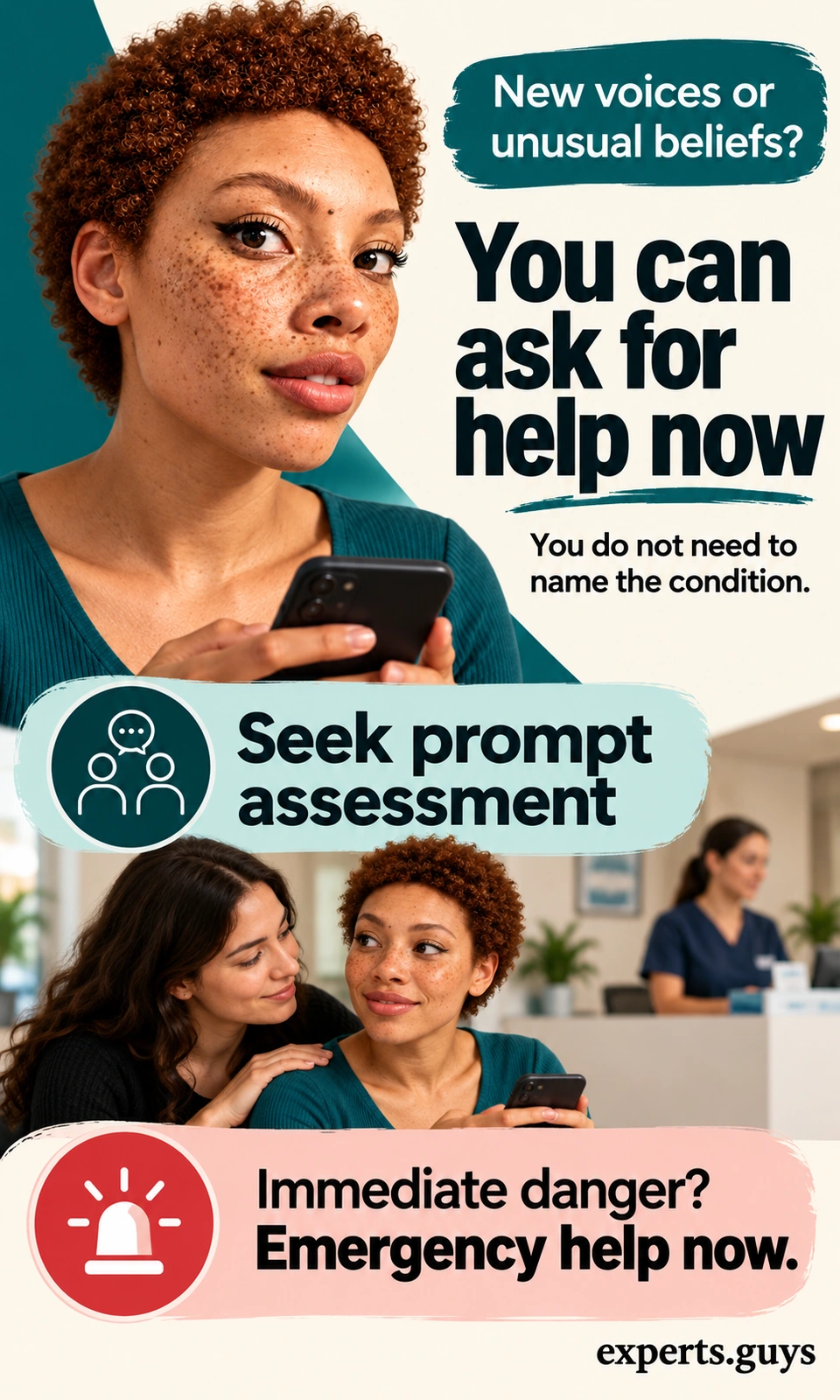
Help should be guided by safety, the nature of the change and its impact on daily life, rather than by whether you can apply the word congruent. Assessment for possible psychosis involves questions about symptoms and possible causes, not a single online test. If something feels new, frightening or difficult to describe, you can seek help while the explanation is still uncertain.
- Immediate danger or severe confusion: seek emergency help now, including if you may act on harmful commands or cannot keep yourself safe.
- New voices, unusual fixed beliefs or a change in what feels real: contact a clinician or your mental health service promptly; do not wait for symptoms to last a particular number of weeks.
- Persistent, worsening or disabling low mood or recurring distressing thoughts: arrange professional assessment even without psychotic symptoms.
How can I explain these experiences and get the right help?
Describe one change without choosing a diagnosis
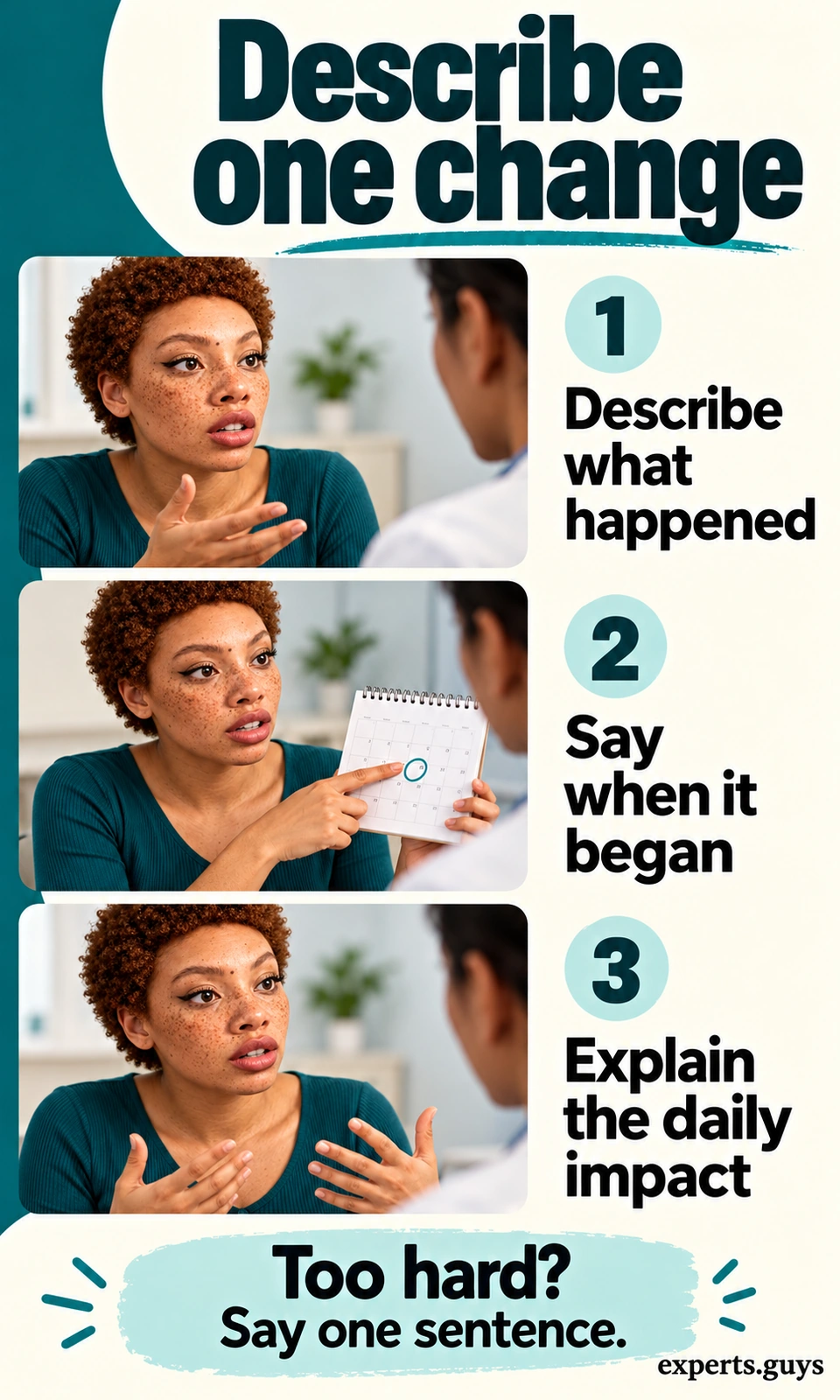
Start with one concrete experience you want a clinician to understand. You do not need to decide whether it counts as a memory bias, delusion or hallucination before saying what happened. The following is a communication aid adapted from appointment guidance, not a treatment exercise or screening score.
- Describe what happened: use your own words, such as “I keep recalling that event” or “I heard a voice when no one was speaking.” Say if you are unsure how to describe it.
- Say when it began: give an approximate onset and whether it is recurring; “I do not know” is useful when the timing is unclear.
- Explain one daily effect: say whether it interrupted sleep, work, eating, conversation or your ability to feel safe.
Illustrative example: “Since last weekend, I have repeatedly heard an accusing voice when I am alone, and I am struggling to sleep.” If a full explanation feels too hard, “Something has changed in what I hear and I need help” is enough to start, or a trusted person can help you communicate. Completion means sharing the concern and arranging the next contact, not proving a diagnosis or feeling better immediately.
Bring the context that changes the assessment
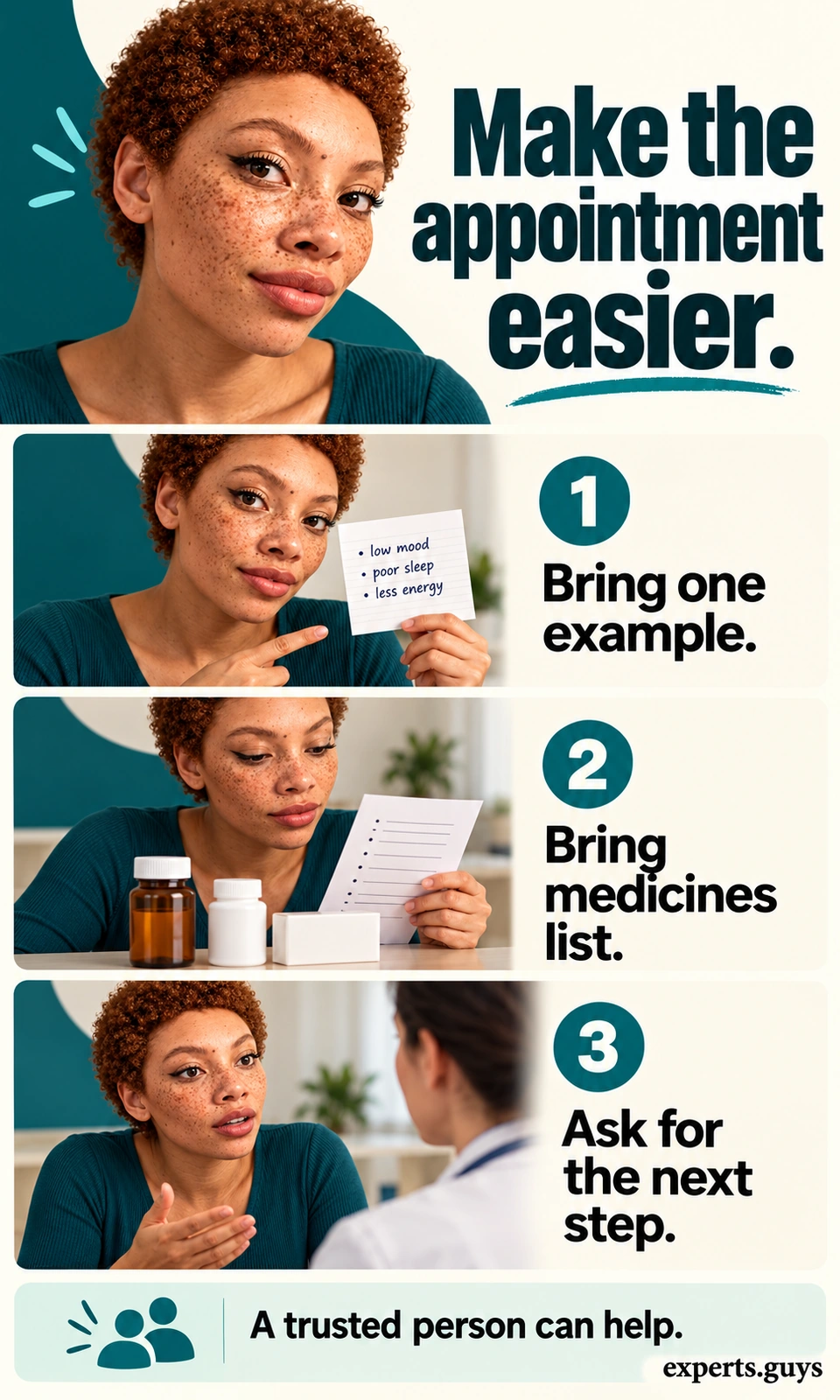
An example is most useful when the clinician can place it in context. NIMH appointment guidance supports preparing concerns, listing medicines and bringing a trusted person if you want support. The short sequence below is an editorial adaptation; use what you can and do not delay urgent care to complete it.
- Bring one example: reuse the description above rather than keeping an extensive diary. Mention whether it occurred while fully awake, around sleep, or during a marked change in mood.
- Bring a medicines list: include nonprescription products and supplements; also tell the clinician about substance use, sleep changes and any past periods of unusually increased energy or reduced need for sleep.
- Ask for the next step: for example, “What are you assessing, who will follow up, and whom should I contact if this worsens?” A supporter can help remember the answer.
If you are supporting someone else
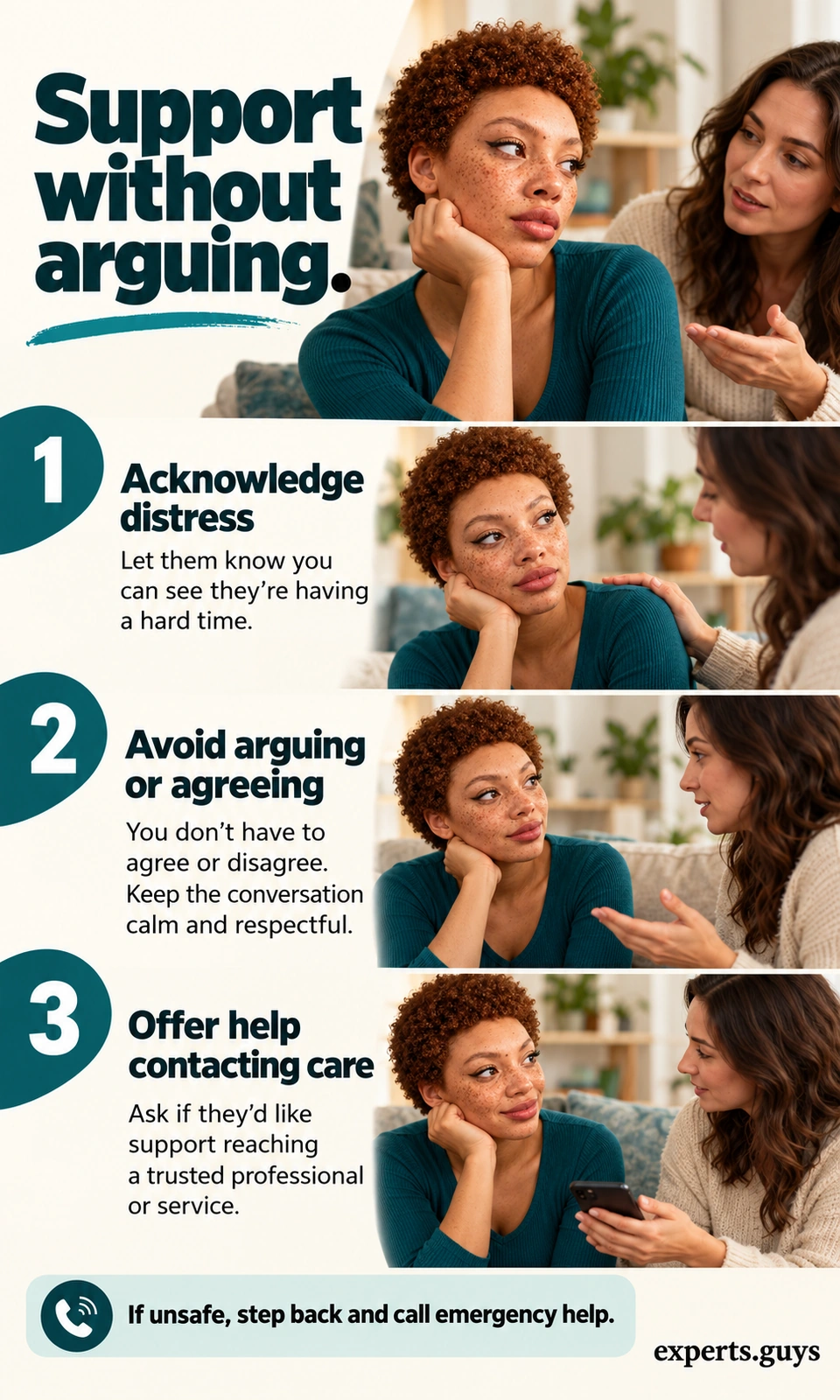
Respond to the person’s distress without endorsing an unusual belief or trying to win an argument about it. Calm listening and support are consistent with NHS guidance for friends and relatives; the example wording below is an adaptation for a brief conversation. You are helping the person reach care, not taking responsibility for diagnosing or resolving the experience yourself.
- Acknowledge distress: “That sounds frightening” recognizes the emotion without confirming the explanation.
- Avoid arguing or agreeing with the belief: “I do not experience it the same way, but I can see this is upsetting.” Keep your tone calm and allow personal space.
- Offer one concrete contact: “Would you like me to sit with you while we call your care team?” If speaking is difficult, keep the offer to one sentence; if the situation is unsafe, step back and contact emergency help.
What treatment may involve
When depression includes psychotic symptoms, specialist care may combine medication, psychological support and practical help. NICE guidance on psychotic depression recommends considering an antidepressant with an antipsychotic and monitoring psychotic symptoms; the plan depends on clinical assessment and preferences. Do not start, stop or change medication on the basis of this article, and ask the prescriber about benefits, side effects and follow-up.
Your useful outcome is a clearer shared account of what has changed and a specific next step in care. Improvement does not depend on finding the perfect label, and difficulty explaining an experience is not a reason to be dismissed. If you leave uncertain about the wording in your notes, clarification belongs in the care conversation rather than in repeated self-testing.
Frequently asked questions
Is mood-congruent memory the same as mood-dependent memory?
No. Mood-congruent memory concerns a match between the emotional content recalled and the current mood. Mood-dependent memory concerns recall when a mood at retrieval resembles the mood present when something was learned; neither phrase alone establishes a depressive disorder.
Must both hallucinations and delusions be present?
No. Psychotic symptoms can include hallucinations, delusions or other disruptions in thinking and perception. The full pattern and possible causes need assessment; a list of examples cannot confirm a particular diagnosis.
Does being unsure about an experience rule out psychosis?
No. Insight can vary, so having doubts does not automatically rule it out. Equally, feeling certain about something does not automatically make it a delusion; explain the experience and its context to a clinician.
Your next step
If you encountered the term in a note, ask what it describes and what it changes in your care. If you are seeking help for a new experience, use one plain-language example and contact the appropriate service. If safety is uncertain, act on that before trying to settle the terminology.
General educational information; not an individual diagnosis or treatment plan. Images are AI-created illustrative scenes, not photographs of documented patients. Example statements are fictional and are not diagnostic tests.